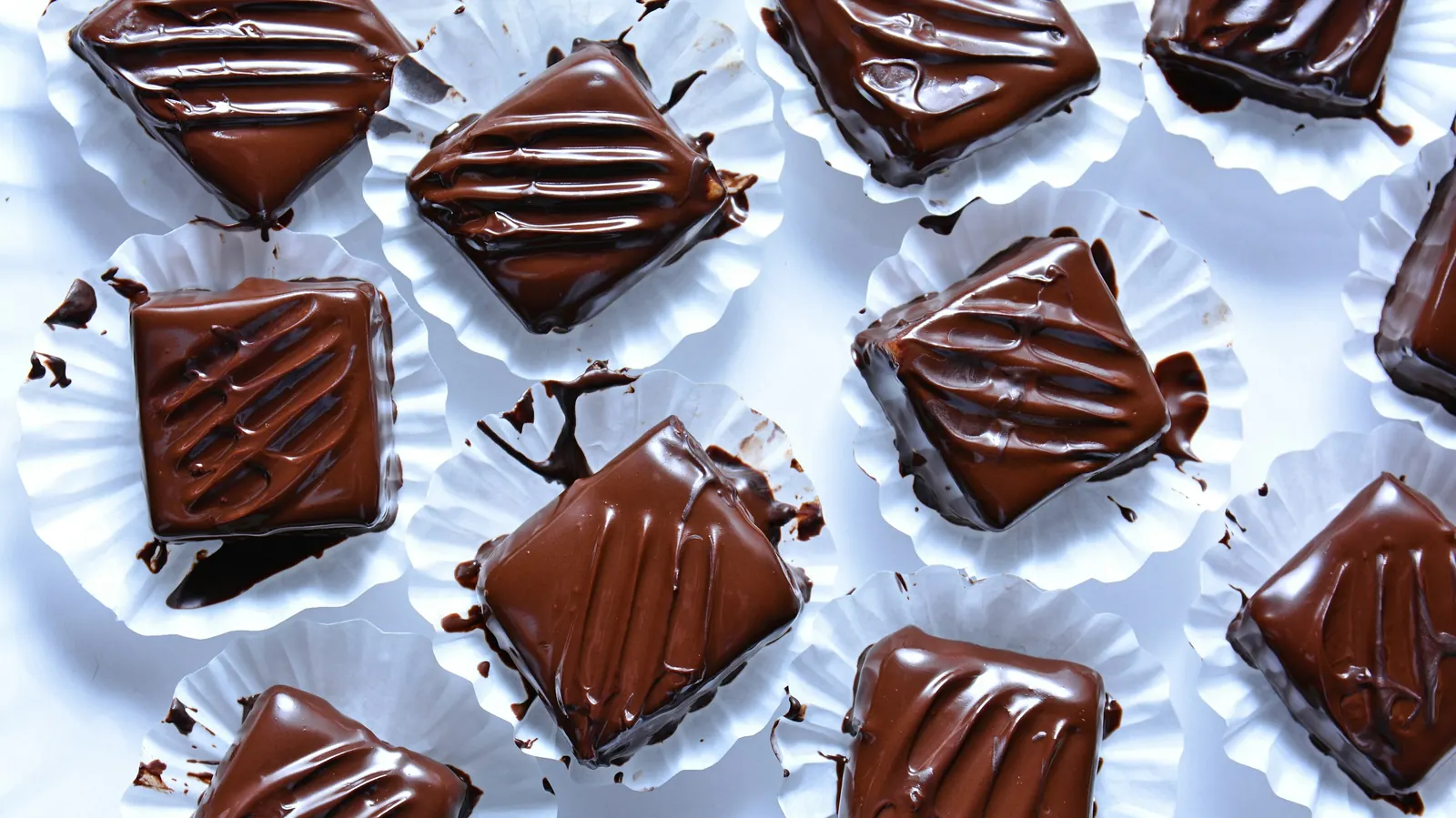
The mold decides how your chocolate looks more than most people expect. Hard polycarbonate gives the high shine you see in a chocolate shop, but it asks for properly tempered chocolate. Silicone lets almost anything pop out, and gives up the shine. Thin clear plastic is cheap and fine for coating, but it wears out.
This guide gives seven chocolate molds across those materials, from professional Belgian and Italian makers to a simple home tray. We have not used them. We name the two sources behind our general advice, and we tell you what the listing leaves out, including food-contact wording on several of the hard molds. One of the makers here sells mainly online, and we flag that.
Julia’s earns a commission on purchases made through links on this page, at no cost to you. Recommendations are based on what a restaurant kitchen looks for, product specifications, maker information and the guidance we name.
Quick verdict: which chocolate mold to buy
Choose the Chocolate World 24-cavity hemisphere mold if you want shop-style shine and will temper your chocolate. Choose the Silikomart Semisfera kit for the same shape in a bisphenol-free plastic. If you don’t want to temper at all, go with the Mrs. Anderson’s silicone bar tray.
Five chocolate molds side by side
Five of the seven, one for each way of working. All seven are covered in full below.
| Pick | Best for | Material | Cavities | Buy on Amazon |
|---|---|---|---|---|

Chocolate World 24-Cavity Hemisphere MoldBest overall
|
Bonbons and shells | Polycarbonate | 24 | View on Amazon |

Silikomart Semisfera 01 Kit with Tritan MoldBest bisphenol-free
|
Filled domes in bisphenol-free plastic | Tritan and silicone | 24 | View on Amazon |

Martellato Heart Gem Polycarbonate MoldBest for gifts
|
Gift boxes | Polycarbonate | 24 | View on Amazon |

Mrs. Anderson’s Baking Silicone Triple Chocolate Bar MoldBest for beginners
|
First-time chocolate making | European-grade silicone | 3 | View on Amazon |

CybrTrayd Mounds Assortment Chocolate Candy MoldBest budget option
|
Occasional batches of coating | PETG plastic | 9 | View on Amazon |
Our picks for the best chocolate molds, from shop style to simple
1. Chocolate World 24-Cavity Hemisphere Mold – The Classic Shop-Style Dome
Half spheres are the most useful shape in chocolate work. You can fill them as bonbons, or join two to make a sphere. This mold has 24 cavities at 30 millimeters across and 15 high, with about 9 grams of chocolate in each, according to the listing.
It’s hard polycarbonate made in Belgium, with a polished cavity interior, and clear so you can see the chocolate. The listing describes it as made for professionals who use the same molds over and over. That’s the point of paying for one. Callebaut says polycarbonate brings out a higher gloss than aluminum or silicone, and that it spreads the chocolate’s heat more evenly.
The trade-off is that a hard mold has no give. Hill Country Chocolate’s guide says the chocolate must contract in order to release cleanly, and it stresses keeping temper, so this mold won’t forgive you for skipping that step. The overall size is 135 by 275 by 24 millimeters, which fits a standard fridge shelf. The listing doesn’t state a food-contact standard, so ask the seller if that matters to you.
Why we like it
- Versatile half-sphere shape
- Made in Belgium, per the listing
- Polished interior for release and shine
- Clear, so you can watch it set
Key specifications
| Model | CW1217 |
|---|---|
| Material | Clear polycarbonate |
| Cavities | 24 |
| Piece size | 30 mm diameter x 15 mm high |
| Chocolate per piece | About 9 g |
| Mold size | 135 x 275 x 24 mm |
| Made in | Belgium |
| Food-contact wording | Not stated |
Why we recommend it
It suits a home chocolate maker ready to learn tempering, or someone already making bonbons. It takes the top spot because the shape does the most jobs and the material gives the finish most of us are after.
Skip it if you don’t want to temper chocolate. It won’t release well and you’ll be frustrated. Start with silicone.
Pros and cons
Pros
- Shop-style gloss, per Callebaut on the material
- Very useful shape
- Clear for checking set
Cons
- Needs tempered chocolate
- Rigid; no flex to help release
- Food-contact wording not stated on the listing
2. Silikomart Semisfera 01 Kit with Tritan Mold – Clear Plastic Without Bisphenols
This is the same 24-dome idea with a different plastic and a helpful extra. The clear mold has half-spheres 31 millimeters across and 16.5 high, holding 8.5 milliliters each, and the kit adds a matching silicone mold for freezing the fillings.
Silikomart says the hard mold is Tritan, an Eastman plastic, 100 percent food safe and free of BPA and all other bisphenols. It says the material resists impact and scratches, and it guarantees reuse up to 3,000 times. It’s the most complete statement on food contact among the hard molds on this page.
That silicone insert is what sets it apart. You can freeze the filling to size, then set it into the chocolate shell, which is simpler than piping. Keep in mind that Callebaut’s and Hill Country’s advice is written about polycarbonate, and we have no independent comparison of Tritan’s shine, so don’t assume it’s exactly the same. The mold measures 275 by 175 by 25 millimeters.
Why we like it
- Bisphenol-free Tritan, per Silikomart
- Matching silicone mold for fillings
- Reuse guarantee of 3,000 times
- Clear for checking set
Key specifications
| Model | Semisfera 01 Kit |
|---|---|
| Material | Tritan plastic, plus a silicone insert mold |
| Cavities | 24 |
| Piece size | 31 mm diameter x 16.5 mm high |
| Chocolate per piece | 8.5 ml cavity volume |
| Mold size | 275 x 175 x 25 mm |
| Made in | Not stated |
| Food-contact wording | 100% food-safe Tritan, free of all bisphenols |
Why we recommend it
It suits someone who wants a clear hard mold and cares about what it’s made of, or who likes filled chocolates and would value the matching insert.
Skip it if you only want a simple solid piece. You’d be paying for an insert you won’t use.
Pros and cons
Pros
- Clearest food-contact statement of the hard molds
- Filling mold included
- Stated durability figure
Cons
- Shine compared with polycarbonate is not established
- Still calls for tempering skill
- Country of manufacture for the Tritan mold not stated
3. Chocolate World 8-Cavity Enrobed Bar Mold – Generous Bars with Raised Detail

Bars take more chocolate and more room for filling. Each of these 8 cavities is 33 millimeters by 105 by 20 high and holds about 60 grams, depending on your chocolate and filling, and each has a raised design on top. That depth is enough for caramel or nut layers.
The mold is polycarbonate, made in Belgium, clear, with what the listing calls a smooth surface for easy release and a glossy finish. It’s 175 by 275 by 24 millimeters in total, the same footprint as other molds of this type. Sold by a specialty shop, Pastry Chef’s Boutique.
Hill Country’s guide suggests beginners start with shallow molds of 10 millimeters or less. This one is twice that, so it isn’t the first mold we’d hand a newcomer, even though it’s a good one. Tap it well as you fill it, since deep cavities trap air.
Why we like it
- Deep enough for fillings
- Made in Belgium
- Raised design on each bar
- About 60 g per bar, per the listing
Key specifications
| Model | CW2362 |
|---|---|
| Material | Polycarbonate |
| Cavities | 8 |
| Piece size | 33 x 105 x 20 mm |
| Chocolate per piece | About 60 g |
| Mold size | 175 x 275 x 24 mm |
| Made in | Belgium |
| Food-contact wording | Not stated |
Why we recommend it
It suits a maker who already tempers and wants a substantial filled candy bar for gifts or sale at a school fair. Eight heavy bars from one mold feels like a real batch.
Skip it if you are just starting. Choose a shallow plain bar like the Goldbaking mold.
Pros and cons
Pros
- Substantial bar size
- Good depth for filling
- Clear, durable material
Cons
- Deep for beginners
- Takes more chocolate
- Food-contact wording not stated on the listing

4. Martellato Heart Gem Polycarbonate Mold – Faceted Hearts from Italy
Martellato is an Italian maker, and this mold makes 24 faceted hearts at 33 by 33 by 15 millimeters. A faceted surface catches light well, so a simple colored shell can look expensive. That makes this one a strong gift-box pick for Valentine’s Day or an anniversary.
The title says polycarbonate and the listing body describes a clear, colorless, break-resistant plastic, made in Italy. The overall size is 6.8 by 10.8 by 1 inches. The listing is sparse otherwise, and it doesn’t say how many grams each piece holds.
A faceted surface shows every flaw, including any poor temper and streaks. Clean it gently, and Hill Country’s guide says light polishing can restore shine on polycarbonate, which is the only care advice we can give you for it since the listing has none.
Why we like it
- Made in Italy
- Faceted surface catches light
- 24 pieces per mold
- Shallow enough for a home fridge shelf
Key specifications
| Model | MA1993 |
|---|---|
| Material | Polycarbonate (title); clear break-resistant plastic (body) |
| Cavities | 24 |
| Piece size | 33 x 33 x 15 mm |
| Chocolate per piece | Not stated |
| Mold size | 6.8 x 10.8 x 1 in |
| Made in | Italy |
| Food-contact wording | Not stated |
Why we recommend it
It suits someone who gives chocolates away and wants the box to look special. At 15 millimeters deep it’s a reasonable size to practice on after a first mold.
Skip it if you want a neutral shape for year-round use. Hearts are hearts.
Pros and cons
Pros
- Striking shape
- Made in Italy
- Moderate depth
Cons
- Shows flaws clearly
- Sparse listing details
- Food-contact wording not stated on the listing
5. Mrs. Anderson’s Baking Silicone Triple Chocolate Bar Mold – No Tempering Worries
This is the mold we’d give someone making chocolate for the first time. It makes 3 standard bars, each 5.5 by 1.25 by 0.25 inches, on a tray of about 8.66 by 6.3 inches. Melt, pour, chill, push out. The bars are thin, so they set fast.
The maker states 100 percent European-grade silicone, non-stick, and safe for the freezer, oven, microwave and dishwasher, from -90 to 570°F, with step-by-step instructions included. It also molds butter, spreads and ice. It’s sold and shipped by Amazon at the time of writing.
Silicone has limits. Hill Country says it gives a matte finish, and that easy release is the trade-off for appearance. Tempering still helps the snap and shine, but it’s the mold where you can get a usable bar without it. And because it’s floppy, place it on a flat tray before you fill it.
Why we like it
- Pops out with no fuss
- Thin bars set quickly
- Instructions included
- Dishwasher safe, per the maker
Key specifications
| Model | 43829 |
|---|---|
| Material | European-grade silicone |
| Cavities | 3 |
| Piece size | 5.5 x 1.25 x 0.25 in |
| Chocolate per piece | Not stated |
| Mold size | 8.66 x 6.3 in |
| Made in | Not stated |
| Food-contact wording | 100% European-grade silicone |
Why we recommend it
It suits a beginner, a family project or anyone making a quick melted-chocolate bar with toppings. It takes away the part that puts most people off.
Skip it if you want a glossy shop finish. Silicone won’t do that for you.
Pros and cons
Pros
- Forgiving release
- Easy to clean
- Sold by Amazon at the time of writing
Cons
- Matte finish, per Hill Country
- Only 3 bars at a time
- Flexible when full
6. Goldbaking Plain Bar Polycarbonate Mold – An Affordable Way into Hard Molds

A plain bar is the simplest thing to do in a hard mold, and it’s a sensible way to learn. The finished bar is about 4.6 by 1.9 by 0.2 inches, and shallow, which is what Hill Country recommends for beginners. The mold itself is 10.8 by 5.3 by 0.9 inches and weighs 320 grams.
Goldbaking gives more practical advice than most: tap gently at several stages to bring out air bubbles, and chill long enough before you try to release. It also says that the weight of a bar varies by chocolate, at 40 to 50 grams, which is the kind of honesty we like to see.
Goldbaking is an online-first brand, the listing is thin on origin and gives no statement about food contact or BPA, and the seller is the brand itself. We include it because it offers the same plain format at an entry level, not because of any evidence of durability. The listing doesn’t give a cavity count, so look at the photo.
Why we like it
- Shallow, beginner-friendly bar
- Useful tips on the listing
- Hard mold finish at an entry level
- Plain face that shows off shine
Key specifications
| Model | Not stated |
|---|---|
| Material | Polycarbonate (title) |
| Cavities | Not stated |
| Piece size | 4.6 x 1.9 x 0.2 in |
| Chocolate per piece | About 40–50 g, per the listing |
| Mold size | 10.8 x 5.3 x 0.9 in |
| Made in | Not stated |
| Food-contact wording | Not stated |
Why we recommend it
It suits someone who has tried silicone and wants to practice tempering without committing to a professional mold.
Skip it if food-contact wording matters to you. The listing doesn’t give any.
Pros and cons
Pros
- Shallow is easier to learn on
- Simple shape
- Practical listing advice
Cons
- Online-first brand
- No food-contact wording on the listing
- Country of manufacture not stated
7. CybrTrayd Mounds Assortment Chocolate Candy Mold – Simple Domes for Everyday Coating
If you just want to dip and mold candy coating for a party or a bake sale, you don’t need polycarbonate. This thin clear sheet has 9 domed cavities in an assortment of sizes, and it’s about 10.25 by 8 inches.
This listing gives the rules plainly: don’t use it with hard candy, hand wash only since it isn’t dishwasher safe, and it isn’t suitable for children under 3. CybrTrayd’s other listing describes its molds as food-grade PETG, made in the USA, and we read that as applying to this family of molds, though this exact listing doesn’t repeat it.
Hill Country’s guide says thin plastic molds of 1 to 2 millimeters warp easily in heat and typically last 100 to 300 uses, and that they don’t shed heat as well, which can mean uneven cooling and bloom. For an occasional batch that’s a fair deal. Dark chocolate that needs to look glossy would be better in a harder mold.
Why we like it
- Low-commitment format
- Clear limits on the listing
- Dome shapes suit many fillings
- Good for candy coating
Key specifications
| Model | AO011 |
|---|---|
| Material | Clear PETG plastic, per the maker’s other listings |
| Cavities | 9 |
| Piece size | Assorted |
| Chocolate per piece | Not stated |
| Mold size | 10.25 x 8 in |
| Made in | USA, per the maker’s other listings |
| Food-contact wording | Food-grade PETG on sister listing, not this one |
Why we recommend it
It suits an occasional maker, a party or a kids’ afternoon with candy coating, where the mold doesn’t need to last for years.
Skip it if you plan to make chocolates often. A thin sheet wears out, and a hard mold pays back with use.
Pros and cons
Pros
- Good for occasional use
- Sold with clear limits
- Variety of dome sizes
Cons
- Thin plastic wears out, per Hill Country
- Hand wash only
- Food-grade wording is on a sister listing
Polycarbonate and silicone molds, in plain terms
Polycarbonate is the hard, clear mold chocolatiers use. Callebaut says it gives a higher gloss than aluminum or silicone, and that it distributes heat more evenly, which lowers the chance of dull spots. It needs tempered chocolate.
Silicone is the flexible option. Hill Country Chocolate’s guide says it gives a matte finish, but that it allows complicated shapes and easy release. Thin PETG plastic is the low-cost choice: light and clear, but easier to warp and with a shorter life by that same guide.

How to choose a chocolate mold for your kitchen
Be honest about tempering. If you won’t temper, buy silicone. Hard molds work because tempered chocolate contracts and pulls away from the mold. Hill Country’s guide gives 88 to 90°F as the working range for dark chocolate. A good candy thermometer helps here.
Start shallow. Hill Country suggests that beginners use molds 10 millimeters deep or less. Deep cavities hold more air and take longer to set.
Match the shape to the job. Domes fill well and can be joined. Bars take toppings and fillings. Faceted shapes show off a colored shell, and they show every flaw too.
Count the chocolate. Each cavity’s weight, times the number of cavities, tells you what one batch needs. Melt extra, since you’ll lose some to scraping.
Read what the listing says on food contact. Silikomart and Mrs. Anderson’s state their materials clearly. Several hard molds here don’t, and we say so in each pick. Ask the seller if that matters to you.
Clean as the maker says. Scratches dull a hard mold, so avoid anything abrasive. Hill Country says light polishing can restore the shine on polycarbonate. Thin plastic here is hand wash only.

How we chose these seven chocolate molds
We looked through molds from Chocolate World, Martellato, Silikomart, Wilton, CybrTrayd, Mrs. Anderson’s Baking and online brands, and kept in-stock listings with a new offer. We kept the number of online-first makers to two at most, and in the end used one. Wilton’s chocolate molds we found were third-party listings with little detail, so we left them out, along with molds already covered on our other pages. All sizes and materials come from the Amazon listings as we read them, so check them before you order.
We have not used these molds. Our general advice comes from Callebaut, a chocolate maker with its own interest in the craft, and from Hill Country Chocolate’s mold guide, a Texas chocolate shop’s blog. Neither reviews these exact products. We found no independent review of any of the seven molds, so the picks rest on the listings and on what those two sources say about each material.
We also searched the U.S. Consumer Product Safety Commission’s recall data by brand, and it returned no recall for a chocolate mold from these makers.
Chocolate mold questions, answered
Are polycarbonate molds worth it?
If you temper chocolate and care about shine, yes. Callebaut says polycarbonate gives a higher gloss than silicone or aluminum. If you only melt chocolate now and then, a silicone or PETG mold will do the job.
Do silicone molds need tempered chocolate?
Not for release. Silicone flexes, so the chocolate comes out either way. Tempering still affects the look and the snap of the piece.
Why won’t my chocolate come out of a hard mold?
Usually the temper or the chill. Hill Country says the chocolate must contract to release cleanly. Callebaut notes that dark patches seen through a clear mold mean it hasn’t fully set, and suggests returning it to the refrigerator briefly.
Is polycarbonate food safe?
Makers sell these for chocolate work, but several listings here state no food-contact standard. If you’d rather avoid bisphenols, Silikomart states that its Tritan mold is free of them. We can’t say more than the makers do.
Can I put these molds in the dishwasher?
The silicone tray here is stated as dishwasher safe. CybrTrayd’s isn’t. The polycarbonate listings don’t say, so wash them gently by hand.
How is a chocolate mold different from a candy mold?
Chocolate molds are chosen for shine and detail, while candy molds also need to deal with sugar, gummies or caramel. If you’re working with hot sugar, check the maker’s limit first.
Our final pick for home chocolate work
If you’re ready to temper, the Chocolate World hemisphere mold is where we’d start. If you aren’t, the Mrs. Anderson’s bar tray will get you making bars tonight. For the technique behind a good shell, see our chocolate cookbook guide. For something warmer, our Mexican hot chocolate guide is a good next read, and our chocolate fountain guide is there for parties.
Julia’s is a working Mexican kitchen in Houston. When you’d rather let someone else cook dinner, call to order at (346) 546-8283 or browse our menu.