A pizza dough box does one quiet job. It holds dough balls for a slow rise, keeps the air off them so they don’t grow a dry skin, and gives each ball room to spread without running into its neighbor. Pizzerias have stacked these boxes for decades because a good cold ferment takes a day or more, and a sheet of plastic wrap over a bowl gets old fast.
The catch for a home cook is size. A standard pizzeria box is 18 by 26 inches, which will not fit many home refrigerators. This guide sorts seven boxes by what they fit into and how they hold the dough. It covers unheated boxes only; if you need warmth for a rise, a heated proofer is a different tool, and we cover those in our guide to the best bread proofing box.
Julia’s earns a commission on purchases made through links on this page, at no cost to you. Recommendations are based on what a restaurant kitchen looks for, product specifications and verified buyer reports.
Quick verdict: which pizza dough box to buy
Buy the DoughMate Pizza Dough Proofing Box and Tray Kit. It is sized for a home refrigerator, holds six 8 to 10 ounce dough balls per tray, is listed as NSF certified and made in the USA, and needs only one lid for the stack. If you bake for a crowd and have a commercial fridge, the Cambro 18 by 26 inch box is the pizzeria standard.
Five dough boxes by kitchen and fridge
| Dough box | Best for | Footprint | Dough capacity | Buy on Amazon |
|---|---|---|---|---|

DoughMate Pizza Dough Proofing Box and Tray KitBest overall
|
Home fridges, weekly cold ferments | About 18 x 13 in | 6 balls per tray | View on Amazon |

Cambro 18 x 26 x 3-Inch Pizza Dough BoxBest for commercial fridges
|
Commercial fridges and big batches | 18 x 26 in | Not stated | View on Amazon |

Babadoh Silicone Dough Proofing Containers, Set of 6Best for single balls
|
Baking one pizza at a time | About 5 x 5 in each | 1 ball each, 6 containers | View on Amazon |
Brød & Taylor 6-Liter Proofing ContainerBest for bulk fermenting
|
Bulk fermenting before shaping | 10.5 x 12.8 in | Up to 3,000 g | View on Amazon |

Chef Pomodoro Pizza Proofing Box, 14 x 11-InchBest small box
|
Small shelves and carrying dough | 14 x 11 in | 4 to 6 balls | View on Amazon |
Our picks for the best pizza dough box
Sizes, materials and certifications below come from each maker’s Amazon listing unless we say otherwise. We have not used these boxes ourselves.
1. DoughMate Pizza Dough Proofing Box and Tray Kit – Built Around a Home Fridge
This kit is two trays, one lid and a plastic dough scraper. Each tray holds six dough balls of 8 to 10 ounces in an interior space of 16 by 11 by 2.75 inches, and the full stack measures 17.75 by 13 by 7 inches. That is the point of it: DoughMate pitches the tray at home pizza ovens and mobile pizza setups rather than at walk-in coolers.
The trays are high-impact copolymer polypropylene with reinforced corners, and the inside walls are smooth, with no ribs or grooves for dough to catch in. That matters at the end of a long ferment, when you want a bench scraper to slide under a soft ball without tearing it. Only the top tray needs the lid, since the stack covers the trays below it.
Why we like it
- The listing states NSF certification and BPA-free plastic.
- Smooth interior walls leave no grooves to trap dough.
- One lid covers a whole stack, which saves fridge space.
Key specifications
| Model | ADTKIT-148 |
|---|---|
| Outside or stated size | 17.75 x 13 x 7 in stacked; tray interior 16 x 11 x 2.75 in |
| Dough capacity | 6 balls of 8 to 10 oz per tray |
| Material | High-impact copolymer polypropylene |
| Lid | 1 lid included |
| Stacking | Yes, 2 trays stack |
| Certification | NSF, per listing |
| Care | Not stated in listing |
Why we recommend it
It suits a home pizza maker who does a cold ferment most weeks and wants a real tray that fits a normal shelf. A stated certification and a stated US origin are more than most boxes in this size offer.
Skip it if you only bake two or three pizzas at a time, since a six-ball tray is more than you need.
Pros and cons
Pros
- Sized for standard refrigerators, per the maker
- Includes a dough scraper
- Stated dough ball count and weight
Cons
- Measure your shelf first; the stack is close to 18 inches long
- Care instructions are not stated in the listing
2. Cambro 18 x 26 x 3-Inch Pizza Dough Box – The Full-Size Pizzeria Format
This is the box many people picture when they think of a pizzeria walk-in. It measures 18 by 26 by 3 inches, and Cambro’s listing says it is for proofing and storing dough while keeping it fresh and preventing crusting. Cambro’s other listing for this same model number describes it as polypropylene.
The lid is a separate purchase: Cambro sells the matching cover as model DBC1826P148. A full-size box suits a bakery rack, a commercial reach-in or a big catering job. In a home kitchen it mainly suits a garage fridge or a chest freezer with room to spare, so measure before you order.
Why we like it
- A known foodservice maker with a dedicated cover in the same line.
- The 3-inch depth leaves room for a ball to relax outward.
- Boxes this size hold many more balls per layer than a home tray.
Key specifications
| Model | DB18263P148 |
|---|---|
| Outside or stated size | 18 x 26 x 3 in |
| Dough capacity | Not stated |
| Material | Polypropylene, per a second Cambro listing |
| Lid | Sold separately (DBC1826P148) |
| Stacking | Not stated in this listing |
| Certification | Not stated in this listing |
| Care | Not stated in listing |
Why we recommend it
It suits a caterer, a food truck or a serious home baker with commercial refrigeration. Buying into a maker with a matched cover also makes it easier to add boxes later.
Skip it if you have a standard home refrigerator; at 26 inches long it is unlikely to fit.
Pros and cons
Pros
- Large footprint for big batches
- Matched cover sold in the same line
- Made for dough, not adapted from general storage
Cons
- Lid costs extra
- Too big for most home fridges
- This listing states no dough ball count
3. Thunder Group 18 x 26 x 3-Inch Pizza Dough Box – NSF Listed and Dishwasher Safe

Thunder Group is a restaurant supply maker, and this is its take on the same 18 by 26 by 3 inch format. The listing is plain and useful: polypropylene, commercial grade, dishwasher safe and NSF certified, sold one box at a time.
The title calls it stackable, which is what you want on a rack. Thunder Group sells a cover as model PLDBC1826PP, but the Amazon listing we checked for that cover was not in stock, so plan how you will cover the top box before buying. In a kitchen that stacks several boxes, the top one is the only one that needs covering.
Why we like it
- The listing states NSF certification.
- Dishwasher safe, which matters in a busy kitchen.
- Sold singly, so you can buy only the boxes you need.
Key specifications
| Model | PLDB182603PP |
|---|---|
| Outside or stated size | 18 x 26 x 3 in |
| Dough capacity | Not stated |
| Material | Polypropylene |
| Lid | Not included; cover PLDBC1826PP was out of stock when checked |
| Stacking | Yes |
| Certification | NSF, per listing |
| Care | Dishwasher safe |
Why we recommend it
It suits a small commercial kitchen that wants a stated certification and dishwasher care in the full-size format. It is the plainer alternative to the Cambro.
Skip it if you need a lid arriving in the same order, since the matching cover was not in stock on Amazon when we checked.
Pros and cons
Pros
- Clear statement of material and certification
- Dishwasher safe
- Stackable full-size format
Cons
- Matching cover was unavailable when checked
- Too large for most home fridges
- Sold by a third-party seller on Amazon
4. Babadoh Silicone Dough Proofing Containers, Set of 6 – One Ball, One Container
Babadoh takes a different approach. Instead of one shared tray, each dough ball gets its own small silicone container with a lid, and this set has six. The original size is meant for balls that make a 12-inch pizza. The brand’s press office lists each container at 13.4 by 12.2 by 6.4 centimeters with a 600 milliliter volume.
The appeal is that a ball can never run into its neighbor, and you can take out one pizza’s worth without disturbing the rest. The press material says the lids sit loosely so gas can escape while the dough stays moist. The silicone is flexible, so you can ease the ball out. A set of six small containers also fits into gaps in a crowded fridge in a way a long tray can’t.
Why we like it
- Listing states silicone passing LFGB food contact testing.
- Dishwasher, microwave and oven safe, per the listing.
- Individual containers let you bake one pizza at a time.
Key specifications
| Model | Original size, set of 6 |
|---|---|
| Outside or stated size | About 13.4 x 12.2 x 6.4 cm each, per the brand |
| Dough capacity | 1 ball each, for 12-inch pizzas |
| Material | Silicone |
| Lid | 6 lids included |
| Stacking | Yes |
| Certification | LFGB food contact testing, per listing |
| Care | Dishwasher, microwave and oven safe |
Why we recommend it
It suits someone who bakes a pizza or two at a time from a batch and wants the rest to stay put. It also suits a fridge with odd spaces and no room for a long tray.
Skip it if you make big pizzas from large dough balls; this size is for 12-inch pies, and a matching tray for moving them together is a separate item.
Pros and cons
Pros
- Balls cannot stick to each other
- Flexible silicone for easy release
- Also usable for storing other food, per the listing
Cons
- Six separate pieces to wash and store
- Size limits you to smaller balls
5. Brød & Taylor 6-Liter Proofing Container – Bulk Ferment With Volume Marks
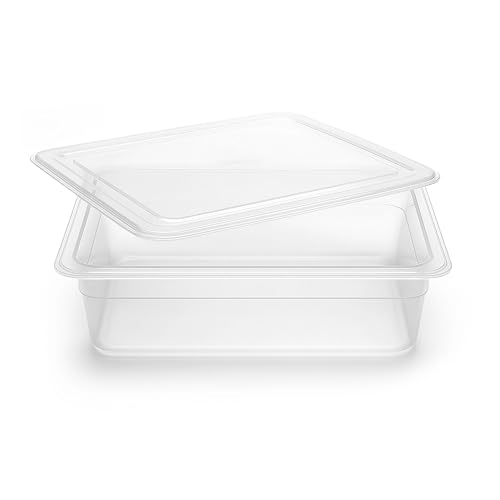
This one is for the stage before the dough balls exist. It is a 6-liter polypropylene box, 10.5 by 12.8 by 4 inches, that holds up to 3,000 grams of dough. Its translucent walls and volume markings let you watch the rise without lifting the lid, and the wide base gives you room to fold dough inside the box.
Brød & Taylor names pizza dough along with bread and sourdough in the title. It is the odd one out here, because you could fit a few balls in it but it is not a ball tray. The 2-pack listing of this same container is on our guide to mixing bowls for sourdough; we list the single box here because many pizza makers need only one for a bulk ferment.
Why we like it
- Volume marks show the rise from outside the box.
- Holds up to 3,000 grams of dough, per the maker.
- Dishwasher safe and freezer friendly, BPA-free polypropylene.
Key specifications
| Model | FP-800 |
|---|---|
| Outside or stated size | 10.5 x 12.8 x 4 in |
| Dough capacity | Up to 3,000 g of dough; ball count not stated |
| Material | BPA-free polypropylene |
| Lid | 1 lid |
| Stacking | Yes, with or without lids |
| Certification | Not stated |
| Care | Dishwasher safe, freezer friendly |
Why we recommend it
It suits a home baker who bulk ferments high-hydration dough and then shapes balls the next day. The compact footprint makes it the easiest box here to fit on a home shelf.
Skip it if you shape balls right after mixing and want to ferment them as balls; a tray does that better.
Pros and cons
Pros
- Compact footprint
- Clear marks for tracking the rise
- Works for bread as well as pizza
Cons
- Not laid out for individual balls
- We repeat this model from a sibling guide in a different pack size
6. Chef Pomodoro Pizza Proofing Box, 14 x 11-Inch – A Small Box With a Carry Handle
At 14 by 11 by 3 inches, this is the smallest tray-style box here. Chef Pomodoro says it holds four to six dough balls sized for 12 to 14 inch thin crust pizzas. The lid snaps on with clasps, and a recessed handle folds out for carrying, which helps when the dough is going to a friend’s backyard oven.
The trays are transparent ABS plastic, so you can check the rise without opening the lid. Treat this as a brand sold mainly online: the details here rest on its listing, and we found no independent test of it. The listing does not state a certification or dishwasher care, so hand washing is the safe assumption until you confirm otherwise.
Why we like it
- Fits smaller shelves than the 17-inch trays.
- Clear walls show the rise.
- Snap clasps and a carry handle help with transport.
Key specifications
| Model | CP-DB |
|---|---|
| Outside or stated size | 14 x 11 x 3 in |
| Dough capacity | 4 to 6 balls for 12 to 14 in thin crust |
| Material | ABS plastic |
| Lid | Snap-on lid included |
| Stacking | Yes, per listing |
| Certification | Not stated |
| Care | Not stated |
Why we recommend it
It suits an apartment fridge or anyone carrying dough to a pizza party. The small footprint is the reason to choose it over the larger trays.
Skip it if you want a stated food-contact certification; the listing does not give one.
Pros and cons
Pros
- Compact
- Secure lid for travel
- Clear sides
Cons
- No certification stated
- No care instructions in the listing
- Rests on listing details only
7. GSM Brands Pizza Dough Proofing Box, 2 Trays and Covers – Two Lids for Two Fridges
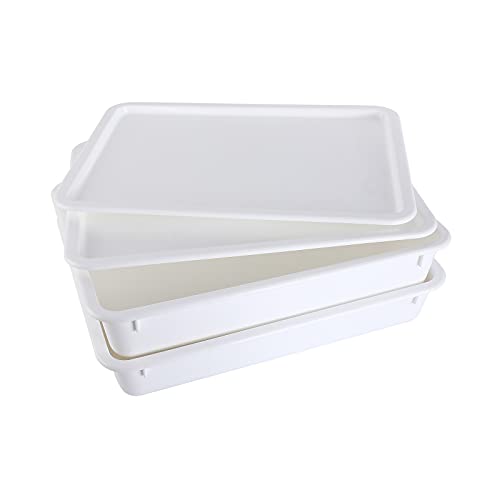
GSM Brands sells two 17.25 by 13 by 3.54 inch trays with a cover for each. That is close to the DoughMate footprint, and the extra lid is the practical difference: you can run the trays separately, on two shelves or in two fridges. The basins stack together for storage once the covers come off.
The plastic is described as food grade, white and BPA free. The listing calls it commercial quality but gives no certification and no dough ball count, so plan your own spacing. At this size, six balls of a home pizza weight is a fair starting point to try, but that is our estimate rather than the maker’s figure. This is another brand we know mainly from its Amazon store, so the details rest on its listing.
Why we like it
- A lid for each tray.
- Slightly deeper than the DoughMate tray at 3.54 inches.
- Stacks for storage when not in use.
Key specifications
| Model | Not stated |
|---|---|
| Outside or stated size | 17.25 x 13 x 3.54 in |
| Dough capacity | Not stated |
| Material | Food-grade BPA-free plastic |
| Lid | 2 covers included |
| Stacking | Yes, nests without covers |
| Certification | Not stated |
| Care | Not stated |
Why we recommend it
It suits a home cook who wants two separately usable trays in a fridge-friendly size. It is a reasonable alternative if the extra lid matters more than a stated certification.
Skip it if you want NSF certification or a stated dough ball count; the DoughMate gives both.
Pros and cons
Pros
- Two lids included
- Fridge-friendly footprint
- Deeper tray
Cons
- No certification stated
- No dough ball count stated
- Rests on listing details only
How to choose a dough box for your kitchen
Measure the fridge first. This decides more than anything else. Take the shelf depth and width with the door closed in mind, then compare them with the outside size of the box. An 18 by 26 inch pizzeria box and a 13 by 18 inch home tray are different purchases.
Count your dough balls. Decide how many pizzas you make in one go, then give each ball enough space to spread. Boxes that state a ball count, such as the DoughMate and the Chef Pomodoro, make this easy. If a listing gives none, plan on testing your spacing with a batch you don’t mind reshaping.
Check the depth. Balls rise and relax outward as they ferment. A depth of around 3 inches is common for trays, and a shallow lid that touches the dough can leave it stuck. If you use large balls, a deeper tray is worth seeking out.
Look at the lid situation. A box without a lid is a tray. Commercial boxes usually sell the cover separately, and home sets may include one lid or several. In a stack, only the top tray needs a lid, so one can be enough.
Read the certification line. Anything touching dough for days should be food-grade. NSF certification is a useful sign in commercial kitchens; here, the DoughMate and Thunder Group listings state it. “BPA-free” is a material claim, not the same thing as a certification.
How we picked these seven dough boxes
We started by counting what was actually in stock on Amazon from makers we could identify, using listing data, and we kept only boxes meant to hold dough. That excluded heated proofers, general storage bins and most of the look-alike multipacks from brands we could not trace. We allowed no more than two brands we know mainly from Amazon, Chef Pomodoro and GSM Brands. Babadoh also has a UK press office and UK retailers.
A search for independent reviews turned up mostly affiliate roundups, and we found no head-to-head test we would rely on, so these picks rest on maker and listing details. We have not used these boxes. Ooni’s own dough boxes are worth a look too, and you will find them in our guide to pizza oven accessories rather than here, to keep each guide’s picks different.
Dough box questions, answered
What is a dough proofing box?
It is a shallow, lidded tray that holds dough balls while they ferment. Most are unheated and go into a refrigerator for a cold ferment. A heated proofer is a separate appliance that adds warmth.
Do you need to oil a dough box?
Many pizza makers lightly oil the tray or the dough balls to help release. Follow your recipe, and go easy with oil on a smooth tray that already releases well.
Can I use a storage container instead?
Yes, if it is food-safe, has a lid and has enough room for the balls to spread. A dough box mainly gives you the right shape, an easy stack and less fuss getting the ball out.
How many dough balls fit in a pizza dough box?
The DoughMate lists six balls of 8 to 10 ounces per tray, and the Chef Pomodoro lists four to six in its smaller box. Commercial 18 by 26 inch boxes hold more, but the listings here don’t state a number.
Are dough boxes dishwasher safe?
Some are. The Thunder Group, Babadoh and Brød & Taylor listings say so. Others don’t state it, so check before you run one through a hot cycle.
Our final pick for a home fridge
The DoughMate kit is the one to start with, because its size, stated certification and dough ball count answer the questions most home pizza makers have. Once the dough is ready, you will want a good surface to bake on, and our guide to the best pizza stone covers that next step, with a pizza peel to get it there. If you would rather let someone else do the cooking tonight, call Julia’s at (346) 546-8283 and call to order.