
KitchenAid is the stand mixer most people picture: a heavy tilt-head machine that has looked much the same for decades, sold in dozens of colors. Cuisinart’s tilt-head mixer is the best-known alternative. It has a bigger bowl, a stronger stated motor, more speeds and a longer warranty, and it usually costs less. On paper, that sounds like an easy win for Cuisinart. In the bowl, it is closer than the numbers suggest.
This guide compares the two brands on capacity, power, speeds, stability with heavy dough, attachments and warranty, using what each maker and their listings state and one named head-to-head review. Then it names one pick from each brand that we can recommend without repeating the most common pages on our site.
Julia’s earns a commission on purchases made through links on this page, at no cost to you. Recommendations are based on what a restaurant kitchen looks for, product specifications and verified buyer reports.
Quick verdict: KitchenAid or Cuisinart?
Choose KitchenAid if you bake bread, bagels or other stiff doughs often, or want the widest choice of sizes, colors and attachments. Its weight keeps it steady, and in PureWow’s head-to-head the Artisan handled every test without trouble. Choose Cuisinart if you mostly make cakes, cookies and frostings, want a larger bowl and a 3-year warranty, and want to spend less. For most occasional bakers the Cuisinart is the better value, but frequent bread bakers should buy the KitchenAid.
The table compares the two brands’ main tilt-head machines. The sections after it explain the differences.
KitchenAid vs Cuisinart stand mixer, side by side
| KitchenAid Artisan (5-quart) | Cuisinart SM-50 (5.5-quart) | |
|---|---|---|
| Bowl | 5 quarts | 5.5 quarts |
| Stated power | 325 watts (PureWow) | 500 watts (listing) |
| Speeds | 10 | 12 |
| Weight | About 23 lb (PureWow) | About 15 lb (PureWow) |
| Heavy dough | Steady, no bucking (PureWow) | Bucked and shook on heavy dough (PureWow) |
| Attachments | More than 10 sold separately | Pasta, ice cream, meat grinder and spiralizer sold separately |
| Sizes in the range | 3.5 to 7 quarts, tilt-head and bowl-lift | Mainly 5.5-quart tilt-head |
| Warranty | 1 year (listings; Top Ten Reviews) | Limited 3 years (listing) |
Capacity: Cuisinart’s bowl is bigger
Cuisinart’s standard mixer, the SM-50, has a 5.5-quart polished stainless steel bowl, according to its listing. KitchenAid’s best-selling Artisan has 5 quarts. Half a quart sounds small, but it is the difference between a double batch of cookie dough fitting comfortably and creeping up the sides. Top Ten Reviews singles out the Cuisinart’s extra capacity as one of its strengths.
KitchenAid answers with range rather than one bigger bowl. Its line runs from the 3.5-quart Artisan Mini to the 7-quart bowl-lift, with the 4.5-quart Classic and 5-quart Artisan between them. Cuisinart’s range is narrower, built mostly around the 5.5-quart tilt-head in several colors. If you know you want a very small mixer or a very large one, KitchenAid has a model for it; our best stand mixer guide covers the 7-quart bowl-lift.
Power and speeds: the numbers favor Cuisinart
The Cuisinart’s listing states a 500-watt motor and 12 speeds. PureWow lists the KitchenAid Artisan at 325 watts and 10 speeds. On a spec sheet, that is a clear Cuisinart win.
Watts measure what a motor draws, not how well a mixer kneads, and the two machines drive their beaters differently. Both use planetary mixing, where the beater spins while it travels around the bowl. KitchenAid says the Artisan Mini has the same power as its Classic mixer and lists 59 touchpoints around the bowl. In practice, the extra speeds on the Cuisinart give you finer steps between a slow stir and a fast whip, which helps with meringue and cream more than with dough.

Heavy dough and stability: where KitchenAid earns its weight
This is the test that separates them. PureWow’s Candace Davison used both for a month, making cupcakes, buttercream, cookie dough and rye bagels. She found the KitchenAid Artisan handled every test flawlessly, without overheating, bucking or shaking. The Cuisinart did well with cakes and cookies but tended to buck and shake with heavy dough, though it never looked likely to tip over.
Weight is the likely reason. PureWow puts the Artisan at about 23 pounds and the Cuisinart at about 15. A heavier base resists the push and pull of a stiff dough. For a flour tortilla or a bolillo dough once a month, the Cuisinart will cope. For bagels or bread every week, the KitchenAid is the safer machine. Our stand mixer for bread guide goes further into dough capacity.
Davison’s verdict matches this: the Cuisinart for bakers who mostly make cookies, cakes and frostings, and the Artisan for bakers who make breads, bagels and hearty doughs. She also notes her own bias, after more than 12 years with a KitchenAid, which is worth keeping in mind.
Ease of use: small differences both ways
PureWow found the Cuisinart’s speed dial easier to turn than the KitchenAid’s lever. Out of the box, the Cuisinart’s tilt head sat a little too high for the beater to reach the bottom of the bowl, and adjusting it meant turning a stiff screw. The KitchenAid’s head is heavy to lift, and its attachments can be harder to take off.
Both bowls are stainless steel, and the Artisan Mini’s listing says its bowl is dishwasher safe. Both makers include a flat beater, dough hook and whisk; Cuisinart adds a splash guard with a pour spout. Top Ten Reviews lists scraping the sides of the bowl as a drawback for both, so keep a spatula handy whichever you choose.

Attachments: KitchenAid’s biggest advantage
Both mixers have a power outlet on the front for extra tools. Cuisinart lists a pasta extruder, pasta roller and cutters, an ice cream maker, a meat grinder and a spiralizer, all sold separately. KitchenAid lists more than 10 attachments for the Artisan Mini alone, and the wider KitchenAid range has many more. Top Ten Reviews notes that KitchenAid’s attachments can be expensive, but the choice is far wider, and third-party makers build for KitchenAid’s hub too.
If you plan to grind meat for chorizo or roll pasta, KitchenAid is the safer bet for finding the tool you want. Our stand mixer attachments guide and stand mixer meat grinder guide cover them.
Warranty and colors
Cuisinart’s listing gives the SM-50 a limited 3-year warranty. KitchenAid’s listings give its tilt-head mixers 1 year; the Artisan Mini listing says a 1-year full warranty, and Top Ten Reviews also lists 1 year for the Artisan. If you want the longest cover for the money, Cuisinart wins this one clearly.
Color is KitchenAid’s other draw. PureWow counted 39 colors for the Artisan against 13 for the Cuisinart, and Cuisinart’s own listing names six. If the mixer will live on the counter, that may matter more than you expect.

Choose KitchenAid if… / Choose Cuisinart if…
Choose KitchenAid if…
- You bake bread, bagels or other stiff doughs often.
- You want a very small or very large mixer, or a bowl-lift model.
- You plan to add attachments such as a meat grinder or pasta roller.
- You want a wide choice of colors.
Choose Cuisinart if…
- You mostly make cakes, cookies, frostings and whipped cream.
- You want a 5.5-quart bowl in a lighter machine.
- You want 12 speeds and a 500-watt stated motor.
- A 3-year warranty and a lower price matter more than the badge.
Our picks for the KitchenAid vs Cuisinart stand mixer choice
One pick per brand, both sold by Amazon.com and in stock when we checked. The KitchenAid Artisan 5-quart is the obvious rival to the Cuisinart, but it already appears on many of our pages, including our best stand mixer guide, where you can read about it. Here we pick the Artisan Mini, the KitchenAid for smaller kitchens, in a black color not shown elsewhere on our site; the white one is in our best stand mixer guide. The Cuisinart is the White Linen color of the SM-50 in the same guide, chosen because it is the brand’s main mixer and the direct rival to the Artisan.
1. KitchenAid Artisan Mini 3.5-Quart Tilt-Head Stand Mixer – Smaller and Lighter

The Artisan Mini is KitchenAid’s smallest tilt-head mixer. The listing says its 3.5-quart stainless steel bowl mixes up to 5 dozen cookies in a batch, and that it has the same power as the KitchenAid Classic while weighing less and taking up less counter space. It has 10 speeds and 59 touchpoints around the bowl, according to the listing.
It comes with a flex edge beater, a coated dough hook and a 6-wire whip, and the bowl is dishwasher safe. The head tilts back for adding ingredients and locks while mixing. The listing says more than 10 attachments fit, sold separately. Bowls and some accessories are sized for particular mixers, so check that anything you add is listed for the 3.5-quart Mini.
The trade-off is capacity. A 3.5-quart bowl suits one or two loaves and normal cookie batches, not double batches or large holiday baking. The listing states a 1-year full warranty.
Why we like it
- Same power as the Classic, per KitchenAid’s listing
- Up to 5 dozen cookies per batch (listing)
- Beater, dough hook and whip included
- Fits KitchenAid’s attachment hub
Key specifications
| Model | KSM3316XBK |
|---|---|
| Bowl capacity | 3.5 quarts, stainless steel |
| Motor (stated) | Same power as the KitchenAid Classic |
| Design | Tilt-head |
| Speeds | 10 |
| Attachments included | Flex edge beater, coated dough hook, 6-wire whip |
| Warranty | 1 year full (listing) |
Why we recommend it
It suits a small kitchen or a household of one or two that wants KitchenAid’s build and attachment hub without the size and weight of the 5-quart Artisan.
Skip it if you bake in big batches; the Cuisinart below holds two more quarts.
Pros and cons
Pros
- Compact and lighter than full-size KitchenAids
- Dishwasher-safe bowl
- Works with KitchenAid attachments
Cons
- Small 3.5-quart bowl
- Bowls and some accessories are size-specific
- 1-year warranty
2. Cuisinart 5.5-Quart 12-Speed Stand Mixer – Bigger Bowl, Longer Warranty
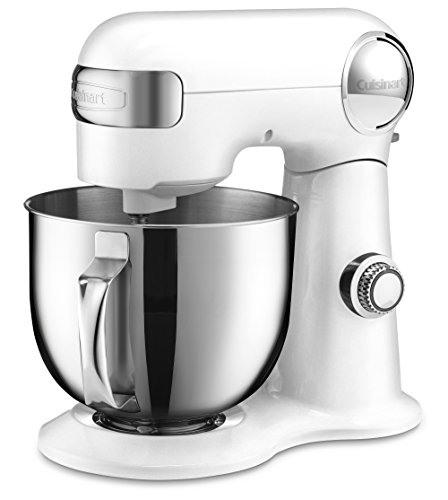
This is Cuisinart’s main stand mixer, the SM-50, in White Linen. The listing gives it a 5.5-quart polished stainless steel bowl, a 500-watt motor, die-cast metal construction and 12 speeds. The head tilts back, and a power outlet on the front takes optional attachments: a pasta extruder, pasta roller and cutters, an ice cream maker, a meat grinder and a spiralizer.
A chef’s whisk, a dough hook, a flat mixing paddle and a splash guard with a pour spout come in the box. PureWow’s tester found it did very well with cookies, cakes and frostings, and its dial easy to adjust. With heavy bagel dough it bucked and shook, so keep a hand nearby and run stiff doughs at the speeds the manual gives.
The listing states a limited 3-year warranty, three times the KitchenAid’s. PureWow also notes that the head may need a small screw adjustment out of the box so the beater reaches the bottom of the bowl.
Why we like it
- 5.5-quart bowl (listing)
- 500-watt stated motor and 12 speeds
- Splash guard with pour spout included
- Limited 3-year warranty (listing)
Key specifications
| Model | SM-50NAS |
|---|---|
| Bowl capacity | 5.5 quarts, stainless steel |
| Motor (stated) | 500 watts |
| Design | Tilt-head |
| Speeds | 12 |
| Attachments included | Chef’s whisk, dough hook, flat paddle, splash guard |
| Warranty | Limited 3 years (listing) |
Why we recommend it
It suits a baker who makes cakes, cookies and frostings in generous batches and wants a full-size bowl and a long warranty for less than a KitchenAid Artisan.
Skip it if you knead stiff bread or bagel dough every week; PureWow found the heavier KitchenAid steadier there.
Pros and cons
Pros
- Larger bowl than the Artisan
- More speeds
- Long warranty
Cons
- Bucks and shakes with heavy dough (PureWow)
- Head height may need adjusting
- Fewer attachments and colors than KitchenAid

KitchenAid and Cuisinart mixer questions, answered
Is Cuisinart as good as KitchenAid?
For cakes, cookies and frostings, very nearly, with a bigger bowl and a longer warranty. For heavy bread and bagel dough, PureWow found the KitchenAid Artisan steadier. Top Ten Reviews also puts KitchenAid ahead on mixing performance.
Do KitchenAid attachments fit a Cuisinart mixer?
We found no statement from either maker that they do. Cuisinart sells its own attachments for the SM-50’s power outlet, so buy those rather than assuming a KitchenAid tool will fit.
Which brand has the better warranty?
Cuisinart. Its listing states a limited 3-year warranty on the SM-50, while KitchenAid’s listings give its tilt-head mixers 1 year.
Is a higher wattage always better?
No. Watts are what a motor draws, not how well it kneads. The Cuisinart’s 500 watts beat the Artisan’s 325 on paper, yet the heavier KitchenAid was steadier with stiff dough in PureWow’s head-to-head.
Our final word on KitchenAid and Cuisinart
For most people who bake a few times a month, the Cuisinart is the better buy: a larger bowl, more speeds and three years of cover. If you bake bread every week, want the attachments, or want a smaller or larger machine than 5.5 quarts, KitchenAid is still the brand to beat. Our stand mixer vs hand mixer comparison helps if you are still deciding whether you need one at all, and our cheap stand mixer guide covers lower-cost options.
And when you would rather leave the baking to someone else, see the menu or call to order.