A mandoline is the fastest way to get thin, even slices of onion, radish or potato, and it is also one of the few kitchen tools with a reputation for taking the tip off a finger. Plenty of cooks own one and leave it in the drawer for that reason. Others simply do not have room for another single-purpose gadget.
This guide covers the mandoline alternative worth reaching for, depending on what you slice and how much. Some get close to a mandoline’s thinness, some are safer, and some are faster for big batches. For each, we say plainly how well it does the job and where it falls short.
Julia’s earns a commission on purchases made through links on this page, at no cost to you. Recommendations are based on what a restaurant kitchen looks for, product specifications and verified buyer reports.
Why cooks look for something other than a mandoline
- Cuts. America’s Test Kitchen, in a 2019 review of cut-resistant gloves, says people commonly slice “a fingernail (or worse)” on a mandoline, and that “injuries are possible even for the most careful or experienced cooks.” Its 2025 mandoline review adds that most mandoline hand guards are weak.
- Storage and cleaning. A full-size mandoline is awkward to store, and the blade has to be washed carefully by hand. America’s Test Kitchen advises hand washing mandoline blades so they keep their edge.
- Batch size. For two radishes, getting the mandoline out is more work than the slicing. For ten pounds of potatoes, a machine is quicker.
- Different shapes. Julienne and ribbons can come from other tools, often more safely.
It is worth being honest about what you give up. The same mandoline review says a mandoline lets you slice “much more precisely, consistently, and quickly than you could with a chef’s knife.” None of the tools below matches a good mandoline for paper-thin, even slices at speed. If that is what you need, our best mandoline slicer guide covers the safest and sharpest ones, and a cut-resistant glove makes any of them safer.
Quick verdict: the best mandoline alternative
For most cooks, the best mandoline alternative is a sharp vegetable knife, such as the Shun Classic Hollow-Edge Nakiri: with a little practice it gives thin, even slices of onion, radish and cucumber, and it does every other vegetable job too. For big batches, a KitchenAid 9-Cup food processor with its slicing discs is faster than either, though not as thin. If you want your hands nowhere near a blade, the Presto Professional SaladShooter slices and shreds straight into the bowl. For julienne, use the Microplane Julienne slicer or a Zyliss julienne peeler, and for thin ribbons, a KitchenAid Y peeler.
Five ways to slice without a mandoline, side by side
Our five standout picks, one per job, with the cuts and settings each maker or listing states. All six tools are reviewed in full below.
| Tool | Cuts | Best for | Hands near the blade? | Buy on Amazon |
|---|---|---|---|---|

Shun Classic Hollow-Edge Nakiri KnifeBest overall
|
Any thickness you can cut | Everyday vegetable slicing | Yes; use a claw grip | View on Amazon |

KitchenAid 9-Cup Food ProcessorBest for big batches
|
Medium and thick slices, shreds | Potatoes, cabbage, cucumbers in bulk | No; food goes down a feed tube | View on Amazon |

Presto Professional SaladShooterBest electric slicer
|
Thick, ripple, two shreds | Slicing straight into a bowl | No; food guide pushes it in | View on Amazon |

Microplane Julienne Professional SlicerBest for julienne
|
Julienne strips | Carrots, jicama, cabbage | Yes; glove advised | View on Amazon |

KitchenAid Y PeelerBest for ribbons
|
Thin ribbons and shavings | Cucumber, zucchini, carrot ribbons | Little; blade faces away | View on Amazon |
Which tool matches which mandoline job
- Thin rounds and half-moons (onion for pickling, radishes, cucumbers): a sharp knife with a straight edge. Slower than a mandoline, but it gets close with practice.
- Thick slices in volume (potatoes for a gratin, cabbage, a tray of cucumbers): a food processor slicing disc or an electric slicer.
- Julienne (carrot or jicama for slaw, toppings for tostadas): a julienne slicer or julienne peeler. America’s Test Kitchen says julienne peelers cut “crisp, uniform” strips and are only “slightly slower than mandoline when making large quantities.”
- Ribbons (cucumber or zucchini for salads): a sharp Y peeler.
- Waffle and crinkle cuts: the SaladShooter’s ripple cone is the closest option here.
Six tools to use instead of a mandoline
1. Shun Classic Hollow-Edge Nakiri Knife – A Vegetable Blade for Thin, Straight Cuts
The most useful mandoline alternative is a knife you trust, and a nakiri is the knife shape built for vegetables. America’s Test Kitchen describes nakiris as made for “slicing, dicing, and chopping vegetables,” with a straight edge that suits “simple push or pull cuts instead of rocking the blade.” That straight, flat edge meets the board along its whole length, which is what you want for clean, thin slices of onion or radish.
This Shun Classic nakiri has a VG-MAX steel core with Damascus cladding, a 16-degree edge and a D-shaped Pakkawood handle that the listing says suits left- and right-handed cooks. It is handcrafted in Japan, carries a limited lifetime warranty and comes with free sharpening and honing from Shun. The hollow-edge scallops along the blade are meant to help slices fall away; that is general kitchen sense about the design, not a Shun claim. The listing is inconsistent on size: the title says 5 inches and a bullet says 5.5 inches, so check the blade length on the listing before you buy. America’s Test Kitchen recommends the Shun Classic 6.5-inch nakiri; it did not review this hollow-edge version.
Two honest limits. A knife will never be as fast or as uniform as a mandoline for a big pile of paper-thin slices; it takes practice and a claw grip, with fingertips tucked. And America’s Test Kitchen warns that a nakiri “should not be used to hack, twist, or force its way through tough or hard food, or it will chip.” Keep it for vegetables and herbs, not winter squash rinds or bones.
Why we like it
- Straight edge for push and pull slicing
- 16-degree edge, VG-MAX core, per the listing
- Handcrafted in Japan, per Shun
- Limited lifetime warranty with free sharpening
Key specifications
| Model | DM0742 |
|---|---|
| Type | Nakiri (vegetable) knife |
| Cuts | Slices, dice, chops at any thickness |
| Thinnest stated cut | Not applicable; depends on the cook |
| Blade | VG-MAX core, Damascus cladding; 5 or 5.5 in (listing unclear) |
| Power | Manual |
| Cleaning | Not stated in the listing; hand wash is general practice for fine knives |
| Warranty | Limited lifetime; free sharpening and honing |
Why we recommend it
It suits cooks who slice vegetables most days and would rather build one skill than store one more gadget.
Skip it if you need a pile of identical paper-thin slices fast; that is still a mandoline’s job.
Pros and cons
Pros
- Does every vegetable job
- Very sharp edge
- Free sharpening from Shun
Cons
- Takes skill to slice thin
- Can chip on hard foods
- Listing unclear on length
2. KitchenAid 9-Cup Food Processor – Two Slicing Discs for Big Batches
If you slice in volume, a food processor is the better alternative: you feed vegetables down a tube and your hands stay well away from the disc. The KitchenAid KFP0918 comes with a 9-cup work bowl, a multi-purpose blade, a reversible medium slicing and shredding disc, and a thick slicing disc, per the listing. A 2-in-1 feed tube takes whole cucumbers and potatoes or narrower items.
Controls are three paddles: high, low and pulse. KitchenAid says every blade and disc stores inside the bowl, which deals with the usual processor complaint about loose parts. For cleaning, the listing suggests adding warm water and a drop or two of dish soap to the bowl and running it.
The trade-off is thickness. This model has medium and thick slicing only; there is no thin disc in the box, so you will not get the near-transparent slices a mandoline makes. For potatoes, cabbage for slaw, cucumbers and onions for cooking, medium is fine. If you want a processor to replace a mandoline for thin slices, look for a model with an adjustable or thin slicing disc; our best food processor guide covers those. Note that this listing’s lead offer is from a third-party seller, sold as new.
Why we like it
- Two slicing options plus a shredding side
- All blades and discs store in the bowl
- 2-in-1 feed tube for different shapes
- Three speeds: high, low and pulse
Key specifications
| Model | KFP0918CU |
|---|---|
| Type | Food processor |
| Cuts | Medium and thick slices, shreds, chopping |
| Thinnest stated cut | Medium slicing disc |
| Blade | Multi-purpose blade, reversible medium disc, thick slicing disc |
| Power | Electric; wattage not stated in the listing |
| Cleaning | Leak-resistant bowl; maker suggests warm water and soap |
| Warranty | 1 year |
Why we recommend it
It suits cooks who slice a lot at once, for scalloped potatoes, slaw or pickles, and who would also use a processor for chopping and shredding.
Skip it if you want paper-thin slices; there is no thin disc included.
Pros and cons
Pros
- Fast for big batches
- Hands stay clear
- Also chops and shreds
Cons
- No thin slicing disc
- Bulky to store
- Third-party seller
3. Presto Professional SaladShooter – Slices Straight Into the Bowl
The SaladShooter is a handheld electric slicer and shredder that sits between a mandoline and a food processor. You drop food into the chamber, push it down with the food guide, and slices come out of the front straight into a bowl or onto a pan. Per the listing, the Professional model comes with four interchangeable cones: thick slices, ripple slices, medium shreds and super shreds, plus a funnel guide.
Presto lists jobs from thick apple slices and medium shreds for hash browns to super shreds for coleslaw and ripple slices for vegetable trays, and also cheese for tacos, crumbs, chopped nuts and grated chocolate. The adjustable food guide adapts to large and small loads. The base wipes clean and everything else is dishwasher safe, per the listing, and the warranty is one year.
Its limit, again, is thinness. There is no thin slicing cone in the list, so it will not give you paper-thin radishes or onion for pickling. What it does give you is volume without your hands near a blade and without assembling a full processor, which is the reason many cooks choose it.
Why we like it
- Four cones: thick, ripple, medium shred, super shred
- Slices straight into any bowl
- Parts dishwasher safe; base wipes clean
- Small enough to store almost anywhere, per Presto
Key specifications
| Model | 02970 |
|---|---|
| Type | Electric slicer and shredder |
| Cuts | Thick slices, ripple slices, medium and fine shreds |
| Thinnest stated cut | Thick slicing cone only (no thin cone listed) |
| Blade | Four interchangeable cones |
| Power | Electric; wattage not stated in the listing |
| Cleaning | Base wipes clean; other parts dishwasher safe |
| Warranty | 1 year limited |
Why we recommend it
It suits cooks who mainly want a mandoline for volume and safety, and who are happy with thick or ripple slices and shreds.
Skip it if thin slices are the whole point; it has no thin slicing cone.
Pros and cons
Pros
- Hands stay clear of blades
- Slices and shreds
- Smaller than a processor
Cons
- No thin slices
- Needs a plug
- Small food chamber for big items
4. Microplane Julienne Professional Slicer – Long Strips From a Handheld Frame
Many mandolines are bought for julienne, and this Microplane does that one cut in a simpler, flatter tool. It is a handheld frame with razor-sharp stainless steel julienne blades, a soft-touch handle and a non-slip rubber foot, per the listing. You rest the foot on a board or bowl and draw the vegetable down the blades. Microplane names potatoes, apples, carrots, courgettes and red cabbage as ideal foods.
For a Mexican kitchen that means carrot and jicama strips for slaws and tostadas, or apple for a salad. It is dishwasher safe and comes with a protective case for the blades, per the listing. The listing does not state the strip size.
Treat it with the same care as a mandoline: your hand moves toward the blades on every stroke. America’s Test Kitchen, writing about julienne peelers, suggests a cut-resistant glove on the hand holding the vegetable, and the same habit makes sense here. Stop when the piece gets short. The listing’s lead offer is sold by Amazon Germany, an Amazon entity, as new.
Why we like it
- Razor-sharp stainless julienne blades, per Microplane
- Non-slip rubber foot for stability
- Protective case included
- Dishwasher safe
Key specifications
| Model | 45041 |
|---|---|
| Type | Handheld julienne slicer |
| Cuts | Julienne strips |
| Thinnest stated cut | Strip size not stated |
| Blade | Stainless steel julienne blades |
| Power | Manual |
| Cleaning | Dishwasher safe |
| Warranty | Not stated |
Why we recommend it
It suits cooks who mainly use a mandoline for julienne and want a flat tool that slips into a drawer.
Skip it if you want plain slices too; it only cuts strips.
Pros and cons
Pros
- Quick, even strips
- Flat and easy to store
- Comes with a blade case
Cons
- Julienne only
- Hand moves toward the blades
- Strip size not stated
5. Zyliss Julienne Y Peeler – Strips for Garnish in Seconds

A julienne peeler is the smallest and simplest way to get strips without a mandoline. It looks like a Y peeler, but the blade has teeth that cut the vegetable into strips as you draw it along. The Zyliss model has an extra-hardened steel blade that Zyliss says stays sharp, a built-in eye cutter and an ergonomic grip, per the listing, and Zyliss lists a five-year warranty.
America’s Test Kitchen’s 2025 julienne peeler review did not include this Zyliss, but its findings apply to the type: julienne peelers are cheap, small and quick, cut “crisp, uniform” strips, take seconds to clean, and are only “slightly slower than mandoline when making large quantities.” The review also notes they can be dangerous and suggests a cut-resistant glove on the hand holding the vegetable.
Use it for carrots, zucchini and cucumber, a garnish for tacos or a quick slaw. The listing says it is dishwasher safe but recommends hand washing to keep the blade sharp. Zyliss also sells a wheat-straw-handled julienne Y peeler under a different model number; this is the white and orange version.
Why we like it
- Extra-hardened steel blade, per Zyliss
- Built-in eye cutter
- Five-year warranty, per the listing
- Tiny; lives in a utensil drawer
Key specifications
| Model | E950019U |
|---|---|
| Type | Julienne Y peeler |
| Cuts | Julienne strips; peels |
| Thinnest stated cut | Strip size not stated |
| Blade | Extra-hardened steel |
| Power | Manual |
| Cleaning | Dishwasher safe; hand wash recommended |
| Warranty | 5 years |
Why we recommend it
It suits cooks who want julienne for a garnish or a small salad and do not want a second slicing tool.
Skip it if you make julienne by the pound; a slicer or a mandoline is faster.
Pros and cons
Pros
- Small and simple
- Long warranty
- Peels too
Cons
- Slow for big batches
- Not independently reviewed
6. KitchenAid Y Peeler – Thin Ribbons With a Straight Blade
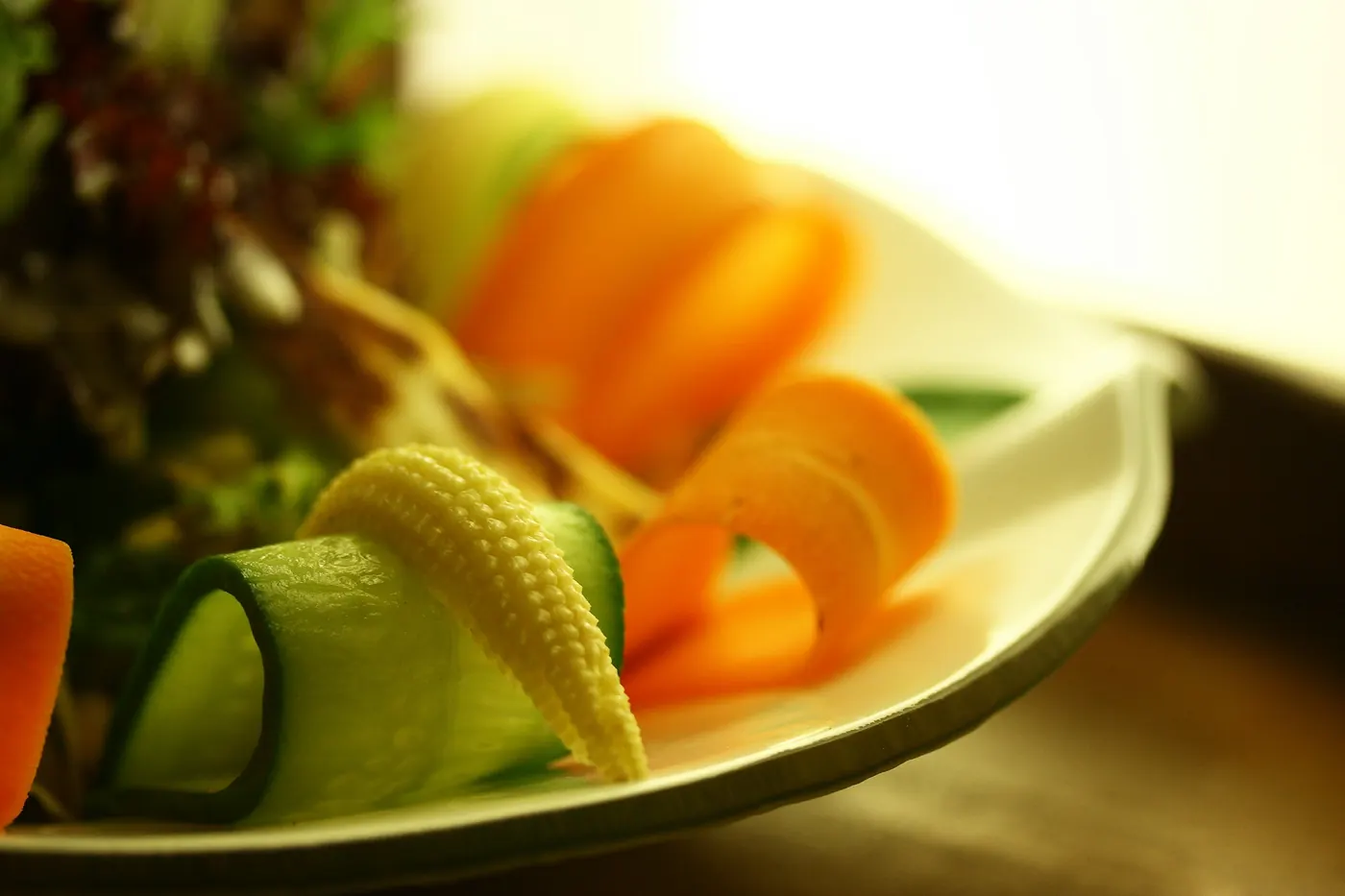
For very thin slices of a long vegetable, a sharp Y peeler is an underrated mandoline stand-in. Drawn the length of a cucumber, zucchini or carrot, it makes ribbons thin enough to see through, which is general kitchen sense rather than a maker claim. The KitchenAid Y peeler has a single-edge straight blade of 420 stainless steel that KitchenAid says is rust resistant and suits soft-skinned produce too.
The listing describes a balanced ABS handle with a chrome-plated bolster, a protective plastic blade cover, dishwasher-safe construction and a lifetime limited warranty with a one-year replacement promise. Because the blade faces away from the hand holding the vegetable, your fingers are further from the edge than on a mandoline.
It only makes ribbons, and only from vegetables long and firm enough to hold. For rounds of onion or radish, you still need a knife. Lay the vegetable flat on a board and peel away from you for the most even ribbons.
Why we like it
- Straight 420 stainless blade, per the listing
- Blade cover included
- Dishwasher safe
- Lifetime limited warranty
Key specifications
| Model | KE145OHOBA |
|---|---|
| Type | Y peeler |
| Cuts | Peels, ribbons, shavings |
| Thinnest stated cut | Not stated |
| Blade | Single-edge straight 420 stainless steel |
| Power | Manual |
| Cleaning | Dishwasher safe |
| Warranty | Lifetime limited; 1-year replacement |
Why we recommend it
It suits cooks who want thin ribbons for salads and garnishes and already need a peeler anyway.
Skip it if you need rounds or julienne; it only peels and ribbons.
Pros and cons
Pros
- Very thin ribbons
- Fingers away from the edge
- Blade cover and long warranty
Cons
- Ribbons only
- Needs long, firm vegetables
Slicing thin with a knife: what helps
Most of the gap between a knife and a mandoline is technique, and a few habits close it. This is general kitchen sense, not a maker’s instruction.
- Make a flat side first. Cut a thin slice off a round onion, potato or radish and set it on that face so it cannot roll.
- Use a claw grip. Curl your fingertips under and let your knuckles guide the side of the blade.
- Let the blade do the work. Push or pull the knife through in one smooth stroke rather than pressing straight down.
- Keep it sharp. A dull edge skids on onion skin and crushes tomatoes. America’s Test Kitchen makes the same point about peelers: sharp blades “bite in exactly where you want them and don’t skid off to cut you.”
If you decide you do want a mandoline after all, wear a cut-resistant glove. America’s Test Kitchen reminds readers that such gloves are “cut-resistant but not cut-proof,” so they are extra insurance, not permission to rush.
How we chose these six tools
We started from the jobs people buy a mandoline for, thin slices, volume slicing, julienne and ribbons, and looked for a tool from a known maker that does each one without a mandoline’s open blade, or with less of it. Every pick was listed in stock and sold new when we checked. We used each maker’s specifications from the Amazon listing and America’s Test Kitchen’s reviews of mandolines, nakiri knives, julienne peelers and cut-resistant gloves, and we say where a review did not cover the exact model. We did not use these products in our kitchen for this guide. We also searched the U.S. Consumer Product Safety Commission’s recall database for each brand and found no recall listed for any of these six models.
Mandoline alternative questions, answered
How do you slice thin without a mandoline?
Use a sharp, straight-edged knife such as a nakiri, cut a flat side on the vegetable so it sits still, and slice with a smooth push or pull stroke while your fingertips stay tucked in a claw grip. For long vegetables, a Y peeler makes even thinner ribbons.
Can a food processor replace a mandoline?
For volume, yes; for paper-thin slices, usually not. A processor’s slicing disc is fast and keeps your hands clear, but the thinnest disc on many models, including the KitchenAid 9-cup on this page, is thicker than a mandoline’s thinnest setting. Check which discs come in the box.
Is a mandoline more dangerous than a knife?
Both can cut you. America’s Test Kitchen notes that cooks often catch a fingertip or nail on a mandoline and that “injuries are possible even for the most careful or experienced cooks.” With a knife, a claw grip keeps fingertips behind the blade. A cut-resistant glove reduces the risk with either tool.
What is the best tool for julienne without a mandoline?
A julienne peeler for small amounts, or a handheld julienne slicer like the Microplane for more. Our best julienne peeler guide compares more options.
What knife is best for slicing vegetables thin?
A knife with a straight, flat edge, such as a nakiri, is easiest for thin push cuts. A chef’s knife works too once you are used to it. Our best nakiri knife guide covers more vegetable knives.
Our final word on slicing without a mandoline
For most kitchens, a sharp vegetable knife and a little practice replace a mandoline for everyday slicing, a processor or SaladShooter covers big batches, and a julienne tool and a Y peeler handle strips and ribbons. If you need perfect paper-thin slices fast, a mandoline is still the tool, and our guide to the best mandoline slicer covers the safest ones. For a smaller budget, see the best value mandoline slicer guide.
And if you would rather someone else did the slicing tonight, see the menu or call to order.