
Stemmed and stemless wine glasses hold the same wine. What changes is where your hand goes, how the glass stands on the table, how it fits in a cabinet and how it survives the dishwasher. None of that is about taste in the narrow sense, but all of it decides which set you reach for on a weeknight and which one stays boxed until a holiday.
This guide compares the two shapes on temperature, stability, breakage, cleaning, storage and use around food, using what wine writers and glass makers say rather than marketing copy. Then it names one stemmed and one stemless set from the same maker, with the same 16-ounce capacity, so the comparison stays fair.
Julia’s earns a commission on purchases made through links on this page, at no cost to you. Recommendations are based on what a restaurant kitchen looks for, product specifications and verified buyer reports.
Quick verdict: stem or no stem?
Buy stemmed glasses if you drink mostly chilled white or rosé, like to swirl, or want the glass that wine writers and Riedel itself treat as the standard for paying attention to wine. Buy stemless if your wine is mostly red, poured at casual meals, on a patio or at a crowded table, and you value a glass that is harder to knock over, easier to store and less likely to snap in the dishwasher. If you can only own one set and you drink both colors, stemmed is the safer all-round choice; stemless is the better second set for everyday and outdoor use.
The table sums up the trade-offs. The sections after it explain each one and where the evidence comes from.
Stemmed vs stemless wine glasses, side by side
| Stemmed glass | Stemless glass | |
|---|---|---|
| Where your hand goes | On the stem, away from the bowl | On the bowl |
| Effect on wine temperature | Little warming from your hand (Wine Enthusiast) | Your hand can warm the wine; matters most for whites |
| Best suited to | Chilled whites, rosé, careful tasting | Reds, casual meals, patio and picnic use |
| Stability | Taller, top-heavy when full | Low and wide; Riedel’s O tumblers rock back upright when tipped |
| Weak point | The stem, which restaurants complain about breaking | Fingerprints on the bowl |
| Storage | Needs tall shelf space | Fits low cabinets; some sets stack |
| Dishwasher | Often safe, but tall stems need a secure place | Usually simpler to load |
Temperature: what your hand does to the wine
This is the argument for the stem, and it is a real one. Wine Enthusiast explains that a longer stem lets you keep your hand away from the bowl, which prevents the wine warming from body heat. It adds that white wine glasses usually have longer stems than red ones for exactly that reason: whites are more sensitive to temperature and are served below room temperature.
How cold is cold? Wine Spectator’s Dr. Vinny suggests whites show their best at about 40 to 50°F and reds at around 60 to 65°F. A chilled white starts well below the temperature of your palm, so a hand wrapped around the bowl pushes it toward room temperature faster than the air alone would. A red is already near its serving range, so the same hand does less harm. Wine Enthusiast makes the same point the other way round: red wine suits stemless glasses because the warmth of your hand is less likely to change it.
Dr. Vinny also notes that a wine served too cold is easy to fix by warming the glass in your hands or waiting a few minutes. That is the one time a stemless bowl is an advantage: if a red has come out of a cool cellar or a wine fridge a little too cold, cupping a tumbler brings it up.
In Houston, where a patio in July is warmer than any wine should be, the gap matters more than the charts suggest. If you pour white wine outside, a stem, small pours and a bottle kept in a wine chiller between glasses all help. If you pour red, a stemless glass is fine.
Stability and breakage: the case for no stem
A stemmed glass carries its weight high, on a thin column, above a small foot. Full of wine, it is easy to catch with an elbow or a serving dish, and the stem is the part that snaps. When Riedel launched its stemless O series, Wine Spectator reported that the company pitched it partly at restaurant owners who complain about broken stems and short storage space. Riedel also said the tumblers wobble back upright when tipped over, and suggested them for the poolside, a boat or a picnic.
That matches what any busy table shows. A low, wide glass on a crowded table of tacos, salsas and shared plates is simply harder to knock over than a nine-inch stem. It is also easier to hand to a guest, and it can’t break at the stem because it has none. Our best stemless wine glasses guide picks tumblers with this kind of use in mind.
The stemless glass still breaks if you drop it, and a thin bowl can crack in a sink. The difference is that it removes the most fragile part of the glass. Makers know where the risk sits: Libbey’s rim guarantee covers chipped rims on its Vina glasses but, in Libbey’s words, does not cover breakage.
Swirling, aroma and the look of the wine
Wine Spectator noted that most serious wine drinkers hold and swirl a glass by the stem, which keeps greasy fingerprints off the bowl and stops the wine warming above its target temperature. Riedel itself told the magazine that its tumblers aren’t meant to replace stemware for serious wine drinkers all the time. Wine Enthusiast adds that a large, rounded red-wine bowl lets more air reach the wine and makes its color easier to see as you swirl.
Stemless glasses keep the bowl shape. Wine Enthusiast describes stemless whites as smaller and narrower and stemless reds as keeping the large open bowl, so the aroma side of the argument is mostly about the bowl, not the stem. What you lose is a clean view of the wine and an easy swirl. You can swirl a tumbler on the table, but a fingerprinted bowl is not the place to judge color.
For a weeknight glass of red with dinner, none of that matters much. If you open a bottle to taste it carefully, or you are pouring for people who will, stemware is the better tool.
Cleaning and the dishwasher
Both shapes can be dishwasher safe; check the maker, not the shape. Libbey rates its Vina stemmed glasses dishwasher safe and asks you to wash them before first use, and its stackable stemless set is listed as dishwasher safe too. The practical difference is loading. A tall stemmed glass needs room on the top rack and can knock against its neighbors when the spray arms run, and the stem is where a glass under stress gives way. A tumbler sits low among the cups.
Hand washing is kinder to either shape. If you do wash stemware by hand, hold it by the bowl rather than twisting the bowl against the stem, and dry it with a lint-free cloth. A stemless bowl will show fingerprints sooner, so expect to polish it more often if you care how the table looks.
Storage and everyday use
Storage is the quiet reason many kitchens go stemless. Maximilian Riedel told Wine Spectator that anyone who lives in a small apartment knows cabinet space is in demand, and that he wanted a tumbler he could drink water, wine and then a cocktail from. A stemless glass fits a standard cabinet shelf, some sets are made to stack, and the same glass can serve water, agua fresca or a spritz.
Stemmed glasses need taller shelf space or a hanging rack. In return they look like wine glasses, which still matters for a holiday table or a gift. If you want a separate set for cocktails, our best cocktail glasses guide covers shapes made for them.
Pour size: the same in either glass
A big bowl is air space, not a serving size. The US National Institute on Alcohol Abuse and Alcoholism defines one standard drink as 5 fluid ounces of table wine at about 12% alcohol, and notes that standard drink amounts may not match the servings people actually pour. Both glasses on this page hold about 16 ounces to the brim, so a normal pour fills only part of the bowl. Pour with that in mind, offer water and food alongside wine, and never drink and drive.
Choose stemmed if… / Choose stemless if…
Choose stemmed wine glasses if…
- You drink mostly chilled white, rosé or sparkling wine
- You like to swirl and look at the wine, or you host people who do
- You want one set that looks right at a formal or holiday table
- You have tall cabinet space or a rack
Choose stemless wine glasses if…
- You drink mostly red, poured with everyday meals
- Your table is crowded, you have children around, or you pour outdoors
- Cabinet space is short, or you want a glass for water and cocktails too
- You have lost too many stems in the dishwasher
Our pick on each side of the stemmed vs stemless wine glasses choice
One set per side, both from Libbey and both rated at 16 ounces, so the only real difference between them is the stem. Both are plain glass rather than crystal. Both were in stock with a new offer sold by Amazon when we checked, and neither listing appears on our other pages. For crystal stemware and more shapes, see our best wine glasses guide.
1. Libbey Vina Tall Wine Glasses, 16 oz, Set of 12 – A Tall Stem for Chilled Wine

This is the stemmed side of the choice in a plain, all-purpose form: a tall glass with a long stem and a bowl shaped for any varietal, sold as a set of twelve. Libbey lists the Vina Tall at 16 ounces, 3.5 inches across and 9 inches tall, and describes it as an all-purpose shape suited to red, white or rosé.
The long stem is the point. It keeps your hand well away from the bowl, which is what you want for a white poured cold from the fridge. Twelve glasses is enough for a family dinner or a small party, and the plain shape works for a weeknight red as well as a holiday white.
Libbey’s page says the glasses are made lead-free in the United States and are dishwasher safe, and asks you to wash them before first use. Its Safedge rim guarantee covers a chipped rim but, Libbey says, not breakage, so treat the stems with the usual care: give them a secure place on the top rack and don’t twist bowl against stem when you dry them.
Why we like it
- Long stem keeps your hand off the bowl
- Made lead-free in the USA, per Libbey
- Dishwasher safe, per Libbey
- Twelve glasses in one set
Key specifications
| Model | 7510 (Vina) |
|---|---|
| Style | Stemmed, all-purpose |
| Capacity | 16 oz (Libbey) |
| Size | 3.5 in wide x 9 in tall (Libbey) |
| Count | 12 |
| Material | Glass, made lead-free (Libbey) |
| Dishwasher | Safe (Libbey) |
| Made in | USA (Libbey) |
Why we recommend it
It suits a household that pours white and rosé as often as red and wants one simple stemmed set for both, with enough glasses for guests.
Skip it if your cabinets are short or your table is usually crowded with children and shared plates; a nine-inch stem is the easiest glass to knock over.
Pros and cons
Pros
- Keeps chilled wine cooler in the hand
- Plain shape for any varietal
- Rim chip guarantee from Libbey
Cons
- Nine inches tall, needs shelf height
- Guarantee does not cover breakage
- Glass, not thin crystal
2. Libbey Stackable Stemless Wine Glasses, 16 oz, Set of 6 – Stacks Low, Stands Steady
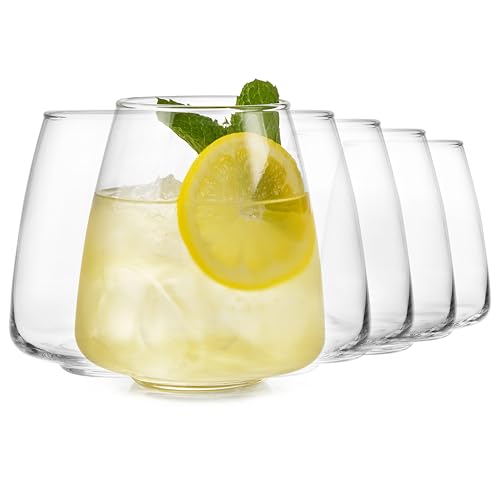
This is the stemless side at the same 16-ounce capacity: a tapered, bulb-shaped tumbler with a base designed to stack, sold as a set of six. The listing describes it as soda lime glass, dishwasher safe, and an all-purpose shape for red or white wine, cocktails or water.
It is the glass for a weeknight red with enchiladas, a pitcher of sangria on the patio or a table where plates are passed hand to hand. The low shape is harder to tip than a tall stem, and stacking means six glasses take up the cabinet space of a few. Like every tumbler, it lets your hand warm the wine, so pour whites in small amounts and keep the bottle cold between glasses.
Care is simple: the listing says it can go in the dishwasher. A stemless bowl shows fingerprints, so expect to polish it before guests arrive. When stacking, keep the glasses dry and don’t force one into another, a general rule for stacked glassware.
Why we like it
- Same 16-ounce capacity as the stemmed pick
- Stackable base for small cabinets
- Dishwasher safe, per the listing
- Works for wine, cocktails and water
Key specifications
| Model | 571 |
|---|---|
| Style | Stemless, tapered bulb, stackable |
| Capacity | 16 oz (listing) |
| Size | Not stated |
| Count | 6 |
| Material | Soda lime glass (listing) |
| Dishwasher | Safe (listing) |
| Made in | Not stated |
Why we recommend it
It suits a cook who mostly pours red with everyday meals, eats outside or has little cabinet space, and wants one glass for wine and everything else.
Skip it if you drink mostly chilled whites; your hand on the bowl will warm them faster than a stem would.
Pros and cons
Pros
- No stem to snap
- Stacks to save space
- Low and steady on a busy table
Cons
- Hand warms chilled wine
- Shows fingerprints
- Height and origin not stated on the listing
How we compared the two shapes
We read what wine writers say about stems and temperature (Wine Enthusiast, and Wine Spectator’s Dr. Vinny for serving temperatures), Wine Spectator’s report on the launch of Riedel’s stemless O series for the maker’s own view of stability, storage and limits, and the NIAAA’s definition of a standard drink. For the picks we chose one maker and one capacity on both sides, read Libbey’s own page for the stemmed set, and used the Amazon listing for the stemless set. We did not handle these glasses ourselves, and we have left out crystal sets whose makers’ lead statements we could not read directly.
Stemmed and stemless glass questions, answered
Are stemless wine glasses bad for wine?
No. They keep the bowl shape that matters for aroma. The main drawback is that your hand warms the wine, which Wine Enthusiast says matters most for whites served below room temperature.
Why do wine glasses have stems?
So you can hold the glass without warming the wine, swirl it easily and see it clearly. Wine Enthusiast notes that white wine glasses usually have longer stems for this reason.
Are stemless glasses better for red wine?
They suit it well. Red is served closer to room temperature, about 60 to 65°F by Dr. Vinny’s guide, so the warmth of your hand changes it less.
Do stemless wine glasses break less?
They can’t break at the stem, which is the weak point of stemware, and a low glass is harder to knock over. Riedel said its O tumblers rock back upright when tipped. A dropped tumbler will still break.
Can I use stemless wine glasses for white wine?
Yes, with small pours. Hold the glass near the base, drink it while it is cold, and keep the bottle in the fridge or a chiller between glasses.
Our final word on stems
The stem earns its place with chilled whites and careful tasting. The stemless glass earns its place everywhere else: weeknight reds, crowded tables, the patio and small kitchens. Most homes that drink wine regularly end up with both, and if you are starting from nothing, start with whichever matches the wine you pour most often.
For more choices, see our best white wine glasses and best Libbey glassware guides. And if you would rather someone else cooked the enchiladas to go with that glass, see the menu or call to order.