Once you have decided on a stand mixer, the next fork in the road is the shape of the machine. On a tilt-head mixer the motor head hinges up and back so you can reach the bowl. On a bowl-lift mixer the head stays put and a lever raises the bowl up to the beater. Both mix, whip and knead with the same kinds of attachments, but the design changes how big the bowl gets, how tall the mixer stands and how it copes with stiff dough.
For a Mexican home kitchen the question usually comes down to two kinds of baking. A weekly cake, a batch of polvorones or whipped cream for tres leches is one kind. Holiday tamales for a crowd, a double batch of bolillo dough or conchas every weekend is the other. This guide compares the two designs on access, capacity, height, stiff dough, attachments and cost, using maker listings and a named review, then gives a pick for each side.
Julia’s earns a commission on purchases made through links on this page, at no cost to you. Recommendations are based on what a restaurant kitchen looks for, product specifications and verified buyer reports.
Quick verdict: tilt-head or bowl-lift?
For most home bakers, a tilt-head is the better choice. It is shorter, so it fits under most wall cabinets, the bowl is easy to reach for scraping and adding ingredients, and a 5-quart bowl covers cakes, cookies and a normal loaf of bread. Choose a bowl-lift if you regularly make big batches or stiff dough, such as several loaves at once or masa for dozens of tamales, and you have the counter height and budget for a larger, heavier machine.
The table sums up the differences; each one is explained below.
Tilt head vs bowl lift stand mixer, side by side
| Tilt-head | Bowl-lift | |
|---|---|---|
| How you reach the bowl | Head hinges up and back | Head is fixed; a lever lowers the bowl |
| KitchenAid bowl sizes | 3.5, 4.5 and 5 qt (Prudent Reviews) | 4.5 up to 8 qt (Prudent Reviews) |
| KitchenAid height | About 14 in; Artisan Mini 12.3 in | About 16.4 to 17 in |
| Stiff dough and big batches | Fine for normal batches; the head can vibrate under heavy loads | Better suited to dense, large batches |
| Changing attachments | Easy with the head tilted back | A little fiddlier with the bowl lowered |
| Colors and bowl options | Many | Few |
| Cost | Lower | Higher |
How each design works
On a tilt-head mixer, a lever or button on the side unlocks the head so it can lift up and back; the bowl then twists onto a plate on the base. Prudent Reviews, which compared KitchenAid’s whole range, describes exactly this, and KitchenAid’s own listing for the Artisan says you can easily add ingredients with the tilt-head design because you have better access to the bowl, then lock the head in place while mixing.
On a bowl-lift mixer the head never moves. The bowl clips onto two arms, and a lever moves the bowl up to the beater and back down. Prudent Reviews sums it up: the head is stationary, and a lever allows you to move the bowl up and down. With the bowl held on both sides rather than twisted onto one plate, the machine is built for heavier work.
Not every tilt-head is the same. Smeg’s newer SMF05 Forte, one of our picks, uses a spring-assisted tilting head that Smeg says supports controlled opening and helps prevent accidental closure, which answers a common worry about heavy heads dropping.

Access: scraping, adding and pouring
This is the tilt-head’s everyday advantage. Tip the head back and the whole bowl is open: you can scrape the sides, check the dough with your fingers and lift the bowl straight out. Prudent Reviews notes that changing attachments is easier on a tilt-head for the same reason.
On a bowl-lift you lower the bowl to get at it, and with the bowl raised you add ingredients through the gap between the bowl rim and the head. Prudent Reviews calls changing attachments a little trickier on bowl-lift models. In general kitchen terms, a pouring shield helps on either type: KitchenAid includes one with both the Artisan and the 7-quart bowl-lift we pick below, and Smeg includes one with the Forte.
Capacity: how much each holds
Bowl size is where the designs split most clearly. Prudent Reviews lists KitchenAid’s tilt-head bowls at 3.5, 4.5 and 5 quarts, and its bowl-lift bowls at 4.5, 5, 6, 7 and 8 quarts, with the 8-quart bowl only on the Commercial model. So a tilt-head tops out around 5 quarts, while the bowl-lift range starts there and keeps going.
KitchenAid translates those sizes into food on its listings. The 5-quart Artisan listing says the bowl can mix up to 9 dozen cookies in a single batch. The 7-quart bowl-lift listing says it can mix 13 dozen cookies per batch, knead over 8.5 pounds of bread or mash over 7.5 pounds of potatoes. Both figures assume the flat beater and 28-gram balls of dough.
For most households, 5 quarts is plenty: a cake, a batch of cookies, a single or double loaf, or masa for a family meal. If your holiday tamalada means masa for a crowd, or you bake several loaves at once, the bigger bowl saves you mixing in rounds.
Height and counter space
Measure before you buy. Prudent Reviews gives KitchenAid’s tilt-head mixers as 14 inches tall, apart from the 12.3-inch Artisan Mini, and its bowl-lift mixers as 16.43 to 17 inches tall. Many kitchens have about 18 inches between the counter and the wall cabinets, which is a general building norm rather than a maker figure, so check your own space.
There is a catch for tilt-heads: the head needs room to lift. A 14-inch tilt-head may slide under the cabinets but still have to be pulled forward before you can open it. A bowl-lift is taller standing still but never gets taller in use, because the head doesn’t move. Either way, measure the gap and allow for the mixer’s full working height.
Weight matters if the mixer has to come out of a cupboard. Prudent Reviews says both types run to roughly 25 pounds depending on model, with bowl-lifts generally heavier because of bigger motors and bodies, and the Artisan Mini the lightest at 18 pounds. A mixer that lives on the counter gets used far more than one you have to lift down each time.
Stiff dough, power and stability
Prudent Reviews says the head of a tilt-head mixer can vibrate more under load, and that bowl-lift models handle denser mixes better. It also lists motor figures: 275 to 325 watts for KitchenAid’s Classic, Deluxe and Artisan tilt-heads, and 1.0 to 1.3 horsepower for its Professional, Pro Line and Commercial bowl-lifts. Treat watts as a rough guide; how a maker measures power and gears the motor matters as much as the number.
Not every tilt-head is light-duty, though. Smeg lists a 750-watt direct-drive motor for the Forte tilt-head and says it delivers high torque for kneading dense bread and pizza dough, with a built-in stability system to cut vibration. That narrows the gap for a home baker who wants a tilt-head’s access with more muscle.
In general kitchen terms, the dividing line is how often you knead stiff dough in large amounts. A tilt-head handles a normal loaf, pizza dough or concha dough. If you knead heavy, low-hydration dough or multiple loaves every week, the bowl-lift’s frame and bigger motor are the safer bet. Our best stand mixer for bread guide covers heavier machines in more detail.
Attachments, colors and cost
Prudent Reviews says KitchenAid’s power-hub attachments, such as the meat grinder, pasta roller and spiralizer, fit both types, so you don’t give up attachments by picking either. Bowls are a different story: tilt-head and bowl-lift bowls are not interchangeable, so buy spare bowls for the design you own. Our best KitchenAid mixer bowl guide sorts them by fit, and our stand mixer attachments guide covers the add-ons.
Tilt-heads win on choice. Prudent Reviews counts dozens of colors for the 5-quart Artisan and far fewer for bowl-lift models, which mostly come with stainless steel bowls. It also describes tilt-head models as significantly less expensive than bowl-lifts. If you will never fill a 7-quart bowl, most of that extra cost goes unused.
Choose a tilt-head if… / Choose a bowl-lift if…
Choose a tilt-head if…
- You bake cakes, cookies and the occasional loaf rather than big batches every week.
- Your wall cabinets are low or the mixer must live in a cupboard.
- You like to scrape the bowl, add ingredients and change beaters easily.
- You want a lower-cost mixer or a particular color.
Choose a bowl-lift if…
- You regularly bake several loaves or large batches of stiff dough.
- You make masa or cookie dough for a crowd and want a 6- to 7-quart bowl.
- You have the counter height and a permanent spot for a heavier machine.
- You want the most stable mixer for long kneading.

Our picks for the tilt head vs bowl lift stand mixer choice
Two tilt-heads and one bowl-lift, all in stock and sold new when we checked. The Smeg Forte appears on no other page of ours. The two KitchenAid models are other colors of mixers in our best stand mixer guide: the Artisan in Black Matte is included because it is the standard tilt-head that the comparison starts from, and the 7-quart bowl-lift in Pistachio because it is the bowl-lift that shows most plainly what the design adds. We found no other bowl-lift maker with a model in stock that we could recommend, which is why that side has one pick.
1. KitchenAid Artisan 5-Quart Tilt-Head Stand Mixer – The Standard Tilt-Head
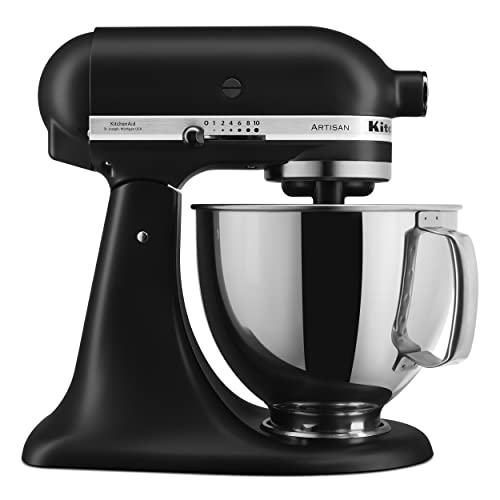
The Artisan is the tilt-head most buyers start from. KitchenAid’s listing gives it a 5-quart stainless steel bowl with a handle, dishwasher safe, that mixes up to 9 dozen cookies in a single batch with the flat beater. It has 10 speeds, from a stir speed up to speed 8 for whipping cream and beyond, and metal construction.
The tilt head lifts back for open access to the bowl and locks in place while mixing, per the listing, and a pouring shield is included. At about 14 inches tall according to Prudent Reviews’ figures for KitchenAid tilt-heads, it suits a counter under standard wall cabinets, as long as you allow room for the head to lift.
It handles everyday baking, from tres leches batter to a loaf of bolillos. For several loaves of stiff dough a week, look at the bowl-lift below. The listing doesn’t state wattage, and the warranty is one year.
Why we like it
- Wide-open bowl access with the head tilted back
- 9 dozen cookies per batch, per the listing
- Pouring shield included
- Many colors in the same model
Key specifications
| Model | KSM150PSBM (Artisan KSM150PS) |
|---|---|
| Design | Tilt-head, locks while mixing |
| Bowl | 5 qt stainless steel, dishwasher safe |
| Speeds | 10 |
| Power | Not stated on listing |
| Included | Pouring shield (listing title) |
| Warranty | 1 year (listing) |
Why we recommend it
It suits a home baker who makes cakes, cookies and the odd loaf and wants a mixer that fits under the cabinets.
Skip it if you knead big batches of stiff dough every week; a bowl-lift is built for that.
Pros and cons
Pros
- Easy scraping and adding
- Fits under most wall cabinets
- Works with KitchenAid hub attachments
Cons
- 5-quart limit
- Head needs clearance to lift
- One-year warranty
2. Smeg SMF05 Forte 5-Quart Stand Mixer – A Tilt-Head With More Muscle

The Forte is Smeg’s answer to the main complaint about tilt-heads. The listing gives a 750-watt direct-drive motor that Smeg says delivers high torque for kneading dense bread and pizza dough, plus a built-in stability system meant to cut vibration while it runs. The head is spring-assisted, which Smeg says supports controlled opening and helps prevent accidental closure.
The bowl is 4.8 liters (5 quarts) of stainless steel with a handle. Smooth Start raises the speed gradually to keep flour in the bowl, and there are 10 electronic speeds with planetary mixing. Smeg packs five accessories: a wire whisk, an aluminum flat beater, a dough hook, a silicone flex-edge beater and a Tritan pouring shield.
It suits a baker who wants tilt-head access but kneads bread or pizza dough often. The bowl is the same size as the Artisan’s, so it doesn’t solve the big-batch question, and this is a newer model, so our notes rest on Smeg’s listing rather than an independent review. The listing shows a one-year manufacturer warranty.
Why we like it
- 750-watt direct-drive motor, per the listing
- Spring-assisted head that resists dropping
- Flex-edge beater and pouring shield included
- Smooth Start to limit splatter
Key specifications
| Model | SMF05PKUS (Forte, pink) |
|---|---|
| Design | Tilt-head, spring-assisted |
| Bowl | 4.8 L (5 qt) stainless steel |
| Speeds | 10 electronic |
| Power | 750 W direct drive (listing) |
| Included | Whisk, flat beater, dough hook, flex-edge beater, pouring shield |
| Warranty | 1 year manufacturer (listing) |
Why we recommend it
It suits a home baker who likes the tilt-head design but kneads bread and pizza dough often enough to want more power.
Skip it if you need more than 5 quarts per batch, or want a long track record before buying.
Pros and cons
Pros
- Most stated power of our tilt-heads
- Five accessories in the box
- Head designed not to drop
Cons
- Still a 5-quart bowl
- New model; details rest on the listing
- Height not stated on listing
3. KitchenAid 7-Quart Bowl-Lift Stand Mixer – Big Batches and Heavy Dough

This is the bowl-lift side of the choice at its clearest. The listing gives a 7-quart stainless steel bowl and says it can mix 13 dozen cookies per batch, knead over 8.5 pounds of bread or mash over 7.5 pounds of potatoes, using the flat beater for the cookie figure. That is the capacity a tilt-head can’t reach.
It has 11 speeds, including a 1/2 speed that KitchenAid says is designed for folding delicate ingredients like blueberries and egg whites without overbeating. The box holds a double flex edge beater, which KitchenAid says scrapes the bowl with two flexible edges, plus a coated flat beater, coated dough hook, 11-wire whip and a pouring shield.
Plan the space. By Prudent Reviews’ figures, KitchenAid’s bowl-lifts stand about 16.4 to 17 inches tall, and they are heavier than the tilt-heads, so this mixer wants a permanent place on the counter. For a household that bakes small batches, it is more machine than needed. The listing shows a one-year limited warranty.
Why we like it
- 7-quart bowl for big batches
- Over 8.5 lbs of bread dough, per the listing
- 1/2 speed for folding
- Double flex edge beater included
Key specifications
| Model | KSM70SKXXPT (KSM70SKXX, Pistachio) |
|---|---|
| Design | Bowl-lift |
| Bowl | 7 qt stainless steel |
| Speeds | 11, including 1/2 speed |
| Power | Not stated on listing |
| Included | Double flex edge beater, flat beater, dough hook, 11-wire whip, pouring shield |
| Warranty | 1 year limited (listing) |
Why we recommend it
It suits a baker who makes several loaves, big cookie batches or masa for a crowd and has a permanent counter spot for it.
Skip it if your cabinets are low or you mostly bake one cake at a time; a tilt-head does that for less.
Pros and cons
Pros
- Largest stated batch sizes here
- Stable bowl for long kneading
- Five accessories in the box
Cons
- Tall and heavy
- Higher cost
- Wattage not on listing
Tilt-head and bowl-lift questions, answered
Is a bowl-lift mixer better than a tilt-head?
Only for big or heavy batches. Prudent Reviews concludes that KitchenAid’s tilt-heads are better for most home kitchens and suggests bowl-lifts for avid bakers who need a heavy-duty mixer for large batches. If you bake a cake or a loaf at a time, a tilt-head is easier to live with.
Will a bowl-lift mixer fit under my cabinets?
Measure first. Prudent Reviews gives KitchenAid’s bowl-lifts as 16.43 to 17 inches tall and its tilt-heads as 14 inches. A bowl-lift never gets taller in use, while a tilt-head needs extra room to open, so allow for that if you plan to use it in place.
Can a tilt-head mixer knead bread dough?
Yes, for normal batches. A tilt-head with a dough hook kneads a loaf or a batch of pizza dough, and Smeg says its Forte tilt-head is built for dense bread and pizza dough. Prudent Reviews notes the head can vibrate more under heavy loads, so for several loaves a week a bowl-lift is the steadier choice.
Do tilt-head and bowl-lift mixers use the same attachments?
Power-hub attachments such as KitchenAid’s meat grinder and pasta rollers fit both types, according to Prudent Reviews. Bowls, beaters and dough hooks are sized to each design, so buy replacements made for your model.
Which design is better for tamale masa?
Either works for a family batch; beating lard until light and then adding masa and broth is a flat-beater job. For a holiday tamalada with masa for several dozen tamales, the larger bowl of a bowl-lift means fewer rounds.
Our final word on stand mixer design
Buy for the biggest batch you make often, not the biggest one you might make once. If that batch fits in 5 quarts, a tilt-head gives you easier access, a lower cost and a better chance of fitting under your cabinets. If you knead big or stiff batches every week, the bowl-lift’s size and stability are worth the height and the price.
Still deciding whether you need a stand mixer at all? Our stand mixer vs hand mixer comparison covers that, and our best cheap stand mixer guide lists lower-cost tilt-heads. And when you would rather someone else did the baking, see the menu or call to order.