
A cast iron skillet is only as good as the thin, dark layer baked onto it. That layer is what lets a tortilla blister instead of stick, and what keeps rust away between meals. Every coat of oil you add, and every meal you cook, builds it a little more.
The honest truth about this category is that you don’t strictly need a special product. America’s Test Kitchen says any vegetable oil will work fine. What a conditioner buys you is convenience: a tin or spray that goes on thin, with ingredients and directions spelled out. This guide covers the ones worth buying, and when a plain bottle is the smarter choice.
Julia’s earns a commission on purchases made through links on this page, at no cost to you. Recommendations are based on what a restaurant kitchen looks for, product specifications and verified buyer reports.
Quick verdict: which cast iron conditioner to buy
For most kitchens, the best cast iron seasoning oil is Field Company’s Cast Iron Seasoning Oil: a simple blend of grapeseed oil, sunflower oil and beeswax from a company that makes the pans. If you want a US-made tin that also names carbon steel, choose Lancaster. If you want a plain oil for the oven, choose Walrus Oil’s safflower bottle.
Below are the seven picks with ingredients and surfaces exactly as each maker gives them, then how to choose one and how to use it without leaving a sticky pan.
Five seasoning conditioners side by side
Our five standout picks, one for each kind of cook, with the details each listing states. All seven are reviewed in full below.
| Conditioner | Best for | Ingredients as listed | Size | Buy on Amazon |
|---|---|---|---|---|
Field Company Cast Iron Seasoning Oil, 2 oz TinBest overall
|
Everyday upkeep | Organic grapeseed, sunflower, beeswax | 2 oz tin | View on Amazon |

Lancaster Cast Iron Seasoning, 2 ozBest US-made
|
US-made, carbon steel too | Beeswax, grapeseed, safflower | 2 oz | View on Amazon |

Walrus Oil Cast Iron Oil, Safflower, 8 ozBest pourable oil
|
Oven seasoning, bigger pans | Safflower oil, vitamin E | 8 oz bottle | View on Amazon |
| Fast, thin coats | 100% canola oil | 8 oz cans, pack of 6 | View on Amazon | |

Crisbee Cream Iron Cast Iron and Carbon Steel Seasoning, 6 ozBest for big surfaces
|
Griddles and large pans | Non-GMO sunflower oil, beeswax | 6 oz | View on Amazon |
Our picks for the best cast iron seasoning oil
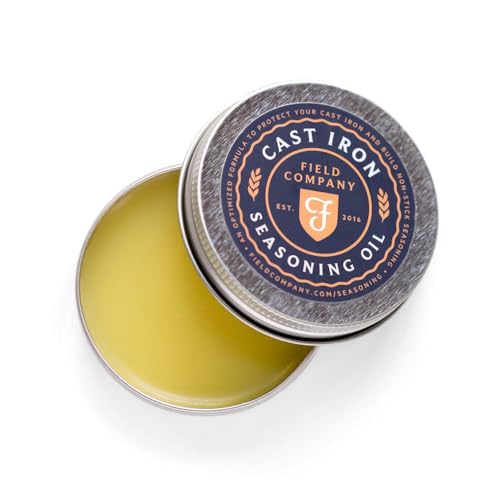
1. Field Company Cast Iron Seasoning Oil, 2 oz Tin – From a Skillet Maker
Field Company makes cast iron pans, so its conditioner comes with a clear point of view on how a pan should be kept. The tin holds a soft blend of organic grapeseed oil, organic sunflower oil and beeswax. Field says it chooses oils high in polyunsaturated fats because they polymerize easily, which is the chemistry behind the hard, dark layer you are trying to build.
The routine on the listing is simple and worth copying with any product on this page. Clean the pan with soap and a brush, use a chain mail scrubber to smooth the surface, apply a dab, then wipe off the excess until the finish is dry and matte. Field suggests doing this every time you clean the pan.
There is one storage note that most rivals skip. Field says to use it within one year for best results, or refrigerate it to extend its shelf life. Two ounces sounds small, but the amount per pan is also small, since a thin coat is the whole idea.
Why we like it
- Made by a cast iron pan maker
- Full ingredient list on the listing
- Clear routine for each cleaning
- Honest shelf-life guidance
Key specifications
| Size | 2 oz tin |
|---|---|
| Form | Soft oil and beeswax blend |
| Ingredients as listed | Organic grapeseed oil, organic sunflower oil, beeswax |
| Surfaces named | Cast iron |
| Food-contact wording | Not stated |
| How applied | Dab, spread thin, wipe to a dry matte finish |
| Storage note | Best within one year; refrigerate to extend |
| Made in | Not stated |
Why we recommend it
It suits a cook who wipes down a skillet after most meals and wants a simple blend from a company that makes the pans.
Skip it if you are stripping and re-seasoning a whole collection, since a 2-ounce tin is a maintenance size.
Pros and cons
Pros
- Short, readable ingredient list
- Spreads thin, per the maker’s routine
- Works as an after-wash habit
Cons
- Small tin
- Shelf life is limited, per the maker
- Contains beeswax
2. Lancaster Cast Iron Seasoning, 2 oz – US-Made, for Upkeep or Oven Work
Lancaster Cast Iron is another pan maker selling its own conditioner, and this one is made in the USA from locally sourced beeswax, grapeseed oil and safflower oil, according to the listing. The formula sits close to Field’s in style, so the choice between them is mostly about which surfaces and which routine you want.
Lancaster names more of them. The listing covers cast iron skillets, Dutch ovens and carbon steel cookware, which helps if your kitchen has both metals. It also gives two ways to use it: a light coat after each use to maintain the seasoning, or a full oven re-seasoning.
The listing says nothing on storage or shelf life and gives no temperature for that oven method, so follow the maker’s directions on the tin. Like the other waxy blends here, it is a thing you scoop and spread, so plan on a paper towel or a clean rag rather than a pour.
Why we like it
- Made in the USA, per the listing
- Three ingredients named
- Names cast iron and carbon steel
- Works for upkeep or a full oven re-seasoning
Key specifications
| Size | 2 oz |
|---|---|
| Form | Oil and beeswax blend |
| Ingredients as listed | Beeswax, grapeseed oil, safflower oil |
| Surfaces named | Cast iron skillets, Dutch ovens, carbon steel cookware |
| Food-contact wording | Not stated |
| How applied | After each use, or complete oven re-seasoning |
| Storage note | Not stated |
| Made in | USA |
Why we recommend it
It suits a cook with a mix of cast iron and carbon steel who wants one US-made tin for both.
Skip it if you want oven temperatures spelled out on the listing; this one leaves them off.
Pros and cons
Pros
- Covers two kinds of cookware
- Simple ingredient list
- From a working cast iron maker
Cons
- Small tin
- No temperature on the listing
- Contains beeswax
3. Walrus Oil Cast Iron Oil, Safflower, 8 oz – A Pourable Oil With NSF Wording
If you want an oil rather than a wax, this is the plainest bottle here: safflower oil with plant-derived vitamin E, which Walrus says is there for shelf life. Walrus describes it as NSF Certified Food-Contact Safe and suitable for restaurants and commercial kitchens. That is the most specific food-contact statement on this page.
Walrus also publishes the clearest oven method we found. Clean the pan and the oven first, wipe on a thin coat with no standing oil, and set the pan dish-side down on the middle rack with a cookie sheet below for drips. Preheat to between 375 and 425 degrees Fahrenheit, with 400 as the ideal, and bake for 30 minutes to an hour with the door cracked. Let it cool in the oven.
Follow the maker’s ceiling. The listing gives a smoke point of 450 to 500 degrees Fahrenheit, but Walrus’s own directions say not to heat it above 450, and that you may see light smoke from 425 to 450. Keep an eye on it the whole time. For a daily coat, Walrus says to wipe it on and buff away the excess, no oven needed.
Why we like it
- NSF food-contact wording from the maker
- Two ingredients, both named
- Full oven directions from the maker
- 8 ounces goes further than a tin
Key specifications
| Size | 8 oz bottle |
|---|---|
| Form | Liquid oil |
| Ingredients as listed | Safflower oil, vitamin E |
| Surfaces named | Cast iron |
| Food-contact wording | “NSF Certified Food-Contact Safe” |
| How applied | Wipe on and buff, or bake at 375–425°F; do not exceed 450°F |
| Storage note | Not stated |
| Made in | Bottled in USA, per the listing |
Why we recommend it
It suits a cook who wants to do a proper oven re-seasoning, or who has a Dutch oven or a large griddle to coat.
Skip it if you don’t want to run an oven with the door cracked; a wipe-on blend is simpler.
Pros and cons
Pros
- No wax, for those who prefer plain oil
- Clear heat limit
- Easy to spread over large pans
Cons
- Liquid is easier to over-apply
- Oven method can smoke, per the maker
- Names cast iron only
4. Lodge Cast Iron Seasoning Spray, 100% Canola Oil, 8 oz, Pack of 6 – Pure Canola, No Propellant

Lodge has made cast iron since 1896, and its seasoning spray is about as simple as this category gets. The company says it is 100% canola oil with no additives or propellants. A spray puts down a thin coat without much effort, which is the hardest part of seasoning to get right with a bottle.
Lodge’s routine is on its single-can listing: wash by hand with a small amount of soap, dry promptly with a lint-free cloth or paper towel, then rub a light layer onto the surface and wipe with a paper towel until no oil residue remains. Don’t skip that last step just because the coat looks thin.
A note on this listing. It is a pack of six 8-ounce cans, and we chose it because the single can already appears in our griddle seasoning guide. If one can is enough for you, buy it there. Six makes sense for a large collection or for sharing with family. The spray’s facts here come from Lodge’s single-can listing, which has the same part number, A-SPRAY.
Why we like it
- 100% canola oil, per Lodge
- No additives or propellants, per Lodge
- Quick way to get a thin coat
- From a long-running US cast iron maker
Key specifications
| Size | 8 oz cans, pack of 6 |
|---|---|
| Form | Spray |
| Ingredients as listed | 100% canola oil |
| Surfaces named | Cast iron cookware |
| Food-contact wording | Not stated |
| How applied | Spray, rub a light layer, wipe until no residue |
| Storage note | Not stated |
| Made in | Not stated for the spray |
Why we recommend it
It suits a cook who wants the fastest possible coat after a wash, or who owns enough cast iron to go through six cans.
Skip it if you own one skillet; six cans is too many, and the single can in our griddle guide is the better buy.
Pros and cons
Pros
- Simple single ingredient
- Even, light coat is easy
- No wax
Cons
- Six-pack is a large purchase
- A plain bottle of canola works too
- Still needs wiping down, like any oil
5. Walrus Oil Cast Iron Seasoning, Beeswax Blend, 4 oz – The Same Oil, With Beeswax
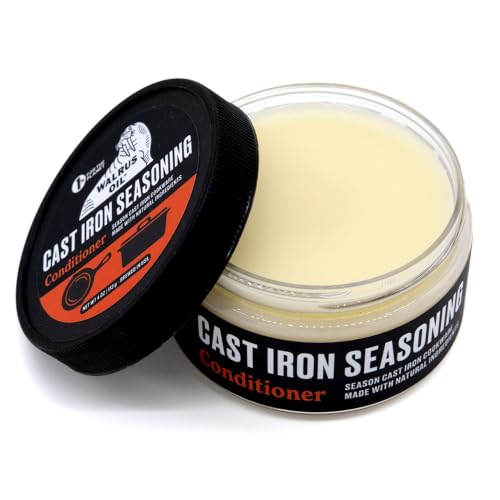
This is the wax version of the Walrus bottle above: safflower oil, vitamin E and beeswax in a 4-ounce container. The listing describes it as an easy wipe-on application, and says the beeswax waterproofs and shines while the safflower oil conditions and helps prevent rust.
It sits between the small tins from Field and Lancaster and the larger pour of the oil. If you like the idea of a blend but find 2 ounces too little for a Dutch oven and a couple of skillets, this is the larger option here.
Note the wording. The listing says 100% food contact safe ingredients, which is a statement about what goes in it. The NSF language appears on the oil’s page, and we did not see it on this listing, so we don’t apply it here. The surfaces it names are griddles, pans, pots and skillets.
Why we like it
- Double the size of the small tins
- Three named ingredients
- Wipe-on application, per the listing
- Names griddles, pans, pots and skillets
Key specifications
| Size | 4 oz |
|---|---|
| Form | Oil and beeswax blend |
| Ingredients as listed | Safflower oil, beeswax, vitamin E |
| Surfaces named | Cast iron griddles, pans, pots, skillets |
| Food-contact wording | “100% Food Contact Safe Ingredients” |
| How applied | Wipe on |
| Storage note | Not stated |
| Made in | Not stated |
Why we recommend it
It suits a cook who prefers a blend to a liquid and needs a bit more than a 2-ounce tin holds.
Skip it if you want no wax on the pan; the Walrus oil above is the same base without it.
Pros and cons
Pros
- Larger than the small tins
- Short ingredient list
- Simple wipe-on use
Cons
- No oven directions on the listing
- Contains beeswax
- Little outside comment that we could find
6. Crisbee Cream Iron Cast Iron and Carbon Steel Seasoning, 6 oz – A Cream for Large Surfaces
Crisbee is a family company built around cast iron seasoning, and Cream Iron is its soft, spreadable format. The listing gives two ingredients, non-GMO sunflower oil and beeswax, and names cast iron, carbon steel and griddles. At 6 ounces, it is a good fit for a large griddle or a stack of pans.
Crisbee says it works for initial seasoning and daily maintenance alike. A cream is easier to spread over a large surface than a stick, which is why we would choose this over the Crisbee Stik for a big griddle. The Stik is covered in our griddle guide. Don’t assume the two have the same recipe; retailers list other oils for other Crisbee formats, so go by the ingredients for the one you buy.
The listing doesn’t spell out the steps, so use the routine common to the other makers here: warm, clean pan, a very thin coat, and wipe until it looks almost dry. Crisbee offers a satisfaction guarantee, and it is family made in the USA, according to the listing.
Why we like it
- Two named ingredients
- Names cast iron, carbon steel and griddles
- 6 ounces suits big surfaces
- Family made in the USA, per the listing
Key specifications
| Size | 6 oz |
|---|---|
| Form | Cream |
| Ingredients as listed | Non-GMO sunflower oil, beeswax |
| Surfaces named | Cast iron, carbon steel, griddles |
| Food-contact wording | Not stated |
| How applied | Not stated; thin coat advised |
| Storage note | Not stated |
| Made in | USA, per the listing |
Why we recommend it
It suits an owner of a large griddle or several pans who wants a wax blend in a size that lasts.
Skip it if you want step-by-step directions on the listing; Field and Walrus give more.
Pros and cons
Pros
- Easy to spread on large areas
- Short ingredient list
- Satisfaction guarantee, per the listing
Cons
- No directions on the listing
- Contains beeswax
- More than one skillet needs
7. Caron & Doucet Cast Iron Seasoning & Cleaning Oil, 8 oz – A Coconut Oil Upkeep Coat

Caron & Doucet takes the opposite route from Field. Its oil is built on refined coconut oil with a proprietary blend of essential oils, and it is sold as both a seasoning and a cleaning oil. The company calls it food grade and says the oil is safe for food contact and cast iron surfaces. The essential oils aren’t itemized, and the base is coconut, so read the full label if you are avoiding either.
The pitch is shelf life. Caron & Doucet says that, unlike canola, hemp or flaxseed, this oil will not go rancid. The company also says the scent is very light and won’t transfer to food. We can’t verify either from a listing, so treat those as the maker’s claims.
One honest caveat. Field chooses polyunsaturated oils because they polymerize easily, and America’s Test Kitchen points to everyday oils such as sunflower, soybean, corn and canola. Coconut oil is mostly saturated, so we see this as an after-wash protective wipe. If you are building seasoning from bare iron, reach for one of the oils above.
Why we like it
- Food-grade wording from the maker
- Liquid wipe for after each wash
- 8-ounce bottle
- Satisfaction guarantee, per the listing
Key specifications
| Size | 8 oz bottle |
|---|---|
| Form | Liquid oil |
| Ingredients as listed | Refined coconut oil, proprietary essential oil blend |
| Surfaces named | Cast iron |
| Food-contact wording | “Food grade”; “safe for food contact” |
| How applied | Follow the maker’s label |
| Storage note | Won’t go rancid, per the maker |
| Made in | Not stated |
Why we recommend it
It suits a cook who wants a shelf-stable wipe after washing and doesn’t need the bottle to build seasoning from scratch.
Skip it if you want to re-season a stripped pan, or you avoid coconut or added scents.
Pros and cons
Pros
- Long shelf life, per the maker
- Easy after-wash habit
- Clear food-contact wording
Cons
- Essential oils not itemized
- Contains coconut
- Not our choice for building new layers

How to choose a cast iron conditioner
What you actually need. For a pan in regular use, a thin wipe after washing is usually enough, and the fat from cooking does the rest. America’s Test Kitchen recommends a plain, neutral oil and steers away from extra virgin olive oil and toasted sesame oil, which have lower smoke points. Buy a conditioner for convenience, not because plain oil fails.
Oil, blend or spray. A liquid suits large pans and full oven seasoning. A wax blend goes on thin with little effort and suits daily upkeep. A spray is the fastest, as long as you still wipe it down.
Ingredients. Read them, because this goes on the surface you cook on. Beeswax appears in four of these seven picks, coconut in one, and Caron & Doucet’s essential oils aren’t itemized. We report only what each maker lists, and we make no health claims for any of them.
Surfaces named. Use a product on what its maker names. Lancaster, Crisbee and the griddle-focused listings go beyond skillets, while others name cast iron alone. None of these seven names enameled cast iron, so don’t assume they suit an enameled Dutch oven.
Heat limits. If you plan to season in an oven, use the maker’s numbers. Walrus says not to exceed 450 degrees Fahrenheit, and it warns of light smoke near that limit. Keep the kitchen ventilated and stay close by.

How to apply it without a sticky pan
The most useful thing all of these makers agree on is thin. Field says to wipe away the excess until the finish is dry and matte, Lodge says to wipe until no oil residue remains, and Walrus says to leave no standing oil. Too much leaves a tacky coat.
Start with a clean, completely dry pan. Lodge calls for prompt drying with a lint-free cloth or paper towel. Add a small amount of conditioner, spread it over the cooking surface, then wipe it back off with a fresh towel as though you had made a mistake. If you are using a chainmail scrubber to clean up, do that first, as Field suggests.
How we picked these seven conditioners
We have not used these products ourselves. We started from what a working kitchen wants from a pan, then read each maker’s listing for ingredients, surfaces, directions and food-contact wording. On a product that touches your cooking surface, we kept to makers we could identify and passed on small brands we could find no outside comment on. Stock and offer condition were checked through Amazon’s product data.
Our general advice on oils comes from America’s Test Kitchen’s guide to cleaning and seasoning cast iron, and the Walrus directions come from Walrus’s own product page. The product details rest on each listing and maker’s statements, not on our own use. We did not reuse the Crisbee Stik, Camp Chef or Blackstone conditioners covered in our griddle guide. Camp Chef’s listing, in particular, gives no ingredients.
Lodge is the one repeat: the same spray as our griddle guide, listed here as a six-pack, because no other spray from a known maker earned a place.

Cast iron conditioner questions, answered
What is the best oil to season cast iron?
America’s Test Kitchen says the choice doesn’t matter a lot and that any vegetable oil will work fine, naming sunflower, soybean, corn and canola among lower-cost options. Field prefers grapeseed and sunflower for their polyunsaturated fats.
What does a cast iron conditioner do?
It puts a thin layer of oil, or oil and wax, on the iron. Heat and cooking bond that layer to the pan over time, and the coat helps protect the surface from moisture between uses.
Can I use olive oil on cast iron?
America’s Test Kitchen advises against extra virgin olive oil and toasted sesame oil for seasoning, since they have lower smoke points and may burn before they polymerize.
How often should I condition cast iron?
Field and Lancaster suggest a light coat after each cleaning or use. Lodge’s routine is the same. A full oven re-seasoning is only for a pan that has lost its finish.
Why is my skillet sticky after seasoning?
Almost always, too much oil. All of the makers here call for a thin layer with the excess wiped away. Next time, use less and wipe harder.
Our final word on seasoning oil
Buy Field for everyday upkeep, Lancaster if you also keep carbon steel, Walrus’s oil for a full oven season, and Lodge’s spray if speed matters most. Still shopping for the pan? See our best cast iron skillet guide, our value picks, and our griddle seasoning guide. If tortillas are the goal, read comal vs cast iron skillet.
And if you would rather someone else seasoned the skillet tonight, see the menu or call to order.