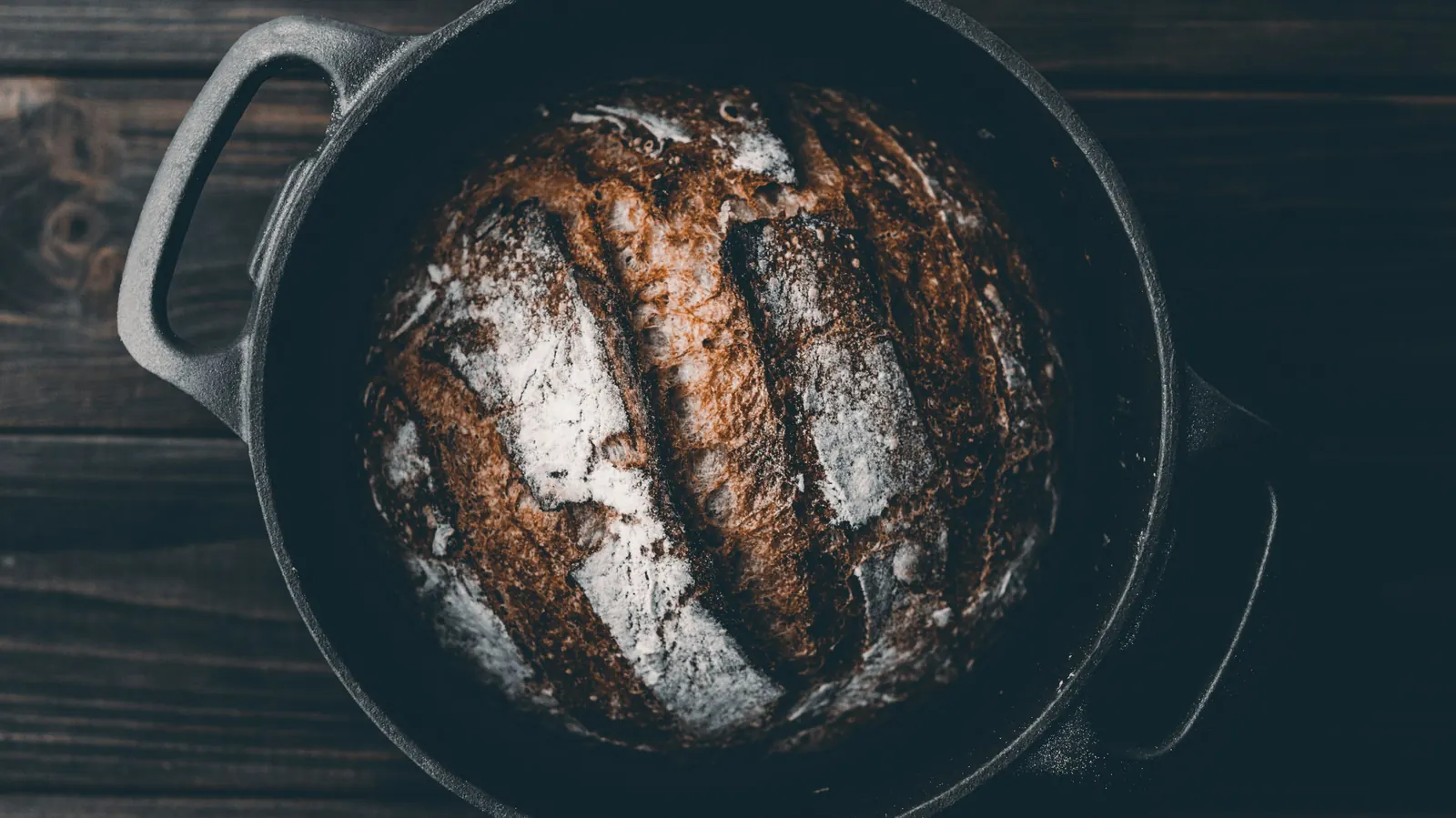
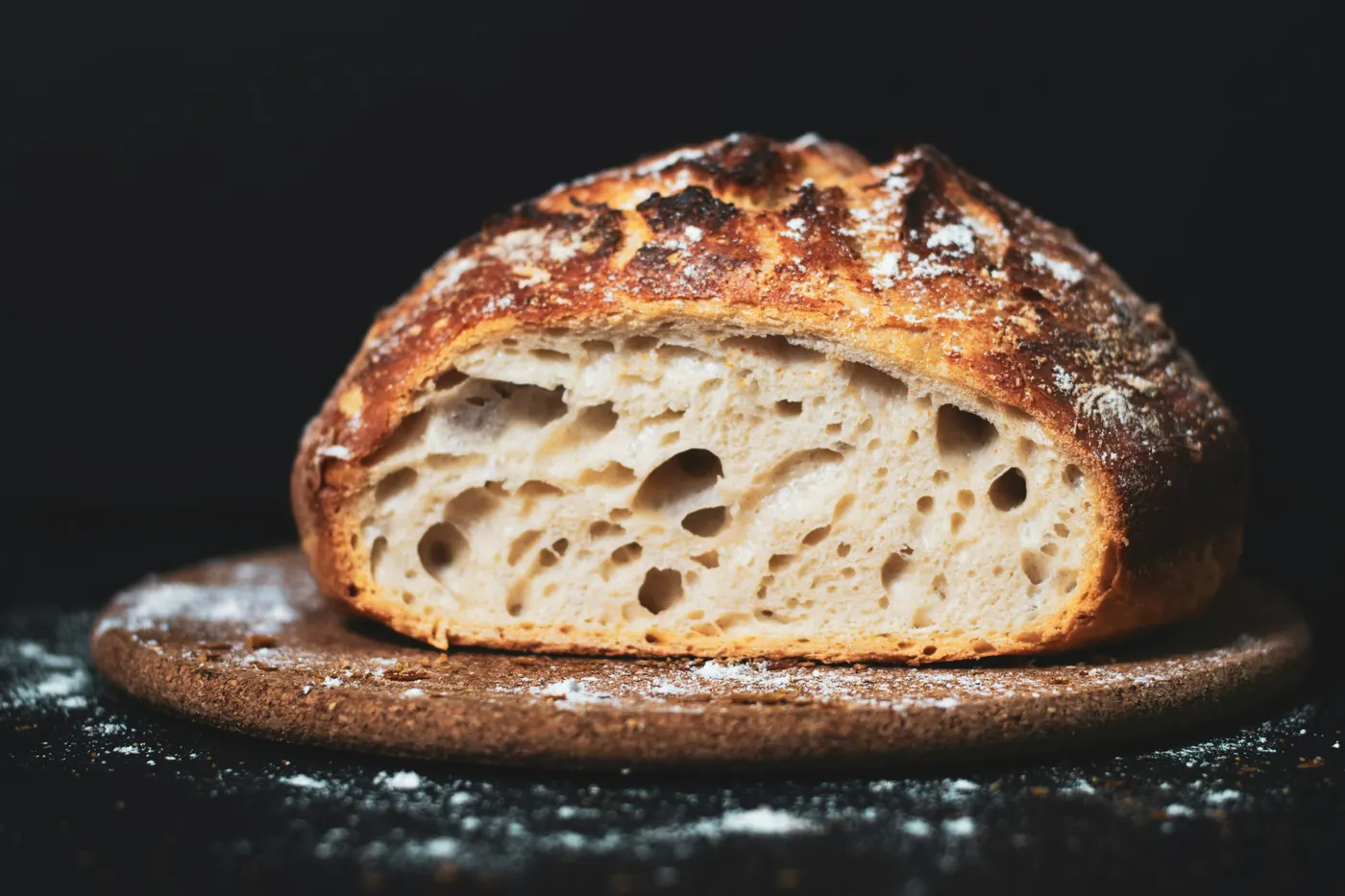
A covered pot is the home baker’s stand-in for a steam-injected bakery oven. The dough goes into a very hot, heavy vessel, the lid traps the moisture it gives off, and that steam keeps the crust soft long enough for the loaf to rise before it sets and browns. Take the lid off partway through and the crust finishes crisp. It is why so many sourdough and no-knead recipes start with “preheat your Dutch oven”.
Not every Dutch oven is equally good at it. Some are too deep to lower dough into safely, some have knobs rated below the temperatures bread recipes use, and some are built for stew first. This guide compares the pots and bread bakers that suit the job: cast iron combo cookers, a purpose-built bread pan, enameled bread ovens and Dutch ovens, and a ceramic cloche. Every specification comes from the maker, Lodge’s trade catalog, a named retailer or the Amazon listing.
Julia’s earns a commission on purchases made through links on this page, at no cost to you. Recommendations are based on what a restaurant kitchen looks for, product specifications and verified buyer reports.
Quick verdict: which pot to bake bread in
For most home bakers, the best Dutch oven for bread is the Lodge cast iron combo cooker: the shallow skillet half lets you set dough down without reaching into a deep, hot pot, there is no knob to limit the oven, and it is made in the USA at a modest price. For a bigger, purpose-built pan, choose the Challenger bread pan. For enamel, the Le Creuset bread oven is built only for loaves, and the Lodge 6-quart Essential Enamel Dutch oven bakes bread and cooks everything else. For a lighter clay option, the Emile Henry bread cloche.
The table compares those five. All nine are reviewed in full after it.
Five bread bakers side by side
One pick for each kind of baker, with the oven limits and weights each maker, retailer or listing states.
| Pot | Best for | Weight | Knob/lid rating | Buy on Amazon |
|---|---|---|---|---|

Lodge Cast Iron Combo Cooker, 3.2-quartBest overall
|
Round sourdough loaves | 13.59 lb, both pieces (Lodge catalog) | No knob; any heat source | View on Amazon |

Challenger Cast Iron Bread PanBest dedicated bread pan
|
Big loaves, safer loading | 20 lb (listing) | Pan to 500°F | View on Amazon |

Le Creuset Round Bread Oven, 9.5-inchBest enameled bread oven
|
Boules, no seasoning | 9 lb 12 oz with lid (retailer) | Stainless knob, any temperature (retailer) | View on Amazon |

Lodge Essential Enamel Dutch Oven, 6-quartBest all-purpose enamel
|
Bread plus everyday cooking | 13.52 lb (Lodge) | Stainless knob; oven to 500°F | View on Amazon |

Emile Henry Ceramic Bread ClocheBest ceramic
|
Lighter lifting, round loaves | About 6 lb (Emile Henry) | 270°C, about 518°F (Emile Henry) | View on Amazon |
Product images from Amazon. Weights and oven limits are as stated by each maker, Lodge’s trade catalog, a named retailer or the Amazon listing; check the listing before you buy.
Our picks for the best dutch oven bread bakers
These nine cover bare cast iron, enameled cast iron and ceramic, in combo cookers, bread-specific bakers and classic round Dutch ovens. Each lists the same eight specifications.
1. Lodge Cast Iron Combo Cooker, 3.2-quart – Shallow Base, No Knob
The combo cooker is two pieces: a 3.2-quart deep pot and a 10.25-inch skillet that doubles as its lid. For bread, the skillet is the useful half. Because it is shallow, you can set a shaped loaf onto it without lowering your hands into a deep, very hot pot, then cover it with the deep half as a dome. The listing itself pitches it for sourdough, saying that used together the two pieces create a tight seal that traps steam.
There is no knob, so there is no part with a lower oven rating than the iron itself; the listing says it handles any heat source, from the stove to the oven to an open flame. Lodge’s catalog lists the two-piece set at 13.59 pounds, and it is made in the USA and seasoned at the foundry with vegetable oil.
When it is not baking bread, it is a skillet and a deep pot for frying or stews. Care, per the listing: hand wash with warm water, dry thoroughly and rub with oil; if a dull spot appears, scour, dry and re-oil.
Why we like it
- Shallow skillet half for loading dough
- No knob to limit oven heat
- Pitched for sourdough by Lodge’s listing
- Made in the USA
Key specifications
| Model | LCC3 |
|---|---|
| Capacity | 3.2-quart pot; 10.25-inch skillet lid |
| Material | Cast iron |
| Interior | Seasoned with vegetable oil |
| Knob/lid rating | No knob; any heat source (listing) |
| Weight | 13.59 lb, both pieces (Lodge catalog) |
| Shape | Round; deep pot plus shallow skillet |
| Care | Hand wash, dry, rub with oil |
Why we recommend it
It suits anyone starting out with sourdough or no-knead bread who wants the safest loading and no oven limits for little money.
Skip it if you bake large or long loaves; a 10.25-inch round base limits the size and shape of the dough.
Pros and cons
Pros
- Easy loading from the shallow side
- Two pans in one
- Inexpensive
Cons
- Heavy for its size
- Bare iron needs drying and oiling
- Round loaves only
2. Challenger Cast Iron Bread Pan – Built Only for Bread
The Challenger pan takes the combo cooker idea and builds it around bread: a shallow cast iron base and a tall, precision-fit lid, with handles the maker says are designed for bulky oven mitts. The listing gives its size as 15.5 by 10.5 by 5.5 inches and its weight as 20 pounds, and says it handles oven temperatures up to 500°F. Those dimensions make it longer than it is wide, with room for loaves bigger than a 10-inch round pot allows.
The maker’s pitch is safety and consistency: the shallow base means you load, score and remove dough without reaching into a deep pot. It also gives a specific tip for avoiding scorched bottoms: about 15 minutes into the bake, invert the lid into the base. It comes pre-seasoned with grapeseed oil and is made in the USA, per the listing.
The trade-offs are weight and size. At 20 pounds, it is the heaviest pan here, and at 15.5 inches long you should measure your oven before buying.
Why we like it
- Shallow base for loading and scoring
- Handles sized for oven mitts
- Room for larger loaves
- Made in the USA
Key specifications
| Model | Not stated |
|---|---|
| Capacity | Not stated; 15.5 x 10.5 x 5.5 in |
| Material | Cast iron |
| Interior | Seasoned with grapeseed oil |
| Knob/lid rating | Oven temperatures up to 500°F (listing) |
| Weight | 20 lb (listing) |
| Shape | Shallow base, tall lid; longer than wide |
| Care | Seasoned cast iron care |
Why we recommend it
Choose it if you bake every week, want bigger loaves than a round pot allows, and like a pan designed around loading dough safely.
Skip it if you want a pan that also cooks dinner; it is a bread pan and a heavy one.
Pros and cons
Pros
- Designed around bread
- Large baking area
- Clear guidance from the maker
Cons
- 20 pounds
- Expensive
- Needs a roomy oven
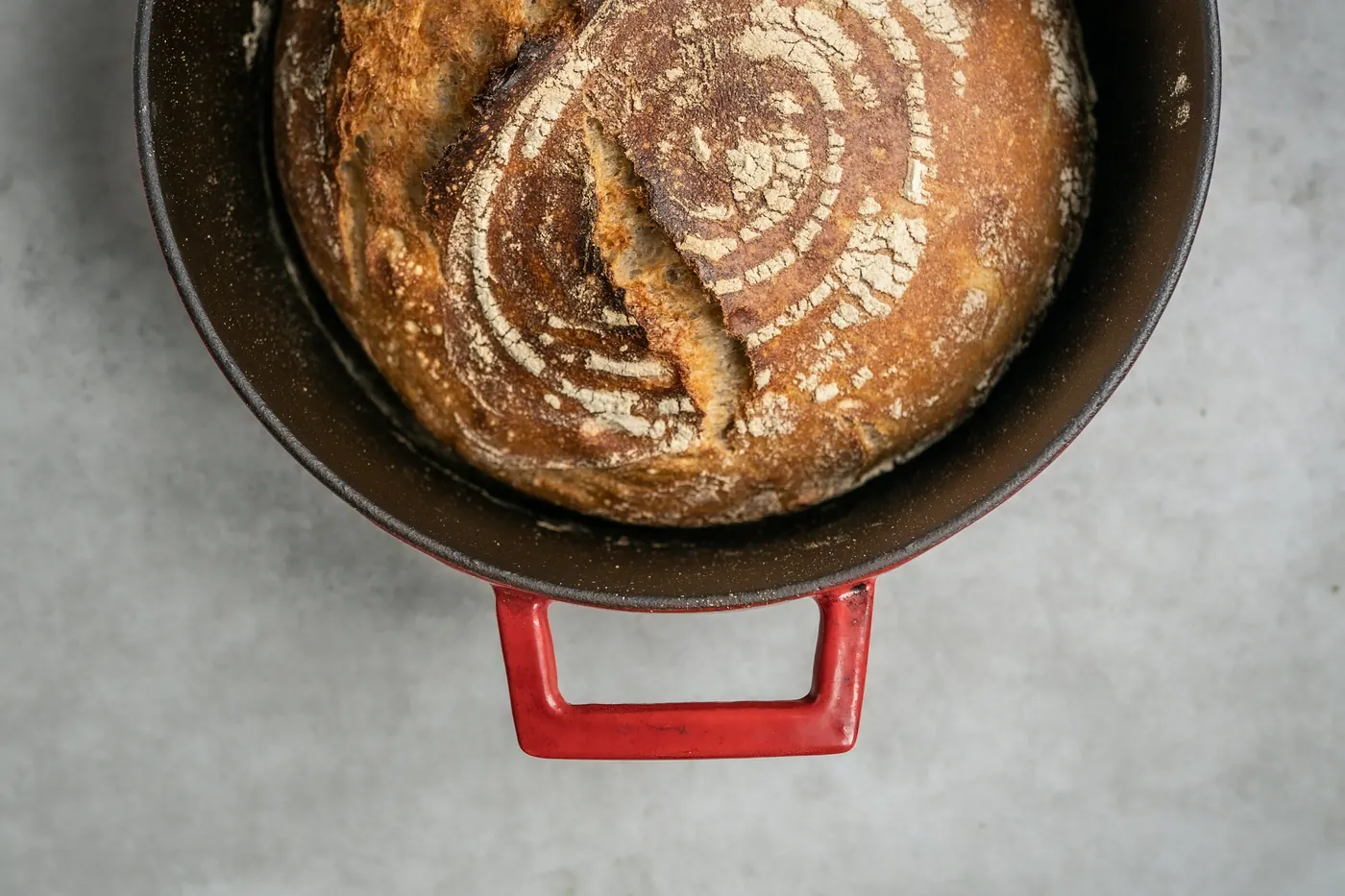
3. Le Creuset Round Bread Oven, 9.5-inch – Low Base, Domed Lid
Le Creuset’s bread oven is the enameled version of the low-base idea. The base is shallow with raised ridges that, per the listing, help even browning and mark the loaf with Le Creuset’s three rings, and the tight-fitting domed lid is designed to trap and circulate steam for crust and rise. The interior is a matte black satin enamel that the listing says develops a patina over time.
Being enameled, it needs no seasoning, and the listing says the enamel resists dulling, staining, chipping and cracking. Cutlery and More lists the 9.5-inch bread oven with a 7.5-inch base, 7 inches tall with the lid, and 9 pounds 12 ounces with the lid. The retailer also says its stainless steel knob is safe at any temperature, that it is made in France, and that it is dishwasher safe, though hand washing is recommended.
Le Creuset says its products comply with all federal safety regulations set by the FDA; we found no explicit lead-free statement from the maker. The 9.5-inch size suits a modest boule. Le Creuset also sells an 11.5-inch oval bread oven, but several colors of it were in short supply when we checked.
Why we like it
- Low base for easy loading
- Domed lid built to trap steam
- Stainless knob, per the retailer
- No seasoning required
Key specifications
| Model | LS2101-2420SS |
|---|---|
| Capacity | Not stated; 9.5-inch, 7.5-inch base (retailer) |
| Material | Enameled cast iron |
| Interior | Matte black satin enamel |
| Knob/lid rating | Stainless knob, safe at any temperature (Cutlery and More) |
| Weight | 9 lb 12 oz with lid (Cutlery and More) |
| Shape | Round; low ridged base, domed lid |
| Care | Dishwasher safe; hand wash recommended |
Why we recommend it
It suits a baker who wants enamel, no seasoning and a low base designed for loading round loaves.
Skip it if you want one pot for bread and soup; it is too shallow for stews.
Pros and cons
Pros
- Bread-specific design
- No seasoning
- Lighter than the cast iron combos
Cons
- Expensive
- Bread only
- Smaller loaves
4. Lodge Essential Enamel Dutch Oven, 6-quart – Bread and Dinner in One Pot
If the pot has to bake bread on Saturday and hold a pot of frijoles or pozole on Sunday, a classic round enameled Dutch oven is the answer, and Lodge’s 6-quart is the inexpensive one. The listing names bread baking first among its uses. Lodge’s own product information says the lid is enameled cast iron with a stainless steel knob, and that the pot is compatible with any stovetop, including induction, and the oven up to 500°F.
Lodge’s store lists it at 13.52 pounds and 13.25 by 11.6 by 6 inches. Unlike Lodge’s bare iron, the enamel line is made by Lodge’s partners in China or Vietnam, per Lodge. Lodge recommends hand washing and says metal utensils are not recommended, and that the pot is not made for use on a grill or over a fire.
The one drawback for bread is depth: you lower the dough into a tall, very hot pot. Many bakers use a parchment sling for that, and it is worth having a good pair of mitts.
Why we like it
- Stainless steel knob, per Lodge
- Oven-safe to 500°F
- 6 quarts: room for a large boule
- Cooks stews and beans too
Key specifications
| Model | EC6D13 |
|---|---|
| Capacity | 6 quarts |
| Material | Enameled cast iron |
| Interior | Porcelain enamel |
| Knob/lid rating | Stainless knob; oven up to 500°F (Lodge) |
| Weight | 13.52 lb (Lodge store) |
| Shape | Round, deep, loop handles |
| Care | Hand wash recommended; no metal utensils |
Why we recommend it
Choose it if you want one enameled pot for bread, braises and beans at a fraction of the French brands’ cost.
Skip it if loading dough into a deep, hot pot makes you nervous; a combo cooker or bread oven is easier.
Pros and cons
Pros
- Affordable enamel
- Knob rated to the pot’s limit
- Useful for much more than bread
Cons
- Deep pot to load
- Heavy
- Not for grills or open fire
5. Emile Henry Ceramic Bread Cloche – Lighter Than Iron
A cloche is the oldest version of this idea: a shallow ceramic base and a bell-shaped cover. Emile Henry makes its cloche in France, and the listing gives the size as 13.2 by 11.2 by 7 inches. The domed lid, per the listing, creates an enclosed baking environment for crust development and a light, open crumb.
Its big advantage is weight. Emile Henry’s own page for its bread cloche gives 2.75 kilograms, about 6 pounds, roughly half the cast iron pots here, and a capacity of 4.5 liters. The same page sets the maximum temperature at 270°C, about 518°F, and lists it as compatible with the oven, microwave, freezer and dishwasher. The listing adds a 10-year warranty.
Emile Henry’s spec page is for the burgundy cloche; this listing is the linen color, which the listing gives the same dimensions. Ceramic can crack if dropped, so give it a steady place to land when it comes out of the oven.
Why we like it
- About 6 lb, per Emile Henry
- Shallow base for easy loading
- Made in France
- 10-year warranty
Key specifications
| Model | EH505508 |
|---|---|
| Capacity | 4.5 liters (Emile Henry) |
| Material | Ceramic |
| Interior | Ceramic; no seasoning |
| Knob/lid rating | Up to 270°C, about 518°F (Emile Henry) |
| Weight | 2.75 kg, about 6 lb (Emile Henry) |
| Shape | Round; shallow base, domed cover |
| Care | Dishwasher compatible |
Why we recommend it
It suits a baker who finds cast iron too heavy to lift in and out of a hot oven.
Skip it if your recipe calls for an oven hotter than about 518°F, the cloche’s stated limit.
Pros and cons
Pros
- Half the weight of iron
- Dishwasher compatible
- Low base
Cons
- Breakable if dropped
- Lower temperature limit than iron
6. Le Creuset Signature Round Dutch Oven, 5.5-quart – Premium All-Rounder

Le Creuset’s 5.5-quart round is the classic premium Dutch oven, and a good bread pot as long as you are comfortable lowering dough into it. The listing rates it compatible with all cooktops and oven-safe up to 500°F, and dishwasher safe. The model number ends in SS, and Cutlery and More’s listings for this pot describe a stainless steel knob that is safe at any temperature, so the knob is not the limit.
The interior is Le Creuset’s light-colored smooth enamel, which the listing says makes it easy to monitor cooking. Cutlery and More lists it with a 10.25-inch top diameter and 11 pounds 4 ounces with the lid. The listing describes tall sides and added depth, plus ergonomic knobs and handles for lifting. Le Creuset says its products comply with FDA safety regulations; we found no explicit lead-free statement from the maker.
Why we like it
- Oven-safe to 500°F, per the listing
- Stainless knob, per the retailer
- No seasoning required
- Lighter than Lodge’s 6-quart enamel
Key specifications
| Model | LS2501-26795SS |
|---|---|
| Capacity | 5.5 quarts |
| Material | Enameled cast iron |
| Interior | Light-colored smooth enamel |
| Knob/lid rating | Oven to 500°F; stainless knob (retailer) |
| Weight | 11 lb 4 oz with lid (Cutlery and More) |
| Shape | Round, tall sides |
| Care | Dishwasher safe |
Why we recommend it
Choose it if you want one premium pot that bakes bread well and cooks everything else for decades.
Skip it if bread is the main use; the Le Creuset bread oven is easier to load.
Pros and cons
Pros
- Versatile size
- No seasoning
- Dishwasher safe
Cons
- Expensive
- Deep pot to load
7. Staub Round Cocotte, 4-quart – Matte Black Interior, French-Made
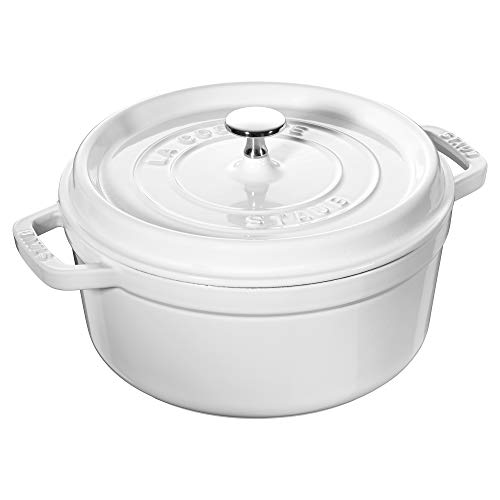
Staub’s cocotte has a dark matte enamel interior, which hides the browning that high-heat bread baking leaves behind, and a heavy, tight-fitting lid with spikes underneath that Staub says return moisture evenly to the food. The listing is unusually precise about limits: the pot is oven safe to 900°F without its lid, and the lids are oven safe to 500°F. The listing rates its brass or nickel-plated knob to 464°F (240°C).
At 4 quarts it is the smallest round pot here, suited to a modest loaf. Cutlery and More lists Staub’s 4-quart round at 10.46 pounds. It is made in France, works on all stovetops including induction, and is dishwasher safe, though Staub recommends hand washing.
Staub’s 5.5-quart cocotte suits bigger loaves, but it was in short supply in every color we checked; this 4-quart, in white, was in stock.
Why we like it
- Dark interior hides baking marks
- Lid rated to 500°F, per the listing
- Knob rated to 464°F, per the listing
- Made in France
Key specifications
| Model | 1102402 (white) |
|---|---|
| Capacity | 4 quarts |
| Material | Enameled cast iron |
| Interior | Matte black enamel |
| Knob/lid rating | Knob 464°F; lid 500°F; pot 900°F without lid |
| Weight | 10.46 lb (Cutlery and More) |
| Shape | Round |
| Care | Dishwasher safe; hand wash recommended |
Why we recommend it
It suits a baker making smaller loaves who wants a dark enamel interior and clear oven ratings.
Skip it if you bake loaves from more than a modest amount of flour; 4 quarts is tight.
Pros and cons
Pros
- Clear lid and pot ratings
- Dark interior
- Also a fine braiser
Cons
- Small for bread
- Expensive for its size
8. Lodge Cast Iron Double Dutch Oven, 5-quart – Bigger Combo, Skillet Lid

The Double Dutch Oven is a larger cousin of the combo cooker: a 5-quart pot whose lid is a dual-handle skillet. The listing calls it ideal for sourdough and pitches it for searing, baking and frying, on the stove, in the oven, on the grill or over a campfire. Lodge’s catalog lists it at 13.13 pounds, as a 10-inch, 5-quart piece.
Like the combo cooker, there is no knob, so the iron sets the only limit, and you can bake with the shallow skillet as the base and the pot as the dome. The extra depth makes it a better all-round pot than the combo cooker for stews and chili. It is seasoned with oil, and Lodge’s care is the same: hand wash, dry, oil.
Why we like it
- 5-quart pot with a skillet lid
- No knob to limit oven heat
- Called ideal for sourdough in the listing
- Stove, oven, grill or campfire
Key specifications
| Model | L8DD3 |
|---|---|
| Capacity | 5 quarts |
| Material | Cast iron |
| Interior | Seasoned |
| Knob/lid rating | No knob; skillet lid |
| Weight | 13.13 lb (Lodge catalog) |
| Shape | Round, 10-inch |
| Care | Hand wash, dry, oil |
Why we recommend it
Choose it if you want the combo cooker’s no-knob design in a deeper pot that also handles big batches of beans or chili.
Skip it if you mainly bake; the combo cooker’s shallower skillet is easier to load.
Pros and cons
Pros
- Two pans in one
- Deeper than the combo cooker
- Made in the USA
Cons
- Heavy
- Bare iron upkeep
9. Tramontina Bestow Enameled Cast Iron Dutch Oven, 5.5-quart – Budget Enamel

Tramontina’s Bestow 5.5-quart round is a lower-cost enameled Dutch oven in heavy HT150 cast iron, with an off-white porcelain enamel interior and a cast iron lid whose self-basting ridges, per the listing, drip condensation back onto the food. The listing names bread baking among its uses, and it works on gas, electric, ceramic glass and induction cooktops.
The listing rates it oven-safe up to 450°F and fits it with a stainless steel knob. That is lower than the 500°F Lodge gives its enamel pot, so bake at 450°F or below in this one. On its own site, Tramontina describes the cooking surface of its enameled cast iron Dutch ovens as lead-free and cadmium-free porcelain enamel. The listing does not give a weight.
Why we like it
- Lower-cost enameled cast iron
- Stainless steel knob
- Self-basting lid ridges
- Induction compatible
Key specifications
| Model | 80131/544DS |
|---|---|
| Capacity | 5.5 quarts |
| Material | Enameled HT150 cast iron |
| Interior | Off-white porcelain enamel |
| Knob/lid rating | Oven-safe to 450°F; stainless knob |
| Weight | Not stated |
| Shape | Round |
| Care | Not stated in listing |
Why we recommend it
It suits a cook who wants an inexpensive enameled pot for stews that will also bake a loaf at 450°F.
Skip it if your recipe preheats the pot hotter than 450°F; choose the Lodge enamel pot or a knobless cast iron baker instead.
Pros and cons
Pros
- Lower cost
- No seasoning
- Stated oven rating
Cons
- 450°F limit
- Weight not stated
How to choose a Dutch oven for bread
Bread asks different things of a pot than a stew does. These are the factors that matter most.
1. The knob is usually the limit
Bread recipes often preheat the oven and the empty pot very hot. The iron and enamel can take it; knobs and some lids are rated lower. Among the pots here, the Lodge combo cooker, Lodge Double Dutch Oven and Challenger pan have no knob at all, Staub rates its lids to 500°F and its 4-quart’s knob to 464°F, Lodge rates its enamel pot and stainless knob to 500°F, and Emile Henry sets its cloche at 270°C, about 518°F. Tramontina rates its Bestow pot to 450°F. If a listing gives no rating, ask the maker before baking hot.
2. Loading: shallow base or deep pot
Lowering soft dough into a deep pot at full heat is the riskiest moment in bread baking. Pans with a shallow base, the combo cooker, Challenger, Le Creuset bread oven and Emile Henry cloche, let you set the loaf down and cover it. With a deep Dutch oven, a parchment sling helps.
3. Size and shape
A round pot makes round loaves. The round pots here run from 3.2 to 6 quarts, and for bread the base diameter matters more than the quart figure, because it decides how wide the loaf can spread. For long or larger loaves, the Challenger’s 15.5 by 10.5-inch footprint gives more room. For a sandwich loaf, a loaf pan does the job better; see our best baking loaf pan guide.
4. Bare iron, enamel or ceramic
- Bare cast iron costs the least and has no limits, but it is heavy and needs drying and oiling.
- Enameled cast iron needs no seasoning and doubles as a stew pot, but check the knob rating.
- Ceramic is roughly half the weight of iron but has a lower temperature limit and can break if dropped.
5. Weight
By the makers’ and retailers’ figures: Emile Henry cloche about 6 pounds, Le Creuset bread oven 9 pounds 12 ounces, Staub 4-quart 10.46, Le Creuset 5.5-quart 11 pounds 4 ounces, Lodge Double Dutch 13.13, Lodge enamel 6-quart 13.52, combo cooker 13.59, Challenger 20. You lift these out of a very hot oven, so be honest about what you can manage.
For the full range of Dutch ovens for braising and stews, see our best Dutch oven guide, and for the budget end, our best value Dutch oven picks.
How we chose these nine bread bakers
We started from what bread asks of a covered pot: a lid that traps steam, a knob or lid that survives a very hot oven, a shape you can load safely, enough room for the loaf and a weight you can lift. We searched Amazon in the United States for combo cookers, bread pans, bread ovens, cloches and round Dutch ovens, checked every listing’s stock with Amazon’s product data, and kept only in-stock pots from identifiable makers. Weights and ratings come from Lodge’s trade catalog and store, Emile Henry, the retailer Cutlery and More and the Amazon listings; we wrote “Not stated” where none gave a figure. Le Creuset’s oval bread oven, Staub’s larger cocottes and several Emile Henry colors were in short supply when we checked, and we passed over oval bread pans from lesser-known sellers. We have not baked in these pots for this guide.
Bread pot questions, answered
What is the best Dutch oven for sourdough?
For most bakers, the Lodge combo cooker: shallow base for loading, no knob, and a tight seal that Lodge’s listing says traps steam. The Challenger bread pan is the larger, purpose-built step up.
What size Dutch oven do I need for bread?
Match the pot to the size of loaf your recipe makes. The round pots here run from 3.2 to 6 quarts; compare base diameters too, because the base decides how wide the loaf can spread.
Is enameled or bare cast iron better for baking bread?
Both bake well. Bare iron has no knob limits on combo designs and costs less; enamel needs no seasoning and doubles as a stew pot, but check the knob rating.
Can I bake bread in a Dutch oven with a plastic knob?
Only within the knob’s rating. Check the maker’s stated limit; if it is lower than your recipe’s oven temperature, fit a metal replacement knob if the maker sells one, or choose a pot without a knob.
Do I need a bread cloche if I have a Dutch oven?
No. A cloche does the same job with a shallower base and less weight; a Dutch oven does it and also cooks stews.
Our final pick for baking bread
Buy the Lodge combo cooker for easy loading, no oven limits and a low price. Choose the Challenger pan for bigger loaves, the Le Creuset bread oven for enamel built only for bread, the Lodge 6-quart enamel pot for bread and dinner in one, and the Emile Henry cloche if weight is the concern. Crusty boules are a different animal from the bolillos that hold a torta together, which bake on open trays, but the same hot-oven habits apply.
Want an easier-loading shape? See our guide to the best bread ovens and combo cookers.
On a budget? See our guide to the best affordable Dutch ovens for bread.
For a lidded skillet that also bakes, see our best cast iron skillet with lid guide, and for every kind of cast iron pan, our best cast iron skillet. Or let us do the cooking: see the menu or call to order.