
KitchenAid and Cuisinart are two of the best-known names in full-size food processors, and their current machines look alike at a glance: a clear bowl, an S-blade, a slicing disc and a shredding disc. The differences are in the details that decide how you will use one every week. Can you change the slice thickness? How big is the feed tube? How long is the motor covered? And how much fits in the bowl before it leaks?
This guide compares the two brands model by model, using what each maker states on its Amazon listings, and then picks one machine from each side. If you are still deciding whether you need a full-size processor at all, start with our guide to the best food processor, which covers mini choppers and other brands too.
Julia’s earns a commission on purchases made through links on this page, at no cost to you. Recommendations are based on what a restaurant kitchen looks for, product specifications and verified buyer reports.
Quick verdict: KitchenAid or Cuisinart?
Buy the Cuisinart Custom 14-Cup if you want the biggest bowl, a 720-watt motor, an extra-large feed tube for whole vegetables and the longest motor warranty: Cuisinart gives a full five years on the motor and a limited three years on the machine. Buy the KitchenAid 13-Cup if you slice a lot and want to change the thickness from outside the bowl, a 3-in-1 feed tube for different shapes, and every blade and disc stored inside the bowl. KitchenAid’s stated warranty is one year.
The table sums up the differences between the two brands’ current full-size lines. Each one gets its own section below.
KitchenAid vs Cuisinart: the main differences side by side
| KitchenAid | Cuisinart | |
|---|---|---|
| Full-size models now on Amazon | 7-cup (KFP0718), 9-cup (KFP0921), 13-cup (KFP1318) | 7-cup Pro Classic, 10-cup Core Custom, 11-cup Pro Custom, 13-cup Core Custom, 14-cup Custom |
| Largest bowl | 13 cups | 14 cups |
| Motor (as stated) | Not stated on KitchenAid’s listings; retailers list 500 W for the 13-cup | 600 W (7-cup), 625 W (11-cup), 720 W (14-cup) |
| Slicing | Adjustable from outside the bowl on the 13-cup; reversible disc on the 7- and 9-cup | Fixed 4 mm slicing disc on the classic models; adjustable disc on the 10-cup Core Custom |
| Feed tube | 3-in-1 (13-cup) or 2-in-1 (7- and 9-cup) | Extra-large tube with small and large pushers (classic models) |
| Blade and disc storage | Inside the bowl on all three | Not built in |
| Warranty (as stated) | 1 year | Full 5 years on the motor, limited 3 years (classic models); limited 3 years (Core Custom 10-cup) |
| Weak at | Short warranty; motor power not published on the listings | Fixed slicing thickness on the 14-cup; no in-bowl storage |
Bowl size: 13 cups against 14
At the top of each range the bowls are close. KitchenAid’s largest current processor holds 13 cups; Cuisinart’s Custom 14 holds 14. Either is enough to shred a block of cheese for a tray of enchiladas, slice a sack of onions or chop the vegetables for a big pot of salsa. Below that, Cuisinart has more steps: 7, 10, 11, 13 and 14 cups against KitchenAid’s 7, 9 and 13.
Bowl size matters more for liquids than for dry ingredients. A processor bowl leaks if you overfill it with thin sauces, because liquid rises up the center stem. KitchenAid describes its 13-cup bowl as leak-resistant with a latched lid; Cuisinart does not make that claim for the Custom 14. If you puree a lot of salsa or soup, work in batches with either one, or use a blender; our guide to the best blender for salsa covers that job.

Motor: what each maker publishes
Cuisinart publishes its wattages, and they are high for home machines: 600 watts on the 7-cup Pro Classic, 625 watts on the 11-cup Pro Custom and 720 watts on the 14-cup Custom. Cuisinart says the 7-cup runs quietly even when kneading batch after batch of thick dough, and the Custom 14 listing names kneading dough among its jobs.
KitchenAid does not give a wattage on its Amazon listings for the 7-, 9- or 13-cup processors. Retailer listings put the 13-cup at 500 watts. On paper that gives Cuisinart the edge for heavy dough and dense mixtures. KitchenAid instead talks about blade design: the 9-cup comes with a four-blade multipurpose blade KitchenAid says minces meat in about ten seconds, and the 13-cup includes a separate dough blade.
For chopping onions, chiles and tomatoes, which is most of what a Mexican home kitchen asks of a processor, either motor is ample. The wattage gap starts to matter with bread or tortilla dough and with big loads of nuts or seeds for mole.
Slicing and shredding discs
This is the clearest difference between the two flagships. KitchenAid’s 13-cup comes with an adjustable slicing disc that you set from outside the bowl, from thick to thin, without taking anything apart. It also includes a reversible shredding disc, a multipurpose blade and a dough blade, all stored in a caddy inside the bowl.
Cuisinart’s Custom 14 comes with a standard 4 mm slicing disc, a medium shredding disc and a chopping and mixing blade, and Cuisinart says plainly that the slicing and shredding blades are not adjustable. If you want thinner or thicker slices, you buy another disc. Cuisinart’s newer Core Custom 10-cup does include an adjustable slicing disc, so if adjustable slicing matters most and you prefer Cuisinart, look there.
For a cook who slices radishes thin for pozole one day and potatoes thick for a gratin the next, KitchenAid’s dial is the more convenient system. For a cook who mostly chops and shreds cheese, the fixed Cuisinart discs are simple and do the job. Our best box grater guide covers the hand-tool option for small amounts.
Feed tube and controls
Cuisinart’s classic processors use an extra-large feed tube that it says holds whole fruits and vegetables, with a small pusher inside the large one for narrow items such as carrots or chiles. The controls are two paddles: on, and off/pulse.
KitchenAid’s 13-cup uses a 3-in-1 feed tube for different shapes and sizes, and the 7- and 9-cup models use a 2-in-1 tube. The 7-cup has three settings, High, Low and Pulse, with illuminated controls; KitchenAid does not list the speed settings for the 13-cup on its Amazon listing. KitchenAid’s bowls use what it calls a twist-free, one-click assembly with a latched lid; Cuisinart’s listings describe no equivalent.

Cleaning and storage
Cuisinart says the Custom 14’s parts are dishwasher-safe. KitchenAid suggests a quick clean for its bowls: add warm water and a drop or two of dish soap to the leak-resistant bowl and run it. The bigger difference is storage. All three current KitchenAid processors store their blades and discs inside the bowl, so nothing sharp rattles around a drawer. Cuisinart’s listings mention no built-in storage, so plan a place for the disc stem and discs.
Warranty and recall history
Cuisinart states a full five-year warranty on the motor and a limited three-year warranty on the Custom 14, the 11-cup Pro Custom and the 7-cup Pro Classic; the 10-cup Core Custom listing gives a limited three-year warranty. KitchenAid’s listings for the 7-, 9- and 13-cup processors state one year. For a machine you expect to keep for many years, that is a real difference.
Both brands have had food processor recalls. In December 2016 the U.S. Consumer Product Safety Commission announced a recall of Cuisinart food processors with four-rivet blades, including models beginning DFP-14, sold from July 1996 through December 2015; the remedy was a free replacement blade (CPSC recall notice). Machines sold new today fall outside those dates. In 2000 the CPSC and KitchenAid announced a repair of older 5- and 7-cup KitchenAid processors, models KFP300, KFP350 and KFP450, whose blade cap could come loose. Neither recall covers the current models in this guide. If you are buying secondhand, check the model number and blade against the recall notices.
What each brand does in a Mexican kitchen
A food processor earns its counter space on the jobs that take longest by hand: slicing onions and radishes for garnish, shredding cheese for enchiladas, chopping a big batch of pico de gallo, and grinding toasted chiles and seeds for a mole paste. For pico, pulse briefly; a processor turns tomatoes to liquid quickly. Our guide to salsa roja vs salsa verde explains which salsas want a coarse chop and which want a smooth puree.
KitchenAid’s adjustable disc suits garnish work, where you want paper-thin radish or onion one day and thicker slices the next. Cuisinart’s bigger motor and feed tube suit volume: whole onions dropped in and sliced, or a large dough. Neither does a cook’s work for you, but both save time when the batch is big.
Choose KitchenAid if… / Choose Cuisinart if…
Choose KitchenAid if…
- You slice often and want to change thickness without swapping discs.
- You want every blade and disc stored inside the bowl.
- You like a latched lid and one-click bowl.
- You want a 9-cup size between compact and full size.
- You want a choice of colors; the 13-cup is listed in black, silver, red and white.
Choose Cuisinart if…
- You want the largest bowl, 14 cups.
- You knead dough and want a published high-wattage motor.
- You want a five-year motor warranty.
- You want an extra-large feed tube for whole vegetables.
- You prefer simple on and off/pulse controls.
If you mainly want a fast way to chop onions and salsa ingredients and have little counter space, neither full-size machine may be the right buy. Our best value food processor guide covers smaller, simpler options.

Choosing the best food processor KitchenAid vs Cuisinart: one pick each
We chose each brand’s flagship full-size processor, in a different finish from the ones on our main food processor page, because these are the two models most cooks are deciding between. Both were in stock on Amazon when we wrote this. We have not cooked with either for this guide.
1. KitchenAid 13-Cup Food Processor – Slice Thickness Set From Outside
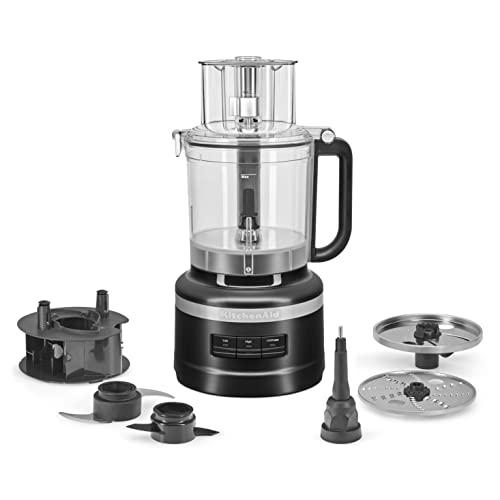
KitchenAid’s 13-cup processor is the brand’s largest current model and the one that shows off its best idea: the Exact Slice disc, which you adjust from thick to thin with a control outside the bowl. That means you can slice tomatoes thick for a salad and onions thin for a garnish without stopping to change discs or reaching near a blade.
In the box are the 13-cup work bowl, a multipurpose blade, the adjustable slicing disc, a reversible shredding disc, a dough blade and a storage caddy that keeps all of them inside the bowl. The 3-in-1 feed tube takes ingredients of different shapes and sizes, from whole tomatoes to cucumbers and potatoes, according to KitchenAid. The bowl assembles with one click, without twisting, and the lid latches.
KitchenAid does not give a wattage on the listing; retailers list 500 watts, lower than Cuisinart’s 720-watt Custom 14. For everyday chopping, slicing, shredding and salsa that is enough. The warranty is one year, the shortest of the two picks, so keep your receipt.
Why we like it
- Slice thickness adjusts from outside the bowl
- All blades and discs store inside the bowl
- 3-in-1 feed tube for different shapes
- Dough blade included
Key specifications
| Model | KFP1318BM (Black Matte) |
|---|---|
| Bowl capacity | 13 cups |
| Motor (as stated) | Not stated on listing; 500 W per retailers |
| Blades and discs | Multipurpose blade, adjustable slicing disc, reversible shredding disc, dough blade |
| Slicing | Adjustable, thick to thin, from outside |
| Feed tube | 3-in-1 |
| Storage | In-bowl caddy for blades and discs |
| Warranty | 1 year |
Why we recommend it
It suits a cook who slices and shreds more than they knead, wants control over slice thickness, and likes a tidy machine with everything stored in the bowl.
Skip it if you make a lot of bread dough or want a long motor warranty; the Cuisinart Custom 14 states more power and five years on the motor.
Pros and cons
Pros
- Adjustable slicing without changing discs
- One-click bowl and latched lid
- Leak-resistant bowl, per KitchenAid
Cons
- One-year warranty
- Wattage not published on the listing
- Bowl one cup smaller than the Cuisinart
2. Cuisinart Custom 14-Cup Food Processor – Big Bowl, Five-Year Motor Warranty

The Custom 14 is the Cuisinart most people picture: two paddles, a 14-cup bowl and an extra-large feed tube. Cuisinart rates the motor at 720 watts and says it can handle almost anything, from hummus, salsa and guacamole to pureed soups, and the listing names kneading dough among its jobs.
It comes with a stainless steel standard slicing disc (4 mm), a medium shredding disc and a stainless chopping and mixing blade, plus a detachable disc stem, a spatula, and small and large pushers in the feed tube. Cuisinart is upfront that the discs are not adjustable; for other slice thicknesses you buy extra discs. The controls are an “on” paddle and an “off/pulse” paddle, the cord is 36 inches, and Cuisinart says the parts are dishwasher-safe.
The warranty is the strongest of the two: a full five years on the motor and a limited three years on the machine. Cuisinart’s 2016 blade recall covered machines sold through December 2015, not ones sold new today.
Why we like it
- 14-cup bowl, the largest of either brand
- 720-watt motor, per Cuisinart
- Extra-large feed tube with two pushers
- Full five-year motor warranty
Key specifications
| Model | DFP-14BKSY (Black Stainless) |
|---|---|
| Bowl capacity | 14 cups |
| Motor (as stated) | 720 W |
| Blades and discs | Chopping/mixing blade, 4 mm slicing disc, medium shredding disc |
| Slicing | Fixed 4 mm; not adjustable |
| Feed tube | Extra-large, with small and large pushers |
| Storage | Not built in |
| Warranty | Full 5 years on motor; limited 3 years |
Why we recommend it
It suits a cook who works in big batches, makes dough, and wants a simple machine with a long motor warranty.
Skip it if you want to change slice thickness often; you will need to buy and store extra discs.
Pros and cons
Pros
- Most power and capacity of the two
- Simple two-paddle controls
- Dishwasher-safe parts, per Cuisinart
Cons
- Slicing and shredding discs not adjustable
- No in-bowl storage for discs
- No separate dough blade listed
How we compared KitchenAid and Cuisinart
We did not test these processors. We compared what KitchenAid and Cuisinart state on their current Amazon listings: bowl size, motor, included blades and discs, slicing, feed tube, cleaning and warranty, and we name retailer listings where a maker does not publish a figure, such as KitchenAid’s wattage. We checked that both picks were in stock on Amazon when we wrote this and searched the U.S. Consumer Product Safety Commission’s recall database for both brands. We did not compare prices, which change often.

KitchenAid and Cuisinart questions, answered
Is KitchenAid or Cuisinart better for a food processor?
It depends on the job. Cuisinart’s Custom 14 has the bigger bowl, a stated 720-watt motor and a five-year motor warranty. KitchenAid’s 13-cup has adjustable slicing, a 3-in-1 feed tube and in-bowl storage, with a one-year warranty.
Which brand has the longer warranty?
Cuisinart. Its classic models carry a full five-year motor warranty and a limited three-year warranty. KitchenAid’s listings state one year.
Which is better for slicing?
KitchenAid’s 13-cup, because you set the thickness from outside the bowl. Cuisinart’s Custom 14 has a fixed 4 mm disc; its Core Custom 10-cup has an adjustable one.
Which is better for dough?
On paper, Cuisinart: it publishes higher wattages, and it says its 7-cup handles batch after batch of thick dough. KitchenAid includes a dough blade with its 13-cup and 9-cup but does not publish wattage on its listings.
Are old Cuisinart food processors safe to use?
Check the blade. The 2016 recall covers Cuisinart processors sold from July 1996 through December 2015 with four rivets in the blade; Cuisinart replaces the blade free. Current models are outside that recall.
Our final word on KitchenAid vs Cuisinart
Both brands make capable full-size processors, and neither is a wrong choice. Choose the Cuisinart Custom 14 for capacity, power and warranty, and the KitchenAid 13-cup for slicing control and a tidier machine. If you already own a KitchenAid stand mixer, our best stand mixer guide covers the attachments that can take on some processor jobs.
For every kind of processor, from mini choppers to 16-cup machines, start with our guide to the best food processor. Or let us do the chopping: see the menu or call to order.