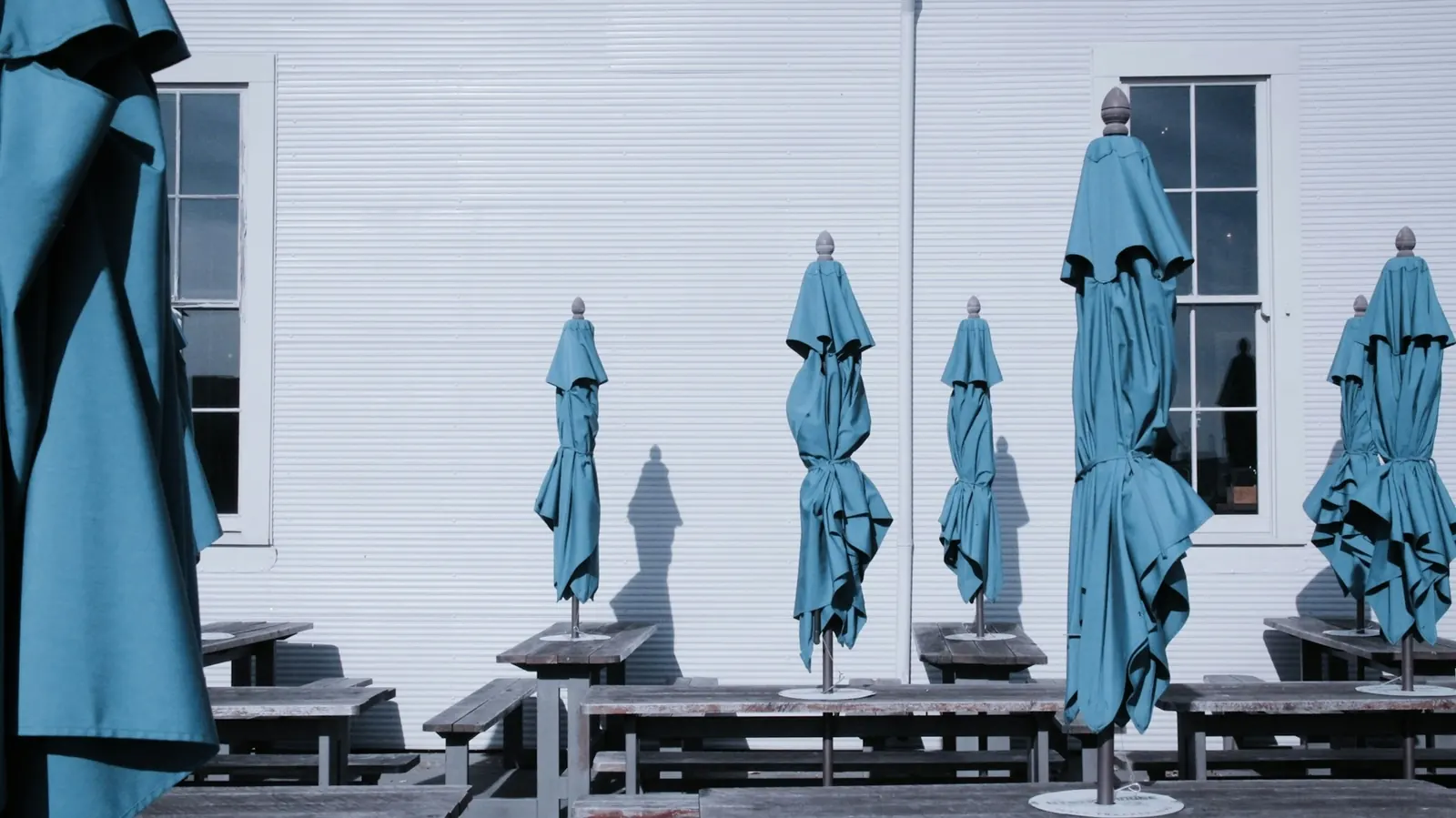
Houston afternoons have a habit. The sun is out, the table is set, and then a gust comes off the yard and lifts the umbrella straight up in its base, or folds a rib back like a broken kite. Anyone who has run a patio knows the sound of an umbrella tipping into a table of drinks, and knows that the fix is half equipment and half habit.
This guide is for a yard or deck that catches a breeze. It narrows our patio umbrella guide down to seven umbrellas built with wind in mind: fiberglass ribs that bend instead of snapping, vented tops that let gusts escape, and commercial frames from California Umbrella, FiberBuilt, EliteShade, ABCCANOPY and Tropishade. We quote every wind claim exactly as the maker states it, and none of them is a promise that an open umbrella will survive a storm. Every maker that addresses wind says the same thing: close it.
Julia’s earns a commission on purchases made through links on this page, at no cost to you. Recommendations are based on what a restaurant kitchen looks for, product specifications and verified buyer reports.
Quick verdict: which wind-ready umbrella to buy
For most windy patios, the California Umbrella 9′ Sun Master Fiberglass Rib Umbrella is the one to buy: eight fiberglass ribs that California Umbrella says flex in wind better than aluminum, a wind vent, sewn-in ties to close it tight, a Sunbrella canopy and a three-year warranty on the ribs. If you want a stated wind figure, FiberBuilt says its 9-foot umbrella was wind tested at 50 mph. For the most venting, the EliteShade 9ft 3-Tier umbrella lets air out through three stacked vents.
The table compares the five picks that cover the most kinds of windy yard. All seven are reviewed in full after it.
Five wind-ready umbrellas at a glance
Size, how each frame handles wind, and what the maker says about it.
| Umbrella | Size & lift | Ribs & vents | Maker’s wind claim | Buy on Amazon |
|---|---|---|---|---|
| 9 ft round, crank, collar tilt | 8 fiberglass ribs, wind vent | “Superior flexibility in windy conditions” | View on Amazon | |

FiberBuilt 9′ Market UmbrellaStated wind test
|
9 ft octagon, crank | Flexible frame; rib count not stated | “Wind tested at 50 MPH” | View on Amazon |

EliteShade 9ft 3-Tier Market UmbrellaMost venting
|
9 ft round, crank, push-button tilt | 8 ribs, steel frame, 3-tier vented top | Vents make it “more stable against windy condition” | View on Amazon |

California Umbrella 11′ Alto Commercial UmbrellaBest for a big table
|
11 ft round, double pulley lift | Reinforced fiberglass ribs, 2 mm-wall pole | Better wind resilience than metal ribs | View on Amazon |

Tropishade 9′ Fiberglass Rib UmbrellaBudget fiberglass
|
9 ft, crank, 3-position tilt | 6 fiberglass ribs, wind vent | Vent “for stability”; warranty excludes wind damage | View on Amazon |
Product images from Amazon. Specifications and wind claims as stated by each maker or Amazon listing; check the listing before you buy.
Our picks for the best patio umbrella for wind
The first four are 9- and 10-foot market umbrellas for an ordinary patio table. Then come two commercial-style California Umbrella Alto models, one large and one small, and a budget fiberglass pick. None of these is in our main patio umbrella guide except as a close relative, and we say where.
1. California Umbrella 9′ Sun Master Fiberglass Rib Umbrella – Ribs That Bend in a Gust

This is the fiberglass-rib version of a California Umbrella model we already recommend in the main guide. The canopy, the crank and the collar tilt are the same, and so is the Sunbrella fabric. What changes is the ribs. The aluminum version uses square aluminum ribs; this one uses round fiberglass ribs, which California Umbrella says offer superior flexibility in windy conditions. Its FAQ puts it plainly: fiberglass ribs are more flexible, especially in windy settings, than aluminum ribs. That is why it is here and not just there.
The rest of the frame is rust-free aluminum with stainless steel hardware, eight ribs and a 1.5-inch aluminum pole, so it fits a standard table hole. You crank it open and twist a collar on the pole to tilt it. A built-in wind vent lets pressure escape from under the canopy, and sewn-in fabric ties hold the canopy tight when it is closed, which matters because a loose canopy flaps and catches wind even when it is down.
The warranty is the clearest on this page: one year on the frame, three years on the fiberglass ribs against breakage “in stable climate conditions” and five years against fading on the Sunbrella fabric. The listing we checked is Taupe. The base is not included.
Why we like it
- Eight fiberglass ribs, per California Umbrella
- Built-in wind vent and sewn-in ties
- Three-year rib warranty
- Sunbrella acrylic with a five-year fade warranty
Key specifications
| Model | GSCUF908117-5461 |
|---|---|
| Size | 9 ft round |
| Ribs | 8 fiberglass |
| Vent | Single wind vent |
| Pole | 1.5 in aluminum |
| Lift/tilt | Crank, collar tilt |
| Wind claim (maker) | “Superior flexibility in windy conditions”; no mph rating |
| Warranty | 1 yr frame, 3 yr fiberglass ribs, 5 yr Sunbrella fade |
Why we recommend it
It suits a family table on an open patio that sees afternoon gusts, and anyone who has already bent an aluminum rib and wants the frame to flex next time.
Skip it if you want a stated wind speed. California Umbrella describes flexibility but gives no mph figure, and its warranty does not cover wind damage.
Pros and cons
Pros
- Fiberglass ribs from a long-established maker
- Longest rib warranty here
- Ties to close the canopy tight
Cons
- No wind rating given
- Base sold separately
2. FiberBuilt 9′ Market Umbrella – A Wind Figure on the Listing
FiberBuilt is a company named for its fiberglass frames, and its own site says its ribs hold up to harsh winds and salt air without losing shape. This 9-foot market umbrella is the one listing on this page that gives a number: FiberBuilt states it was “wind tested at 50 MPH”, and adds that “flexibility is our greatest strength”. We have not seen the test itself, so read that as the maker’s claim, not a rating to stand under in a storm.
The canopy is octagonal, 9 feet across and 96 inches high, and opens with a crank. The pole is two pieces of powder-coated aluminum, 1.5 inches in diameter, which fits most table holes and most bases. The cover is spun acrylic that FiberBuilt says protects from the sun’s rays. FiberBuilt calls it contract grade and says it is used in many multi-family settings.
The listing does not mention a tilt, a rib count or a vent, so plan on a straight canopy. The warranty is one year against manufacturer’s defects. The color we link is Forest Green with a champagne bronze pole.
Why we like it
- Maker states it was wind tested at 50 mph
- Contract-grade frame, per FiberBuilt
- 1.5 in two-piece aluminum pole
- Spun acrylic canopy
Key specifications
| Model | 9HCRCB-Forest Green |
|---|---|
| Size | 9 ft octagon, 96 in high |
| Ribs | Flexible (FiberBuilt fiberglass line); count not stated |
| Vent | Not stated |
| Pole | 1.5 in powder-coated aluminum, 2 pieces |
| Lift/tilt | Crank; tilt not stated |
| Wind claim (maker) | “Wind tested at 50 MPH” |
| Warranty | 1 year, manufacturer’s defects |
Why we recommend it
It suits a buyer who wants a frame from a fiberglass specialist and a written wind figure to compare against, for a pool deck or a table that stays put.
Skip it if you need to tilt the shade as the sun drops. The listing does not mention a tilt.
Pros and cons
Pros
- Only stated mph figure among the 9-footers
- Acrylic canopy
- Standard pole size
Cons
- Rib count and vent not stated
- No tilt mentioned
- One-year warranty

3. EliteShade 9ft 3-Tier Market Umbrella – Three Vents to Spill the Gusts
EliteShade takes the other route to wind: instead of a flexible frame, it gives the air somewhere to go. The canopy is built in three tiers, and EliteShade says hot air or wind flows through the multiple vents quickly, which makes the umbrella more stable in windy conditions and cooler underneath. On a humid Houston evening, that second point is as welcome as the first.
The frame is alloy steel, powder-coated against rust, with eight ribs and a 1.5-inch pole. It opens with a crank and tilts with a push button. The canopy is 100% solution-dyed acrylic at 260 gsm, and EliteShade claims ten years without fading on the top, plus water and oil resistance. That is a strong fabric claim at this size; we report it as EliteShade’s own.
The base is not included, and EliteShade points buyers to its own range of bases. No warranty is stated on the listing. The color we link is Heather Beige.
Why we like it
- Three-tier vented top
- Solution-dyed acrylic canopy, 260 gsm
- 1.5 in powder-coated steel pole
- Crank and push-button tilt
Key specifications
| Model | 9Ft-3 (WUMB_J) |
|---|---|
| Size | 9 ft round |
| Ribs | 8, powder-coated steel frame |
| Vent | 3-tier vented top |
| Pole | 1.5 in alloy steel |
| Lift/tilt | Crank, push-button tilt |
| Wind claim (maker) | Vents make it “more stable against windy condition”; no mph rating |
| Warranty | Not stated |
Why we recommend it
It suits a patio where the breeze is steady rather than violent, and anyone who wants an acrylic canopy and a tilt in the same umbrella.
Skip it if fiberglass ribs are the point. This frame is steel, so it relies on venting, not flex.
Pros and cons
Pros
- Most venting of the 9-footers
- Acrylic fabric
- Tilts
Cons
- Steel ribs, not fiberglass
- No warranty stated
4. ABCCANOPY 10FT 3-Tier Market Umbrella – Vents and Fiberglass Together

ABCCANOPY combines both approaches in one 10-foot umbrella: a three-tier vented top and eight fiberglass ribs. ABCCANOPY’s listing says it can “withstand +36 mph wind”, and explains that fiberglass ribs are tougher and more elastic than iron ribs. As with every figure here, that is the maker’s claim, not an independent rating.
A 10-foot canopy covers a larger round table than a 9-footer, and the listing describes the vented path as letting crosswinds blow through for extra stability. It opens with a crank and tilts with a push button. The canopy is solution-dyed polyester with a UPF 50+ coating, and ABCCANOPY says the color lasts two years, a more modest and more believable claim than many.
The listing does not give a pole diameter, a base or a warranty, so check the pole against your table hole and base before you order. The color we link is Navy Blue.
Why we like it
- Eight fiberglass ribs
- Three-tier vented top
- Maker states +36 mph wind
- 10 ft canopy
Key specifications
| Model | 3 Tiers Umbrella 10FT Navy |
|---|---|
| Size | 10 ft round |
| Ribs | 8 fiberglass |
| Vent | 3-tier vented top |
| Pole | Not stated |
| Lift/tilt | Crank, push-button tilt |
| Wind claim (maker) | “Withstand +36 mph Wind” |
| Warranty | Not stated |
Why we recommend it
It suits a six-seat round table in an exposed yard, where you want both a flexible frame and venting in a home-patio umbrella.
Skip it if you need to know the pole diameter before buying. The listing does not say.
Pros and cons
Pros
- Fiberglass and venting in one frame
- Larger shade area
- Stated wind figure
Cons
- Polyester, not acrylic
- Pole size and warranty not stated
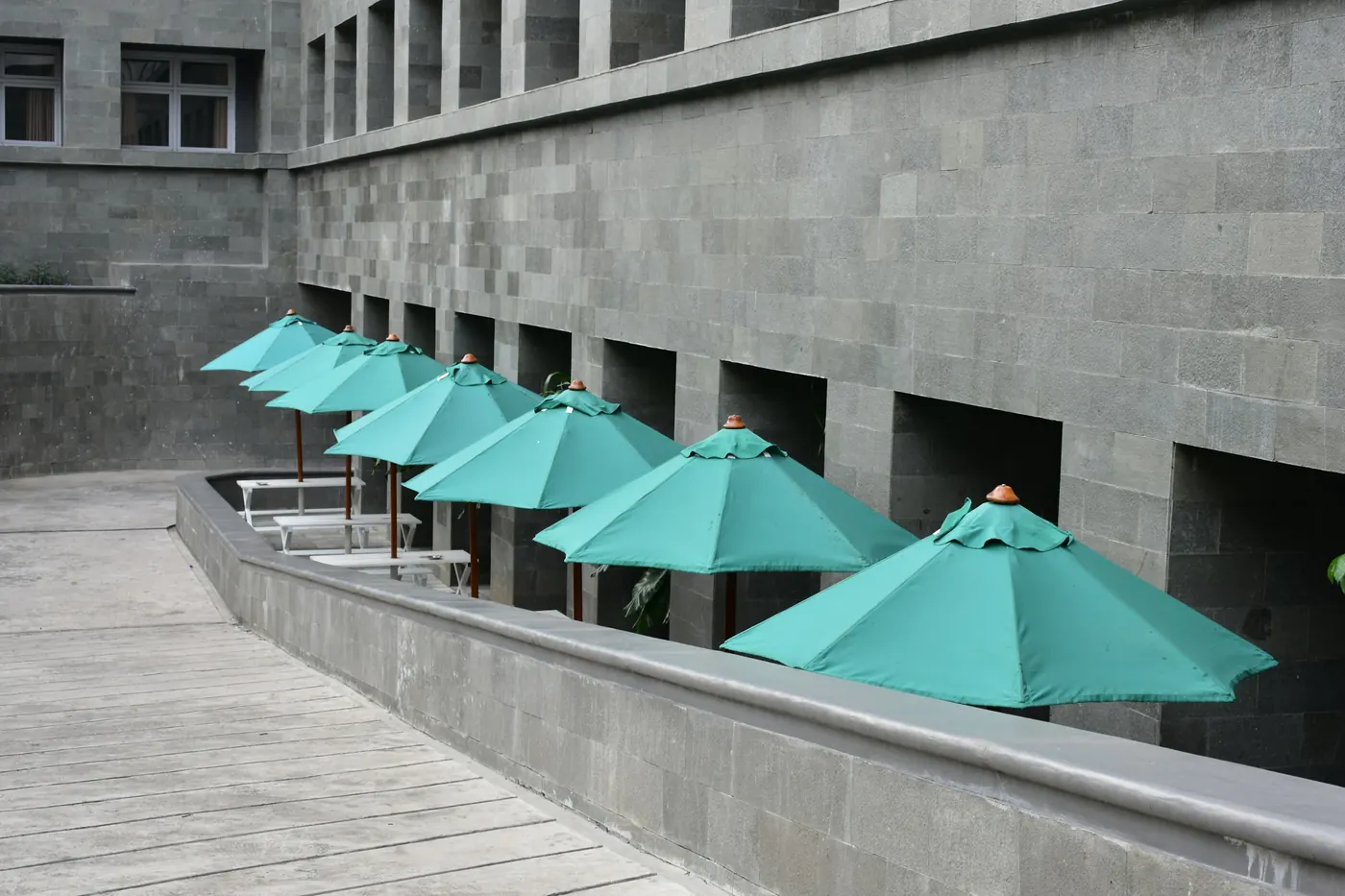
5. California Umbrella 11′ Alto Commercial Umbrella – Restaurant-Grade Frame for a Long Table
The Alto is the kind of umbrella you see on restaurant patios and resort pool decks, and California Umbrella lists it as designed for outdoor dining areas and high-traffic patios. At 11 feet it shades a big round table or a long one with six to eight chairs. California Umbrella describes the frame as commercially rated, with reinforced fiberglass ribs engineered to flex under pressure and resist breakage, and says they deliver better wind resilience than standard metal ribs.
The pole is aluminum with a 2 mm-thick wall, heavier than a typical home umbrella pole. It opens with a double rope-and-pulley lift, which California Umbrella says stands up to frequent daily use; there is no crank and no tilt. The canopy is Sunbrella, which the listing says is guaranteed not to fade for more than five years.
Read the manual before you buy. California Umbrella’s Alto instructions say the umbrella is not meant for use in windy or inclement weather and should always be closed and tied before high wind. The same manual sets a minimum base weight of 70 pounds to keep warranty coverage in commercial settings, and California Umbrella’s own size guide calls for 100 pounds or more for an 11-foot umbrella. Budget for that base. The color we link is Pacific Blue.
Why we like it
- Commercially rated frame, per California Umbrella
- Reinforced fiberglass ribs
- 2 mm-wall aluminum pole
- Sunbrella canopy
Key specifications
| Model | AMZLTO118002-5401-SWV |
|---|---|
| Size | 11 ft round |
| Ribs | Reinforced fiberglass |
| Vent | Not stated on listing |
| Pole | Aluminum, 2 mm wall |
| Lift/tilt | Double pulley lift; no tilt |
| Wind claim (maker) | Better wind resilience than metal ribs; manual: not for windy weather |
| Warranty | Not stated on listing |
Why we recommend it
It suits a big family table or a small business patio where the umbrella goes up and down every day and has to keep doing it for years.
Skip it if you want to tilt the shade or you cannot fit a heavy base. Without one, an 11-foot canopy is the riskiest umbrella on this page.
Pros and cons
Pros
- Heaviest-duty frame here
- Large shade
- Clear manual guidance on base weight
Cons
- No tilt
- Needs a very heavy base
- Rope-and-pulley lift, no crank
6. California Umbrella 7.5′ Alto Push-Open Umbrella – Less Canopy, Less Wind Load

The simplest way to make an umbrella safer in wind is to make it smaller. A 7.5-foot canopy has much less fabric for a gust to push on than a 9- or 11-foot one, and it suits a bistro table for two, a balcony or a small deck. California Umbrella’s small Alto keeps the commercial details of its bigger sibling.
The ribs are half-inch contract-grade fiberglass, there is a single wind vent, and the pole is a two-piece aluminum tube with a 2 mm wall. There is no crank: you push the canopy up the pole and pin it, a simpler mechanism with no gears. All hardware is stainless steel. The canopy is Sunbrella solution-dyed acrylic.
The warranty is one year on the frame and three years on the fiberglass ribs. The base is not included; California Umbrella’s size guide calls for at least 50 pounds for an umbrella up to 7.5 feet. Like the 11-foot Alto, it is covered by the manual that says to close and tie it before high wind. The listing we checked is Navy.
Why we like it
- Half-inch contract-grade fiberglass ribs
- Single wind vent
- Simple push-up lift with no crank
- Three-year rib warranty
Key specifications
| Model | ALTO758117-5439 |
|---|---|
| Size | 7.5 ft round |
| Ribs | 1/2 in contract-grade fiberglass |
| Vent | Single wind vent |
| Pole | Two-piece aluminum, 2 mm wall |
| Lift/tilt | Push open; no tilt |
| Wind claim (maker) | None on listing; manual: close in windy conditions |
| Warranty | 1 yr frame, 3 yr fiberglass ribs |
Why we recommend it
It suits a balcony, a small deck or a two-seat table where a big umbrella would be overkill and the wind comes around the corner of the building.
Skip it if you need shade over four or more chairs. At 7.5 feet the canopy will not reach.
Pros and cons
Pros
- Small canopy, small wind load
- Commercial fiberglass frame
- Sunbrella fabric
Cons
- No tilt or crank
- Shades a small table only
7. Tropishade 9′ Fiberglass Rib Umbrella – Fiberglass Ribs on a Budget
Tropishade’s 9-foot umbrella is the most basic fiberglass-rib frame on this page. It has six fiberglass ribs, which Tropishade fits for extra strength, and a single wind vent that it says is there for stability. The frame is aluminum with a rust-free bronze powder coat.
It opens with a crank and has what Tropishade calls a three-position dura-tilt. The pole is 1.375 inches, slightly slimmer than the common 1.5 inches, and joins with a push-button coupling; Tropishade says it fits most patio furniture and bases, but check your base’s adapter. The cover is polyester, with no UV or fade figure given.
The warranty is honest in a way that tells you something: one year from purchase, and it does not cover wind damage. Six ribs means more fabric between each one than an eight-rib canopy, so treat this as a sensible budget frame and close it early. The base is not included. The listing we checked is Beige.
Why we like it
- Six fiberglass ribs
- Single wind vent
- Crank and three-position tilt
- Aluminum frame, powder-coated
Key specifications
| Model | 636B19 |
|---|---|
| Size | 9 ft |
| Ribs | 6 fiberglass |
| Vent | Single wind vent |
| Pole | 1.375 in aluminum |
| Lift/tilt | Crank, 3-position tilt |
| Wind claim (maker) | Vent “for stability”; no mph rating |
| Warranty | 1 year; excludes wind damage |
Why we recommend it
It suits a buyer who wants ribs that flex rather than snap, on a budget, for a yard with an occasional breeze.
Skip it if you want a premium canopy. The polyester cover has no stated UV or fade rating.
Pros and cons
Pros
- Fiberglass ribs and a tilt
- Tilts
- Clear warranty terms
Cons
- Only six ribs
- Slimmer 1.375 in pole
- Polyester canopy
How to choose an umbrella for a windy patio
No umbrella is windproof, whatever the listing title says. What you can buy is a frame that fails less often and a setup that keeps it on the ground. These are the points that matter.
1. Fiberglass ribs or vents, ideally both
Ribs take the load when a gust hits. Aluminum and steel ribs are stiff, and when they go past their limit they bend or snap. Fiberglass ribs flex and spring back. California Umbrella says its fiberglass ribs are more flexible in windy settings than aluminum, and backs them with a three-year warranty against one year on aluminum ribs. Vents attack the problem from the other side, by letting pressure escape through the top. A single vent is standard; EliteShade and ABCCANOPY use three tiers.
2. Read wind claims for what they are
FiberBuilt says “wind tested at 50 mph”, ABCCANOPY says “+36 mph”. Neither publishes how the test was run, and neither is a promise that the umbrella will stay up at that speed in your yard, in your base. Treat a number as a way to compare frames, not as a reason to leave the umbrella open. Tropishade and California Umbrella both exclude wind damage from their warranties, which tells you how makers really view it.
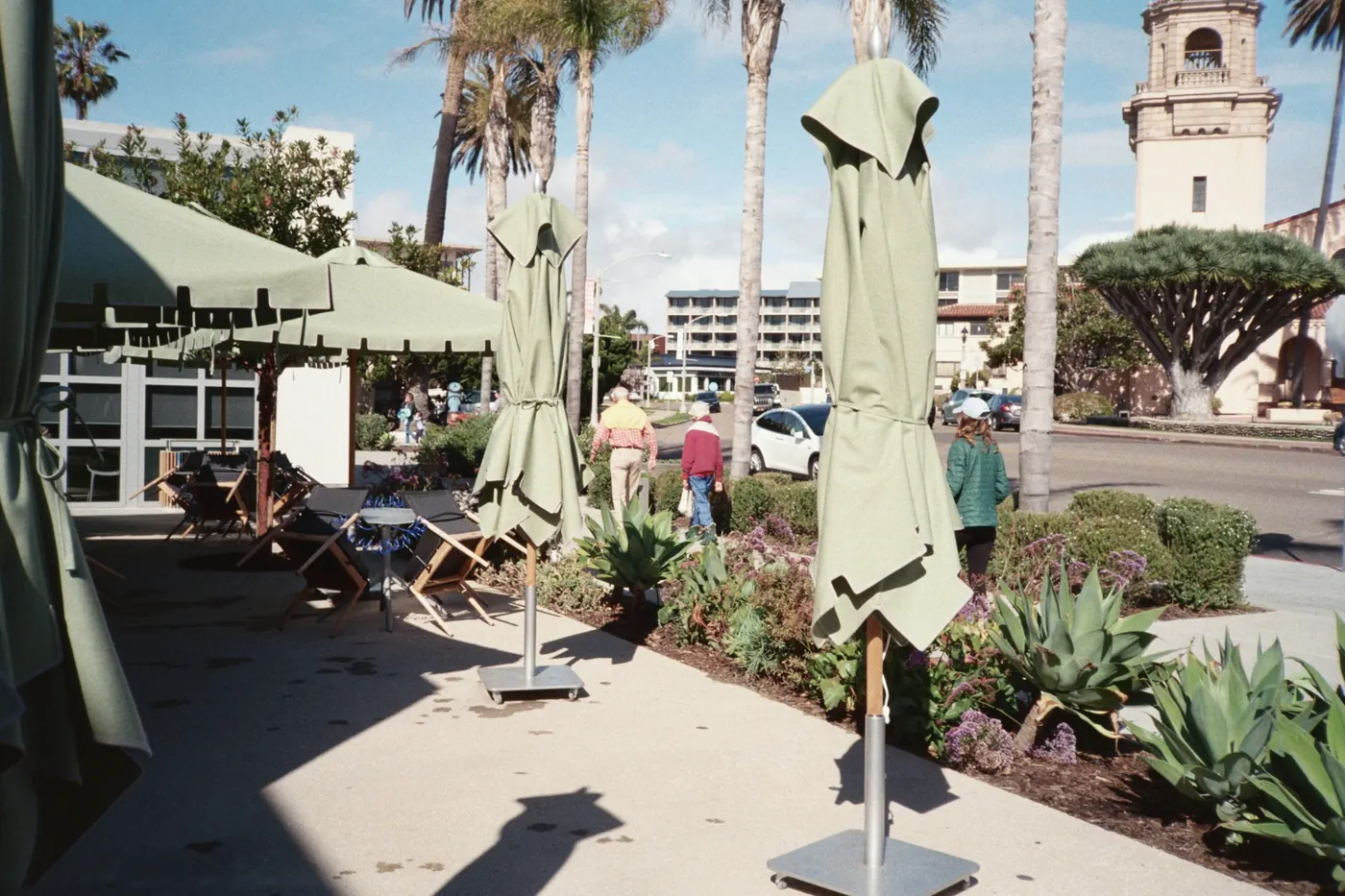
3. Size down if your yard is exposed
Every extra foot of canopy is more fabric for the wind to push. California Umbrella’s own sizing advice is a canopy about 2 feet wider than the table on each side, and it warns that going much wider without a massive base “turns your umbrella into a kite”. On a windy balcony, a 7.5-foot umbrella is the safer choice.
4. The base does most of the work
A strong frame in a light base just tips over in one piece. California Umbrella’s size guide asks for at least 50 pounds up to 7.5 feet, 60 to 75 pounds for 9 feet and 100 pounds or more for 11 feet, and more again for a freestanding umbrella. A table helps, but California Umbrella’s FAQ says an umbrella used in a table should still sit in a base of suitable weight to provide stability against wind.
5. Close it: the one rule every maker agrees on
California Umbrella’s care guide puts it simply: a patio umbrella is a shade device, not a wind structure, and no canopy and no amount of ballast makes an open umbrella safe in a gust front. Close and tie the canopy before a storm, a high-wind warning or an overnight absence, and if the canopy starts to lift or the frame shudders, close it then. Never move or rotate an umbrella while it is open. And keep any canopy well clear of a grill or fire pit; the fabric is not made to sit over open flame.
How we chose these seven wind-ready umbrellas
We started from what a restaurant patio needs: an umbrella that will not fold or fly the first time a summer storm rolls in. We looked only for frames with a stated wind feature, fiberglass ribs or a multi-tier vent, from makers with their own Amazon listings that were in stock when we checked, and we skipped unbranded listings and near-identical models sold under different names. We left out every umbrella already in our main patio umbrella guide, except the fiberglass sibling of one California Umbrella model, for the reason given in its review. Specifications, wind claims and warranties come from each maker’s Amazon listing, California Umbrella’s own manual, FAQ, care page and size guide, and FiberBuilt’s website. We checked the U.S. Consumer Product Safety Commission’s recall database for each brand here and found no recalls for them. We have not used these umbrellas for this guide.
Windy-patio umbrella questions, answered
What is the best patio umbrella for strong winds?
One with flexible fiberglass ribs, a vent, and a base heavy enough for its size, closed whenever the wind picks up. The California Umbrella 9′ Sun Master fiberglass model fits that best for an ordinary table. But no umbrella on the market should be left open in strong winds; every maker that addresses it says to close it.
Are fiberglass ribs better than aluminum in wind?
For gusts, yes, according to the makers. California Umbrella says its fiberglass ribs are more flexible in windy settings than aluminum ribs and warrants them for three years instead of one. California Umbrella describes them as engineered to flex under pressure and resist breakage.
Which are the top rated patio umbrellas for wind?
We do not quote star ratings, which change. Among makers that publish a wind figure, FiberBuilt states its 9-foot umbrella was wind tested at 50 mph and ABCCANOPY says its 10-foot umbrella withstands over 36 mph. Treat both as maker claims.
Do vents really help in wind?
They help, but they do not make an umbrella windproof. A vent lets air escape through the top instead of lifting the canopy. EliteShade and ABCCANOPY use three tiers of vents; most others have one.
How heavy a base does a windy patio need?
Start with the maker’s figure and go heavier. California Umbrella recommends at least 60 to 75 pounds for a 9-foot umbrella and 100 pounds or more for 11 feet, with extra weight when the umbrella stands on its own. Our guide to the best patio umbrella covers base types alongside the umbrellas.
Our final word on the best patio umbrella for wind
Buy the California Umbrella 9′ Sun Master fiberglass model for a standard table, the FiberBuilt 9-footer if you want a stated wind test, the EliteShade 3-Tier for maximum venting, and the 11-foot Alto only if you can give it a 100-pound base. Whatever you choose, fasten the ties and close it when the wind comes up. For the rest of the outdoor table, see our guides to the best outdoor dining set and outdoor string lights.
When the weather turns and dinner moves indoors, see the menu for party trays and family plates, or call to order.