Chlorine is usually the first thing you notice in tap water, and a kitchen notices it fast: in a pitcher of agua fresca, a pot of beans or a tray of ice. It is also one of the easier problems to address, because ordinary carbon filters are built for it. Penn State Extension names carbon filtration as a way to reduce chlorine, which is why the shelf is so crowded.
That crowding is the trouble. Almost every filter says it reduces chlorine. This guide only counts the ones where we could read an NSF/ANSI 42 certification on the listing or in a certifier’s directory. It also tells you who did the certifying, and where the label stops short. These are taste and odor filters first, and we make no health claims for them.
Julia’s earns a commission on purchases made through links on this page, at no cost to you. Recommendations are based on what a restaurant kitchen looks for, product specifications and verified buyer reports.
Quick verdict: which chlorine filter to buy
For most kitchens the EcoPure EPWPFF is the one to buy: listed in NSF’s directory under NSF/ANSI 42 and 53, a spare filter in the box and no second faucet to drill for. If you rent, the PUR Plus faucet filter needs no tools and its model appears in NSF’s own directory under Standard 42. If you want no installation at all, the Epic Pure XP pitcher states NSF/ANSI 42 outright.
Five chlorine filters at a glance
One filter for each way of fitting one into a kitchen. All seven filters are reviewed in full below.
| Chlorine filter | Type | Standard, as read | Rated life | Buy on Amazon |
|---|---|---|---|---|

EcoPure EPWPFF Direct Connect FilterBest overall
|
Under sink, your faucet | NSF/ANSI 42, 53 (NSF directory) | 6 months (listing) | View on Amazon |

PUR Plus Faucet-Mount FilterBest for renters
|
Faucet mount | NSF/ANSI 42 (NSF directory) | 100 gal or 3 months | View on Amazon |

Epic Pure XP 10-Cup PitcherBest pitcher
|
10-cup pitcher | NSF/ANSI 42, 372 (listing) | 100 gal, 3 to 4 months | View on Amazon |

EcoPure ECOP20 2-Stage Under Sink SystemBest with its own faucet
|
Under sink, separate faucet | NSF/ANSI 42, 53 (NSF directory) | 270 gal (NSF) | View on Amazon |

Waterdrop CTF-03 Countertop FilterBest countertop
|
Countertop, on the faucet | NSF/ANSI 42 (listing) | 8,000 gal or 12 months | View on Amazon |
Product images from Amazon. Standards are as stated on the listing or in the named directory; check the current label before you buy.
What NSF/ANSI 42 tells you, and what it does not
NSF/ANSI 42 is the standard these listings cite for chlorine, taste and odor. Read the claim line, not just the number: NSF’s directory lists “Chlorine Reduction” and “Taste and Odor Reduction” as separate entries for each model, so you can see exactly what a certification covers.
Two details catch people out. The first is the certifier. NSF is one of several bodies; the EPA’s page on certified filters also names CSA Group, IAPMO R&T, UL and WQA, so an IAPMO mark will not appear in NSF’s list and has to be looked up with IAPMO. The second is chloramine. NSF’s directory treats “Chloramine Reduction” as its own claim, separate from chlorine. If your water utility disinfects with chloramine, a chlorine line on the label does not cover it, so ask the utility and look for the word itself.
These filters also leave dissolved minerals alone. Waterdrop says plainly that its system below will not reduce TDS, so do not expect them to touch hard water scale.
Our picks for the best water filter for chlorine
Ordered by how well each suits an ordinary home kitchen, and each one has a Standard 42 statement we read ourselves. The last two are Amazon’s house brand and Waterdrop, and they rest on the listing alone.
1. EcoPure EPWPFF Direct Connect Filter – On NSF’s List, No Extra Faucet
This is an under-sink filter that connects to the cold line, so filtered water comes out of the faucet you already have. We read it in NSF’s own directory: the EcoPure EPWPFF is listed under NSF/ANSI 42 for chlorine reduction, taste and odor reduction and Class I particulate reduction, and under NSF/ANSI 53 for lead, mercury, benzene and cyst reduction. The listing holder is Water Channel Partners, and the replacement element is the EPWPRF.
This bundle includes one extra EPWPRF filter. The cartridge twists off without tools and without shutting off the water, and EcoPure says to change it every six months. The housing is about 14 by 4 inches, and color-coded inlet and outlet tubing comes with an installation guide.
The listing’s contaminant count is inconsistent (58 in one line, 72 in the title), so go by the NSF directory rather than the number. It does not give a gallon rating or a warranty. Measure first, since it has to fit under the sink with room to change the filter.
Why we like it
- In NSF’s directory under Standards 42 and 53
- Uses your existing faucet
- Spare filter in the box
- Twist-off filter change, no water shutoff
Key specifications
| Model | EPWPFF (filter EPWPRF) |
|---|---|
| Type | Under sink, direct connect |
| Chlorine standard | NSF/ANSI 42 (NSF directory) |
| Who certified it | NSF |
| Other claims read | NSF/ANSI 53: lead, mercury, benzene, cysts |
| Rated life | 6 months (listing); gallons not stated |
| Faucet | Your existing faucet |
| Warranty | Not stated in listing |
Why we recommend it
It suits a household that cooks and drinks from the kitchen tap and wants chlorine reduced in all of it, without a pitcher in the fridge or a second faucet in the counter.
Skip it if you rent and cannot touch the plumbing, or you want filtered and unfiltered water from the same sink.
Pros and cons
Pros
- Standards readable in NSF’s directory
- Spare filter included
- No countertop drilling
Cons
- Six-month change interval
- Your washing-up water goes through the filter too
- No gallon rating or warranty stated
2. PUR Plus Faucet-Mount Filter – On NSF’s List, No Tools
PUR’s faucet-mount unit installs on the tap with no tools. The listing says it is certified by NSF to reduce chlorine and WQA-certified to reduce lead, but it does not print the standard number, so we looked it up. NSF’s directory lists PUR model FM2500V, the model on this listing, under NSF/ANSI 42 for chlorine reduction, taste and odor reduction and Class I particulate reduction.
It is the smallest commitment on this page, and it behaves like one. The filter is rated at 100 gallons or three months, and a change light tells you when it is time. PUR says it fits most standard faucets and is not designed for pull-out or handheld models, which rules out a lot of newer kitchens. Check yours before ordering.
Why we like it
- FM2500V confirmed in NSF’s directory under Standard 42
- No tools to install
- Filter change light
- No plumbing work
Key specifications
| Model | FM2500V |
|---|---|
| Type | Faucet mount |
| Chlorine standard | NSF/ANSI 42 |
| Who certified it | NSF (directory); WQA for lead (listing) |
| Other claims read | Lead (WQA); microplastics (listing) |
| Rated life | 100 gal or 3 months |
| Faucet | Mounts on your faucet |
| Warranty | Not stated |
Why we recommend it
Choose it if you rent, or if you want to find out whether a filter changes your cooking water before you commit to anything under the sink.
Skip it if you have a pull-out or handheld faucet, which PUR says it is not designed for.
Pros and cons
Pros
- Model confirmed on NSF’s list
- No plumbing
- Change light
Cons
- Short 100-gallon life
- Does not fit pull-out faucets
- Sits on the faucet, in the way of big pots
3. Epic Pure XP 10-Cup Pitcher – Standard 42 Stated Outright
Pitchers are where the wording gets slippery, so it helps that Epic spells it out: the Pure XP filter is NSF certified to NSF/ANSI 42 and NSF/ANSI/CAN 372. Be careful with the next part of the same sentence. Epic says the filter is “independently tested to” other standards, including 53 and 401, which is a different thing from certified. We count the 42 claim for this page and treat the rest as Epic’s own statement.
The pitcher holds 10 cups, is made of BPA- and BPS-free Tritan and fits a fridge shelf, according to Epic. The filter lasts 100 gallons, about three to four months, and you replace only an inner cartridge rather than the whole housing. There is no installing, but you do wait for it to drip through, and Epic asks you to let the top chamber empty before pouring and to keep a hand on the lid. For more options, compare our water filter pitcher guide.
Why we like it
- States NSF certification to Standard 42 by number
- Replaceable inner cartridge
- Timer built into the lid
- No installation
Key specifications
| Model | EW-PTCH |
|---|---|
| Type | 10-cup pitcher |
| Chlorine standard | NSF/ANSI 42 |
| Who certified it | NSF (Epic’s statement on the listing) |
| Other claims read | NSF/ANSI/CAN 372; others tested, not certified |
| Rated life | 100 gal, about 3 to 4 months |
| Faucet | None |
| Warranty | Not stated |
Why we recommend it
It suits a small household or an apartment that drinks filtered water but cooks from the tap anyway.
Skip it if you want to fill stockpots, since a pitcher is the wrong tool for that volume.
Pros and cons
Pros
- Clear split between certified and tested claims
- Less plastic thrown out at each change
- Fits a fridge shelf
Cons
- Gravity filtering takes time
- Lid needs a hand on it when pouring, per Epic
- We did not check Epic in NSF’s directory
4. EcoPure ECOP20 2-Stage Under Sink System – Read It on NSF’s List
The ECOP20 is the pick for people who want to check the paperwork themselves. NSF’s directory lists it, with element ECODWF, under NSF/ANSI 42 for chlorine reduction and taste and odor reduction, and under NSF/ANSI 53 for cyst, lead, MTBE and VOC reduction. The figure of 58 contaminants in the listing is EcoPure’s own count.
It installs on the 3/8-inch cold line and comes with a chrome faucet, so unfiltered water stays at the main tap for washing up. That faucet needs a hole in the sink or counter. The directory rates it at 270 gallons and half a gallon a minute, which is much less than the direct-connect filters on this page. EcoPure says the filters twist off with no tools and no water shutoff.
Why we like it
- NSF directory entry for Standard 42 and 53
- Encapsulated filters twist off with no shutoff
- Included chrome faucet
- Warranty extends with registration, per EcoPure
Key specifications
| Model | ECOP20 (element ECODWF) |
|---|---|
| Type | Under sink, separate faucet |
| Chlorine standard | NSF/ANSI 42 |
| Who certified it | NSF (directory) |
| Other claims read | NSF/ANSI 53: cyst, lead, MTBE, VOC |
| Rated life | 270 gal (NSF) |
| Faucet | Included chrome faucet |
| Warranty | 1 year; lifetime with registration and regular filter changes |
Why we recommend it
It suits a cook who wants a dedicated tap for drinking and cooking water, and an entry on NSF’s site to point to.
Skip it if you need high flow or do not want to drill, since 0.5 GPM through a separate faucet will feel slow for big pots.
Pros and cons
Pros
- Most checkable certification here
- Dishwater does not use up the filter
- No-mess filter changes
Cons
- Lowest rated capacity of the under sink picks
- Needs a faucet hole
- Slow stated flow
5. Culligan US-DC3 Direct Connect System – A Year Between Changes
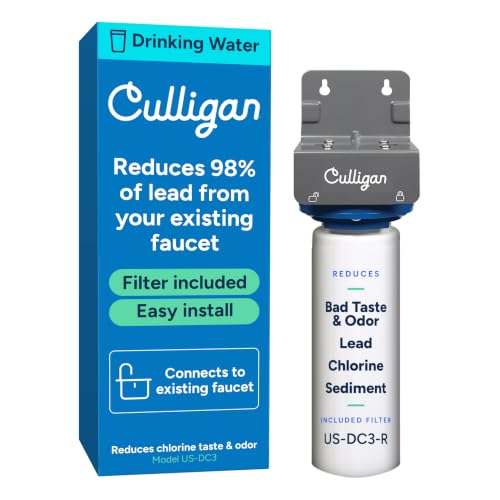
Culligan’s US-DC3 connects to the cold line and sends filtered water to your own faucet, like the EcoPure EPWPFF, but with a longer interval: up to 4,750 gallons or 12 months per cartridge. The stated flow is 1.5 gallons per minute. Culligan says its carbon block reduces chlorine taste and odor, sediment and Class I particulates as well as 98% of lead.
The system’s own listing says only “IAPMO Certified”. The standard numbers are on the listing for its replacement cartridge, the US-DC3-R, which says it is tested and certified to NSF/ANSI 42 and 53. We read the two together, and you should keep the replacement part number handy. The cartridge swaps with a twist-lock and no shutoff, and the system carries a two-year limited warranty.
Why we like it
- Standards stated on the cartridge listing
- 12-month, 4,750-gallon rating
- Twist-lock change with no shutoff
- 2-year limited warranty
Key specifications
| Model | US-DC3 (cartridge US-DC3-R) |
|---|---|
| Type | Under sink, direct connect |
| Chlorine standard | NSF/ANSI 42 (cartridge listing) |
| Who certified it | IAPMO (listing) |
| Other claims read | NSF/ANSI 53; lead; Class I particulate |
| Rated life | 4,750 gal or 12 months |
| Faucet | Your existing faucet |
| Warranty | 2-year limited |
Why we recommend it
Choose it if you would rather change a filter once a year, and you want the whole kitchen faucet filtered at a good flow.
Skip it if you want the standard numbers on the system’s own listing, since they appear only on the cartridge’s.
Pros and cons
Pros
- Long life with a lead claim as well
- Fast stated flow
- Installation parts included, per Culligan
Cons
- Standard number is on a separate listing
- Filters your washing-up water too
- Replacement is one specific cartridge
6. Amazon Basics Under Sink Filter – Does the One Job on the Label
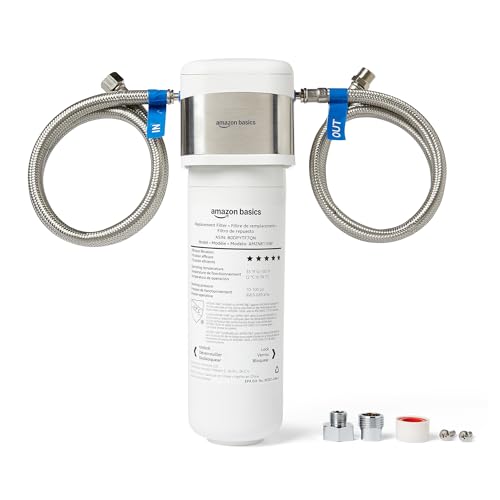
This is the plainest label on the page: it certifies chlorine, taste and odor and little else. Amazon’s listing says the filter is certified by IAPMO against NSF/ANSI 42 and NSF/ANSI 372, and rates it at 11,000 gallons or 12 months on municipal water, with a 3/8-inch line that connects to a standard US sink. It uses cold water only.
There is no lead claim, no Standard 53 and no reduction table in what we read, so do not buy it expecting more than better-tasting water. For that job a single twist-and-lock unit is enough. Amazon Basics is a house brand, and the listing gives no warranty term, so this one rests on the listing alone.
Why we like it
- IAPMO certification to Standard 42 stated
- Very high gallon rating
- Twist-and-lock changes
- Connects to your existing faucet
Key specifications
| Model | AMZN8116UA |
|---|---|
| Type | Under sink, direct connect |
| Chlorine standard | NSF/ANSI 42 |
| Who certified it | IAPMO (listing) |
| Other claims read | NSF/ANSI 372; no other reduction claims read |
| Rated life | 11,000 gal or 12 months |
| Faucet | Your existing faucet |
| Warranty | Not stated |
Why we recommend it
It suits someone whose only complaint about the water is the chlorine taste at the kitchen faucet.
Skip it if you want a lead or cyst claim; choose the EcoPure EPWPFF or Culligan instead.
Pros and cons
Pros
- Clear, narrow claim
- High capacity
- Named certifier
Cons
- Chlorine, taste and odor only
- No warranty term on the listing
- House brand with no data sheet read
7. Waterdrop CTF-03 Countertop Filter – No Plumbing, Stainless Housing
The CTF-03 sits on the counter and connects to the faucet, in a 304 stainless steel housing. The listing title says NSF/ANSI 42 certified and rates the filter at up to 12 months or 8,000 gallons. It does not name the certifier in the text we read, so treat that as Waterdrop’s statement. We skip the listing’s language about alkaline water and health, which we cannot support and which is not why you would buy a chlorine filter.
Fit is the catch. Waterdrop says it works with standard faucets only and not with pull-out, handheld, spray-style or sensor faucets. It takes only the WD-CFF-02 replacement filter, and it does not reduce TDS. If you do not want it on the counter, our faucet filter guide covers other options.
Why we like it
- NSF/ANSI 42 named in the listing title
- No under-sink work
- Stated 8,000-gallon life
- Stainless housing
Key specifications
| Model | WD-CTF-03 |
|---|---|
| Type | Countertop, faucet connected |
| Chlorine standard | NSF/ANSI 42 |
| Who certified it | Not named in text read |
| Other claims read | Does not reduce TDS, per Waterdrop |
| Rated life | 8,000 gal or 12 months |
| Faucet | Connects to your faucet |
| Warranty | Not stated |
Why we recommend it
Choose it if you rent and want more capacity than a clip-on filter, and you have counter space beside a standard faucet.
Skip it if you have a pull-out or sensor faucet, or you want a certifier you can look up by name.
Pros and cons
Pros
- Long stated life
- Renter-friendly
- 304 stainless housing, per the listing
Cons
- Certifier not named
- Takes counter space
- Strict faucet limits
- Only one replacement filter fits

How to choose a chlorine filter for your kitchen
Decide how much water it has to treat. If you only mind chlorine in what you drink, a pitcher is enough. If it bothers you in beans, rice and soup, treat the faucet, because a pot of water will outrun a pitcher every time.
Read the standard and the claim. You want Standard 42 and the word chlorine. A “reduces chlorine” line with no standard is only a claim, and a bare “NSF” badge may refer to something else. Standard 372, for example, is cited on some filter listings for lead-free materials, not for chlorine.
Check the faucet and the cabinet. The faucet-mount and countertop picks here exclude pull-out faucets. Under sink units need clearance for the change. Separate-faucet units need a hole.
Look at gallons and months together. Most units give both and tell you to change at whichever comes first. A big gallon figure does not save you a change if the calendar limit arrives first.

Know what you are not buying. None of these is a softener. Penn State Extension points to an ion exchange softener for hardness, not a carbon filter.
How we picked these seven chlorine filters
We have not tried these filters ourselves. We searched Amazon US by filter type and only counted in-stock listings where NSF/ANSI 42 could be read directly: on the listing, in the NSF directory (for PUR FM2500V, EcoPure ECOP20 and EcoPure EPWPFF), or on the matching cartridge listing (Culligan). Filters that only say “certified” or “reduces chlorine” without a readable Standard 42 were left out, which removed some well-known pitchers, including a Brita listing that reads “WQA NSF/ANSI Certified” with no standard number. We did not open the IAPMO or WQA directories, so those certifications are as the sellers state them. Background on carbon and chlorine comes from Penn State Extension.
Chlorine filter questions, answered
Does a carbon filter remove chlorine?
Carbon is the usual way to reduce it, and Penn State Extension notes carbon filtration for reducing chlorine. A certified claim and on-time filter changes are what you can actually check.
What does a chlorine taste and odor filter do?
It addresses how the water tastes and smells, which is what the Standard 42 claims above cover. It does not by itself mean the filter deals with anything else. Look for a separate standard or claim for anything further.
Will these filters take out chloramine?
Do not assume so. NSF’s directory lists chloramine reduction as a separate claim from chlorine, and we did not read a chloramine claim for these seven. Ask your utility which disinfectant it uses.
Is an NSF logo the same as NSF/ANSI 42?
No. A logo may refer to another standard. Check the standard number and the claim on the label or in the certifier’s directory.
Can I just let tap water sit out instead?
We did not read a source on how well that works, and it may not apply if your utility uses chloramine, so we will not recommend it. A filter with a stated claim is the checkable route.

Our final pick for chlorine in tap water
Buy the EcoPure EPWPFF if you can get under the sink, the PUR Plus if you cannot, and the Epic Pure XP if a pitcher is all you want. For other filter types and what they add beyond chlorine, start with our guides to the best water filter pitcher and the best under sink water filter. And if you would rather not cook tonight, the kitchen at Julia’s is open: call to order or see the menu.