Water is the main ingredient in an agua fresca. A pitcher of horchata, jamaica or agua de sandía is mostly water, and so is a pot of café de olla and every ice cube in a glass of tamarindo. If your tap water tastes of chlorine, so will all of them. A water filter pitcher is the simplest way to change that: fill it from the tap, let it run through a cartridge, and keep it in the fridge.
The hard part is reading the box. Every pitcher claims to reduce a long list of things, but only some of those claims are certified to an NSF/ANSI standard by an independent body, and the standard tells you what was actually checked. This guide sorts that out for eight pitchers and dispensers, quoting only what each maker’s certification lists.
Julia’s earns a commission on purchases made through links on this page, at no cost to you. Recommendations are based on what a restaurant kitchen looks for, product specifications and verified buyer reports.
Quick verdict: which water filter pitcher to buy
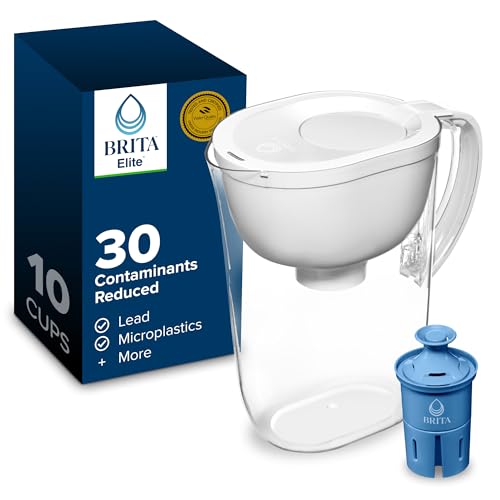
For most kitchens, the best water filter pitcher is the Brita Large 10-Cup Elite pitcher: Brita’s Elite filter is certified by WQA against NSF/ANSI 42, 53 and 401 for the claims on its data sheet, including chlorine taste and odor and lead, and one filter is rated for 120 gallons, about six months. For a slim fridge-door pitcher on the same three standards, choose the PUR Plus 7-Cup; for the widest certified list among the ion-exchange pitchers, including PFOA/PFOS, the ZeroWater 10-Cup, with a short 15-gallon filter life.
Below, five standouts side by side, then all eight reviewed in full.
Five water filter pitchers compared
One pick for each kind of kitchen, with the certifications and filter life each maker lists. All eight are reviewed below.
| Pitcher | Best for | NSF/ANSI standards (as listed) | Filter life (as stated) | Buy on Amazon |
|---|---|---|---|---|
Brita Large 10-Cup Elite PitcherBest overall
|
Most households | 42, 53, 401 (WQA) | 120 gal, about 6 months | View on Amazon |

PUR Plus 7-Cup PitcherBest for the fridge door
|
Small fridges, dishwasher cleaning | 42, 53, 401 (NSF, WQA) | 40 gal, about 2 months | View on Amazon |
ZeroWater 10-Cup PitcherBest ion exchange
|
Very low dissolved solids, with a meter | 42, 53 (IAPMO R&T) | 15 gal | View on Amazon |

Waterdrop PT-07 10-Cup PitcherLongest filter life
|
Better-tasting water, few filter changes | 42, 372 (NSF) | 200 gal or 3 months | View on Amazon |

Brita UltraMax 27-Cup Elite DispenserBest dispenser
|
Big batches of aguas frescas and ice | 42, 53, 401 (WQA); PFOA/PFOS under 53 (IAPMO R&T) | 120 gal, about 6 months | View on Amazon |
Product images from Amazon. Certifications are as listed on each maker’s performance data sheet or certification page; they apply to the specific pitcher and filter models named there.
Our picks for the best water filter pitcher
The eight below include the two big carbon-filter brands, an ion-exchange pitcher, two long-life pitchers and two large dispensers for a counter or a fridge shelf. For each, the certifications are quoted from the maker’s performance data sheet or certification statement, naming the standard and the body that certified it. Where a maker advertises results from its own or third-party testing that are not certified, we leave those claims out.
1. Brita Large 10-Cup Elite Pitcher – Three Standards, Six-Month Filter
Brita’s Everyday 10-cup pitcher with the Elite filter (model OB46 with filter OB06) is the pitcher to buy if you want one that fits most fridges, fills three reusable bottles, and needs a new filter only twice a year. Brita rates each Elite filter for 120 gallons, about six months for an average family, and the pitcher has an electronic SmartLight indicator to remind you when it is time.
The certifications are what set it apart. Brita’s performance data sheet states that the Elite filter is certified by WQA against NSF/ANSI 42, 53 and 401 for the claims on that sheet. For this pitcher, that includes chlorine taste and odor and Class I particulates under Standard 42; lead (the lead claim is marked as certified by NSF International), mercury, asbestos and benzene under Standard 53; and microplastics in the 0.5 to 1 micron range under Standard 401. Some claims on the sheet, including PFOA/PFOS and cadmium, are marked as valid only for certain Brita models, and this 10-cup Everyday model is not on that list.
The data sheet also sets the limits: process no more than 2 gallons a day, use cold water only (32 to 85°F), and do not use it with water that is microbiologically unsafe. For aguas frescas, coffee and ice, the practical result is water without a chlorine taste, from a pitcher that is easy to fill and pour.
Why we like it
- Certified by WQA to NSF/ANSI 42, 53 and 401, per Brita’s data sheet
- Lead claim under Standard 53 applies to this model
- 120-gallon filter, about six months
- 10-cup capacity, fits most fridges
- Electronic filter-change indicator
Key specifications
| Pitcher | Brita Everyday OB46 with Elite filter OB06 |
|---|---|
| Capacity | 10 cups |
| Filter type | Activated carbon (Brita Elite) |
| Filter life (as stated) | 120 gallons, about 6 months |
| NSF/ANSI certifications (as listed) | 42 (chlorine taste and odor, Class I particulates); 53 (lead, mercury, asbestos, benzene and others); 401 (microplastics and others) |
| Certified by | WQA; lead also by NSF International |
| Filter speed (if stated) | Not stated; max 2 gallons a day |
| Dispenser version available | Yes (UltraMax 27-cup, pick 7) |
Why we recommend it
It suits most households that want better-tasting tap water with the fewest filter changes and a certified lead claim, in a pitcher that fits on a fridge shelf.
Skip it if PFOA/PFOS is your main concern: on Brita’s data sheet that claim does not cover this 10-cup Everyday model, though it does cover the UltraMax dispenser below.
Pros and cons
Pros
- Three NSF/ANSI standards
- Long 120-gallon filter
- Electronic indicator
Cons
- Some claims apply only to other Brita models
- Cold water only
- Filter speed not stated
2. PUR Plus 7-Cup Pitcher – Slim Enough for the Fridge Door
PUR’s 7-cup Plus pitcher is narrower than most, and PUR says it fits most refrigerator doors, which frees a shelf for the jars of agua de jamaica. It is dishwasher safe, and the stay-tight lid lets you pour while water is still filtering.
It comes with the PUR PLUS filter (PPF951K). PUR’s performance data sheet for its pitchers and dispensers, which lists this pitcher family (PPT711), states that the system is tested and certified against NSF/ANSI 42, 53 and 401 for the claims on the sheet; the sheet names both NSF International and WQA as certifiers, and marks the lead claim under Standard 53 as certified by WQA. The PPF951K’s listed claims include chlorine taste and odor, zinc and Class I particulates under Standard 42; lead, mercury, cadmium, copper, benzene and several other chemicals under Standard 53; and a set of emerging compounds such as bisphenol A and ibuprofen under Standard 401.
PUR’s Amazon listing also says the filter is IAPMO certified to reduce total PFAS and microplastics. The data sheet we read does not list a PFAS claim, so we do not repeat it; check the current sheet on PUR’s site if PFAS matters to you. Each filter is rated for 40 gallons, about two months.
Why we like it
- Certified to NSF/ANSI 42, 53 and 401, per PUR’s data sheet
- Lead claim under Standard 53
- Slim 7-cup body fits most fridge doors
- Dishwasher-safe pitcher
Key specifications
| Pitcher | PUR Plus PPT711 with PPF951K filter |
|---|---|
| Capacity | 7 cups |
| Filter type | Activated carbon and ion exchange |
| Filter life (as stated) | 40 gallons, about 2 months |
| NSF/ANSI certifications (as listed) | 42 (chlorine taste and odor, zinc, Class I particulates); 53 (lead, mercury, cadmium, copper, benzene and others); 401 (several emerging compounds) |
| Certified by | NSF International and WQA (lead: WQA) |
| Filter speed (if stated) | Not stated; rated 2 gallons a day |
| Dispenser version available | Yes (PUR Plus 30-cup, pick 8) |
Why we recommend it
Choose it for a small household or a crowded fridge, if you want a certified lead claim and a pitcher you can put in the dishwasher.
Skip it if you hate changing filters: at 40 gallons, you will replace it three times as often as Brita’s Elite.
Pros and cons
Pros
- Three NSF/ANSI standards
- Fits a fridge door
- Dishwasher safe
Cons
- Short 40-gallon filter
- Only 7 cups
- PFAS claim not on the data sheet we read
3. ZeroWater 10-Cup Pitcher – Certified for PFOA/PFOS, With a TDS Meter
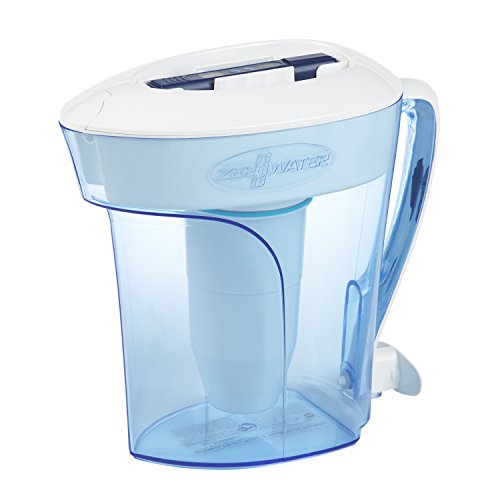
ZeroWater takes a different approach. Its 5-stage ion exchange filter, ZeroWater says, removes virtually all dissolved solids, the minerals and salts measured as TDS, and every pitcher comes with a TDS meter so you can see when the filter is spent.
ZeroWater’s performance data sheet for the ZP-010 and its sister models states that the system is certified by IAPMO R&T against NSF/ANSI 53 and 42. Under Standard 53 it lists hexavalent chromium, lead, mercury and PFOA/PFOS; under Standard 42, chlorine. Of the pitchers here, it is the one whose PFOA/PFOS claim is certified for the pitcher itself.
The trade-off is filter life. The data sheet rates each filter for 15 gallons, and how quickly you reach it depends on how many dissolved solids your tap water carries. Because it removes minerals as well, the water tastes different from your tap; whether you prefer that is personal. The listing describes a comfort-grip handle and a quick-fill spigot.
Why we like it
- Certified by IAPMO R&T to NSF/ANSI 53 and 42
- Certified PFOA/PFOS, lead, chromium and mercury claims under Standard 53
- TDS meter included
- Many dispenser sizes use the same filter
Key specifications
| Pitcher | ZeroWater ZP-010 Ready-Pour |
|---|---|
| Capacity | 10 cups |
| Filter type | 5-stage ion exchange |
| Filter life (as stated) | 15 gallons |
| NSF/ANSI certifications (as listed) | 53 (hexavalent chromium, lead, mercury, PFOA/PFOS); 42 (chlorine) |
| Certified by | IAPMO R&T |
| Filter speed (if stated) | Not stated; service flow 4 gallons a day |
| Dispenser version available | Yes (several sizes on the same data sheet) |
Why we recommend it
Choose it if you want a pitcher whose PFOA/PFOS claim is certified for that exact pitcher, or if you want water with almost no dissolved solids and a meter to check it.
Skip it if your tap water is hard or you go through a lot of water: a 15-gallon filter will need replacing often.
Pros and cons
Pros
- Certified PFOA/PFOS claim
- TDS meter in the box
- Comfort-grip handle and spigot
Cons
- Shortest filter life here
- Removes minerals as well
- No Standard 401 claims
4. Waterdrop PT-07 10-Cup Pitcher – A 200-Gallon Filter
Waterdrop’s Lucid pitcher is built around filter life. The listing rates each PF-01A filter for up to 200 gallons or three months, whichever comes first, and an LED indicator tracks it. The 10-cup body measures 10 by 5 by 10.1 inches and is designed to fit most fridges, and the listing describes a hands-free lid that dispenses water without being opened.
The certifications are narrower than Brita’s or PUR’s, and it is worth being precise. Waterdrop states that the pitcher has passed NSF/ANSI 42 and 372 certification, and its own site says it was certified by NSF International. Standard 42 here covers chlorine taste and odor; Standard 372 covers lead-free materials in the pitcher’s own parts, not lead reduction in the water. Waterdrop also advertises reductions in other substances based on third-party testing, which are not certified, so we leave them out. The listing adds that this model does not lower TDS.
For a kitchen that mostly wants water without a chlorine taste for coffee, tea and aguas frescas, and wants to change filters as rarely as possible, it does that job.
Why we like it
- Filter rated for 200 gallons or 3 months
- Certified to NSF/ANSI 42 for chlorine taste and odor
- NSF/ANSI 372 lead-free materials
- Hands-free lid and LED indicator
Key specifications
| Pitcher | Waterdrop WD-PT-07B with PF-01A filter |
|---|---|
| Capacity | 10 cups (2.4 L) |
| Filter type | Activated carbon and carbon fiber |
| Filter life (as stated) | 200 gallons or 3 months |
| NSF/ANSI certifications (as listed) | 42 (chlorine taste and odor); 372 (lead-free materials) |
| Certified by | NSF International, per Waterdrop |
| Filter speed (if stated) | Not stated by Waterdrop |
| Dispenser version available | Yes (Waterdrop sells larger dispensers) |
Why we recommend it
Choose it if taste is your aim and you want the fewest filter changes of any pitcher here.
Skip it if you want a certified lead or PFAS reduction claim; this pitcher’s certifications do not cover either.
Pros and cons
Pros
- Longest filter life
- Hands-free pouring lid
- Certified for chlorine taste and odor
Cons
- No certified health-effects claims
- Does not lower TDS
5. Brita Large 10-Cup Pitcher, Standard Filter – The Simple Starter

This is the same 10-cup Brita Everyday pitcher (OB46) sold with Brita’s Standard filter (OB03) instead of the Elite. It holds 10 cups, has an easy-fill locking lid and a sticker filter indicator, and accepts Elite filters later if you want to upgrade.
The Standard filter’s certifications are narrower. Brita’s data sheet says it is certified by WQA against NSF/ANSI 42 and 53: chlorine and zinc under Standard 42, and cadmium, copper and mercury under Standard 53. There is no lead claim. Brita rates the filter for 40 gallons, about two months, and like the Elite it is for cold water only.
If your concern is the taste of chlorine in the water you use for tea, coffee or agua de limón, the Standard filter covers it.
Why we like it
- Certified by WQA to NSF/ANSI 42 and 53
- Chlorine taste and odor claim under Standard 42
- Same pitcher accepts Elite filters later
- 10-cup capacity
Key specifications
| Pitcher | Brita Everyday OB46 with Standard filter OB03 |
|---|---|
| Capacity | 10 cups |
| Filter type | Granular activated carbon |
| Filter life (as stated) | 40 gallons, about 2 months |
| NSF/ANSI certifications (as listed) | 42 (chlorine, zinc); 53 (cadmium, copper, mercury) |
| Certified by | WQA |
| Filter speed (if stated) | Not stated; max 2 gallons a day |
| Dispenser version available | Yes (Brita dispensers take the same filter) |
Why we recommend it
Choose it if you mainly want water without a chlorine taste and like the option of upgrading the filter later without buying a new pitcher.
Skip it if you want a certified lead claim; the Standard filter has none, while the Elite does.
Pros and cons
Pros
- Certified for chlorine taste and odor
- Upgradable to Elite filters
- Fits most fridges
Cons
- No lead claim
- 40-gallon filter
- Sticker indicator only
6. Clearly Filtered 10-Cup Pitcher – Long Filter, Tritan Body

Clearly Filtered sells its pitcher on an unusually long list of reduction claims, and it publishes the third-party test results behind them. Those claims are from testing, not certification, so we do not repeat them. What Clearly Filtered states as certification is this: the pitcher is certified by NSF International to NSF/ANSI 42 for chlorine taste and odor reduction and to NSF/ANSI 372 for lead-free materials.
The maker’s help center also says it has been moving its certifications from WQA to NSF and is pursuing Standards 53 and 401 with NSF, so the certified list may grow; check the current statement before you buy if a particular contaminant matters to you.
The pitcher itself holds 80 fluid ounces (about 10 cups), is made of Tritan plastic that the maker describes as BPA-free, and has a hinged fill lid and a water dam to limit spills. Each filter is rated for 100 gallons, which the listing puts at about four months.
Why we like it
- Certified by NSF International to NSF/ANSI 42 and 372
- 100-gallon filter, about four months
- Third-party test results published by the maker
- Tritan body, hinged fill lid
Key specifications
| Pitcher | Clearly Filtered P-V3 |
|---|---|
| Capacity | 80 fl oz (about 10 cups) |
| Filter type | Affinity Filtration (maker’s name) |
| Filter life (as stated) | 100 gallons, about 4 months |
| NSF/ANSI certifications (as listed) | 42 (chlorine taste and odor); 372 (lead-free materials) |
| Certified by | NSF International, per the maker |
| Filter speed (if stated) | Not stated |
| Dispenser version available | Not stated in the listing |
Why we recommend it
Choose it if you like to read the test results yourself and want a long-lasting filter in a sturdy pitcher.
Skip it if you want certified health-effects claims today: its certifications cover chlorine taste and odor and lead-free materials only.
Pros and cons
Pros
- 100-gallon filter
- Published test data
- Sturdy Tritan body
Cons
- Certified claims limited to 42 and 372
- Certification status changing
7. Brita UltraMax 27-Cup Elite Dispenser – Big Batches From a Spigot
When you make aguas frescas by the jar, fill ice trays and brew coffee every morning, a 10-cup pitcher runs dry fast. Brita’s UltraMax holds 27 cups and dispenses through a spigot, so it can sit on the counter or a fridge shelf and nobody has to lift it to pour.
It uses the same Elite filter as our top pick, and here the full set of Elite claims applies. Brita’s data sheet lists the UltraMax (OB24) among the models for which every claim is valid, so on top of the WQA certification to NSF/ANSI 42, 53 and 401, it carries the PFOA/PFOS claim certified by IAPMO R&T against Standard 53, as well as the cadmium and other model-specific claims. The filter is rated for 120 gallons, about six months.
It is a big, flat shape: about 14 inches wide and 9.7 inches tall per the listing, so measure the shelf first.
Why we like it
- 27-cup capacity with a spigot
- Elite filter certified to NSF/ANSI 42, 53 and 401 (WQA)
- PFOA/PFOS claim under Standard 53 covers this model
- 120-gallon filter, about six months
Key specifications
| Pitcher | Brita UltraMax OB24 with Elite filter OB06 |
|---|---|
| Capacity | 27 cups |
| Filter type | Activated carbon (Brita Elite) |
| Filter life (as stated) | 120 gallons, about 6 months |
| NSF/ANSI certifications (as listed) | 42, 53 and 401 claims on Brita’s sheet, including lead, PFOA/PFOS and microplastics |
| Certified by | WQA; PFOA/PFOS by IAPMO R&T; lead by NSF International |
| Filter speed (if stated) | Not stated; max 2 gallons a day |
| Dispenser version available | This is the dispenser |
Why we recommend it
Choose it for a family or a busy kitchen that goes through a lot of filtered water, and for the full Elite certification list including PFOA/PFOS.
Skip it if fridge space is tight. At 27 cups it takes a whole shelf.
Pros and cons
Pros
- Largest capacity here
- Full Elite claim list applies
- Spigot, no lifting
Cons
- Bulky on a shelf
- Filter speed not stated
8. PUR Plus 30-Cup Dispenser – PUR’s Filter at Party Size

PUR’s 30-cup dispenser uses the same PUR PLUS filter as the 7-cup pitcher, and PUR’s performance data sheet lists this dispenser family (DS1811) alongside the pitchers. That means the same certifications: NSF/ANSI 42, 53 and 401 for the claims on the sheet, including chlorine taste and odor, lead, mercury and cadmium, with NSF International and WQA named as certifiers.
It has a pull-down spout, a carry handle for refilling, a filter-change light, and PUR says it is dishwasher safe and fits in the fridge or on the counter. The filter is rated for 40 gallons, about two months, which goes quickly at this size.
As with the pitcher, PUR’s listing mentions an IAPMO certification for total PFAS and microplastics that we did not find on the data sheet we read.
Why we like it
- 30-cup capacity with a pull-down spout
- Same certified PUR PLUS filter as the pitcher
- Dishwasher safe
- Filter-change light
Key specifications
| Pitcher | PUR Plus DS1811Z with PPF951K filter |
|---|---|
| Capacity | 30 cups |
| Filter type | Activated carbon and ion exchange |
| Filter life (as stated) | 40 gallons, about 2 months |
| NSF/ANSI certifications (as listed) | 42, 53 and 401 claims on PUR’s sheet, including lead |
| Certified by | NSF International and WQA (lead: WQA) |
| Filter speed (if stated) | Not stated; rated 2 gallons a day |
| Dispenser version available | This is the dispenser |
Why we recommend it
Choose it if you already like PUR’s filter and want a large supply ready for parties, ice and big batches of agua fresca.
Skip it if you want long filter life; at 40 gallons you will replace filters far more often than with Brita’s UltraMax.
Pros and cons
Pros
- Biggest capacity
- Certified lead claim
- Dishwasher safe
Cons
- Short filter life for its size
- Takes up a lot of room
How to choose a water filter pitcher
Five questions settle it. Start with your water, not the pitcher.
1. What is in your water?
Brita’s and ZeroWater’s data sheets both recommend having your water supply tested before you buy, so you can match the filter to what is actually there. If chlorine taste is the only issue, a Standard 42 certification covers it. If something more specific concerns you, look for that exact substance on the maker’s data sheet.
2. Which standard, and certified by whom?
Read the certification, not the box. NSF/ANSI 42 covers aesthetic effects such as chlorine taste and odor. NSF/ANSI 53 covers the substances the data sheets group under health effects, such as lead and mercury. NSF/ANSI 401 covers emerging compounds and incidental contaminants, such as some pharmaceuticals and microplastics. NSF/ANSI 372 concerns lead-free materials in the product itself. The certifier should be a named body, such as NSF International, WQA or IAPMO R&T, and the claim applies only to the pitcher models listed. “Tested to” a standard is not the same as certified to it.
3. Filter life
Ratings here run from 15 gallons (ZeroWater) to 200 gallons (Waterdrop). The certifications only hold up to the rated capacity, so a long-life filter is fewer replacements, not better filtering. If you drink and cook with a lot of water, factor in how often you will change it.
4. Capacity and shape
A 7-cup pitcher fits a fridge door; a 10-cup pitcher fills three bottles; a 27- to 30-cup dispenser keeps a crowd supplied. For a pitcher of aguas frescas each day, plus coffee and ice, a dispenser saves constant refilling.
5. Cold water only
Brita’s data sheets say not to use hot water (maximum 85°F), and PUR gives 82°F. Filter cold water, then heat it in your electric kettle or coffee maker. None of these pitchers is for water that is microbiologically unsafe, as both Brita’s and PUR’s sheets state.
How we chose these eight pitchers
We started from what a kitchen uses filtered water for: drinks, coffee, ice and the water in aguas frescas. We looked at pitchers and dispensers sold on Amazon in the United States and in stock when we checked, from makers that publish a performance data sheet or certification statement, and we read those documents directly: Brita’s sheets for the Elite and Standard filters, PUR’s sheet for the PUR PLUS filter, ZeroWater’s data sheet, and the certification statements from Clearly Filtered and Waterdrop. Every contaminant named on this page is one the maker lists as certified, with the standard and the certifier. We left out reduction claims based only on in-house or third-party testing. We have not used these pitchers ourselves, and we make no health claims of our own. We left out LARQ’s PureVis pitcher, whose maker describes its filters as independently tested to NSF/ANSI 42, 53 and 401 rather than certified, and Aquagear, whose listing describes third-party testing without a certification.
Water filter pitcher questions, answered
Which water filter pitcher removes the most contaminants?
Of the pitchers here, Brita’s Elite and PUR’s PLUS filters carry the longest certified lists, across NSF/ANSI 42, 53 and 401. ZeroWater’s certified list is shorter but includes PFOA/PFOS and hexavalent chromium for the pitcher itself. Compare the specific substances you care about on each data sheet.
Is Brita or PUR better?
They are close. Brita’s Elite lasts 120 gallons against PUR’s 40, and its 10-cup pitcher is larger. PUR’s 7-cup pitcher is slimmer and dishwasher safe. Both carry certified lead claims under NSF/ANSI 53 for the models named on their data sheets.
What does NSF/ANSI 42 certification mean?
It covers aesthetic effects, mainly chlorine taste and odor and, on some sheets, particulates or zinc. A pitcher certified only to 42 (and 372 for its materials), like Waterdrop’s PT-07, is certified to improve taste, not for health-effects claims.
How often should I change a pitcher filter?
At the rated capacity, or the time limit if one is given: 40 gallons or about two months for Brita Standard and PUR PLUS, 120 gallons or about six months for Brita Elite, 15 gallons for ZeroWater, 100 gallons for Clearly Filtered and 200 gallons or three months for Waterdrop.
Does filtered water make better aguas frescas and coffee?
If your tap water tastes of chlorine, removing that taste helps every drink made with it, including the ice. Freeze filtered water in good ice cube trays so the ice does not bring the taste back.
The pitcher we would keep in the fridge
More appliance and fixture guides: countertop ice makers, nugget ice makers, induction cooktops, kitchen faucets, oven thermometers, oven mitts, electric hot plates.
More water filter guides: under-sink water filters, faucet water filters, countertop water filters.
Worried about lead? See our guide to the best water filter pitchers for lead removal.
Using 5-gallon jugs instead? See our guide to the best water dispensers.
On a budget? See our guide to the best affordable water filter pitchers.
Want filtered water on the go? See our guide to the best water bottles with built-in filters.
Related guide: Best brita filter.
Related guide: Best water filter for chlorine.
Related guide: Pitcher vs faucet water filter.
Related guide: Brita vs pur water filter.
Buy the Brita Large 10-Cup Elite pitcher if you want one pitcher that fits most fridges, carries certified claims across three NSF/ANSI standards and needs a new filter only twice a year. Choose the PUR Plus 7-Cup for a fridge door, the ZeroWater 10-Cup if a certified PFOA/PFOS claim on the pitcher itself matters most, and the Brita UltraMax if you go through water by the gallon. Then make a pitcher of jamaica with it. And if you would rather we made the aguas frescas tonight, see the menu or call to order.