Every pot of frijoles, every pitcher of agua de horchata and every bag of ice starts with the water from your tap. If that water tastes of chlorine, so does everything you make with it. An under sink filter treats the water before it reaches a faucet, out of sight, and gives you filtered water for drinking and cooking at the turn of a handle.
This guide compares eight under sink systems: carbon filters that keep minerals in, and reverse osmosis (RO) systems that take most of them out. For each one we say what is certified, to which NSF/ANSI standard and by whom, and where a claim is only the seller’s.
Julia’s earns a commission on purchases made through links on this page, at no cost to you. Recommendations are based on what a restaurant kitchen looks for, product specifications and verified buyer reports.
Quick verdict: which under sink water filter to buy
The best under sink water filter for most kitchens is the Aquasana Claryum 2-Stage: Aquasana’s data sheet states WQA certification to NSF/ANSI 42, 53 and 401, and it wastes no water. If you want reverse osmosis, the Waterdrop X16 is a tankless system whose listing states IAPMO R&T certification to NSF/ANSI 58; the iSpring RCC7 is the classic tank option, and the Waterdrop 10UA is the simple budget choice that feeds your own faucet.
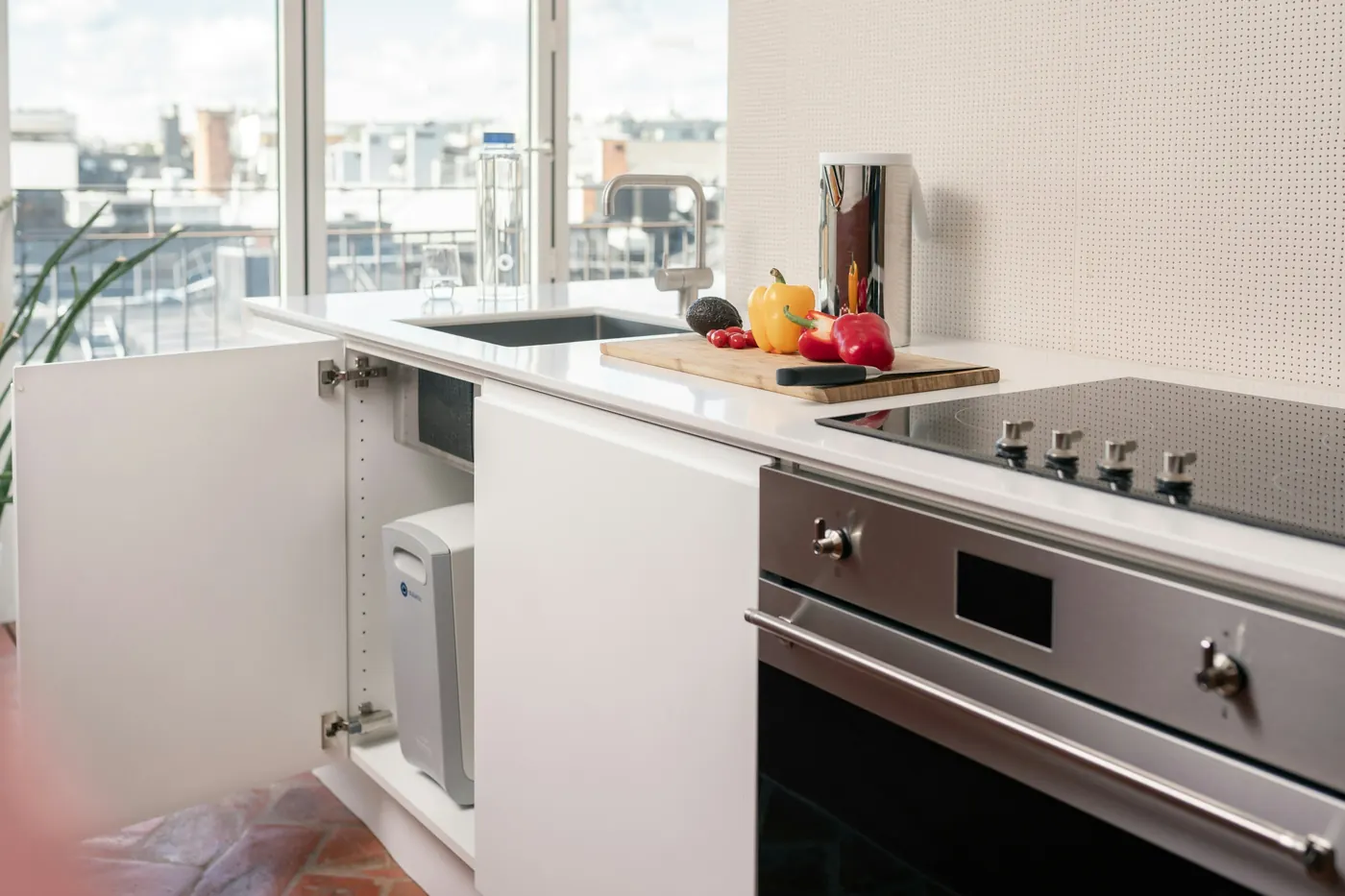
Five under sink filters at a glance
Our five standout picks, one for each kind of kitchen, with the type, certifications, filter life and wastewater ratio each maker or listing states. All eight systems are reviewed in full below.
| Under sink filter | Type | Certifications | Filter life | Wastewater ratio | Buy on Amazon |
|---|---|---|---|---|---|

Aquasana Claryum 2-Stage Under Sink FilterBest overall
|
Carbon | WQA: NSF/ANSI 42, 53, 401 | 500 gal / 6 mo | None | View on Amazon |

Waterdrop X16 Tankless Reverse Osmosis SystemBest tankless RO
|
Tankless RO | IAPMO: NSF/ANSI 42, 58, 372 | 6–24 mo by stage | 3:1 | View on Amazon |

iSpring RCC7 5-Stage Reverse Osmosis SystemBest tank RO
|
RO with tank | NSF/ANSI 58 (listing; certifier not named) | Not stated | Not stated | View on Amazon |

Waterdrop 10UA Under Sink FilterBudget pick
|
Carbon | NSF/ANSI 42 (listing) | 12 mo | None | View on Amazon |

Delta Clarifi Tankless Reverse Osmosis SystemLongest filter life
|
Tankless RO | IAPMO: NSF/ANSI 53, 58, 372 | 2 yr / 1,320 gal | 2:1 | View on Amazon |
Product images from Amazon. Specifications and certifications are as stated by each maker or listing; check the listing and the maker’s performance data sheet before you buy.
Our picks for the best under sink water filter
The first five cover most kitchens, from carbon to tankless and tank RO; the last three cover standard cartridges, a fast-flowing direct-connect system and the smallest inline option. Each entry lists the certifications as the maker or listing states them, and says when we could not confirm them.
1. Aquasana Claryum 2-Stage Under Sink Filter – Certified Carbon, Own Faucet
The Aquasana Claryum 2-Stage is the under sink water filter we would point most kitchens to first. It is a carbon system, not reverse osmosis, so it sends no water down the drain and leaves the minerals in your water alone. It comes with a brushed nickel faucet that mounts on the sink, and the filters twist off their housing without disconnecting any lines, according to the Amazon listing.
What sets it apart is the paperwork. Aquasana’s performance data sheet for the AQ-5200 says the system is tested and certified by WQA to NSF/ANSI 42, 53 and 401. Under Standard 53 the sheet lists lead, mercury, cysts, asbestos and PFOA/PFOS; Standard 42 covers chlorine, chloramine and particulates; and Standard 401 covers a list of trace compounds, including microplastics. That is a broad set of certified claims for a system with no tank and no drain line.
Aquasana rates the filters at 500 gallons and the data sheet gives a flow of 0.5 gallons per minute, which is fine for filling a pot for frijoles or a jug for agua de jamaica. The listing says the system needs about 12 inches of space under the sink plus clearance, and it uses a 3/8-inch tee on the cold line.
Why we like it
- Aquasana’s data sheet states WQA certification to NSF/ANSI 42, 53 and 401
- Lead and PFOA/PFOS are listed under the certified Standard 53 claims
- No tank and no wastewater, as a carbon system
- Twist-off filters with no lines to disconnect (listing)
Key specifications
| System | Aquasana AQ-5200 (AQ-5200.55) |
|---|---|
| Type | Carbon block (Claryum), 2 stages |
| Certifications | WQA to NSF/ANSI 42, 53, 401 (maker’s data sheet) |
| Filter life | 500 gallons or 6 months |
| Faucet / tank | Faucet included; no tank |
| Wastewater ratio | None (not RO) |
| Flow (as stated) | 0.5 gpm |
| Warranty | 1 year (listing) |
Why we recommend it
It suits a kitchen that wants certified carbon filtration for drinking and cooking water without the drain line, tank and wastewater of reverse osmosis.
Skip it if you want lower dissolved solids or softer-tasting water; the listing says this system does not reduce TDS.
Pros and cons
Pros
- Broad certified claims on the maker’s data sheet
- Dedicated faucet included
- Compact, no tank
Cons
- Filters are rated for 6 months, shorter than some rivals
- Does not reduce TDS (listing)
- Needs a drilled hole or spare sink hole for the faucet
2. Waterdrop X16 Tankless Reverse Osmosis System – Fast Flow, Minerals Added Back
The Waterdrop X16 is a tankless reverse osmosis system, which means it pushes water through the membrane on demand instead of filling a storage tank. Waterdrop rates it at 1,600 gallons per day at peak and says it fills a 6-ounce cup in about two seconds. The listing gives a 3:1 pure-to-drain ratio, so for every three cups of filtered water, about one goes to the drain.
The listing says the system is tested and certified by IAPMO R&T against NSF/ANSI 42, 58 and 372 (372 covers the lead content of the materials, not what the water contains). It also lists lead, arsenic, fluoride, chlorine and PFOA/PFOS among substances “tested by SGS” to be reduced; those are test claims, not certified ones, so read Waterdrop’s current performance data sheet before relying on any single figure. The X16 runs water through 11 stages, including a mineral stage that Waterdrop says adds minerals back and makes the water weakly alkaline.
Reverse osmosis takes out most dissolved minerals, which is why it is the usual choice for very clear ice and for coffee people who want to control the water; the X16’s mineral stage puts some back for taste. The listing mentions an LED display but does not state the power requirement; tankless systems like this generally need an outlet under the sink, and the drain connection is a job for a licensed plumber where local code requires one.
Why we like it
- IAPMO R&T certification to NSF/ANSI 42, 58 and 372 stated in the listing
- No storage tank to take up cabinet space
- 3:1 pure-to-drain ratio stated by Waterdrop
- Rated at 1,600 gallons per day at peak
Key specifications
| System | Waterdrop X16 |
|---|---|
| Type | Tankless reverse osmosis with mineral stage |
| Certifications | IAPMO R&T to NSF/ANSI 42, 58 and 372 (listing) |
| Filter life | F2 filter 6 months, F1A mineral filter 12 months, X16-F3 RO filter 24 months (replacement listings) |
| Faucet / tank | Faucet not stated in listing; tankless |
| Wastewater ratio | 3:1 pure to drain |
| Flow (as stated) | 1,600 gallons per day peak |
| Warranty | Not stated |
Why we recommend it
It suits a busy kitchen that wants reverse osmosis water for drinking, coffee and ice without a tank, and likes the idea of some minerals added back.
Skip it if you have no outlet under the sink, or if you want certification to NSF/ANSI 53 for health-related claims such as lead; the listing names 42, 58 and 372 only.
Pros and cons
Pros
- Tankless design frees cabinet space
- High rated output
- Certifier and standards named in the listing
Cons
- Power requirement not stated in the listing
- Sends some water to the drain
- Three different filters to replace
3. iSpring RCC7 5-Stage Reverse Osmosis System – Classic Tank, Standard Filters
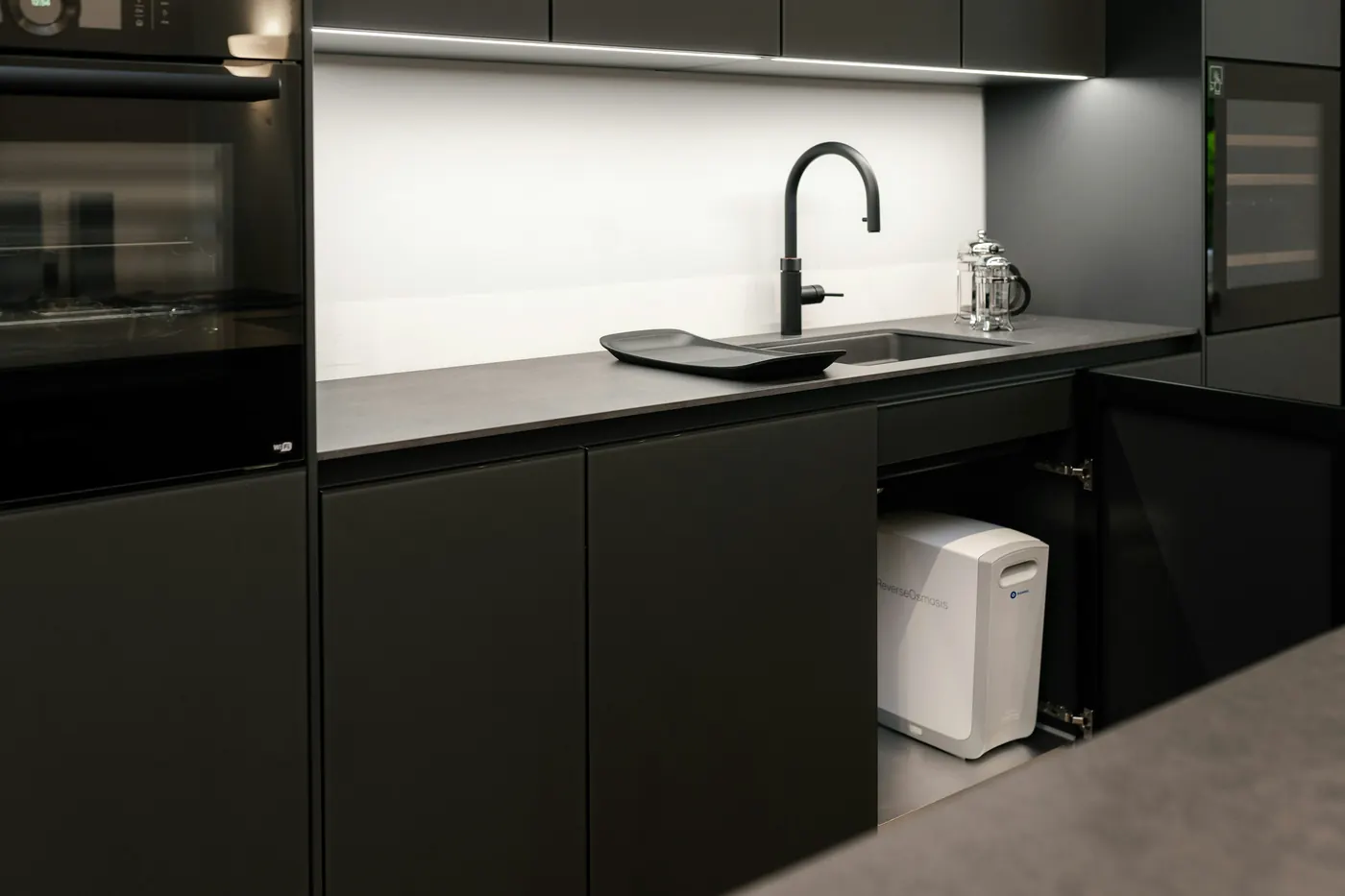
The iSpring RCC7 is the classic layout for home reverse osmosis: five filter stages, a storage tank and a separate faucet. It is rated at 75 gallons per day. Because water collects in the tank, it needs no power, and the listing says it fits under most kitchen sinks.
The listing says the RCC7 is certified to NSF/ANSI 58 but does not name the certifier, and we did not find a certification listing for this model to confirm it. Treat that as the seller’s claim. The listing also claims reductions of lead, fluoride, arsenic and PFAS; we do not repeat those as certified.
The RCC7 uses standard-size cartridges, which many buyers prefer because replacements are easy to find. The listing does not state the wastewater ratio. A tank system like this one needs a drain saddle, a feed tee and a hole for the faucet, so plan on a licensed plumber where your code calls for one.
Why we like it
- No electricity needed
- Brushed nickel faucet included
- Standard cartridge layout
- Faucet mounts from above the counter (listing)
Key specifications
| System | iSpring RCC7-BN |
|---|---|
| Type | Reverse osmosis with storage tank, 5 stages |
| Certifications | NSF/ANSI 58 per listing; certifier not named |
| Filter life | Not stated in listing |
| Faucet / tank | Faucet and tank included |
| Wastewater ratio | Not stated |
| Flow (as stated) | 75 gallons per day |
| Warranty | 1 year (listing) |
Why we recommend it
It suits a kitchen with room for a tank that wants reverse osmosis water without needing an outlet under the sink.
Skip it if your cabinet is crowded; the tank takes a lot of space under the sink.
Pros and cons
Pros
- No power needed
- Long-established design
- Faucet included
Cons
- Certifier not named in the listing
- Tank takes cabinet space
- Wastewater ratio not stated
4. Waterdrop 10UA Under Sink Filter – Uses Your Own Faucet
The Waterdrop 10UA is a single carbon cartridge that connects straight to the cold-water valve and feeds your existing faucet, so there is no extra faucet, no tank and no drain line. The listing says it installs with push-to-connect fittings and that the cartridge twists out for replacement.
The listing title says the 10UA is certified to NSF/ANSI 42, which covers chlorine, taste and odor, but it does not name the certifier. The title also mentions lead and PFOA/PFOS; we did not find those listed as certified claims, so we leave them out. Waterdrop rates the filter at 12 months on municipal water and gives a tested flow of 0.75 gallons per minute at 60 psi.
Because it feeds the main faucet, all of your cold water runs through it, including water for washing dishes, which uses the filter faster. Waterdrop says it is for cold, municipal water only, not well water or hot water.
Why we like it
- Connects to the existing faucet; no drilling
- 12-month filter rating on city water (listing)
- Compact single cartridge
- Push-to-connect fittings (listing)
Key specifications
| System | Waterdrop WD-10UA |
|---|---|
| Type | Carbon, single stage |
| Certifications | NSF/ANSI 42 per listing; certifier not named |
| Filter life | 12 months |
| Faucet / tank | Uses your faucet; no tank |
| Wastewater ratio | None (not RO) |
| Flow (as stated) | 0.75 gpm at 60 psi |
| Warranty | 1 year (listing) |
Why we recommend it
It suits renters and small kitchens that want better-tasting cold water from the tap they already have.
Skip it if you want certified lead or PFAS reduction; the only certification the listing names is NSF/ANSI 42.
Pros and cons
Pros
- Simple install
- Long filter life
- Takes little space
Cons
- Certified claim limited to taste and odor (per listing)
- Filters all cold water, including dishwater
- Cold, municipal water only
5. Delta Clarifi Tankless Reverse Osmosis System – Two-Year Filters
Delta makes faucets, and the Clarifi is its tankless reverse osmosis system. The listing gives a 2:1 filtered-to-waste ratio and says the filters are synchronized to a two-year life, with tool-free changes. Delta’s installation manual lists the carbon filter (DWQ300202) and RO filter (DWQ300102) at 2 years or 1,320 gallons, whichever comes first.
Delta’s manual says the RO filter, used in this system, is certified by IAPMO R&T against ASSE 1086 and NSF/ANSI 372, 53 and 58 for the claims on its performance data sheet. The listing names NSF/ANSI 42 and 401 as well. We did not read the data sheet itself, so we do not list which contaminants are covered; check it for lead or PFAS before you buy.
Like other tankless RO systems, it needs power under the sink, and the drain connection should go to a licensed plumber where code requires it. The manual gives an operating range of 20 to 87 psi.
Why we like it
- Two-year filter life on both filters (Delta manual)
- 2:1 filtered-to-waste ratio (listing)
- IAPMO R&T certification named in Delta’s manual
- 5-year limited system warranty (listing)
Key specifications
| System | Delta DWQ1001012 |
|---|---|
| Type | Tankless reverse osmosis, 6 stages |
| Certifications | IAPMO R&T: NSF/ANSI 53, 58, 372, ASSE 1086 (Delta manual) |
| Filter life | 2 years or 1,320 gallons |
| Faucet / tank | Tankless; faucet not stated |
| Wastewater ratio | 2:1 |
| Flow (as stated) | Not stated |
| Warranty | 5-year limited (listing) |
Why we recommend it
It suits a kitchen that wants RO water with the fewest filter changes and a known faucet brand behind it.
Skip it if you want to see every certified contaminant before buying; we could not confirm the full list.
Pros and cons
Pros
- Long filter life
- Better waste ratio than most tank systems
- Certifier named by the maker
Cons
- Needs power
- Full certified-claim list not confirmed by us
- Faucet inclusion not clear in the listing
6. iSpring US31 3-Stage Under Sink Filter – Three Stages, 10,000 Gallons

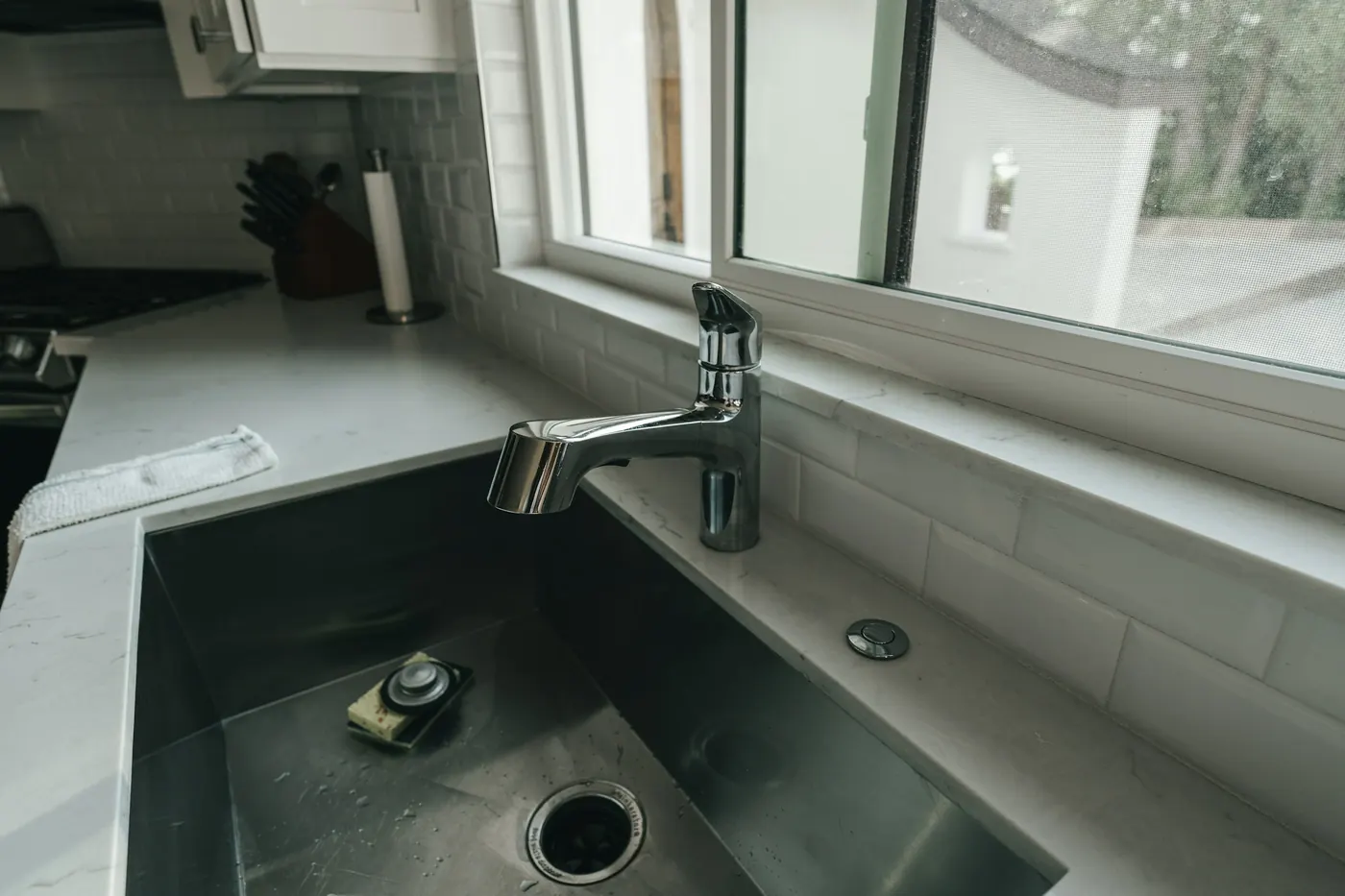
The iSpring US31 is a three-stage carbon system built on standard 2.5 by 10-inch cartridges: sediment, granular carbon and carbon block. iSpring rates the set at 10,000 gallons or up to 12 months and says it delivers 1 gallon per minute through the included brushed nickel faucet.
The listing says the filters are NSF/ANSI certified but does not name the standard or the certifier, and it calls other results “SGS-tested”, which is a laboratory test, not a certification. We list it here for its capacity and its standard housings, not for certified contaminant claims.
Three canisters take more width under the sink than a single cartridge. The upside is that any shop that sells 10-inch filters can supply replacements.
Why we like it
- 10,000-gallon rating (listing)
- Standard 10-inch cartridges
- Faucet included
- Clear first-stage housing to check the sediment filter
Key specifications
| System | iSpring US31 |
|---|---|
| Type | Carbon, 3 stages |
| Certifications | Listing says NSF/ANSI certified filters; standard and certifier not named |
| Filter life | 10,000 gallons or up to 12 months |
| Faucet / tank | Faucet included; no tank |
| Wastewater ratio | None (not RO) |
| Flow (as stated) | 1 gpm |
| Warranty | 1 year (listing) |
Why we recommend it
It suits a cook who wants a high-capacity carbon system and the freedom to buy standard replacement cartridges.
Skip it if you want certified contaminant claims you can look up.
Pros and cons
Pros
- High rated capacity
- Common cartridge size
- Faucet mounts from above the counter (listing)
Cons
- Certification details vague in the listing
- Wider than single-cartridge systems
- Housings need a wrench to open
7. Frizzlife FK99 Under Sink Filter – Long-Life Filter, 2 GPM
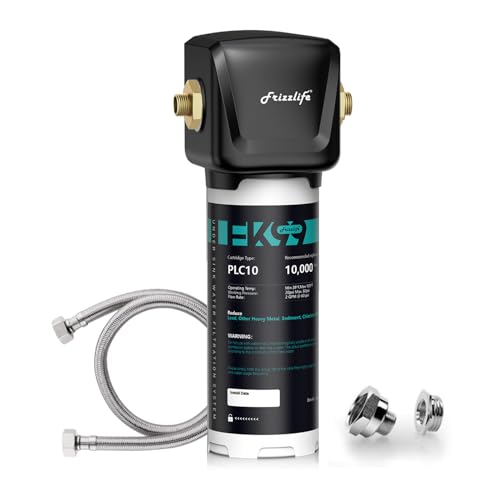
The Frizzlife FK99 is a direct-connect carbon system that feeds your existing faucet, with no extra hole to drill. Frizzlife lists a rated flow of 2 gallons per minute at 60 psi, the highest stated flow in this guide.
The title says NSF/ANSI 53 and 42 certified, while a bullet describes NSF 42 and 53 certified filtration ingredients and a 0.5-micron carbon block. We did not check a certifier’s listing for this model, so treat the certification as the seller’s statement. Frizzlife rates the inner filter for 10,000 gallons or 12 months, and you replace only that inner part, not the housing.
The listing says it uses lead-free brass fittings and an auto-shutoff head, so you do not need to shut off the water to change the filter. It can also feed a refrigerator ice maker with an add-on kit, which is useful if you want filtered ice without a second system. It is for cold water only.
Why we like it
- 2 gpm stated flow at 60 psi
- 10,000-gallon, 12-month filter rating (listing)
- Auto-shutoff head for filter changes
- Can also feed an ice maker with a kit (listing)
Key specifications
| System | Frizzlife FK99 |
|---|---|
| Type | Carbon, direct connect |
| Certifications | NSF/ANSI 42 and 53 per listing |
| Filter life | 10,000 gal or 12 months (listing) |
| Faucet / tank | Uses your faucet; no tank |
| Wastewater ratio | None (not RO) |
| Flow (as stated) | 2 gpm at 60 psi |
| Warranty | Up to 18 months (listing) |
Why we recommend it
It suits a kitchen that fills big pots and wants filtered water from the main faucet without a slow trickle.
Skip it if you want a certification you can look up by model before you buy; check with the certifier first.
Pros and cons
Pros
- Fast stated flow
- Replace only the inner filter
- Ice-maker option
Cons
- Certification not confirmed by us
- Filters all cold water at that faucet
- Shorter guarantee than some here
8. CuZn UC-200 Inline Under Sink Filter – Five-Year Rating, Inline Install

The CuZn UC-200 is a single inline canister that sits on the cold line under the sink. It uses sediment membranes, KDF-55 and coconut shell carbon, and CuZn rates it for five years, far longer than the cartridges above.
The listing title names NSF/ANSI 42 and 372, and the copy says the components and materials are NSF/ANSI 42 certified; it does not name a certifier, and it describes the system as independently tested for its other claims. We read that as component certification, not a system certification, and do not repeat its lead or PFAS claims.
There is no cartridge to change: when the five years are up, the whole unit is replaced. The listing says no drilling is needed and all parts are included.
Why we like it
- Five-year filter rating (listing)
- No drilling; inline connection
- Very small under-sink footprint
- Does not remove minerals (listing)
Key specifications
| System | CuZn UC-200 |
|---|---|
| Type | Inline sediment, KDF and carbon |
| Certifications | NSF/ANSI 42 and 372 components per listing; certifier not named |
| Filter life | 5 years |
| Faucet / tank | Uses your faucet; no tank |
| Wastewater ratio | None (not RO) |
| Flow (as stated) | Not stated |
| Warranty | Not stated |
Why we recommend it
It suits a cook who wants to fit something small and forget about it, mainly for chlorine taste.
Skip it if you want a system certified as a whole for health-related contaminants.
Pros and cons
Pros
- Long rated life
- Tiny footprint
- Simple install
Cons
- Component, not system, certification
- Flow not stated
- Whole unit replaced at end of life
Carbon or reverse osmosis?
Carbon filters, like the Aquasana, Waterdrop 10UA and iSpring US31, push water through activated carbon. They improve chlorine taste and odor, and the certified ones reduce whatever is listed on their data sheet. They keep the calcium and magnesium in your water, waste none of it and usually need no power.
Reverse osmosis forces water through a membrane that holds back most dissolved solids. The result tastes flatter to some people and cleaner to others, and it makes very clear ice. The trade-offs are a drain line, some wastewater (the ratio varies by system) and, for tankless models, an outlet under the sink. If your water leaves scale in the kettle, RO water also leaves less of it in a coffee maker.
How to choose an under sink filter
1. Read the certification, not the box
Look for a performance data sheet that names the standard and the certifier: NSF/ANSI 42 for chlorine, taste and odor; 53 for health-related contaminants such as lead; 58 for reverse osmosis; 401 for trace compounds; and 372 for lead content of the materials themselves. A system certified only to 372 says nothing about what it removes. If the listing says “tested” without naming a certifier, that is a test claim.
2. Decide what you are filtering for
If your goal is better-tasting water for coffee and aguas frescas, a certified carbon system is enough. If you want lower dissolved solids or are dealing with something a carbon filter is not certified for, look at RO. Your city’s annual water quality report tells you what is in your water.
3. Count the space and the holes
Tank RO systems need the most room. Systems with their own faucet need a spare sink hole or a drilled one. Direct-connect and inline systems feed your existing faucet. Our under sink organizer guide helps when you are fitting a filter around cleaning supplies.
4. Price out the filters, not just the system
Filter life ranges from six months to five years in this guide. Check the replacement filter’s availability and life before you buy.
5. Plan the installation
Most carbon systems are within reach of a handy owner. RO systems involve a drain connection and sometimes power. Where local plumbing code requires it, or if you are unsure, use a licensed plumber.
Filtered water in a Mexican kitchen
A restaurant kitchen goes through filtered water all day: in the coffee urn, in the ice bin and in the big jars of agua fresca by the register. At home the uses are the same, just smaller. Water you can taste, like the base of aguas frescas, benefits most, and so does coffee; our coffee maker guide covers the brewer. If you make a lot of ice, a filtered line feeding a countertop ice maker reservoir is a sensible pairing.
How we picked these eight under sink systems
We did not test these filters. We read each system’s Amazon listing and, where we could get it, the maker’s performance data sheet or manual, and we report certifications only as those documents state them, naming the standard and certifier. Where a listing makes a claim without a certifier, or calls it “tested”, we say so and do not repeat it as certified. We checked that every pick was in stock on Amazon when we wrote this. We left out APEC’s ROES-50 because its listing showed limited stock, and A. O. Smith because only replacement filters came up. Water filters cannot make health promises, and neither do we: what a filter removes is what its certification covers.
Under sink water filter questions, answered
What is the best rated under sink water filter?
On certifications we could read, the Aquasana Claryum 2-Stage (WQA, NSF/ANSI 42, 53 and 401 on its data sheet) for carbon and the Waterdrop X16 (IAPMO R&T, NSF/ANSI 42, 58 and 372 in its listing) for reverse osmosis.
Do under sink filters remove lead?
Only the ones certified for it. Check the data sheet for lead listed under NSF/ANSI 53 (or 58 for RO) and the name of the certifier, such as NSF, WQA or IAPMO R&T.
Is reverse osmosis better than a carbon filter?
Not better, different. RO removes most dissolved solids and makes clearer ice, but wastes some water and needs a drain. Certified carbon keeps minerals and wastes nothing.
Can I install an under sink water filter myself?
Many carbon systems connect to the cold-water valve with push-fit fittings. RO systems add a drain line and sometimes power. Follow local code, and use a licensed plumber where it requires one.
How often do the filters need changing?
From six months to five years in this guide. Follow the maker’s rating, and sooner if flow drops.
Our pick for filtered water under the sink
Buy the Aquasana Claryum 2-Stage if you want certified carbon filtration and no wastewater. Choose the Waterdrop X16 or Delta Clarifi for tankless reverse osmosis, the iSpring RCC7 for a tank system with no power needed, and the Waterdrop 10UA if you just want better water from the faucet you already have. If you are replacing the faucet too, start with our kitchen faucet guide, and for filtered water without plumbing, see our water filter pitcher picks.
More water filter guides: faucet water filters, countertop water filters.
Replacing the filter in your fridge instead? See our guide to the best refrigerator water filters.
Related guide: Best reverse osmosis system under sink.
Related guide: Countertop vs under sink water filter.
Filtered water goes into every agua fresca on our menu. If you would rather someone else made dinner tonight, call to order.