Grinding your own meat gives you control over the cut, the fat and the coarseness, which is why chorizo, burgers and picadillo taste different when you start from whole pork shoulder or chuck. The first decision is how to turn the auger: with your arm, or with a motor. A hand grinder is a cast iron or stainless steel body that clamps to a table and turns with a crank. An electric grinder does the same job with a motor, much faster, and plugs into the wall.
Both use the same parts inside: an auger that pushes the meat forward, a cross-shaped knife and a perforated plate that sets the texture. What differs is how much meat you can get through while it is still cold, how much effort that takes, how you clean it, and what can go wrong. This guide compares them on those points, says which most home cooks should buy, and names one or two examples of each.
Julia’s earns a commission on purchases made through links on this page, at no cost to you. Recommendations are based on what a restaurant kitchen looks for, product specifications and verified buyer reports.
Quick verdict: crank or motor?
If you grind a few pounds at a time, a few times a year, a hand grinder is enough. It is simpler, quieter, easy to store and has no motor to fail. If you grind more than about five pounds at once, grind often, or make sausage from a whole shoulder or a deer, buy an electric grinder. Speed is not only about saving your arm: food safety guidance says meat should stay at 40°F or below while you work, and a motor gets the batch done before it warms.
The table sums up the differences; the sections after it explain each one.
Hand vs electric meat grinder, side by side
| Hand grinder | Electric grinder | |
|---|---|---|
| Power | Your arm on a crank | Motor; 575 W on the LEM #8 below |
| Throughput | Depends on you; not usually stated | 2 to 3 lb per minute (LEM #8 Countertop listing) |
| Comfortable batch | A few pounds | Many pounds in one session |
| Mounting | Clamps or bolts to a table edge | Sits on the counter, needs an outlet |
| Jams | Back the crank off by hand | Reverse switch on most models |
| Main safety point | Sharp knife and plate; keep fingers out of the throat | Never feed by hand; use the stomper (LEM) |
| Cleaning | Hand wash and dry (cast iron); some stainless models dishwasher-safe | Hand wash and dry; LEM says not dishwasher safe |
| Storage | Small, no cord | Larger, heavier, motor body |
Capacity: how much meat you can grind while it is cold
This is the difference that matters most, and it is a food safety question as much as a convenience one. The University of Alaska Fairbanks Cooperative Extension, in its guide to making sausage at home, says meat should be kept out of the temperature danger zone of 40°F to 140°F, and that the two cardinal rules are to keep meat cold and keep meat clean, in that order. It advises keeping meat as cold as possible, 40°F or lower, during processing.
The same guide says to work with small quantities, because the danger of bacterial contamination increases with bigger batches, and to refrigerate the rest of the mixture when you are not working with it. It calls five pounds of meat a good-sized batch.
An electric grinder makes that easy. LEM lists its #8 Countertop grinder at 2 to 3 pounds per minute, so a five-pound batch takes a few minutes. With a hand grinder, the rate depends on your arm, the plate and how well chilled the meat is, and makers rarely state it. As general kitchen sense: a hand grinder handles a couple of pounds of pork for chorizo comfortably, but for ten or twenty pounds of venison you would be cranking long enough that the meat on the tray warms. If you go the hand route, grind in small portions and keep the rest in the refrigerator, exactly as the extension guide says.
Effort, speed and texture
Both types produce the same texture with the same plate. UAF’s extension guide recommends an eighth-inch plate for fresh sausage and says meat is easier to grind if it is slightly frozen. LEM’s manual for its #8 electric grinder makes a related point from the machine’s side: if meat mashes instead of coming out in clean strands, chill it to 40°F and check that the plate and knife are installed properly, because a dull knife or plate also causes mashing.
The difference is effort. A hand grinder asks for steady cranking with one hand while you feed with the other, and it needs a firm table to clamp to. An electric grinder leaves both hands free to feed and catch the meat. For tough cuts with a lot of sinew, a motor with a reverse switch also helps: LEM says its push-button forward and pulse reverse help clear jams. With a hand grinder you clear a jam by turning the crank back and, if needed, taking the head apart.
Safety: different risks, same sharp parts
Both grinders have a sharp knife and plate, and LEM warns that they are sharp and should be handled with extreme caution. The real difference is the motor. LEM’s manual for its #8 electric grinder says never to feed food into the grinder by hand, always to use the provided meat stomper, and never to scrape food from the plate with your fingers while it is running. It also says to unplug the unit before changing parts or cleaning, that the appliance is not recommended for use near or by children, and that it should not be used to grind bones, deep-frozen food or hard items.
A hand grinder stops the moment you stop turning, which makes it more forgiving. As general kitchen sense, the risks are a grinder that slips off a thin or slick table, and fingers pushed down the throat to move the meat; use a pusher or a wooden spoon handle there too. Clamp it to a sturdy surface, and check the clamp’s range against your table: VEVOR lists 0.4 to 1.8 inches for its #5.
Cleaning and care
Every part that touches raw meat must be cleaned. UAF’s guide says to clean all surfaces that will touch the meat, naming grinder plates, knives and mixing bowls, and to sanitize them with a dilute bleach solution of one tablespoon of bleach to a gallon of water. It also suggests running a piece of bread through the grinder last to clear fat from the plates, a tip LEM repeats in its manual.
Material decides how you wash. LEM says the parts of its #8 electric grinder are not dishwasher safe, should be hand washed in warm soapy water, never soaked, and dried immediately, warning that discoloration may occur. Cast iron hand grinders need the same hand washing and drying to prevent rust; CucinaPro recommends hand washing for its table-mount cast iron grinder. Some stainless steel hand grinders are the exception: VEVOR lists the parts of its 304 stainless #5 as dishwasher safe.

Space, noise and cost
A hand grinder is small, has no cord, and makes no more noise than the crank. It fits in a drawer or on a shelf and can go to a hunting camp or a backyard. An electric grinder needs counter space while in use, a nearby outlet, and somewhere to store a motor body; LEM says to store its grinder upright to extend the life of the motor.
On cost, without quoting prices: hand grinders are generally the cheaper way in, and a basic electric grinder costs more, with larger heads and stronger motors costing more again. As general kitchen sense, that gap is the reason many people start with a hand grinder and move to electric once grinding becomes a habit.
Choose a hand grinder if… / Choose an electric grinder if…
Choose a hand grinder if…
- You grind a few pounds at a time, such as pork for a batch of chorizo or beef for burgers.
- You grind a few times a year and want something small to store.
- You want a quiet tool with no motor or cord.
- You have a sturdy table edge to clamp it to.
Choose an electric grinder if…
- You grind five pounds or more in a session, or process game.
- You grind often enough that cranking would be a chore.
- You want both hands free and a reverse switch for sinewy cuts.
- You want to finish while the meat is still at 40°F or below.

Our picks on each side of the hand vs electric meat grinder question
One electric grinder and two hand grinders, all in stock when we checked, and none of them on our other grinder pages. For more choice on each side, see our best electric meat grinder and best hand meat grinder guides.
1. LEM #8 Countertop Electric Meat Grinder – Compact Motor From a Grinding Specialist

LEM Products, of West Chester, Ohio, makes meat processing gear, and this is its compact grinder for occasional grinding at home. The listing gives 575 watts and 2 to 3 pounds per minute, with a #8 aluminum head that locks on with a quarter turn and comes apart easily. The plates and knife are stainless steel.
It has a push-button forward and a pulse reverse to clear jams. LEM says it is for beef, pork, poultry and game, and not for grinding bones. A stuffing tube and stuffing plate are included, so it doubles as a basic sausage stuffer for chorizo links.
LEM says all parts clean with warm soapy water; as with its other aluminum grinder heads, keep them out of the dishwasher and dry them straight away. There is a one-year factory warranty, and LEM says it carries replacement parts for many of its products, past and present. That matters for a grinder, because knives and plates dull with use.
Why we like it
- 2 to 3 lb per minute (listing)
- Forward and pulse reverse
- Stuffing tube and plate included
- Maker stocks replacement parts
Key specifications
| Model | 1224 |
|---|---|
| Type | Electric |
| Head size | #8 |
| Body material | Aluminum head; stainless plates and knife |
| Power | 575 W |
| Plates and extras | Plates (count not stated), stuffing tube and plate |
| Cleaning | Warm soapy water |
| Warranty | 1 year |
Why we recommend it
It suits a home cook who grinds several pounds at a time a few times a year and wants a maker with parts and support behind it.
Skip it if you process whole deer or grind every week; a #12 or larger grinder from our deer meat grinder guide will keep up better.
Pros and cons
Pros
- Compact for an electric grinder
- Reverse to clear jams
- Replacement parts from the maker
Cons
- Built for occasional use, per LEM
- Aluminum head needs hand washing
- Number of plates not stated in the listing
2. CucinaPro #8 Cast Iron Hand Meat Grinder – Classic Clamp-On Crank

This is the hand grinder in its traditional form: a heavy cast iron body that clamps to the edge of a table, a crank on one side and a plate on the front. CucinaPro lists it as size 8 with a tabletop clamp and two cutting disks, and says it can be used for all meat grinding and mincing, and as a sausage maker.
Cast iron is the reason it feels solid in use and the reason it needs care. As with any bare cast iron, wash it by hand, dry it at once and keep it dry in storage, or it will rust. CucinaPro recommends hand washing for its table-mount cast iron grinder.
The listing is short and does not state the plate sizes, weight or a formal warranty, offering a satisfaction guarantee instead. This listing is sold by River Colony Trading, a third-party seller, rather than by Amazon. For a few pounds of pork or beef at a time, it is the simple, traditional choice.
Why we like it
- Heavy cast iron body (listing)
- Tabletop clamp included
- Two cutting disks
- No motor, no cord
Key specifications
| Model | 265-08 |
|---|---|
| Type | Manual, clamp-on |
| Head size | #8 |
| Body material | Cast iron |
| Power | Hand crank |
| Plates and extras | 2 cutting disks |
| Cleaning | Hand wash, dry at once |
| Warranty | Satisfaction guarantee (no term stated) |
Why we recommend it
It suits a cook who grinds a few pounds now and then and likes a traditional tool that will last with basic care.
Skip it if you want dishwasher-safe parts; the VEVOR stainless grinder below is listed as dishwasher safe.
Pros and cons
Pros
- Solid cast iron
- Clamp included
- Simple and quiet
Cons
- Rusts if left wet
- Sparse listing details
- Third-party seller
3. VEVOR #5 Stainless Steel Hand Meat Grinder – Dishwasher-Safe Parts, Small Footprint
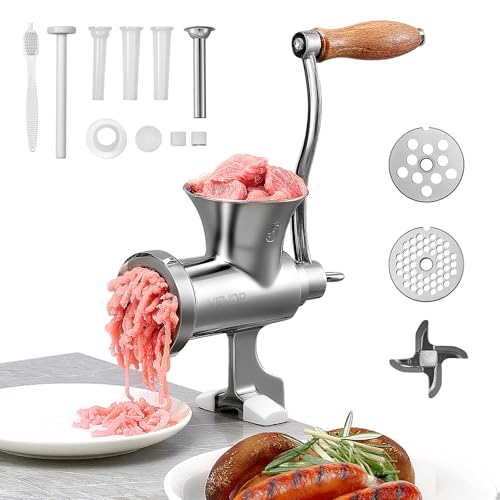
This is a smaller, modern take on the hand grinder. VEVOR makes the body from 304 stainless steel and lists the detachable parts as dishwasher safe, which removes the main chore of a cast iron grinder. The listing gives the size as 11.2 by 3.4 by 8.9 inches, small enough for a drawer.
It comes with two cutting plates and four sausage tubes, and a steel table clamp with non-slip pads that opens from 0.4 to 1.8 inches. VEVOR lists beef, pork, chicken, fish, vegetables and chili peppers among the things it grinds, and suggests a little edible oil on the blade to keep it in good condition.
A #5 head is small. It suits a pound or two at a time, which is plenty for a chorizo batch or a pan of picadillo, but it will feel slow for bigger jobs. VEVOR’s listing also says it handles small bones; we would not rely on any hand grinder for that, and electric grinder makers such as LEM say not to grind bones at all.
Why we like it
- 304 stainless steel body (listing)
- Dishwasher-safe parts (listing)
- Four sausage tubes included
- Clamp opens 0.4 to 1.8 inches
Key specifications
| Model | #5 |
|---|---|
| Type | Manual, clamp-on |
| Head size | #5 |
| Body material | 304 stainless steel |
| Power | Hand crank |
| Plates and extras | 2 plates, 4 sausage tubes |
| Cleaning | Dishwasher-safe parts |
| Warranty | Not stated |
Why we recommend it
It suits a small household that grinds a pound or two at a time and wants the easiest cleanup.
Skip it if you grind more than a couple of pounds at once; the larger cast iron CucinaPro or the electric LEM will be quicker.
Pros and cons
Pros
- Will not rust like cast iron
- Easy cleanup
- Compact
Cons
- Small #5 head
- Generalist brand; the listing is the main source
- No warranty stated

How we compared hand and electric grinders
We did not grind with these machines for this guide. Food safety points come from the University of Alaska Fairbanks Cooperative Extension’s guide to making sausage at home, published in cooperation with the USDA. Machine safety and care come from LEM’s use and maintenance manual for its #8 electric grinder. Product details come from each maker’s Amazon listing, and stock was checked on the day of writing. Points that are general kitchen knowledge are labeled as such.
Meat grinder questions, answered
Is a hand meat grinder worth it?
Yes, for small batches. It grinds to the same texture as an electric grinder with the same plate, it is quiet and small, and it has no motor to fail. It becomes hard work for large batches.
How cold should meat be before grinding?
UAF’s extension guide says to keep meat at 40°F or lower during processing, and that meat is easier to grind if it is slightly frozen. LEM’s electric grinder manual says not to grind deep-frozen food, so aim for firm and very cold rather than frozen solid.
Can I put meat grinder parts in the dishwasher?
It depends on the material. LEM says the parts of its #8 electric grinder are not dishwasher safe, and cast iron should be hand washed and dried. Some stainless steel grinders, such as the VEVOR #5, are listed as dishwasher safe. Follow your maker’s instructions.
What temperature should ground meat be cooked to?
UAF’s guide says all ground meat should be cooked to an internal temperature of 160°F, and turkey or other poultry to 165°F. Check with a meat thermometer rather than by color.
Is a stand mixer attachment an option?
Yes, if you already own a stand mixer. It sits between the two: powered, but limited by the mixer’s motor. Our stand mixer meat grinder guide covers them.
Our take on crank versus motor
Most home cooks who grind occasionally will be happy with a hand grinder, and it is the cheaper, simpler way to find out whether grinding your own is worth it. Once batches grow past five pounds or grinding becomes a regular job, an electric grinder pays its way, mainly because it keeps the meat cold and the work short. Whichever you choose, keep the meat cold, keep everything clean, and cook it to 160°F. For homemade chorizo, our best electric meat grinder guide walks through the steps, or call to order from Julia’s.