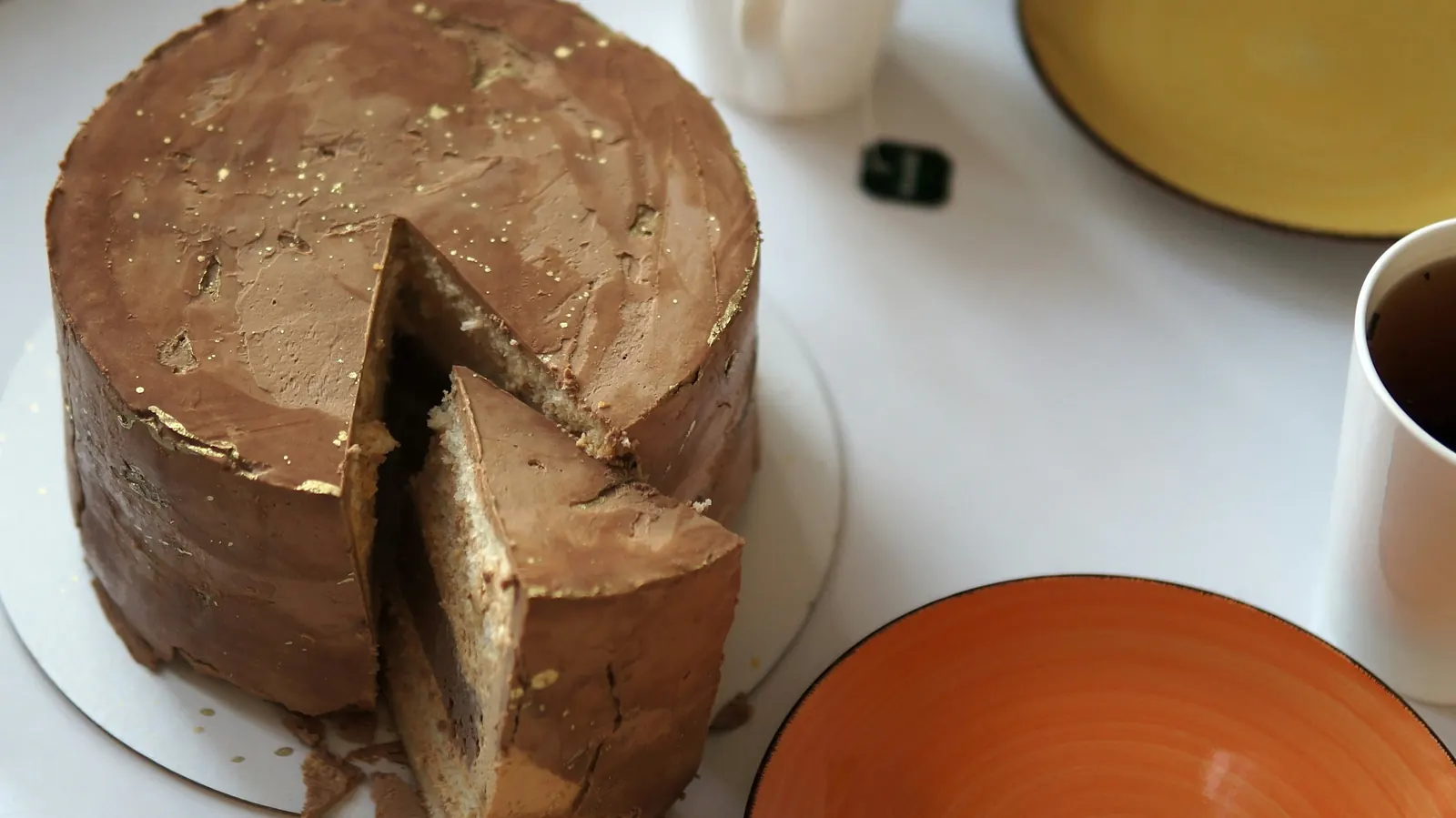
Most American layer cake recipes are written for 8-inch or 9-inch round pans, and many say either will do. One inch across seems too small to matter, but a round pan’s area grows with the square of its width, so the 9-inch pan has about a quarter more floor than the 8-inch. Pour the same batter into each and you get two different cakes: one taller, one wider and thinner, and they don’t bake in the same time.
In a restaurant pastry kitchen, pans match the recipe card exactly, because that is how a tres leches or a layer cake comes out the same every day. At home you can be more flexible if you know what changes. This guide compares the 8-inch and 9-inch round cake pan on area, volume, layer height, bake time and recipe conversion, using King Arthur Baking’s recipes and makers’ own figures, then names two pans for each size.
Julia’s earns a commission on purchases made through links on this page, at no cost to you. Recommendations are based on what a restaurant kitchen looks for, product specifications and verified buyer reports.
Quick verdict: 8-inch or 9-inch?
Buy the size your favorite recipes call for. If you are starting from scratch, a pair of 9-inch pans is the more flexible first buy: it takes most standard two-layer recipes, and King Arthur suggests 9-inch pans when an 8-inch pan is too shallow for a recipe. Choose 8-inch pans if you want taller, more dramatic layers, a slightly smaller cake, or your recipes are written for them. Either way, buy pans at least 2 inches deep.
The table sums up the differences. The sections after it explain each one.
8 inch vs 9 inch cake pan, side by side
| 8-inch round | 9-inch round | |
|---|---|---|
| Floor area (our arithmetic) | About 50 sq in | About 64 sq in, roughly 27% more |
| Volume of a 2-inch-deep pan, to the brim (our arithmetic) | About 7 cups | About 8.8 cups |
| Same batter in each | Taller layer | About a fifth shallower |
| Bake time, King Arthur yellow cake | 38 to 44 minutes | 36 to 42 minutes |
| Bake time, King Arthur fudge cake | 35 to 38 minutes | “A bit less” |
| If the pan is shallow | Risk of overflow | King Arthur’s suggested swap |
| Converting to 9 x 13 (King Arthur) | Two layers: bake 20 to 25% longer | Two layers: bake 30 to 40% longer |
| Storage | Smaller; nests inside a 9-inch | Wider |
Area: a quarter more cake floor
A round pan’s area is pi times the radius squared, so an extra inch across adds more than it seems. By our arithmetic, an 8-inch pan has about 50 square inches of floor and a 9-inch pan about 64. That is roughly 27 percent more.
The difference shows up in the finished cake. A 9-inch layer is wider, and if you cut both into the same number of slices, each 9-inch slice is bigger. If you want more servings from the same recipe, the 9-inch pans give you more surface to cut; if you want taller, more striking slices, the 8-inch pans give you height.
Volume: what a 2-inch pan holds
At 2 inches deep, an 8-inch pan holds about 100 cubic inches, or roughly 7 cups to the brim, and a 9-inch pan about 127 cubic inches, or roughly 8.8 cups, by our arithmetic. You never fill a cake pan to the brim, because the batter needs room to rise, so these are ceilings rather than batter amounts.
Depth matters as much as width. King Arthur’s Favorite Fudge Birthday Cake calls for two 8 by 2-inch round pans and says they need to be at least 2 inches tall; if your 8-inch pans are shorter, it says to use 9-inch pans instead. The bigger floor spreads the batter thinner, so it stays inside a shallower pan. America’s Test Kitchen also likes round cake pans at least 2 inches deep, as our best round cake pan set guide explains.
Pans sold as 8 or 9 inches aren’t all the same depth. Nordic Ware lists its Naturals rounds at 2.5 inches tall, USA Pan its 9-inch at 2.25 inches, and Chicago Metallic its 8-inch at 2 inches. A deeper pan is more forgiving when a recipe makes a little extra batter.
Layer height and bake time
Pour the same batter into an 8-inch and a 9-inch pan and the 9-inch layer will be about a fifth shallower, by our arithmetic, because the same volume spreads over 27 percent more floor. A thinner layer bakes through sooner.
King Arthur’s recipes show how much sooner. Its Back-to-Basics Yellow Cake makes two 8-inch or 9-inch rounds and gives 38 to 44 minutes for 8-inch pans and 36 to 42 minutes for 9-inch pans. Its Favorite Fudge Birthday Cake bakes 35 to 38 minutes in 8-inch pans, and a bit less in 9-inch pans. So the swap costs only a few minutes, but you should start checking early when you move to the bigger pan.
The reverse swap needs more care. Moving a 9-inch recipe into 8-inch pans makes taller layers that take longer, and if the pans are shallow, the batter may rise over the rim. Fill each pan no more than about halfway to two-thirds, which is general baking practice rather than a figure from these sources, and bake any extra batter as cupcakes.
Converting a recipe between sizes
Most two-layer recipes work in either size without changing the ingredients, as King Arthur’s yellow cake shows: the recipe yields two 8-inch or two 9-inch rounds. Only the bake time and layer height change.
If you want the same layer height in both sizes, scale the batter by area. By our arithmetic, a 9-inch layer needs about 1.27 times the batter of an 8-inch layer to come out equally tall, and an 8-inch layer needs about four fifths of a 9-inch layer’s batter.
King Arthur’s guide to turning layer cakes into sheet cakes adds a useful reference point. It says about 6 cups of batter fits a 9 by 13-inch pan, and when you bake a two-layer recipe as one sheet, it suggests baking about 20 to 25 percent longer if the recipe was written for two 8-inch rounds, or 30 to 40 percent longer for two 9-inch rounds. Our best cake pans 9×13 guide covers that pan.
Which size suits which cake
The 8-inch pan suits tall layer cakes meant to impress, and smaller households that don’t need a big cake. Three 8-inch layers stack into a striking cake. The 9-inch pan suits everyday two-layer cakes, recipes that run a little generous, and cakes for a crowd, since each layer is wider. It is also the size many single-layer cakes, such as a simple snack cake or a pastel de elote baked in a round pan, are written for; check your recipe.
If you bake often, owning both sizes is common, and an 8-inch pan nests inside a 9-inch pan for storage. Our round cake pan set guide includes sets in both sizes.
Choose an 8-inch pan if… / Choose a 9-inch pan if…
Choose an 8-inch pan if…
- Your favorite recipes are written for 8-inch rounds.
- You want taller layers and a more dramatic slice.
- You bake smaller cakes for a small household.
- Your pans are a full 2 inches deep or more.
Choose a 9-inch pan if…
- You are buying your first pair of round pans.
- You want a little more room for generous recipes.
- You want wider slices or more servings.
- You want a shorter bake and less risk of overflow.
Our picks on each side of the 8-inch vs 9-inch question
Two picks per size. The Nordic Ware Naturals pans appear on both sides, so the only difference between them is the size; a nonstick pan from Chicago Metallic or USA Pan completes each side. None of these listings appears on our other pages. All four were in stock and sold by Amazon.com when we checked. Each is a single pan, so buy two for a standard two-layer cake.
1. Nordic Ware Naturals 8-inch Round Cake Pan – Bare Aluminum, Tall Sides

Nordic Ware’s Naturals round is plain aluminum with an encapsulated rim to resist warping. The listing gives an 8-inch interior diameter, an 8.6-inch exterior and a height of 2.5 inches, deeper than the 2-inch minimum King Arthur asks for in its 8-inch fudge cake.
Aluminum heats quickly and evenly, and bare light metal is the classic choice for layer cakes because it browns gently. The trade-off is release: without a coating, you need to grease the pan and line the bottom with a parchment round. Nordic Ware says it is made in America of domestic and imported materials, and the listing notes a lifetime warranty.
The listing gives a weight of 0.7 pounds. Nordic Ware also makes the 9-inch below, so you can buy a matched set in both sizes.
Why we like it
- 2.5-inch height (listing)
- Natural aluminum for even baking
- Encapsulated rim against warping
- Made in America (listing)
Key specifications
| Model | 46800AMZ |
|---|---|
| Inside diameter | 8 in |
| Height | 2.5 in (listing) |
| Material | Natural aluminum, uncoated |
| Weight | 0.7 lb (listing) |
| Oven limit | Not stated |
| Warranty | Lifetime (listing) |
| Care | Grease and line; care not stated in the listing |
Why we recommend it
It suits a baker who wants tall 8-inch layers in a light, bare aluminum pan.
Skip it if you want easy release without parchment; the Chicago Metallic below is coated.
Pros and cons
Pros
- Deeper than many 8-inch pans
- Matches the 9-inch Naturals
- Nothing to scratch or peel
Cons
- Needs greasing and parchment
- Sold singly
- Care not stated in the listing
2. Chicago Metallic 8-inch Nonstick Round Cake Pan – Straight Sides, Easy Release

Chicago Metallic’s 8-inch round is heavy-weight aluminized steel with a silicone-based nonstick coating and a reinforced wire rim, according to the listing. It measures 8 inches across and 2 inches high, and the listing describes straight sides for layer cakes.
It is oven safe to 450°F and not meant for the broiler. Chicago Metallic suggests it for single, double or triple layer cakes as well as cinnamon rolls, tarts and brownies. A lifetime limited warranty is listed.
At exactly 2 inches deep, it meets King Arthur’s minimum for its 8-inch fudge cake but has less headroom than the Nordic Ware. Fill it no more than about two-thirds full and save extra batter for cupcakes.
Why we like it
- Nonstick release
- Straight sides for stacking
- Wire-reinforced rim
- Lifetime limited warranty
Key specifications
| Model | 16628 |
|---|---|
| Inside diameter | 8 in |
| Height | 2 in |
| Material | Aluminized steel, silicone-based nonstick |
| Weight | Not stated |
| Oven limit | 450°F; not for the broiler |
| Warranty | Lifetime limited (listing) |
| Care | Not stated in the listing |
Why we recommend it
It suits a baker who wants straight-sided 8-inch layers that release easily.
Skip it if your recipes run generous; a deeper pan like the Nordic Ware gives more room.
Pros and cons
Pros
- Easy release
- Straight sides
- Warranty listed
Cons
- Only 2 inches deep
- Coating needs gentle tools
- Not for the broiler
3. Nordic Ware Naturals 9-inch Round Cake Pan – Bare Aluminum, Room to Rise

The 9-inch member of the Naturals line: natural aluminum, an encapsulated rim, a 9-inch interior and a 9.6-inch exterior, with the height given as 2.5 inches in the listing. That depth plus the larger floor makes it the forgiving choice for recipes that make a little more batter than expected.
Like the 8-inch, it is uncoated, so grease it and line the bottom. Nordic Ware says it is made in America of domestic and imported materials, and the listing gives a lifetime warranty and a weight of 0.91 pounds.
Because the batter spreads thinner in this pan, start checking for doneness a few minutes before a recipe’s 8-inch time, as King Arthur’s yellow cake timings suggest.
Why we like it
- 9-inch floor, 2.5-inch height
- Natural aluminum for even baking
- Matches the 8-inch Naturals
- Made in America (listing)
Key specifications
| Model | 46900AMZ |
|---|---|
| Inside diameter | 9 in |
| Height | 2.5 in (listing) |
| Material | Natural aluminum, uncoated |
| Weight | 0.91 lb (listing) |
| Oven limit | Not stated |
| Warranty | Lifetime (listing) |
| Care | Grease and line; care not stated in the listing |
Why we recommend it
It suits a first-time buyer who wants a flexible, deep 9-inch pan for most two-layer recipes.
Skip it if you don’t want to line pans; the USA Pan below is coated.
Pros and cons
Pros
- Deep and wide: forgiving
- Light, even-heating aluminum
- Pairs with the 8-inch
Cons
- Needs greasing and parchment
- Sold singly
- Oven limit not stated
4. USA Pan 9-inch Nonstick Round Cake Pan – Coated, Made in the USA

USA Pan’s 9-inch round is aluminized steel with Americoat, which USA Pan describes as a patented silicone nonstick coating free of PTFE, PFOA and BPA. The listing gives the size as 9 inches across and 2.25 inches deep, and says it is made in the USA.
USA Pan recommends washing with hot water, mild soap and a gentle brush or sponge. The coating is meant for quick release, which suits layer cakes you want to turn out cleanly, though a parchment round is still cheap insurance.
The quarter inch of extra depth over a 2-inch pan gives a little more headroom, and the 9-inch floor keeps layers thinner and quicker to bake than the same batter in an 8-inch pan.
Why we like it
- Silicone nonstick coating (maker)
- 2.25 inches deep
- Made in the USA (listing)
- Care instructions stated
Key specifications
| Model | 1070LC |
|---|---|
| Inside diameter | 9 in |
| Height | 2.25 in |
| Material | Aluminized steel, Americoat silicone nonstick |
| Weight | Not stated |
| Oven limit | Not stated |
| Warranty | Listed; terms not stated |
| Care | Hot water, mild soap, gentle brush or sponge |
Why we recommend it
It suits a baker who wants a coated 9-inch pan that turns layers out cleanly.
Skip it if you prefer bare metal; the Nordic Ware 9-inch above is uncoated.
Pros and cons
Pros
- Easy release
- Deeper than 2 inches
- Made in the USA
Cons
- Oven limit not stated
- Coating needs gentle care
- Sold singly
8-inch vs 9-inch cake pan questions, answered
Can I use 9-inch pans for an 8-inch recipe?
Yes. The layers will be thinner and bake a few minutes faster. King Arthur’s yellow cake gives 38 to 44 minutes in 8-inch pans and 36 to 42 in 9-inch pans, and King Arthur suggests 9-inch pans when 8-inch pans are shorter than 2 inches.
Can I use 8-inch pans for a 9-inch recipe?
Usually, if the pans are at least 2 inches deep. The layers will be taller and take longer. Fill each pan no more than about two-thirds full, bake any extra batter as cupcakes, and test with a toothpick rather than going by time alone.
How much bigger is a 9-inch cake than an 8-inch?
About 27 percent more area, by our arithmetic: roughly 64 square inches against 50.
How deep should a round cake pan be?
At least 2 inches. King Arthur asks for that in its 8-inch fudge cake, and America’s Test Kitchen likes pans at least 2 inches deep. The pans above run from 2 to 2.5 inches.
Do I need two pans?
For a standard two-layer cake baked at once, yes. Every pick here is sold singly, so buy two of the same size.
Which pans go in your oven first
If you are starting out, buy two 9-inch pans at least 2 inches deep. They take most layer cake recipes, bake a little faster and leave room for generous batters. Buy 8-inch pans when your recipes call for them or you want tall, dramatic layers. Whichever you choose, match the pan to the recipe when you can and check early when you can’t.
For more choices, see our best cake pans guide and our best square cake pan guide. And when you would rather someone else did the baking, see the menu or call to order.