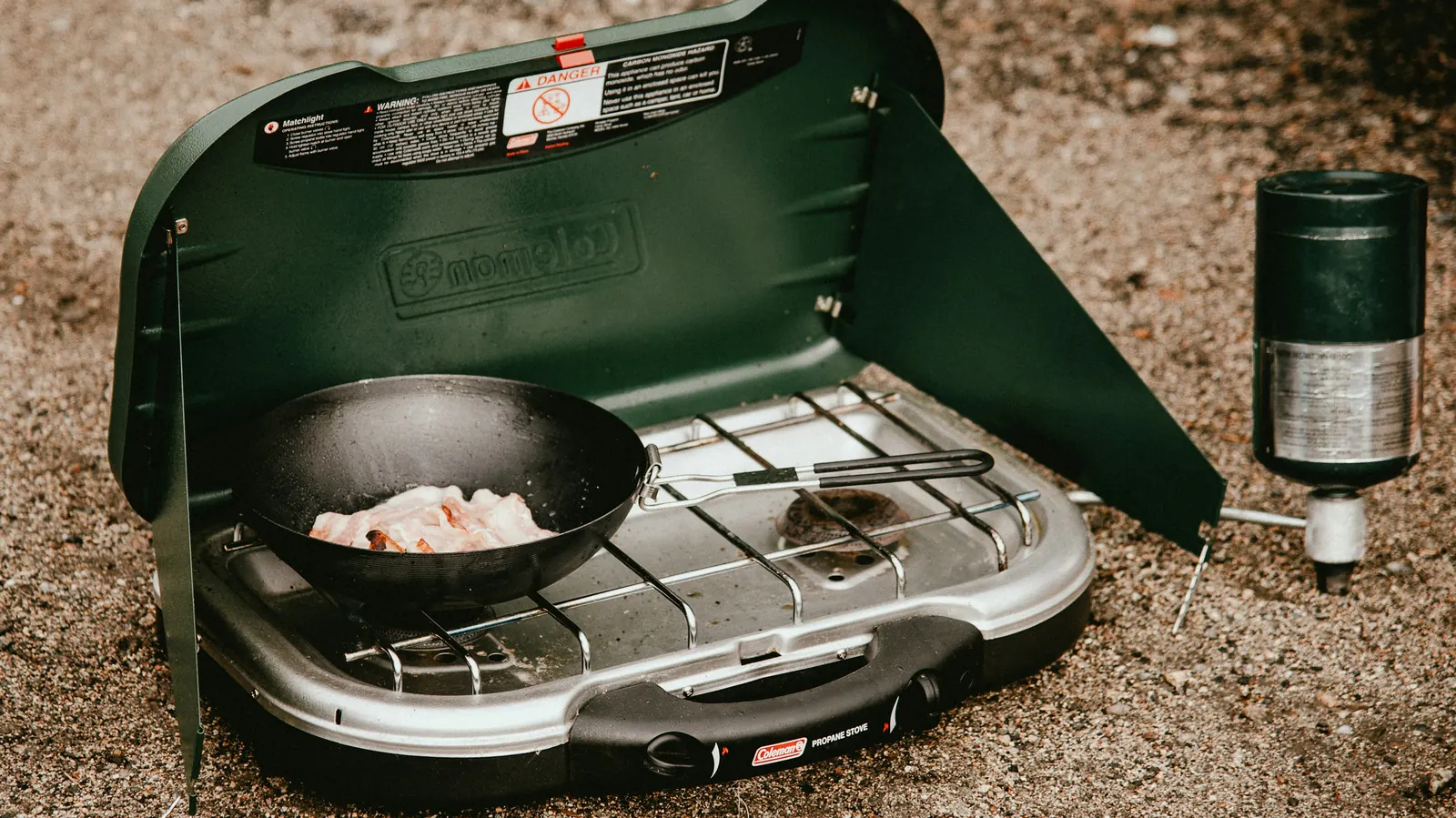
A camp stove is a restaurant’s back burner taken outdoors. It is the place a pot of frijoles simmers while the meat is on the fire, where a comal warms tortillas one after another, and where the coffee gets made at six in the morning before anyone wants to start charcoal. What matters is the same as on a kitchen range: steady heat you can turn down, room for the pans you own, and a flame that stays lit when the wind picks up.
This guide compares seven gas camping stoves sold on Amazon in the United States: four two-burner propane stoves for car camping, a single-burner dual-fuel stove and two backpacking stoves. For each we list the burners, stated BTU, fuel, ignition, wind protection, weight and warranty as the maker or Amazon listing gives them, and we write “Not stated” where neither does. Where OutdoorGearLab has published results for a stove, we say so and name the source.
Julia’s earns a commission on purchases made through links on this page, at no cost to you. Recommendations are based on what a restaurant kitchen looks for, product specifications and verified buyer reports.
Quick verdict: which camping gas stove to buy
For most car campers, the best camping gas stove is the Camp Chef Everest 2X: two 20,000 BTU burners, matchless ignition, a folding lid that works as a windscreen and 215 square inches of cooking space, and it is OutdoorGearLab’s best overall camping stove. On a tighter budget, the Coleman Triton+ gives two burners, push-button ignition and a three-year limited warranty. For a griddle for tortillas and fajitas, choose the Coleman Cascade 3-in-1. For one burner on a table, the dual-fuel Gas One GS-3400P; for a backpack, the 2.3-ounce SOTO WindMaster.
The table compares the five picks we would steer most campers toward, one for each kind of trip. All seven stoves are reviewed in full after it.
Five camp stoves at a glance
Burners, stated output, fuel and wind protection for our five standout picks, as each maker or Amazon listing states them.
| Stove | Best for | Burners & BTU | Fuel & wind | Buy on Amazon |
|---|---|---|---|---|

Camp Chef Everest 2X Two-Burner StoveBest overall
|
Car camping, families, windy sites | 2 x 20,000 BTU | Propane; 3-sided windscreen | View on Amazon |
Coleman Triton+ Two-Burner Propane StoveBest value
|
First camp stove, weekend trips | 2 burners; 22,000 BTU total | Propane; dual wind guards | View on Amazon |

Coleman Cascade 3-in-1 Camp StoveBest with a griddle
|
Tortillas, fajitas, breakfast | 2 burners; 24,000 BTU total | Propane; two wind guards | View on Amazon |
Gas One GS-3400P Dual Fuel StoveBest dual fuel
|
One burner, either fuel | 1 x 8,000 BTU | Butane or propane; none described | View on Amazon |
| Backpacking, coffee, one-pot meals | 1 burner; 11,000 BTU | Gas-mix canister; concave burner | View on Amazon |
Product images from Amazon. Specifications as stated by each maker or Amazon listing; SOTO figures come from its Amazon listing. Check the listing before you buy.
Our picks for the best camping gas stove
The seven stoves below run from a 2.3-ounce backpacking burner to a 40,000 BTU two-burner for a group site. Each pick explains who it suits, the specs that matter at camp, and one honest reason to skip it.
1. Camp Chef Everest 2X Two-Burner Stove – Strong Burners, Real Windscreen
The Everest 2X has the most power of the compact tabletop stoves here: two 20,000 BTU cast-aluminum burners, 40,000 BTU in total, according to Camp Chef. The cooking area is 215 square inches, enough for a 12-inch skillet and a pot side by side. The listing gives the closed size as 25.2 by 12.7 by 5.6 inches, with a carry handle and a drip tray for cleanup.
Wind is where cheap camp stoves fail, and this is where the Everest 2X stands out. The folding lid and side panels form a three-sided windscreen. OutdoorGearLab named it the best overall camping stove in its camping stove roundup, scored it 8.5 out of 10 for wind resistance, and wrote that the windscreen gives “nearly seamless protection from crosswinds.” It also scored 9.0 for simmering, which is what you need for a pot of beans that should bubble gently, not scorch.
Matchless ignition lights the burners without a lighter. Camp Chef does not state the weight on its page; OutdoorGearLab measured 13.97 pounds and called it one of the heavier tabletop models. Its reviewers also found the latches can bend over time. The listing gives a one-year warranty.
Why we like it
- Two 20,000 BTU burners (Camp Chef)
- Three-sided windscreen from the folding lid
- Matchless ignition
- 215 sq in of cooking space
- OutdoorGearLab’s best overall camping stove
Key specifications
| Model | MSHPX |
|---|---|
| Burners | 2 |
| BTU (stated) | 2 x 20,000 (40,000 total) |
| Fuel | Propane |
| Ignition | Matchless |
| Wind protection | Folding lid, 3-sided windscreen |
| Weight | Not stated (13.97 lb measured by OutdoorGearLab) |
| Warranty | One year |
Why we recommend it
It suits families and group campsites where two pans run at once: beans and rice on one side, eggs, chorizo or a comal on the other, even in a breeze.
Skip it if you pack light or watch every dollar; it is heavier and costs more than the Coleman stoves.
Pros and cons
Pros
- High output on both burners
- Strong wind protection
- Good simmer control (OutdoorGearLab)
Cons
- Heavy and bulky
- Latches can bend over time (OutdoorGearLab)
- One-year warranty
2. Coleman Triton+ Two-Burner Propane Stove – Push-Button Start, Long Warranty
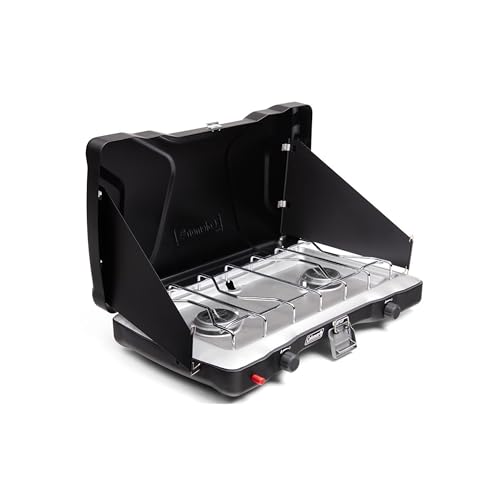
The Triton is the classic green-box camp stove in a newer form. The Triton+ version adds push-button Instastart ignition, so you do not need a lighter to get it going. Coleman lists 22,000 BTU in total across two independently adjustable burners, room for a 12-inch and a 10-inch pan, and up to one hour on high from one 16-ounce propane cylinder.
Dual wind guards fold out on either side to shield the burners. The grate is removable chrome-plated steel and the cooktop is rust-resistant aluminized steel, so a spill wipes out. A heavy-duty latch keeps the stove closed in the car, and a built-in handle carries it. The listing gives the size as 13.7 by 5.7 by 22.6 inches, and Coleman backs it with a three-year limited warranty, the longest stated here.
The trade-off is fine control. OutdoorGearLab tested the standard Triton, which it calls nearly identical to the Triton+ apart from the igniter, and gave it the lowest simmering score in its lineup, 6.0 out of 10. For beans, keep the pot on the lowest setting and stir more often than you would at home. The listing does not state the weight.
Why we like it
- Push-button Instastart ignition
- Fits a 12-inch and a 10-inch pan
- Up to 1 hour on high per 16 oz cylinder
- Three-year limited warranty
Key specifications
| Model | 2157318 |
|---|---|
| Burners | 2 |
| BTU (stated) | 22,000 total |
| Fuel | Propane (16 oz cylinder) |
| Ignition | Push-button Instastart |
| Wind protection | Dual wind guards |
| Weight | Not stated |
| Warranty | 3-year limited |
Why we recommend it
It suits first-time campers and weekend trips where you want two burners, easy lighting and a long warranty without paying for high output.
Skip it if you cook delicate sauces or long simmers often; OutdoorGearLab found its simmer control the weakest of the stoves it scored.
Pros and cons
Pros
- Matchless lighting
- Easy-clean cooktop
- Long warranty
Cons
- Lower output than the Camp Chef
- Weak simmer control (OutdoorGearLab, standard Triton)
- Weight not stated
3. Coleman Cascade 3-in-1 Camp Stove – Burners, Grill and Griddle
The Cascade 3-in-1 is a two-burner propane stove that comes with removable cast iron grill and griddle accessories. For a Mexican camp kitchen that matters: the griddle does the job of a comal for tortillas and quesadillas, and the grill side handles fajita meat and peppers. Coleman lists 24,000 BTU in total and up to one hour on high from one 16-ounce propane cylinder.
Coleman says the two burners have improved knob rotation for precise temperature and simmer control, and OutdoorGearLab agreed, scoring it 8.5 out of 10 for simmering and naming it its top pick for a stove and grill combo. Rotary ignition lights it without matches. A recessed carry handle, a place to store the regulator and a nylon case for the accessories make it easier to pack.
Wind is its weak point. Coleman fits two wind guards, but OutdoorGearLab called them thin and scored the stove 6.5 for wind resistance. Pick a sheltered spot for the stove. The listing does not state the weight or the warranty.
Why we like it
- Cast iron grill and griddle included
- 24,000 BTU total (Coleman)
- Good simmer control (OutdoorGearLab)
- Rotary matchless ignition
Key specifications
| Model | 2157356 |
|---|---|
| Burners | 2 |
| BTU (stated) | 24,000 total |
| Fuel | Propane (16 oz cylinder) |
| Ignition | Rotary, matchless |
| Wind protection | Two wind guards |
| Weight | Not stated |
| Warranty | Not stated in the listing |
Why we recommend it
It suits campers who want tortillas, pancakes and fajitas without packing a separate griddle. It is the most complete camp kitchen in one box on this list.
Skip it if you camp somewhere windy; its wind guards are thinner than the Camp Chef’s windscreen.
Pros and cons
Pros
- Griddle for tortillas
- Fine simmer control
- Accessory carry case
Cons
- Thin wind guards (OutdoorGearLab)
- Cast iron accessories add weight
- Warranty not stated in the listing
4. Camp Chef Mountaineer Aluminum Stove – Built for Overland Trips
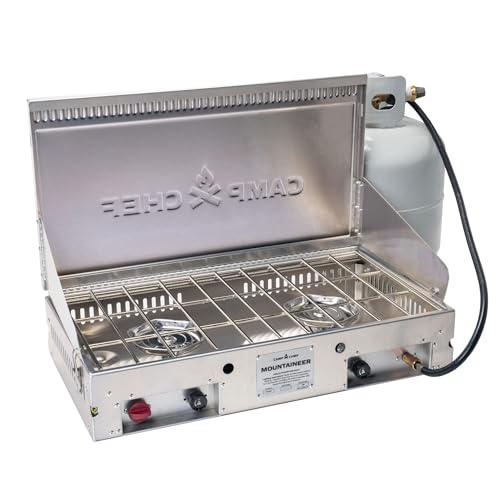
The Mountaineer is Camp Chef’s aluminum cooking system: the same two 20,000 BTU cast aluminum burners as the Everest 2X, 40,000 BTU in total, in a rust-resistant aluminum body that Camp Chef pitches at overlanding and river trips. A suitcase-style latching lid closes it for travel and folds up into a windscreen when you cook, and the listing says a three-sided windscreen is included.
The important difference is the fuel connection. The Mountaineer comes with a 5-foot hose and regulator and no propane tank, so it is set up to run from a larger refillable propane tank rather than a 1-pound cylinder screwed onto the side. A bigger tank means fewer fuel changes on a long trip.
Matchless ignition and appliance-style knobs light it and set the heat. Camp Chef’s listing gives a one-year limited warranty covering defects in materials and workmanship. The listing does not state the weight.
Why we like it
- Two 20,000 BTU burners
- Rust-resistant aluminum build
- Lid folds into a windscreen
- 5-ft hose and regulator included
Key specifications
| Model | MS40AX |
|---|---|
| Burners | 2 |
| BTU (stated) | 2 x 20,000 (40,000 total) |
| Fuel | Propane via 5-ft hose and regulator |
| Ignition | Matchless |
| Wind protection | 3-sided windscreen; lid folds up |
| Weight | Not stated |
| Warranty | 1-year limited |
Why we recommend it
It suits overlanders, RV travelers and anyone who already carries a refillable propane tank and cooks for a group every day.
Skip it if you want to use small 1-pound cylinders; the listing describes a hose-and-regulator setup for a separate tank, which you have to carry.
Pros and cons
Pros
- High output
- Aluminum resists rust
- Runs from a bulk tank
Cons
- Tank sold separately
- Weight not stated
- One-year warranty
5. Gas One GS-3400P Dual Fuel Stove – Butane or Propane
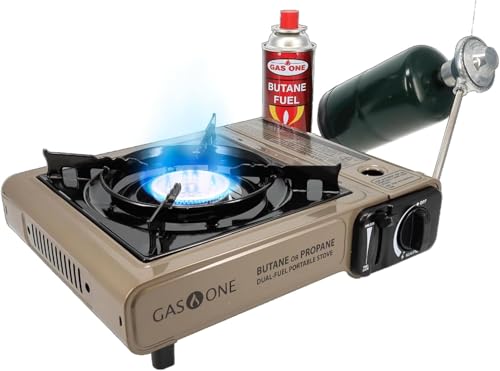
Gas One’s dual fuel stove runs on either an 8-ounce butane cartridge or a 16.4-ounce (1-pound) propane cylinder, with the propane converter regulator included, according to the listing. That flexibility is useful: butane for a mild afternoon at the lake, propane when the night gets cold or the butane runs out. The listing gives 8,000 BTU in its size field.
Piezo-electric ignition lights it without matches, and an adjustable dial sets the flame. For safety, the listing lists a pressure sensor that ejects the butane cartridge if it detects irregular pressure and a gas flow cut-off mechanism. A carrying case is included, according to the listing title. The listing does not describe any wind protection, so set it out of the breeze.
OutdoorGearLab named the GS-3400P its best value single burner, and it notes that butane is not ideal in cold temperatures. The listing gives a 1-year warranty and does not state the weight.
Why we like it
- Runs on butane or propane, regulator included
- OutdoorGearLab’s best value single burner
- Carrying case included
- Cartridge ejection and gas cut-off safety
Key specifications
| Model | GS-3400P |
|---|---|
| Burners | 1 |
| BTU (stated) | 8,000 |
| Fuel | 8 oz butane or 16.4 oz propane |
| Ignition | Piezo-electric |
| Wind protection | Not stated |
| Weight | Not stated |
| Warranty | 1 year |
Why we recommend it
It suits campers and emergency kits where you want one stove that takes whichever fuel you can find.
Skip it if you want a fast boil; the Camp Chef Everest 2X states 20,000 BTU per burner, more than double this stove’s.
Pros and cons
Pros
- Two fuel options
- Matchless ignition
- Carrying case
Cons
- Weight not stated
- Lower stated output than the Camp Chef burners
- Single burner
6. Jetboil MiniMo Cooking System – Fast Boil That Can Also Simmer

The Jetboil MiniMo is a burner and an insulated cooking cup that work as one unit, built mainly to heat water fast: the listing says it reaches a rolling boil in just over two minutes and uses half the fuel of traditional systems. At camp that means coffee, oatmeal, instant rice or rehydrated beans before anyone else has the two-burner lit.
What sets it apart from most cup systems is heat control. Jetboil says its regulator allows incremental adjustment from a light simmer to a full boil, enough for warming a sauce or wilting greens in the cup. The cup has metal handles and a wide, low shape so you can eat straight from it, a push-button igniter lights the burner, and the kit includes a lid, bottom cover, fuel can stabilizer and pot support.
The listing does not state the BTU output, the cup capacity or the weight, and JetPower fuel is sold separately. Jetboil gives a one-year limited warranty.
Why we like it
- Rolling boil in just over two minutes (listing)
- Adjustable from simmer to boil (listing)
- Push-button igniter
- Includes pot support and fuel can stabilizer
Key specifications
| Model | MNMCB |
|---|---|
| Burners | 1 (integrated cup) |
| BTU (stated) | Not stated |
| Fuel | JetPower canister (sold separately) |
| Ignition | Push-button igniter |
| Wind protection | Not stated |
| Weight | Not stated |
| Warranty | 1-year limited |
Why we recommend it
It suits hikers, early risers and anyone who wants fast hot water and a little real cooking from one small kit, next to a bigger camp stove.
Skip it if you want to fry, sear or warm tortillas; it cooks in its own cup, not in a skillet.
Pros and cons
Pros
- Very fast boil
- Simmer control
- Eat straight from the cup
Cons
- Not for frying or searing
- BTU and weight not stated
- Fuel sold separately
7. SOTO WindMaster Backpacking Stove with 4Flex – Under Three Ounces
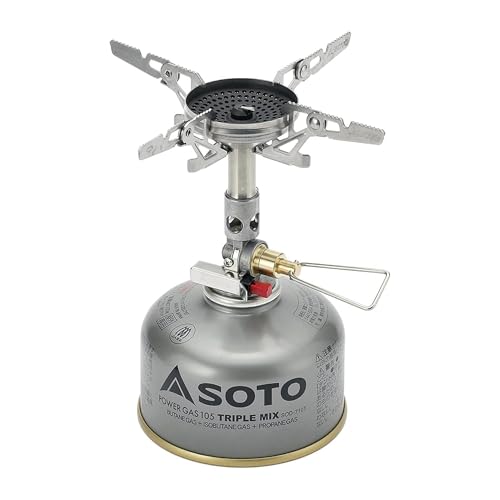
The WindMaster is a small burner that screws onto a fuel canister. The listing gives its weight as 67 grams, or 2.3 ounces, and its output as 11,000 BTU (3,260 watts). SOTO says it boils two cups of water in under two and a half minutes and burns for about an hour and a half on an 8-ounce (250-gram) canister.
Its selling point is wind. SOTO says the concave burner head and the pot sitting close to the flame act like a built-in windscreen, and that it keeps a steady output in cold or gusty weather; that is the maker’s claim, and we did not read an independent wind test of this model. The box includes the 4Flex pot support for larger pots, and a push-button igniter is built into the burner post.
SOTO’s regulator takes butane, isobutane and propane mixtures, and the listing says 100 percent propane must not be used. Keep the plastic cap on the canister when the stove is packed, and keep the base out of sand. The listing does not give a warranty term, only how to contact SOTO for a repair.
Why we like it
- 2.3 oz (67 g), per the listing
- 11,000 BTU stated
- Built-in igniter
- 4Flex support for larger pots
Key specifications
| Model | WindMaster with 4Flex |
|---|---|
| Burners | 1 |
| BTU (stated) | 11,000 |
| Fuel | Butane, isobutane or propane mix canister (no 100% propane) |
| Ignition | Built-in igniter |
| Wind protection | Concave burner head (SOTO’s claim) |
| Weight | 2.3 oz (67 g) |
| Warranty | Not stated as a term |
Why we recommend it
It suits backpackers and anyone who wants the smallest possible stove for coffee and one-pot meals.
Skip it if you cook for more than two; a tiny burner under a big pot is unstable and slow.
Pros and cons
Pros
- Lightest stove here
- Igniter built in
- Stated wind design
Cons
- Wind claim is the maker’s
- Not for big pans
- No 100% propane
How to choose a camping stove for real cooking
Five things decide whether a gas stove will cook a proper meal at camp, not just boil water.
1. Two burners or one
Two burners is what a real meal needs: one for the pot, one for the pan or comal. Every two-burner stove here takes a 12-inch skillet. A single burner is fine for coffee, one-pot meals or as a second stove beside the grill.
2. BTU, and what it does not tell you
Stated output runs from 8,000 BTU for the Gas One single burner to 40,000 BTU for the two Camp Chef stoves. More BTU boils water faster, but a camp kitchen also needs a low, steady flame. OutdoorGearLab’s results show it: the Everest 2X scored high for both boil time and simmering, while the Triton, with less output, scored lowest for simmering.
3. Wind protection
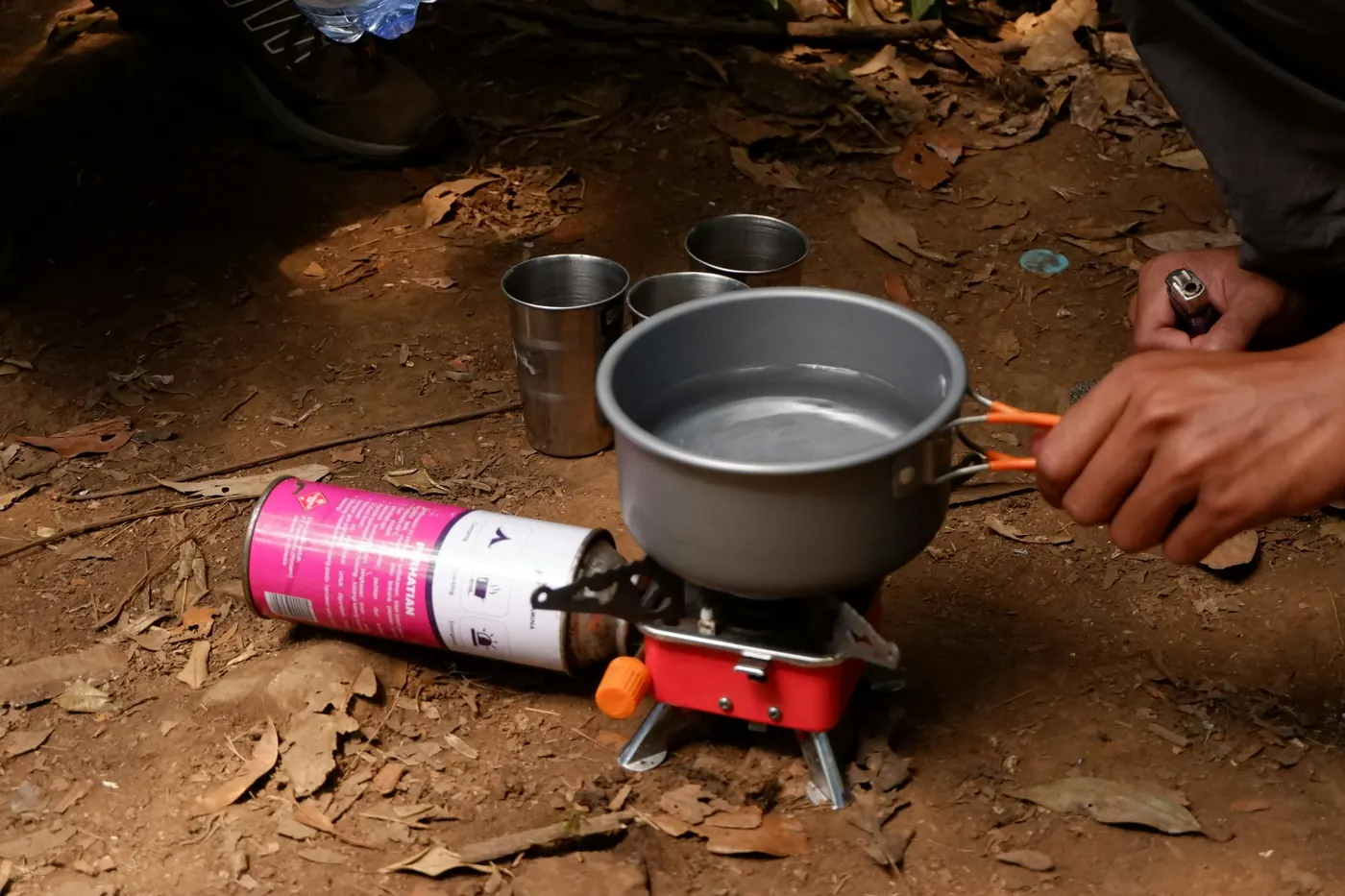
Wind steals heat and can blow out a flame. OutdoorGearLab found that tight windscreens and recessed burners did best. Three-sided screens like the Camp Chef’s beat thin side flaps. On canister stoves, never wrap the canister in a homemade windscreen; MSR warns that trapped heat can make the canister leak or explode.
4. Ignition
Push-button and rotary igniters save fumbling with a lighter, but they can fail. Carry a lighter anyway.
5. Size, weight and what you cook
Car campers can carry a 14-pound two-burner; backpackers count ounces. If tortillas and fajitas are the plan, a griddle like the Cascade’s, or a comal on any two-burner, matters more than raw output. For bigger griddle cooking, see our guide to the best portable outdoor griddle.
The best gas for a camping stove
The stove decides the fuel, so check the listing first. Here is how the three common camp fuels compare, based on the makers’ own information.
- Propane in 1-pound (16-ounce) cylinders runs most two-burner stoves. Coleman rates the Triton+ and Cascade at up to one hour on high per cylinder. Propane handles cold weather better than butane, which is why it is the usual choice for car camping.
- Butane in 8-ounce cartridges runs flat single-burner stoves like the Gas One GS-3400P. It is compact and easy to load, but OutdoorGearLab notes that butane is not ideal in cold temperatures.
- Isobutane-propane canisters run backpacking stoves like the SOTO WindMaster and Jetboil MiniMo. SOTO says not to use 100 percent propane in the WindMaster, and MSR’s PocketRocket 2 manual calls for an 80/20 isobutane-propane canister certified to EN 417 and warns that O-rings can stiffen and leak below freezing.
- Bulk propane through a hose runs stoves like the Camp Chef Mountaineer. A refillable tank lasts longer and puts the fuel farther from the flame.
How we picked these seven stoves
We started from what a kitchen needs from a burner: enough heat to boil and sear, a low flame for beans and sauces, room for the pans you own, and a flame that holds in wind. We then looked at gas camping stoves sold on Amazon in the United States and in stock when we checked, and took each specification from the maker (Camp Chef, MSR) or the brand’s Amazon listing. Where neither gave a figure we wrote “Not stated.” For performance, we read OutdoorGearLab’s camping stove and backpacking stove roundups and the full Everest 2X review, and we cite their scores by name. We have not cooked on these stoves for this guide. We left out stoves showing very low stock, including the Camp Chef Explorer, a Eureka Ignite we could not find in stock, the Iwatani 35FW butane stove and the MSR PocketRocket 2, both back-ordered when we last checked. The safety rules below still draw on MSR’s PocketRocket 2 manual, which is clear and general.
Gas stove safety at camp
Read your stove’s manual before the trip. These rules come from MSR’s PocketRocket 2 manual, the National Fire Protection Association and the US Fire Administration:
- Never cook inside a tent, camper or car. MSR’s manual warns that its stove can produce carbon monoxide, which is poisonous and has no odor, and that using it in an enclosed space such as a camper, tent, car or home can kill you. It is marked for outdoor use only. Treat every camp stove the same way unless its maker’s manual says otherwise.
- Check for leaks with soapy water. MSR says to check for leaks using soapy water, never a flame. NFPA’s grilling safety tips give the same test for propane hoses: a leak releases bubbles.
- If the flame goes out, NFPA says to turn the gas off and wait at least five minutes before relighting. If you smell gas, MSR’s steps are to turn the stove off, put out nearby flames, disconnect the fuel and leave the area while it clears.
- Keep people back. MSR recommends keeping children at least 10 feet from the stove and fuel, and never leaving a lit stove unattended.
- Cook outside, away from things that burn. MSR’s manual says to keep combustibles at least 4 feet from the top and sides of a burning stove, and flammable liquids and vapors at least 25 feet away. The USFA says to use propane grills outside only and never walk away from a lit grill; the same habits apply to a camp stove.
Camp stove questions, answered
What is the best camping gas stove?
For most car campers, the Camp Chef Everest 2X: two 20,000 BTU burners, a three-sided windscreen and OutdoorGearLab’s best overall award. The Coleman Triton+ costs less and has a longer warranty.
What is the best gas for a camping stove?
Use whatever your stove is built for. Propane is the usual fuel for two-burner stoves and handles cold better; butane suits flat single-burner stoves in mild weather; isobutane-propane canisters run backpacking stoves.
Can I use a camping stove in my tent?
No. MSR’s manual warns that its stove produces carbon monoxide and that using it in a tent, camper, car or home can kill you. Cook outside, away from the tent.
Can I cook tortillas on a camp stove?
Yes. Set a comal or griddle over one burner on medium heat. A two-burner stove lets you keep beans on the other burner. Our guide to the best comal for tortillas covers the pan.
How long does a 1-pound propane cylinder last?
Coleman rates its Triton+ and Cascade at up to one hour on high per 16-ounce cylinder. On low it lasts longer, so pack spares for a weekend.
Our pick for the camp kitchen
Buy the Camp Chef Everest 2X if you want one camping gas stove that boils fast, simmers well and holds its flame in wind. Choose the Coleman Triton+ to save money, the Cascade 3-in-1 for a griddle, the Gas One for a single burner on butane or propane, and the SOTO WindMaster or Jetboil MiniMo when you carry everything on your back.
Need a surface to cook on? See our guide to the best camp kitchen tables.
Related guide: Best camping cookware set.
Related guide: Best camping oven.
For the rest of the camp kitchen, add a camp Dutch oven for a pot of beans, a camping charcoal grill for carne asada, and one of our cooler picks to keep the meat cold until it hits the fire. For the beans themselves, read charro beans vs refried beans. Or let us do the cooking: see the menu or call to order.