A hand squeezer asks a lot of the joints that hurt first: a tight grip, a hard pinch and a twist at the wrist, repeated for every half lemon or lime. If your hands are stiff or sore, a pitcher of limeade or a round of margaritas can turn into a chore you put off.
The fix is a juicer that moves the work somewhere else. A motor can do the squeezing, a long lever can let your arm and body weight do the pressing, or a gear can multiply a light squeeze. This guide sorts the options by how much grip each one asks for, using what each maker states and what independent reviewers found.
Julia’s earns a commission on purchases made through links on this page, at no cost to you. Recommendations are based on what a restaurant kitchen looks for, product specifications and verified buyer reports.
Quick verdict: which juicer is easiest on sore hands
For most people with arthritic hands, the Breville Citrus Press is the one to buy: you lower a lever onto the fruit and a motor does the juicing, and America’s Test Kitchen found it pressed citrus of all sizes “smoothly and effortlessly”. If you want a lighter, smaller electric that you press down with your palm rather than your fingers, the Dash Dual Citrus Juicer is ATK’s budget pick. For no electricity at all, a countertop lever press such as the Zulay Kitchen Cast Iron Juicer lets your arm do the work instead of your grip.
None of these is a medical device, and this is a buying guide rather than health advice. If you have specific limits on what your hands can do, a hand therapist or occupational therapist can tell you which motions to avoid; the sections below explain how each juicer moves the effort.
Five easy-grip juicers side by side
Our five standout picks, one for each way of taking strain off your hands, with the details each maker or listing states. All eight juicers are reviewed in full below.
| Juicer | Best for | How you press | Power | Buy on Amazon |
|---|---|---|---|---|
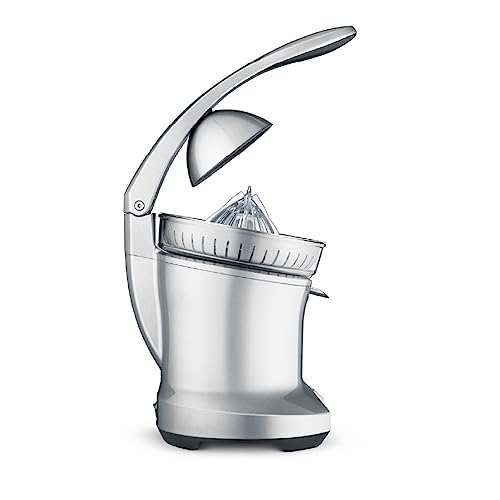
Breville Citrus PressBest overall
|
Least hand effort, any fruit | Lower the lever; motor juices | Electric, 110 watts | View on Amazon |
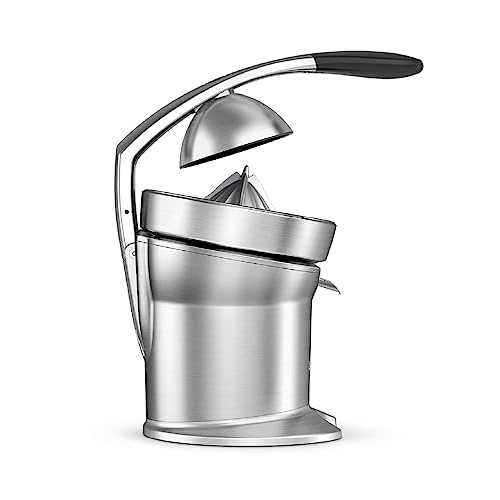
Breville Citrus Press ProSmoothest lever
|
A power-assisted lever | Lower the hinged arm; motor juices | Electric, 110 watts | View on Amazon |

Dash Dual Citrus JuicerBudget electric
|
Light, small, low cost | Press fruit down with the palm | Electric (wattage not stated) | View on Amazon |

Zulay Kitchen Cast Iron JuicerBest manual lever
|
No plug, big batches | Pull a long lever arm down | Manual | View on Amazon |
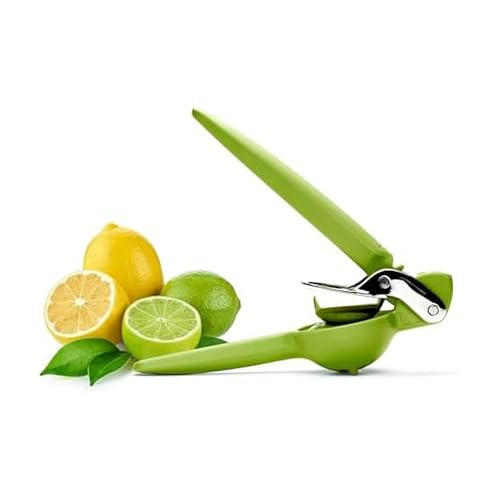
Chef’n FreshForce Citrus JuicerBest handheld
|
A few limes or lemons | Squeeze; gears add force | Manual | View on Amazon |
Product images from Amazon. Power and operation are as stated by each maker; check the listing before you buy.
Our picks for the best citrus juicer for arthritic hands
These eight juicers cover the three ways to take the squeeze out of your fingers: electric presses with a lever, electric reamers you press down with your palm, and manual presses that swap grip for leverage. Each pick says how you operate it, what the maker states and one honest reason to skip it.
1. Breville Citrus Press – A Lever and a Motor Do the Work
The Breville Citrus Press is a motorized juicer with a hinged arm. You set a halved fruit on the cone, lower the arm, and the motor spins the cone while the arm holds the fruit in place. Breville describes the operation as one-handed and says the safety switch will not let the cone spin until the arm is lowered and there is enough pressure on top of the fruit.
For sore hands, the point is where the effort goes. Your fingers never close around the fruit; you push a lever down with an open hand or forearm, and the motor does the squeezing. America’s Test Kitchen named it the winner of its electric citrus juicer review, saying it “pressed citrus of all sizes smoothly and effortlessly at an impressive speed” and that its reamer only started spinning after the lever was lowered. Reviewed also called it fast and quiet.
Breville says the one cone handles everything from the smallest lime to the largest grapefruit, so there are no parts to swap mid-batch, and a drip-stop spout holds juice back when you move the glass. The cone, juice collector, filter and fruit dome all go in the dishwasher, which saves scrubbing a ridged cone by hand. It is a large machine, though: ATK lists it at almost seven pounds.
Why we like it
- Lever-operated: the motor juices, your fingers do not squeeze
- Winner of America’s Test Kitchen’s electric juicer review
- One cone for limes through grapefruit, per Breville
- Cone, collector, filter and dome are dishwasher safe
Key specifications
| Model | BCP600SIL |
|---|---|
| Type | Electric lever press |
| Operation | Lower the arm onto the fruit; motor spins the cone (one-handed, per Breville) |
| Power | 110 watts |
| Handle/lever | Triple-hinged arm with fruit dome |
| Weight | About 6 lb 14 oz (America’s Test Kitchen) |
| Dishwasher-safe parts | Cone, juice collector, filter, fruit dome |
| Warranty | 1-year limited |
Why we recommend it
Choose it if grip and pinch are what hurt, and you juice often enough to give an appliance counter space. It is the closest thing here to juicing without using your hands at all, and it handles a breakfast glass of orange juice as easily as a few limes.
Skip it if lifting a heavy appliance in and out of a cupboard is a problem; at nearly seven pounds it is best left on the counter.
Pros and cons
Pros
- No squeezing or twisting needed
- Fast, according to ATK and Reviewed
- Handles all citrus sizes with one cone
- Main parts are dishwasher safe
Cons
- Heavy to move and store
- Large countertop footprint
- One-year warranty only
2. Breville Citrus Press Pro – A Smoother, Power-Assisted Arm
The Citrus Press Pro is the older, heavier sibling of our top pick, with a die-cast body and a die-cast stainless steel cone. Breville describes its “active-arm press with power assisted lever” as making pressing “effortless”, and the same safety switch keeps the cone still until the arm is down and pressing on the fruit.
America’s Test Kitchen rated it highly recommended, a step below the cheaper Citrus Press. Its testers found it a little slower and gave a little less juice, but they also noted that “pressing downward feels a bit more smooth”. If the feel of the lever matters more to you than a few seconds per batch, that smoother arm is the reason to choose this one.
Breville’s Quadra-Fin cone is ridged and shaped to suit citrus of every size, and the listing says it handles lemons and limes as well as oranges and large grapefruit. Adjustable pulp control is named in the listing title. As with the Citrus Press, the cone, collector, filter and fruit dome go in the dishwasher. ATK lists it at almost ten pounds, so it is a machine that lives on the counter.
Why we like it
- Power-assisted lever that ATK found smoother to press
- Die-cast body and acid-resistant die-cast steel cone
- Adjustable pulp control
- Dishwasher-safe cone, collector, filter and dome
Key specifications
| Model | 800CPXL |
|---|---|
| Type | Electric lever press |
| Operation | Lower the power-assisted arm; motor spins the cone |
| Power | 110 watts |
| Handle/lever | Die-cast, triple-hinged arm |
| Weight | About 9 lb 14 oz (America’s Test Kitchen) |
| Dishwasher-safe parts | Cone, juice collector, filter, fruit dome |
| Warranty | 1-year limited |
Why we recommend it
It suits a cook who wants the steadiest, smoothest lever action and a metal-bodied machine that will stay put on the counter. The extra weight is a benefit while you juice, because the press does not shift as you lower the arm.
Skip it if you would ever need to lift it. At close to ten pounds it is the heaviest juicer here, and ATK’s testers did not think most people need to pay extra over the Citrus Press.
Pros and cons
Pros
- Smoothest lever action in ATK’s review
- Sturdy die-cast build
- Pulp control
Cons
- Heaviest pick, almost 10 lb
- Slightly slower than the Citrus Press
- Costs more than our top pick

3. Dash Dual Citrus Juicer – Light and Pressed with the Palm
The Dash Dual is a small electric reamer: you press a halved fruit down onto the cone and a motor turns it, reversing direction to pull out more juice. There is no lever, so you do push down, but with the flat of your hand on the peel rather than a pinch between fingers and thumb.
America’s Test Kitchen made it the best buy in its electric juicer review, saying it “did an excellent job juicing all sizes of citrus fruit”. It was slower than the Brevilles, taking about two minutes longer for ten lemons, and its double strainer sometimes clogged with pulp. At just under two pounds by ATK’s measure, it is light enough to lift out of a cupboard and put back without strain.
Dash includes two cones, one for small limes and lemons and one for oranges and grapefruit, plus an adjustable pulp screen and a 20-ounce container with a spout. The listing describes hand washing the removable cones, container and lid; it does not say they are dishwasher safe.
Why we like it
- America’s Test Kitchen’s best buy among electric juicers
- Just under 2 lb, easy to lift and store
- Two cones, small and large fruit
- Auto-reversing reamer and adjustable pulp screen
Key specifications
| Model | JB065AQ |
|---|---|
| Type | Electric reamer, press-down |
| Operation | Press the fruit onto the cone; auto-reversing motor turns it |
| Power | Not stated |
| Handle/lever | None (container has a pour spout) |
| Weight | About 1 lb 16 oz (America’s Test Kitchen) |
| Dishwasher-safe parts | Not stated; listing describes hand washing |
| Warranty | Not stated |
Why we recommend it
It suits a small kitchen and a smaller budget, and anyone whose fingers ache but who can still lean an open palm on a piece of fruit. It is the lightest electric pick here.
Skip it if pushing down with your wrist bent is uncomfortable; a lever press such as the Breville keeps your wrist straighter and needs less downward force from the hand.
Pros and cons
Pros
- Light and compact
- Two cone sizes
- ATK’s budget electric pick
Cons
- You still press down by hand
- Strainer can clog with pulp, per ATK
- Hand wash; warranty not stated
4. Cuisinart Pulp Control Citrus Juicer – Three-Year Warranty, Palm-Pressed

Cuisinart’s Pulp Control juicer works like the Dash: an auto-reversing electric reamer that you press the fruit onto. Its one universal cone, Cuisinart says, takes everything from the smallest lime to the largest grapefruit, and a “final spin” feature pulls more juice from the pulp at the end.
Two details make it worth a look for sore hands. The extra-long snap-up spout lets you set a glass underneath and fill it without lifting a container, and the parts are dishwasher safe, so cleaning the ridged cone does not mean scrubbing it by hand. Cuisinart also backs it with a three-year limited warranty, the longest of any juicer on this page.
Reviewed found it quiet, compact and good for yield, but its pulp control was inconsistent, clogging at times and letting too much pulp through at others, and the reamer was awkward to put back after cleaning. That last point is worth weighing if fiddly parts are hard for your fingers.
Why we like it
- Three-year limited warranty
- One cone for limes through grapefruit
- Long snap-up spout fills a glass directly
- Dishwasher-safe parts
Key specifications
| Model | CCJ-500P1 |
|---|---|
| Type | Electric reamer, press-down |
| Operation | Press the fruit onto the auto-reversing cone |
| Power | Not stated |
| Handle/lever | None; snap-up spout |
| Weight | Not stated |
| Dishwasher-safe parts | Yes (per Cuisinart’s listing) |
| Warranty | 3-year limited |
Why we recommend it
It suits someone who wants a modest electric juicer that goes in the dishwasher and comes with a longer warranty than the rest. Like the Dash, it needs a downward push with the palm rather than a grip.
Skip it if fitting small parts back together is a struggle; Reviewed found the reamer awkward to reinstall.
Pros and cons
Pros
- Three-year warranty
- Dishwasher-safe parts
- Quiet and compact, per Reviewed
Cons
- Pulp control inconsistent, per Reviewed
- Reamer awkward to refit
- Still pressed down by hand
5. Zulay Kitchen Cast Iron Juicer – Leverage Instead of Grip
A countertop lever press is the manual answer to weak grip. You set a half fruit in the bowl and pull a long arm down; the length of the arm multiplies the force, so your shoulder and body weight do what your fingers would otherwise have to. Zulay says its cast iron lever arm gives “serious mechanical advantage” and juices “with a single pull”.
The 5-inch bowl takes everything from small limes to large grapefruit, according to Zulay, and rubberized feet keep the press planted. America’s Test Kitchen rated a Zulay Kitchen heavy-duty manual press highly recommended, saying it “yielded great volumes of juice with ease”, but also that its testers had to hold the back of the juicer to keep it steady. ATK lists a 4-inch bowl for the press it reviewed, so it may not be this exact model; treat the review as a guide to the style.
A cast iron press is heavy by design, which is good while you juice and less good when you lift it. Plan to give it a permanent spot on the counter.
Why we like it
- Long lever arm: arm and shoulder do the work
- 5-inch bowl, limes to large grapefruit, per Zulay
- No electricity or parts to wear out
- Rubberized feet to keep it steady
Key specifications
| Model | Cast Iron Juicer |
|---|---|
| Type | Manual countertop lever press |
| Operation | Pull the lever arm down onto the fruit |
| Power | Manual |
| Handle/lever | Long cast iron lever arm |
| Weight | Not stated (cast iron) |
| Dishwasher-safe parts | Not stated |
| Warranty | Not stated |
Why we recommend it
It suits people who juice in batches, for limeade or a pitcher of margaritas, and want no motor at all. Pulling a lever with the whole arm spreads the load away from the small joints of the hand.
Skip it if you cannot steady the base with your other hand while you pull, or need to move the press often; it is heavy and does not bolt down.
Pros and cons
Pros
- Leverage replaces grip
- Handles all citrus sizes
- Highly rated style, per ATK
Cons
- Heavy to lift
- Needs a steadying hand on the base
- Weight, care and warranty not stated
6. Hamilton Beach Commercial 932 Manual Citrus Juicer – Commercial Lever Press

The Hamilton Beach 932 is a classic bar and diner press from the company’s commercial line. Like the Zulay, it uses a long extractor arm, and Hamilton Beach says the arm exerts up to 2,000 pounds of force on the fruit. That figure is the maker’s, but the principle is plain: the long arm multiplies a modest pull into a hard press.
It is built for steady use. The metal parts have an enamel finish that Hamilton Beach says resists citrus acid, “Sure Grip” feet help stop it tipping, and it carries NSF certification for food service equipment. The stainless steel strainer cone and plastic funnel come off for cleaning; the listing does not say whether they go in the dishwasher.
Hamilton Beach lists it for lemons, limes, oranges and grapefruit, and backs it with one year of parts and labor, which is unusual for a manual tool.
Why we like it
- Long extractor arm, up to 2,000 lb of force per the maker
- NSF certified for food service
- Acid-resistant enamel finish
- One-year parts and labor warranty
Key specifications
| Model | 932 |
|---|---|
| Type | Manual countertop lever press |
| Operation | Pull the extractor arm down onto the fruit |
| Power | Manual |
| Handle/lever | Long extractor arm |
| Weight | Not stated |
| Dishwasher-safe parts | Not stated; cone and funnel remove for cleaning |
| Warranty | 1 year parts and labor |
Why we recommend it
It suits someone who wants a lever press from a known appliance maker with a real warranty, and juices enough to justify a dedicated tool on the counter.
Skip it if you want independent reviews before you buy; we found no recent test of this model by a reputable reviewer, so this pick rests on the maker’s specifications.
Pros and cons
Pros
- Lever does the pressing
- Commercial build, NSF certified
- Parts and labor warranty
Cons
- No recent independent review found
- Weight not stated
- Dishwasher use not stated
7. Chef’n FreshForce Citrus Juicer – Gears Multiply a Light Squeeze
Sometimes you only need one lime. The Chef’n FreshForce is a hinged hand squeezer with a patented dual-gear mechanism that Chef’n says “increases pressing power and helps reduce hand fatigue”. It is also the top pick in our guide to lime squeezers.
America’s Test Kitchen rated it highly recommended among manual juicers, finding it gave “more squeezing force for the same amount of exertion” and that “the long arms gave us better leverage to press the fruit”. Reviewed made it its best overall citrus juicer and said the gears helped its testers press into the fruit “without much effort”. At 10.25 inches long, its handles are longer than many simple squeezers.
It is still a squeeze, though. Gears reduce the force, they do not remove the grip, and the bowl suits lemons and limes rather than oranges. Chef’n says it is top-rack dishwasher safe.
Why we like it
- Dual gears add squeezing force, per Chef’n and ATK
- Long 10.25-inch handles for leverage
- Top pick of Reviewed; highly recommended by ATK
- Top-rack dishwasher safe
Key specifications
| Model | 102-159-018 |
|---|---|
| Type | Handheld hinged squeezer |
| Operation | Squeeze the handles; dual gears multiply the force |
| Power | Manual |
| Handle/lever | Two long handles, 10.25 inches overall |
| Weight | Not stated |
| Dishwasher-safe parts | Top rack |
| Warranty | Not stated |
Why we recommend it
It suits mild stiffness and small jobs: a lime for tacos, a lemon for a dressing. It is the easiest hand squeezer we found evidence for, and it fits in a drawer.
Skip it if closing your hand around two handles is painful at all; an electric or lever press is the better choice.
Pros and cons
Pros
- Less force than a plain squeezer
- Small and inexpensive
- Dishwasher safe
Cons
- Still needs a grip
- Too small for oranges and grapefruit
- Warranty not stated
8. Joseph Joseph Helix Citrus Juicer – A Twist That Uses the Shoulder

The Helix takes a different route. Instead of squeezing two handles together, you set a half fruit between two stainless steel cups and twist the handles horizontally. Joseph Joseph says this twist-action “multiplies the squeezing force” and that the horizontal motion “leverages shoulder power”.
That is the appeal for some people with sore fingers: the effort moves from a closing grip to a turning motion led by the arm. Whether that suits you depends on which joints hurt; if twisting at the wrist is the problem, this is not the tool. We found no independent review of the Helix from America’s Test Kitchen or Reviewed, so this pick rests on the maker’s description.
It comes apart into two pieces, both dishwasher safe, and Joseph Joseph lists it for lemons, limes and small oranges. The maker offers a one-year warranty against manufacturing defects.
Why we like it
- Horizontal twist that uses shoulder power, per the maker
- Stainless steel and BPA-free nylon
- Two-piece, dishwasher-safe design
- One-year warranty
Key specifications
| Model | 20101 |
|---|---|
| Type | Handheld twist-action press |
| Operation | Twist the two handles horizontally |
| Power | Manual |
| Handle/lever | Two side handles |
| Weight | Not stated |
| Dishwasher-safe parts | Yes, both pieces |
| Warranty | 1 year against manufacturing defects |
Why we recommend it
It suits someone whose fingers object to squeezing but who can turn the forearm comfortably, and who wants a small tool rather than an appliance.
Skip it if wrist rotation hurts; this tool depends on it, and no independent reviewer has measured how much effort it takes.
Pros and cons
Pros
- Twisting motion instead of a squeeze
- Dishwasher safe
- Compact
Cons
- Requires wrist and forearm rotation
- No independent review found
- Only for lemons, limes, small oranges
How to choose a juicer that spares your hands
Arthritis charities and hand therapists publish the same core advice for everyday tasks, and it maps neatly onto juicers. Versus Arthritis, the UK charity, lists five joint protection principles, including “use stronger joints to do tasks”, “use less effort” and “avoid gripping things tightly”. The Hand Therapy Team at St George’s Hospital in London gives similar rules in its joint protection booklet: use larger, stronger joints where possible, reduce effort and force, and use appliances and assistive devices to reduce strain on your joints. Here is how that translates when you choose a juicer.
1. Where the force comes from
This is the main decision. A lever-operated electric press (both Brevilles) needs the least from your hands: you lower an arm and the motor juices. A press-down electric reamer (Dash, Cuisinart) still needs a push with the palm, but no grip. A manual lever press (Zulay, Hamilton Beach) needs a firm pull, but from the arm and shoulder. A handheld squeezer, even a geared one, needs a grip. Pick the first type your hands can manage comfortably.
2. Wrist position
Pressing straight down on a reamer can bend the wrist back. A lever lets you push with a flat hand or forearm and keeps the wrist straighter. If wrist pain is your main problem, favor a lever press over a press-down reamer.
3. Weight and where it will live
Heavy is good on the counter and bad in a cupboard. The Brevilles weigh roughly seven and ten pounds by America’s Test Kitchen’s measure, and cast iron presses are heavy too. If the juicer has to come out and go back every time, the Dash, at just under two pounds per ATK, is the practical choice.
4. Cleaning
A ridged cone is fiddly to scrub. Dishwasher-safe parts (both Brevilles, the Cuisinart, the Chef’n and the Helix) save that step. Also check how many pieces you must take apart and refit: Reviewed found the Cuisinart’s reamer awkward to put back.
5. The fruit you juice
Handheld squeezers suit lemons and limes. For oranges and grapefruit, choose a juicer with a large cone or bowl; every electric and lever press here handles them. Our guide to lime versus lemon squeezers explains how bowl size matches fruit size.
How we chose these eight juicers
We started from how each juicer applies force, then checked every model’s operation, power, weight, cleaning and warranty against the maker’s own Amazon listing, which is where most of these specifications come from. For performance we relied on two independent reviews, which we name: America’s Test Kitchen’s reviews of electric and manual citrus juicers, and Reviewed’s roundup of citrus juicers. Weights come from ATK’s measurements where the makers do not publish them. Every pick was in stock on Amazon when we checked. We have not used these juicers ourselves; where we describe how one feels or performs, we say whose finding it is.
We also checked the Arthritis Foundation’s Ease of Use program, which certifies products that pass both laboratory and patient testing. Its current product list includes no citrus juicers, so none of these juicers carries that seal, and we do not suggest otherwise.
We left some juicers out on purpose. The Vinci hands-free juicer sounds ideal, since you press a button and it squeezes inside a closed lid, but America’s Test Kitchen did not recommend it: its lid could not fully close on oranges or grapefruit, and the juiced halves “barely looked squeezed”. ATK also found that the SMEG hand-press and the KitchenAid Go Cordless juicers needed so much pressure that testers’ hands tired quickly. Small aluminum squeezers with short handles, such as the OXO and KitchenAid hand squeezers, left ATK’s testers’ hands tired as well.
Juicing questions for stiff or sore hands
What type of citrus juicer is easiest to use with arthritis?
A lever-operated electric press, such as the Breville Citrus Press, asks the least of your fingers: the motor does the juicing and you only lower an arm. A countertop manual lever press is next, because the arm and shoulder do the work. Handheld squeezers need the most grip.
Are electric citrus juicers hard to press?
It depends on the design. Reamer-style electrics like the Dash and Cuisinart need you to press the fruit down by hand, which is a palm push rather than a grip. Some take more force than others: ATK found the SMEG and KitchenAid Go Cordless tiring to press. Lever models remove most of that effort.
Does any juicer carry the Arthritis Foundation’s Ease of Use seal?
Not that we could find. The Arthritis Foundation’s current Ease of Use product list includes no citrus juicers, so be wary of any listing that implies one is certified without naming the program.
Is a manual lever press easier than a hand squeezer?
For most people, yes. A long lever multiplies the force of a pull, so the arm and shoulder do the pressing. You do need to steady the base with your other hand, as America’s Test Kitchen noted with the Zulay press.
Can I make juicing easier with the juicer I already have?
A few habits help: juice room-temperature fruit, roll it on the counter under your palm first, and cut it across the middle. Take breaks during big batches; both Versus Arthritis and St George’s Hand Therapy Team advise pacing tasks and respecting pain. If you are unsure what suits your hands, ask a hand therapist or occupational therapist.
Our final pick for easier juicing
Buy the Breville Citrus Press if you want juicing to take almost nothing from your hands. Choose the Dash Dual for a light, low-cost electric you press with your palm, or a Zulay or Hamilton Beach lever press if you would rather not plug anything in. Keep a Chef’n FreshForce in the drawer for the single lime.
For the full range of citrus tools, see our guide to the best citrus juicer, and for the rest of a home margarita setup, our margarita accessories guide. And if you would rather someone else did the squeezing tonight, see the menu or call to order.