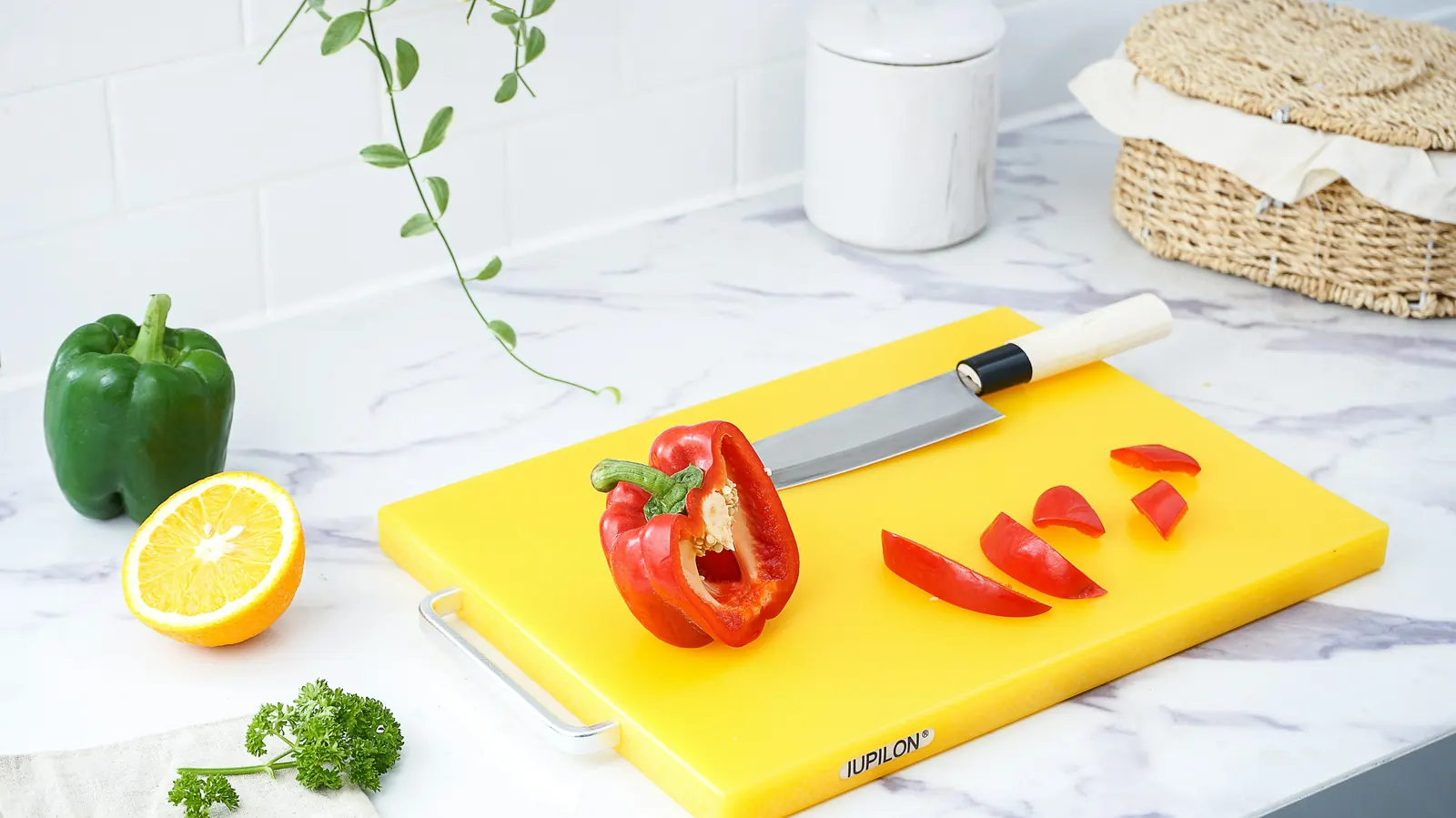
Walk into the prep area of most restaurant kitchens and the cutting boards are plastic: white, red, green and yellow slabs that go through the dish machine at the end of every shift. Wood has its place, but when raw chicken for tinga, pork for al pastor and a mountain of onions and cilantro all pass across the same counter in a morning, a board you can scrub hard and wash hot is the practical choice.
Plastic and composite boards are not all alike, though. Some are thin flexible sheets, some are half-inch slabs built for commercial dishwashers, and some are made from paper or plant-based composites that sit between plastic and wood. This guide compares the ones worth buying from identifiable makers, using what each maker or Amazon listing states, and says so where a detail is not published.
Julia’s earns a commission on purchases made through links on this page, at no cost to you. Recommendations are based on what a restaurant kitchen looks for in a cutting board, product specifications and verified buyer reports.
Quick verdict: which plastic cutting board to buy
For most home kitchens, the OXO Good Grips Utility Cutting Board is the one to buy: a roomy, double-sided plastic board with non-slip feet, a drip-catcher groove and dishwasher cleanup. If you want a firmer composite surface made in the USA, choose the Epicurean All-In-One Cutting Board. If you cook like a restaurant, with raw meat and produce on separate boards, the six-color San Jamar Saf-T-Grip system is the most complete set here.
Below, the five standouts side by side, then all eight boards in full, and what food safety agencies say about keeping any board clean.
Five plastic and composite boards compared
One board for each kind of cook, with the material, size and dishwasher guidance each maker or listing states. All eight boards are reviewed in full below.
| Cutting board | Best for | Material | Size (stated) | Buy on Amazon |
|---|---|---|---|---|

OXO Good Grips Utility Cutting BoardBest overall
|
Everyday prep at home | Plastic, double-sided | 14.78 x 10.39 in | View on Amazon |

Epicurean All-In-One Cutting BoardBest composite
|
A firm, heat-tolerant surface | Paper composite (Richlite) | 14.5 x 11.25 in | View on Amazon |

San Jamar Saf-T-Grip Cutting Board SystemBest color-coded set
|
Separate boards by food type | Co-polymer blend | 6 boards, 12 x 18 x 0.5 in | View on Amazon |

Thirteen Chefs 18 x 12 Cutting BoardBest restaurant-style slab
|
Heavy chopping, big batches | Polypropylene (HDPP) | 18 x 12 x 0.5 in | View on Amazon |
| A big, light, simple board | BPA-free polypropylene | 12 x 18 x 0.25 in | View on Amazon |
Product images from Amazon. Materials and sizes are as stated by each maker or Amazon listing; check the listing before you buy.
Our picks for the best cutting board plastic and composite
These eight boards cover the real choices: soft plastic boards that go in the dishwasher and are kind to knife edges, thick commercial slabs, color-coded sets for keeping raw meat apart from produce, and composite boards made from paper or plant-based materials. Each review gives the material, size, thickness, grip, groove and care as the maker or listing states them, and says “not stated” where nothing is published.
1. OXO Good Grips Utility Cutting Board – Non-Slip Feet and a Drip Catcher
OXO’s Utility board is the middle size of its Good Grips plastic range, and the one that suits most home kitchens. OXO gives it as 10.39 by 14.78 inches, large enough to dice an onion, a few tomatoes and a bunch of cilantro for pico de gallo without pushing anything off the edge, and small enough to fit in a standard dishwasher rack.
Both sides are cutting surfaces. OXO describes them as non-porous, says they resist odors and won’t dull knife blades, and builds in two details that matter during prep: non-slip feet that keep the board from skating across the counter, and an integrated drip-catcher with easy-pour corners. That groove holds the juice from a cut tomato or a resting piece of grilled meat so it ends up in the pan rather than on the counter.
The edges taper into soft handles for carrying the board to the stove. The listing calls the board dishwasher safe, which is the easiest way to clean any plastic board after raw meat. One caveat is that feet on one face mean that side sits on the counter; OXO calls the board double-sided, but buyers should expect the footed side to be steadier.
If you carve roasts or turkeys, OXO also makes a larger carving and cutting board in the same range with deeper juice grooves; for everyday chopping, the Utility size is the better fit.
Why we like it
- Non-slip feet hold it in place, per OXO
- Integrated drip-catcher and easy-pour corners
- Double-sided, non-porous surfaces that resist odors
- Dishwasher safe, per the listing
Key specifications
| Model | 11272800 |
|---|---|
| Material | Plastic (type not stated) |
| Size | 14.78 x 10.39 in |
| Thickness | Not stated |
| Non-slip | Non-slip feet |
| Juice groove | Yes (drip-catcher) |
| Dishwasher safe | Yes |
| Care | Dishwasher or hot soapy water |
Why we recommend it
It does every everyday job well: the feet stop it sliding, the groove catches juice, and it goes in the dishwasher. For a home cook buying one plastic board, it is the safe choice.
Skip it if you need a board big enough for a whole brisket or a turkey; OXO’s larger carving board suits that better.
Pros and cons
Pros
- Stays put on the counter
- Catches juice
- Easy dishwasher cleanup
Cons
- Thickness and plastic type not published
- Footed side is the steadier one
2. Epicurean All-In-One Cutting Board – Made in the USA from Paper Composite
Epicurean boards are not plastic in the usual sense. The maker says they are made in the USA from Richlite, a paper composite, using trees harvested under North American sustainable forestry guidelines. The result is thin, light and firm, with a surface that feels closer to dense wood than to soft polyethylene.
The All-In-One version adds the two things the basic Epicurean board lacks: non-slip feet in the corners and what the listing calls a generous juice groove. At 14.5 by 11.25 inches it is a useful everyday size. Epicurean describes the material as nonporous, knife friendly and easy to maintain, and says it is temperature resistant to 350°F, so a hot pan set down on it briefly is less of a worry than with a soft plastic board.
Epicurean’s own description of its material is candid: expect knives to lightly score the surface, which the maker says shows the board is protecting the edge, and expect the natural color to develop a patina over time, like wood. That is worth knowing if you want a board that looks new for years.
The Kitchen Series boards from the same maker are sold as dishwasher safe, but this All-In-One listing does not say so directly, and silicone feet are another thing to check; if dishwasher care matters to you, confirm it on the listing before you buy.
Why we like it
- Made in the USA, per Epicurean
- Temperature resistant to 350°F, per the listing
- Non-slip feet and a juice groove
- Nonporous composite that is light to lift
Key specifications
| Model | 505-151101003 |
|---|---|
| Material | Paper composite (Richlite) |
| Size | 14.5 x 11.25 in |
| Thickness | Not stated |
| Non-slip | Non-slip feet in the corners |
| Juice groove | Yes |
| Dishwasher safe | Not stated on this listing |
| Care | Easy to maintain, per maker; heat resistant to 350°F |
Why we recommend it
It suits cooks who want something firmer and more heat tolerant than plastic, without the oiling a wood board needs, and who like the idea of a US-made board.
Skip it if you prefer a soft surface; composite is harder than polyethylene and some cooks find it louder and less forgiving under the knife.
Pros and cons
Pros
- Stated heat resistance
- Feet plus juice groove
- Made in the USA
Cons
- Harder surface than plastic
- Color develops a patina
- Dishwasher care not stated on this listing
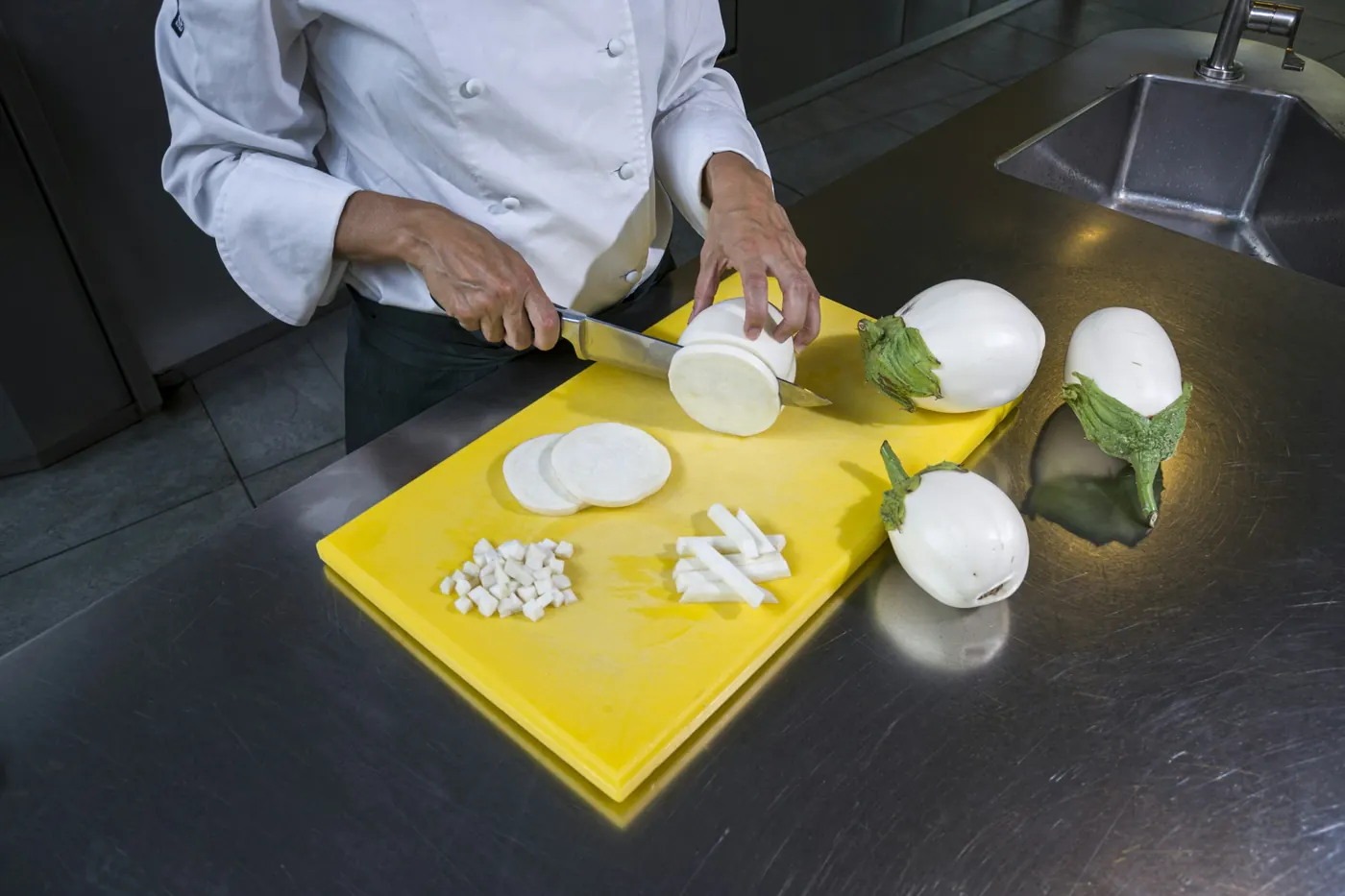
3. San Jamar Saf-T-Grip Cutting Board System – Six Colors for Six Food Types
San Jamar makes food-service equipment, and this is the kind of board set you see in commercial kitchens. The system includes six Saf-T-Grip boards in blue, brown, green, red, white and yellow, each 12 by 18 inches and half an inch thick, so you can give each type of food its own board.
The boards are built for heavy use. San Jamar says they are made from a co-polymer blend designed to withstand high-temperature dishwashers, resist warping and not dull knives. Rubberized corners grip the counter so the board does not move, a molded-in ruler helps with even cuts, and a food safety hook lets you carry and hang the board without touching the cutting surface.
Six half-inch boards take up real space, so this set is for a cook with room to store them, or for anyone who preps big quantities for parties. For a home kitchen, the system’s value is discipline: if raw chicken always goes on one color and the onions, limes and herbs for salsa always go on another, cross-contamination is much easier to avoid. More on that in the food safety section below.
The listing does not mention a juice groove, and the boards are flat slabs, so they suit chopping more than carving juicy roasts.
Why we like it
- Six colors to separate food types
- Rubberized corners grip the counter
- Made for high-temperature dishwashers, per San Jamar
- Hook for carrying without touching the surface
Key specifications
| Model | CBG1218KC |
|---|---|
| Material | Co-polymer blend |
| Size | 12 x 18 in (six boards) |
| Thickness | 0.5 in |
| Non-slip | Rubberized corners |
| Juice groove | Not stated |
| Dishwasher safe | Yes, high-temperature dishwashers |
| Care | Dishwasher; hang by hook |
Why we recommend it
It is the most complete color-coding system here, built to commercial standards, for cooks who want a separate board for raw meat, poultry, seafood and produce every time.
Skip it if you have limited storage; six half-inch boards are bulky.
Pros and cons
Pros
- Full six-color system
- Thick and non-slip
- Commercial dishwasher rated
Cons
- Bulky to store
- No juice groove mentioned
4. Thirteen Chefs 18 x 12 Cutting Board – A Half-Inch Commercial Slab
Thirteen Chefs sells the plain white slab that restaurant kitchens are built around. The listing gives it as 18 by 12 by 1/2 inch and 3 pounds, made from high-density polypropylene, which the maker says is warp resistant and BPA free, and NSF stamped for food service and commercial kitchens.
A half-inch board has weight on its side. It does not flex when you rock a chef’s knife through a pile of onions, and the maker says it resists slipping on most surfaces, though there are no feet or rubber corners. Eighteen inches is the size most prep cooks reach for: enough room to break down a whole chicken or trim a few pounds of skirt steak for fajitas.
Thirteen Chefs is unusually frank about limits. The listing says the board can handle restaurant or home dishwashers up to 200°F, that hot pans and ovens will melt any plastic cutting board, and that serrated knives and cleavers will scar the surface. That last point applies to every board on this page.
There is no juice groove on this version; Thirteen Chefs sells a separate grooved model for carving. The company backs its boards with a satisfaction guarantee.
Why we like it
- Half-inch HDPP that resists warping, per the maker
- NSF stamped for food service
- Dishwasher safe up to 200°F
- Large 18 x 12 prep area
Key specifications
| Model | SYNCHKG113428 |
|---|---|
| Material | High-density polypropylene (HDPP) |
| Size | 18 x 12 in |
| Thickness | 0.5 in |
| Non-slip | Resists slipping on most surfaces (no feet) |
| Juice groove | No (sold separately as a grooved model) |
| Dishwasher safe | Yes, up to 200°F |
| Care | Keep away from hot pans and ovens |
Why we recommend it
It is the closest thing on this list to a restaurant prep board: thick, heavy, plain and made to be washed hot. Buy two, one for raw meat and one for everything else.
Skip it if you want feet or a groove; this slab has neither.
Pros and cons
Pros
- Thick and stable
- NSF stamped
- Clear care limits published
Cons
- Heavy at 3 pounds
- No feet or juice groove
5. Joseph Joseph Folio 4-Piece Color-Coded Cutting Board Set – Slim Case Storage

Joseph Joseph’s Folio set takes the color-coding idea and fits it into a home kitchen. Four boards, each 9 by 13 inches according to the listing, stand in a slim case that holds them apart so air can circulate. Tiered design and stainless-steel bars on the boards make it easy to pull out the one you want.
The boards are double-sided with what Joseph Joseph calls knife-friendly, textured cutting surfaces and non-slip feet. The maker notes that the knife-friendly surface is designed to mark slightly during use, which is honest and normal for any soft plastic board. The boards are dishwasher safe and BPA free; the case is wiped clean with a damp cloth.
At 9 by 13 inches, these are smaller than a commercial board. They are the right size for a lime, a jalapeño and half an onion, or for trimming a couple of chicken breasts, but a whole chicken or a big batch of salsa needs more room. For a small apartment kitchen where a stack of six thick boards is out of the question, the Folio is the neat way to keep raw meat and produce apart.
Joseph Joseph gives a one-year guarantee against manufacturing defects.
Why we like it
- Four color-coded boards in one slim case
- Case holds boards apart so air circulates
- Non-slip feet and textured surfaces
- Boards are dishwasher safe
Key specifications
| Model | 60184 |
|---|---|
| Material | BPA-free plastic (type not stated) |
| Size | 9 x 13 in (four boards) |
| Thickness | Not stated |
| Non-slip | Non-slip feet |
| Juice groove | Not stated |
| Dishwasher safe | Boards yes; case wipe clean |
| Care | Surface designed to mark slightly |
Why we recommend it
It is the tidiest way to run separate boards in a small kitchen, with storage that keeps them dry and organized.
Skip it if you prep big quantities; 9 by 13 inches fills up fast.
Pros and cons
Pros
- Compact color-coded storage
- Feet on every board
- One-year guarantee
Cons
- Small boards
- Thin, flexible boards may mark quickly
6. Farberware 12 x 18 Reversible Plastic Cutting Board – Big and Light
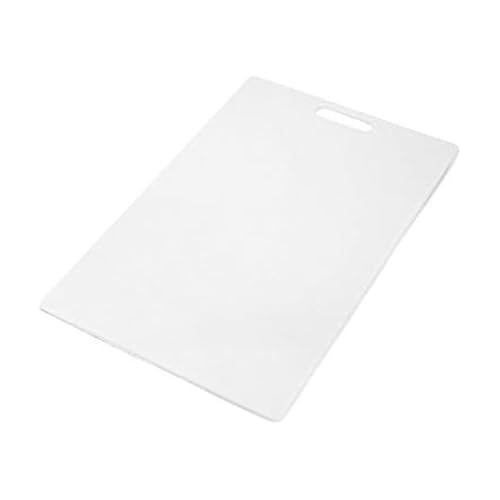
Farberware’s 12 by 18 inch poly board is the simple, inexpensive option: a large, reversible sheet of BPA-free polypropylene a quarter-inch thick, with a hand hole for carrying and hanging. The listing says it is gentle on knives, non-absorbent and dishwasher safe.
The size is the selling point. Eighteen inches matches the restaurant slabs above, so you have room to work through a pile of peppers and onions for fajitas, but at a quarter-inch the board is much lighter and easier to lift into the sink or the dishwasher. The trade-off is stiffness; thin boards can flex and, with very hot water, are more likely to warp than a half-inch slab.
Farberware does not mention non-slip feet or a groove. A damp towel or a sheet of shelf liner underneath stops any flat board from sliding, and that small step matters with a knife in your hand.
The board carries the Lifetime Brands limited warranty, according to the listing.
Why we like it
- Large 12 x 18 inch surface
- BPA-free polypropylene, per the listing
- Reversible, with a hand hole
- Dishwasher safe
Key specifications
| Model | 78900-10 |
|---|---|
| Material | BPA-free polypropylene |
| Size | 12 x 18 in |
| Thickness | 0.25 in |
| Non-slip | Not stated |
| Juice groove | Not stated |
| Dishwasher safe | Yes |
| Care | Dishwasher; limited warranty |
Why we recommend it
For a big board at a low cost, or a second board kept just for raw meat, it does the job without fuss.
Skip it if you want a board that stays flat and still on its own; it is thin and has no stated grip.
Pros and cons
Pros
- Large and light
- Reversible
- Warranty stated
Cons
- Thin board can flex
- No feet or groove stated
7. Material MK Free Cutting Board, Large – A Plant-Based Composite

Material, the kitchenware brand, makes its MK Free board from what it calls a biocomposite of natural clay minerals and biopolymers, made in Finland. It is the newest kind of board on this page, aimed at cooks who want the easy care of plastic from a different material. The brand markets it as free of permanent microplastics; that is the maker’s claim, and we have not seen independent data on it.
In the kitchen, the facts that matter are practical. The listing describes the surface as non-porous and suitable for raw meat, poultry, fish and produce, says the board goes in the dishwasher, and says it needs no oiling. A lightly textured surface adds a little friction under the knife, and Material says it is gentle on blades. There is a built-in juice groove and a hole for hanging.
At 17.5 by 12 inches and a quarter-inch thick, it is large but slim. The listing does not mention feet; Material’s own tip is to lay a damp cloth underneath on quartz or marble counters to hold it in place, which tells you it can slide on smooth stone.
The listing gives no warranty.
Why we like it
- Clay-mineral and biopolymer composite, per Material
- Non-porous and dishwasher safe
- Built-in juice groove
- Large 17.5 x 12 inch surface
Key specifications
| Model | AB009 |
|---|---|
| Material | Biocomposite of clay minerals and biopolymers |
| Size | 17.5 x 12 in |
| Thickness | 0.25 in |
| Non-slip | Not stated; maker suggests a damp cloth underneath |
| Juice groove | Yes |
| Dishwasher safe | Yes |
| Care | No oiling needed; made in Finland |
Why we recommend it
It suits cooks who want a dishwasher-safe board that is not made of conventional plastic, with a groove and plenty of room.
Skip it if you want a board with built-in grip; you will need a cloth under it on smooth counters.
Pros and cons
Pros
- Different material from standard plastic
- Juice groove and hanging hole
- Dishwasher safe
Cons
- Can slide on stone counters
- Material claims are the maker’s own
- No warranty stated
8. Dexas Superboard Cutting Board with Handle – Made in the USA

Dexas has made its Superboard for a long time, and this 11 by 14.5 inch version with a handle is a straightforward everyday board. The listing describes a high-density poly cutting surface that helps keep knives sharp, a non-porous surface that resists stains and odors, and a reversible design so you can use one side for raw meat and the other for produce.
The size sits between OXO’s Utility board and the 18-inch slabs: comfortable for most dinner prep, small enough to wash in the sink or the dishwasher, which the listing says it is safe for. The handle makes it easy to carry chopped onions and peppers to the pan and slide them in.
Dexas says the board is made in the USA. The listing does not give a thickness, mention feet or a groove, or state a warranty. As with any flat board, a damp towel underneath keeps it steady.
Using the two sides for different foods is a sensible habit, but it is not the same as having two boards: the side facing down still sits on the counter. If you cook raw meat often, a second board is the safer system.
Why we like it
- Made in the USA, per Dexas
- High-density poly surface that is knife friendly
- Reversible, with a carrying handle
- Dishwasher safe
Key specifications
| Model | 451-55 |
|---|---|
| Material | High-density poly |
| Size | 11 x 14.5 in |
| Thickness | Not stated |
| Non-slip | Not stated |
| Juice groove | Not stated |
| Dishwasher safe | Yes |
| Care | Dishwasher; resists stains and odors |
Why we recommend it
It is a sensible mid-size board for cooks who prefer to buy American-made and want a handle for carrying prep to the stove.
Skip it if you need feet or a groove; the listing mentions neither.
Pros and cons
Pros
- US-made
- Handy mid size with handle
- Dishwasher safe
Cons
- Thickness not published
- No stated grip or groove
How to choose a plastic cutting board
The differences between plastic boards are small on paper and large in daily use. These are the points a kitchen looks at.
Size. Buy bigger than you think. A board around 15 by 10 inches handles a weeknight dinner; 18 by 12 is the standard restaurant size and gives room to cut and push food aside without it falling off. Check that the board fits your sink and dishwasher before you order.
Thickness. Half-inch slabs like the Thirteen Chefs and San Jamar boards stay flat, feel solid under a chef’s knife and stand up to hot washing. Quarter-inch boards are lighter and cheaper but can flex. Thin flexible mats are handy for tipping food into a pan, but they are not a main board.
Grip. A board that slides is dangerous. Feet, rubber corners or a textured underside help; if a board has none, put a damp towel or a piece of shelf liner under it every time.
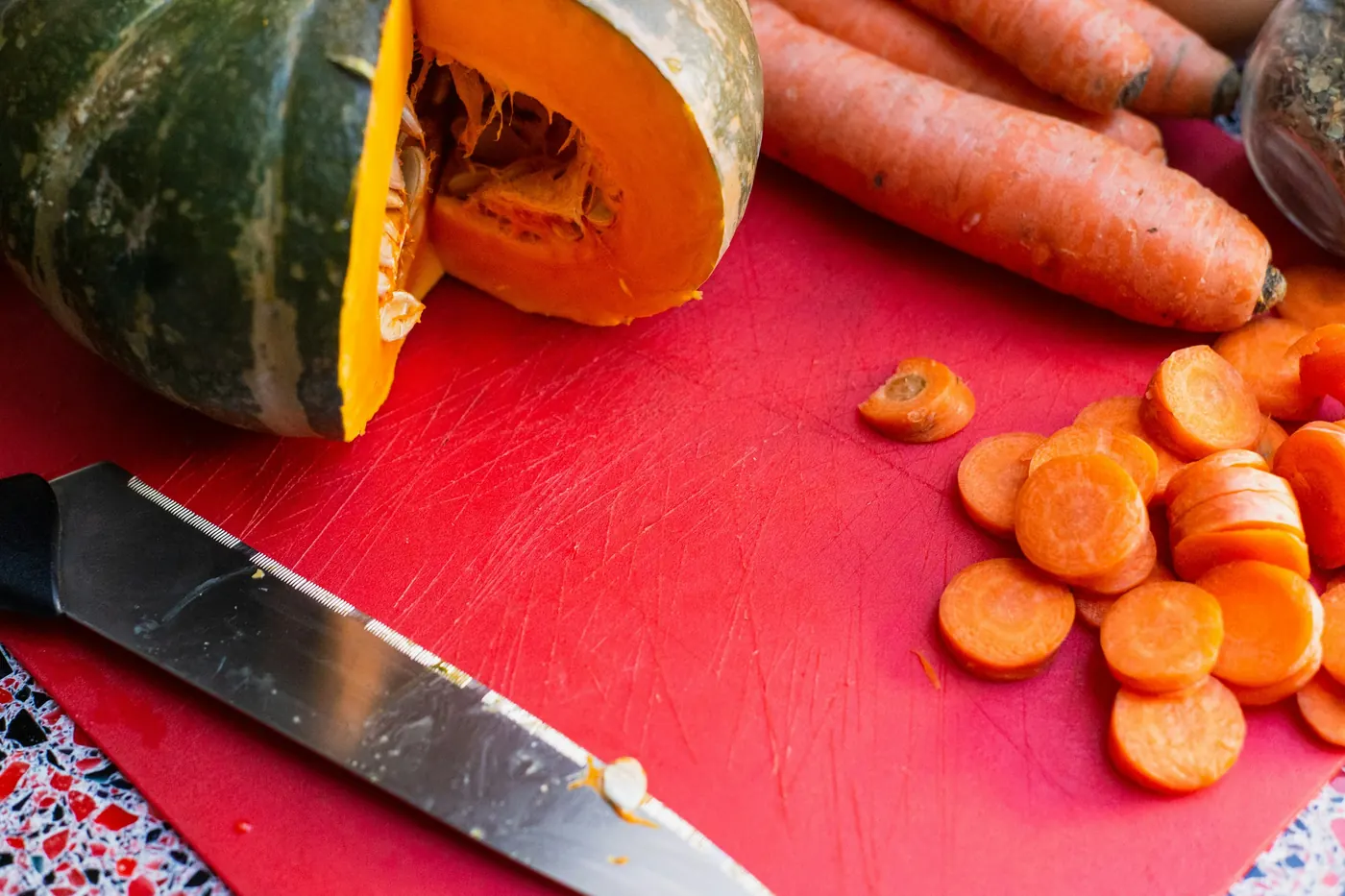
Juice groove. Useful for slicing tomatoes, citrus and cooked meat, which release liquid. It cuts into usable flat space, so many cooks keep one grooved board for carving and a flat one for chopping.
Material. Polyethylene and polypropylene are the soft plastics most boards use; they are gentle on knives and mark easily. Composites like Epicurean’s paper-based Richlite and Material’s clay-mineral blend are firmer and more heat tolerant but harder under the blade.
How many. Two boards is the minimum in a kitchen that handles raw meat: one for raw meat, poultry and seafood, one for everything else. A color-coded set makes that habit automatic.
Keeping a plastic board food safe
Here we stick to what food safety authorities say. The FDA’s safe food handling guidance advises using one cutting board for fresh produce and a separate one for raw meat, poultry and seafood, and washing cutting boards with hot soapy water after preparing each food item.
The University of Wisconsin–Madison Extension’s guide to cutting board safety says consumers may choose either wood or a nonporous surface such as plastic, that nonporous plastic boards can be washed in a dishwasher, and that any board with cracks, crevices, chips or grooves should be replaced. It gives a sanitizing solution of 1 tablespoon of regular chlorine bleach per gallon of water. The University of Illinois Extension’s meat safety page also recommends a dedicated board just for raw meat, and says that once a board has many cut marks, including deep grooves, it is time for a new one.
Color-coding is a common way to keep those boards apart. North Dakota State University Extension suggests trying a color-coding system to reduce the risk of cross-contamination, with red for meat and green for produce as an example. Commercial sets follow similar schemes, but the exact colors vary by maker, so pick a system and stick to it.
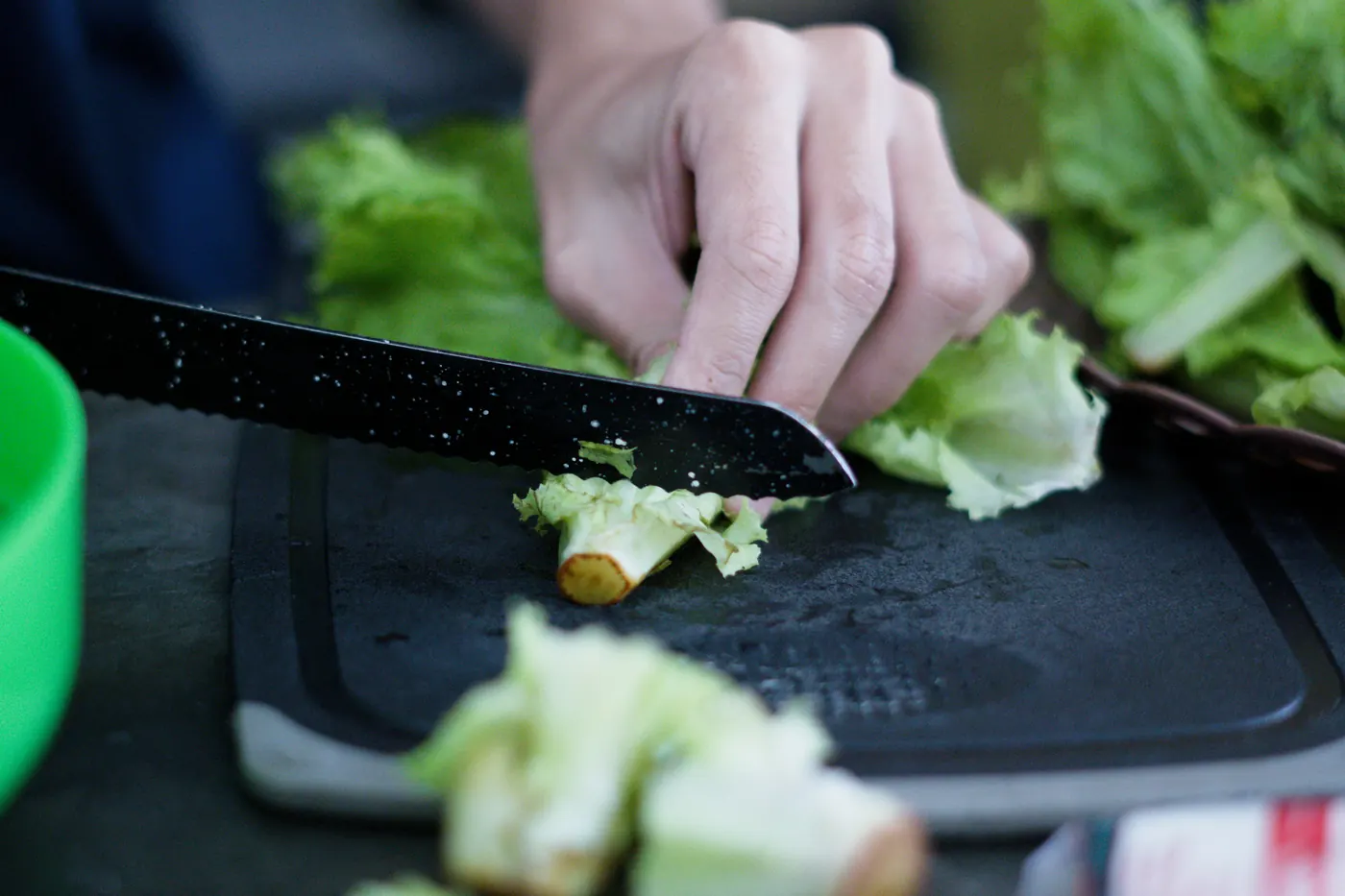
The practical takeaway for a plastic board is that it does not last forever. Soft plastic scores with every cut, and those knife marks are exactly what the extension services tell you to watch for. When the surface is deeply grooved and no longer cleans up smooth, replace it.
How we chose these eight boards
We started from what a kitchen that handles raw meat and fresh produce every day asks of a board: enough room to work, a surface that is kind to knives, grip on the counter, and cleaning that is fast and thorough. We then looked for plastic and composite boards sold on Amazon in the United States from identifiable makers, checked each one’s stock with Amazon’s product data before writing, and took materials, sizes, thicknesses and care from the maker’s description or the brand’s Amazon listing. Where a detail is not published, we say “not stated”. We left out unbranded sellers and near-identical boards. We did not use these boards for this guide. We also did not cite America’s Test Kitchen, Serious Eats or Wirecutter, because we could not read their current reviews when we wrote it; food safety guidance comes only from the FDA and the university extension pages linked above.
Plastic cutting board questions, answered
What is the best type of plastic for a cutting board?
Most boards are polyethylene or polypropylene, both soft enough to be kind to knife edges. Commercial boards are often high-density polyethylene or polypropylene in thick slabs, like the Thirteen Chefs board. Thickness and grip matter more day to day than the exact plastic.
Are plastic cutting boards safe for raw meat?
Food safety authorities accept plastic and other nonporous boards, and the FDA advises keeping a separate board for raw meat, poultry and seafood. Wash it with hot soapy water after each use, or in the dishwasher if the maker says it is dishwasher safe, and replace it when it is deeply grooved.
Which plastic cutting board brands are worth buying?
From the boards here, OXO, San Jamar and Thirteen Chefs stand out for plain, practical plastic boards; Epicurean and Material for composite boards; and Joseph Joseph for color-coded storage. All publish the material and care information we list.
Is a composite board better than plastic?
It is firmer and, in Epicurean’s case, heat resistant to 350°F, so it handles a hot pan set down briefly. It is also harder under the knife. Soft plastic is gentler on edges and usually cheaper; composite lasts longer between replacements but shows a patina.
How often should you replace a plastic cutting board?
There is no fixed schedule. Replace it when it has deep grooves, cracks or chips that no longer scrub clean, which is what the Wisconsin and Illinois extension services advise.
Our final pick for a plastic board
Buy the OXO Good Grips Utility board if you want one plastic board that does everything at home. Choose the Epicurean All-In-One if you prefer a firm composite surface, the San Jamar system if you want a full set of colors, and a Thirteen Chefs slab if you want the restaurant prep board. Whatever you buy, keep raw meat on its own board.
Plastic is only one option; our guide to the best cutting board covers the wider choice, including wood. For the rest of the kit, see our Mexican cooking tools guide, and if you are breaking down braised pork or beef on that board, our pick of the best meat claws makes quick work of it.
And if you would rather leave the chopping to us tonight, see the menu or call to order.