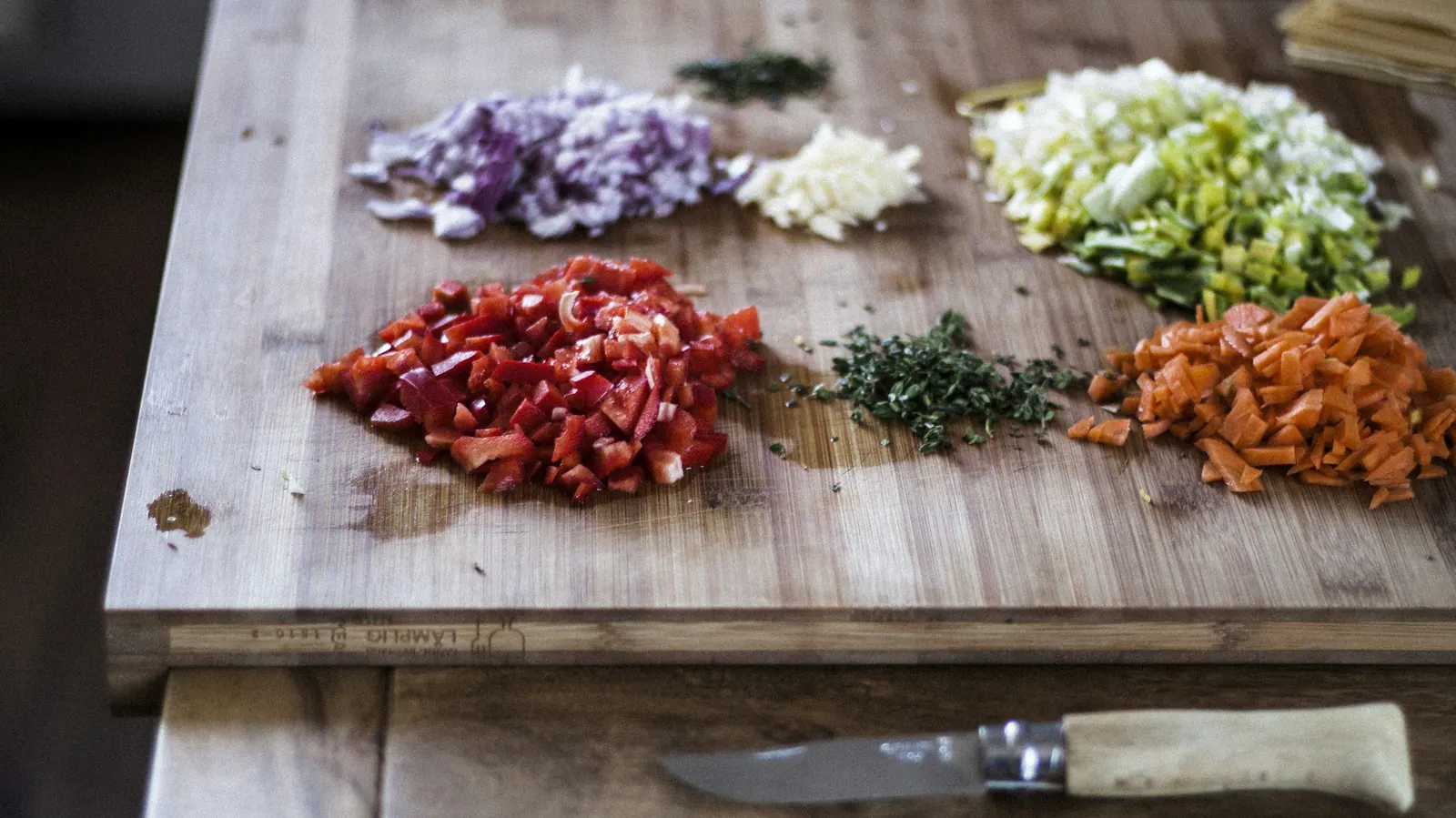
Every plate of tacos starts on a cutting board. Before a single tortilla hits the comal, onions get diced, cilantro gets chopped, tomatoes and chiles get cut down for pico de gallo, and limes get quartered. When the carne asada comes off the grill, it goes back onto a board to rest and be sliced across the grain. A good board stays put, is kind to your knife and is easy to keep clean, and that matters far more than how it looks on the counter.
The choice is wider than it used to be. Wood now comes in edge grain and end grain, plastic ranges from thin flexible boards to heavy restaurant boards, and there are paper composites, clay-based composites and Japanese rubber boards too. This guide explains what each material does well, names nine boards worth buying, and pulls the cleaning advice from university extension services rather than from marketing copy.
Julia’s earns a commission on purchases made through links on this page, at no cost to you. Recommendations are based on what a restaurant kitchen looks for, product specifications and verified buyer reports.
Quick verdict: which cutting board to buy
For most home kitchens, the best cutting board is a large wooden board for everyday prep plus a dishwasher-safe board for raw meat. Our wood pick is the Teakhaus Edge-Grain Teak Carving Board, 20 x 15 inch: big, heavy enough to stay still, reversible, with a juice groove for carving. For raw chicken and steak, choose the OXO Good Grips Plastic Carving & Cutting Board, which has non-slip feet, a drip catcher and goes in the dishwasher.
If you only want one board and hate hand washing, the Epicurean Kitchen Series composite board is the compromise: dishwasher safe and gentle on knives, according to the maker.
Five cutting boards side by side
Our five standout picks, one for each kind of cook, with the specifications each maker or listing states. All nine boards are reviewed in full below.
| Cutting board | Best for | Material & size | Care (per maker) | Buy on Amazon |
|---|---|---|---|---|
| Everyday prep and carving | Teak, edge grain, 20 x 15 x 1.5 in | Hand wash, oil now and then | View on Amazon | |

OXO Good Grips Plastic Carving & Cutting BoardBest plastic
|
Raw meat and poultry | Plastic, 21.11 x 14.34 in | Dishwasher safe | View on Amazon |

Epicurean Kitchen Series Composite Board, 17.5 x 13 inchBest dishwasher-safe
|
One board for everything | Paper composite, 17.5 x 13 in | Dishwasher safe | View on Amazon |
| Fine knives, herbs and fish | Synthetic rubber, 15.7 x 9.1 x 0.5 in | Wash; sand to renew surface | View on Amazon | |
| Big jobs on a small budget | Polypropylene, 15 x 20 in | Dishwasher safe | View on Amazon |
Product images from Amazon. Sizes, materials and care are as stated by each maker or listing; check the listing before you buy.
Our picks for the best cutting board
These nine boards cover every material worth considering: teak and maple wood in edge grain and end grain, plastic from a light home board to a heavy restaurant-style one, two composites and a Japanese rubber board. Each pick explains who it suits, the specs that matter for real prep work, and one honest reason to skip it. If you already know you want wood or plastic, our dedicated guides to the best cutting board wood and the best cutting board plastic go deeper on each.
1. Teakhaus Edge-Grain Teak Carving Board, 20 x 15 inch – Big, Steady and Reversible

If you have the counter space for one serious board, make it a large wooden one, and this Teakhaus is the one we would point most home cooks to. At 20 by 15 inches and 1.5 inches thick, there is room to dice two onions, a bunch of cilantro and a pile of tomatoes for salsa without everything spilling onto the counter, and Teakhaus lists its weight at 12 pounds, which keeps it from creeping around while you chop.
The board is edge grain: long strips of teak glued side by side, so the knife works along the length of the fibers. Teakhaus describes teak as naturally oily and moisture resistant, and the board arrives pre-oiled. It is reversible, with a deep juice groove around one face for carving and grip handles cut into the ends for carrying it to the table.
That groove is what makes it the right all-rounder for a Mexican kitchen. Rested carne asada or a roast chicken leaks juice when you slice it, and the groove keeps it off the counter. Flip the board over and you have a flat surface for vegetables.
Care is simple but not optional. Teakhaus says it is hand wash only, not dishwasher safe, with a little oil to keep the wood in good shape. This listing is the board sold as a set with EON conditioning oil, a blend of beeswax, coconut oil and orange essential oil. One line of the listing still says the oil is sold separately, so check what is in the box when it arrives.
Why we like it
- Large 20 x 15 inch surface, 1.5 inches thick
- Juice groove on one side, flat surface on the other
- FSC-certified teak, pre-oiled at the factory, per Teakhaus
- Grip handles for carrying it to the table
Key specifications
| Model | Not shown on this set listing; same size as Teakhaus 109 |
|---|---|
| Material | FSC-certified teak |
| Size | 20 x 15 in (12 lb, per Teakhaus) |
| Thickness | 1.5 in |
| Grain/type | Edge grain, reversible |
| Juice groove | Yes, one side |
| Dishwasher safe | No |
| Care | Hand wash; oil occasionally |
Why we recommend it
It suits anyone who cooks most nights and wants a board big enough for real prep that doubles as a carving board for grilled meat. The weight keeps it steady, and Teakhaus says the board needs only minimal care.
Skip it if you have a small kitchen or a small sink: a 12-pound board this size is awkward to wash and needs somewhere to live.
Pros and cons
Pros
- Plenty of room for a full batch of salsa prep
- Heavy enough to stay put
- Juice groove for carving, flat reverse for vegetables
Cons
- Heavy and bulky to wash
- Not dishwasher safe
- Listing conflicts on whether the oil is included
2. OXO Good Grips Plastic Carving & Cutting Board – Non-Slip Board for Raw Meat
A second board for raw meat is the simplest food-safety habit in any kitchen, and this OXO is a good one to dedicate to it. It measures 21.11 by 14.34 inches, big enough for a whole chicken, a flank steak or a tray of chicken thighs being trimmed for tinga.
OXO gives it non-slip feet so it stays put on the counter, soft tapered edges that act as handles, and an integrated drip catcher with easy-pour corners, which helps when you are carving something juicy and want to tip the drippings into a pan. Both sides can be used, and OXO describes the surfaces as non-porous and odor resistant, and says they won’t dull knife blades.
The big practical advantage is the dishwasher. The listing describes it as dishwasher safe, which makes the hot, thorough wash after raw meat much easier than scrubbing a wooden board by hand.
OXO does not state the type of plastic or the thickness on the listing, so we have left those as not stated.
Why we like it
- Non-slip feet hold it in place
- Drip catcher and easy-pour corners
- Dishwasher safe, per the listing
- Large enough for whole birds and roasts
Key specifications
| Model | 11272900 |
|---|---|
| Material | Plastic (type not stated) |
| Size | 21.11 x 14.34 in |
| Thickness | Not stated |
| Grain/type | Double-sided plastic, non-slip feet |
| Juice groove | Yes, drip catcher |
| Dishwasher safe | Yes |
| Care | Dishwasher |
Why we recommend it
It suits cooks who want a dedicated raw-meat board that cleans up in the dishwasher and stays steady while they trim and carve.
Skip it if you want a board for knife work on vegetables every day: hard plastic boards scar with use, and once the grooves are deep, extension services advise replacing them.
Pros and cons
Pros
- Goes in the dishwasher
- Stays put on non-slip feet
- Catches juice when carving
Cons
- Plastic type and thickness not stated
- Large for a standard dishwasher rack; measure first
- Will need replacing once deeply scarred
3. John Boos Maple Edge-Grain Board and Care Set, 18 x 12 inch – American Maple, Oil Included

The listing says John Boos’s American-made line goes back to 1887, and this set pairs an edge-grain maple board with the oil and cream it needs. The board is 18 by 12 inches and 1.25 inches thick, and the board-only listing for the same model gives its weight as 8 pounds, so it is smaller and easier to handle than a 20 by 15 inch board.
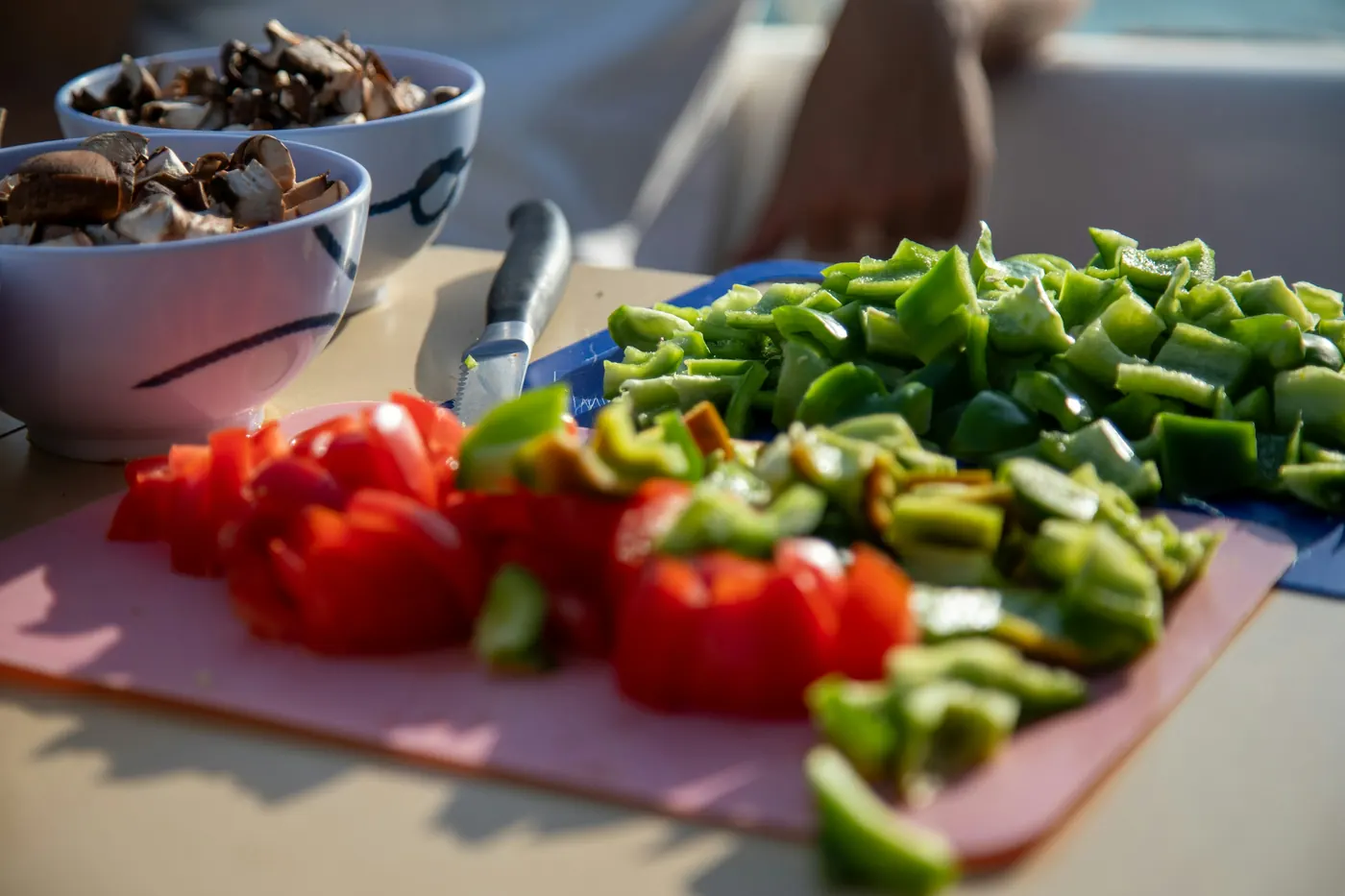
It is North American hard rock maple, per the listing, with two smooth cutting surfaces. The listing mentions no juice groove, so think of it as a vegetable and bread board: onions, garlic, chiles, herbs and the limes for your margaritas.
Boos is clear about care. Its care guide says to rinse the board with warm water and a gentle detergent, dry it thoroughly and stand it up to air dry. For a board in daily use it suggests monthly maintenance with Mystery Oil followed by Board Cream, and both are in this set. Done properly, that routine is a few minutes once a month.
Why we like it
- Edge-grain hard rock maple, 1.25 inches thick
- Reversible, with two cutting surfaces
- Mystery Oil and Board Cream included, per the listing
- Manageable 8-pound board
Key specifications
| Model | MPL1812125G, with oil and cream |
|---|---|
| Material | Hard rock maple |
| Size | 18 x 12 in (8 lb, per the board-only listing) |
| Thickness | 1.25 in |
| Grain/type | Edge grain, reversible |
| Juice groove | Not listed |
| Dishwasher safe | Not listed; wash by hand |
| Care | Hand wash; oil about monthly with daily use |
Why we recommend it
It suits cooks who want a traditional American maple board for daily vegetable prep, in a size that fits a normal counter and sink, with the care products already in the box.
Skip it if you mostly carve meat: without a juice groove, a resting steak will run onto the counter.
Pros and cons
Pros
- American-made, per the listing
- Oil and cream in the set
- Easier to lift than larger boards
Cons
- No juice groove
- Needs regular oiling
- Thinner than a 1.5-inch block
4. Epicurean Kitchen Series Composite Board, 17.5 x 13 inch – Dishwasher Safe and Light
Epicurean boards are made from a paper composite, pressed and bonded into a thin, hard sheet, in Superior, Wisconsin, according to the maker. The appeal is that it behaves somewhere between wood and plastic: Epicurean says it is knife friendly, heat resistant and dishwasher safe, and that restaurants have used the same material in commercial dishwashers for decades.
This 17.5 by 13 inch size is a good all-purpose board. It is light enough to pick up with one hand and slide chopped onions into a pan, and both sides can be used. Epicurean warns that knives will lightly score the surface, which it presents as a sign the board is protecting the edge, and that its boards, especially the natural color, develop a patina over time, the way wood does. This listing is the dark slate color.
The Kitchen Series is a plain flat board without a juice groove. If you want one, Epicurean’s All-In-One boards add a groove and non-slip feet. Epicurean also suggests washing and drying a new board two or three times if it has a slight odor when it arrives.
Why we like it
- Dishwasher safe, per Epicurean
- Light, thin and reversible
- Made in the USA
- One-year full warranty, per the listing
Key specifications
| Model | 001-181302 (Slate) |
|---|---|
| Material | Paper composite |
| Size | 17.5 x 13 in |
| Thickness | Not stated |
| Grain/type | Composite, reversible |
| Juice groove | No (All-In-One version has one) |
| Dishwasher safe | Yes |
| Care | Dishwasher or hand wash |
Why we recommend it
It suits a cook who wants one board that handles vegetables and raw meat and can go straight into the dishwasher afterward.
Skip it if you want a juice groove or non-slip feet: this series has neither, so it suits chopping better than carving.
Pros and cons
Pros
- Dishwasher safe
- Light and easy to move
- Made in the USA
Cons
- No juice groove on this series
- Light boards can slide on a slick counter
- Color can develop a patina over time
5. Asahi Cookin’ Cut Rubber Cutting Board, 15.7 x 9.1 inch – Soft on Knife Edges

Synthetic rubber boards are common in Japanese professional kitchens and still unfamiliar to many home cooks in the United States. Parker Asahi has made its Cookin’ Cut rubber boards in Japan since 1965, according to the listing, and this 15.7 by 9.1 inch board is half an inch thick.
The selling point is feel. Asahi says the elasticity of rubber gives a soft cutting surface that is gentle on blades and reduces impact on the knife and your hands, and that the rubber’s “restorative force” helps prevent deep knife scratches. That makes it a good match for thin, hard Japanese knives and for fine work like mincing cilantro or slicing fish for ceviche.
It also absorbs little water and dries quickly, by the maker’s account. When the surface gets stained or scratched, Asahi says you can sand it back with a board scraper or waterproof sandpaper, which gives it a long working life. The listing does not say whether it is dishwasher safe, so we would wash it by hand.
Why we like it
- Soft synthetic rubber, gentle on knife edges, per Asahi
- Low water absorption and quick drying
- Surface can be sanded to renew it
- Made in Japan
Key specifications
| Model | Part no. 688-0005 |
|---|---|
| Material | Synthetic rubber |
| Size | 15.7 x 9.1 in |
| Thickness | 0.5 in |
| Grain/type | Rubber |
| Juice groove | Not stated |
| Dishwasher safe | Not stated |
| Care | Wash and dry; sand to renew surface |
Why we recommend it
It suits cooks with good knives who want a board that protects the edge and stays usable for years with an occasional sanding.
Skip it if you want a big board: at 15.7 by 9.1 inches it is a prep board for one task at a time, not a carving board.
Pros and cons
Pros
- Gentle on fine knife edges
- Dries quickly
- Can be resurfaced
Cons
- Small surface
- Dishwasher use not stated
- Can stain; Asahi suggests sanding stains out
6. San Jamar Saf-T-Grip Plastic Cutting Board, 18 x 12 inch – Restaurant-Style Board with Grip Corners

San Jamar makes equipment for commercial kitchens, and the Saf-T-Grip is the kind of half-inch plastic board you see stacked in restaurant prep areas. This one is 18 by 12 inches and half an inch thick, made from what San Jamar calls a warp-resistant co-polymer blend designed to minimize knife dulling.
The features are the practical ones a busy kitchen asks for. Anti-slip grip corners keep it from skating on a steel table or a stone counter, a food safety hook lets you hang it to dry rather than stacking it wet, and the listing says it is dishwasher safe.
The same board is sold in several colors on Amazon, including white, red, green, blue and brown. Many kitchens give each color one job, such as one color for raw meat and another for produce, which makes it easy to keep raw chicken away from the onions destined for pico de gallo. Choose whichever colors make sense for your own kitchen.
Why we like it
- Half-inch, warp-resistant co-polymer board
- Anti-slip grip corners
- Hook for hanging storage
- Dishwasher safe, per the listing
Key specifications
| Model | CBG121812GN (green) |
|---|---|
| Material | Co-polymer plastic blend |
| Size | 18 x 12 in |
| Thickness | 0.5 in |
| Grain/type | Commercial plastic, grip corners |
| Juice groove | Not stated |
| Dishwasher safe | Yes |
| Care | Dishwasher; hang to dry |
Why we recommend it
It suits cooks who want a no-nonsense commercial board, or a set of colored boards to separate raw meat from produce.
Skip it if you want a board to carve on: the listing does not mention a juice groove, so a resting steak will run.
Pros and cons
Pros
- Built for commercial use
- Grip corners and hanging hook
- Available in several colors
Cons
- No juice groove mentioned
- Hard plastic scars over time
- Sparse maker information on the listing
7. John Boos CCB End-Grain Maple Chopping Block, 20 x 15 inch – A True Butcher Block

This is a butcher block in the old sense: end-grain maple, 2.25 inches thick and 21 pounds, according to the listing. In end-grain construction the short ends of the wood face up, like a checkerboard of tiny columns, so the knife edge slips between the fibers instead of slicing across them. Makers of end-grain boards, Boos among many, sell them on being kind to knives.
At 20 by 15 inches it has room for heavy work, such as breaking down a chicken, cutting a brisket point or chopping a big batch of carne for tacos, and the weight means it will not move at all. It is reversible, with recessed finger grips, and has an oil finish from the factory.
Care follows the Boos routine: wipe it with mild soap and water, dry it, oil it at least once a month with Mystery Oil and then Board Cream, and never put it in the dishwasher.
Why we like it
- End-grain hard maple, 2.25 inches thick
- 21 pounds: it stays exactly where you put it
- Reversible, with finger grips
- Made in the USA
Key specifications
| Model | CCB2015-225 |
|---|---|
| Material | Maple |
| Size | 20 x 15 in (21 lb) |
| Thickness | 2.25 in |
| Grain/type | End grain, reversible |
| Juice groove | Not listed |
| Dishwasher safe | No |
| Care | Hand wash; oil at least monthly |
Why we recommend it
It suits serious cooks who want one permanent block on the counter for heavy chopping and good knives.
Skip it if you need to move your board: at 21 pounds it is a piece of furniture, and it is too big for many sinks.
Pros and cons
Pros
- End grain is gentle on knives
- Completely stable
- Made in the USA
Cons
- Very heavy
- Needs regular oiling
- No juice groove
8. Material MK Free Cutting Board, Large – Slim Clay-Based Composite

Material’s MK Free board is a newer kind of composite. The listing describes it as a biocomposite of natural clay minerals and biopolymers, made in Finland, and the brand markets it as free of permanent microplastics. We report that as the maker’s claim; we have not seen independent research on it.
In the kitchen, what matters is that it is thin, non-porous and dishwasher safe. At 17.5 by 12 inches and a quarter of an inch thick, it slides into a drawer or hangs from its built-in hole, and it has a juice groove around the edge. Material says the surface is lightly textured to add friction between knife and board, and gentle on blades.
Thin boards are light, which is good for tipping diced tomatoes into a bowl but means they can slide. Material’s own tip is to set the board on a damp cloth on quartz or marble counters, which is good advice for any light board.
Why we like it
- Non-porous and dishwasher safe, per Material
- Juice groove on a slim quarter-inch board
- Hanging hole for storage
- Textured surface for knife control
Key specifications
| Model | AB009 |
|---|---|
| Material | Clay mineral and biopolymer composite |
| Size | 17.5 x 12 in |
| Thickness | 0.25 in |
| Grain/type | Composite |
| Juice groove | Yes |
| Dishwasher safe | Yes |
| Care | Dishwasher; no oiling |
Why we recommend it
It suits small kitchens and cooks who want a thin, easy-storing board with a groove that goes in the dishwasher.
Skip it if you want heft: a quarter-inch board needs a damp towel underneath to stay still during hard chopping.
Pros and cons
Pros
- Slim and easy to store
- Dishwasher safe
- Juice groove
Cons
- Light enough to slide
- Newer material with a short track record
9. Farberware Extra Large Plastic Cutting Board, 15 x 20 inch – A Big Board on a Small Budget
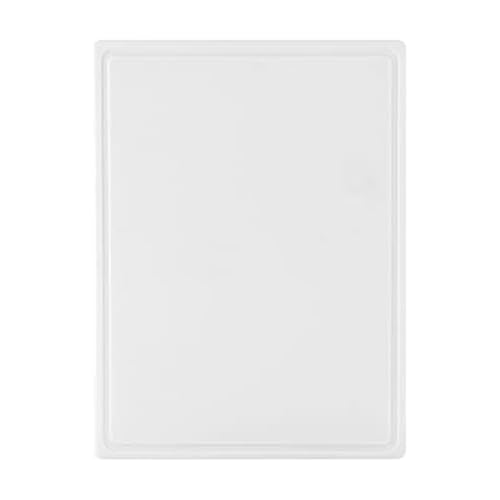
Not every board needs to be an heirloom. This Farberware is a plain, large polypropylene board with a deep juice groove, and it does the basic jobs well: trimming a pork shoulder, carving a turkey, or cutting a big batch of vegetables for fajitas.
Farberware describes the plastic as BPA-free polypropylene that is non-absorbent and non-porous, and the board as reversible and dishwasher safe. It is 0.39 inches thick. The listing gives the size as 15 by 20 inches in the title but says 14 by 20 inches in one bullet, so allow for either when you measure your dishwasher.
Because it is inexpensive, it is easy to treat as a consumable: use it hard for raw meat, run it through the dishwasher, and replace it when the knife grooves get deep, which is what extension services recommend for any worn board.
Why we like it
- Large surface with a deep juice groove
- BPA-free polypropylene, per Farberware
- Reversible and dishwasher safe
- Easy to replace when worn
Key specifications
| Model | 5281635 |
|---|---|
| Material | Polypropylene (BPA-free) |
| Size | 15 x 20 in (one bullet says 14 x 20 in) |
| Thickness | 0.39 in |
| Grain/type | Plastic, reversible |
| Juice groove | Yes |
| Dishwasher safe | Yes |
| Care | Dishwasher |
Why we recommend it
It suits anyone who wants a big, dishwasher-safe raw-meat board without spending much.
Skip it if you want a board that grips the counter: the listing mentions no non-slip feet or grip corners, so put a damp towel underneath.
Pros and cons
Pros
- Low cost for the size
- Deep juice groove
- Dishwasher safe
Cons
- Size listed inconsistently
- No non-slip feet
- Will need replacing sooner
How to choose a cutting board for real prep work
In a restaurant kitchen, boards are tools, not decoration. These are the things that decide whether a board earns its place.
1. Material: wood, plastic, composite or rubber
Wood is the most pleasant to cut on and, if you oil it, lasts for many years, but it needs hand washing. Plastic is light, cheap and usually dishwasher safe, which makes it the easy choice for raw meat, but it scars and has to be replaced. Composites such as Epicurean and Material sit in between: dishwasher safe, but harder under the knife than wood. Rubber is soft on knife edges and can be sanded back to a fresh surface. The University of Maine Cooperative Extension’s guide to safe cutting boards sums up similar trade-offs: wood is durable and gentle on knives, plastic is easy to clean, and composite boards balance the two but can develop grooves over time.
2. Edge grain or end grain
Edge-grain boards have long strips of wood running the length of the board; they are lighter, cheaper and need less oil. End-grain boards set the short ends of the wood face up, so the knife slips between fibers rather than across them. Makers such as Larch Wood and Ironwood Gourmet say end grain is kinder to knives; it is also usually thicker, heavier and more expensive. Our wood cutting board guide covers the difference in detail.
3. Size
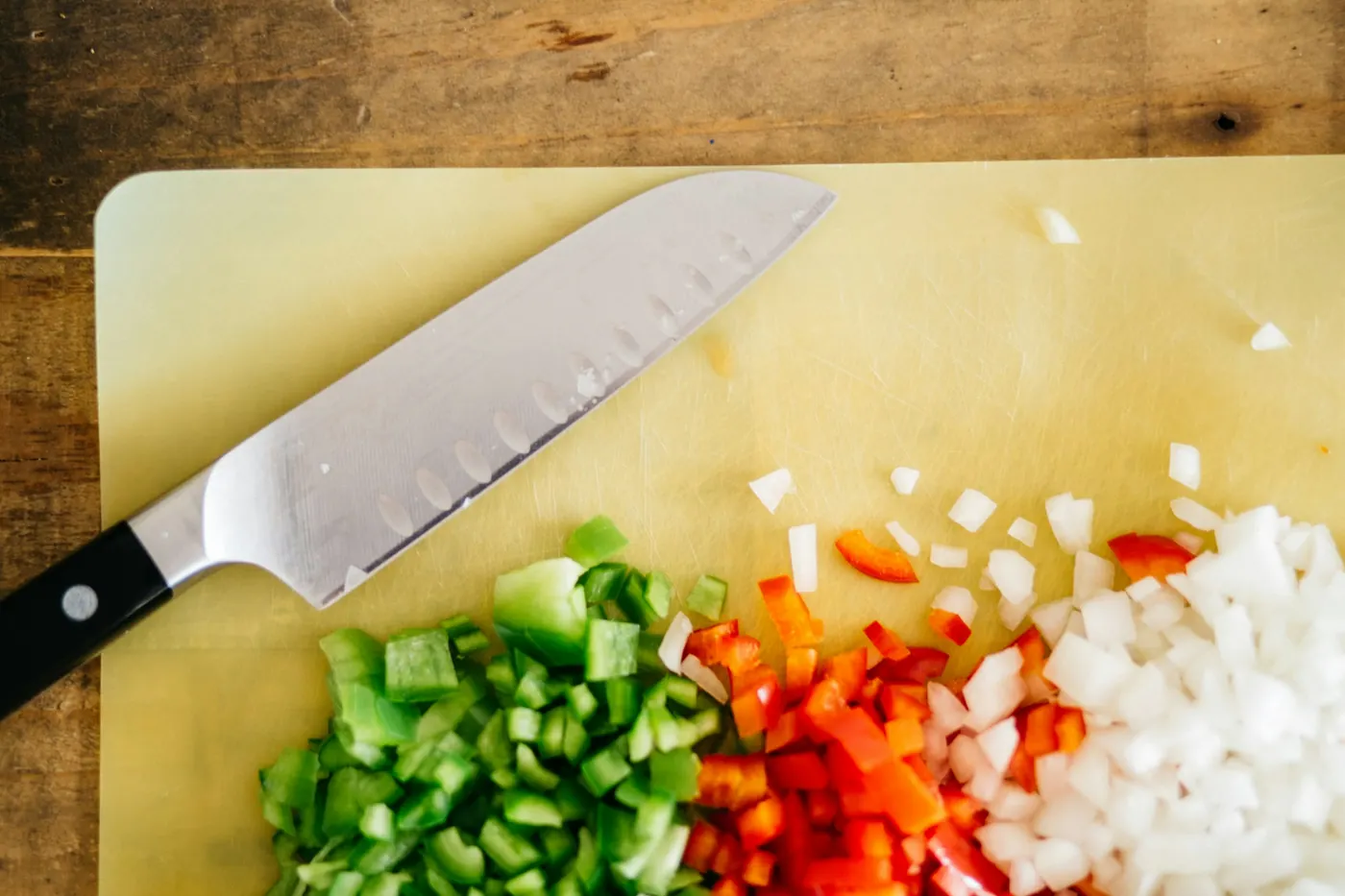
Buy bigger than you think. A board around 18 by 12 inches is the practical minimum for chopping a full batch of salsa, because diced onion, tomato, chile and cilantro each need their own pile. A small board is useful for a lime or a jalapeño, but it should not be your only one. Check your sink and dishwasher before buying a large board.
4. Weight and grip
A board that moves is a board that cuts fingers. Heavy wood stays put on its own; light boards need non-slip feet, grip corners or a damp towel underneath.
5. Juice groove
A groove is worth having on a board you carve on, because rested meat always leaks. On a vegetable board it just gets in the way, which is why reversible boards with a groove on one side only are so useful.
6. How you will clean it
Be honest about this one. If you will not hand wash and oil a wooden board, buy plastic or composite for daily work and keep wood for bread and vegetables.
Keeping boards food-safe: what extension services advise
We are a restaurant, not a food-safety authority, so this section sticks to what university extension services publish.
Use separate boards. The University of Arizona Cooperative Extension’s fact sheet on cutting boards, which draws on USDA Food Safety and Inspection Service guidance, recommends one board for raw meat, poultry or fish and a second for cooked or ready-to-eat foods such as salads, vegetables or bread. The University of Maine’s guide makes the same recommendation and notes that plastic or other nonporous boards can be a practical option for raw animal products.
Wash after every use. Arizona’s fact sheet says to wash all boards with hot, soapy water and a brush after each use, then rinse and air dry or pat dry. It lists nonporous acrylic, plastic and glass boards, and solid wood boards, as able to go in a dishwasher, but makers of wood boards such as John Boos and Teakhaus say not to, and Maine’s guide warns that wood can warp. Follow the maker of your board.
Sanitize now and then. Maine’s guide gives a dilute bleach method: half a teaspoon of unscented liquid chlorine bleach per quart of water, left on the surface for one minute, then wiped or rinsed and dried. Arizona’s sheet gives a slightly stronger mix of one teaspoon per quart. Use one of their published methods rather than guessing.
Replace worn boards. Both guides say boards wear out. Maine advises replacing boards with deep grooves, cracks or excessive wear once they can no longer be cleaned effectively.
Oil wood, but not with cooking oil. Maine recommends food-safe mineral oil or beeswax about once a month and says to avoid olive or vegetable oil, which can turn sticky and rancid.
How we chose these nine boards
We started from what a working Mexican kitchen asks of a board: room for a full batch of salsa prep, stability under a heavy knife, a groove for carving grilled meat, and a cleaning routine people will actually follow. We then looked for boards sold on Amazon in the United States from identifiable makers, covering wood in both grain types, plastic from home to commercial grade, composites and rubber. We checked each one’s stock with Amazon’s product data before writing and took sizes, materials and care instructions from the maker or the brand’s Amazon listing, writing “not stated” where neither gives a figure. Food-safety advice comes only from the University of Maine and University of Arizona extension publications cited above. We did not use these boards for this guide, and we have not cited published equipment reviews because we did not read them for these models.
Cutting board questions, answered
What is the best cutting board type?
There is no single best type, which is why most cooks end up with two. A large wooden board is the most pleasant for everyday vegetable prep, and a plastic or composite board that goes in the dishwasher is the practical choice for raw meat and poultry. Extension services recommend keeping separate boards for raw meat and ready-to-eat foods either way.
Which cutting board brands are worth looking at?
For wood, John Boos, Teakhaus, Larch Wood and Sonder Los Angeles are established makers that publish their sizes and care instructions. For plastic, OXO for home kitchens and San Jamar for commercial-style boards. Epicurean is the best-known paper composite, and Asahi and Hasegawa are the names in Japanese rubber and polyethylene boards.
Is a wooden or plastic cutting board better for raw meat?
Extension guidance leans toward nonporous boards for raw animal products. Arizona’s fact sheet says microorganisms on plastic boards were more easily washed off, while those trapped in wood are harder to dislodge by rinsing. If you use wood for meat, keep it as a meat-only board and clean and sanitize it every time.
What is the best cutting board for everyday use?
One that is big enough, stays still and that you will actually clean. For most people that is a large edge-grain board such as the Teakhaus or John Boos maple board, or the Epicurean if you want everything in the dishwasher.
How long does a cutting board last?
Plastic boards last until the knife scars get deep, which extension services treat as the point to replace them. A well-oiled wooden board can last many years, and both wood and rubber boards can be sanded to remove worn surfaces.
Our pick for a hard-working counter
Buy the Teakhaus if you want one large wooden board that handles salsa prep on one side and carving on the other, and add the OXO or the budget Farberware as a dishwasher-safe board kept just for raw meat. If you would rather never hand wash a board, the Epicurean is the one to choose, and the Asahi rubber board is the pick for anyone who cares most about their knife edges.
A board is the base of a good kit: our guide to Mexican cooking tools covers the rest, from the best molcajete for grinding salsa to the best grill tools for carne asada. For what to do with all those chopped tomatoes and tomatillos, see salsa roja vs salsa verde, and for the herbs, our guide to Mexican herbs.
Using hard Japanese knives? See our guide to the best cutting boards for Japanese knives, from hinoki to soft rubber.
On a budget? See our guide to the best budget cutting boards.
More specific guides: the best cutting boards for meat, and for upkeep, the best cutting board oils and waxes.
Related guide: Best non plastic cutting board.
Related guide: Best cutting board for vegetables.
Related guide: Glass vs wood cutting board.
And if you would rather skip the chopping tonight, see the menu or call to order.