
When your hands are sore, a stuck lid stops dinner. The salsa jar, the chipotles in adobo, the cajeta that has glued itself to the threads: each one asks for a tight pinch and a hard twist, and those are the two movements stiff or painful hands find hardest. The fix is not more grip. It is a tool that grips for you, gives you leverage, or does the turning itself.
This guide is the low-grip-strength companion to our main best jar opener guide, and it does not repeat that guide’s picks. Here are seven openers chosen for hands that cannot squeeze hard: an under-cabinet mount, an electric opener, three handheld grippers that tighten themselves around the lid, a palm-sized cone for bottle caps and a set of rubber pads. For each, we give the lid sizes, power and care the maker states.
Julia’s earns a commission on purchases made through links on this page, at no cost to you. Recommendations are based on what a restaurant kitchen looks for, product specifications and verified buyer reports.
Quick verdict: which opener to buy for sore hands
For most people with weak or painful hands, the pick is the Jiffy Twist Under-Cabinet Jar Opener: it stays mounted under a cabinet, holds the lid for you, and leaves one hand to turn the jar, with no squeezing at all. If turning a jar is also hard, choose the INSTACAN Higher Torque Electric Jar Opener, which grips and turns the lid at the press of a button. For a drawer tool that clamps itself to the lid, the Jokari Easy Grip Adjustable Jar Opener.
We make no medical claims here. The Arthritis Foundation’s own advice is simple: “Install a fixed jar opener, or keep a rubber jar opener in the kitchen,” and it also suggests getting “an electric can and jar opener.” This list follows that advice. If a hand condition makes kitchen work painful, an occupational therapist can recommend tools for your hands.
Five openers for weak hands compared
The five standouts, one for each way of taking strain off your hands. All seven openers are reviewed below.
| Opener | Type | Lid sizes (per maker) | What your hands do | Buy on Amazon |
|---|---|---|---|---|

Jiffy Twist Under-Cabinet Jar OpenerBest overall
|
Mounted grip, also handheld | All sizes | One hand turns the jar | View on Amazon |

INSTACAN Higher Torque Electric Jar OpenerBest hands-free
|
Electric, 2 AA batteries | 1.2 to 3.5 in | Press a button, steady the jar | View on Amazon |

Jokari Easy Grip Adjustable Jar OpenerBest self-tightening gripper
|
Handheld, twist-to-fit jaws | 1 to 4 in | Turn a handle, no squeezing | View on Amazon |

Zyliss Strongboy Adjustable Jar OpenerBest long handle
|
Handheld, rubber-lined loop | 2 to 10 cm (about 0.8 to 3.9 in) | Turn a long handle | View on Amazon |

Dycem Non-Slip Cone Bottle OpenerBest for bottle caps
|
Palm-held non-slip cone | Small bottle caps | Press with the palm and turn | View on Amazon |
Product images from Amazon. Lid sizes and features are as stated by each maker or listing; check the listing before you buy.
Our picks for the best jar opener arthritis sufferers can use
Every opener below takes at least one hard movement off your hands: the pinch, the squeeze, or the twist. Before you choose, think about which of those hurts most, and measure your widest lid. A wide jar of pickled jalapeños is a different job from a small bottle of hot sauce.

1. Jiffy Twist Under-Cabinet Jar Opener – Holds the Lid, You Turn the Jar
A mounted opener is the one tool the Arthritis Foundation names first for the kitchen, and the Jiffy Twist is a clear example. It sticks to the underside of a wall cabinet with an industrial-strength peel-and-stick adhesive, so there are no screws to drive. You push the lid up into its shaped jaw, which holds the lid still, and turn the jar with one hand. Your fingers never have to pinch the lid at all.
The listing says the jaw has a patented shape that gives more mechanical advantage than a plain V-shaped opener, with a zero-slip gripping surface and a patented cover over the blade, so there is no row of exposed teeth to catch a knuckle or chew up a plastic lid. It fits jars and bottles of all sizes, per the listing.
It also works off the wall: the back has a gripping pattern so it can be used as a handheld opener. The listing says it is made in the USA and carries a lifetime manufacturer’s warranty. Cleaning instructions are not stated.
Why we like it
- One-handed use once mounted
- Covered blade, no exposed teeth
- Peel-and-stick mounting, no drilling
- Lifetime manufacturer’s warranty, per the listing
Key specifications
| Opener | Jiffy Twist, model 0923 |
|---|---|
| Type | Under-cabinet grip that also works handheld |
| Lid sizes | Jars and bottles of all sizes (per listing) |
| Hand strength needed | No pinch; one hand turns the jar |
| Power | Manual |
| Mount | Industrial peel-and-stick adhesive under a cabinet |
| Care | Not stated |
| Warranty | Lifetime manufacturer’s warranty (per listing) |
Why we recommend it
It suits anyone whose fingers hurt to pinch a lid but who can still turn a jar with a whole hand, and who wants the opener in the same spot every time.
Skip it if you have no wall cabinet near your prep area, or if turning the jar itself is painful; an electric opener takes that job too.
Pros and cons
Pros
- No pinching or squeezing
- Always in the same place
- Made in the USA, per the listing
Cons
- You still turn the jar
- Adhesive mount needs a clean, flat cabinet underside
- Care not stated
2. INSTACAN Higher Torque Electric Jar Opener – One Press, No Twisting
If both pinching and twisting hurt, an electric opener does the hard part. You set this one on the lid and press the button; its jaws close on the lid and turn it, then stop when they reset. INSTACAN says it opens tight and vacuum-sealed glass jars and is meant to cut hand strain and wrist twisting. It runs on two AA batteries, which are not included.
The adjustable jaws take lids from 1.2 to 3.5 inches and jar bodies from 1 to 3.5 inches, which covers standard salsa, jam and chipotle jars. The body measures 8.46 by 4.33 by 2.87 inches. INSTACAN is clear about the limits: use it on glass jars with twist-off lids, not plastic, oddly shaped or conical jars; dry the jar and lid first, since oil or condensation makes it slip; and steady tall or large jars with a hand while it runs.
This is a different model (KC12) from the INSTACAN opener in our best jar opener electric guide, which compares seven battery openers in more depth. Cleaning instructions are not stated.
Why we like it
- Grips and turns the lid itself
- Fits lids 1.2 to 3.5 inches
- Stops on its own when the jaws reset
- Clear guidance on which jars it suits
Key specifications
| Opener | INSTACAN, model KC12 |
|---|---|
| Type | Battery-powered automatic opener |
| Lid sizes | Lids 1.2 to 3.5 in; jar bodies 1 to 3.5 in |
| Hand strength needed | Press a button and steady the jar |
| Power | 2 AA batteries (not included) |
| Mount | None; sits on the lid |
| Care | Not stated |
| Warranty | Not stated |
Why we recommend it
It suits cooks who cannot twist a lid at all, and anyone who wants the least possible effort on everyday glass jars.
Skip it if many of your jars are plastic or wider than 3.5 inches, which INSTACAN says it is not made for.
Pros and cons
Pros
- Least hand effort of any type
- Handles vacuum-sealed glass jars, per INSTACAN
- Compact enough for a drawer
Cons
- Glass twist-off jars only
- Needs batteries
- Large jars still need steadying
3. Jokari Easy Grip Adjustable Jar Opener – Jaws That Tighten for You
Most handheld grippers still ask you to squeeze. Jokari’s does not: you twist its handle to open or close the jaws until they fit snugly around the lid, then turn the handle to open the jar. The fitting is done by the screw mechanism, not by your grip, which is why it suits hands that cannot clamp down hard.
Jokari says the jaws fit lids from 1 inch up to 4 inches across, which takes in wide jars of pickles and big jars of salsa that some openers cannot reach. It stands less than 3 inches tall, so it lies flat in a drawer without snagging, and it needs no batteries. Jokari pitches it for anyone struggling with arthritis or weak grip strength.
The listing does not state the materials or how to clean it, so wipe it after sticky lids.
Why we like it
- Fits lids 1 to 4 inches, per Jokari
- Screw-adjusted jaws, no squeezing
- Under 3 inches tall, stores flat
- No batteries
Key specifications
| Opener | Jokari Easy Grip Adjustable Jar Opener |
|---|---|
| Type | Handheld gripper with twist-to-fit jaws |
| Lid sizes | 1 to 4 in |
| Hand strength needed | Turn a handle; no squeeze |
| Power | Manual |
| Mount | None, handheld |
| Care | Not stated |
| Warranty | Not stated |
Why we recommend it
It suits cooks who can still turn a handle but cannot squeeze, and who keep a range of jar sizes, including wide ones.
Skip it if any turning is painful; the jar still needs a twist, and an electric opener avoids that.
Pros and cons
Pros
- Widest stated lid range here
- Grip comes from the mechanism, not your fingers
- Flat for drawer storage
Cons
- Takes a moment to adjust for each jar
- Materials and care not stated
4. Zyliss Strongboy Adjustable Jar Opener – A Rubber Loop and a Long Handle
The Zyliss works on the same idea as the Jokari but with a rubber-lined loop instead of jaws. You twist the handle to size the loop, slip it over the lid and turn. Zyliss says the rubber grip inside the loop fits securely around the lid, and the long, bulbous handle gives extra leverage, so a smaller effort at the end of the handle turns a tight lid.
Zyliss lists lids from 2 to 10 centimeters across, about 0.8 to 3.9 inches, which covers bottles as well as jars. The tool is about 20 centimeters long. After use, you twist the handle again to pull the loop in for storage. Zyliss describes it as made for older cooks and for people with arthritis, osteoporosis and joint pain.
The rubber lining is gentle on plastic lids, which a toothed metal opener can crack. Care and materials are not stated on the Amazon listing.
Why we like it
- Rubber-lined loop grips without teeth
- Long handle adds leverage
- Lids from 2 to 10 cm, per Zyliss
- Retracts for storage
Key specifications
| Opener | Zyliss Strongboy, model E930048 |
|---|---|
| Type | Handheld gripper with adjustable rubber-lined loop |
| Lid sizes | 2 to 10 cm (about 0.8 to 3.9 in) |
| Hand strength needed | Turn a long handle; no squeeze |
| Power | Manual |
| Mount | None, handheld; about 20 x 5 x 3 cm |
| Care | Not stated |
| Warranty | Not stated |
Why we recommend it
It suits cooks who want the most leverage from a hand tool, and kitchens with plastic lids that toothed openers damage.
Skip it if your widest jars are over about 4 inches across.
Pros and cons
Pros
- Leverage from the long handle
- Gentle on plastic lids
- Works on bottles too
Cons
- Longer than other hand tools
- Care not stated
5. Kuhn Rikon Compact Jar Opener – Small Enough for Any Drawer

Kuhn Rikon makes two openers in our main jar opener guide; this is a different, smaller one. Kuhn Rikon describes a mechanism that grips the lid securely and a comfortable handle with a smooth turning motion, meant to cut strain for people with weak hands or arthritis. It is built to be lightweight and to store easily in a kitchen drawer.
The Amazon listing does not give a lid range. A US retailer that sells it, Chef Knives To Go, lists it as adjustable for lids up to 3.5 inches across, with a stainless steel blade. That covers standard salsa and chipotle jars, but measure your wide jars first.
Care advice differs between sources: the Amazon listing says it wipes clean or can go in the dishwasher, while that retailer lists hand wash and dry. Washing by hand is the safe choice.
Why we like it
- Compact and lightweight
- Designed for weak hands, per Kuhn Rikon
- Stainless steel blade, per a US retailer
- Established Swiss maker
Key specifications
| Opener | Kuhn Rikon Compact, item 22898 |
|---|---|
| Type | Handheld adjustable gripper |
| Lid sizes | Up to 3.5 in (per a US retailer; not stated on Amazon) |
| Hand strength needed | Some turning; mechanism does the gripping |
| Power | Manual |
| Mount | None, handheld |
| Care | Sources differ; hand wash to be safe |
| Warranty | Not stated |
Why we recommend it
It suits a small kitchen or a crowded gadget drawer, and cooks who want a lighter tool than the long-handled openers here.
Skip it if you want full specifications from the listing; this one gives fewer details than the others.
Pros and cons
Pros
- Small and light
- Grips by mechanism, not squeeze
- Well-known maker
Cons
- Lid range not on the Amazon listing
- Conflicting care advice
- Shorter handle, less leverage
6. Dycem Non-Slip Cone Bottle Opener – Palm Grip for Small Caps
Small caps are often harder than big lids, because there is so little to hold. Dycem, a maker of non-slip aids, shapes this opener as a dome that sits in the palm of your hand. You press it down over the cap and turn with the whole hand, using the palm rather than pinching with the fingertips. Grip bars around the cone add hold.
Dycem lists it for ketchup bottles, fizzy drink tops and medicine bottles, and says its grip even opens push-down-and-twist pill bottles. In a Mexican kitchen that means hot sauce bottles, bottled salsa and the small caps on vanilla and Maggi. It also helps grip small cupboard knobs. Dycem’s listings for the same model in other colors give the size as 2 inches across.
It is not meant for wide jar lids; pair it with one of the openers above for those. Care is not stated.
Why we like it
- Uses the palm, not the fingertips
- Non-slip material with grip bars
- Works on push-and-turn caps, per Dycem
- Small enough for a pocket or bag
Key specifications
| Opener | Dycem, model 50-1651Y (yellow) |
|---|---|
| Type | Non-slip cone, held in the palm |
| Lid sizes | Small bottle caps; about 2 in across |
| Hand strength needed | Press with the palm and turn |
| Power | Manual |
| Mount | None, handheld |
| Care | Not stated |
| Warranty | Not stated |
Why we recommend it
It suits anyone who manages jars with another tool but still struggles with small bottle caps and pill bottles.
Skip it if your trouble is wide jar lids; it is too small for them.
Pros and cons
Pros
- Easy on the fingers
- Handles caps other openers miss
- Compact
Cons
- Small caps only
- Care not stated
7. Regent Round Jar Gripper Pads, 4 Pack – Rubber Grip in Every Drawer
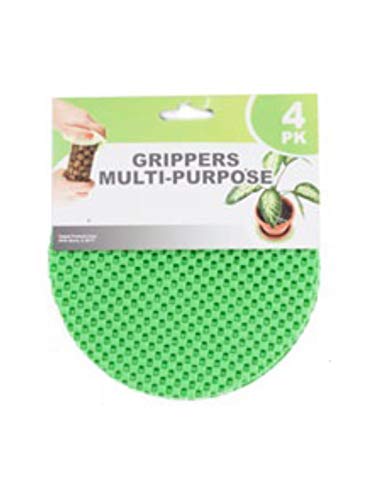
The Arthritis Foundation’s second suggestion for the kitchen is to keep a rubber jar opener handy, and this is the simplest version. Regent sells four round gripper pads, each 5.5 inches across, in one color per set. You lay a pad over the lid and turn; the rubber adds grip so your hand does not slip.
Four pads means one can live by the stove, one in the pantry and one wherever else you open jars. A pad adds grip but no leverage, so it works best on lids that are only a little tight or slippery with oil. For a lid that will not move, use one of the tools above and keep a pad under the jar to stop it spinning.
Material and care are not stated beyond “gripper pad”; rinse and dry them after sticky jars.
Why we like it
- Four pads in a set
- 5.5 inches across, fits most lids
- Also steadies a jar on the counter
Key specifications
| Opener | Regent, model R-36698 |
|---|---|
| Type | Round jar gripper pads, set of 4 |
| Lid sizes | Pads 5.5 in across |
| Hand strength needed | Adds grip, not leverage |
| Power | Manual |
| Mount | None |
| Care | Not stated |
| Warranty | Not stated |
Why we recommend it
It suits anyone who wants grip in several places at once, or a helper to go with a mounted or electric opener.
Skip it if you need real help with tight lids; a pad alone does not add leverage.
Pros and cons
Pros
- Four pads to spread around the kitchen
- Nothing to adjust
- Doubles as a jar mat
Cons
- No leverage
- Colors vary; material not stated
How to choose a jar opener when grip is weak
Which movement hurts. Opening a jar takes three things: pinching the lid, squeezing to hold it, and twisting. A rubber pad helps a little with the pinch. A self-tightening gripper like the Jokari or Zyliss removes the squeeze. A mounted opener like the Jiffy Twist removes the pinch and the squeeze, leaving only a turn of the jar. An electric opener removes all three. Pick the type that takes away the movement that hurts.
Lid size. The electric opener here stops at 3.5 inches, the Zyliss at about 3.9, the Jokari at 4. Measure your widest jars, such as big pickled jalapeño or salsa jars, before buying, and keep a pad or the Dycem cone for small bottle caps.

Where it lives. A mounted opener is always in the same place, which matters when reaching into a deep drawer is itself a strain. A handheld tool goes wherever the jar is. An electric opener needs a home and a supply of batteries.
One hand or two. If one hand is much weaker than the other, a mounted opener or an electric one lets the stronger hand do the work. A handheld gripper needs one hand on the jar and one on the tool.
Your lids. Toothed openers can crack plastic lids, which is why the covered blade on the Jiffy Twist and the rubber loop on the Zyliss are worth noting. INSTACAN says its electric opener is for glass jars with twist-off lids only.
How we chose these seven openers
We started from the Arthritis Foundation’s kitchen advice, which names fixed (mounted) openers, rubber openers and electric openers, and looked for the clearest example of each from an identifiable maker, plus self-tightening grippers that remove the need to squeeze. We left out every product already in our main jar opener and electric jar opener guides. Each pick was in stock on Amazon in the United States when we wrote this, and every specification comes from the maker’s listing or a named retailer; where a maker gives no detail, we say “not stated”. We did not include the many unbranded openers sold only on Amazon, and the Black+Decker Lids Off and Hamilton Beach Open Ease electric openers were showing limited stock. We also searched the US Consumer Product Safety Commission recall database for each brand here and found no jar opener recalls. We have not used these products ourselves, and nothing on this page is medical advice.
Arthritis jar opener questions, answered
What is the best jar opener for arthritis?
It depends on which movement hurts. For most people a mounted opener such as the Jiffy Twist is the best balance, since it takes away the pinch and squeeze. If twisting a jar also hurts, an electric opener like the INSTACAN does all the work. The Arthritis Foundation suggests both fixed and electric jar openers for the kitchen.
Is an electric jar opener better for weak hands?
It takes the most effort out, because it grips and turns the lid while you only steady the jar. The trade-offs are batteries, a lid limit (3.5 inches on the INSTACAN) and, for this model, glass twist-off jars only. Our electric jar opener guide compares more of them.
Do rubber jar grippers help with arthritis?
They add grip, and the Arthritis Foundation suggests keeping a rubber jar opener in the kitchen. But a pad adds no leverage, so for tight lids pair it with a gripper, a mounted opener or an electric one.
What helps with small bottle caps?
A palm-held cone like the Dycem lets you press and turn with the whole hand instead of pinching with the fingertips. Dycem lists it for ketchup bottles, drink tops and medicine bottles.
Where should an under-cabinet jar opener go?
Under a wall cabinet close to where you prep, at a height where you can hold the jar comfortably below it. The Jiffy Twist mounts with adhesive, so the underside needs to be clean and flat.

A kinder kitchen for sore hands
Mount a Jiffy Twist near your prep space, keep a Dycem cone for small caps, and choose the INSTACAN if twisting at all is hard. For the full range of openers, including the OXO, Kuhn Rikon and Brix picks, see our best jar opener guide. Other tools made with sore hands in mind include our picks for the best citrus juicer for arthritic hands and the best can opener. And for what is inside those jars, see our guides to the best jarred salsa and the best chipotle peppers in adobo sauce.
On the days when no jar is worth the fight, see our menu and call to order.