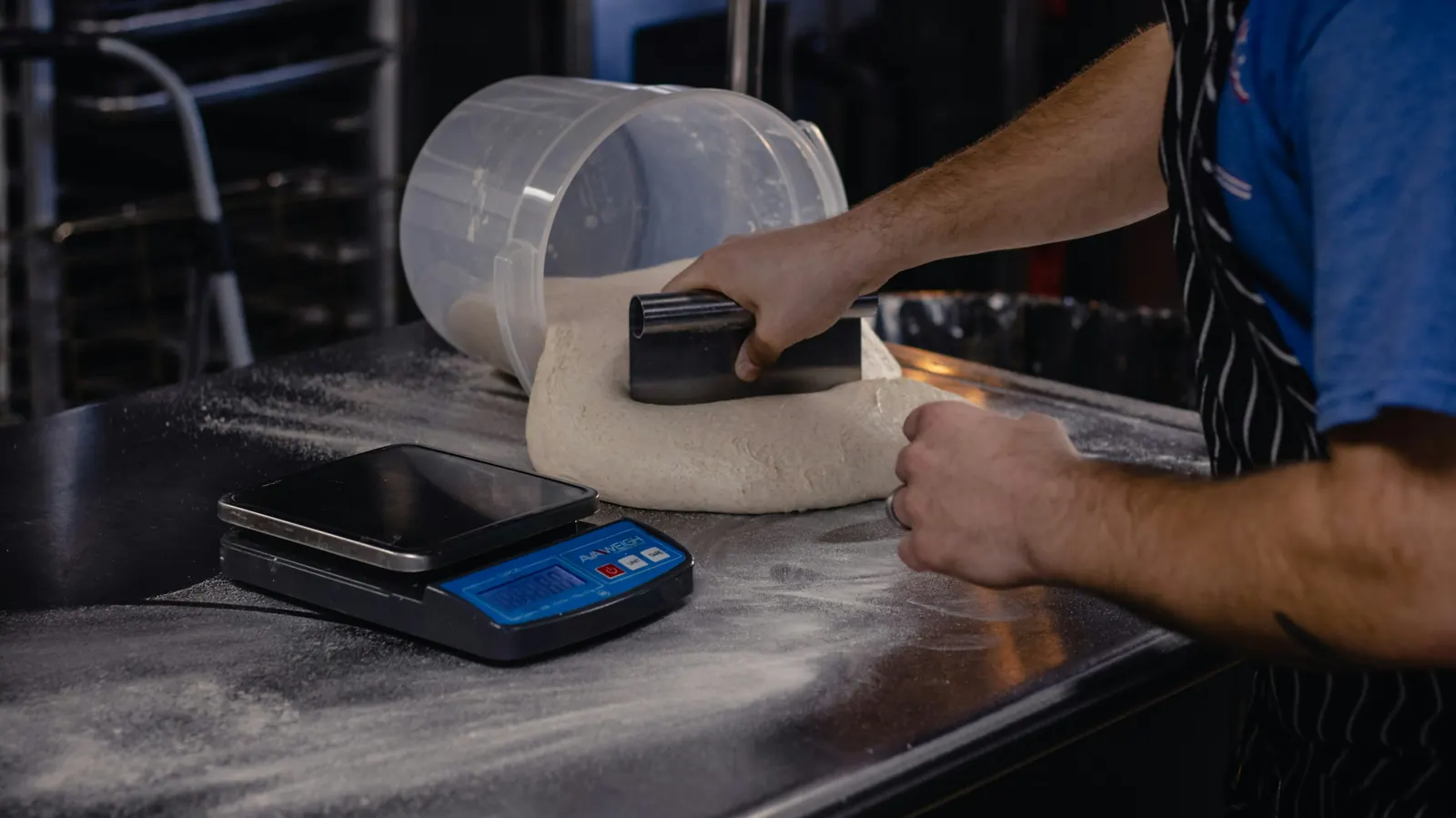
Sourdough asks two different things of a scale in the same morning. Feeding the starter and mixing the dough means weighing flour and water by the kilogram, often in a heavy bowl or a tall tub. Then the salt goes in, and for a single loaf that is around ten grams, where a gram either way is a real share of the total. Most everyday kitchen scales handle the first job well and the second only roughly.
This guide is for bakers who already know they want to weigh everything and now want a scale built around that routine: fine resolution for salt and levain, enough capacity for a big dough, a tare button that keeps up with one-bowl mixing, and, on a few models, a baker’s percentage mode that does the arithmetic for you.
Julia’s earns a commission on purchases made through links on this page, at no cost to you. Recommendations are based on what a restaurant kitchen looks for, product specifications and verified buyer reports.
Quick verdict: which scale to buy for sourdough
For most sourdough bakers, the Smart Weigh Dual Platform Kitchen Scale is the one to buy: the large platform weighs up to 10 kg in 1 g steps for flour, water and the whole dough, and the small platform reads to 0.01 g up to 300 g for salt and yeast, all in one footprint. If you want the scale to work out hydration and salt for you, choose the THINKSCALE 8 kg scale with baker’s percentage. If you already own a good 1 g scale, add an American Weigh Scales SC-2KG for the small amounts.
None of the seven scales below appears on our main best kitchen scale guide or our baking scale guide; this list is built around the sourdough routine specifically.
Five sourdough scales side by side
Our five standout picks, one for each kind of sourdough baker, with the capacity and smallest step each listing states. All seven scales are reviewed in full below.
| Sourdough scale | Best for | Capacity | Smallest step | Buy on Amazon |
|---|---|---|---|---|

Smart Weigh Dual Platform Kitchen ScaleBest overall
|
Dough and salt on one scale | 10 kg large, 300 g small | 1 g large, 0.01 g small | View on Amazon |

THINKSCALE 8 kg Scale with Baker’s PercentageBest baker’s percentage
|
Hydration without a calculator | 8 kg (17.6 lb) | About 1 g (±1 g stated) | View on Amazon |

My Weigh KD-7000 Stainless Steel ScaleBest for big doughs
|
Long sessions, heavy tubs | 7 kg | 1 g | View on Amazon |

TIMEMORE Black Mirror Basic 3 ScaleBest rechargeable 0.1 g
|
One loaf at a time, finely | 2 kg | 0.1 g | View on Amazon |
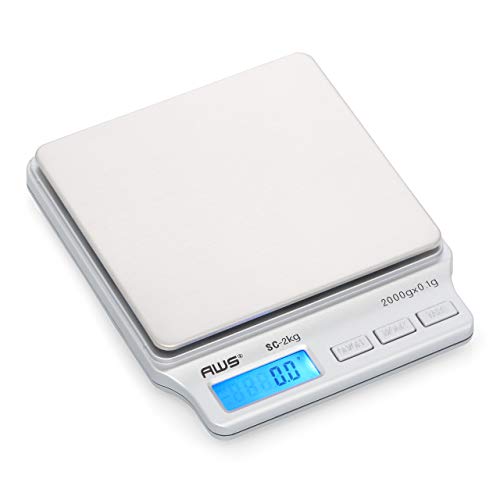
American Weigh Scales SC-2KG Precision ScaleBest second scale
|
Salt and levain beside a 1 g scale | 2 kg | 0.1 g | View on Amazon |
Product images from Amazon. Capacities and steps are as each listing states; check the listing before you buy.
Our picks for the best kitchen scale sourdough bakers can use
These seven scales split into three kinds: big-capacity scales for mixing (two with a baker’s percentage mode), a dual-platform scale that does both jobs, and compact 0.1 g scales for salt, levain and starter feeds. We stopped at seven because the other options we found were either unbranded listings with conflicting numbers or near-copies of a scale already here.
1. Smart Weigh Dual Platform Kitchen Scale – Dough and Salt on One Base
A sourdough bake moves between big numbers and small ones, and this scale gives each its own platform. The large stainless platform reads from 1 g up to 10 kg, which covers a double batch of dough in a heavy bowl. The small platform reads from 0.01 g up to 300 g, so the 10 g of salt for a single loaf, or a few grams of instant yeast for a hybrid dough, get weighed on a sensor built for small amounts.
That split matters more than it sounds. America’s Test Kitchen points out that most kitchen scales show 1 g steps but that this does not mean they reliably catch single-gram differences, and in its precision-scale review it says a deviation of a few tenths of a gram can change a finished result. A dedicated small platform answers that without a second gadget on the counter.
The listing names a backlit LCD, tare, and units in grams, kilograms, ounces, pounds and fluid ounces. Both platforms are stainless steel and wipe clean. Smart Weigh states a 2-year warranty. The listing does not state the power source, the auto-off timing or the platform sizes, so check the product photos to make sure your bowl fits the large side.
Why we like it
- Large platform weighs 1 g to 10 kg, per the listing
- Small platform reads 0.01 g up to 300 g for salt and yeast
- Backlit display and tare on both jobs
- 2-year manufacturer warranty stated
Key specifications
| Model | DS-100 |
|---|---|
| Capacity | 10 kg (large), 300 g (small) |
| Smallest step | 1 g (large), 0.01 g (small) |
| Platform | Two stainless steel platforms |
| Baker’s percentage | Not stated |
| Power | Not stated |
| Auto-off | Not stated |
| Warranty | 2 years |
Why we recommend it
It suits the baker who wants one scale for the whole bake, from the morning levain build to the final salt, and who would rather not keep a pocket scale in a drawer.
Skip it if you want the scale to calculate hydration for you; the listing does not mention a percentage mode.
Pros and cons
Pros
- Covers big doughs and tiny amounts
- Stainless platforms wipe clean
- Two-year warranty
Cons
- Power source and auto-off not stated
- No baker’s percentage mode listed
- Title’s “10 kg x 0.01 g” combines two platforms
2. THINKSCALE 8 kg Scale with Baker’s Percentage – Hydration Without a Calculator
Sourdough recipes are usually written as baker’s percentages: flour is 100 percent, and water, salt and levain are each a share of the flour weight. King Arthur Baking’s reference uses 66 percent water and 2 percent salt in its white bread example. On most scales you do that math yourself. On this one you set the flour as 100 percent and the display shows each addition as a percentage, with color cues as you approach the target, according to the listing.
The capacity is 8 kg (17.6 lb), which leaves room for a large dough in a heavy bowl. The listing gives a weighing range of 3 g to 8,000 g with ±1 g accuracy, so this is a 1 g class scale; it is not the tool for weighing 2 g of yeast exactly. The stainless pan lifts off for washing under the tap, and the clear cover doubles as a small tray. The body is rated IPX6 against splashes.
It is USB rechargeable, the listing claims up to 60 days per charge, and a USB adapter is included according to the title. It also has hold and auto-off. THINKSCALE is a smaller brand; the listing promises replacement support but does not state a warranty term.
Why we like it
- Baker’s percentage mode with flour set as 100 percent
- 8 kg capacity for big doughs
- Removable stainless pan; IPX6 splash rating
- Rechargeable, with a USB adapter included per the title
Key specifications
| Model | TK-KP-8 |
|---|---|
| Capacity | 8 kg (17.6 lb) |
| Smallest step | ±1 g accuracy stated; range from 3 g |
| Platform | Removable stainless steel pan |
| Baker’s percentage | Yes |
| Power | USB rechargeable |
| Auto-off | Yes (timing not stated) |
| Warranty | Not stated |
Why we recommend it
It suits the baker who adjusts hydration from bake to bake and wants to see 72 or 78 percent on the display instead of working it out on a phone with doughy fingers.
Skip it if you need tenths of a gram; pair it with a 0.1 g scale for yeast and small salt amounts.
Pros and cons
Pros
- Percentage mode built in
- Pan lifts off for washing
- No disposable batteries
Cons
- 1 g class accuracy only
- Warranty term not stated
- Lesser-known brand
3. My Weigh KD-7000 Stainless Steel Scale – Plugs In for Long Sessions
A sourdough day is long. Between the levain build, the autolyse and the mix, a scale that switches itself off after a minute can lose your running total in the middle of an addition. The KD-7000 answers that in two ways: it runs on the included DC power supply, and its auto-off is programmable, according to the listing.
The black version’s listing gives the capacity as 7 kg in 1 g steps, which handles a big tub of dough. The silver listing linked here adds the details that matter in a floury kitchen: a removable, washable stainless steel tray, and a protective acrylic shield over the display and keypad. It also has tare, a hold function for reading the weight after you lift a bowl off, and an overload indicator.
It runs on 3 AA batteries (not included) when you want it away from an outlet. My Weigh’s same-family KD-8000 adds a baker’s percentage mode, but it was listed as low stock when we checked, so it is not recommended here. The listing does not state a warranty.
Why we like it
- DC power supply included, plus AA option
- Programmable auto-off for long sessions
- Removable, washable stainless tray
- Acrylic shield over the display and keypad
Key specifications
| Model | KD-7000 (SCKD7000SILV) |
|---|---|
| Capacity | 7 kg (per the black version’s listing) |
| Smallest step | 1 g |
| Platform | Removable stainless steel tray |
| Baker’s percentage | No (not listed) |
| Power | DC adapter (included) or 3 AA (not included) |
| Auto-off | Programmable |
| Warranty | Not stated |
Why we recommend it
It suits the baker who mixes large or several doughs on a counter near an outlet and wants a scale that stays on and shrugs off flour.
Skip it if you want a slim scale that slides into a drawer; this is a bench scale with a shielded keypad, not a thin one.
Pros and cons
Pros
- Stays on with mains power
- Tray comes off for washing
- Hold and overload indicator
Cons
- 1 g steps; no fine weighing
- Batteries not included
- Capacity stated only on the black listing
4. TIMEMORE Black Mirror Basic 3 Scale – Tenths of a Gram to 2 kg
This is sold as a coffee scale, and the coffee features (three brewing modes and a water-to-coffee ratio calculator) are not what makes it useful for bread. What matters is the range: 0.2 g to 2,000 g in 0.1 g steps, according to the listing. That covers a starter feed, a levain build and the salt in tenths of a gram, and a single-loaf dough of around 500 g flour fits within the 2 kg limit if your bowl is light.
It charges by USB-C from a 1,600 mAh battery that the listing rates at up to 24 hours per charge, so there are no coin cells or AAAs to replace. The top is glass with touch controls, and the whole scale weighs about 300 g and measures about 15 x 13 x 2.6 cm, small enough for a drawer.
The platform is coffee-scale sized, so a wide mixing bowl will cover the display; use it for the small weighings and a larger scale for the main mix of a big batch. The listing does not state a warranty or the auto-off timing.
Why we like it
- 0.1 g steps from 0.2 g to 2,000 g
- USB-C rechargeable, up to 24 hours per charge
- Glass top with touch controls wipes clean
- Slim enough to store in a drawer
Key specifications
| Model | Black Mirror Basic 3 (TES016) |
|---|---|
| Capacity | 2 kg |
| Smallest step | 0.1 g |
| Platform | Glass top, about 15.2 x 13 cm body |
| Baker’s percentage | No (coffee ratio mode only) |
| Power | 1,600 mAh battery, USB-C |
| Auto-off | Not stated |
| Warranty | Not stated |
Why we recommend it
It suits the baker who makes one loaf at a time and wants fine resolution for everything, or who also brews pour-over coffee and wants one scale for both.
Skip it if you mix big doughs in a heavy bowl; 2 kg runs out quickly once a ceramic bowl is on it.
Pros and cons
Pros
- Fine steps across a useful range
- Rechargeable, no batteries to buy
- Compact and easy to clean
Cons
- 2 kg limit includes the bowl
- Small platform for wide bowls
- Warranty not stated
5. American Weigh Scales SC-2KG Precision Scale – A Ten-Year Second Scale
Plenty of bakers already own a good 1 g kitchen scale and only need help with the small numbers. The SC-2KG is a compact precision scale that reads to 0.1 g up to 2 kg, per the listing, which is enough for salt, levain, a starter jar and its feed, and the inclusions for a loaf.
It comes with two protective covers that double as weighing trays, which keeps salt and flour off the sensor. It has tare and reads in grams, ounces and several jewelers’ units you will not need. American Weigh Scales backs it with a 10-year limited warranty, the longest stated on this page.
America’s Test Kitchen’s precision-scale review notes that precision scales have small platforms and cannot replace a regular kitchen scale; they work alongside one. That is exactly the job here. The listing does not state the battery type or the auto-off timing.
Why we like it
- 0.1 g steps up to 2 kg
- Two covers double as weighing trays
- 10-year limited warranty stated
- Pocket-sized; stores anywhere
Key specifications
| Model | AMW-SC-2KG |
|---|---|
| Capacity | 2 kg |
| Smallest step | 0.1 g |
| Platform | Small; two covers act as trays |
| Baker’s percentage | No (not listed) |
| Power | Not stated |
| Auto-off | Not stated |
| Warranty | 10-year limited |
Why we recommend it
It suits the baker who already has a capacity scale they like and wants the small weighings, salt above all, to be exact.
Skip it if you want one scale for everything; the platform is too small for a mixing bowl.
Pros and cons
Pros
- Fine resolution for salt and yeast
- Longest warranty here
- Covers protect the sensor
Cons
- Too small for a dough bowl
- Battery type not stated
- Extra units add clutter
6. Bonvoisin 30 kg Baking Scale with Percentage Weighing – Bakery-Size Batches
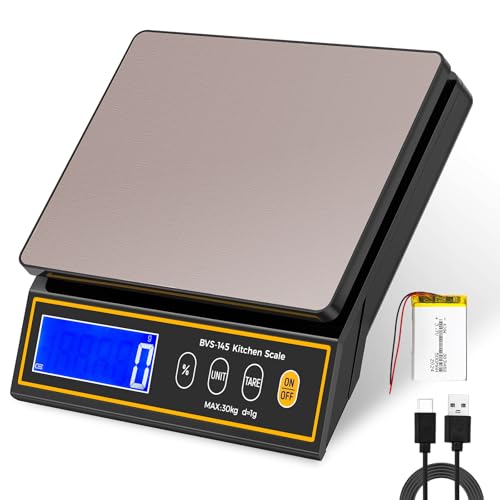
If you bake for a market stall, a church sale or a large family, the dough can outgrow a 5 kg or even 10 kg scale once the tub is on it. This Bonvoisin model weighs up to 30 kg (66 lb) with 1 g readability and a 5 g minimum, according to the listing, and it includes a percentage function for baker’s math. It is a different, much larger model from the 5 kg Bonvoisin on our baking scale guide.
The stainless platter measures 9.45 x 7.09 inches, which gives a big tub somewhere to sit, and the display is tilted slightly so you can read it past a large container. The listing is clear that the platter does not come off, so cleaning means wiping around it. The shell is ABS plastic.
It runs on a rechargeable, replaceable battery that the listing rates at up to 60 hours of use; a USB cable is included, but you need your own 3–5 V adapter. Units include grams, kilograms, ounces, pounds and milliliters. No warranty term is stated.
Why we like it
- 30 kg capacity in 1 g readability
- Percentage weighing for baker’s math
- Large 9.45 x 7.09 inch platter
- Rechargeable battery that can be replaced
Key specifications
| Model | XXX-145-1 |
|---|---|
| Capacity | 30 kg (66 lb) |
| Smallest step | 1 g (5 g minimum load) |
| Platform | Stainless steel, 9.45 x 7.09 in, not removable |
| Baker’s percentage | Yes |
| Power | Rechargeable, USB cable (adapter not included) |
| Auto-off | Not stated |
| Warranty | Not stated |
Why we recommend it
It suits the home baker who mixes several loaves’ worth of dough at once in a big tub and still wants percentage weighing.
Skip it if you bake one or two loaves a week; the 5 g minimum and 1 g steps make it a poor scale for small amounts.
Pros and cons
Pros
- Highest capacity on this page
- Tilted display stays readable
- Percentage mode included
Cons
- Platter does not come off
- Charging adapter not included
- Warranty not stated
7. Greater Goods 0.1 g Scale with Timer – A Timer for Stretch and Folds

Another coffee scale that earns a place on a bread counter. It reads in 0.1 g steps up to 6.6 lb (about 3 kg), per the listing, and adds a count-up and count-down timer. Bread bakers can use that timer for the gaps in a sourdough schedule: the autolyse rest, or the half-hour gaps between sets of stretch and folds.
The weighing surface is 5.25 inches square under a heat-resistant silicone cover that the listing says is dishwasher-safe, which keeps flour and starter off the electronics. It runs on 3 AAA batteries (included), has auto-shutoff, and Greater Goods states a 5-year warranty. Units include grams, milliliters, pounds and ounces.
A note on the brand: in January 2025 the CPSC announced a Greater Goods recall of several kitchen scale models over an accessible coin battery (recall 25-111). This model, 0460, is not on that recall’s model list, and it runs on AAA batteries, not a coin cell.
Why we like it
- 0.1 g steps up to about 3 kg
- Count-up and count-down timer
- Dishwasher-safe silicone cover
- 5-year warranty stated
Key specifications
| Model | 0460 |
|---|---|
| Capacity | 6.6 lb (about 3 kg) |
| Smallest step | 0.1 g |
| Platform | 5.25 in square, silicone cover |
| Baker’s percentage | No (not listed) |
| Power | 3 AAA (included) |
| Auto-off | Yes (timing not stated) |
| Warranty | 5 years |
Why we recommend it
It suits the baker who makes a single loaf, wants fine resolution, and likes a timer on the same device that weighs the salt.
Skip it if your dough bowl is heavy; a ceramic bowl and a full dough can push past 3 kg.
Pros and cons
Pros
- Fine steps with a useful capacity
- Built-in timer
- Long warranty
Cons
- About 3 kg limit
- Small surface for wide bowls
- Uses disposable batteries
Why 0.1 g matters for salt and levain
The case for a finer scale is simple arithmetic. King Arthur Baking’s baker’s percentage reference uses 2 percent salt in its white bread formula. For a loaf made with 500 g of flour, that is 10 g of salt. A 1 g scale can be a gram off either way, and on 10 g that is a tenth of the salt. A 0.1 g scale narrows the error to a few hundredths of the total.
The same goes for small levain builds and starter feeds. If you keep a small starter, say 20 g fed with 20 g of flour and 20 g of water, a 1 g scale leaves little room for error. America’s Test Kitchen makes the same point about yeast and salt in its precision-scale review, and adds that a precision scale works alongside a regular scale rather than replacing it.
Flour and water are another matter. At 350 g of water, a gram either way is far below anything you would notice in the dough, so a 1 g scale is fine for the main mix. That is why the dual-platform scale tops this list, and why a 1 g capacity scale plus a small 0.1 g scale is a sensible pair.
How to choose a kitchen scale for sourdough
Capacity, counting the bowl
The capacity on the box includes whatever container you use. A ceramic mixing bowl can weigh well over a kilogram before any flour goes in, and a big plastic dough tub adds more. For a single loaf, 3 kg is workable with a light bowl; for two loaves or more, look at 5 kg and up. The scales here run from 2 kg to 30 kg.
Resolution where it counts
Decide whether you want one scale with two ranges (the Smart Weigh’s two platforms), one scale with fine steps throughout (the TIMEMORE or the Greater Goods, within their 2 to 3 kg limits), or a 1 g capacity scale plus a small precision scale. All three approaches work; the last is often the most flexible.
Tare and a display you can see
One-bowl mixing means pressing tare after each ingredient, so the button should be easy to hit with floury hands. Check that the display sits clear of a wide bowl: the Bonvoisin tilts its display for this reason, and America’s Test Kitchen’s main scale review puts heavy weight on displays that stay readable under a large bowl.
Auto-off and power
Sourdough steps can be slow. A scale that shuts off after a minute can lose the running total mid-pour. Look for a mains option (the My Weigh), a programmable auto-off, or simply a long default timer. Rechargeable scales (THINKSCALE, TIMEMORE, Bonvoisin) save on batteries; check whether a charging adapter is included.
Baker’s percentage, if you will use it
A percentage mode is a convenience, not a requirement. If you adjust hydration often or scale recipes up and down, it saves time. If you follow one recipe in grams, it adds buttons you will not press.
Cleaning
Flour and wet starter find every gap. A removable tray or pan, a silicone cover or a sealed glass top all make cleanup easier. Fixed platforms with seams around the edge are harder to keep clean.
How we chose these seven sourdough scales
We have not used these scales for this guide. We started from what a working kitchen asks of a scale for bread: enough capacity for the dough and its container, fine resolution for salt and leavening, and a body that survives flour. We then read each product’s Amazon listing for capacity, steps, power, cleaning and warranty, and checked that each one was in stock on Amazon when we wrote this.
For background we used King Arthur Baking’s reference on baker’s percentage and America’s Test Kitchen’s reviews of everyday and precision kitchen scales. We checked the U.S. Consumer Product Safety Commission’s recall database for the brands here; the only kitchen scale recall we found from these brands was the January 2025 Greater Goods recall, which does not list the model above. We left out scales already recommended on our parent and baking guides, scales listed as low stock (including My Weigh’s KD-8000), and unbranded listings whose titles and descriptions gave conflicting capacities or steps.
Sourdough scale questions, answered
What is the best kitchen scale for sourdough bread?
For most bakers, a scale that covers both big and small amounts. The Smart Weigh dual platform does that on one base. A good 1 g scale paired with a 0.1 g precision scale such as the American Weigh SC-2KG works just as well.
Do I really need 0.1 g resolution for sourdough?
Not for flour and water. It helps with salt, small levain builds and any commercial yeast. At 2 percent salt on 500 g of flour you are weighing 10 g, where a 1 g error is a tenth of the salt.
How much capacity does a sourdough scale need?
Add the weight of your bowl or tub to the total dough weight. A single loaf in a light bowl fits under 3 kg; larger batches or heavy bowls call for 5 kg or more.
Is a baker’s percentage function worth it?
It is worth it if you change hydration or batch size often. It shows each ingredient as a share of the flour so you do not have to calculate. If you always bake the same recipe in grams, a plain scale does the job.
Can I use a coffee scale for sourdough?
Yes, within its limits. Coffee scales such as the TIMEMORE and Greater Goods read 0.1 g, which is useful for salt and starter, but their 2 to 3 kg capacity and small platforms suit single loaves and light bowls.
Our pick for the sourdough counter
If you buy one scale for sourdough, make it the Smart Weigh dual platform, so the dough and the salt each get the resolution they need. Once your weighing is sorted, the rest of the kit matters too: a bench scraper for sourdough for dividing and shaping, a silicone baking mat for sourdough for a cleaner bench, and a bread proofing box to keep fermentation on schedule. For scales for everyday cooking, see our main kitchen scale guide.
And when you would rather someone else did the baking and cooking, Julia’s Mexican Restaurant is at 5402 N Highway 6 in Houston. See the menu and call to order.