
A Mexican pantry runs on cans. Chipotles in adobo, whole tomatillos, black and pinto beans, hominy for pozole, evaporated milk for tres leches: a single weeknight pot of enchilada sauce can mean three or four lids. For most cooks that is a few seconds of cranking. For someone whose fingers ache, whose grip has weakened or whose wrists object to twisting, it can be the step that decides whether dinner gets made at all.
This guide is the narrow version of our best can opener roundup. It leaves aside speed and price and asks one question: which openers ask the least of your hands? That means openers that do the turning for you, openers that lock on so you never squeeze the arms, long cranks that give you leverage, and side-cutting designs that leave no sharp lid to pick out of the can.
Julia’s earns a commission on purchases made through links on this page, at no cost to you. Recommendations are based on what a restaurant kitchen looks for, product specifications and verified buyer reports.
Quick verdict: which can opener is easiest on sore hands
For the least effort, choose the Kitchen Mama Auto Electric Can Opener: you set it on the can, press one button and it travels around the lid by itself, cutting along the side so the edges stay smooth. If you want a plug-in machine on the counter, the Hamilton Beach Smooth Touch was America’s Test Kitchen’s top electric opener, though you must hold its lever down. For a manual opener with no squeezing at all, the Bartelli Soft Edge 3-in-1 locks on and turns with one large knob. None of these is a medical device, and none carries the Arthritis Foundation’s Ease of Use seal.
Five easy-grip can openers compared
Our five standout openers, one for each way of taking the strain off your hands. All eight picks are reviewed in full below.
| Can opener | Best for | Power and cut | What your hands do | Buy on Amazon |
|---|---|---|---|---|

Kitchen Mama Auto Electric Can OpenerBest overall
|
Weak grip, any can size | Batteries; side cut, smooth edges | Press one button | View on Amazon |
| Big cans, pop-tops, daily use | Corded; side cut, smooth lids | Hold the lever down | View on Amazon | |

Bartelli Soft Edge 3-in-1 Safety Can OpenerBest no-squeeze manual
|
No power, no squeezing | Manual; side cut, smooth edges | Turn one large knob | View on Amazon |

Kuhn Rikon Auto Safety Master OpenerBest for cans and jars
|
One tool for cans, jars, bottles | Manual; breaks the seal, no sharp edges | Turn a long handle | View on Amazon |

Swing-A-Way Easy-Crank Can OpenerBest leverage
|
Stiff wrists, a classic design | Manual; cut type not stated | Hold the arms, turn a long crank | View on Amazon |
Product images from Amazon. Power, cut and features are as stated by each maker or listing; check the listing before you buy.
Two of these openers also appear in our general can opener guides: the Smooth Touch family is the top electric pick in our electric can opener guide, and the Zyliss Lock & Lift below sits in the main roundup. They are here again because, for sore hands, they solve specific problems the others do not, and we explain which.

Our picks for the best can opener arthritis sufferers can live with
The eight openers below fall into three groups. Two are powered and do the turning for you. Four are manual safety or locking openers that remove the need to squeeze the arms together, the motion many people with sore hands find hardest. Two are conventional crank designs with longer handles or easier lid release. Each review says what your hands still have to do.
1. Kitchen Mama Auto Electric Can Opener – One Button, Then Hands Off
This is the opener that asks the least of your hands. You set the small battery-powered unit on top of the can, press the button once, and it drives itself around the rim and stops. There is no lever to hold, no arm to squeeze and no knob to turn. Kitchen Mama’s listing describes it as hands-free and says it is designed for people with limited hand strength; that is the maker’s description, not a medical claim we can make for it.
The blade cuts along the side of the can rather than through the top, which the listing says leaves smooth edges on both lid and can. That matters if lifting a jagged lid out of a can of chipotles in adobo is the part you dread. America’s Test Kitchen recommended a Kitchen Mama battery opener as the best battery-powered option in its electric can opener review, noting that it stayed stable even on narrow 6-ounce cans of tomato paste. ATK also found its cutting wheel bent slightly after more than a dozen cans. We cannot confirm the model ATK used is this exact current version.
Kitchen Mama sells a newer Auto 2.0, which is the pick in our electric guide. We list the original here because it is the version closest to what ATK recommended, and it is still sold in several colors. The listing does not state how many batteries it takes, how to clean it or the warranty, so check those details on the listing before you buy.
Why we like it
- One-touch, hands-free operation, according to the listing
- Side cut leaves smooth edges on the lid and can, per the maker
- Cordless and compact, so it can live in a drawer
- ATK recommended a Kitchen Mama battery opener as its best battery-powered pick
Key specifications
| Model | CO1100-R (red) |
|---|---|
| Type | Automatic, sits on top of the can |
| Power | Batteries (number not stated on the listing) |
| Cut | Side cut, smooth edges |
| Lid removal | Not stated |
| What your hands do | Place it, press one button |
| Care | Not stated |
| Warranty | Not stated |
Why we recommend it
It suits anyone for whom grip strength, not just comfort, is the problem. Once it is on the can, the motor does all of the work, and the smooth edges mean you can lift the lid away with your fingertips.
Skip it if you open big cans every day: ATK found battery openers slower than countertop machines, and you will be buying batteries.
Pros and cons
Pros
- No squeezing, cranking or holding a lever
- Smooth side-cut edges
- Stable on small cans, per ATK
Cons
- Slower than a countertop opener
- Runs on batteries
- Cleaning and warranty not stated
2. Hamilton Beach Smooth Touch Electric Can Opener with Scissors – A Countertop Motor and Smooth Lids

If you open cans often, a countertop machine is faster than a battery unit, and the Smooth Touch is the one America’s Test Kitchen named its winner among electric openers. ATK found it reliable across more than a dozen cans of every size and said it left no dangerous sharp edges. Hamilton Beach says it cuts along the side of the can, so the lid comes off smooth and can be set back on the can to cover leftovers in the fridge.
The catch for sore hands is the lever. ATK noted that every countertop model it tried, the Smooth Touch included, needs you to keep pressure on the lever for the motor to run. Hamilton Beach describes it as a light touch with one hand, and many cooks find a press easier than a twist, but it is not hands-free. The listing says the extra-tall design takes regular and pop-top cans, and ATK pointed out that pull-tabs are hard for people with diminished hand strength to grasp, so an opener that handles them is useful.
This version, model 76607, comes with a pair of stainless scissors that store in the back of the machine, handy for opening bags of dried chiles or masa harina without hunting for shears. The Smooth Touch in our main guides is the 76606AG without scissors; the opener itself is the same design.
Why we like it
- ATK’s winning electric can opener (the Smooth Touch)
- Side cut for smooth, touchable lids, per Hamilton Beach
- Opens regular, extra-tall and pop-top cans, per the listing
- Scissors store in the back of the unit
Key specifications
| Model | 76607 |
|---|---|
| Type | Countertop electric |
| Power | Corded |
| Cut | Side cut, smooth lids |
| Lid removal | Lid lifts off smooth; reusable as a cover |
| What your hands do | Align the can, hold the lever down |
| Care | Cutting wheel never touches food (listing); cleaning not stated |
| Warranty | 1 year |
Why we recommend it
It suits a kitchen that opens big cans of beans and tomatoes several times a week and has counter space and an outlet to spare. It is quick, ATK found it durable, and the smooth lid is safe to handle.
Skip it if pressing and holding a lever hurts; a hands-free battery opener like the Kitchen Mama avoids that.
Pros and cons
Pros
- Fast, and ATK’s top electric pick
- Smooth lids you can reuse as covers
- Handles pop-top cans
Cons
- You must hold the lever down
- Takes counter space and an outlet
- Cleaning instructions not on the listing
3. Bartelli Soft Edge 3-in-1 Safety Can Opener – No Arms to Squeeze
Most manual openers need two motions at once: squeeze the arms together to hold the wheel in the lid, and turn the knob. The Bartelli removes the squeeze. It has a single handle instead of a pair of arms, and the listing says its mechanism locks onto the can by itself and cuts around the side, so all you do is turn one large knob. The maker describes it as suitable for people with arthritis or hand pain because no strenuous gripping is required.
America’s Test Kitchen recommended it in its can opener review, praising its compact size and noting that it left lids and cans without sharp edges. ATK also found it “a little more awkward to use” than openers with arms, because you steady it by pressing a hand rest on the lid rather than holding a handle. That is worth knowing: pressing down with a flat palm is easier for some hands than gripping, and harder for others.
It doubles as a bottle and jar opener, and the listing says the smooth-edged lid can be set back on the can to keep food covered while you cook. The Amazon listing does not give a brand field, a warranty or care instructions, so we list those as not stated.
Why we like it
- Single-handle, no-squeeze design with a large knob, per the listing
- Side cut leaves no sharp edges, per the maker and ATK
- Recommended by America’s Test Kitchen
- Built-in bottle and jar opener
Key specifications
| Model | BCO-301b |
|---|---|
| Type | Manual safety opener, single handle |
| Power | None |
| Cut | Side cut, smooth edges |
| Lid removal | Lid lifts off; re-sealable, per listing |
| What your hands do | Press the hand rest, turn one knob |
| Care | Not stated |
| Warranty | Not stated |
Why we recommend it
It is the manual opener for cooks who cannot squeeze two arms together but can still turn a knob. It needs no batteries or outlet and fits in a drawer.
Skip it if pressing down on the lid with your palm is uncomfortable; ATK found the hand-rest design a little awkward.
Pros and cons
Pros
- No squeezing
- No sharp edges
- Compact, no power needed
Cons
- Steadied with a palm rest, which ATK found awkward
- Still needs a turning motion
- Warranty and care not stated
4. Kuhn Rikon Auto Safety Master Opener – Cans, Jars and Bottles with One Tool
Sore hands rarely stop at cans. The same cook who struggles with a can of tomatillos usually struggles with the lid on a jar of salsa or a bottle of Mexican Coke. Kuhn Rikon’s Master Opener puts five openers in one tool: standard cans, ring-pull cans, crown-cap bottles, screw-top bottles and jars. The listing says it attaches with “lock-on” technology that grips the lid, so you do not clamp it on, and its long handle gives extra grip and leverage.
On cans, it does not cut through the metal at all. Kuhn Rikon says it opens the can without cutting, leaving no sharp edges on the rim or lid, and that the opener never touches the food. The lid comes off with a small pair of built-in pincers, so you never touch it. America’s Test Kitchen recommended the related Kuhn Rikon Auto Safety LidLifter, calling it comfortable, with no sharp edges, though slower than traditional openers. The Master Opener is a different model that adds the jar and bottle tools; ATK did not review it.
It measures 9 by 2.75 inches, carries a two-year warranty according to the listing, and should be wiped with a damp cloth rather than put in the dishwasher. If jars are your main problem, our jar opener guide covers dedicated tools.
Why we like it
- Five opener functions in one gadget, per the listing
- Locks onto the lid with no clamping
- Opens cans without cutting the metal, so no sharp edges, per Kuhn Rikon
- Pincers lift the lid away
- Two-year warranty, per the listing
Key specifications
| Model | 2262 (red) |
|---|---|
| Type | Manual safety opener with jar and bottle tools |
| Power | None |
| Cut | Breaks the seal without cutting metal; no sharp edges |
| Lid removal | Built-in pincers |
| What your hands do | Turn a long handle |
| Care | Wipe with a damp cloth; not dishwasher safe |
| Warranty | 2 years |
Why we recommend it
It suits a cook who wants one tool in the drawer for every stubborn lid, and who prefers turning a long handle to squeezing. The no-cut method is the safest way we found to deal with lids by hand.
Skip it if speed matters: ATK found Kuhn Rikon’s safety design slower than conventional openers, and the lid-lifting method takes a few tries to learn.
Pros and cons
Pros
- Cans, jars and bottles in one tool
- No sharp edges, never touches food
- Two-year warranty
Cons
- Slower than a cutting opener
- Hand wash only
- Takes practice to learn
5. OXO Good Grips Lock and Go Manual Can Opener – Locks On, Releases with a Button

The Lock and Go keeps the shape of a familiar handheld opener but takes away the need to keep squeezing. OXO’s listing says its locking arms hold the can steady once closed, so your hand can relax while you turn the large knob. When you are done, a one-touch side button unlocks it, and magnetic handles lift the lid away so you do not touch the sharp edge.
It has OXO’s soft, non-slip grip on both the handle and the knob, and a stainless steel cutting wheel. Because it is a conventional top-cutting style rather than a side cutter as far as the listing says, the can rim and lid edge can still be sharp; the magnet is there so you do not have to handle them. OXO says to hand wash it with soap and water.
This is a newer OXO model than the soft-handled opener in our main can opener guide, and the locking arms are the difference that matters for sore hands. We have not found an independent review of it.
Why we like it
- Locking arms hold the can, so you stop squeezing, per OXO
- Large knob and soft non-slip grip
- Magnetic handles lift the lid away
- One-touch release button
Key specifications
| Model | 11314700 |
|---|---|
| Type | Manual locking opener |
| Power | None |
| Cut | Not stated (stainless cutting wheel) |
| Lid removal | Magnetic handles |
| What your hands do | Close the arms once, turn the knob, press to release |
| Care | Hand wash |
| Warranty | Not stated on the listing |
Why we recommend it
It suits someone who likes a standard opener but tires from holding the arms closed. You squeeze once to lock it, then only turn.
Skip it if you need smooth edges; the listing does not say it side-cuts, so the lid may be sharp even though the magnet keeps it off your fingers.
Pros and cons
Pros
- Lock removes the constant squeeze
- Release button and magnetic lid lift
- Familiar shape
Cons
- Still needs one firm squeeze to lock
- Edges may be sharp
- No independent review found
6. Zyliss Lock & Lift Can Opener – Smooth Turning with a Lock
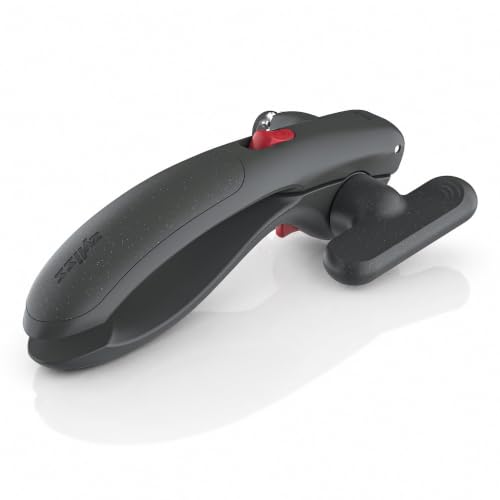
The Zyliss Lock & Lift is also in our main can opener roundup, as its locking pick. It earns a second place here because America’s Test Kitchen described it as “very smooth” to operate, and a knob that turns easily is exactly what stiff fingers need. Zyliss says its lock mechanism secures the wheel onto the can for steady opening and that the knob turns smoothly without straining hands.
ATK’s testers were split on the lock button: some liked not having to squeeze the arms, others found it annoying. ATK also found its magnet for lifting lids not very effective, though Zyliss says the built-in magnet and release lever allow hands-free disposal. If you choose between this and the OXO Lock and Go, the Zyliss has the independent review behind it; the OXO has the softer, larger grip.
The listing does not state care instructions or a warranty. The cutting wheel is stainless steel.
Why we like it
- ATK called it “very smooth” to operate
- Lock holds the wheel on the can, per Zyliss
- Magnet and release lever for the lid
- Opens cans of any size, per the listing
Key specifications
| Model | E930050 |
|---|---|
| Type | Manual locking opener |
| Power | None |
| Cut | Not stated (stainless cutting wheel) |
| Lid removal | Magnet and release lever |
| What your hands do | Lock once, turn the knob |
| Care | Not stated |
| Warranty | Not stated |
Why we recommend it
It suits a cook who wants a manual opener with an easy-turning knob and some independent backing. The lock means you are not holding the arms closed for the whole lid.
Skip it if you rely on the magnet; ATK found it did not lift lids well.
Pros and cons
Pros
- Very smooth turning, per ATK
- Lock removes the constant squeeze
- Compact
Cons
- Lock button divided ATK’s testers
- Magnet not effective, per ATK
- Care and warranty not stated
7. Swing-A-Way Easy-Crank Can Opener – A Longer Crank for More Leverage
Some cooks with sore hands find a crank easier than a knob, because a long handle lets the wrist and forearm do the turning instead of the fingers. Swing-A-Way’s Easy-Crank has an extra-long crank handle that, in the listing’s words, gives a better grip and helps take the strain and pain from your hands; the listing also says the crank folds down for storage. The arms carry soft cushioned grips.
The listing describes an all-steel opener with a high-carbon cutting wheel that glides across the can top, cuts skip-proof and includes a bottle opener. It is a conventional opener, so you still squeeze the arms to hold it on the can, and the listing does not say whether it leaves smooth edges. America’s Test Kitchen recommended Swing-A-Way’s smaller Portable opener for comfort and ease, but found its edges sharp and a bit jagged; it did not review the Easy-Crank.
Swing-A-Way recommends washing it by hand in warm water with a mild detergent and drying it straight away, which protects the steel.
Why we like it
- Extra-long crank handle for leverage, per the listing
- Soft cushioned grips on the arms
- All-steel body with a high-carbon cutting wheel
- Crank folds for storage
Key specifications
| Model | 6080 |
|---|---|
| Type | Manual crank opener |
| Power | None |
| Cut | Not stated |
| Lid removal | By hand |
| What your hands do | Squeeze the arms, turn a long crank |
| Care | Hand wash, dry immediately |
| Warranty | Not stated |
Why we recommend it
It suits someone whose fingers object to small knobs but who can still hold the arms together. A longer lever means less force for each turn.
Skip it if squeezing is the problem; the Bartelli or a powered opener avoids it entirely.
Pros and cons
Pros
- Long crank for leverage
- Steel construction
- Folds flat
Cons
- You still squeeze the arms
- Edges likely sharp; cut not stated
- Lid lifted by hand
8. Zyliss MagiCan Manual Can Opener – Smooth Edges and a Five-Year Guarantee

The MagiCan is a compact handheld opener that Zyliss says leaves smooth edges for safer handling and has a built-in lid-release system, so the lid drops away without your fingers. The soft-grip handle is shaped to work in either hand, which helps if one hand is worse than the other.
Zyliss makes the handle partly from wheat straw, which it says cuts plastic use by up to 20 percent and keeps the opener light. A lighter tool is less tiring to hold up over the edge of a can. Zyliss backs it with a five-year guarantee, the longest on this list according to the listings.
We found no independent review of the MagiCan, and the listing does not explain exactly how it cuts or whether you squeeze to hold it on. Treat it as a light, smooth-edged option rather than a no-grip one.
Why we like it
- Leaves smooth edges, per Zyliss
- Hands-free lid release
- Soft grip for left or right hand
- Five-year Zyliss guarantee
Key specifications
| Model | E930049 |
|---|---|
| Type | Manual handheld opener |
| Power | None |
| Cut | Smooth edges, per maker |
| Lid removal | Built-in lid release |
| What your hands do | Not stated in detail; turn the knob |
| Care | Not stated |
| Warranty | 5-year Zyliss guarantee |
Why we recommend it
It suits a cook who wants a light, small manual opener with smooth edges and a long guarantee, and who still has a moderate grip.
Skip it if you want proven performance; it is new and we found no independent review.
Pros and cons
Pros
- Smooth edges
- Light, ambidextrous handle
- Five-year guarantee
Cons
- No independent review found
- Operation details thin on the listing
How to choose a can opener for sore or weak hands
Start with the motion that hurts, not the brand. A can opener asks your hand for up to four things: a squeeze to hold it on the can, a twist or crank to drive the wheel, a pinch to pick out the lid, and the strength to hold it steady. The right opener removes the ones you find hardest.
1. Decide how much the opener should do for you
If grip strength is the main limit, a powered opener is the simplest answer. America’s Test Kitchen’s can opener guide says outright that for people with arthritis or limited grip or squeeze strength, it recommends an electric can opener. Battery models like the Kitchen Mama sit on the can and drive themselves. Countertop models are faster, but ATK found they all need you to keep pressure on a lever.
2. If you go manual, remove the squeeze
ATK notes that safety openers reduce hand strain because they do not require squeezing the arms. The Bartelli has no arms at all, Kuhn Rikon’s opener locks itself onto the lid, and locking designs from OXO and Zyliss need one squeeze rather than a constant one.
3. Look for smooth edges and a lid you never touch
Side-cutting and no-cut openers leave a lid with a dull edge you can lift with your fingertips. Top-cutting openers leave a sharp lid sitting in the food, which is fiddly to fish out with sore fingers. If you choose a top cutter, look for a magnet or pincers, though ATK found magnets help without removing the risk completely.
4. Bigger knobs, longer handles
Leverage is free strength. A long crank like the Swing-A-Way’s, or a long handle like Kuhn Rikon’s, means less force per turn. Wide, soft knobs are easier for stiff fingers than small hard ones.
5. Think about the cans you actually open
A Mexican pantry ranges from 7-ounce cans of chipotles to 28-ounce cans of tomatoes and big cans of hominy. ATK found the Kitchen Mama steady on narrow 6-ounce cans and the Smooth Touch reliable on cans of every size it tried. Pull-tab cans matter too: ATK pointed out that they are hard for people with diminished hand strength to open, so an opener that handles them, like the Smooth Touch, is worth having.
6. Check safety notices for electric models
We searched the U.S. Consumer Product Safety Commission’s recall database for can openers and for these brands and found no recall of any can opener. Recalls change, so check cpsc.gov/Recalls with your model number if you buy a powered opener.
How we picked these eight openers
We began with the motions that cause trouble for sore hands, then looked at powered openers from Kitchen Mama, Hamilton Beach and Cuisinart and manual safety, locking and crank openers from Bartelli, Kuhn Rikon, OXO, Zyliss, Swing-A-Way, KitchenAid and Starfrit. We kept only openers that were in stock on Amazon when we checked. We left out the KitchenAid Classic Multifunction and Starfrit MightiCan because ATK recommended them only with reservations, the OXO Smooth Edge opener because it showed limited stock, and unbranded openers with no identifiable maker.
Specifications come from the makers’ Amazon listings, which each review cites. We read America’s Test Kitchen’s reviews of manual and electric can openers and quote their findings where we use them. We also checked the Arthritis Foundation’s list of products certified under its Ease of Use program: no can opener appears on it, so none of these picks carries that seal. We have not used these openers for this guide, and we did not rely on Serious Eats or Wirecutter.

Can opener questions for sore hands, answered
What is the best can opener for arthritis?
A hands-free battery opener such as the Kitchen Mama Auto asks the least of your hands: place it and press one button. America’s Test Kitchen recommends an electric opener for anyone with limited grip or squeeze strength. If you would rather not use batteries or a plug, a no-squeeze safety opener like the Bartelli is the manual alternative.
Are electric can openers easier to use with weak hands?
Usually, but not all of them are hands-free. Countertop models need you to hold the lever down for the whole cut, according to ATK. Battery models that sit on top of the can, like the Kitchen Mama, drive themselves once you press the button.
Is any can opener certified by the Arthritis Foundation?
Not that we could find. The Arthritis Foundation lists the products it has certified under its Ease of Use program, and when we checked, the list held no can opener or other kitchen utensil. Several listings describe their openers as suitable for arthritis; that is the maker’s description, not a certification.
Which can openers leave smooth edges?
Side-cutting and no-cut openers: here, the Kitchen Mama, Hamilton Beach Smooth Touch, Bartelli, Kuhn Rikon and, according to Zyliss, the MagiCan. Conventional top-cutting openers leave sharp edges, which ATK noted on many traditional models.
What else helps if opening cans hurts?
Steady the can on a damp towel so it does not spin, open cans before your hands get tired at the end of a cooking session, and keep a jar opener nearby for the salsa jars. For squeezing limes, our guide to the best citrus juicer for arthritic hands covers lever and electric presses. For questions about your own joints, ask your doctor or an occupational therapist.
Our pick for opening cans without the strain
Choose the Kitchen Mama Auto if you want an opener that does everything after one button, and the Hamilton Beach Smooth Touch if you open many cans and can manage a lever. Choose the Bartelli or Kuhn Rikon if you want a manual opener with no squeezing and no sharp lids, and the Swing-A-Way Easy-Crank if leverage helps more than anything else. For every kind of opener, including the restaurant-style clamp models, see our main can opener guide, and for what to do with those cans of chiles and tomatoes, read about enchilada sauces.
And on the days when no can is worth the effort, see the menu or call to order.