
Start with the awkward truth: the classic gin martini is usually stirred, not shaken. The International Bartenders Association’s recipe for the Dry Martini says to pour the gin and vermouth into a mixing glass with ice and “stir well”, and Difford’s Guide notes that current bartending convention is for martinis to be stirred. Shaking makes the drink colder and more diluted, Difford’s explains, with a softer texture, but the air it whips in also leaves the martini looking cloudy.
Plenty of martini-style drinks are shaken, though, and some people simply like a shaken martini. The IBA’s own recipes for the Vesper and the Espresso Martini both call for a shaker, and the Mexican martini that Texas bars made famous is shaken with lime and orange liqueur. So this guide covers the shakers that suit martinis best, cobblers and Parisian shakers that pour a fine, clean stream, tins for two drinks at once, and two mixing glasses for anyone who wants to stir the classic properly.
Julia’s earns a commission on purchases made through links on this page, at no cost to you. Recommendations are based on what a working kitchen and bar look for in bar tools, the makers’ own specifications and published reviews and buyer reports, which we cite.
Quick verdict: which martini shaker to buy
For most home bars, the best martini shaker is the Cocktail Kingdom Usagi heavyweight cobbler: a 500 ml, one-drink shaker in 18/8 stainless steel with a strainer built into the lid, so a shaken martini pours straight into the glass with nothing else to buy. If you want a shaker made in Japan, the Nagao Tsubamesanjo 500 ml cobbler is SUS304 steel from Tsubame City. If you mostly drink classic gin martinis, buy a Cocktail Kingdom Yarai mixing glass as well, because those are stirred.
The rest of this page explains when to shake and when to stir, which shaker style pours best into a martini glass, and who each pick suits. For shakers in general, including the full range of styles, see our main guide to the best cocktail shaker.
Five martini shakers and glasses compared
Our five standout picks, one for each kind of martini drinker, with the specifications each maker or listing states. All nine are reviewed in full below.
| Shaker or glass | Best for | Type & material | Capacity | Buy on Amazon |
|---|---|---|---|---|
| One shaken martini, poured clean | Three-piece cobbler, 18/8 stainless | 500 ml (17 oz), one drink | View on Amazon | |

Nagao Tsubamesanjo Cobbler Shaker, 500 mlMade in Japan
|
A Japanese-made cobbler | Three-piece cobbler, SUS304 (18-8) stainless | 500 ml (16.9 fl oz) | View on Amazon |

Barfly Parisienne Cocktail Shaker, 24 ozBest Parisian
|
Classic shape, no strainer holes to clog | Parisian two-piece, stainless steel | 24 oz (700 ml) | View on Amazon |

Cocktail Kingdom Koriko Weighted Shaking TinsBest for two drinks
|
Two espresso or Mexican martinis at once | Boston tin-on-tin, stainless steel | 18 oz + 28 oz tins, two drinks | View on Amazon |

Cocktail Kingdom Yarai Mixing Glass, 500 mlBest for stirring
|
A classic, stirred gin martini | Mixing glass, glass | 500 ml, one to two drinks | View on Amazon |
Product images from Amazon. Capacities and materials are as stated by each maker, listing or named retailer; check the listing before you buy.
Our picks for the best martini shaker
Seven of these nine are shakers: three cobblers, a large etched cobbler, a Parisian shaker, a set of tins and a glass bottle shaker. The last two are mixing glasses, because for a classic gin martini the honest recommendation is to stir. Each pick explains who it suits and gives one honest reason to skip it.
1. Cocktail Kingdom Usagi Heavyweight Cobbler Shaker, 500 ml – Shakes and Strains in One

A cobbler shaker is the old-fashioned three-piece design: a cup, a lid with a strainer built in, and a small cap. It is the style most people picture when they think of a martini shaker, and for a shaken martini it makes good sense. You build one drink, shake, lift the cap and pour a thin, steady stream through the built-in strainer into a chilled glass.
The Usagi is Cocktail Kingdom’s heavyweight version. The maker gives it a one-drink capacity of 500 ml (17 oz) and says it is 18/8 stainless steel, “made to an exacting standard for easy separation after shaking”. Its distributor Urban Bar describes the steel as extra thick. A martini is a small drink, about 70 ml of liquid in the IBA recipe, so 500 ml leaves generous room for ice to move, which is what chills the drink quickly.
Easy separation matters more on a cobbler than on any other shaker. The lid sits inside the cup, and cold metal contracts around it as you shake, so cheap cobblers can stick fast. A twist rather than a pull usually frees it. The built-in strainer holds back ice cubes but not every small chip; if you want a perfectly clear, chip-free shaken martini, pour through a small fine-mesh strainer as well.
Why we like it
- Built-in strainer: no separate strainer to buy
- 18/8 stainless steel, extra-thick build
- Made for easy separation after shaking, according to the maker
- One-drink size suits a martini
Key specifications
| Model | Usagi Heavyweight Cobbler, mirror finish |
|---|---|
| Type | Cobbler |
| Material | 18/8 stainless steel |
| Capacity | 500 ml (17 oz); one drink |
| Pieces | 3 (cup, strainer lid, cap) |
| Weight | Not stated |
| Dishwasher safe | Not stated |
| Made in | Not stated |
Why we recommend it
Choose it if you make one shaken martini, Vesper or espresso martini at a time and want a single, well-made tool that shakes and strains. It is also a handsome thing to set on the table.
Skip it if you mostly drink classic gin martinis. Those are stirred, and a mixing glass does that job better than any shaker.
Pros and cons
Pros
- Shakes and strains in one tool
- Thick 18/8 stainless steel
- Made to separate easily
Cons
- One drink per shake
- Weight and care not stated in the listing
- Strainer lets small ice chips through
2. Nagao Tsubamesanjo Cobbler Shaker, 500 ml – Made in Tsubame, Japan
Tsubame, in Niigata, is a Japanese metalworking town known for stainless steel tableware, and this 500 ml shaker comes from there. The listing gives the country of origin as Japan, Tsubame City, names Akakawa Utensil as the manufacturer and Nagao as the distributor, and gives the steel as SUS304, the Japanese designation for 18-8 stainless.
The listing is unusually complete. The shaker stands 7.7 inches tall with an outer diameter of 3.3 inches, weighs 350 g, and is made of steel 1.0 mm thick, mirror polished outside. A Japanese buying guide from Mynavi lists it as a three-piece shaker, the larger size in the range. That makes it the same size class as the Usagi, with room for one martini and a full load of ice.
What the listing does not give is care instructions. Treat it as you would any polished stainless shaker: rinse straight after use, wash by hand, and dry before putting the cap back on, so water does not sit in the strainer.
Why we like it
- Made in Tsubame City, Japan, according to the listing
- SUS304 (18-8) stainless steel, 1.0 mm thick
- Full dimensions and weight stated
- Three-piece cobbler with a built-in strainer
Key specifications
| Model | 94031 |
|---|---|
| Type | Cobbler |
| Material | SUS304 (18-8) stainless steel, mirror outside |
| Capacity | 500 ml (16.9 fl oz) |
| Pieces | 3 (per Mynavi) |
| Weight | 350 g |
| Dishwasher safe | Not stated |
| Made in | Japan (Tsubame City) |
Why we recommend it
Choose it if you want a Japanese-made cobbler with every important detail on the label, or a well-made gift for someone who likes shaken martinis.
Skip it if you want care instructions from the maker; the listing gives none, so plan on washing it by hand.
Pros and cons
Pros
- Made in Japan
- 18-8 stainless, weight and size stated
- Built-in strainer
Cons
- Care instructions not stated
- One drink at a time
- Piece count comes from a buying guide, not the listing

3. Viski Two-Toned Heavyweight Cobbler Shaker, 16.5 oz – Thick Walls, Gold and Gunmetal

Viski’s heavyweight shaker is another one-drink cobbler, linked here in its gold and gunmetal black finish. The listing title names martinis and describes a “substantial stainless steel shaker” with 1.35 mm walls, a polished gold-plated cap and a built-in strainer, designed, Viski says, by professionals.
Thick walls are what make a cobbler feel solid in the hand and help it keep its shape, which matters because a cobbler only seals if the lid and cup stay perfectly round. The listing gives the capacity as 16.5 oz, the same size class as the Usagi and Nagao, enough for one martini and plenty of ice.
The listing is less forthcoming on the details that matter after you buy it. It does not give the steel grade, the weight, where it is made or how to wash it, and the warranty field reads “No Warranty”. Hand washing is the safe choice for any plated finish.
Why we like it
- 1.35 mm thick stainless steel walls
- Built-in strainer for a one-tool shaken martini
- Two-tone finish suited to a bar cart
- Viski names martinis in the listing title
Key specifications
| Model | 10295 |
|---|---|
| Type | Cobbler |
| Material | Stainless steel, 1.35 mm walls (grade not stated) |
| Capacity | 16.5 oz |
| Pieces | Cup with built-in strainer and cap (count not stated) |
| Weight | Not stated |
| Dishwasher safe | Not stated |
| Made in | Not stated |
Why we recommend it
Choose it if you want a heavy, two-tone cobbler for display and occasional shaken martinis, and you like Viski’s other barware.
Skip it if you want a maker that states the steel grade and warranty. The Usagi and Nagao listings give more of the facts.
Pros and cons
Pros
- Thick, solid walls
- Built-in strainer
- Two-tone finish for display
Cons
- Steel grade and care not stated
- No warranty, per the listing
- Plated cap needs gentle care
4. Barfly Diamond Lattice Japanese-Style Cobbler, 24 oz – Room for a Bigger Build

Most good cobblers are one-drink shakers. Barfly’s three-piece shaker is larger, at 24 ounces (700 ml), which gives you room for a martini-style drink with more liquid in it, such as an espresso martini with its shot of coffee, or two small martinis if you do not overfill it with ice. Barfly does not state a drink capacity, so treat that as a judgment, not a rating.
Barfly is Mercer Culinary’s bar line. The listing describes the shaker, top and cap as heavy-duty stainless steel, all etched with a diamond lattice pattern, “precision formed for easy separation after shaking”, with an integral strainer “for easy pouring”. The etched pattern is decorative, but a textured surface is also easier to grip than mirror steel once the shaker frosts over.
Care follows the rest of the Barfly range: the maker recommends hand washing with mild soap and warm water, says all its stainless steel products are dishwasher safe, and warns against detergents containing bleach or heavy chlorination.
Why we like it
- 24-ounce capacity, larger than most cobblers
- Integral strainer for pouring without other tools
- Precision formed for easy separation, according to Barfly
- Etched pattern gives a better grip
Key specifications
| Model | M37205 |
|---|---|
| Type | Cobbler (Japanese style) |
| Material | Heavy-duty stainless steel, etched |
| Capacity | 24 oz (700 ml); drink capacity not stated |
| Pieces | 3 (shaker, top, cap) |
| Weight | Not stated |
| Dishwasher safe | Yes; hand washing recommended, no bleach detergents |
| Made in | Not stated |
Why we recommend it
Choose it if you like the cobbler style but want more room, for espresso martinis or a bigger build, and like a textured grip.
Skip it if you only make one classic-size martini at a time; a 500 ml cobbler is lighter and pours the same way.
Pros and cons
Pros
- Larger than most cobblers
- Textured, grippy finish
- Clear care instructions
Cons
- Drink capacity not stated
- Etching takes more care to clean
- Steel grade not stated
5. Barfly Parisienne Cocktail Shaker, 24 oz – Two Pieces, Classic Shape
A Parisian, or French, shaker has the tapered silhouette of a cobbler but only two pieces: a base and a fitted metal top, with no built-in strainer. Bar supplier KaTom describes it as combining the practicality of the Boston shaker with the look of the cobbler. For martinis that is a sensible compromise: it looks like a martini shaker, but there are no small strainer holes to clog and you choose your own strainer.
Barfly’s version holds 24 ounces (700 ml) in heavy-duty stainless steel. The maker says it is “precision formed for easy separation after shaking” and that the oversized top “allows for optimal mixing”, giving the ice room to move. To pour, lift off the top and strain through a Hawthorne strainer; for a crystal-clear martini, hold a fine-mesh strainer under it as well. Our guide to the best cocktail shaker strainer explains the options.
Barfly’s usual care advice applies: hand wash recommended, dishwasher safe, and no detergents with bleach or heavy chlorination.
Why we like it
- Classic tapered shape in two pieces
- No built-in strainer holes to clog
- Precision formed for easy separation, according to Barfly
- Oversized top gives the ice room to move
Key specifications
| Model | M37085 |
|---|---|
| Type | Parisian (French) |
| Material | Heavy-duty stainless steel |
| Capacity | 24 oz (700 ml); drink capacity not stated |
| Pieces | 2 (base and top) |
| Weight | Not stated |
| Dishwasher safe | Yes; hand washing recommended, no bleach detergents |
| Made in | Not stated |
Why we recommend it
Choose it if you want the look of a classic martini shaker with the simplicity of two pieces, and you already own, or will buy, a good strainer.
Skip it if you want to pour straight from the shaker with nothing else to hand; a cobbler has its strainer built in.
Pros and cons
Pros
- Elegant shape, only two parts
- Nothing to clog
- Heavy-duty steel
Cons
- Needs a separate strainer
- Drink capacity not stated
- Hand washing recommended
6. Cocktail Kingdom Koriko Weighted Shaking Tins – Two Martinis in One Shake
If you make martinis for two, or a round of espresso martinis after dinner, a set of tins is faster than any cobbler. Cocktail Kingdom pairs an 18-ounce (532 ml) and a 28-ounce (830 ml) weighted tin and gives the set a two-drink capacity. The maker calls Koriko “the industry-standard shaking tins preferred by professional bartenders”.
Tins have practical advantages for shaken martinis. They hold the most ice, which chills the drink fast, and the seal is tight: Cocktail Kingdom says its quality control gives “a perfect balance between flexibility and rigidity that ensures a tight seal with easy separation”. The large tin also works on its own as a vessel for stirring, if you do not own a mixing glass.
Tins have no strainer, so you need a Hawthorne strainer, and for the clearest martini a fine-mesh strainer too. The listing gives the tins as dishwasher safe. They are not as elegant on the table as a cobbler, which matters if you like to serve a drink with the shaker on the side.
Why we like it
- Two-drink capacity, according to Cocktail Kingdom
- Both tins weighted
- Made to seal tightly and separate easily
- Dishwasher safe, according to the listing
Key specifications
| Model | KORIKO-SHAKER |
|---|---|
| Type | Boston, tin-on-tin |
| Material | Stainless steel (grade not stated) |
| Capacity | 18 oz (532 ml) and 28 oz (830 ml) tins; two drinks |
| Pieces | 2 tins |
| Weight | Not stated (both tins weighted) |
| Dishwasher safe | Yes |
| Made in | Not stated |
Why we recommend it
Choose them if you shake drinks for two or more, make espresso martinis often, or want the tool most bartenders learn on.
Skip them if you want a shaker that pours on its own and looks the part at the table; tins need a strainer and a little practice to seal.
Pros and cons
Pros
- Two drinks per shake
- Most ice, fastest chill
- Dishwasher safe
Cons
- Strainer sold separately
- Small learning curve to seal
- Utilitarian look

7. Godinger Glass Martini Shaker, 19 oz – Screw Top, Made in Italy

Godinger’s shaker is a glass bottle with a screw-on cover and a strainer built into it. The listing calls it a martini shaker, gives a 19-ounce capacity and says it is made in Italy. Godinger, which says it has made giftware since 1973, describes a tight screw-on cover that “ensures no leakage while mixing”.
A screw top has one clear advantage over a pressed-on cobbler lid: it unscrews, so it cannot freeze stuck in the same way. The glass body lets you see the drink as you build it, which helps when you are learning to measure by eye, and it looks at home on a bar cart.
Glass has trade-offs. It conducts cold less readily than thin steel, so a shaken drink may take a few more seconds to chill, and it can break if dropped on a hard floor. The listing does not give care instructions, a weight or a model number from the maker, so treat it as a hand-wash piece.
Why we like it
- Screw-on cover that will not freeze shut
- Built-in strainer
- Glass body shows the drink as you build it
- Made in Italy, according to the listing
Key specifications
| Model | Not stated |
|---|---|
| Type | Glass bottle shaker with screw top |
| Material | Glass body (cover material not stated) |
| Capacity | 19 oz |
| Pieces | Bottle and screw cover with built-in strainer |
| Weight | Not stated |
| Dishwasher safe | Not stated |
| Made in | Italy |
Why we recommend it
Choose it as a gift, for an occasional shaken martini, or if you have struggled with stuck cobbler lids.
Skip it if the shaker will be used hard or outdoors. Glass can break, and steel chills a drink faster.
Pros and cons
Pros
- Leak-resistant screw top
- See-through body
- Made in Italy
Cons
- Glass can break
- Chills more slowly than steel
- Care and weight not stated
8. Cocktail Kingdom Yarai Mixing Glass, 500 ml – For the Stirred Classic
This is not a shaker, and that is the point. The IBA’s Dry Martini is gin and dry vermouth stirred with ice in a mixing glass, then strained into a chilled glass, and Difford’s Guide recommends stirring whenever a generous amount of vermouth is used. If the martini you love is the clear, silky, classic kind, a mixing glass is the tool to buy.
The Yarai is the mixing glass many bars use, with its cross-hatched cut pattern. Cocktail Kingdom’s distributor Urban Bar gives the 500 ml size a one-to-two-drink capacity, measures it at 13 cm tall and 9 cm across, and describes it as dishwasher safe. It fits Julep, Antique, Koriko and Buswell strainers, the distributor says, so you can strain straight into the glass with a Julep or Hawthorne strainer.
Stirring is gentle: about 30 seconds of steady stirring with a long bar spoon chills and dilutes the drink without clouding it. Difford’s suggests keeping the stirring glass in the freezer, which makes the job quicker. The Yarai is heavy and stable, but it is still glass; set it down gently on stone counters.
Why we like it
- The right tool for the stirred, classic martini
- One-to-two-drink capacity
- Fits common Julep and Hawthorne strainers
- Dishwasher safe, according to the distributor
Key specifications
| Model | MXG-YAR500 |
|---|---|
| Type | Mixing glass (for stirring) |
| Material | Glass (type not stated) |
| Capacity | 500 ml (16.9 oz); one to two drinks |
| Pieces | 1 |
| Weight | Not stated |
| Dishwasher safe | Yes (distributor) |
| Made in | Not stated |
Why we recommend it
Choose it if you drink gin or vodka martinis, Manhattans or Negronis, all of which are traditionally stirred. Add a bar spoon and a Julep or Hawthorne strainer.
Skip it if you only make shaken drinks such as the espresso martini or the Mexican martini; it cannot shake.
Pros and cons
Pros
- Makes a clear, classic martini
- Fits standard strainers
- Dishwasher safe
Cons
- Cannot shake
- Needs a bar spoon and strainer
- Glass can chip or break
9. Cocktail Kingdom Sokata Mixing Glass, 675 ml – Plain Glass, Pouring Spout

The Sokata is Cocktail Kingdom’s plainer mixing glass, smooth rather than cut, with a spout for pouring. Retailer Boston General Store describes the design as “crafted for smooth, controlled stirring, with a weighted base and a spout for easy pouring”. This large size holds 675 ml (23 oz), and the listing says it holds one to two drinks.
The extra room is useful for martinis. Stirring works best when the glass is well filled with ice, and a larger glass lets you stir two martinis with a full load of ice without liquid climbing over the rim. The spout means you can pour without a strainer in a pinch, though a Julep or Hawthorne strainer keeps the ice back properly; the listing says it is compatible with Julep, Antique, Koriko and Buswell strainers.
The listing calls it dishwasher safe and suggests pairing it with Cocktail Kingdom’s 30 cm bar spoons for best results. Boston General Store, describing the 500 ml size, recommends hand washing even so.
Why we like it
- 675 ml: room for two stirred martinis and plenty of ice
- Weighted base and pouring spout
- Fits standard strainers, according to the listing
- Dishwasher safe, according to the listing
Key specifications
| Model | MXG-SOK675 |
|---|---|
| Type | Mixing glass (for stirring) |
| Material | Glass (type not stated) |
| Capacity | 675 ml (23 oz); one to two drinks |
| Pieces | 1 |
| Weight | Not stated (weighted base) |
| Dishwasher safe | Yes (hand washing suggested by a retailer) |
| Made in | Not stated |
Why we recommend it
Choose it if you often stir two martinis at once or prefer a plain, easy-to-clean glass with a spout.
Skip it if you only stir one drink at a time and want the classic cut-glass look; the 500 ml Yarai suits that better.
Pros and cons
Pros
- Large capacity for two drinks
- Spout for clean pouring
- Weighted base
Cons
- Cannot shake
- Plain look
- Glass type not stated
How to choose a shaker for martinis
Five questions decide what to buy. The first is the one most guides skip.
1. Will you shake or stir?
Decide which martinis you actually make. The classic gin or vodka martini, made only of spirit and vermouth, is stirred in the IBA recipe and by current bar convention, according to Difford’s Guide, which also points out that a shaken martini was historically ordered by another name, the Bradford. Drinks with juice, coffee, cream or egg are shaken, because they need the force of shaking to mix and aerate. That puts the Espresso Martini, the Vesper (shaken in the IBA recipe) and the Mexican martini on the shaker side. If you make both kinds, a cobbler and a mixing glass together cover everything.
2. Cobbler, Parisian or tins
- Cobbler shakers have a built-in strainer and pour a fine, controlled stream straight into a martini glass. They are the classic martini shaker, usually sized for one drink, and the lid can stick when cold.
- Parisian shakers have the cobbler’s shape in two pieces and need a separate strainer. Nothing to clog, and you choose how finely to strain.
- Boston tins hold the most and shake two drinks at once. They need a strainer and a little practice, as our guide to shakers for margaritas explains in more detail.
3. A fine pour and fine straining
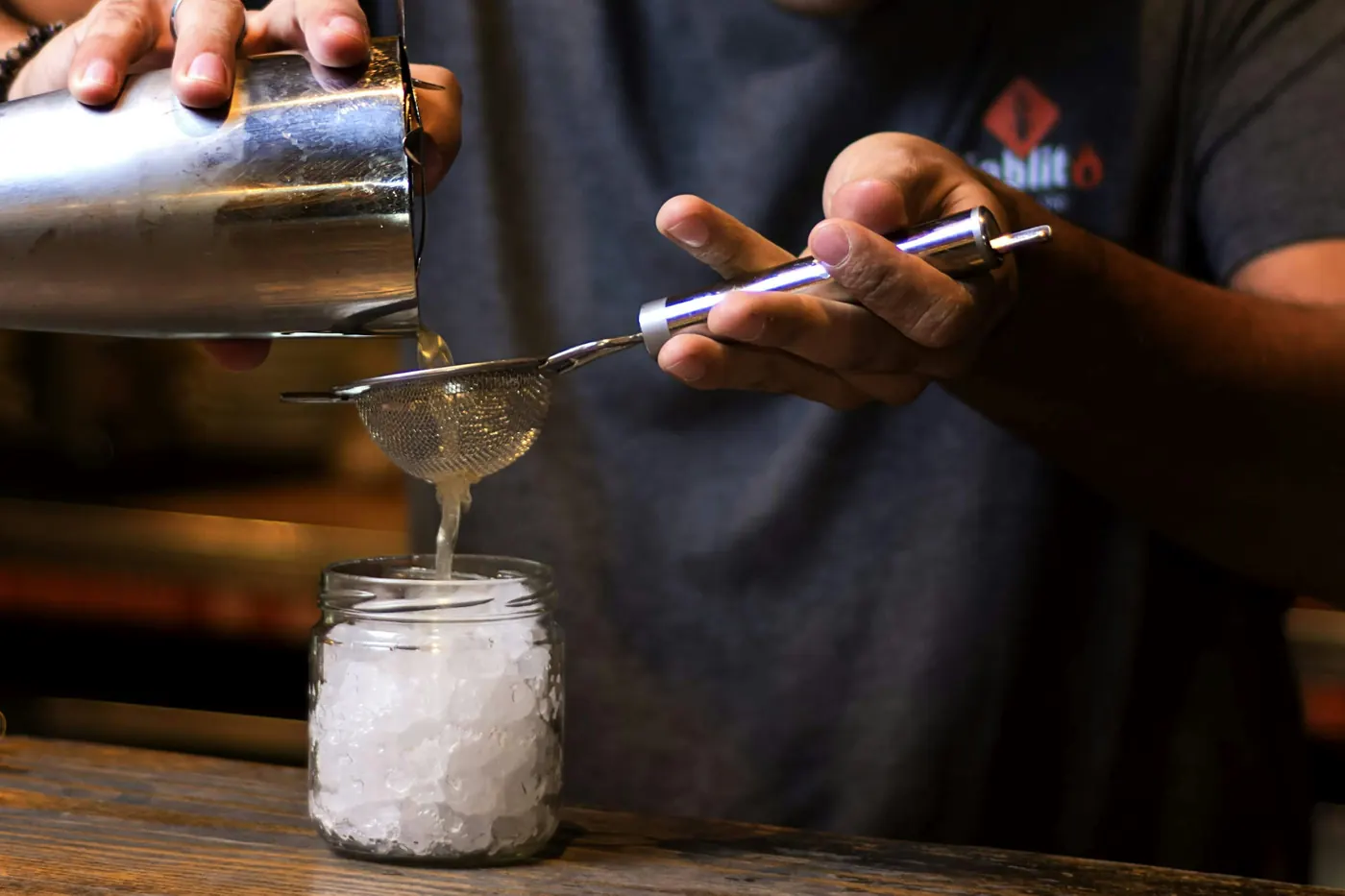
A martini is served “up”, without ice, so any chips of ice that escape the shaker float on top and melt into the drink. Difford’s Guide’s recipe for a very dry martini calls for fine-straining into the chilled glass, even though that drink is stirred. With a cobbler, the built-in strainer catches the cubes; hold a small fine-mesh strainer under the spout if you want the drink perfectly clear. With tins or a Parisian shaker, use a Hawthorne strainer with a fine-mesh strainer below it, a technique called double straining.
4. Capacity
The IBA Dry Martini is 60 ml of gin and 10 ml of dry vermouth, only 70 ml (under 2.5 ounces) of liquid. Even an espresso martini, with vodka, coffee liqueur, sugar syrup and a shot of espresso, is a small drink. A 500 ml cobbler is plenty for one, with room for the ice to move. For two drinks at once, choose a 24-ounce shaker or a set of tins, and for stirring two martinis, a mixing glass of 600 ml or more.
5. Material and finish
Stainless steel chills fastest and lasts. Where makers state the grade it is 18/8 (also written 18-8 or SUS304), about 18 percent chromium and 8 percent nickel. Thicker steel, like the Usagi’s or Viski’s 1.35 mm walls, helps a cobbler keep its shape so the lid keeps sealing. Glass looks lovely and lets you watch the drink, but chills more slowly and can break. For a mixing glass, glass is the norm because you are stirring, not shaking.
How we chose these martini tools
We began with the drinks. The IBA’s published recipes told us which martinis are stirred and which are shaken, and Difford’s Guide’s history of the martini explained why bartenders prefer to stir the classic. From there we looked for shakers suited to martini-style drinks: cobblers and Parisian shakers that pour cleanly into a stemmed glass, a larger cobbler and a set of tins for two drinks, and mixing glasses for the stirred classic. We considered only identifiable makers sold on Amazon in the United States, including Cocktail Kingdom, Nagao, Viski, Barfly and Godinger, and confirmed each one’s material, capacity and care on its Amazon listing, noting where a detail came from a distributor, a retailer or a buying guide instead. Every pick was in stock when we checked; several Japanese cobblers, including most Yukiwa listings, and OXO’s steel shaker were out of stock or nearly so and were left out. We have not used these products ourselves; where we describe how one performs, we say whose description it is.
How to make a shaken or a stirred martini
- Chill the glass. Put a martini glass or coupe in the freezer, or fill it with ice and water while you mix.
- Measure. Use a jigger. For a classic martini, the IBA uses 60 ml of gin and 10 ml of dry vermouth; adjust the vermouth to taste.
- Stir or shake. To stir, fill a mixing glass with ice, add the gin and vermouth and stir steadily with a bar spoon for about 30 seconds. To shake, fill the shaker two-thirds with ice, seal it and shake hard for about 10 to 15 seconds.
- Strain. Empty the ice water from the glass. Strain the drink in, through a fine-mesh strainer if you shook it.
- Garnish. The IBA’s garnish is oil squeezed from a lemon peel, or green olives if requested.

The Mexican martini, a Texas favorite, follows the shaken route. Punch traces it to Austin’s Cedar Door bar in the 1980s, though the local Tex-Mex chain Trudy’s also claims it: tequila, orange liqueur, lime juice and a splash of olive brine, shaken and served up with olives, with the shaker on the side so guests can top up their glass. That is where a good-looking cobbler earns its place on the table. Our guide to tequila types explains which tequila suits it.
Martini shaker questions, answered
Should a martini be shaken or stirred?
A classic martini of gin or vodka and vermouth is traditionally stirred: the IBA’s Dry Martini recipe says to stir in a mixing glass, and Difford’s Guide says current bartending convention is to stir. Shaking makes it colder, more diluted and cloudy. Martini-style drinks with coffee or citrus, such as the espresso martini and the Mexican martini, are shaken. Either way, it is your drink; make it how you like it.
What kind of shaker is best for martinis?
A heavyweight cobbler, such as the Cocktail Kingdom Usagi or the Nagao, for shaken martinis one at a time: it pours a fine stream through its own strainer. For two drinks at once, a set of tins with a Hawthorne strainer. For the stirred classic, a mixing glass.
What does Wirecutter recommend for a martini shaker?
Wirecutter, the New York Times product-review site, publishes and updates a guide to cocktail shakers. We are not affiliated with it, and we could not confirm its current picks when we wrote this, so we have not repeated them here; read its guide directly for its latest recommendations. Our picks are based on the makers’ specifications and the sources cited on this page.
How long should you shake or stir a martini?
Shake hard for about 10 to 15 seconds, until the outside of a metal shaker frosts. Stir for about 30 seconds in a mixing glass full of ice. Both chill the drink and add a little water from the melting ice, which is part of how a martini should taste.
Do I need a strainer for a martini?
With a cobbler, the strainer is built in. With tins, a Parisian shaker or a mixing glass, use a Hawthorne or Julep strainer. Because a martini is served without ice, many bartenders also pour through a small fine-mesh strainer to catch ice chips.
How strong is a martini?
The IBA Dry Martini uses 60 ml of gin, about 2 fluid ounces, and the vermouth adds more alcohol. That is more than one U.S. standard drink, which the National Institute on Alcohol Abuse and Alcoholism defines as 1.5 fluid ounces of 40% spirit. Measure with a jigger, drink responsibly, and never drink and drive.
Our martini shaker pick, in short
Buy the Cocktail Kingdom Usagi cobbler if you shake martini-style drinks one at a time, the Nagao if you want a cobbler made in Japan, and the Koriko tins if you shake for two. If the martini you love is the classic gin and vermouth, add a Yarai mixing glass and stir it. For every shaker style, not just those suited to martinis, see the best cocktail shaker; for complete kits, our guide to the best cocktail shaker set; and for the strainer that finishes the pour, the best cocktail shaker strainer.
And if you would rather someone else made the drinks tonight, see our drinks and the menu, or call to order.