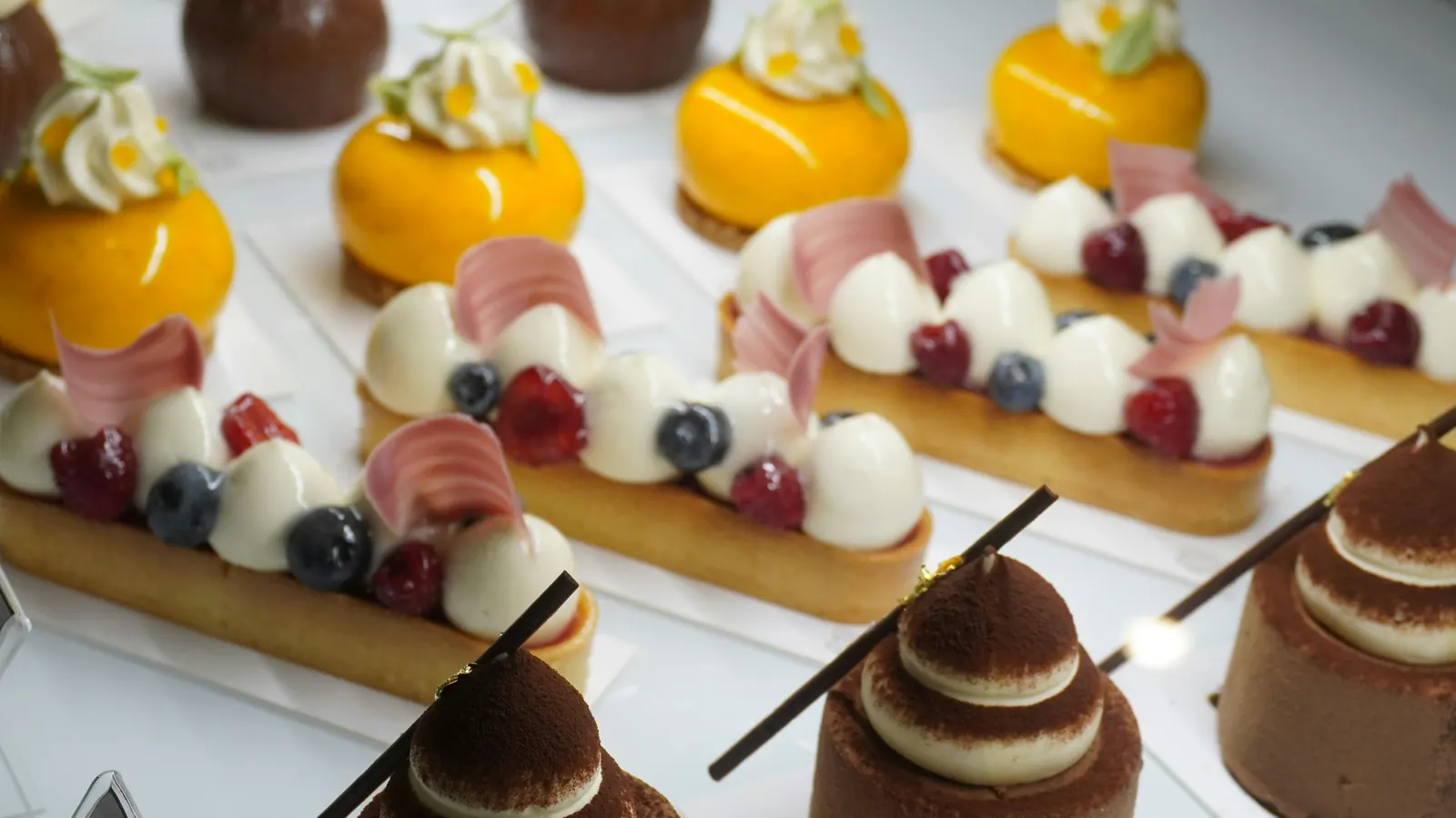
Pastry is the part of baking where technique shows most. Butter has to stay cold, dough has to rest and a cream can turn in seconds. You can’t taste your way out of a mistake, so a good pastry book has to teach you what to watch for. It’s more demanding than a general baking book, and that is why it earns its own shelf.
This guide covers eight books by named authors and schools, mostly in the French tradition, plus a London bakery book and a book on laminated dough. They all differ from the titles on our general baking cookbook guide. Four have a Publishers Weekly review that we read, and each pick says what it rests on.
Julia’s earns a commission on purchases made through links on this page, at no cost to you. Recommendations are based on what a restaurant kitchen looks for in a book, publisher and listing information, and the published reviews we name. We have not cooked from these books ourselves.
Quick verdict: the best pastry cookbook for most home bakers
For most serious home bakers, start with The Art of French Pastry by Jacquy Pfeiffer, a 2014 James Beard award winner that explains the reason behind each step. For a full course from a school, choose Ferrandi’s French Patisserie. If you only want croissants and puff pastry, choose Pastry Temple.
Five pastry books side by side
Five of the eight, one for each kind of baker. All eight are described below.
| Book | Best for | Focus | Evidence | Buy on Amazon |
|---|---|---|---|---|

The Art of French Pastry, Jacquy PfeifferBest overall
|
Learning why steps work | Classic French pastry | James Beard; Publishers Weekly | View on Amazon |

French Patisserie, FERRANDI ParisBest full course
|
A full course | French, basic to advanced | Publisher; named blog review | View on Amazon |

Le Cordon Bleu Pastry SchoolBest step-by-step
|
Planning by difficulty | Illustrated French recipes | Publishers Weekly | View on Amazon |

The Violet Bakery Cookbook, Claire PtakBest relaxed style
|
Relaxed baking | Scones, tarts, galettes | Publishers Weekly | View on Amazon |

Pastry Temple, Christina WoodBest for laminated dough
|
Croissants and puff pastry | Three foundational doughs | Publisher description | View on Amazon |
Our picks for the best pastry cookbook
1. The Art of French Pastry, Jacquy Pfeiffer – A Teacher Explains the Why
This book won the James Beard Foundation’s 2014 award for Baking and Dessert, and Publishers Weekly’s October 2013 review explains why a home baker might care. It calls the book thorough and user friendly, says it explains the reasoning behind each step and notes that “Diagrams are precise and leave no doubt as to the proper approach.”
The review covers basics such as pastry cream and brioche, classics such as éclairs, croissants and tart doughs, plus cookies, cakes, ice creams and Alsatian specialties. Pastry is a skill where small errors show up late, so a book that explains the reason for a step will save you more failed batches than one with prettier pictures. Jacquy Pfeiffer wrote it with Martha Rose Shulman. That teaching focus is why it is our first choice.
Why we like it
- 2014 James Beard award for Baking and Dessert
- Reasoning behind each step, per Publishers Weekly
- Photos and diagrams of technique, per the review
Key specifications
| Author | Jacquy Pfeiffer with Martha Rose Shulman |
|---|---|
| Publisher | Knopf |
| Format | Hardcover |
| Published | 2013 |
| Pages | 432 |
| Style | Classic French |
| Skill level | Committed home baker (our reading) |
Why we recommend it
It suits a home baker ready to learn French pastry properly and who wants a teacher on the page.
Skip it if you want quick sweets for tonight. Everything here rewards patience.
Pros and cons
Pros
- Award winner
- Named review praises its clarity
- Covers the core French doughs and creams
Cons
- Time-consuming subject
- Published in 2013
2. French Patisserie, FERRANDI Paris – A Culinary School Between Two Covers
FERRANDI Paris is a French culinary school, and this 656-page book is its pastry course. The publisher says it runs from croissants and paper-thin mille-feuille to yule logs and Paris-Brest, moving from basic technique to Michelin-level desserts, with guidance on equipping a kitchen.
Anna Gibson of the Inviting History blog, who says she has little baking experience, reviewed it in 2018 from a publisher’s copy. She reports three levels for each recipe, from the traditional version to a chef’s advanced take, and recommends it for aspiring pros and for home cooks because of the clear Level 1 recipes. She also says her own attempt at religieuses was somewhat unsuccessful, though she did not blame the instructions.
Why we like it
- 656 pages, per the listing
- Three levels per recipe, per a named review
- Written by a culinary school
Key specifications
| Author | FERRANDI Paris |
|---|---|
| Publisher | Flammarion |
| Format | Hardcover |
| Published | 2017 |
| Pages | 656 |
| Style | Classic to modern French |
| Skill level | Beginner to advanced, in levels (review) |
Why we recommend it
It suits an ambitious baker who wants one large book to grow into over many years.
Skip it if you want a small book to keep by the mixer. This is a very large book.
Pros and cons
Pros
- Most complete book here
- Levels let you start simple
- Large number of illustrations, per the review
Cons
- Large format at 656 pages
- Reviewer is a blogger, not a pastry cook
3. Le Cordon Bleu Pastry School – 100 Recipes With Illustrated Steps
Publishers Weekly reviewed this in November 2018 and calls it a comprehensive collection of 85 confections and 15 foundational French pastry preparations. It reports illustrated steps, time and difficulty ratings, storage guidance and separate ingredient and equipment lists for each recipe.
Those ratings help when you are deciding what you can finish by Saturday. The review names easier recipes such as mango jellies and chocolate fondants, and harder ones such as the chocolate tonka bean and berry prestige, and calls the book a strong option for home bakers at any skill level. The title says 101 recipes, while the review counts 85 plus 15, so don’t take either figure too literally.
Why we like it
- Named Publishers Weekly review
- Time and difficulty ratings, per the review
- Storage guidance, per the review
Key specifications
| Author | Le Cordon Bleu |
|---|---|
| Publisher | Grub Street Cookery |
| Format | Hardcover |
| Published | 2018 |
| Pages | 521 |
| Style | French classic and modern |
| Skill level | All levels (review) |
Why we recommend it
It suits a home baker who likes knowing how hard and how long before starting.
Skip it if you want the author’s personal voice. This is a school book.
Pros and cons
Pros
- Clear difficulty ratings
- Each recipe illustrated
- Well-known school
Cons
- British publisher, so check measures in the copy you get
- Less personal than Pfeiffer’s book
4. Patisserie at Home, Melanie Dupuis and Anne Cazor – 100 Recipes With Illustrations

The publisher presents this as a French pastry book for home bakers, with 100 easy-to-master recipes and full-color illustrations. It teaches the basics and the tools needed for more elaborate desserts. Melanie Dupuis is a pastry chef and Anne Cazor is a molecular gastronomist, which suggests a focus on why things work.
At 288 pages it is the friendly-sized alternative to the two school books above. The easy-to-master claim belongs to the publisher, and we have no review to check it against, since Publishers Weekly shows none. It is a reasonable first French pastry book if the larger volumes look like too much.
Why we like it
- 100 recipes, per the publisher
- Illustrated technique, per the publisher
- A pastry chef and a scientist as authors
Key specifications
| Author | Melanie Dupuis, Anne Cazor |
|---|---|
| Publisher | Harper |
| Format | Hardcover |
| Published | 2016 |
| Pages | 288 |
| Style | French |
| Skill level | Home baker (publisher) |
Why we recommend it
It suits a home baker who wants French pastry in a manageable size.
Skip it if you want a deep reference, since the larger books go further.
Pros and cons
Pros
- Friendly size
- Science-minded pairing
- Trade publisher
Cons
- Rests on the publisher and listing
- Less depth than the school books
5. Bouchon Bakery, Thomas Keller and Sebastien Rouxel – A Restaurant Group’s Bakery Book

Publishers Weekly’s August 2012 review says this book is for cooks who want to take baking to the next level. It praises the clear, precise recipes and the sections on technique and equipment, and it warns that the book may not suit anyone looking for fast, simple baking.
That warning is the buying advice. The book comes from Thomas Keller and Sebastien Rouxel, and the review stresses its precision. By its title it is a bakery book more than a strict pastry book, so it sits at the edge of this page. It works best for a cook who already has the basics.
Why we like it
- Named Publishers Weekly review
- Technique and equipment sections, per the review
- From Thomas Keller and Sebastien Rouxel
Key specifications
| Author | Thomas Keller, Sebastien Rouxel |
|---|---|
| Publisher | Artisan |
| Format | Hardcover |
| Published | 2012 |
| Pages | 400 |
| Style | Restaurant bakery |
| Skill level | Experienced home baker (review) |
Why we recommend it
It suits an experienced baker who enjoys exact instructions and restaurant standards.
Skip it if you want fast or simple baking, as the review itself warns.
Pros and cons
Pros
- Precise recipes, per the review
- Strong technique section
- Well-known lead author
Cons
- Not for fast baking, per the review
- A bakery book more than a pure pastry book
6. Dominique Ansel: The Secret Recipes, Dominique Ansel – Recipes and Stories From the Cronut Creator

Dominique Ansel is a James Beard Award-winning pastry chef, classically trained in Paris, and the creator of the Cronut, according to the overview. The publisher describes a book that combines 30 new recipes with memoir and the stories behind his most sought-after creations.
Read it for the thinking. Thirty recipes is a small count compared with the school books, so this is not a reference. It is a look at how a working pastry chef builds an idea. The overview names the book as new recipes and stories, and we did not read a trade review for it.
Why we like it
- 30 recipes, per the publisher
- A chef’s memoir alongside the recipes
- Trained in Paris, per the overview
Key specifications
| Author | Dominique Ansel |
|---|---|
| Publisher | Simon & Schuster |
| Format | Hardcover |
| Published | 2014 |
| Pages | 272 |
| Style | Modern pastry |
| Skill level | Experienced home baker (our reading) |
Why we recommend it
It suits a baker who wants inspiration and a pastry chef’s story as much as instruction.
Skip it if you want a complete course in technique. The Art of French Pastry is the better teacher.
Pros and cons
Pros
- Personal and readable
- A famous chef’s process
- Trade publisher
Cons
- Small recipe count
- No named review read
7. The Violet Bakery Cookbook, Claire Ptak – A London Bakery, Morning to Evening
Publishers Weekly’s July 2015 review calls this a “stellar collection” from the owner of Violet in London, with a foreword by Alice Waters, for whom Ptak previously worked at Chez Panisse. It reports three sections, Morning, Midday and Evening, with recipes from scones and savory toasties to tarts and an apple galette.
The review also praises the full-page color photos and the author’s down-to-earth tone. That makes it the warm counterweight to the French school books: this is a neighborhood bakery’s cooking and not a lesson in lamination. If your idea of pastry is a galette on the counter, start here.
Why we like it
- Named Publishers Weekly review
- Down-to-earth tone, per the review
- Sweet and savory, by time of day
Key specifications
| Author | Claire Ptak, foreword by Alice Waters |
|---|---|
| Publisher | Ten Speed Press |
| Format | Hardcover |
| Published | 2015 |
| Pages | 272 |
| Style | Bakery |
| Skill level | Home baker (our reading) |
Why we recommend it
It suits a relaxed baker who wants scones, tarts and galettes and little fuss.
Skip it if you want classic French technique. This is a different tradition.
Pros and cons
Pros
- Warm and approachable, per the review
- Strong photography, per the review
- Savory recipes included
Cons
- Not French pastry
- Less technique than the school books
8. Pastry Temple, Christina Wood – Brioche, Puff Pastry and Croissant
This book teaches three foundational doughs, brioche, puff pastry and croissant, which the publisher calls the Three Pillars of Pastry. It has more than 30 sweet and savory recipes developed by the Temple Pastries bakery. Christina Wood, the author, is described as self-taught.
That narrow focus is what makes it useful. Many home bakers really want one thing, to make a good croissant, and a focused book may suit them better than 650 pages on everything. The publisher also reports a 2026 Pubwest design award, which speaks to the look of the book and not to its recipes. We read no review.
Why we like it
- Three doughs, taught in depth, per the publisher
- More than 30 recipes, per the publisher
- Written by a self-taught baker, per the overview
Key specifications
| Author | Christina Wood |
|---|---|
| Publisher | Sasquatch Books |
| Format | Hardcover |
| Published | 2025 |
| Pages | 208 |
| Style | Laminated and enriched dough |
| Skill level | Home baker (publisher) |
Why we recommend it
It suits a home baker who wants to master croissants and puff pastry in particular.
Skip it if you want cakes, creams and plated desserts. This book stays with its three doughs.
Pros and cons
Pros
- Tight focus
- Sweet and savory
- Recent book
Cons
- Small recipe count
- Rests on the publisher and listing
How to choose a pastry book for your kitchen
Choose a tradition. French pastry is its own discipline, with creams and laminated doughs at its heart. A bakery book such as Violet sounds looser, judging by its review’s down-to-earth description. Know which you want before you buy.
Look for visual teaching. Pastry is about textures and shapes that are hard to describe. Publishers Weekly calls out the diagrams in Pfeiffer and the illustrated steps in Le Cordon Bleu for this reason.
Check for difficulty guidance. Le Cordon Bleu rates its recipes, and Ferrandi offers levels, per a named review. Those signals stop you from starting a two-day project on a Friday night.
Think about book size. A 656-page school book is a reference for a stand and a counter, while a focused book is easier to live with. Both can be right.
Check your tools too. Pastry brushes, cutters and pastry wheels matter here. Our pastry brush guide and pastry wheel guide cover two of them.
How we picked these eight pastry books
We searched Amazon’s Books index for pastry and French pastry titles, then kept those in stock as new copies from named authors or schools at established publishers. Rose Levy Beranbaum and Joanne Chang have books on our baking page, so we left those out here. The Baking Bible’s lead offer came from a third-party seller, and Laduree Sucré came only from third-party sellers, so neither made the list.
We have not baked from these books. We read Publishers Weekly on four picks, the James Beard list for Pfeiffer’s award and one named blog review of Ferrandi, and Publishers Weekly showed no review for the others we checked. Recipe counts come from titles, publishers or reviews. A search for further reviews returned mostly retail and reader pages, so we did not rely on those.
French pastry book questions, answered
What is the best French pastry book for a beginner?
Patisserie at Home is the friendliest in size, by its publisher’s description. Le Cordon Bleu Pastry School is also described by Publishers Weekly as suiting bakers at any skill level, and Ferrandi’s Level 1 recipes were recommended to beginners by the blogger we read.
Which book is best for croissants?
Pastry Temple focuses on croissant, brioche and puff pastry. The Art of French Pastry and Ferrandi’s book also cover croissants, per their reviews and publisher.
Are these books too professional for home cooks?
Some lean that way. Bouchon Bakery is precise, per Publishers Weekly, and may not suit fast baking. The Violet Bakery Cookbook is the most relaxed book here, by its review’s account.
Do I need special equipment?
Expect to want a scale, and possibly more. Pfeiffer’s and Keller’s books address equipment or technique in detail, and Ferrandi’s includes guidance on equipping a kitchen, per the publisher.
Our final pick for learning pastry at home
Start with The Art of French Pastry if you want a real teacher, and add Pastry Temple if croissants are the goal. For sweets outside pastry, our dessert cookbook guide and pie cookbook guide have more.
And if you would rather have someone else handle dinner while the dough rests, Julia’s is at 5402 N Highway 6 in Houston. Call to order at (346) 546-8283.