Most Pyrex shoppers have already made up their minds about the brand. The harder question is which Pyrex, since the name covers press-on storage, locking storage, deep bakeware, plain dishes, measuring cups and mixing bowls, and they don’t all do the same things. A locking Freshlock box, for one, doesn’t belong in the oven.
There’s also a real issue under the name. The Pyrex sold in US kitchens today isn’t the glass many people remember, and that changes how you should treat it. We explain what we read about that, then say which piece suits which job.
Julia’s earns a commission on purchases made through links on this page, at no cost to you. We have not used these products ourselves. Recommendations rest on maker details and on the published reviews we read and name below.
Quick verdict: which Pyrex to buy for what
For leftovers, buy the Pyrex Simply Store 12-Pack; it’s simple and has no gaskets to clean. For food that travels, the Freshlock 7-Pack locks but can’t go in the oven. For baking, the Deep 3-Pack gives you the most room. Treat all of it as tempered glass that doesn’t like sudden temperature changes. If thermal shock is what worries you most, look at a borosilicate maker such as OXO instead.
Five Pyrex picks side by side
These five cover the main jobs. Sizes and limits come from each listing, except where we name a reviewer.
| Product | Best for | Size | Lid and oven | Buy on Amazon |
|---|---|---|---|---|

Pyrex Simply Store 12-Pack Glass Storage SetBest overall
|
Everyday leftovers | 1 to 4 cups | Press-on lid | View on Amazon |

Pyrex Freshlock 7-Pack Glass Storage SetBest for locking lids
|
Lunches that travel | 1 to 4 cups | Locking lid | View on Amazon |
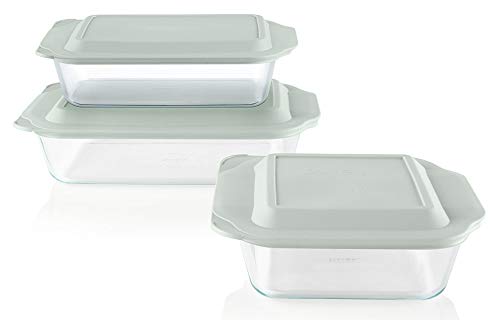
Pyrex Deep 3-Pack Glass Baking Dish SetBest bakeware
|
Enchiladas and casseroles | 9×13, 7×11, 8×8 | Preheated oven only | View on Amazon |
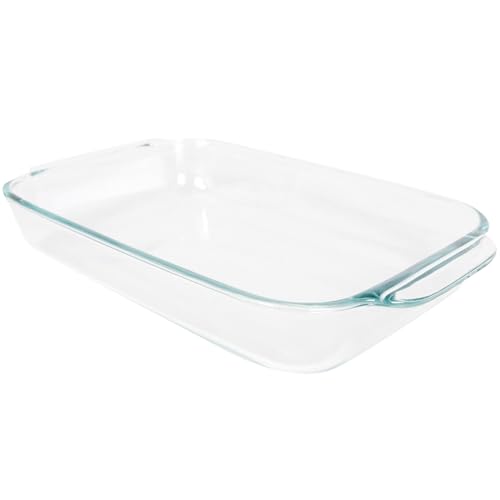
Pyrex 2-Quart Oblong Baking DishBest single dish
|
One small dish | 11 x 7 in | Preheated oven only | View on Amazon |

Pyrex Colors Tinted 3-Piece Mixing BowlsBest bowls
|
Prep bowls | 1.3 to 4.5 qt | No lid | View on Amazon |
Our picks for the best pyrex glass
1. Pyrex Simply Store 12-Pack Glass Storage Set – The Plain Set Most Homes Want
If you’ve settled on Pyrex for leftovers, this is the set we’d start with. You get three each of the 1-cup, 2-cup and 4-cup rounds, plus three 3-cup rectangles, so a pot of frijoles, a cup of salsa and tomorrow’s lunch all have a home. The listing describes high-quality tempered glass with a snug plastic lid.
Snug is the word to notice. These lids press on; they don’t lock. The listing makes no leakproof claim for this line, so keep it in the fridge and don’t send soup to work in it. For that job, look at the Freshlock set below or a Rubbermaid Brilliance.
We didn’t find an independent test of this exact line, so this pick rests on the listing and on what the set is built to do. What it has going for it is simplicity: no gaskets to dig clean and no latches to break. America’s Test Kitchen’s complaints about Pyrex’s locking set were about exactly those parts. That reasoning is ours, not a test result.
Why we like it
- Four useful sizes, three of each
- No gasket channel to clean
- Lids are freezer, microwave and top-rack dishwasher safe, per the listing
- Glass resists stains and odors, per the listing
Key specifications
| Model | 1136614 |
|---|---|
| Material | Tempered glass, plastic lids |
| Size | 1, 2, 3 and 4 cup |
| Count | 12 containers with lids |
| Oven | Not stated on this listing; keep lids out |
| Other safe uses | Freezer, microwave, top-rack dishwasher |
| Warranty on listing | Not stated |
| Best job | Fridge and freezer leftovers |
Why we recommend it
It suits a household that stores most leftovers in the fridge and wants plenty of containers without gaskets to look after.
Skip it if you carry food in a bag. A press-on lid isn’t built for that.
Pros and cons
Pros
- Wide run of small sizes
- Simple to clean
- Rounds nest neatly
Cons
- Not leakproof by design
- Glass is heavy for lunches
- No independent test found for this line
- Nothing here holds a big batch
2. Pyrex Simply Store 11-Cup Glass Container – Room for a Whole Batch

The sets stop at small sizes, and that’s where a cook runs out of room. The 11-cup rectangle takes the rest of a pot of pozole or a full batch of rice. It’s the same simple idea as the set above, with a snug BPA-free lid.
The listing is short and gives little beyond size and lid. A full container this size is heavy in glass, so use two hands, and let hot food cool before you press the lid on and move it to the fridge. Keep it away from sudden temperature changes, as the safety section below explains.
Why we like it
- Holds a full batch
- Rectangle sits well on a fridge shelf
- Same lid style as the rest of the line
Key specifications
| Model | 1149488 |
|---|---|
| Material | Glass, plastic lid |
| Size | 11 cups |
| Count | 1 container with lid |
| Oven | Not stated on this listing; keep lid out |
| Other safe uses | Not stated on this listing |
| Warranty on listing | Not stated |
| Best job | Big-batch leftovers |
Why we recommend it
It suits anyone who cooks a big pot on Sunday and eats from it through the week.
Skip it if your fridge shelves are short or you find heavy glass awkward. A big plastic Brilliance is far lighter.
Pros and cons
Pros
- Big capacity
- See-through sides
- One simple part
Cons
- Heavy when full
- Thin listing details
- Single container only
3. Pyrex Freshlock 7-Pack Glass Storage Set – Locking Lids, With Caveats
This is the Pyrex line for food that travels. The listing calls the locking lids airtight and leakproof, and each lid has a write-and-erase label. The set covers 1-cup, 2-cup and 4-cup sizes in rounds and squares.
America’s Test Kitchen tested a larger Freshlock set and did find a leakproof seal. It still rated the line Recommended with Reservations: gaskets developed significant odors, the narrow lid channel was hard to clean, the latches were stiff and clunky, and the mixed shapes took up more storage. It was also the only glass set in that test that wasn’t ovensafe.
That last point matters most. Don’t plan to bake or roast in Freshlock, whatever you do with other Pyrex. It’s for storing and for reheating in the microwave.
Why we like it
- Leakproof seal, per America’s Test Kitchen
- Write-and-erase labels on the lids
- Useful small sizes
Key specifications
| Model | 1149252 |
|---|---|
| Material | Glass, locking plastic lids |
| Size | 1, 2 and 4 cup |
| Count | 7 containers with lids |
| Oven | Not ovensafe, per America’s Test Kitchen |
| Other safe uses | Microwave, per the listing |
| Warranty on listing | Not stated |
| Best job | Food that travels |
Why we recommend it
It suits someone who wants Pyrex’s glass and needs lids that lock for the trip to work.
Skip it if you want a glass container you can also bake in. America’s Test Kitchen’s winner, Rubbermaid Brilliance glass, goes in the oven to 450°F.
Pros and cons
Pros
- Sealed well in a published test
- Lids carry their own labels
- Good lunch sizes
Cons
- Gaskets held odors, per America’s Test Kitchen
- Lid channels are hard to clean
- Stiff latches
- Not for the oven
4. Pyrex Deep 3-Pack Glass Baking Dish Set – Three Deep Pans With Lids
This set gets you a 9×13 at 3 inches deep, plus a 7×11 and an 8×8 at 2.75 inches deep, each with a BPA-free lid. Pyrex says the line is up to 50 percent deeper than its Basics dishes, which gives enchiladas, migas casserole or a saucy chicken more room before they bubble over.
The lids are for the fridge, freezer and microwave, not the oven. The listing says the glass is safe in a preheated oven, in a microwave and in a freezer. Read that word preheated carefully, and read our safety section before moving this dish from cold to hot.
We’ve kept single Deep dishes off this page because they sit on our other baking guides. Buying the three together makes sense only if you’d really use all three sizes.
Why we like it
- Up to 50 percent deeper than Basics, per Pyrex
- Lids make it a storage dish as well
- Three sizes in one box
Key specifications
| Model | 1135014 |
|---|---|
| Material | Glass, plastic lids |
| Size | 9x13x3, 7x11x2.75, 8x8x2.75 in |
| Count | 3 dishes with lids |
| Oven | Preheated oven; lids out |
| Other safe uses | Freezer, microwave, dishwasher; lids top rack |
| Warranty on listing | Not stated |
| Best job | Casseroles and enchiladas |
Why we recommend it
It suits a family that bakes casseroles often and likes to store leftovers in the same dish.
Skip it if you broil the top of your enchiladas. Glass shouldn’t go under a broiler, so choose metal or enameled iron for that.
Pros and cons
Pros
- Depth stops spillover
- Bake, store and serve in one dish
- Lids included
Cons
- Not for a broiler or stovetop
- Heavy when full
- Three dishes need cabinet room
5. Pyrex 2-Quart Oblong Baking Dish – The Plain 11×7 Dish
If you only need one dish, this is the plain one: 11 by 7 inches and 1.5 inches deep, with no lid. It’s the right size for a small pan of enchiladas, a batch of brownies or roasted vegetables for two or three people. The shallow sides should brown food better than the Deep line, though that’s our reasoning rather than a test.
It’s sold by AMCAN rather than by Amazon, and the listing’s model fields don’t quite match (6001011 and 6001012), so check what arrives. The listing gives a two-year limited warranty on ovenware and calls it made in the USA. We rest this pick on those listing details alone.
Why we like it
- Simple shape, easy to clean
- Two-year warranty, per the listing
- Made in the USA, per the listing
Key specifications
| Model | 6001012, part 6001011 |
|---|---|
| Material | Glass, no lid |
| Size | 11 x 7 x 1.5 in, 2 qt per the title |
| Count | 1 dish |
| Oven | Preheated oven; never a broiler |
| Other safe uses | Not stated on this listing |
| Warranty on listing | Two-year limited, per the listing |
| Best job | Small casseroles |
Why we recommend it
It suits a cook for two or three who wants one honest dish and doesn’t need a lid.
Skip it if you want to store food in it. There’s no lid, and foil gets old fast.
Pros and cons
Pros
- Useful small size
- Nothing to wear out
- Serves at the table too
Cons
- Third-party seller
- No lid
- Listing model fields conflict
6. Pyrex 9-Inch Glass Pie Plate – See the Bottom Crust Brown

The value of a clear pie plate is that you can lift it and see whether the bottom crust is done. This 9-inch plate is listed for fruit pies, savory pies, quiches and cheesecakes, and it’s dishwasher safe. No lid comes with it. It’s also a good fit for a flan-style custard or an empanada-dough tart.
The seller is Plero, and the listing warns that the color of the glass may vary. Other pie dishes are on our baking dishes guide, so read that page if you prefer a taller rim. Let the oven preheat fully, and set the hot plate on a dry towel or rack, never a wet counter.
Why we like it
- Clear glass shows the crust
- Listed for sweet and savory pies
- Dishwasher safe, per the listing
Key specifications
| Model | 209 |
|---|---|
| Material | Clear glass, no lid |
| Size | 9 in |
| Count | 1 plate |
| Oven | Not stated on this listing; preheat fully |
| Other safe uses | Dishwasher |
| Warranty on listing | Not stated |
| Best job | Pies and quiche |
Why we recommend it
It suits an occasional pie baker who likes to see how the crust is browning.
Skip it if you want a very crisp bottom crust every week. In our judgment, a metal pan is the better tool for that.
Pros and cons
Pros
- Simple single piece
- Shows browning
- Easy to wash
Cons
- Third-party seller
- Glass tint may vary
- No lid for storing leftovers
7. Pyrex Essentials 2-Pack Glass Measuring Cups – The Small Cups for Small Jobs

A 1-cup and a 2-cup, with bold marks in ounces and milliliters, a curved spout and a grip handle. These are the sizes that see the most work: a cup of stock for rice, or melted butter for a batch of pan de elote. The listing says tempered glass that’s safe in the dishwasher, freezer, microwave and a preheated oven.
The Pyrex 3-pack and the 4-cup are on our other guides, so this pair is for the kitchen that doesn’t need a big one. A liquid measuring cup is where glass makes real sense, though the warning holds here too: don’t pour boiling liquid into a cup straight from the freezer, or cold water into one straight from the microwave. For more options, see our liquid measuring cups guide.
Why we like it
- Marks in ounces and milliliters
- Curved spout
- Microwave safe, per the listing
Key specifications
| Model | 1149092 |
|---|---|
| Material | Tempered glass, per the listing |
| Size | 1 and 2 cup |
| Count | 2 cups |
| Oven | Preheated oven, per the listing |
| Other safe uses | Dishwasher, freezer, microwave |
| Warranty on listing | Not stated |
| Best job | Measuring and melting |
Why we recommend it
It suits anyone who wants a small, sturdy measuring pair they can also microwave.
Skip it if you often measure more than 2 cups, or you need to read marks without bending down. Angled cups exist for that.
Pros and cons
Pros
- Easy to read
- Pours well
- Doesn’t hold odors, per the listing
Cons
- No large size
- Glass can break if dropped
- Marks must be read from the side
8. Pyrex Colors Tinted 3-Piece Mixing Bowls – Nesting Bowls in Tinted Glass
These are 1.3-quart, 2.3-quart and 4.5-quart bowls in tinted glass, and they nest. This is the one same-model listing on this page: the lidded version of this set is on another of our mixing bowl guides, and we list the unlidded one because many cooks don’t need lids on prep bowls. The title says no lids, even though parts of the listing’s feature text talk about lids, so buy it expecting none.
The listing calls it tempered glass, made in the USA. Tinted glass doesn’t change the rules: same care with temperature changes. Use them for masa, guacamole for a crowd, or marinating. See the glass mixing bowls guide for other makers.
Why we like it
- Three nesting sizes
- Tempered glass, per the listing
- Made in the USA, per the listing
Key specifications
| Model | 1149499, part 1149547 |
|---|---|
| Material | Tinted tempered glass |
| Size | 1.3, 2.3 and 4.5 qt |
| Count | 3 bowls, no lids |
| Oven | Not stated on this listing |
| Other safe uses | Not stated for the bowls |
| Warranty on listing | Not stated |
| Best job | Prep and mixing |
Why we recommend it
It suits a cook who wants a color on the counter and three sizes that stack away.
Skip it if you want lids for marinating in the fridge. Buy the lidded set instead.
Pros and cons
Pros
- Good range of sizes
- Stack into one space
- Color helps tell them apart
Cons
- No lids
- Listing text is inconsistent
- Heavier than steel bowls
Where Pyrex falls short, and the soda-lime question
Here’s the part that matters. Pyrex began as Corning’s low-expansion borosilicate glass. According to Iowa State University Extension, World Kitchen moved to tempered soda-lime glass for kitchenware sold in the United States after buying the brand in 1998. Iowa State’s plain summary is that tempered soda-lime glass doesn’t handle heat as well as borosilicate.
The physics is simple. Soda-lime glass expands about three times as much as borosilicate when heated. Tom Kuntzleman, a chemistry educator writing at ChemEd X, works out that borosilicate can take a temperature difference of about 183 K and soda-lime about 54 K. That’s his calculation from textbook values, and it doesn’t account for tempering, so don’t read it as a test of a Pyrex dish.
Tests do exist. Iowa State reports that Consumer Reports found in 2010 that newer Pyrex, moved hot onto a wet granite counter, shattered almost instantly. NBC 5 Chicago ran a similar demonstration in 2019 with glass expert Mark Meshulam: a soda-lime dish exploded on a wet stone slab, and a borosilicate one broke into three pieces. That second dish still broke, which is worth remembering. NBC also counted 850 reports of shattering glass cookware to the CPSC over seven years, across Pyrex and other brands, so that figure isn’t Pyrex alone.
The company’s side, as NBC reported it from Corelle Brands, then Pyrex’s maker: any glass bakeware has a risk of breakage, and Pyrex glassware has an exceptional safety record. We couldn’t open Pyrex’s own FAQ and safety pages for this article because the site refused the connection, so read the paper instructions in the box, which are the ones that count.
The rules we’d follow come from Iowa State: never use glassware on a stovetop or under a broiler, let the oven fully preheat first, don’t go directly from freezer to oven or back, and throw away dishes with chips, cracks or scratches. To that we’d add what the demonstrations show: set a hot dish on a dry towel or rack, not a wet counter, and don’t add cold liquid to a hot dish.
Other limits are simpler. In Prudent Reviews’ tests of food storage, Pyrex Ultimate finished near the bottom because it leaked when shaken and was tricky to close, so it’s not on this page. America’s Test Kitchen preferred Rubbermaid Brilliance for glass storage. If you want a glass box that bakes and seals, compare OXO Smart Seal, which its listing describes as shock-resistant borosilicate, and which Prudent Reviews named best overall. OXO isn’t flawless either: America’s Test Kitchen found its latches stiff.
How to choose among Pyrex lines
Decide if it will travel. Simply Store’s press-on lids are for the fridge. Freshlock locks, but at the cost of gaskets you’ll have to keep clean.
Decide if it will go in the oven. Baking dishes will, when preheated. Freshlock won’t, per America’s Test Kitchen. Plastic lids stay out in all cases.
Buy sizes you’d cook for. Small rounds fill up a cabinet fast. Many homes need one 11-cup or a 9×13 more than they need six more 1-cup rounds.
Watch who sells it. Some classic pieces come from third-party sellers, and their titles, tints and model numbers can vary. Check the seller’s name on the offer before you buy.
Be careful with vintage ideas. Reports of how old Pyrex behaved don’t tell you how a new dish behaves. Treat what you buy now as tempered soda-lime unless the maker says otherwise; none of these listings names the glass type.
How we picked these Pyrex pieces
We haven’t used these pieces ourselves. We counted different lines and jobs, not colors, and we checked every listing through Amazon’s data for current stock and a new offer. Exact listings already on our other guides are out, apart from one stated same-model listing. Where a pick has no named review, it rests on the listing.
For evidence we read Iowa State Extension, Tom Kuntzleman at ChemEd X, NBC 5 Chicago, America’s Test Kitchen and Prudent Reviews. Prudent Reviews earns affiliate fees. A check of the CPSC’s recall database by brand turned up no Pyrex recall under that name, which doesn’t speak to the breakage reports above.
Pyrex glass questions, answered
Is Pyrex still borosilicate?
For US kitchenware, Iowa State Extension says Pyrex moved to tempered soda-lime after 1998. None of the listings on this page names the glass type, so we’d assume soda-lime unless the maker’s box says otherwise.
Is soda-lime Pyrex dangerous?
It can break under sudden temperature change, and so can borosilicate if the shock is big enough. Follow the rules above. Corelle Brands told NBC that any glass bakeware has a risk of breakage.
Can Pyrex go from the fridge to the oven?
Iowa State warns against going straight from freezer to oven or the reverse. Bring chilled dishes closer to room temperature and preheat the oven fully first; your box’s instructions have the final word.
Can I use Pyrex on the stove or under a broiler?
No. Iowa State says never to use glassware for stovetop cooking or under a broiler.
Can Pyrex storage go in the oven?
Some can, some can’t. America’s Test Kitchen found Freshlock wasn’t ovensafe. Plastic lids don’t go in the oven. Check your line’s listing before you try it.
Our final pick for Pyrex glass
Related guide: Pyrex vs anchor hocking.
Start with the Simply Store 12-Pack if your need is leftovers, and add the Deep 3-Pack if you bake. Keep the temperature rules in mind and these will do what they’re meant to do. For other makers, see our guides to glass food storage containers and glass baking dishes.