Pyrex and Anchor Hocking are the two names most American kitchens reach for when a recipe says “a 9 by 13 glass dish.” They sit side by side on store shelves, both are made in the United States according to their listings, and from across the room their dishes look nearly the same. So the question is fair: is one actually better, or are you choosing between two labels on the same glass?
Mostly the second, and that’s useful to know before you pay extra for a name. This guide compares the two brands on the glass itself, oven limits, care rules, lids, warranty and range, using each maker’s own instructions where we could read them, then names one dish from each side.
Julia’s earns a commission on purchases made through links on this page, at no cost to you. Recommendations are based on what a restaurant kitchen looks for, product specifications and verified buyer reports.
Quick verdict: Pyrex or Anchor Hocking?
For most home cooks it doesn’t matter much. Both brands’ American bakeware is tempered soda-lime glass, according to Iowa State University Extension, so they bake and break in much the same way. Buy whichever has the size, shape and lid you want. Lean to Anchor Hocking if you want a written 425°F limit and a stated five-year replacement warranty on the listing. Lean to Pyrex if you want the wider range of lines and lids. If you want glass that takes sudden temperature changes better, neither is the answer; look at borosilicate instead.
The table sums up what we could confirm; the sections after it explain each line.
Pyrex vs Anchor Hocking, side by side
| Pyrex (US) | Anchor Hocking | |
|---|---|---|
| Glass in US bakeware | Tempered soda-lime (Iowa State Extension) | Tempered soda-lime (Iowa State Extension) |
| Origins | Corning, 1915 (Iowa State) | Ohio, 1905 (Anchor Hocking listing) |
| Stated oven limit | Not stated on the listings we read | 425°F, preheated oven (Anchor Hocking care page) |
| Stovetop, broiler | No (Iowa State’s rule for all glassware) | No, and no toaster oven (Anchor Hocking) |
| Made in | USA (listings) | USA (listings) |
| Warranty | Not stated on the listing we picked | Five years, replacement if used as instructed (listing) |
| Lids | Plastic lids sold with or for many dishes | TrueFit, TrueSeal and locking plastic lids on many dishes |
The glass: the same kind on both sides
This is the part most comparisons get wrong. Pyrex began in 1915 as Corning’s low-expansion borosilicate glass, the kind used in laboratories. According to Iowa State University Extension, Corning sold the name in 1998, and the kitchenware sold in the United States has since been made from tempered soda-lime glass. The same Iowa State page says Anchor Hocking products are also made from tempered soda-lime glass.
So in a home oven, a current American Pyrex dish and an Anchor Hocking dish are made of the same kind of glass. Iowa State’s summary of that glass applies to both: tempered soda-lime doesn’t handle heat as well as borosilicate, but it holds up better when knocked or dropped. Tasting Table’s 2026 comparison by Allie Sivak reaches the same conclusion, that both brands now use soda-lime and are very similar for baking.
Two footnotes are worth knowing. Pyrex sold in Europe is a separate licence, and Iowa State says it is borosilicate, marked with an uppercase PYREX in an oval. And older American Pyrex marked in uppercase letters may be the original borosilicate. If you find a vintage dish in a thrift store, the logo on the underside tells you which glass you have.
Heat limits and what each maker says
Anchor Hocking is the more explicit of the two. Its care page says to use its glass bakeware in preheated gas or electric ovens, conventional or convection, up to 425°F. It also rules out any flame or direct heat source, naming the stovetop, the broiler and the toaster oven. That last one catches people out, because a countertop oven looks like a small version of the big one, but its elements sit close to the dish.
We couldn’t read Pyrex’s own US care pages; the site refused our connection each of the three times we tried. Pyrex’s product copy on its Amazon listings, sold by Amazon.com, says its tempered glass can go from room temperature into a preheated oven, and the listing for our Pyrex pick says it is durable as long as sudden changes in temperature are avoided. Neither listing we used states a top temperature, so we won’t give one. Read the leaflet in the box, which is the instruction that counts.
Iowa State’s rules for glass bakeware cover both brands and match Anchor Hocking’s. Never use glass on the stovetop or under the broiler. Let the oven preheat fully before the dish goes in. Don’t move a dish straight from the freezer to the oven. Cover the bottom of the dish with liquid before cooking meat or vegetables that will release juices, and never add cold liquid to a hot dish.
Breakage: a shared risk, not a brand problem
Glass bakeware that shatters is the worry behind most searches for this pair. Iowa State reports that Consumer Reports found in 2010 that newer US glass bakeware, moved from a hot oven to a wet granite counter, shattered almost instantly. Because both brands use the same type of glass, that risk is not something you escape by choosing one over the other.
The protection is in how you handle it, and the two sources agree. Anchor Hocking says to avoid sudden or severe temperature changes, handle hot dishes with a dry cloth or potholder, and never set a hot dish on a wet or cold surface. Iowa State adds: put hot glass on a dry towel or potholder, not on metal or the counter, and throw away any dish with chips, cracks or scratches, because damaged glass is weaker. The simplest habit is to lay a dry towel or a rack out before you open the oven, so the hot dish has somewhere safe to land.
Lids, shapes and range
Here the brands do differ, though it’s a matter of catalogue rather than quality. Pyrex has the bigger lineup in stores, including the Basics, Deep, Easy Grab and tinted Colors lines, and Tasting Table notes its sculpted and tinted styles. Anchor Hocking’s range is smaller but covers the same everyday shapes: 8-inch squares, 9 by 13 rectangles, loaf dishes and pie plates, many with TrueFit or locking plastic lids, plus deep dishes and embossed or studded-border pieces, according to Tasting Table.
For lids, check the exact pairing. Pyrex sells many dishes with a matching numbered lid, and the listings warn that a lid fits only its own dish. Anchor Hocking’s lids are for storage and the microwave only: its care page says the plastic covers are not for the oven, stovetop, broiler or toaster oven, and should not be microwaved for more than 60 seconds at a time. Pyrex lids are plastic too, so treat them the same way and keep them out of the oven.
Warranty and where they’re made
The Anchor Hocking listing we picked promises a five-year warranty: the company says it will replace chipped, cracked or broken glass bakeware used according to its instructions. The Pyrex listing we picked states no warranty, and we couldn’t reach Pyrex’s site to check its terms, so that line stays “not stated” rather than a guess.
Both picks are listed as made in the USA. Anchor Hocking’s listing says it started in Ohio in 1905 and still makes its glass bakeware in America. Anchor Hocking’s FAQ also says its products are free of lead, cadmium and heavy metals and comply with California’s Proposition 65. Plain clear glass has no glaze, so lead is less of a question here than with glazed ceramic, but it is good to see the maker say so.
Cleaning and everyday use
On care the two behave the same. Both picks are dishwasher safe according to their listings, and glass doesn’t stain or hold onto smells the way some plastics do. Baked-on cheese from enchiladas comes off more easily after a soak in warm water than with scraping, and you should skip metal scouring pads, since scratches are a reason to retire a dish. Anchor Hocking asks you to wash new food storage glass and lids before first use.
Glass also lets you see the bottom browning, which is handy for a pan of rice or a fruit crisp. For browning and crisp edges on cakes and bars, a metal pan usually does better; our glass vs metal baking pan comparison explains why, and our ceramic vs glass baking dish page covers the stoneware option.
Choose Pyrex if… / Choose Anchor Hocking if…
Choose Pyrex if…
- You want a particular line, color or deep dish that only Pyrex makes.
- You’re matching dishes or lids you already own.
- You want the brand that is easiest to find in most stores.
Choose Anchor Hocking if…
- You want the oven limit and care rules written plainly by the maker.
- A stated five-year replacement warranty matters to you.
- You want a lidded 8-inch dish that bakes, covers and stores.
Choose neither if…
- You often go from fridge or freezer straight into the oven. Borosilicate dishes tolerate that better; our best glass baking dish guide includes several.
Our pick on each side of the Pyrex vs Anchor Hocking question
One plain dish per brand, both in stock when we checked. The Pyrex is the standard 9 by 13; the Anchor Hocking is an 8-inch square with a lid. Each model also appears on one other page of ours in a different listing: the Pyrex Basics 3-quart is in our best baking dishes guide with a red lid, and this is the bare dish for cooks who don’t need one. The Anchor Hocking 8-inch is the square companion to the lidded 3-quart in our best baking dish with lid guide. For the full Pyrex lineup, see our best Pyrex glass guide.
1. Pyrex Basics 3-Quart 9 x 13-inch Glass Baking Dish – The Classic Casserole Size
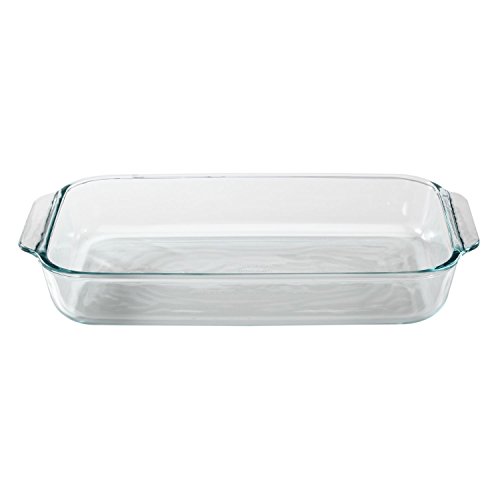
This is the dish most recipes mean by “a 9 by 13.” The listing gives the size as 8.9 by 13.2 inches and the capacity as 3 quarts, with no lid in the box. That is the size for a family pan of enchiladas, a tray of chilaquiles baked for a crowd, or a sheet of tres leches cake.
The listing says the glass is nonporous, won’t stain or absorb odors, and is safe for the oven, microwave, freezer and dishwasher, and that it is made in the USA. It adds a fair warning in its own words: the dish is durable as long as sudden changes in temperature are avoided. As American Pyrex, it is tempered soda-lime glass according to Iowa State Extension.
The listing states no maximum temperature and no warranty, and Pyrex’s own site refused our connection, so follow the instructions packed with the dish. Keep it off the stovetop and out from under the broiler, set it on a dry towel or rack when it comes out, and add liquid before it heats, not after.
Why we like it
- The standard 3-quart, 9 x 13-inch size (listing)
- Oven, microwave, freezer and dishwasher safe (listing)
- Made in the USA (listing)
- Nonporous glass that won’t hold odors (listing)
Key specifications
| Model | 1105397 |
|---|---|
| Material | Pyrex glass; tempered soda-lime (Iowa State) |
| Size | 8.9 x 13.2 inches |
| Capacity | 3 quarts |
| Lid | None |
| Max oven temp (stated) | Not stated |
| Care | Dishwasher safe |
| Made in | USA |
Why we recommend it
It suits a cook who wants one plain, full-size glass dish for casseroles and sheet cakes and already has foil or a sheet pan to cover it.
Skip it if you want a lid for leftovers or a warranty in writing; the Anchor Hocking below has both. This listing is sold by a third-party seller, so check the seller before you buy.
Pros and cons
Pros
- Standard recipe size
- Freezer, microwave and oven safe
- Made in the USA
Cons
- No lid
- No top temperature or warranty on the listing
- Sold by a third-party seller
2. Anchor Hocking 8-inch Square Glass Baking Dish with Red Lid – Bake, Cover and Store

This is the everyday 8-inch square, the size for brownies, cornbread, a small pan of baked rice or a half batch of enchiladas. It comes with a red plastic lid, so the leftovers go straight into the fridge in the dish they baked in. The listing title calls it a TrueFit lid and the description calls it TrueSeal; either way, it is a press-on storage lid.
The listing says the glass is tempered to resist chipping and handle oven heat up to 425°F, which matches Anchor Hocking’s care page, and that the dish is safe in the microwave, fridge, freezer, dishwasher and preheated oven. Anchor Hocking says it will replace any chipped, cracked or broken glass bakeware used according to its instructions, under a five-year warranty, and that the dish is made in the USA. The lead offer was from a third-party seller when we last checked, so check the seller before you buy.
The lid is the part to watch. Anchor Hocking’s care page says plastic covers are not for the oven, stovetop, broiler or toaster oven, and should be microwaved for no more than 60 seconds when reheating. Take it off before the dish goes in the oven, and don’t move the dish from freezer to oven without thawing first.
Why we like it
- Stated limit of 425°F in a preheated oven (maker)
- Five-year replacement warranty (listing)
- Lid included for storage
- Made in the USA (listing)
Key specifications
| Model | 91816ECOM |
|---|---|
| Material | Tempered glass; soda-lime (Iowa State) |
| Size | 8-inch square |
| Capacity | Not stated |
| Lid | Red plastic storage lid, not for the oven |
| Max oven temp (stated) | 425°F |
| Care | Dishwasher safe |
| Made in | USA |
Why we recommend it
It suits a small household or a baker who wants one square dish that goes from oven to fridge with its own lid, with clear maker rules and a warranty.
Skip it if you cook for a crowd; an 8-inch square is too small for a family casserole, so pair it with a 9 by 13.
Pros and cons
Pros
- Clear maker temperature limit
- Five-year warranty
- Lid for leftovers
Cons
- Capacity not stated
- Lid must come off for the oven
- Too small for big batches
Pyrex and Anchor Hocking questions, answered
Is Anchor Hocking as good as Pyrex?
For baking, yes. Iowa State Extension says both brands’ American bakeware is tempered soda-lime glass, so they heat and break in much the same way. The real differences are the range of shapes, the lids and the warranty terms.
Is Pyrex still borosilicate?
Not in the United States. Iowa State says American Pyrex kitchenware has been tempered soda-lime glass since the brand changed hands in 1998. Pyrex sold in Europe is borosilicate under a separate licence.
Which glass bakeware brand handles temperature changes best?
Neither of these two. Borosilicate glass handles sudden changes better than soda-lime, according to Iowa State, though no glass dish should go on a wet counter or from freezer to hot oven. Our best glass baking dish guide lists borosilicate options.
Can Pyrex or Anchor Hocking go under the broiler?
No. Anchor Hocking rules out the broiler, the stovetop and the toaster oven, and Iowa State’s rules for all glass bakeware say never to use glass under a broiler or on the stove.
Can the plastic lids go in the oven?
No. Anchor Hocking’s care page says its plastic covers are not for the oven. Treat Pyrex’s plastic lids the same way and use them for storage and short microwave reheats only.
Which glass dish goes in your cupboard
Buy on the dish, not the name. If you need a 9 by 13 and the Pyrex is the one you can get, it will bake exactly as well as the Anchor Hocking would. If you want an oven limit and a warranty in writing, and a lid in the box, the Anchor Hocking is the slightly better buy. Whichever you choose, the care routine matters more than the brand. And on nights when nobody wants to bake, see our menu or call to order.