Most glass baking dishes look alike on the shelf: clear, rectangular, two handles. The difference is in the glass itself. Some makers use tempered soda-lime glass, some use borosilicate, one on this page uses white opal glass, and each one writes its own rules about heat, cold and the freezer. Those rules decide whether a pan of enchiladas can go from the fridge into a hot oven, or whether it needs to sit on the counter first.
Our main baking dish guide compares glass, ceramic and metal side by side. This page stays with glass and sorts it by brand and by glass type, with each maker’s care rules quoted as the maker gives them. None of the seven dishes below is a pick on the main guide or on our lasagna, brownie, lidded dish or pie dish pages; where we chose a brand that appears on those pages, the review says which product it is and why we picked a different one.
Julia’s earns a commission on purchases made through links on this page, at no cost to you. Recommendations are based on what a restaurant kitchen looks for, product specifications and verified buyer reports.
Quick verdict: which glass baking dish to buy
For most kitchens, the Anchor Hocking 2-piece set (2-quart and 3-quart) is the one to buy: tempered glass made in the USA, the two sizes a household uses most, and a five-year limited warranty on the listing. If you want borosilicate glass, which handles sudden temperature changes better, choose the Simax 2.6-quart roaster, rated from -40°F to 572°F. For big batches in borosilicate, the Ôcuisine rectangle and square set is made in France and rated to 662°F.
The reviews below give each dish’s glass type, temperature range and care rules, and one honest reason to skip it.
Five glass baking dishes compared
Five standout dishes, one for each kind of cook, with the specifications each maker or listing states. All seven dishes are reviewed in full below.
| Baking dish | Best for | Glass & size | Stated oven range | Buy on Amazon |
|---|---|---|---|---|

Anchor Hocking Glass Baking Dishes, 2-Piece SetBest overall
|
Everyday casseroles, two sizes | Tempered glass, 2 qt and 3 qt | Preheated oven, to 425°F (maker FAQ) | View on Amazon |

Simax 2.6-quart Rectangular Glass RoasterBest borosilicate
|
Fridge to oven, covered bakes | Borosilicate, 2.6 qt | -40°F to 572°F | View on Amazon |

Ôcuisine Borosilicate Rectangle and Square Dish Set with LidsBest for big batches
|
Large trays, high heat | Borosilicate, 5.2 qt and 2.4 qt | -40°F to 662°F (dishes only) | View on Amazon |

Pyrex Deep 7 x 11-inch Glass Baking Dish with LidBest for small households
|
Deep bakes for two to four | Glass (type not stated), 7 x 11 x 2.75 in | Preheated oven; no maximum given | View on Amazon |

Libbey Baker’s Basics 5-Piece Glass Bakeware SetBest starter set
|
A first kitchen | Glass (type not stated), 9 x 13, 8 x 8 and more | Oven safe; no maximum given | View on Amazon |
Product images from Amazon. Temperature ranges are as stated by each maker or listing. Plastic lids never go in the oven, whatever the dish is rated for.
Soda-lime or borosilicate: what the glass type means
Glass bakeware sold in the US today comes in two main types, and the maker usually tells you which one you are buying.
Tempered soda-lime glass is what Anchor Hocking makes, and what most American-market Pyrex dishes have been made of for decades. Anchor Hocking explains on its own site that tempering “more than double[s] the mechanical strength” compared with annealed borosilicate, so the dish is harder to break by knocking it. It also says that when tempered glass does break, it “breaks into relatively small pieces” that generally lack sharp shards. The trade-off is heat: soda-lime glass expands more as it heats, so it is more sensitive to sudden temperature changes. That is why Pyrex and Anchor Hocking both tell you not to move their glass straight from the freezer to a hot oven.
Borosilicate glass expands much less with heat. The Museum of Glass in Tacoma describes it as “hard glass” with a low expansion coefficient that resists thermal shock, while soda-lime has a higher coefficient and is more susceptible to it. Simax and Ôcuisine sell their dishes on that point, with stated ranges from -40°F up to 572°F and 662°F. Borosilicate is not unbreakable, though: it can still crack under a fast or uneven temperature change, and it is less resistant to knocks. Pyrex’s own FAQ puts the trade-off plainly: soda-lime resists impact breakage slightly better, borosilicate handles extreme temperature changes slightly better.
Opal glass, the white glass Luminarc calls “culinary opal”, is a tempered glass too. It looks like ceramic but behaves like glass, and Luminarc rates it to 250°C (482°F).
If a listing does not say which glass it is, as with the Pyrex and Libbey dishes below, treat it as you would tempered soda-lime glass and follow the maker’s care rules to the letter.
Our picks for the best baking dish glass
These seven dishes cover tempered, borosilicate and opal glass, from a single 8-inch square to a 5.2-quart roaster, and from one dish to a five-piece kitchen starter set. Each review names the glass type where the maker states it, the temperature range, and the care rules that come with it.
1. Anchor Hocking Glass Baking Dishes, 2-Piece Set – Two Sizes, Made in the USA
This set is the plainest way to get Anchor Hocking’s tempered glass in the two sizes most households use: one 2-quart and one 3-quart baking dish, both clear. The 3-quart takes a full tray of enchiladas or a pan of chilaquiles for the family; the 2-quart handles rice, a side of calabacitas or a half batch. According to the listing, both are microwave, preheated oven, refrigerator, freezer and dishwasher safe, the glass is made in the USA, and the set carries a limited five-year warranty.
Anchor Hocking’s FAQ gives a maximum oven temperature of 425°F for its tempered glass. Its care guidance says to keep the glass off the stovetop, out from under the broiler and away from toaster ovens and grills; not to add liquid to a hot dish; not to set hot glass on a wet or cold surface; and to thaw frozen food before it goes into a preheated oven. For foods that release liquid, add enough liquid to cover the bottom of the dish before baking.
Our main baking dish guide picks Anchor Hocking’s 3-quart dish sold with a lid and an insulated carrier. This is a different product: two bare dishes for the price-conscious cook who bakes more than they carry. The listing also mentions BPA-free plastic lids, but its “includes” line names only the two dishes, so check the box contents before counting on lids.
Why we like it
- Two of the most useful sizes in one box.
- Made in the USA, per the listing.
- Limited five-year warranty on the listing.
- Tempered glass, which Anchor Hocking says breaks into small pieces rather than large shards.
Key specifications
| Model | 82761OBL11 |
|---|---|
| Glass type | Tempered glass |
| Pieces | 2 dishes |
| Capacity | 2 qt and 3 qt |
| Oven limit | Preheated oven, 425°F (Anchor Hocking FAQ) |
| Lid | Not listed in the contents |
| Made in | USA |
| Care | Dishwasher safe; no stovetop or broiler |
Why we recommend it
It suits most households that want dependable everyday glass in two sizes from a long-standing American maker.
Skip it if you want to go straight from freezer to oven; Anchor Hocking says to thaw first, and a borosilicate dish suits that habit better.
Pros and cons
Pros
- Two everyday sizes.
- Made in the USA.
- Five-year limited warranty.
Cons
- 425°F maximum, lower than the borosilicate picks.
- No freezer-to-oven use.
- Lids unclear from the listing.
2. Simax 2.6-quart Rectangular Glass Roaster – Borosilicate From Freezer Cold to 572°F
Simax makes its glass in the Czech Republic, and this rectangular roaster is borosilicate glass, the type that tolerates sudden temperature changes best. The listing states a range from -40°F to 572°F and says the dish can go into the oven, the fridge and the microwave without shattering from the temperature change. It measures about 12.5 x 9 x 4 inches and holds 2.6 quarts, deep enough for a pan of rajas con crema or a tray of baked chiles rellenos.
It comes with two lids. The glass lid fits tightly for covered baking, and Simax says it doubles as a small roasting pan or serving dish. A plastic lid is included for storage, and the flat top lets you stack dishes in the fridge. The listing says the glass is cadmium and lead free, does not absorb odors or flavors, and is dishwasher safe.
Our lidded dish guide picks a round Simax casserole. This is a different shape, a rectangle for layered bakes and roasting, and the clearest example on this page of what borosilicate glass offers.
Why we like it
- Borosilicate glass, rated -40°F to 572°F.
- A glass lid for covered baking and a plastic lid for storage.
- Made in the Czech Republic, per the listing.
- Four inches deep.
Key specifications
| Model | Not stated |
|---|---|
| Glass type | Borosilicate |
| Pieces | 1 dish, glass lid, plastic lid |
| Capacity | 2.6 qt (about 12.5 x 9 x 4 in) |
| Oven limit | 572°F; rated down to -40°F |
| Lid | Glass (oven) and plastic (storage) |
| Made in | Czech Republic |
| Care | Dishwasher safe |
Why we recommend it
It suits cooks who move dishes between fridge, oven and microwave and want glass that is made for it.
Skip it if you need a full 9 x 13 tray; at 2.6 quarts it is a mid-size dish.
Pros and cons
Pros
- High stated heat limit.
- Bakes covered with its own glass lid.
- Deep sides.
Cons
- Smaller than a standard 9 x 13.
- Borosilicate is less resistant to knocks than tempered glass.
- No model number on the listing.
3. Ôcuisine Borosilicate Rectangle and Square Dish Set with Lids – French Glass for Big Batches
Ôcuisine’s set pairs a large rectangular roaster with a nearly square dish, both borosilicate glass made in France. The listing gives the rectangle as 15.9 x 10.4 x 2.8 inches (5.2 quarts) and the square as 9.8 x 8.7 x 2.8 inches (2.4 quarts). The big dish is wider than a standard 9 x 13, which leaves room for a full family tray of enchiladas verdes or a whole roast chicken with vegetables.
The stated range is the widest on this page, from -40°F to 662°F. The listing also describes the glass as “fully tempered”, in addition to borosilicate. The red lids are for storage only: Ôcuisine says they are not oven, air fryer or microwave safe. Its use instructions say to wash the glass with soap and warm water, avoid abrasive cleansers, and never set a hot dish on a damp surface after it comes out of the oven.
Ôcuisine sells several other sizes and pairings on Amazon, including a square and round set; we chose this one because the large rectangle covers the jobs most cooks buy glass for.
Why we like it
- Widest stated temperature range here, -40°F to 662°F.
- A large 5.2-quart roaster plus a 2.4-quart square.
- Made in France, per the listing.
- Lids for storing leftovers.
Key specifications
| Model | Not stated (part 13426470304808) |
|---|---|
| Glass type | Borosilicate |
| Pieces | 2 dishes, 2 lids |
| Capacity | 5.2 qt (15.9 x 10.4 x 2.8 in) and 2.4 qt (9.8 x 8.7 x 2.8 in) |
| Oven limit | 662°F; rated down to -40°F |
| Lid | Red lids; not oven or microwave safe |
| Made in | France |
| Care | Soap and warm water; no abrasive cleansers |
Why we recommend it
It suits cooks who feed a crowd or batch-cook and want borosilicate glass in a large size.
Skip it if your oven or cabinets are small; the big dish is almost 16 inches long.
Pros and cons
Pros
- Large capacity.
- Very high stated heat limit.
- Storage lids included.
Cons
- Lids stay out of the oven and microwave.
- Dishwasher use not stated.
- Large dish needs a big oven.
4. Pyrex Deep 7 x 11-inch Glass Baking Dish with Lid – Deeper Sides, Smaller Footprint
Pyrex’s Deep line is up to 50% deeper than its Basics dishes, according to the listing, and this 7 x 11-inch size is 2.75 inches deep. The extra depth stops spillovers and holds more food in less counter space, which makes it a good fit for a household of two to four: a pan of tamale pie, a baked pasta, or a half tray of enchiladas with plenty of sauce.
The dish comes with a BPA-free plastic lid that is freezer, microwave and top-rack dishwasher safe. The glass is preheated oven, microwave and freezer safe. The listing does not say which type of glass this dish is; Pyrex’s FAQ says the company produces both soda-lime and borosilicate glass, so we treat this dish as tempered soda-lime and follow Pyrex’s rules. Those say: preheated ovens only, never on the stovetop or under the broiler, no hot glass on a wet or cool surface, no liquid added to a hot dish, and no moving straight from the freezer to a hot oven. Plastic lids never go in a conventional oven.
Our lasagna guide picks the 9 x 13-inch version of this dish. We picked the 7 x 11 here because it is the size the other pages do not cover, for smaller households.
Why we like it
- 2.75 inches deep in a 7 x 11-inch footprint.
- Snug-fitting BPA-free plastic lid for storage.
- Non-porous glass that resists stains and odors, per the listing.
Key specifications
| Model | 1149531 |
|---|---|
| Glass type | Not stated |
| Pieces | 1 dish, 1 lid |
| Capacity | 7 x 11 x 2.75 in (volume not stated) |
| Oven limit | Preheated oven; no maximum given |
| Lid | BPA-free plastic; not for the oven |
| Made in | Not stated |
| Care | Dishwasher safe; lid top rack |
Why we recommend it
It suits small households that want a deep, lidded dish for bakes and leftovers from the best-known glass bakeware brand.
Skip it if you want to know exactly which glass you are buying; Pyrex does not say on this listing.
Pros and cons
Pros
- Deep sides for saucy dishes.
- Lid for the fridge.
- Compact size.
Cons
- Glass type not stated.
- Thaw before baking from frozen.
- Lid is plastic only.
5. Libbey Baker’s Basics 5-Piece Glass Bakeware Set – A Glass Kit for a First Kitchen
Libbey’s Baker’s Basics set covers most baking in one box: a 9 x 13-inch baking dish, an 8 x 8-inch baking dish, a 9.5-inch deep pie plate, a 2-quart mixing bowl and a 2-quart round casserole with a glass cover. That is a casserole dish for enchiladas, a square for cornbread or a tres leches, a pie plate for pay de queso, a bowl and a covered dish for rice or beans.
According to the listing, the pieces are stackable, have handles with the dimensions embossed on them, and are safe in the oven, microwave, freezer and refrigerator, and in the dishwasher. Libbey does not state the glass type or a maximum oven temperature on the listing, so follow the instructions in the box and treat the glass gently with temperature changes.
Our lidded dish guide picks Libbey’s Baker’s Premium set with lids. This Basics set is a different line, chosen here because it equips a whole kitchen with glass at once.
Why we like it
- Five pieces covering casseroles, squares, pie, mixing and covered dishes.
- Glass cover for the round casserole.
- Dimensions embossed on the handles.
- Stackable for storage.
Key specifications
| Model | 56291 |
|---|---|
| Glass type | Not stated |
| Pieces | 5 pieces plus 1 glass cover |
| Capacity | 9 x 13 in, 8 x 8 in, 9.5-in pie plate, 2-qt bowl, 2-qt casserole |
| Oven limit | Oven safe; no maximum given |
| Lid | Glass cover for the casserole |
| Made in | Not stated |
| Care | Dishwasher safe |
Why we recommend it
It suits a first kitchen or anyone replacing mismatched bakeware in one purchase.
Skip it if you already own a pie plate and mixing bowls; a single dish or a two-dish set is better value.
Pros and cons
Pros
- Broad range of shapes.
- Covered casserole included.
- Stacks to save space.
Cons
- No stated oven temperature.
- Glass type not stated.
- Only one lid in the set.
6. Luminarc Smart Cuisine 8 x 8-inch Opal Glass Baking Dish – White Glass, Made in France
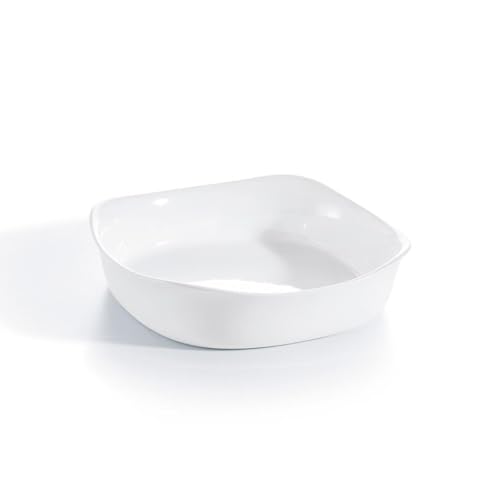
Luminarc’s Smart Cuisine dish is glass, but not clear glass. It is made of what Luminarc calls “culinary opal”, a white tempered glass that the listing describes as durable and lightweight. It looks like a white ceramic dish on the table, without the weight of stoneware or the glaze questions that come with ceramic.
The dish is a 20 x 20 cm square, about 8 x 8 inches, and stackable. The listing gives an oven limit of 250°C (482°F), says it releases food easily and is dishwasher safe, and that it is made in France. That size suits a pan of cornbread, a small batch of brownies or a gratin of potatoes and poblanos for two or three people.
Because it is opaque, you cannot see the bottom of the bake as you can with clear glass, so you lose glass’s best trick for judging browning. You gain a dish that goes from oven to table and looks finished.
Why we like it
- Tempered opal glass, light for its size.
- Oven rated to 250°C (482°F).
- Made in France, per the listing.
- Stackable and dishwasher safe.
Key specifications
| Model | P4025 |
|---|---|
| Glass type | Tempered opal glass |
| Pieces | 1 dish |
| Capacity | 20 x 20 cm (about 8 x 8 in); volume not stated |
| Oven limit | 250°C (482°F) |
| Lid | None |
| Made in | France |
| Care | Dishwasher safe |
Why we recommend it
It suits cooks who want the look of a white baker with the lighter weight of glass.
Skip it if you like to check the bottom crust through the dish; opal glass is not see-through.
Pros and cons
Pros
- Clean white look for the table.
- Higher stated limit than Anchor Hocking’s 425°F.
- Light to handle.
Cons
- Opaque, so no view of the bottom.
- Single small size.
- Freezer use not stated.
7. Crystalia Borosilicate Baking Dish Set, 2 Pieces – Two Near-Square Sizes

Crystalia sells this pair as square dishes, though by the listing’s own numbers they run slightly longer than wide. The large tray is 11.1 x 12.5 x 2 inches and holds 3.4 quarts; the medium is 8.7 x 10.1 x 2 inches and holds 2.1 quarts. The brand name on the listing is Volarium.
The listing says the glass is borosilicate, and that the dishes are safe in ovens and microwaves and go from oven to refrigerator to freezer to table. The large dish takes a family-size bake, a pan of flan or a tray of roasted vegetables; the medium one suits brownies or a side dish. The listing also allows glass-ceramic stoves, and gas with a heat diffuser, but we would keep these in the oven.
The listing gives no temperature limit, no dishwasher statement and no country of origin. Without those details, the safe habit is the same as for any glass: preheat the oven, avoid sudden temperature changes and set hot dishes on a dry trivet.
Why we like it
- Two near-square sizes in one set.
- Borosilicate glass, per the listing.
- Oven, microwave, refrigerator and freezer use.
Key specifications
| Model | Not stated |
|---|---|
| Glass type | Borosilicate |
| Pieces | 2 dishes |
| Capacity | 3.4 qt (11.1 x 12.5 x 2 in) and 2.1 qt (8.7 x 10.1 x 2 in) |
| Oven limit | Not stated |
| Lid | None listed |
| Made in | Not stated |
| Care | Not stated |
Why we recommend it
It suits bakers who use square pans more than long rectangles and want two sizes.
Skip it if you want a stated temperature limit and full care instructions; this listing does not give them.
Pros and cons
Pros
- Two useful sizes.
- Borosilicate glass, per the listing.
- Capacity stated in quarts.
Cons
- No oven limit stated.
- No lids listed.
- Care and origin not stated.
How to choose a glass baking dish
Glass is easy to clean, non-porous and lets you see the food as it bakes. These are the things that separate one glass dish from another.
The glass type, and the rules that come with it
Tempered soda-lime glass is tougher against knocks; borosilicate copes better with fast temperature swings. Neither is foolproof. Read the maker’s rules for the dish you buy: Pyrex and Anchor Hocking say no freezer-to-hot-oven moves, while Simax and Ôcuisine rate their borosilicate from -40°F up to 572°F and 662°F.
The stated oven limit
Anchor Hocking gives 425°F for its tempered glass; Pyrex gives no number and says any temperature a recipe calls for in a fully preheated oven. If you roast at high heat or finish dishes very hot, a borosilicate dish with a stated limit above 500°F gives more room.
Size and depth
A 3-quart, 9 x 13-inch dish feeds most families. Deep dishes, like the Pyrex Deep or the Simax roaster, hold saucy bakes without spilling over. Two people do well with a 2-quart or 8 x 8-inch dish.
Lids and what they are for
Most lids sold with glass dishes are plastic and stay out of the oven. A glass lid, like the Simax’s, can bake covered. If you need a lid that latches for the car, see our guide to baking dishes with lids.
Safe handling habits
Whatever the glass, the makers agree on the basics: put the dish in a fully preheated oven, keep it off burners and out from under the broiler, add a little liquid before baking foods that release juice, and set the hot dish on a dry trivet or towel, never a wet counter or a cold stone surface. Discard glass that is chipped or cracked.
How we picked these seven glass dishes
We looked at glass baking dishes from Pyrex, Anchor Hocking, OXO, Libbey, Simax, Ôcuisine, Luminarc, Borcam, Crystalia and Amazon Basics, along with a range of anonymous Amazon-only sellers. We left out every dish already picked on our main baking dish guide, our lasagna dish guide, our brownie pan guide, our lidded dish guide and our pie dish guide. That ruled out OXO entirely, since both of OXO’s glass dishes are picks on the main guide. We passed on anonymous brands and on Amazon Basics, and kept only dishes that showed as in stock on Amazon when we checked.
We stopped at seven. Other in-stock glass dishes we found were either near-duplicates of these, already picked elsewhere on the site, or from sellers we could not identify.
Specifications come from each maker’s Amazon listing, Anchor Hocking’s FAQ and “why choose glass” pages, and Pyrex’s FAQ and safety and usage instructions, each named where we use it. Background on borosilicate and soda-lime glass comes from the Museum of Glass in Tacoma. We searched the US Consumer Product Safety Commission’s recall site for each brand and found no recall covering these dishes. We have not used these dishes for this guide.
Glass baking dish questions, answered
What is the best glass baking dish brand?
It depends on the glass you want. For tempered glass, Anchor Hocking and Pyrex are the long-standing American brands; Anchor Hocking states made in the USA on our pick. For borosilicate, Simax (Czech Republic) and Ôcuisine (France) both state the glass type and a wide temperature range.
What makes a best quality glass baking dish?
A maker that states the glass type, a clear temperature range and full care instructions, plus a warranty if you can get one. Thick, even walls and handles big enough to grip with oven mitts matter in daily use.
Is borosilicate glass better than tempered glass for baking?
Better for sudden temperature changes, according to the makers and the Museum of Glass, but not for knocks. Anchor Hocking says tempered glass is stronger mechanically and breaks into smaller pieces. Choose by how you cook.
Can a glass baking dish go from the freezer to the oven?
Not Pyrex or Anchor Hocking glass; both say to thaw first. Simax and Ôcuisine rate their borosilicate from -40°F, but a preheated oven and some care are still sensible.
Can I put a glass baking dish under the broiler?
No for Pyrex and Anchor Hocking, which both say so in their care guidance. If you want to brown cheese on top, use a broiler-safe ceramic or metal dish.
The glass dish to start with
Buy the Anchor Hocking 2-piece set if you want everyday tempered glass in two sizes. Choose the Simax roaster if you move dishes from fridge to oven, and the Ôcuisine set if you cook for a crowd. For pie plates in glass, see our pie dish guide, and for warming up tomorrow’s enchiladas in that dish, our guide to reheating Mexican leftovers.
And if you would rather someone else filled the dish tonight, see the menu or call to order.