A sourdough starter is not fussy about its home, but you will be. You open this jar every feeding, you stir in it, you watch it rise, and you scrape it clean, so a poor shape becomes a small daily annoyance.
This guide compares eight wide-mouth jars, from a mason jar you may already own to kits made for the purpose, and explains the one rule that matters most: keep the lid loose.
Julia’s earns a commission on purchases made through links on this page, at no cost to you. Recommendations are based on what a working kitchen looks for in a container, the makers’ own specifications and experienced home bakers’ published guides, which we name.
Quick verdict: which sourdough starter jar to buy
For most bakers, the best sourdough starter jar is the Weck 745 Tulip Jar: its wide mouth and rounded base scrape clean, and the glass lid simply rests on top so the culture can breathe. If you want rise marks in the box, choose the Brød & Taylor 32 oz Jar. To start right now, use a Ball wide-mouth quart with the lid left loose.
Five starter jars at a glance
Five of the eight jars, one for each kind of baker, with the details each listing states. All eight are reviewed below.
| Jar | Best for | Capacity | Lid | Buy on Amazon |
|---|---|---|---|---|

Weck 745 Tulip Jars, 1 Liter, Set of 2Best overall
|
Long-term starters | 1 liter | Glass, rests on top | View on Amazon |
Brød & Taylor 32 oz Sourdough Starter JarBest made for starter
|
New bakers who want marks | 32 oz | Loose plastic | View on Amazon |

Brød & Taylor 12 oz Small Starter JarBest small jar
|
Less discard | 12 oz | Loose plastic | View on Amazon |

Ball Wide Mouth Quart Mason Jars, Set of 2Budget pick
|
Starting this week | 32 oz | Metal, keep loose | View on Amazon |
| Gifts and first starters | 34 oz | Cloth or silicone cover | View on Amazon |
Product images from Amazon. Details are as each listing states; check the listing before you buy.
Our picks for the best sourdough starter jar
These eight jars cover the tulip shape, straight sides, classic canning jars and full kits. Each pick says who it suits, what the listing or a home baker reports, and one honest reason to skip it.
1. Weck 745 Tulip Jars, 1 Liter, Set of 2 – No Corners, a Lid That Just Rests
The jar we would buy for most starters. Weck’s tulip shape has a wide mouth and rounded base, and the home baker behind the plant.well blog calls these her favorite jars for starter and discard, because a spatula scrapes the rounded bottom without leaving anything in the corners.
The lid is the other reason. This is a glass lid that sits on the rim, so you can simply rest it on top with no gasket or clips, which lets the culture breathe while keeping debris out. If your set includes a rubber ring and clips, save them for storing dry goods or preserves.
A liter is a little over The Pantry Mama’s suggested 16 to 32 ounces, so it gives a generous starter plenty of room to rise. You also get two, so one can be washed while the other is in use.
Why we like it
- Rounded base scrapes clean, per a home baker’s account
- Glass lid rests loosely on the rim
- Set of two
- BPA free, per the listing
Key specifications
| Model | 745 |
|---|---|
| Capacity | 1 liter |
| Material | Glass |
| Shape | Tulip with a wide mouth, rounded base |
| Lid | Glass lid; use without gasket or clips |
| Rise tracking | None; add a rubber band |
| Care | Not stated in this listing |
| Made in | Not stated |
Why we recommend it
Choose it if you keep a starter for the long term and want an easy jar to scrape and wash. It also looks tidy on a counter.
Skip it if you want measurement marks on the glass. Weck adds none, so add a rubber band or a strip of tape.
Pros and cons
Pros
- Easy to scrape clean
- Loose glass lid
- Two jars in the set
Cons
- No markings
- Larger than most small starters need
- Seller listing is promotional
2. Brød & Taylor 32 oz Sourdough Starter Jar – Built for the Job, Marks Included
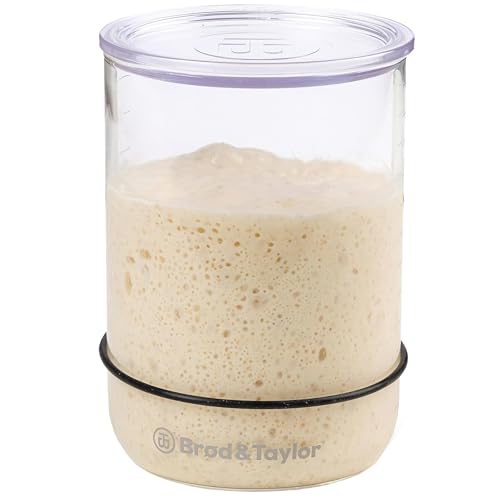
The only pick here designed from the start around feeding a culture. It has straight sides for a uniform rise, a curved bottom, a 4-inch opening that fits a hand, and a loose plastic lid that Brød & Taylor says prevents pressure from building.
The glass is borosilicate, it holds up to 300 grams of active starter, and the black silicone band and printed centimeter and inch marks make it easy to see how far the culture has grown since the last feeding.
Both jar and lid are dishwasher safe. These specifications come from the maker, and we did not find an independent test, so treat the design claims as Brød & Taylor’s own.
Why we like it
- Straight sides and a curved bottom
- Measurement marks and a level band
- Loose-fitting lid
- Dishwasher safe jar and lid
Key specifications
| Model | SH-800 |
|---|---|
| Capacity | 32 oz; up to 300 g active starter |
| Material | Borosilicate glass |
| Shape | Straight sides, curved bottom, 4 by 5 inches |
| Lid | Loose plastic |
| Rise tracking | Printed marks and silicone band |
| Care | Dishwasher safe |
| Made in | Not stated |
Why we recommend it
Choose it if you are new to sourdough and want a jar that takes the guesswork out of when to feed, with everything included in one box.
Skip it if you already own canning jars. A jar and a rubber band do the same job, with less polish.
Pros and cons
Pros
- Marks and band included
- Easy to clean
- Sensible size
Cons
- One jar only
- Evidence comes from the maker
- Plastic lid
3. Weck 743 Mold Jars, Set of 2 – Straight-Sided, Flat-Bottomed Weck

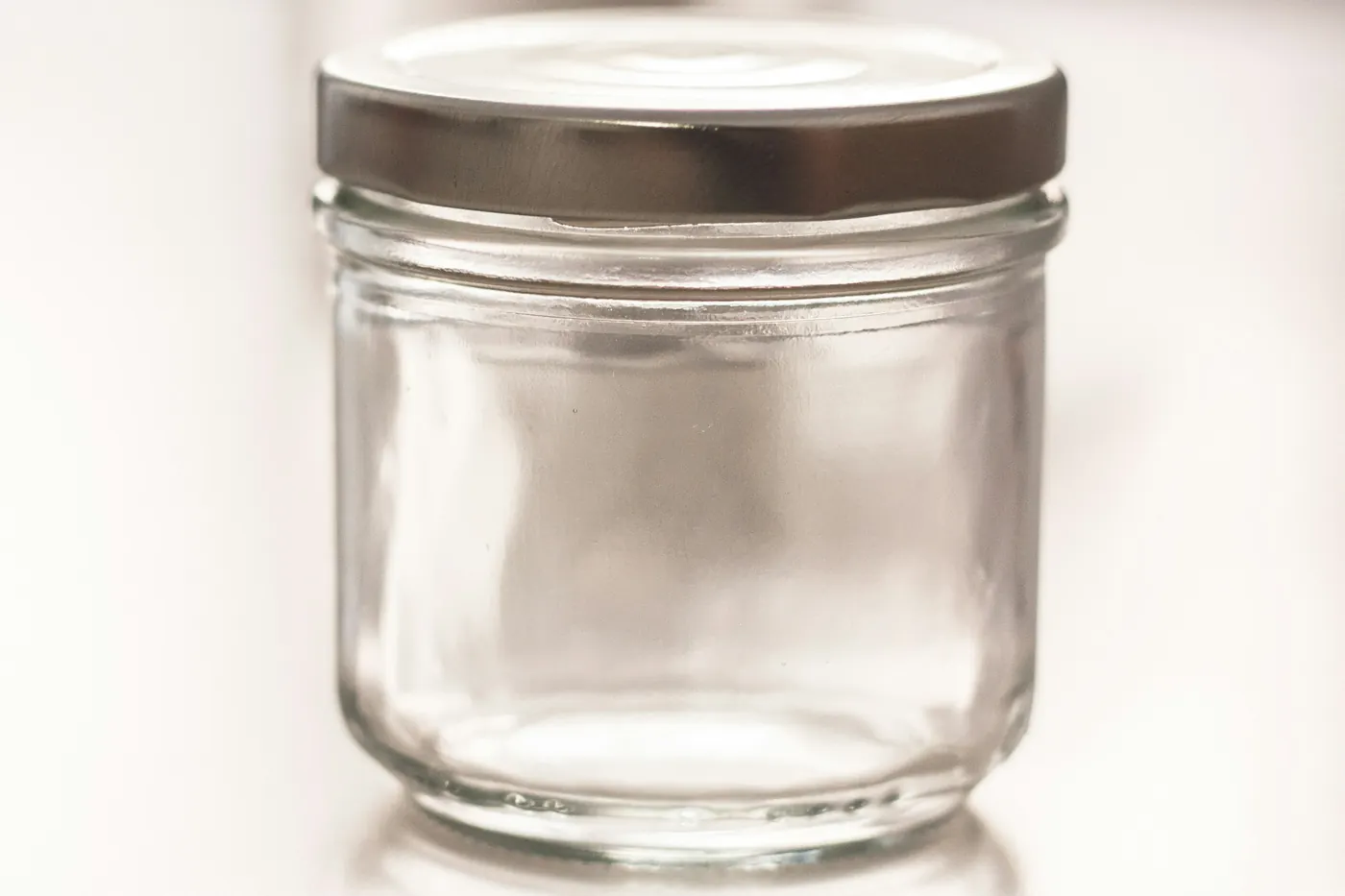
If you prefer the Weck lid but want straight sides for watching the rise, this is the alternative. The same blogger points to Weck’s flat-bottomed, straight-sided jar for bakers who prefer that shape, and The Pantry Mama lists a Weck starter jar as a premium option.
The listing is confused on size. The title says 1 liter, while the size field and first feature say 3/4 liter, and that feature names the 743 as a 3/4-liter jar. Go by 3/4 liter, which sits inside the usual 16 to 32-ounce range, and confirm on arrival.
The glass is thick and listed as dishwasher and microwave safe. Use the glass lid without clips or gasket for a starter, since the airtight setup is meant for storage.
Why we like it
- Straight sides show the rise
- Glass lid, gasket and clips are separate
- Thick, heat-resistant glass, per the listing
- Set of two
Key specifications
| Model | 743 |
|---|---|
| Capacity | 3/4 liter by the size field; the title says 1 liter |
| Material | Glass |
| Shape | Straight sides, flat bottom, wide mouth |
| Lid | Glass lid; use without gasket or clips |
| Rise tracking | None; add a rubber band |
| Care | Dishwasher and microwave safe, per the listing |
| Made in | Not stated |
Why we recommend it
Choose it for the Weck look in a shape that makes a rise easy to read at a glance.
Skip it if you want to scrape out every last bit. A flat bottom has corners, unlike the tulip jar above.
Pros and cons
Pros
- Easy to read the rise
- Fits the usual size range
- Two jars
Cons
- Listing size conflict
- No marks
- Flat corners to scrape
4. Brød & Taylor 12 oz Small Starter Jar – A Small Starter and Less Discard
A small starter wastes less flour, and this jar is made for that habit. It is 3 inches wide and 3.6 inches tall, and holds up to 100 grams of fully risen starter, which suits a small loaf or weekly baking.
It has the same printed marks, silicone ring, curved bottom and loose lid as the bigger jar, and both pieces are dishwasher safe. Brød & Taylor also says up to four small jars fit in its Sourdough Home warmer, if you keep more than one culture.
Note that 12 ounces falls below the 16 to 32 ounces The Pantry Mama suggests, so make sure you truly keep small. A 100-gram maximum leaves little margin for a big feed before a large bake.
Why we like it
- Holds up to 100 g of risen starter
- Marks and silicone ring
- Curved bottom for scooping
- Dishwasher safe
Key specifications
| Model | SH-850 |
|---|---|
| Capacity | 12 oz; up to 100 g risen starter |
| Material | Glass |
| Shape | 3 by 3.6 inches, curved bottom |
| Lid | Loose plastic |
| Rise tracking | Printed marks and silicone ring |
| Care | Dishwasher safe |
| Made in | Not stated |
Why we recommend it
Choose it if you bake one loaf a week and hate throwing away discard. It also fits a tight fridge shelf.
Skip it if you build large levains or bake several loaves at a time. The 32 oz version has more room.
Pros and cons
Pros
- Less discard
- Very compact
- Marks included
Cons
- Small maximum
- Below the usual size advice
- Evidence comes from the maker
5. Ball Wide Mouth Quart Mason Jars, Set of 2 – The Jar You May Already Own
You do not need a special jar to keep a starter alive. A wide-mouth Ball quart holds 32 ounces, the top of The Pantry Mama’s range, and the plant.well blogger lists it as an easy and simple place to start, with Weck as a later upgrade.
What you give up is ease of cleaning. She finds starter sticks in the inward-curving top and that the bottom corners are hard to scrape. Brød & Taylor makes the same point about ridges, though it sells a competing jar.
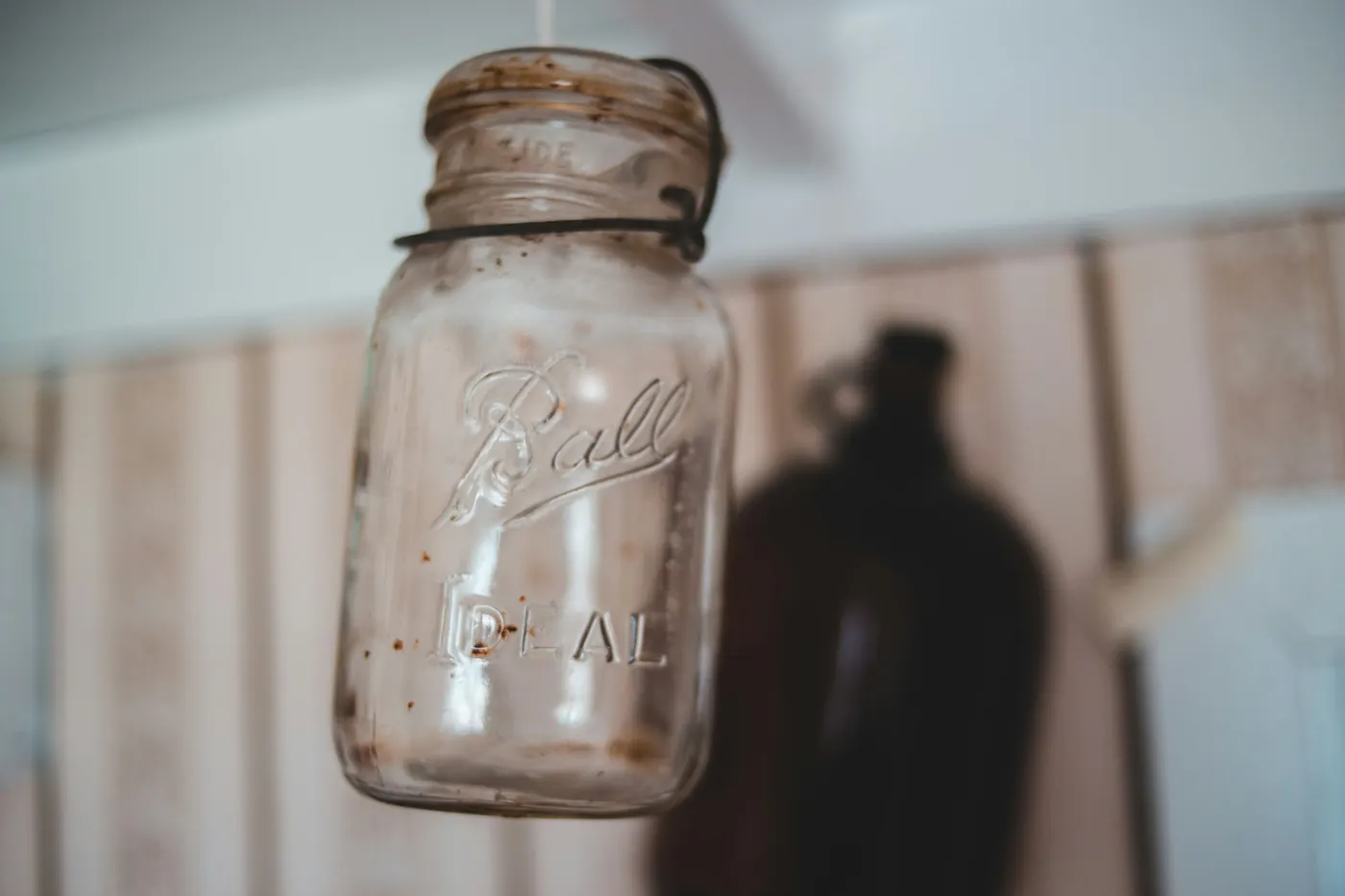
Never tighten the band on an active starter. Set the lid on top or run the band on loosely, because a starter needs some airflow and should not sit in a completely airtight jar, as The Pantry Mama explains. The set is BPA free and made in the USA, per the listing.
Why we like it
- Wide-mouth 32 oz size
- BPA free, per the listing
- Made in the USA, per the listing
- Easy to replace, sold in many stores
Key specifications
| Model | 31054 |
|---|---|
| Capacity | 32 oz |
| Material | Glass |
| Shape | Wide mouth with threads and shoulders |
| Lid | Metal lid and band; keep loose |
| Rise tracking | None; add a rubber band |
| Care | Not stated in this listing |
| Made in | USA |
Why we recommend it
Choose it to get started this week. If you stick with sourdough, you can upgrade later and use these jars for your discard.
Skip it if scraping out sticky starter annoys you. A straight-walled jar with no threads cleans faster.
Pros and cons
Pros
- Widely available
- Enough room to rise
- Easy starter jar
Cons
- Threads and shoulders trap starter
- Lid must stay loose on an active culture
- Third-party seller when checked
6. Le Parfait Super Jar, 1 Liter – French Glass for a Tall Rise

Le Parfait’s classic French jar is built for preserving, but its listing also names fermenting, and its 1-liter height gives a culture room to rise. It is soda-lime glass with a natural rubber gasket and a stainless wire bail, and the listing says it is free from BPA and lead.
The wire bail is the thing to watch. It makes an airtight seal, which is right for preserves and wrong for a jar of active starter, so leave the bail open with the lid resting on top, or remove the gasket, while it ferments. That is our own suggestion based on the airflow advice above, not something Le Parfait states.
You also get a rounded jar with a shoulder, so it is not as easy to scrape as a tulip jar. It comes as one jar, sold by Le Parfait America.
Why we like it
- Tall 1-liter jar
- Soda-lime glass made in France
- Listing names fermenting
- Reusable rubber gasket, per the listing
Key specifications
| Model | Super Jars |
|---|---|
| Capacity | 1 liter (32 oz per the title) |
| Material | Soda-lime glass |
| Shape | Tall, rounded, wide mouth |
| Lid | Glass with wire bail and gasket; leave unclamped |
| Rise tracking | None; add a rubber band |
| Care | Not stated |
| Made in | France |
Why we recommend it
Choose it if you like the look on a counter and already make preserves, so the jar has a second life.
Skip it if you want a jar sold for starter. Le Parfait is a preserving jar first, and it does not state starter use.
Pros and cons
Pros
- Well-made French jar
- Good height
- Doubles for preserves
Cons
- Airtight unless left open
- Shoulder makes it harder to scrape
- Not sold for starter
7. KneadAce Pro 34 oz Sourdough Starter Kit – Bands, Cover and Thermometer in One Box

If you want every accessory in one box, this is a tidy kit from a small brand. The 34-ounce jar has a funnel-shaped opening and printed volume, net weight and feed-line marks, plus a cloth cover for the counter and a silicone cover for the fridge that doubles as an anti-slip base.
You also get a thermometer, a spatula and an elastic band marked with days of the week, to remind you when you last fed the starter. KneadAce adds a video guide and a recipe. The plant.well blogger listed a KneadAce set as her best set with extras, mentioning the printed jar weight and date band, though her write-up may describe a sibling model.
The brand is Amazon-first, so there is little outside information, and we would not expect a thermometer in a kit to be precise.
Why we like it
- Printed volume, weight and feed lines
- Cloth and silicone covers
- Date band and thermometer
- Spatula, video guide and recipe included
Key specifications
| Model | KA06 |
|---|---|
| Capacity | 34 oz |
| Material | Not stated here; a sibling KneadAce listing says glass |
| Shape | Funnel-shaped opening |
| Lid | Cloth cover and silicone cover |
| Rise tracking | Printed marks and date band |
| Care | Not stated in this listing |
| Made in | Not stated |
Why we recommend it
Choose it as a gift or for a first starter, when having all the small tools in one box is the point.
Skip it if you already have a thermometer and a spatula. A plain jar and a rubber band are enough.
Pros and cons
Pros
- Everything in one box
- Printed weight helps with feeding
- Cloth cover for airflow
Cons
- Amazon-first brand
- Extras may go unused
- Thermometer accuracy unknown
8. INOBYO 24 oz Sourdough Starter Jar Kit – Borosilicate With No Threads

A smaller kit in a size inside the usual range. The jar is 24 ounces of borosilicate glass with a wide, non-threaded straight-edged mouth, a design that avoids the threads that trap starter on a mason jar.
The kit has a breathable cloth cover, a spatula, a dated feeding band, a thermometer and a recipe. The listing also marks it dishwasher safe. It does not include a starter culture, as the listing makes clear.
INOBYO is an Amazon-first brand with no independent review that we could read, so this pick rests on the listing. We include it because a threadless 24-ounce jar is a useful size.
Why we like it
- 24 oz, inside the usual size range
- Non-threaded straight-edged mouth
- Cloth cover, band, thermometer, spatula
- Borosilicate glass, per the listing
Key specifications
| Model | SSJ-01 |
|---|---|
| Capacity | 24 oz |
| Material | Borosilicate glass |
| Shape | Wide, non-threaded mouth |
| Lid | Cloth cover; silicone lid version shown |
| Rise tracking | Dated feeding band |
| Care | Dishwasher safe, per the title |
| Made in | Not stated |
Why we recommend it
Choose it for a compact counter jar with the accessories included, if you do not need a big-name maker.
Skip it if you want a maker with a track record. Weck and Brød & Taylor have more to go on, and this pick rests on the listing alone.
Pros and cons
Pros
- Threadless mouth
- Good everyday size
- Dishwasher safe
Cons
- Amazon-first brand
- No independent review read
- Extras may go unused
How to choose a jar for feeding starter
The Pantry Mama, Kate Freebairn’s sourdough site, lays out a useful checklist in its guide to starter containers, and the plant.well blog adds real-world notes on Weck, KneadAce and Ball. Neither is a controlled test, so treat both as experienced home bakers’ views.
1. Size
The Pantry Mama suggests a jar that comfortably holds 100 to 200 grams of starter, which it puts at 16 to 32 ounces. A starter can double or more, so a jar that looks too large on day one usually is not. Keep very small amounts in a very small jar, or you will struggle to read the rise.
2. A wide mouth with no shoulders
That guide says a wide mouth and no shoulders is best. You need to get a spoon or spatula in to stir, and a shoulder traps dried starter that is hard to clean. Straight sides also make a rise easier to judge.
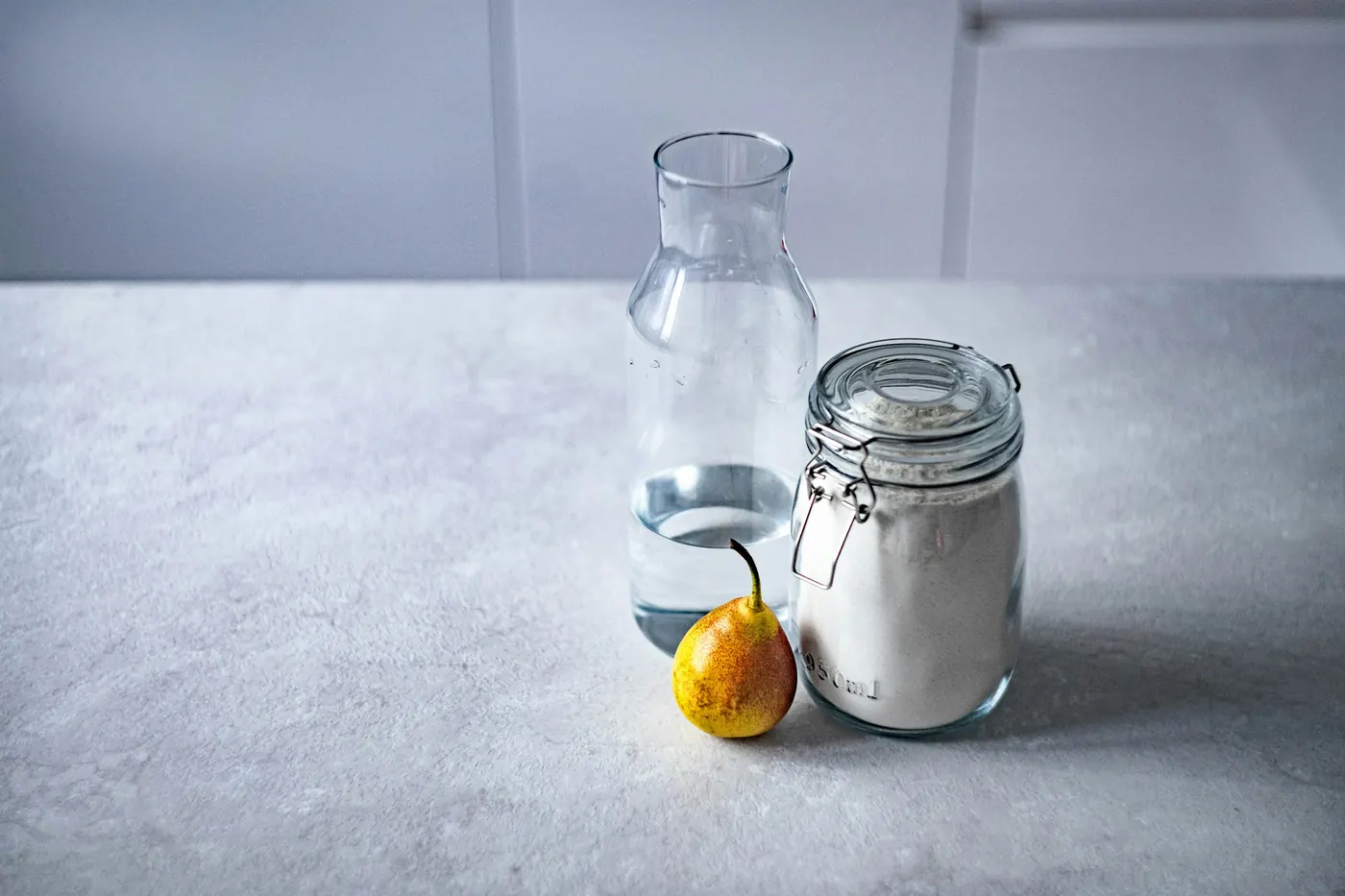
3. A lid that stays loose
This is the one point every source agrees on: a starter needs some airflow, so do not seal it tightly. A clamp or screw lid can be used in the fridge, The Pantry Mama says, once tightened for storage only. On the counter, rest the lid on top. A cloth cover also works, but it will let the top dry out sooner.
4. Clear glass
You judge a starter by looking through the side of the jar. Clear glass lets you see the bubbles and the height. A rubber band or a strip of tape marks the starting level on any jar, so built-in marks are a convenience rather than a need.
5. Easy cleaning
Dried starter sets hard, so choose a shape you can reach into. The plant.well writer likes Weck’s rounded bottom for that reason and finds Ball’s inward curve and corners harder. Soak a jar in cold water before it dries, and clean it often enough that it stays easy.
How we picked these eight jars
We looked for wide-mouth glass jars from identifiable makers, sold new and in stock on Amazon in the United States, and we read each listing for capacity, shape and lid. We used the two home-baker guides above for how jars work in daily use, and we have not kept a starter in each jar ourselves. Plain glass needs no lead-free glaze statement, as there is no glaze, and Le Parfait’s listing also describes its glass as lead-free. Weck and Brød & Taylor each appear twice because the two models differ in size or shape and suit different bakers. At most two picks are Amazon-first brands, and the many look-alike kits from unknown sellers are left out. The Kilner set named in the guide above was down to its last units when we checked, so it is not here.
Starter jar questions, answered
What size jar do I need for a sourdough starter?
For most home bakers, 16 to 32 ounces, as The Pantry Mama suggests. Go smaller only if you deliberately keep a tiny starter.
Can I use a mason jar for sourdough starter?
Yes. A wide-mouth mason jar works well, and it is a common place to start. Leave the lid loose, and expect the threads and shoulder to take more cleaning.
Should a sourdough starter jar be airtight?
Not on the counter. The Pantry Mama says a starter needs some access to airflow and that a lid should not make the jar completely airtight. Gas has to escape as it ferments.
Does a starter need a special jar?
No. Starter jars are a convenience. What they add is straight sides, marks and a loose lid, and the same results come from any clear, wide-mouth jar with a rubber band.
How often should I change the jar?
Any time the sides get crusty. Move the starter to a clean jar and wash the old one. Having two jars, as with the Weck sets, makes that a simple swap.
Our last word on starter jars
Buy the Weck tulip jars if you want an easy-to-scrape jar with a loose glass lid, or the Brød & Taylor 32 oz if you want marks and a band in the box. If you are just getting started, use a Ball quart and upgrade only if it annoys you.
A jar is only one part of sourdough baking. See the best mixing bowls for sourdough for the bulk rise, the best kitchen scale for sourdough for feeding by weight, and the best proofing basket for shaping.
And if you would rather someone else did the cooking tonight, see the menu or call to order.