A good wine book does what a good server does at the table: it takes something that looks complicated and makes the next choice easier. In a restaurant kitchen we think about ingredients the same way. You do not need to know everything about a chile to cook with it. You need to know which one to reach for and why.
The trouble is that “wine book” covers a thick reference, a course, a pocket annual and a map collection, and those do very different jobs. This guide picks eight from named authors at established publishers, and tells you plainly which ones have a review we read and which rest on what the publisher and author say. Everything here is for adults of legal drinking age.
Julia’s earns a commission on purchases made through links on this page, at no cost to you. Recommendations are based on what a restaurant kitchen looks for in a book, Amazon listing details, publisher information and published reviews, which we name.
Quick verdict: which wine book to buy first
For most readers the best wine book is Karen MacNeil’s The Wine Bible: one broad, readable volume that covers the basics and the regions. If you want a wine book for beginners that teaches in order, choose Kevin Zraly’s Windows on the World Complete Wine Course. If pictures work better for you than paragraphs, choose Aldo Sohm’s Wine Simple.
The other five cover maps, a one-sitting primer, tasting exercises, an annual buying guide and serious sommelier study.

Five wine books side by side
Five of the eight, one for each kind of reader, with details from the listing and publisher. All eight are described in full below.
| Book | Best for | Level | Format | Buy on Amazon |
|---|---|---|---|---|

The Wine Bible, Karen MacNeilBest overall
|
One book for the whole subject | Beginner to enthusiast | Paperback, 736 pages | View on Amazon |
Windows on the World Complete Wine Course, Kevin ZralyBest for beginners
|
Learning in order, lesson by lesson | Beginner | Hardcover, 464 pages | View on Amazon |

Wine Simple, Aldo Sohm and Christine MuhlkeBest for visual learners
|
Readers who learn from pictures | Beginner to enthusiast | Hardcover, 272 pages | View on Amazon |
| Understanding where wine comes from | Enthusiast and up | Hardcover, 432 pages | View on Amazon | |

The 24-Hour Wine Expert, Jancis RobinsonBest short read
|
A quick start or a small gift | Beginner | Hardcover, 112 pages | View on Amazon |
Our picks for the best wine book, one by one
1. The Wine Bible, Karen MacNeil – The One Book That Covers It All
This is the broad, friendly reference a wine shelf can be built around. Workman describes a tour of the basics (vineyards, grape varieties, climate and terroir) broken up with tips, anecdotes, definitions, maps and labels. The publisher counts over 400 full-color photographs.
We picked the third edition, in paperback. Workman says it adds chapters on Great Britain, Croatia and Israel, a section on wine in the ancient world, a revised list of recommended bottles by country and region, and a grape glossary of more than 400 varieties.
Karen MacNeil’s background explains the range: the publisher notes she created the Rudd Center for Professional Wine Studies at the Culinary Institute of America and hosted a PBS series on wine and food. Forbes, quoted by the publisher, calls her writing style “engaging and conversational.” That matters in a book this long, because you will read it in pieces rather than straight through.
Why we like it
- Covers wine basics and the regions in one volume, per Workman
- Third edition adds new country chapters and a revised bottle list
- Grape glossary lists more than 400 varieties
- Over 400 color photographs, plus maps and labels
Key specifications
| Author | Karen MacNeil |
|---|---|
| Publisher | Workman Publishing |
| Format | Paperback (third edition) |
| Pages | 736 (per the listing) |
| Released | 2022 (per the listing) |
| Level | Beginner to enthusiast |
| Focus | Regions, grapes and basics |
| Evidence | Blurbs quoted by the publisher |
Why we recommend it
Choose this if you want one book to keep and return to for years. It should serve the small question (what is this grape?) as well as the big one (why does this region’s wine taste the way it does?).
Skip it if you want a short read for the weekend; it is a long book, and the 24-Hour Wine Expert below is a better fit.
Pros and cons
Pros
- Very broad coverage
- Conversational voice, per Forbes
- Revised bottle recommendations
Cons
- Long for a first read
- Bottle lists date as vintages change
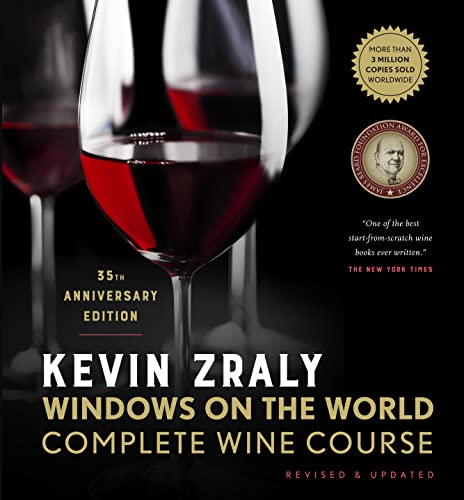
2. Windows on the World Complete Wine Course, Kevin Zraly – A Structured Class in a Book
Where The Wine Bible is a reference, this is a course. Kevin Zraly founded and taught the Windows on the World Wine School, which the publisher says ran for over 40 years and graduated about 25,000 students, and the book carries that teaching over with guided tastings, quizzes and FAQs.
Union Square & Co. lists grape varieties, winemaking, styles and how to read a bottle’s label, plus a way to evaluate a wine in about a minute. Regions include Bordeaux, Burgundy, California and New York, with maps, photos and infographics along the way.
This revised 35th anniversary edition adds chapters on Prosecco, rosé and Sicilian wines, and the publisher counts more than 800 recommended value wines. The New York Times line the publisher quotes, “One of the best start-from-scratch wine books ever written,” fits the design. It is the wine book for beginners we would point to for anyone who learns best from a syllabus.
Why we like it
- Built as a course, with guided tastings and quizzes
- Written by a long-running wine school’s founder
- Covers reading a label and judging a wine quickly
- Lists over 800 value wines, per the publisher
Key specifications
| Author | Kevin Zraly |
|---|---|
| Publisher | Union Square & Co. |
| Format | Hardcover (revised 35th edition) |
| Pages | 464 (per the listing) |
| Released | 2020 (per the listing) |
| Level | Beginner |
| Focus | A step-by-step wine course |
| Evidence | Blurbs quoted by the publisher |
Why we recommend it
This suits anyone who likes being taught in order, and it should work well for two friends tasting through the lessons together.
Skip it if you dislike a textbook shape, or if you want the newest bottle picks; this edition dates from 2020.
Pros and cons
Pros
- Teaching structure
- Guided tastings and quizzes
- Long teaching track record behind it
Cons
- Older edition than some picks here
- Course format is less handy as a quick reference
3. Wine Simple, Aldo Sohm and Christine Muhlke – A Sommelier Explains, With Pictures
Aldo Sohm is a sommelier at Le Bernardin in New York, and this book is aimed at the anxiety people feel in front of a wine list. It has a direct review we read: Chris Ernest Hall, writing in the Journal of Wine Economics in 2024, calls it “one of the most attractive books I’ve ever read,” citing the maps, explainers and humorous cartoons.
Hall describes four main parts: what wine is, how to drink it, how to evolve your palate, and pairing wine with food. He says it is built to be read through and then consulted later, with a tasting protocol in the second chapter that you can run with friends. He also credits Sohm with good advice on finding bargains.
His criticism is useful too. In trying to cover the whole world, he writes, some of the geography can feel cursory. Coverage leans toward Europe, and he points to Lodi in California and to New Zealand as thin spots. Treat this as the introduction, not the atlas.
Why we like it
- Direct, named review in the Journal of Wine Economics
- Heavily illustrated with maps and explainers
- Includes a tasting protocol to run with friends
- A full part on pairing wine and food
Key specifications
| Author | Aldo Sohm and Christine Muhlke |
|---|---|
| Publisher | Clarkson Potter |
| Format | Hardcover |
| Pages | 272 (per the listing) |
| Released | 2019 (per the listing) |
| Level | Beginner to enthusiast |
| Focus | Wine basics, palate and pairing |
| Evidence | Journal of Wine Economics review |
Why we recommend it
Choose this if a wall of text puts you off. Hall says it would also suit an experienced drinker who wants to rethink some old rules of thumb.
Skip it if you want deep regional coverage, especially outside Europe; the review calls some of that coverage cursory.
Pros and cons
Pros
- Attractive, per a named reviewer
- Casual, conversational voice
- Advice on finding value
Cons
- Some regions get thin coverage, per the same review
- Not a deep reference
4. The World Atlas of Wine, 9th Edition, Hugh Johnson, Jancis Robinson and Julia Harding – Every Region on a Map

A map can explain a wine faster than a paragraph, and this is the book that treats wine as geography. The publisher, Octopus, presents it as the authoritative wine reference since its first edition in 1971. Hugh Johnson and Jancis Robinson are joined here by Julia Harding as maps editor.
The ninth edition is new this year. Octopus says it adds 18 new maps and revises the text throughout, with attention to climate change, new vineyards in northern Europe and sustainability. The last edition came out in 2019, so this one is worth preferring over an older copy.
The publisher quotes Eric Asimov of the New York Times calling it “the single most important reference book on the shelf of any wine student,” and Andrew Jefford of Decanter calling it “The most useful single volume on wine ever published.” Both are lines chosen by the publisher and may have been written about earlier editions, so read them as the book’s reputation, not as a review of this printing.
Why we like it
- New edition with 18 new maps, per the publisher
- Text revised throughout
- Covers climate change and new vineyard areas
- Co-written by Master of Wine Jancis Robinson
Key specifications
| Author | Hugh Johnson, Jancis Robinson and Julia Harding |
|---|---|
| Publisher | Mitchell Beazley |
| Format | Hardcover (ninth edition) |
| Pages | 432 (per the listing) |
| Released | 2026 (per the listing) |
| Level | Enthusiast and up |
| Focus | Wine regions, mapped |
| Evidence | Blurbs quoted by the publisher |
Why we recommend it
This suits a reader who already knows the basics and wants to see where a bottle comes from. Keep it close when you open something unfamiliar.
Skip it as a first book if you want to be told what to drink; it explains places rather than teaching you to taste.
Pros and cons
Pros
- Current edition
- Maps you can return to for years
- Strong reputation, per the quoted critics
Cons
- A reference hardcover, not one to carry around
- More reference than lesson
5. The 24-Hour Wine Expert, Jancis Robinson – The Basics in One Sitting
Most wine books ask for months. This one asks for an afternoon. Abrams describes a small 5 by 7 inch hardcover that aims to give a general reader a working knowledge of wine in a day: choosing a bottle in a store, reading a label, judging color and aroma, and pairing wine with food.
Jancis Robinson is a Master of Wine and a co-author of the atlas above, so this is a very experienced writer deliberately staying short. Abrams quotes Florence Fabricant in the New York Times calling it “a compact, breezy, one-shot wine seminar,” and a Washington Post review describing it as an invitation to learn the basics rather than gospel.
At 112 pages with 30 black-and-white illustrations, it will not replace a reference. It is, though, the easiest way on this page to find out whether you want to go further, and it is small enough to take to the wine shop.
Why we like it
- Short enough to finish in a sitting
- Practical focus on choosing and reading a bottle
- Written by a Master of Wine
- Quoted favorably from the New York Times and Washington Post, per Abrams
Key specifications
| Author | Jancis Robinson |
|---|---|
| Publisher | Abrams Image |
| Format | Hardcover |
| Pages | 112 (per the listing) |
| Released | 2016 (per the listing) |
| Level | Beginner |
| Focus | A short primer on buying and tasting |
| Evidence | Blurbs quoted by the publisher |
Why we recommend it
Buy this for the person who says they would like to know a bit more about wine but would never open a 700-page book.
Skip it if you already know your grapes; it is a primer and stops there.
Pros and cons
Pros
- Quick read
- Small format
- Experienced author
Cons
- Limited depth by design
- Black-and-white illustrations only
6. Wine: A Tasting Course, Marnie Old – Learn With a Glass in Hand

This DK book takes the view that you learn wine with a glass in your hand. The publisher describes a visual course with themed tasting exercises that teach you to smell, swirl and taste, plus short boxes on food pairing, the spectrum of styles, grape varieties and regions. The updated edition also covers wine myths and facts.
Marnie Old is a sommelier. DK says she was director of wine studies at the French Culinary Institute in Manhattan and the founding education chair of the American Sommelier Association, so the teaching background is there.
We did not read an independent review of this one, and the DK page carries no outside quotes, so this pick rests on the publisher’s description and the author’s background. It earns its place because it does something the others only touch on: it turns each lesson into something to taste, a natural next step after a first book.
Why we like it
- Themed tasting exercises, per DK
- Strongly visual layout
- Author has a wine-teaching background
- Covers food pairing alongside grapes and regions
Key specifications
| Author | Marnie Old |
|---|---|
| Publisher | DK |
| Format | Hardcover |
| Pages | 256 (per the listing) |
| Released | 2021 (per the listing) |
| Level | Beginner |
| Focus | Learning through tasting exercises |
| Evidence | Publisher and author details |
Why we recommend it
This suits a couple or a small group who would enjoy opening a few bottles and comparing them with a guide alongside.
Skip it if you want to read about wine rather than buy bottles for the exercises.
Pros and cons
Pros
- Lessons you can taste
- Visual format
- Experienced teacher
Cons
- Exercises mean buying several bottles
- Less regional depth than a reference
7. Hugh Johnson’s Pocket Wine Book 2027, Hugh Johnson and Margaret Rand – An Annual Guide for the Shop Aisle

This is a different sort of wine book: an annual you consult rather than read. Octopus describes concise facts and commentary on wines, growers and regions worldwide, including which vintages to buy, drink or cellar, the best growers, grape varieties and food pairings.
The 2027 book is a 50th anniversary edition, and it adds a supplement on flavor and climate change, noting that wines tend toward lower acidity, softer tannins and higher alcohol. Octopus credits Hugh Johnson and Margaret Rand as authors; the Amazon listing names Rand alone.
The publisher quotes The Times calling it “A thorough guide to just about everything worth drinking.” Its value depends on being current, which is why we chose the newest edition. Older years are still sold, but their vintage advice has aged.
Why we like it
- Vintage guidance refreshed each year
- Pocket format for a shop or restaurant
- Covers growers worldwide
- New supplement on climate change and flavor
Key specifications
| Author | Hugh Johnson and Margaret Rand |
|---|---|
| Publisher | Mitchell Beazley |
| Format | Hardcover |
| Pages | 336 (per the listing) |
| Released | 2026 (per the listing) |
| Level | Enthusiast |
| Focus | Vintages, growers and what to buy |
| Evidence | Blurbs quoted by the publisher |
Why we recommend it
This suits someone who already buys wine regularly and wants a quick second opinion in the aisle.
Skip it if you are just starting out; concise entries work best when you already know the terms.
Pros and cons
Pros
- Very current
- Easy to carry
- Broad worldwide coverage
Cons
- Concise style can be hard for beginners
- Needs replacing to stay current
8. The Sommelier’s Atlas of Taste, Rajat Parr and Jordan Mackay – How Great European Wines Should Taste

Once you have the basics, the next question is what a classic wine is supposed to taste like. This book is a field guide to exactly that. The catalog description we read calls it a reference to how Europe’s great wines should taste, organized by region, for aspiring sommeliers, people working on blind tasting and enthusiasts who want a direct way to describe wine.
Ten Speed Press is an established food and drink publisher, and Jordan Mackay’s name will be familiar from Franklin Smoke on our grill cookbook page. Those details and the catalog description are the basis for this pick; we did not read an independent review of it.
It covers Europe only, as the subtitle says, so it will not help with a bottle from Chile, Mexico or California. Think of it as a second or third book for someone already tasting with purpose.
Why we like it
- Organized by region, per the catalog description
- Focuses on how a wine should taste, not just where it is from
- Aimed at blind tasting study
- From an established food and drink publisher
Key specifications
| Author | Rajat Parr and Jordan Mackay |
|---|---|
| Publisher | Ten Speed Press |
| Format | Hardcover |
| Pages | 352 (per the listing) |
| Released | 2018 (per the listing) |
| Level | Advanced |
| Focus | Taste profiles of great European wines |
| Evidence | Publisher and author details |
Why we recommend it
This suits a serious hobbyist or someone studying to become a sommelier who wants tasting descriptions to check against.
Skip it if you drink mostly New World wine, or if this would be your first wine book.
Pros and cons
Pros
- A clear, narrow purpose
- Good next step after the basics
- Named authors at a known publisher
Cons
- Europe only
- Too specialized for most beginners
How to choose a wine book you will actually open
Decide between learning and looking things up. A course such as Zraly’s is meant to be read in order. A reference such as the atlas is meant to be opened when a question comes up. Buying a reference when you want lessons is the usual way a wine book ends up unread.
Match the length to your patience. The range here runs from 112 pages to 736, by the listings. A short book you finish teaches more than a long one you abandon, so start small if you are not sure.
Check the edition date. Grape basics change slowly, but bottle recommendations and vintage advice age quickly. The atlas and the pocket guide are this year’s books; the Zraly course and Wine Simple are older, so read their bottle suggestions as a starting point.
Think about how you learn. If maps stick with you, buy the atlas. If you remember what you taste, buy Marnie Old’s course. If you like a voice talking you through it, MacNeil and Sohm are the conversational choices.
Plan for the glass as well as the page. Tasting side by side is easier with the right stemware. Our guide to the best wine glasses covers that, and a wine opener and a decanter round out the kit.
How we chose these eight wine books
We searched Amazon’s book listings and kept only print editions shown as plainly in stock when we checked. We required a named author and an established publisher, then read the publisher’s page for each title wherever we could reach it. Page counts and dates come from the listing. We have not used these books in our kitchen, and we give no prices or ratings.
The Evidence row in each pick tells you what stands behind it. Wine Simple has a direct review we read, by Chris Ernest Hall in the Journal of Wine Economics. The Wine Bible, the Zraly course, the atlas, the 24-Hour Wine Expert and the pocket guide carry review lines that the publisher quotes; a publisher chooses those lines, and they may refer to earlier editions. Wine: A Tasting Course and The Sommelier’s Atlas of Taste rest on publisher, catalog and author details. That does not mean no review of them exists, only that we did not read one.
Stock ruled out one popular title. Neither print listing we checked for Wine Folly by Madeline Puckette and Justin Hammack was plainly in stock: the first edition showed limited stock and the Magnum Edition showed a future date. Look it up yourself if a graphic guide appeals.

Wine book questions, answered
What is the best wine book for beginners?
Windows on the World Complete Wine Course if you want lessons in order, and The 24-Hour Wine Expert if you want something short. Both are aimed at people starting from nothing.
Is The Wine Bible good for a beginner?
Yes, as long as you dip into it rather than read it straight through. Workman presents it as covering the basics as well as the regions, though at 736 pages it is a lot for a first sitting.
Which wine book helps most with food pairing?
Wine Simple gives a full part to pairing, according to the Journal of Wine Economics review, and the Zraly course includes food pairing notes. For the food we know best, see our guide on what to drink with Mexican food.
Should I buy the newest edition of a wine book?
For annual guides and atlases, yes, because their value is in being current. For a basics book, an edition a few years old teaches the same fundamentals.
What wine book makes a good gift?
The 24-Hour Wine Expert is an easy small gift, and The World Atlas of Wine is the larger one for someone who already enjoys the subject.
Our final pick for the wine shelf
Buy The Wine Bible if you want one book for the long run, the Zraly course if you want to be taught, and Wine Simple if you want the friendliest pages. Then pour something and start reading; our guide to the best wine glasses will help with the pouring.
Related guide: Best wine pairing book.
And if you would rather someone else cooked tonight, see the food menu and drinks page, or call to order.