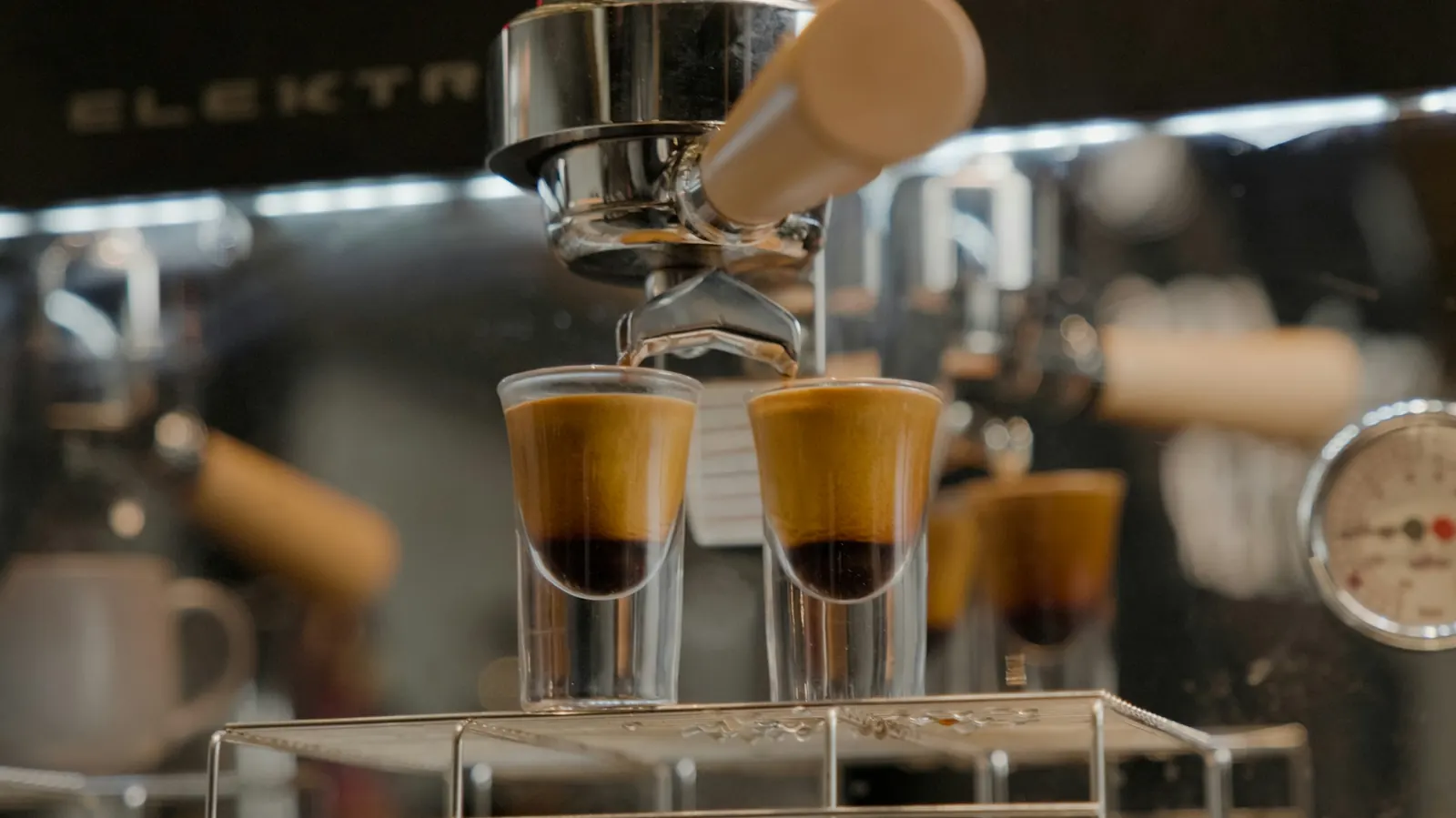
An espresso shot glass is a small measuring tool more than a drinking glass. It sits under the portafilter, catches the shot, and the lines printed on its side tell you whether you pulled a single, a double or something that ran too long. A plain, unmarked shot glass can hold espresso, but it cannot tell you anything about it.
This guide covers marked glasses for a home espresso setup: double-spouted shot pitchers that split a double into two cups, heavy straight-sided measures, a pitcher with a handle, a tall three-ounce glass for long shots, borosilicate cups with a V spout and a stainless cup that will not break in the sink. For shot glasses meant for spirits, see our separate guide to the best shot glasses.
Julia’s earns a commission on purchases made through links on this page, at no cost to you. Recommendations are based on what a restaurant kitchen looks for, product specifications and verified buyer reports.
Quick verdict: which espresso shot glass to buy
For most home baristas, the best shot glasses for espresso are Rattleware’s 3-ounce double-spout shot pitchers, sold in pairs. Rattleware makes espresso bar tools, and the listing spells out white markings at every half ounce to 2 1/2 ounces and every 10 ml to 70 ml, with a spout on each side so a double can pour into two cups. If you only ever pull singles, the Kolder Mini Measure, made in America, reads to 1 ounce and 30 ml in fine steps. For doubles and long shots, the Oggi 3-ounce measuring shot glass marks every half ounce and every 10 ml up to 90 ml.
Five espresso shot glasses compared
Our five standout picks side by side, one for each kind of buyer, with the capacity and markings each listing states. All seven are reviewed in full below.
| Shot glass | Best for | Material | Capacity & marks | Buy on Amazon |
|---|---|---|---|---|
| Splitting a double, everyday dialing in | Clear glass | 3 oz; 1/2 to 2 1/2 oz, 10 to 70 ml | View on Amazon | |

Kolder Mini Measure Heavy Glass, 1 ozBest for single shots
|
Singles and ristretto, fine readings | Heavyweight glass, made in America | 1 oz; 20 marks to 30 ml | View on Amazon |

Rattleware 3 oz Shot Pitcher With HandleBest with a handle
|
Pouring hot shots into milk drinks | Clear glass, pink markings | 3 oz; ml and oz scales | View on Amazon |
Oggi Measuring Shot Glass, 3 ozBest for doubles
|
Doubles, lungo, a carajillo’s espresso | Weighty glass, heavy base | 3 oz; every 0.5 oz and 10 ml | View on Amazon |

MHW-3BOMBER 2 oz Stainless Espresso CupBest unbreakable
|
Hard counters, travel, clumsy mornings | 304 stainless steel | Holds 3 oz; lines at 1, 1.5, 2 oz | View on Amazon |
Our picks for the best shot glasses for espresso
Every glass here has volume markings, which is the point of an espresso shot glass. All seven were in stock on Amazon when we checked. Plain glass needs no special lead statement, and none of these picks is crystal or glazed ceramic.
1. Rattleware 3 oz Double-Spout Shot Pitchers, Set of 2 – Splits a Double Cleanly

Rattleware is a specialty coffee supplier whose range, as Seattle Coffee Gear lists it, runs from tampers and knock boxes to milk pitchers, and its glass shot pitcher is one of the most familiar items on a café bar. This listing is the pair: two clear glass pitchers, each about 2.9 by 2 by 2.4 inches, short enough to sit under most portafilters on a home machine.
The markings are the reason to buy it. The listing describes white printed lines at 1/2, 1, 1 1/2, 2 and 2 1/2 ounces, plus 10 to 70 ml in 10 ml steps. The rim holds 3 ounces, so there is headroom above the top line for crema and a shot that runs a little long. Each pitcher has a spout on both sides, so a double can be poured into two cups, or the glass can be used by left- and right-handed cooks alike.
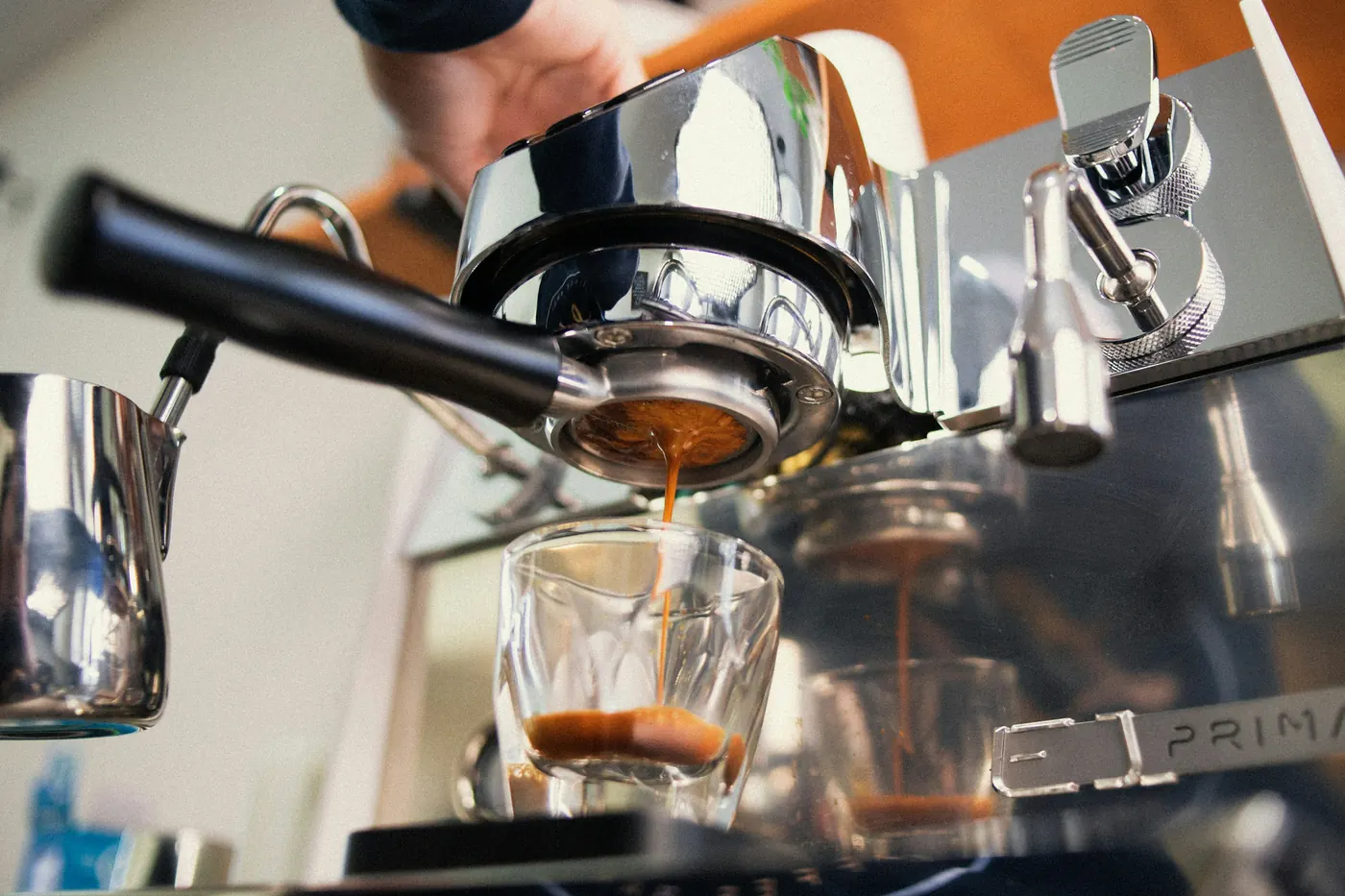
Two pitchers are useful in practice: put both under a double-spout portafilter and you can see whether the two streams are even, which is a quick clue to uneven tamping or distribution. Rattleware recommends hand washing, though the listing says the glass is commercial-dishwasher safe. One buyer reported in Seattle Coffee Gear’s reviews that the markings on their unit were off, so check a new glass against a scale once.
Why we like it
- Ounce and milliliter scales, per the listing
- Spout on each side
- Two pitchers for a split double
- Headroom above the 2 1/2 oz line
Key specifications
| Model | 5001721pr |
|---|---|
| Material | Clear glass |
| Capacity | 3 oz to the rim |
| Markings | 1/2 to 2 1/2 oz; 10 to 70 ml |
| Count | 2 |
| Dimensions | About 2.89 x 2.02 x 2.40 in |
| Dishwasher safe | Hand wash recommended; commercial dishwasher safe |
| Made in | Not stated |
Why we recommend it
It suits anyone with a home espresso machine who wants to see shot volume at a glance and split doubles between two cups.
Skip it if you want a glass to drink from; a spouted pitcher is a measuring tool, not a serving glass.
Pros and cons
Pros
- Clear dual scales
- Pours from either side
- Comes as a pair
Cons
- No handle; hot to hold when full
- Printed lines, hand wash advised
- One buyer reported inaccurate marks
2. Kolder Mini Measure Heavy Glass, 1 oz – Fine Steps for a Single
The Kolder Mini Measure is the small, heavy, straight-sided glass many cooks already know from the baking aisle, and it happens to be the right size for a single espresso. Kolder’s listing says it is made in America from heavyweight glass, with a weighted base that resists tipping.
It carries 20 measurements, which the listing says are permanently marked and will not fade or wear off: up to 6 teaspoons, 2 tablespoons, 1 ounce and 30 ml. For espresso, the milliliter and ounce scales are the useful ones. A single shot sits near the top of the glass, which makes small differences in volume easier to see than they would be in a wide 3-ounce pitcher. A ristretto, the shorter shot, shows clearly below the 1-ounce line.
The trade-off is capacity. At 1 ounce, it has no room for a double, so pair it with a larger glass if you pull both. It is dishwasher safe according to the listing, and the color of the markings varies by listing (this one is red).
Why we like it
- 20 permanent marks, per Kolder
- Weighted base resists tipping
- Made in America
- Dishwasher safe
Key specifications
| Model | 13211 |
|---|---|
| Material | Heavyweight glass |
| Capacity | 1 oz / 30 ml |
| Markings | 20 increments: tsp, tbsp, oz, ml |
| Count | 1 |
| Dimensions | Not stated |
| Dishwasher safe | Yes |
| Made in | USA |
Why we recommend it
It suits a cook who pulls single shots or ristretto and wants the finest readings in the smallest glass.
Skip it if you mostly pull doubles; a 1-ounce glass overflows.
Pros and cons
Pros
- Fine, permanent graduations
- Heavy and stable
- Doubles as a kitchen measure
Cons
- Too small for a double
- No spout
- Sold singly
3. Rattleware 3 oz Shot Pitcher With Handle – A Grip for Hot Shots
This is Rattleware’s 3-ounce shot pitcher in a version with a handle, which makes a difference when the glass is full of coffee straight from the group head and you are pouring it into a cup of steamed milk. The listing gives its size as about 2 by 2 by 2.4 inches.
The markings are printed in pink, which the listing describes as bold graduations in both milliliters and ounces, chosen to be easy to read against dark coffee. Rattleware pitches it for espresso shots, double shots and small measured ingredients, and the shape is the familiar beaker style with a pouring lip.
It is sold as a single glass here; Rattleware also lists the same model as a pair (model 5004966pr) if you want two. Compared with our top pick, you give up the second spout and the white scale, and gain a handle. Dishwasher information is not spelled out on this listing beyond the claim that it withstands frequent washing, so hand washing is the safe way to protect printed lines.
Why we like it
- Handle for pouring hot shots
- Pink ml and oz scales
- Compact 3 oz size
- Also sold as a pair
Key specifications
| Model | 5004966 |
|---|---|
| Material | Clear glass |
| Capacity | 3 oz |
| Markings | Pink ml and oz graduations |
| Count | 1 |
| Dimensions | About 2 x 2 x 2.4 in |
| Dishwasher safe | Not stated |
| Made in | Not stated |
Why we recommend it
It suits a home barista who makes lattes and cappuccinos and pours each shot into milk rather than drinking it straight.
Skip it if you want to split a double into two cups; it has one pouring lip.
Pros and cons
Pros
- Handle keeps fingers off hot glass
- Easy-to-read colored marks
- Small enough for most machines
Cons
- Single spout
- Dishwasher care not stated
4. Oggi Measuring Shot Glass, 3 oz – Room for Doubles and Long Shots
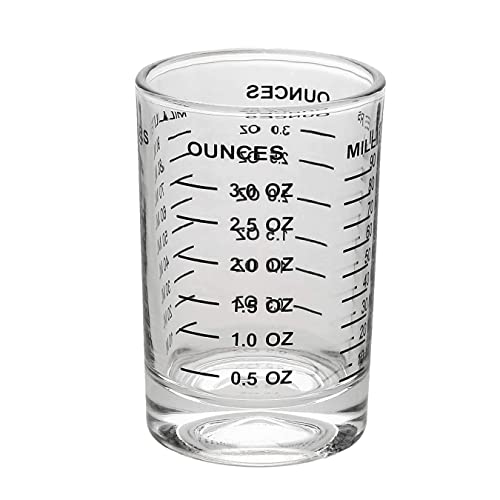
Oggi makes bar and kitchen tools, and its measuring shot glass is a heavy, straight-sided glass with large printed markings. The listing gives a 3-ounce capacity, marked in half-ounce steps, and a 90 ml capacity marked every 10 ml, which covers a double shot with plenty of room left above it.
That extra height is what separates it from a 1-ounce measure. A lungo, a longer pull, or the two ounces of espresso many carajillo recipes call for both fit with space to spare, and the heavy base keeps the glass upright on a drip tray. The listing describes it as weighty glass with a heavy base to help avoid spills.
The trade-off is that it has no spout or handle, so pouring from it is like pouring from any tumbler, and the half-ounce steps are coarser than the Kolder’s. Oggi markets it for spirits as well as espresso, so it works as a bar measure too.
Why we like it
- Every 0.5 oz and 10 ml, per Oggi
- Room above a double shot
- Heavy base
- Large, easy-to-read marks
Key specifications
| Model | 7639 |
|---|---|
| Material | Weighty glass |
| Capacity | 3 oz / 90 ml |
| Markings | 0.5 oz and 10 ml steps |
| Count | 1 |
| Dimensions | Not stated |
| Dishwasher safe | Not stated |
| Made in | Not stated |
Why we recommend it
It suits someone who pulls doubles or long shots and wants one sturdy glass that also measures for cocktails.
Skip it if you need fine readings on a single shot; the Kolder reads in smaller steps.
Pros and cons
Pros
- Big capacity with clear marks
- Stable heavy base
- Useful at the bar too
Cons
- No spout or handle
- Coarser half-ounce steps
- Care not stated
5. Rattleware 2 oz Graduated Shot Glass – A Plain Measure in Milliliters

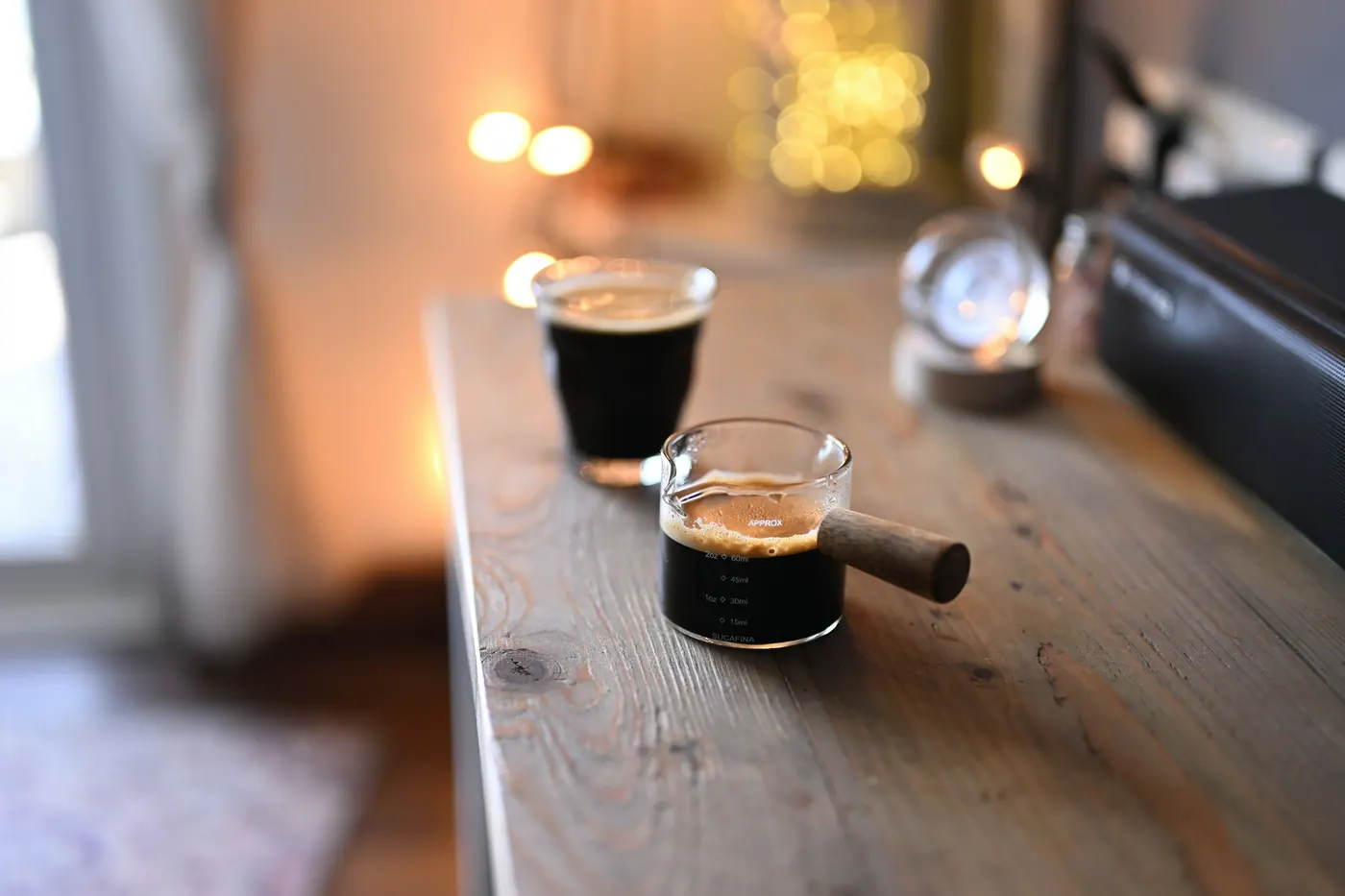
Rattleware’s 2-ounce graduated shot glass is the simplest design here: a thick, straight-sided glass with milliliter markings on the body and no spout or handle. The listing describes it as heavy-duty glass meant for café and home bar use.
Two ounces is a sensible size for espresso. It holds a standard double with a little headroom, and it is narrower than a 3-ounce pitcher, so a single shot rises higher on the scale and is easier to read. The listing says the markings are in milliliters only, so if you think in ounces, remember that 30 ml is roughly an ounce.
It is dishwasher safe according to the listing. The listing title says “cups” while the unit count reads one, so check the quantity on the product page before you order.
Why we like it
- Holds a double with headroom
- Thick glass, per the listing
- Dishwasher safe
- Rattleware’s coffee-bar range
Key specifications
| Model | 5005027pr |
|---|---|
| Material | Thick clear glass |
| Capacity | 2 oz |
| Markings | Milliliters |
| Count | Not clearly stated |
| Dimensions | Not stated |
| Dishwasher safe | Yes |
| Made in | Not stated |
Why we recommend it
It suits a cook who wants a sturdy, no-frills glass that covers singles and doubles and reads in metric.
Skip it if you need an ounce scale; this one is marked in milliliters only.
Pros and cons
Pros
- Right size for a double
- Simple to clean
- Narrow shape reads well
Cons
- Metric markings only
- No spout
- Pack quantity unclear
6. Ackers BORO3.3 2 oz Measuring Cups, Set of 2 – Borosilicate With a V Spout

Ackers BORO3.3 sells small measuring cups in 3.3 borosilicate glass, the heat-resistant type used for much ovenproof kitchen glassware. This set has two 2-ounce cups, each with a V-shaped spout that the listing says narrows the stream for careful pouring.
The scales are the most detailed on this list. The listing describes red graduations covering 5 to 60 ml, 1/4 to 2 fluid ounces, 1 to 12 teaspoons, 1/2 to 4 tablespoons and 1/16 to 1/4 cup. For espresso, the 5 ml steps give a close reading on a single, and the 60 ml top covers a standard double.
The makers advise hand washing the cups to help preserve the printed markings. Ackers BORO3.3 is a brand found mainly on Amazon, so there is less outside information about it than about Rattleware or Kolder. We include it for the glass type and the spout, which none of the other straight-sided picks has.
Why we like it
- 3.3 borosilicate glass
- 5 ml steps to 60 ml
- V spout for clean pours
- Two cups in the set
Key specifications
| Model | 2 Oz-Pack of 2 |
|---|---|
| Material | 3.3 borosilicate glass |
| Capacity | 2 fl oz / 60 ml |
| Markings | ml, fl oz, tsp, tbsp, cup |
| Count | 2 |
| Dimensions | Not stated |
| Dishwasher safe | Hand wash advised |
| Made in | Not stated |
Why we recommend it
It suits a cook who wants fine metric readings and a spout, in heat-resistant glass, for both espresso and kitchen measuring.
Skip it if you want a glass that can go in the dishwasher without a second thought.
Pros and cons
Pros
- Most detailed scales here
- Spout on a straight cup
- Heat-resistant glass
Cons
- Hand wash to keep the print
- Little information beyond the listing
7. MHW-3BOMBER 2 oz Stainless Espresso Cup – Will Not Shatter
MHW-3BOMBER makes espresso accessories, and this is its stainless steel answer to the glass shot pitcher. The listing says it is 304 stainless steel, so it will not rust or shatter if it hits a tile floor, and it has a handle and a pointed pouring spout.
The markings are inside the cup, at 1, 1.5 and 2 ounces, and the listing says it holds up to 3 ounces at most, so a double has room. The mouth is 2.76 inches across, which the maker says suits most portafilters. This listing is the plain polished finish; the same cup comes in coated black and white, and the maker says to keep the coated versions out of the dishwasher.
The obvious drawback is that you cannot see through steel. You read the level from above, against three lines, rather than watching the shot and crema build from the side. That makes it a durable everyday cup rather than a tool for dialing in a new coffee.
Why we like it
- 304 stainless, per the listing
- Lines at 1, 1.5 and 2 oz
- Handle and pointed spout
- Wide 2.76-inch mouth
Key specifications
| Model | G512 |
|---|---|
| Material | 304 stainless steel |
| Capacity | Up to 3 oz |
| Markings | Inside lines at 1, 1.5, 2 oz |
| Count | 1 |
| Dimensions | 2.76-in mouth |
| Dishwasher safe | Not stated for this finish |
| Made in | Not stated |
Why we recommend it
It suits a household where glass breaks, or anyone who takes a manual espresso maker camping.
Skip it if you want to watch the shot; steel hides the color and the crema.
Pros and cons
Pros
- Won’t break
- Handle and spout
- Room for a double
Cons
- Opaque, only three lines
- Coarse readings
How to choose an espresso shot glass
Markings you can read
The scale is the reason to own one. Look for both ounces and milliliters if you follow recipes from different sources, and for small steps (5 or 10 ml) if you pull singles. Contrasting colors such as white, red or pink are easier to read against dark coffee than faint etching. Printed lines usually last longer with hand washing; Kolder’s listing is one of the few that says its marks are permanent.
Size: single, double or long
Italy’s espresso institute, the INEI, specifies 25 ml in the cup for its certified Italian espresso, and a double is usually around twice that. A 1-ounce glass suits singles and ristretto, a 2-ounce glass holds a double, and a 3-ounce glass leaves room for crema, a lungo or a shot that runs long. If you only buy one, 2 to 3 ounces covers most home machines.
Spout, handle or straight sides
A spout matters if you pour the shot into milk or split a double; two spouts let you pour from either side. A handle keeps your fingers off hot glass. Straight-sided glasses without either are sturdier, read more evenly and are easier to clean.
Height under the portafilter
Measure the gap between your machine’s drip tray and the portafilter spouts before you buy. Rattleware’s pitchers are about 2.4 inches tall, which fits most home machines; a taller glass may need you to remove the drip tray grate.
Material
Clear glass lets you watch the shot and the crema build, which is useful when you are adjusting the grind. Borosilicate handles sudden heat better than ordinary glass. Stainless steel will not break but hides the shot. Plain glass and stainless need no lead-free statement; if you ever buy a crystal or glazed ceramic shot cup, look for the maker’s own lead-free statement first.
Volume or weight
Marks are a good everyday guide, but they are not the whole story. Barista Hustle points out that crema is mostly trapped gas, far lighter than the liquid beneath it, so its volume changes with how fresh the coffee is and makes volume a rough measure. Many baristas weigh the shot on a scale instead and use the glass to check flow and split doubles. If you want to do the same, our guide to the best kitchen scale covers scales that read in small steps.
How we chose these seven glasses
We started from the brands a coffee bar would recognize and searched Amazon for shot glasses and pitchers that carry volume markings, then read each listing for capacity, the units and steps of the scale, the material and care. We kept only glasses that were in stock when we checked and dropped unmarked double-wall cups, which are made for drinking rather than measuring, and tequila shot glasses, which belong in our shot glass guide. We used Seattle Coffee Gear’s product page and buyer reviews for Rattleware, Barista Hustle on measuring by weight, and the INEI’s published espresso parameters. We have not used these glasses in Julia’s kitchen; we name what each maker and listing says.
Espresso shot glass questions, answered
How many ounces is an espresso shot glass?
Most hold 2 to 3 ounces, with markings that stop a little short of the rim. A 1-ounce measure works for single shots only. The extra room above the top line is for crema and a shot that runs long.
Can you use a regular shot glass for espresso?
Yes, if it fits under the portafilter and you don’t mind guessing. A bar shot glass has no scale, or just one line, so it cannot tell you how much you pulled. Thick bar glass can also be cold and pull heat out of the shot.
Are espresso shot glass markings accurate?
Close enough for everyday use, but not exact. Printed lines vary from glass to glass, one Rattleware buyer reported marks that were off, and crema makes volume hard to read. Check a new glass once with water on a kitchen scale (1 ml of water weighs about 1 gram).
Can espresso shot glasses go in the dishwasher?
Some can: Kolder’s and Rattleware’s 2-ounce glass are listed as dishwasher safe. Others, including Ackers’ cups, advise hand washing to protect the printed scale. Hand washing is the safest choice for any glass with printed lines.
Do I need a shot glass if I weigh my espresso?
You still need something to catch the shot. A small marked glass lets you weigh the shot and see the flow at the same time, and a double-spout pitcher shows whether both streams are even.
The espresso shot glasses we would buy first
Related guide: Best espresso cups.
Start with Rattleware’s pair of double-spout pitchers: two scales, two spouts and room for a double. Add the Kolder Mini Measure if you pull singles, or the Oggi 3-ounce glass if you pull long. For the machine itself, see the best espresso machine or, if you are just starting out, the best espresso machine for beginners. To grind for it, see the best small espresso grinder. If the espresso is going into a carajillo, measure the liqueur with a jigger, serve it only to adults of legal drinking age and never drink and drive. And when you would rather someone else made dinner, see the menu or call to order.