A cookie scoop does one thing well: it drops the same amount of dough every time, so a tray of cookies bakes evenly and the recipe gives the yield it promises. America’s Test Kitchen puts it plainly: when cookies are portioned larger or smaller than the recipe directs, “they may not produce the intended texture.” If you have no scoop, the goal is the same even portions by another route.
This guide covers what to use instead of a cookie scoop: a kitchen scale, a measuring spoon, a bench scraper with a chilled slab of dough, parchment, and a piping bag for soft doughs. For each we say how close it gets to a scoop and where it falls short.
Julia’s earns a commission on purchases made through links on this page, at no cost to you. Recommendations are based on what a restaurant kitchen looks for, product specifications and verified buyer reports.
Why bakers look for a cookie scoop alternative
- There is no scoop in the drawer, or not the right size for the recipe.
- Scoops are single-purpose. A disher takes room for a tool many people use a few times a year.
- Some doughs fight a scoop. Very stiff dough strains the trigger, and very soft dough sticks inside the bowl of the scoop.
- Some bakers want more precision than a scoop gives, for example when baking for a bake sale or matching a recipe’s yield exactly.
Quick verdict: the best cookie scoop alternative
For the most even cookies, the best cookie scoop alternative is a digital kitchen scale such as the Escali Arti Glass Food Scale: weigh the whole batch, divide by the number of cookies, and weigh each ball. It is slower than a scoop but more exact. For speed, a level 1-tablespoon measuring spoon is the closest no-skill stand-in. For a big batch, pat the dough into a slab on parchment, chill it, and cut it into even squares with a bench scraper, the method King Arthur Baking describes. For soft, pipeable doughs, use a piping bag. If you bake drop cookies every week, a real scoop is faster than any of these; our guide to the best cookie scoop covers sizes.
Five ways to portion cookies without a scoop, side by side
Our five picks, one for each way to portion dough, with what each maker or listing states. All five are reviewed in full below.
| Alternative | Best for | How even? | Speed | Buy on Amazon |
|---|---|---|---|---|

Escali Arti Glass Food ScaleBest overall alternative
|
Exact, matching cookies | The most even | Slowest | View on Amazon |
Cuisinart Magnetic Measuring SpoonsBest quick stand-in
|
Everyday drop cookies | Good if leveled | Fast | View on Amazon |

Winco 4.5 x 4-inch Blade ScraperBest for big batches
|
Cutting a chilled slab into squares | Even if the slab is even | Fast once chilled | View on Amazon |

Reynolds Kitchens Pop-Up Parchment SheetsBest for slab and log dough
|
Shaping and chilling dough | Works with the scraper | Needs chilling time | View on Amazon |

Wilton Professional Reusable Piping Bag, 12-inchBest for soft doughs
|
Soft, pipeable cookie doughs | Takes practice | Fast once filled | View on Amazon |
Product images from Amazon. Sizes and materials are as stated by each maker or listing; check the listing before you buy.
Even cookies without a scoop: the no-buy options
Two sources we read cover the basics. King Arthur Baking’s PJ Hamel, in The fastest way to scoop drop cookies (2015), scooped a tray of cookies with a regular spoon and then tried two spoons, but found that “the dough stuck to both spoons instead of just one.” Her point is that a scoop is faster and cleaner, and “lets you portion out the same amount of dough each time.” So a single spoon works; a second spoon mostly adds washing up.
In A simple way to shape cookies (2019), Hamel skips scooping altogether. She pats drop-cookie dough onto greased parchment or waxed paper, wraps and chills it for 30 minutes, then cuts it into pieces, noting that “a bench knife, heavy chef’s knife, or rolling pizza cutter are all suitable tools for the task.” That is the method behind two of our picks below.
America’s Test Kitchen’s How to Fix 10 Common Cookie Problems adds two useful details: “A typical cookie requires a #30 scoop,” and “If the dough seems too soft, chill it for 10 to 15 minutes before portioning.” Chilling helps every method on this page, not only scooping.
- One spoon and your finger or a second spoon: fine for a casual batch; expect some variation.
- Roll by hand: pinch off dough and roll balls between your palms; compare each to the first ball by eye. This is general kitchen sense, and it is how many polvorones and other shaped Mexican cookies are made anyway.
- Divide in halves: split the dough in half, then each half in half again, until you have the number of pieces the recipe needs. Also general kitchen sense, and surprisingly even.

Five tools to use instead of a cookie scoop
All five are from established makers and were in stock on Amazon, sold new by Amazon, on the day of writing. Each handles portioning in a different way.
1. Escali Arti Glass Food Scale – The Most Even Cookies
A scoop measures dough by volume; a scale measures it by weight, which is more exact because it ignores air pockets and chunky mix-ins. The method is simple: weigh the whole bowl of dough (after taring the empty bowl), divide by the number of cookies the recipe should make, and weigh each ball to that number. It is slower than a scoop, but every cookie comes out the same size, so they all finish baking at the same time.
Escali’s Arti is a tempered glass scale that weighs up to 15 pounds and reads in grams, pounds, ounces, fluid ounces or milliliters. The listing describes a tare button that resets the scale to zero to subtract a container, a display hold that keeps showing the reading after the item is removed, and automatic shut-off after five minutes of inactivity. It runs on two CR2032 batteries, which are included, and measures 9 x 6.5 x 0.75 inches. Escali lists a lifetime limited warranty.
Weighing every ball is tedious for a big batch. A good compromise is to weigh the first few and then match the rest by eye. The scale is useful far beyond cookies, which is the real reason to buy one. Our guide to the best kitchen scale for baking compares others.
Why we like it
- Tare button for weighing in the bowl
- Display hold keeps the reading visible
- Up to 15 pounds, five units
- Lifetime limited warranty, per the listing
Key specifications
| Model | 157 (157SS) |
|---|---|
| Type | Digital kitchen scale |
| Capacity | 15 lb |
| Units | g, lb, oz, fl oz, ml |
| Size | 9 x 6.5 x 0.75 in |
| Power | Two CR2032 batteries, included |
| Warranty | Lifetime limited |
Why we recommend it
Choose it if you want matching cookies, bake to a recipe’s exact yield, or want one tool that helps with all your baking.
Skip it if speed matters more than precision; a spoon is quicker.
Pros and cons
Pros
- Most even portions
- Useful for all baking
- Thin and easy to store
Cons
- Slow ball by ball
- Needs batteries
- Still need to shape by hand
2. Cuisinart Magnetic Measuring Spoons – A Level Tablespoon Every Time
Many cookie recipes describe portions in tablespoons, and a cookie scoop is often sold by the tablespoon it holds. A real measuring tablespoon, filled and leveled, gives a much more even portion than a dinner spoon, whose size varies from set to set. Press the dough in, scrape it level against the side of the bowl, and push it out onto the sheet with a finger.
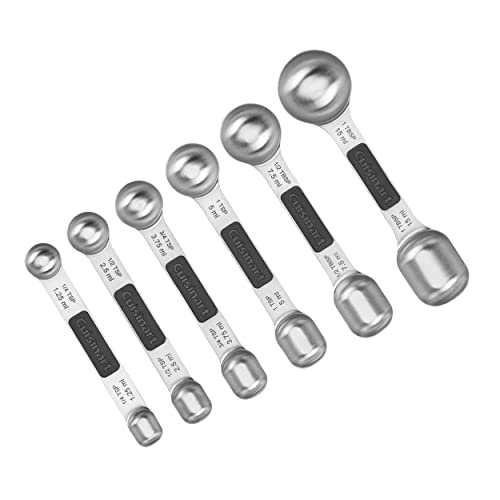
Cuisinart’s set has six stainless steel spoons: 1 tablespoon, ½ tablespoon, 1 teaspoon, ¾ teaspoon, ½ teaspoon and ¼ teaspoon. The listing says heavy-duty magnets hold the spoons together for storage, the narrow heads fit into spice jars, and the measurements are marked on both sides. For larger cookies, use two level tablespoons per cookie.
The limit is sticky dough. It clings inside the bowl of the spoon, and the push-out step is messier than a scoop’s release. Chilling the dough first, as ATK advises for soft dough, helps. Our guide to the best measuring spoons covers other sets.
Why we like it
- A true level tablespoon
- ½-tablespoon spoon for small cookies
- Magnets keep the set together
- Markings on both sides
Key specifications
| Model | CTG-00-6MSP |
|---|---|
| Type | Measuring spoon set |
| Pieces | 6: 1 Tbsp to ¼ tsp |
| Material | Stainless steel |
| Storage | Magnetic nesting |
| Warranty | Not stated on the listing |
Why we recommend it
Choose it if you want a fast, reasonably even portion with a tool you will use daily anyway.
Skip it if your dough is very sticky and you cannot chill it; it will cling to the spoon.
Pros and cons
Pros
- Fast
- Even if leveled
- Everyday tool
Cons
- Sticky dough clings
- Messier release than a scoop
- Only up to 1 tablespoon
3. Winco 4.5 x 4-inch Blade Scraper – Cuts a Chilled Slab Into Even Squares
This is the method King Arthur Baking describes: pat the dough into an even slab on parchment, chill it, then cut it into squares. Each square becomes a cookie, and if the slab is an even thickness, every piece is the same size. It is the fastest way through a double batch, and the squares can go onto the sheet as they are or be rolled into balls.
A bench knife is one of the tools King Arthur names for the cutting. Winco’s TN54 is a stainless steel blade scraper, 4.5 by 4 inches, with a wooden handle. The listing says it has a satin finish that resists corrosion, that it handles scraping and chopping, and that it is dishwasher safe. Its straight edge cuts straight down through cold dough, and it also lifts the pieces and scrapes the board clean afterwards.
It needs planning: the slab has to chill, so this is not the method for dough you want to bake right now. Uneven patting gives uneven cookies, so pat the slab to a steady thickness. A ruler-marked scraper would help with spacing; this one has no markings. Our guide to the best bench scraper covers marked models.
Why we like it
- Straight steel edge cuts cold dough cleanly
- Also scrapes the board and lifts dough
- Dishwasher safe, per the listing
- Small enough for a drawer
Key specifications
| Model | TN54 |
|---|---|
| Type | Blade scraper |
| Material | Stainless steel blade, wooden handle |
| Size | 4.5 x 4 in |
| Markings | None |
| Cleaning | Dishwasher safe |
Why we recommend it
Choose it if you bake large batches, freeze dough ahead, or like to plan cookies a day in advance.
Skip it if you want to bake the moment the dough is mixed.
Pros and cons
Pros
- Fast for many cookies
- Even if the slab is even
- Useful for bread and tortilla dough
Cons
- Dough must chill first
- No measuring marks
- Square pieces, not balls
4. Reynolds Kitchens Pop-Up Parchment Sheets – For the Slab, the Log and the Pan
The slab method needs something to pat the dough onto and wrap it in, and King Arthur calls for greased parchment or waxed paper. Parchment is also what you need to roll dough into a log for slice-and-bake cookies: roll the log in a sheet, twist the ends, chill it, and slice it into rounds of even thickness. That is another way to get even cookies with no scoop at all, and it is general kitchen sense rather than from the sources above.
Reynolds’ pop-up sheets come 30 to a box, each about 10.75 by 13.75 inches, pre-cut and lying flat, so they do not curl the way a roll does. Reynolds says they are non-stick, oven-safe up to 425°F, and can be reused up to three times per baking session, so the sheet you chilled the slab on can then line the baking pan.
A sheet this size suits one slab or one log and one half-size pan; it will not line a large full sheet pan. Watch the 425°F limit for any cookie baked hotter. Our guide to the best parchment paper covers rolls.
Why we like it
- Pre-cut sheets lie flat
- Oven-safe to 425°F, per Reynolds
- Reusable up to 3 times per session
- One-hand pop-up box
Key specifications
| Model | G79277 |
|---|---|
| Type | Pre-cut parchment sheets |
| Count | 30 sheets |
| Size | About 10.75 x 13.75 in |
| Heat limit | 425°F |
| Reuse | Up to 3 times per baking session |
Why we recommend it
Choose it if you will use the slab or slice-and-bake method, or want lined pans without wrestling a roll.
Skip it if you already keep a parchment roll; any parchment does this job.
Pros and cons
Pros
- No curling edges
- Shape, chill and bake on one sheet
- Easy cleanup
Cons
- Too small for full sheet pans
- 425°F limit
- Disposable after a few uses
5. Wilton Professional Reusable Piping Bag, 12-inch – For Soft Doughs
Some cookie doughs are too soft to scoop or cut cleanly: meringue cookies, soft butter-cookie doughs and some sandwich-cookie batters. These are piped. A piping bag with a plain opening lets you squeeze out mounds of the same size in a row; with practice they come out very even. This is general kitchen sense rather than something our sources cover, and it only suits dough soft enough to pass through the bag.
Wilton’s 12-inch bag is a reusable, featherweight polyester bag. The listing says it is lightweight and flexible and won’t turn stiff, that a grease-resistant coating stops the filling seeping through, and that it can be washed and reused, with or without a coupler. Wilton sells it for icing cakes, cookies and cupcakes, so it also earns its place after the cookies are baked.
Firm drop-cookie doughs with chips or nuts will not pipe; chunks block the opening. Filling and washing a bag takes longer than using a spoon, and there is a learning curve. Our guide to the best piping bags covers disposable options.
Why we like it
- Reusable and washable
- Grease-resistant coating, per Wilton
- Works with or without a coupler
- Also ices the finished cookies
Key specifications
| Model | 191005782 (part 331321) |
|---|---|
| Type | Reusable piping bag |
| Material | Polyester, grease-resistant coating |
| Size | 12 in |
| Tips | Fits standard couplers and tips, per the title |
| Warranty | Not stated |
Why we recommend it
Choose it if you bake soft, pipeable cookies or also decorate with icing.
Skip it if your cookies are chunky drop cookies; they will not pipe.
Pros and cons
Pros
- Even rows of soft dough
- Reusable
- Doubles for icing
Cons
- Soft doughs only
- Learning curve
- More to wash

Which method for which cookie
This is our kitchen’s summary of the sources above, not a published test:
- Chocolate chip and other drop cookies, baked today: a level measuring tablespoon, or a scale if you want them to match.
- A double batch, or dough to freeze: pat a slab on parchment, chill and cut with a bench scraper.
- Slice-and-bake butter cookies: roll a log in parchment, chill and slice.
- Polvorones, wedding cookies and other rolled balls: weigh the first few, then roll the rest by hand to match.
- Meringues and soft doughs: a piping bag.
What we left out, and why
We left out ice cream scoops: a trigger-release ice cream scoop is essentially a large cookie scoop, so it is not really an alternative, and our ice cream scoop alternative page covers the reverse question. We left out melon ballers because the ones from established makers were already recommended on our other pages, and small portions are just as easy with the ½-tablespoon spoon. A cookie press makes even cookies too, but only spritz-style shapes from soft dough, so it is a different tool rather than a scoop stand-in.
When a real cookie scoop makes more sense
King Arthur’s test is the honest one: a scoop is faster, keeps fingers out of the dough, and portions the same amount each time. If you bake drop cookies often, a spring-loaded scoop in the size your recipes use (ATK suggests a #30 for a typical cookie) beats every method here on speed, and nearly matches a scale on evenness. The alternatives make sense when you bake rarely, want more precision, or are making a cookie that is not a drop cookie at all.
Cookie scoop alternative questions, answered
What can I use instead of a cookie scoop?
A level measuring tablespoon for speed, a kitchen scale for precision, a chilled slab of dough cut with a bench scraper for big batches, a parchment-wrapped log for slice-and-bake cookies, or a piping bag for soft doughs.
How do I make cookies the same size without a scoop?
Weigh the dough, divide by the number of cookies, and weigh each portion. If you have no scale, divide the dough in half again and again until you reach the right number of pieces.
Can I use two spoons to portion cookie dough?
You can, but King Arthur’s PJ Hamel found the dough “stuck to both spoons instead of just one.” One spoon plus a finger to push the dough off is simpler.
What size is a tablespoon cookie scoop?
A tablespoon scoop holds about a level measuring tablespoon of dough, so a level tablespoon is the direct stand-in. ATK says a typical cookie needs a #30 scoop; check your recipe for its size.
Should I chill dough before portioning?
If it is soft, yes. ATK suggests chilling for 10 to 15 minutes before portioning, and the slab method needs about 30 minutes, per King Arthur.
Our final word on even cookies without a scoop
A scale gives the most even cookies, a level tablespoon gives the quickest decent ones, and a chilled slab cut with a bench scraper handles the big batches. Keep the piping bag for soft doughs. If you bake drop cookies every week, buy the scoop. And if you would rather someone else made dessert tonight, call to order from Julia’s.