
A pastry cutter, or pastry blender, has one job: break cold butter into small pieces coated in flour without melting it. Those pieces turn to steam in the oven and leave the flaky layers in pie crust, biscuits and scones. Plenty of other tools do the same job, some faster, some with less washing up.
This guide covers the pastry cutter alternative that suits each kitchen and each dough, how well each works and what it costs you, using what King Arthur Baking and America’s Test Kitchen publish, read directly. Where something is our own kitchen sense rather than a source’s, we say so.
Julia’s earns a commission on purchases made through links on this page, at no cost to you. Recommendations are based on what a restaurant kitchen looks for, product specifications and verified buyer reports.
Why cut in butter without a pastry cutter
A good pastry blender is still a cheap, simple tool, and our best pastry dough blender guide covers the ones worth buying. But King Arthur Baking’s PJ Hamel lists several ways to work butter into flour for biscuits: “your fingers, a fork or pastry blender, a stand mixer, or a food processor.” People reach for the others for plain reasons:
- Hard, cold butter is tiring to cut by hand. In her piece on mixer pie crust, Hamel notes that working hard chunks of cold butter into flour can be difficult even with a pastry blender.
- Warm hands and warm kitchens. King Arthur’s grated-butter article says cutting in can leave butter too soft in a warm kitchen or with warm hands. In Houston that is most of the year.
- Consistency. Machines and graters give pieces of the same size every time.
- You already own the alternative. A box grater, a food processor or a stand mixer is in many kitchens already.
Quick verdict: the best pastry cutter alternative
For most kitchens, the best pastry cutter alternative is a box grater, such as the Spring Chef stainless box grater: King Arthur’s bakers grate cold butter on the largest holes, which gives even shreds fast and keeps warm hands off the fat. For pie dough in quantity, a food processor like the KitchenAid 7-cup is quickest; America’s Test Kitchen cuts butter into flour this way. For a single crust, a 4-cup mini processor does it with less to wash. If you own a stand mixer, King Arthur says it gives results very close to hand work, more consistently. With no tools at all, a sturdy dinner fork or your fingertips will do.
Five ways to cut in butter, side by side
One pick per approach, with the details each maker or listing states.
| Tool | Best for | Speed | Watch out for | Buy on Amazon |
|---|---|---|---|---|

Spring Chef Large Stainless Steel Box GraterBest overall
|
Biscuits, scones, shortbread | Fast, even shreds | Fully frozen sticks slip | View on Amazon |
KitchenAid 7-Cup Food Processor, WhiteBest for pie dough
|
Double crusts, big batches | Fastest; pulse | Easy to overwork | View on Amazon |
Cuisinart Mini-Prep Plus 4-Cup Food ProcessorBest for one crust
|
Single crusts, small kitchens | Fast, small loads | Too small for double batches | View on Amazon |
KitchenAid Artisan 5-Quart Stand Mixer, Almond CreamBest hands-off
|
Pie dough without hand work | Steady, consistent | Large; only if you bake a lot | View on Amazon |

Oneida Moda 18/10 Dinner Forks, Set of 4Best no-tool option
|
Small batches, soft butter | Slowest | Tiring with very cold butter | View on Amazon |
Product images from Amazon. Details are as stated by each maker or listing. Check the listing before you buy.

What you are aiming for, whatever the tool
The tool matters less than the result, and the result depends on the dough:
- Biscuits. King Arthur’s PJ Hamel aims for “an evenly crumbly mixture (think breadcrumbs).”
- Pie crust. Uneven is the goal. America’s Test Kitchen cuts cold butter into flour in a food processor “until it resembled pebbly pieces,” and its flakiest pastry method also presses thin slices of cold butter between floured fingers until they look like nickels.
- Keep it cold. Hamel’s mixer pie crust piece says to keep the butter in your pastry as cold as possible, because intact chunks of butter make the steam pockets that give flakiness.
- Do not overwork it. In her biscuit guide, Hamel’s advice is “don’t beat up your dough”: mix only until it holds together.
As general kitchen sense, if the butter starts to look greasy or smear, put the bowl in the freezer for 10 minutes and carry on. That pause is in the spirit of King Arthur’s grated-butter tip below, where shreds go back in the freezer to firm up.
Our picks for the best pastry cutter alternative
We chose one tool per approach that King Arthur Baking or America’s Test Kitchen names, from identifiable makers: Spring Chef, KitchenAid, Cuisinart and Oneida. Each was in stock on Amazon US, sold new, when we checked. Specifications come from the listings; technique comes from the named sources or is labeled as general kitchen sense. We have not made pastry with every tool here.
1. Spring Chef Large Stainless Steel Box Grater – Even Butter Shreds in a Minute
Grating is the method King Arthur Baking has written up most fully. In Kelly Vaughan’s 2026 article on grated butter, King Arthur’s Sarah Jampel calls it faster and more efficient than cutting in a large amount of butter, and says the shreds come out a uniform size, so biscuits bake more evenly. Chef Mei Lin says grated butter gives “finer, more consistent strands of fat,” and bakers Gale Gand and Lin both use the largest holes of a box grater. Jampel uses the slicer side for biscuits, which makes thin sheets that stay distinct and build layers.
Two safety and handling notes from the same article. King Arthur’s test kitchen found a whole frozen stick “too hard and slippery to grate easily, which could lead to injury,” so Jampel grates cold butter and then freezes the shreds for 10 to 15 minutes. And lightly coating the stick in flour first makes it easier to hold and slows melting.
Spring Chef’s large grater (model SYNCHKG069204) has four sides, coarse, medium, fine and a slicer, so it covers both the large-hole and slicer methods. The listing says the blades are stainless steel, the removable rubber base stops slipping and the grater is dishwasher safe. It does not state the dimensions or a warranty.
Why we like it
- King Arthur’s bakers grate butter on a box grater
- Coarse side and slicer side both included
- Non-slip removable base, per the listing
- Dishwasher safe
Key specifications
| Model | SYNCHKG069204 |
|---|---|
| Type | 4-sided box grater |
| Capacity | Not applicable |
| Power | Manual |
| Material | Stainless steel blades |
| Cleaning | Dishwasher safe |
| Warranty | Not stated |
Why we recommend it
It suits a biscuit or scone baker, or anyone in a warm kitchen who wants the butter in the bowl before it softens.
Skip it if you hate cleaning a grater; butter is greasier to wash off than cheese.
Pros and cons
Pros
- Even shreds, quickly
- Hands barely touch the butter
- Useful every day for cheese
Cons
- Frozen sticks are risky to grate
- Spring Chef is an Amazon-first brand; sold by the brand
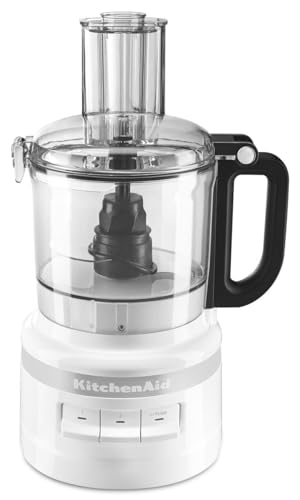
2. KitchenAid 7-Cup Food Processor, White – Pie Dough in Pulses
A food processor is on King Arthur’s list and is how America’s Test Kitchen cuts butter into flour for its flakiest pastry, until the mix resembles pebbly pieces. It is the fastest route for a double crust, and the blade does the work while your hands stay away from the butter.
KitchenAid’s 7-cup model (KFP0718) has three controls, high, low and pulse, a multi-purpose blade and a reversible slicing and shredding disc, all stored inside the bowl, per the listing. The bowl assembles with one click and a latched lid. KitchenAid gives a one-year warranty. This is the white finish of the same 7-cup model that our best food processor guide lists in black; we include it because a full-size processor is the main machine route, and this listing was sold by Amazon when we checked.
The risk is speed. As general kitchen sense, use short pulses, stop while you can still see pea-size and larger pieces of butter, and add the water by hand in a bowl so the dough is not overmixed. Our own pastry blender guide makes the same point: a processor is easy to overwork.
Why we like it
- ATK cuts butter into flour in a processor
- Pulse control for short bursts
- Blades and disc store in the bowl
- Sold by Amazon when we checked
Key specifications
| Model | KFP0718WH |
|---|---|
| Type | Food processor |
| Capacity | 7 cups |
| Power | Electric; wattage not stated in listing |
| Material | Not stated |
| Cleaning | Leak-resistant bowl; rinse with warm soapy water |
| Warranty | 1 year |
Why we recommend it
It suits a baker who makes double-crust pies or big batches of biscuits and wants a processor for salsa and slicing the rest of the time.
Skip it if you only bake a crust or two a year; a grater or fork is enough.
Pros and cons
Pros
- Fastest for big batches
- Keeps hands off the butter
- Useful far beyond pastry
Cons
- Easy to overmix
- More parts to wash than a fork
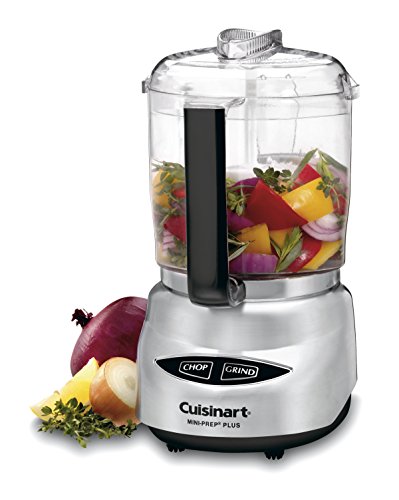
3. Cuisinart Mini-Prep Plus 4-Cup Food Processor – One Crust, Little Cleanup
If a full-size processor is more machine than you want for a single pie shell, a small one does the same work on a smaller load. The method is the one America’s Test Kitchen uses: cold butter and flour, processed until the mix looks like pebbly pieces.
Cuisinart’s Mini-Prep Plus (model DLC-4CHB) has a 4-cup work bowl with a handle, a 250-watt motor and an auto-reversing stainless steel blade with two modes, chop and grind, per the listing. The bowl and lid are dishwasher safe, the food-contact parts are BPA-free, and Cuisinart gives an 18-month limited warranty. Note that it has push-button chop and grind rather than a labeled pulse setting.
As general kitchen sense, a 4-cup bowl suits one single crust’s worth of flour and butter, not a double batch; work in two rounds if you need more, and tap the button in short bursts so the butter stays in visible pieces.
Why we like it
- Small bowl suits a single crust
- Dishwasher-safe bowl and lid
- BPA-free food-contact parts, per Cuisinart
- 18-month limited warranty
Key specifications
| Model | DLC-4CHB |
|---|---|
| Type | Mini food processor |
| Capacity | 4 cups |
| Power | 250 W |
| Material | Plastic housing, brushed-metal finish; stainless blade |
| Cleaning | Bowl and lid dishwasher safe |
| Warranty | 18-month limited |
Why we recommend it
It suits a small household or small kitchen that bakes the occasional quiche or single-crust pie.
Skip it if you bake double crusts often; the bowl is too small to do it in one go.
Pros and cons
Pros
- Small and quick to wash
- Also chops herbs, garlic and nuts
- Sold by Amazon when we checked
Cons
- One crust at a time
- No labeled pulse setting
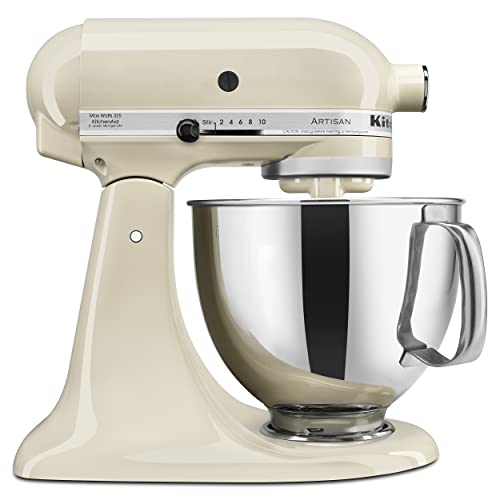
4. KitchenAid Artisan 5-Quart Stand Mixer, Almond Cream – Consistent Crust, No Hand Work
King Arthur’s PJ Hamel has made the case for pie crust in a stand mixer twice. Her method: cut the cold butter into pats, put on the beater, and run the mixer at speed 2. She writes that “whether you work butter into flour by hand or using a stand mixer, you should get very similar results,” but that “the mixer is more time-efficient and consistent,” and that it makes the process effortless for bakers who find hand work hard.
The Artisan (model KSM150PS, here in Almond Cream) has a 5-quart stainless steel bowl with a handle, a tilt head, 10 speeds and a pouring shield, per the listing. KitchenAid says the bowl is dishwasher safe and gives a one-year replacement warranty. This is the same Artisan model our best stand mixer guide reviews in another color; we include this listing because the mixer is the sourced hands-off method and it was sold by Amazon when we checked.
As general kitchen sense, a stand mixer is only worth buying for pastry if you will also use it for cookies, bread and cakes. If you already have one, it is the easiest pastry cutter alternative on this page.
Why we like it
- King Arthur gives a mixer pie crust method
- Results very similar to hand work, per Hamel
- 10 speeds; speed 2 is the one Hamel uses
- Dishwasher-safe stainless bowl
Key specifications
| Model | KSM150PSAC |
|---|---|
| Type | Tilt-head stand mixer |
| Capacity | 5 qt |
| Power | Electric, 10 speeds; wattage not stated in listing |
| Material | Metal construction; stainless bowl |
| Cleaning | Bowl dishwasher safe |
| Warranty | 1 year, replacement |
Why we recommend it
It suits a frequent baker, or anyone whose hands find cutting cold butter painful.
Skip it if it would be bought for pastry alone; a grater costs far less and takes no counter space.
Pros and cons
Pros
- Consistent, hands-free
- Handles big batches
- Does many other jobs
Cons
- Large and heavy
- A big purchase for pastry alone

5. Oneida Moda 18/10 Dinner Forks, Set of 4 – The Tool Already in the Drawer
A fork is on King Arthur’s list, next to fingers and the pastry blender itself. Press the tines down through pieces of butter in the flour, turn the bowl and repeat. It is slow with very hard butter, but it works for a small batch of biscuits or a single crust, and nobody needs to buy anything.
If your forks bend, a heavier one helps. Oneida’s Moda forks (item T711004H) are 18/10 stainless steel with a mirror finish and, per Oneida, heavy in the hand. The set is four dinner forks with a limited lifetime warranty. They are dishwasher safe, per the listing.
As general kitchen sense, cut cold butter into small cubes first, so the fork only has to break pieces down rather than through a whole block. Two table knives drawn through the butter in opposite directions do a similar job, and your fingertips, as in America’s Test Kitchen’s nickel-size method, work too; keep the butter cold and the work quick.
Why we like it
- King Arthur names a fork for cutting in butter
- 18/10 stainless steel, per Oneida
- Limited lifetime warranty
- Sold by Amazon when we checked
Key specifications
| Model | T711004H |
|---|---|
| Type | Dinner forks, set of 4 |
| Capacity | Not applicable |
| Power | Manual |
| Material | 18/10 stainless steel |
| Cleaning | Dishwasher safe |
| Warranty | Limited lifetime |
Why we recommend it
It suits an occasional baker who wants no extra gadgets, or anyone whose flatware drawer needs sturdier forks anyway.
Skip it if you bake pies often; a fork is the slowest method here.
Pros and cons
Pros
- No gadget to store
- Heavy forks do not bend easily
- Fine for small batches
Cons
- Slow with very cold butter
- Uneven pieces unless you are patient
Which method suits which dough
- Flaky biscuits and scones. Grate the butter. King Arthur’s bakers use it for biscuits and shortbread, and say it gives even shreds and defined layers.
- Pie crust. A food processor in short pulses, as America’s Test Kitchen does, or a stand mixer at low speed, as King Arthur does. Stop while the butter is still in pebbles.
- Flour tortillas. As general kitchen sense, these are usually made with lard or shortening rubbed in until fine, so a fork or fingertips are enough. Our corn vs flour tortillas explainer covers the difference.
- Shortbread pressed into a pan. Gale Gand, in King Arthur’s article, says grating makes shortbread lighter and lets you press the dough in without rolling.
Pastry cutter alternative questions, answered
What can I use instead of a pastry cutter?
King Arthur Baking lists your fingers, a fork, a stand mixer and a food processor. Its bakers also grate cold butter on a box grater. Two knives work too, as general kitchen sense.
Should the butter be frozen to grate it?
Cold, not rock hard. King Arthur’s test kitchen found a whole frozen stick too hard and slippery to grate safely. Grate cold butter and freeze the shreds for 10 to 15 minutes if you want them firmer.
Is a food processor better than a pastry cutter?
It is faster and keeps your hands off the butter, which America’s Test Kitchen uses for its flaky pastry. The risk is overmixing; pulse briefly and stop while the butter is still in visible pieces.
Can I make pie crust in a stand mixer?
Yes. King Arthur’s PJ Hamel uses the beater at speed 2 with cold butter cut into pats, and says the results are very similar to hand work, and more consistent.
How small should the butter pieces be?
For biscuits, King Arthur aims for an even, breadcrumb-like mix. For pie crust, America’s Test Kitchen stops at pebbly pieces, and larger flattened pieces add flakiness.
Our last word on cutting in butter without a pastry cutter
You do not need a pastry cutter to make flaky dough. A box grater is the quickest cheap route for biscuits, a food processor or stand mixer handles pie crust in quantity, a mini processor suits one crust, and a sturdy fork does the job when nothing else is to hand. Keep the butter cold and stop mixing early. If you would rather have the classic tool, our best pastry dough blender guide compares them, and our best box grater guide covers more graters.
And if you would rather someone else did the baking, see the menu or call to order.