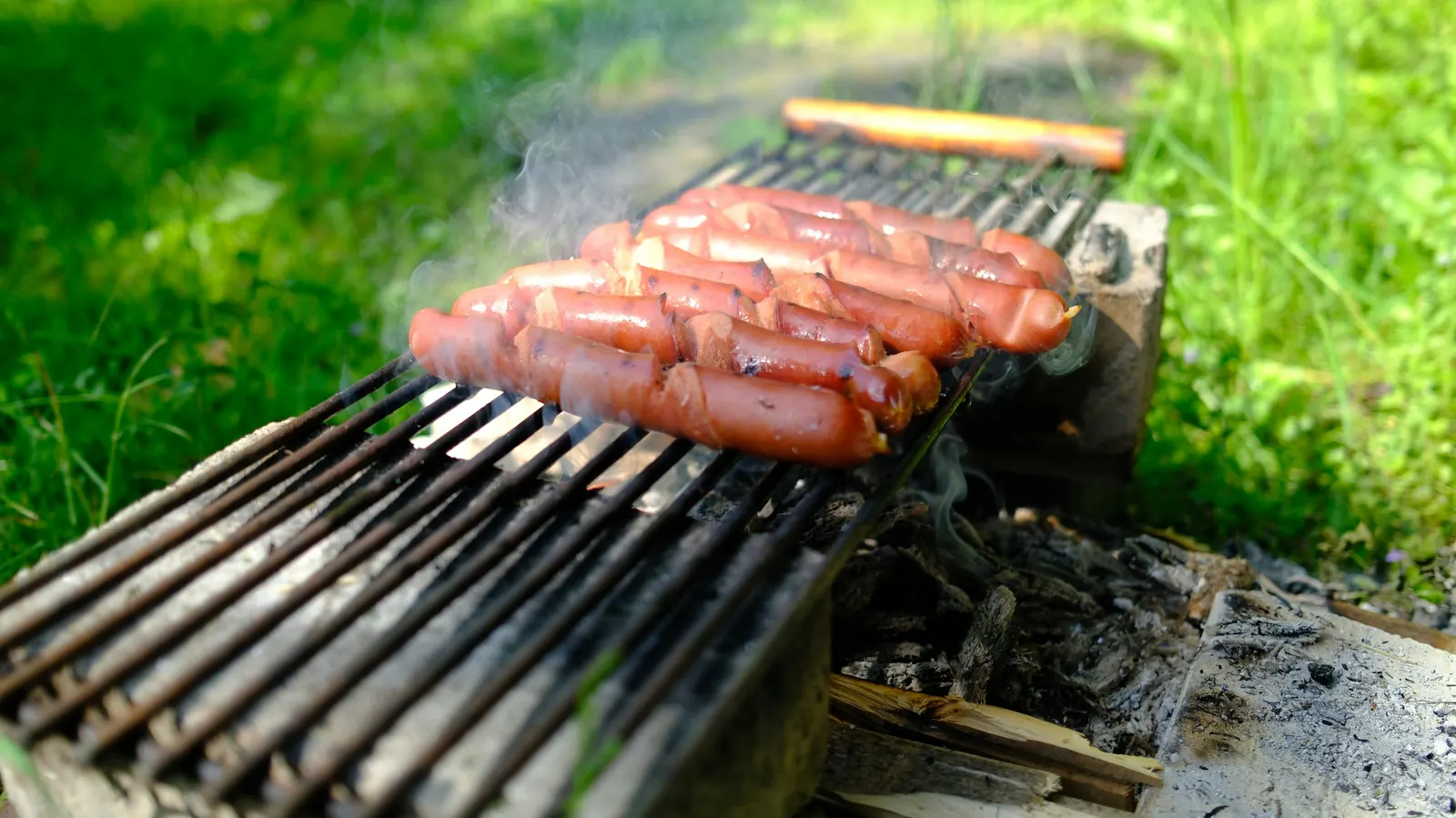
A pellet grill and a dedicated smoker can both turn out a slow-cooked pork shoulder or a rack of ribs. The difference is in everything around that cook: what burns, how the heat is held, how hot the box can go, and how much you have to stand next to it. A pellet grill feeds wood pellets to a small fire with an electric auger and a controller. A dedicated smoker, whether a charcoal bullet, an offset or an electric cabinet, is built only for low heat and smoke.
In a restaurant kitchen, low and slow is a familiar job, from barbacoa to a pot of beans that sits for hours. This guide compares the two on heat range, searing, effort, smoke, power, capacity and cleanup, says which suits which cook, and names in-stock examples for each side.
Julia’s earns a commission on purchases made through links on this page, at no cost to you. Recommendations are based on what a restaurant kitchen looks for, product specifications and verified buyer reports.
Quick verdict: pellet grill or dedicated smoker?
For most backyards that will have only one outdoor cooker, buy the pellet grill. It smokes at around 180°F, it also grills and roasts at 500°F or more, and a controller holds the temperature for you. Buy a dedicated smoker if you already own a grill and only want to smoke: an electric cabinet if you want the simplest set-and-wait box, or a charcoal smoker if you want the strongest smoke and don’t mind tending vents and coals.
The table sums up the differences; the sections after it explain each one.
Pellet grill vs smoker, side by side
| Pellet grill | Dedicated smoker | |
|---|---|---|
| Fuel | Wood pellets fed by an electric auger | Charcoal and wood, or an electric element with wood chips |
| Heat control | Digital controller runs the auger and fan | Vents (charcoal) or a thermostat (electric) |
| Temperature range (our picks) | 180 to 500°F (Pit Boss), 180 to 600°F (Weber) | 100 to 275°F (Masterbuilt electric) |
| Searing | Yes on models with a direct-flame option | No on an electric cabinet |
| Tending | Low; fill the hopper and set the dial | Low on electric; high on charcoal |
| Power | Needs an outlet | Electric needs an outlet; charcoal does not |
| Shape | Horizontal barrel, one or two grates | Vertical box or bullet with stacked racks |
How each one makes heat and smoke
Traeger explains the pellet grill plainly: an auger moves wood pellets from the hopper to the fire pot, where a hot rod lights them, a fan circulates heat and smoke, and “it’s all operated by a controller that maintains precise temperature.” The auger runs on electricity, so a pellet grill is an outdoor appliance that needs a plug. A drip tray sits between the fire and the food to stop flare-ups.
A dedicated smoker comes in several forms. Bob Vila’s smoker guide, by Mike Bruton, describes charcoal smokers as controlled with vents, electric smokers as using an automatic internal thermostat and wood chips for smoke, and offset smokers as having a separate firebox that lets you add fuel without losing temperature. What they share is purpose: they are built to hold low heat for hours, not to grill a steak.
Temperature range: the biggest practical difference
This is where the two part ways. The Weber Searwood 600 listing gives a range of 180 to 600°F, and the Pit Boss 500 FB2 gives 180 to 500°F, so either one can smoke a brisket in the morning and roast chicken thighs or bake in the evening. Bob Vila makes the same point: pellet smokers “can also roast and bake meats in addition to smoking them.”
An electric cabinet smoker stops much lower. Masterbuilt lists its 710 WiFi Digital Smoker at 100 to 275°F. That is plenty for smoking, and the low end opens up things a pellet grill can’t hold, such as cold-weather jerky or warm-smoking cheese and fish. But it will not crisp chicken skin the way a 400°F grill does, and it is no substitute for a grill.
Searing and grilling
Many pellet grills cook only with indirect heat, which is gentle and even but slow to brown. Some models now open a path to the flame. Pit Boss says the 500 FB2’s Flame Broiler lever allows direct-flame searing up to 1,000°F. Weber says the Searwood’s DirectFlame design has no large sheet diffuser blocking the flame, for deeper sear marks and browning. If you want one cooker that smokes and grills, look for a direct-flame feature like these.
A dedicated smoker does not try. An electric cabinet’s 275°F ceiling rules out searing, and a charcoal bullet or offset smoker is set up for indirect heat. Owners of a dedicated smoker usually keep a separate grill for steaks and fajitas; our best charcoal grill guide covers that side.
Effort: how much you stand by the fire
Bob Vila calls pellet smokers “the ultimate in set-it-and-forget-it smoking” and says automated fans, vents and the auger keep the temperature where you want it. Electric smokers are close behind: the thermostat holds the heat, and some models can be run remotely. Masterbuilt’s 710 WiFi Digital lets you set time and temperature on the panel or in its app.
Charcoal asks the most of you. The same guide says charcoal smokers need you to keep a constant eye on the meat, and that you control the heat only with vents. That is part of the appeal for many cooks, and it needs no outlet, but it is a different afternoon from setting a dial and walking away. Offset smokers also take longer to heat up than electric, pellet or charcoal smokers, according to Bob Vila.
Smoke flavor
Bob Vila says charcoal produces more smoke than gas or electric, which is why it makes meat taste smokier. Electric smokers make their smoke from wood chips smoldering near the element, and pellet grills from the burning pellets themselves. Traeger, unsurprisingly, says its wood-fired flavor beats gas and charcoal; treat that as a maker’s claim.
As general kitchen sense rather than a measured result: the more of the heat that comes from wood or charcoal, the more smoke character you tend to get, and the cleaner and more controlled the fire, the lighter it tends to be. If you buy a pellet grill and want more smoke, a smoke tube is a simple add-on; our best smoke tube for pellet grill guide covers them. Many pellet grills also have a low smoke setting: Weber’s SmokeBoost holds the Searwood at 180°F to increase smoke absorption, according to the listing.
Power, fuel and where it lives
Both a pellet grill and an electric smoker need power. Bob Vila notes that pellet smokers need external power, so they are not very portable, and that electric smokers do too. Plan a spot near an outdoor outlet before you buy. A charcoal smoker needs no power at all.
Fuel is the other running cost. A pellet grill burns only pellets made for cooking, and our best smoker pellets guide covers the hardwoods and blends. An electric smoker burns a small load of wood chips for smoke while the element does the heating; our best smoker wood chips guide covers those. Hopper size matters on a pellet grill: Pit Boss lists the 500 FB2’s hopper at 5 pounds, small enough that a long overnight cook will need a refill.
Capacity and shape
A pellet grill is a barrel on legs, usually with one main grate and an upper rack. Pit Boss lists the 500 FB2 at 518 square inches over two tiers. A vertical smoker stacks its racks: Masterbuilt lists 710 square inches over four chrome racks in a cabinet about 22 inches wide and deep and 41 inches tall, and the listing says it fits up to 8 Boston butts. If you smoke for crowds in a small yard, the vertical box gives you more rack space for its footprint.
Cleanup
A pellet grill leaves ash in the fire pot and grease on the drip tray, and both need clearing out from time to time; follow the maker’s manual for how often. Masterbuilt says the 710 has a removable rear grease tray for easier cleanup, plus a removable water bowl that catches drippings. A charcoal smoker leaves a bowl of ash after each cook. None of them is hard, but none cleans itself.
Cook it safely, whichever you choose
Smoking is slow, so check the meat, not the clock. A reliable probe thermometer tells you when pork, poultry or beef has reached a safe internal temperature, and all three of our picks below come with at least one probe. Our best meat thermometer for smoker guide covers wireless and leave-in options.
Choose a pellet grill if… / Choose a smoker if…
Choose a pellet grill if…
- You want one outdoor cooker that smokes, grills, roasts and bakes.
- You want the temperature held for you while you get on with the day.
- You have an outdoor outlet and room for a barrel-shaped grill.
- You want to sear, and the model has a direct-flame option.
Choose a dedicated smoker if…
- You already own a grill and only want to add smoking.
- You want the simplest set-and-wait box (electric) or the strongest smoke (charcoal).
- You smoke for crowds and want stacked racks in a small footprint.
- You want low temperatures for jerky, fish or cheese (electric).
Our picks for each side of pellet grill vs smoker
Two pellet grills and one electric smoker, all from established outdoor-cooking makers and all in stock, sold by Amazon, when we checked. None of these listings appears on our other pages. For a charcoal smoker, the Weber Smokey Mountain Cooker in our best smoker guide is the classic starting point, so we have not repeated it here.
1. Weber Searwood 600 Pellet Grill – Smokes Low, Sears Over Open Flame

The Searwood 600 is Weber’s answer to the main complaint about pellet grills, that they smoke well but sear poorly. The listing gives a range of 180 to 600°F and describes DirectFlame cooking with no large sheet diffuser blocking the flame, so food gets direct heat for sear marks and browning. It is the clearest example of a pellet grill doing both jobs.
Weber says the Rapid React PID controller brings the grill to its set temperature in 15 minutes or less, recovers quickly after the lid is opened and holds temperature in cold weather. For smoking, the SmokeBoost setting holds the grill at 180°F to increase smoke absorption. A manual mode keeps fuel and fan speed steady for griddling or cooking with the lid open, and a griddle insert and rotisserie are sold separately.
It connects over Wi-Fi and Bluetooth, and one food probe reads out on the grill display and in the Weber Connect app. The listing gives a 5-year limited warranty. It is a large grill, about 59 by 32 by 49 inches according to the listing, so measure your patio.
Why we like it
- 180 to 600°F range (listing)
- Direct-flame cooking for searing
- SmokeBoost setting holds 180°F
- 5-year limited warranty (listing)
Key specifications
| Model | 1500120 |
|---|---|
| Fuel | Wood pellets (electric auger) |
| Temperature range | 180 to 600°F |
| Searing | DirectFlame cooking |
| Cooking area | Not stated in the listing |
| Controls | PID controller, Wi-Fi and Bluetooth app, 1 probe |
| Size | 58.7 x 31.8 x 49.1 inches |
| Warranty | 5-year limited |
Why we recommend it
It suits a cook who wants one outdoor cooker for both low-and-slow smoking and real searing, with app control.
Skip it if you only want to smoke; you would be paying for searing ability you will not use.
Pros and cons
Pros
- Widest range of our picks
- Fast stated heat-up
- Established maker with a long warranty
Cons
- Large footprint
- Needs an outlet
- Cooking area and hopper size not stated in the listing
2. Pit Boss 500 FB2 Pellet Grill – Compact, With a Flame Broiler

The 500 FB2 is a smaller, simpler pellet grill for a patio or a first pellet cooker. Pit Boss lists 518 square inches of cooking space over two tiers, a digital control board from 180 to 500°F in 5°F steps, and a Flame Broiler lever that opens the fire to the grate for direct-flame searing up to 1,000°F.
It has two meat probe ports with one probe included, a solid bottom shelf for pellets and tools, and a 5-year warranty, according to the listing. There is no Wi-Fi, which keeps the controls simple.
The trade-off is the hopper: the listing gives its capacity as 5 pounds. That is enough for many cooks, but a long brisket or pork shoulder may need a refill partway through, so keep a bag of pellets nearby and check the hopper before you go to bed.
Why we like it
- Flame Broiler for direct-flame searing
- 518 square inches on two tiers
- Two probe ports, one probe included
- 5-year warranty (listing)
Key specifications
| Model | 11086 (500 FB2) |
|---|---|
| Fuel | Wood pellets (electric auger), 5 lb hopper |
| Temperature range | 180 to 500°F |
| Searing | Flame Broiler, direct flame up to 1,000°F |
| Cooking area | 518 square inches |
| Controls | Digital board, 5°F steps, 1 probe |
| Size | Not stated in the listing |
| Warranty | 5-year |
Why we recommend it
It suits a smaller household that wants to smoke and grill on one compact pellet grill without an app.
Skip it if you plan long overnight cooks often; the 5-pound hopper means refills.
Pros and cons
Pros
- Sears with an open flame
- Simple controls
- Long warranty
Cons
- Small hopper
- Lower top temperature than the Weber
- No Wi-Fi
3. Masterbuilt 710 WiFi Digital Electric Smoker – Four Racks, App Control

This is the dedicated smoker in its easiest form: a vertical electric cabinet you plug in, set and leave. Masterbuilt lists 710 square inches of cooking space on four chrome-coated racks, enough for up to 8 Boston butts or 12 chickens by the listing’s count, and a temperature range of 100 to 275°F set on the panel or in the Masterbuilt app.
The patented side wood chip loader lets you add chips without opening the door, so heat and smoke stay in. A removable water bowl adds moisture, and a removable rear grease tray makes cleanup easier, according to Masterbuilt. The app monitors up to four meat probes and sends alerts.
Masterbuilt gives the cabinet as about 22.3 inches wide, 22.9 inches deep and 40.6 inches tall, with a 1-year warranty. Neither Masterbuilt’s page nor the listing states a UL, ETL or CSA certification, so we can’t say it has one. It has a 275°F ceiling, so pair it with a grill if you want to sear.
Why we like it
- 710 square inches on four racks (Masterbuilt)
- Side chip loader keeps the door shut
- Low 100°F setting for jerky, fish or cheese
- App monitors up to four probes
Key specifications
| Model | MB20070924 |
|---|---|
| Fuel | Electric element, wood chips for smoke |
| Temperature range | 100 to 275°F |
| Searing | No |
| Cooking area | 710 square inches, 4 racks |
| Controls | Digital panel and Wi-Fi app |
| Size | 22.3 x 22.9 x 40.6 inches |
| Warranty | 1-year |
Why we recommend it
It suits a cook who already has a grill and wants a simple, roomy smoker that holds its own temperature.
Skip it if you want the strongest smoke flavor; a charcoal smoker gives more, at the cost of more tending.
Pros and cons
Pros
- Most rack space of our picks
- Set and wait, with app alerts
- Small footprint
Cons
- Tops out at 275°F
- Shortest warranty of our picks
- No stated safety certification
Pellet grill and smoker questions, answered
Is a pellet grill a real smoker?
Yes. It burns wood pellets for heat and smoke and holds low temperatures, around 180°F on our two picks. It is a smoker that can also grill, which is why many people buy one instead of a separate smoker and grill.
Which gives more smoke flavor?
Charcoal, according to Bob Vila’s guide, which says charcoal produces more smoke than gas or electric. Between a pellet grill and an electric smoker, flavor depends on the wood and how long you smoke; a low smoke setting or a smoke tube helps on a pellet grill.
Is a pellet grill or an electric smoker easier?
Both hold their own temperature. The electric smoker is the simpler machine, but it only smokes. The pellet grill does more and needs pellets topped up on long cooks.
Do I need electricity for a smoker?
For a pellet grill or an electric smoker, yes. A charcoal smoker needs none, which is one reason people still choose one.
Can I sear on a smoker?
Not on an electric cabinet, which tops out at 275°F on our pick. Some pellet grills can, through a direct-flame feature like Pit Boss’s Flame Broiler or Weber’s DirectFlame design.
Which one belongs in your backyard
If you are buying one outdoor cooker, the pellet grill is the better choice for most people, because it smokes, grills and roasts with the temperature held for you. A dedicated smoker makes sense as a second cooker next to a grill you already own: electric for ease, charcoal for smoke. For more models, see our best pellet grill and best electric smoker guides, and our guide to barbacoa for a slow-cooked dish worth the wait. When you would rather someone else did the cooking, see the menu or call to order.