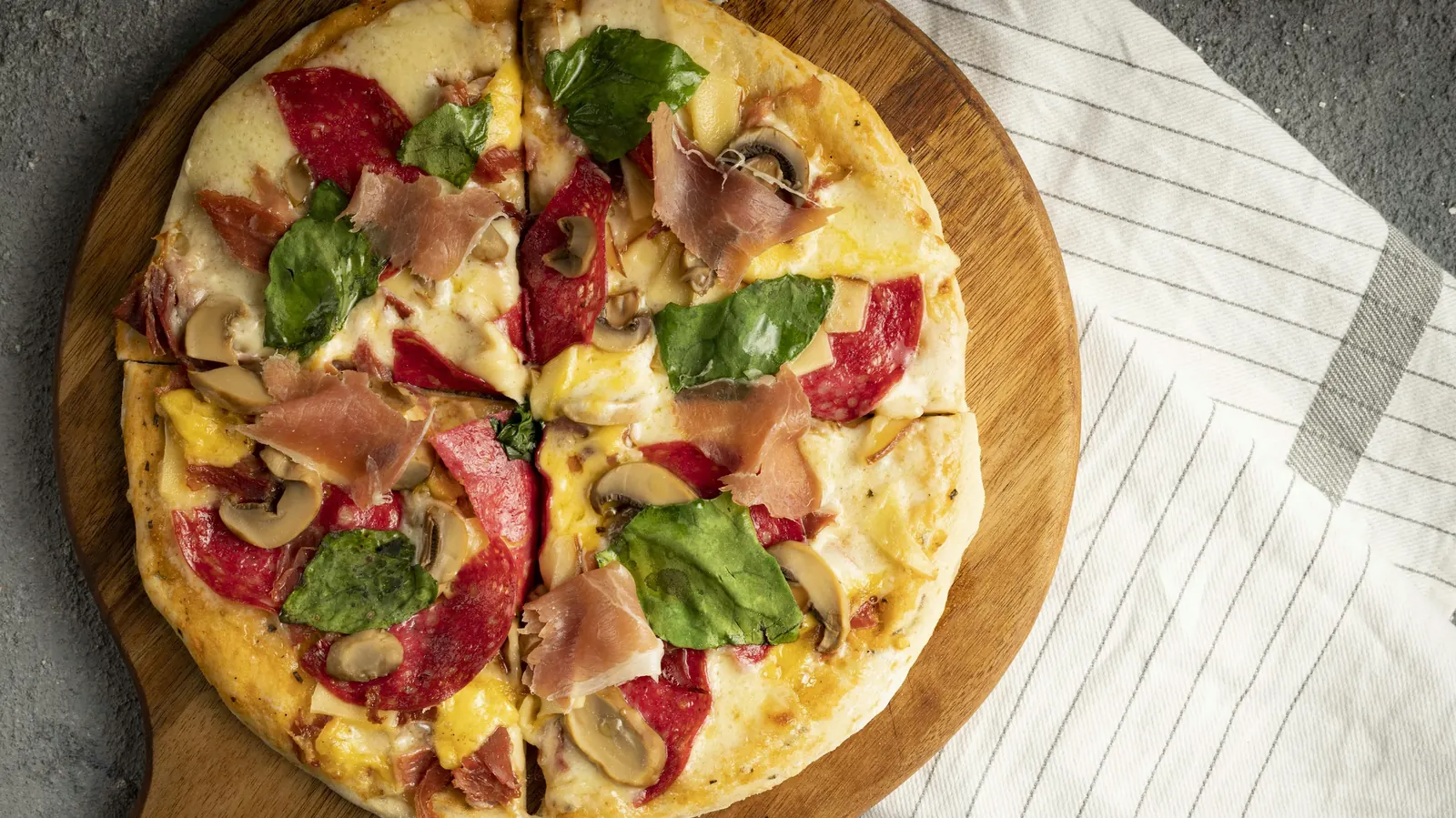
A dedicated pizza oven is a wonderful thing, but it is also a big purchase, it lives outside, and it needs fuel, space and practice. Most people who want better pizza at home do not need one. What they need is more heat under the crust than a thin sheet pan can give.
This guide covers the pizza oven alternative that suits each kind of kitchen: a steel or stone for the oven you already have, a stone for the grill, and a countertop pizza maker for when the oven is not an option. It also covers how to get the most from each, using what King Arthur Baking and the makers say.
Julia’s earns a commission on purchases made through links on this page, at no cost to you. Recommendations are based on what a restaurant kitchen looks for, product specifications and verified buyer reports.
Why look past a dedicated pizza oven
- Cost and space. A steel or stone fits in a drawer or stays in the oven; a pizza oven needs a patio and a cover.
- Fuel and learning curve. Wood, charcoal and gas ovens each take practice to manage. Your kitchen oven does not.
- Year-round baking. An indoor steel works in any weather.
- Other uses. A steel doubles as a griddle and a stone bakes bread; a countertop maker also makes quesadillas.
Quick verdict: the best pizza oven alternative
For most kitchens the best pizza oven alternative is a pizza steel in your regular oven, such as ThermiChef’s 3/8-inch steel: King Arthur Baking says steels heat faster and transfer heat better than stones, for crisper, better-browned crusts, and they will not crack. If a 27-pound plate is too heavy, a stone such as Emile Henry’s glazed square stone is lighter and easier to clean. Have a gas grill? A grilling stone like Cuisinart’s turns it into a summer pizza oven. And if you would rather not heat the oven at all, a countertop pizza maker such as Chefman’s makes a crisp pan-style pizza in minutes.
Five ways to crisp pizza without a pizza oven
Our five picks, one per kind of setup, with what each maker or listing states.
| Alternative | Best for | Type and heat | Buy on Amazon |
|---|---|---|---|
ThermiChef 16 x 16-inch Pizza Steel, 3/8 inchBest overall
|
Crispest crust in a home oven | Steel, 3/8 in, 27.5 lb | View on Amazon |
| Easy cleanup, cut on the stone | Glazed ceramic, 14 in square | View on Amazon | |
Unicook 15 x 12-inch Rectangular Cordierite StoneBest lightweight stone
|
Light stone, personal pizzas | Cordierite, 1,450°F | View on Amazon |
Cuisinart Alfrescamore 13-inch Pizza Grilling StoneBest for the grill
|
Pizza on a gas grill | Cordierite, 13 in round | View on Amazon |

Chefman Everything Maker and Pizza Oven, 12-inchBest countertop
|
Fast pizza without the oven | Electric, 428°F | View on Amazon |
How to get pizza-oven results from what you have
A pizza oven’s advantage is a very hot floor under the dough and hot air above it. You can get surprisingly close with the right surface and patience.
Use a thick surface, not a sheet pan
King Arthur Baking’s David Tamarkin calls sheet pans a poor substitute because they are too thin to produce a good crust. A steel or stone stores heat and dumps it into the dough the moment it lands. Between the two, he concludes steel is the better choice if you can only pick one: it heats faster and transfers heat better. Our pizza stone vs pizza steel comparison goes through that choice in detail.
Preheat longer than you think
King Arthur advises preheating the oven with the steel or stone inside for at least an hour before baking, aiming for at least 500°F on the surface if you have an infrared thermometer. Convection can speed the preheat.
Rest the surface between pizzas
Each pizza pulls heat out of the steel or stone. King Arthur suggests letting it recover for at least five minutes between pizzas, or each one will come out paler and less crisp; some bakers use two surfaces and alternate. A thicker steel recovers faster, which is ThermiChef’s case for its 3/8-inch plate.
Go bigger if your oven allows
King Arthur recommends a rectangular slab as large as your oven allows, because a bigger target makes it easier to slide the pizza on. Measure the inside of your oven, leaving room for air to move around the edges, before you buy.
The grill: free extra heat in summer
A covered grill with a stone on the grate behaves like a small oven, and it keeps the heat out of the kitchen. Cordierite stones are the usual choice, and the makers here rate theirs for grill use. Keep the lid closed while the stone heats.
Countertop makers: quick, but not the same crust
Electric pizza makers heat in minutes and are handy in a hot climate or a small kitchen, but they run cooler than a preheated steel, so they make a crisp pan-style crust rather than a blistered one. Our best countertop pizza oven guide covers the full range, from pizza makers to small electric ovens.
Our picks for the best pizza oven alternative
1. ThermiChef 16 x 16-inch Pizza Steel, 3/8 inch – The Closest Thing to Oven-Floor Heat
If you want a crisp, browned crust from the oven you already have, start with a steel. King Arthur Baking’s David Tamarkin, comparing steels and stones in 2026, concludes that steels are the better choice if you can pick only one, because they “simply get hot faster and transfer heat better”, which means faster baking, better browning and crisper crusts. He also calls steels “pretty much indestructible”, where stones can crack.
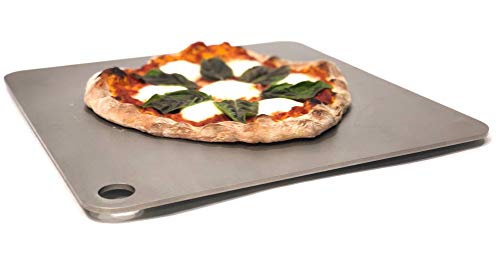
ThermiChef’s 3/8-inch steel is the heavy option: 16 by 16 inches, 27.5 pounds, cut from a single piece of low-carbon steel in Minnesota. ThermiChef says the thicker plate stores more heat and recovers faster between pizzas than its 1/4-inch steel, which suits back-to-back pies for a crowd, and that it takes pizzas up to 15 inches across. It also works on the grill, over two stovetop burners as a griddle, or over a campfire.
It ships shot-blasted, not pre-seasoned, so season it once before first use as ThermiChef describes: wash, oil thinly and bake at 375°F for an hour. Measure your oven first; the maker recommends its 14-inch size for compact ovens. And mind the weight when you lift it out of a hot oven.
Why we like it
- Steel heats and transfers heat faster than stone, per King Arthur Baking
- 3/8-inch plate recovers faster between pizzas, per ThermiChef
- Fits pizzas up to 15 inches
- Made in the USA and sold by the maker
Key specifications
| Model | PS001-04 |
|---|---|
| Type | Low-carbon steel, 3/8 in |
| Size | 16 x 16 in |
| Weight | 27.5 lb |
| Heat limit | Not stated |
| Works on | Oven, grill, stovetop, campfire |
| Care | Season before first use; builds a patina |
| Made in | USA (Minnesota) |
Why we recommend it
Choose this if you bake pizza often, want the crispest crust a home oven can give, and can handle a heavy plate.
Skip it if lifting 27.5 pounds in and out of the oven is a problem; ThermiChef’s thinner steels weigh less.
Pros and cons
Pros
- Will not crack
- Stores heat for several pizzas in a row
- Doubles as a griddle
Cons
- Very heavy
- Must be seasoned first
- May not fit compact ovens
2. Emile Henry 14 x 14-inch Square Pizza Stone – Glazed Stone You Can Cut On

A stone is lighter and easier to live with than a steel, and Emile Henry’s square stone fixes two of a stone’s usual annoyances. It is glazed, so it can go in the dishwasher and you can cut pizza directly on it without scratching the surface, according to the maker, and it has handles. Emile Henry says it is oven, grill, broiler and freezer safe and covers it with a 10-year warranty against manufacturing defects in household use.
Because the surface is glazed, we checked the maker’s lead statement: Emile Henry says “There is no lead or cadmium in our products” and that its glazes meet California Prop 65. That is a maker statement, which our lead rule requires for glazed food surfaces.
Expect a stone to brown a little more slowly than a steel, as King Arthur’s comparison explains, and give it the same long preheat: at least an hour in the oven before the first pizza. At 14 inches square it suits most home ovens.
Why we like it
- Glazed surface you can cut on, per Emile Henry
- Dishwasher safe, with handles
- Oven, grill and broiler safe
- Maker states no lead or cadmium in its products
Key specifications
| Model | 797524 |
|---|---|
| Type | Glazed ceramic (Flame) |
| Size | 14 x 14 in |
| Weight | Not stated |
| Heat limit | Not stated (“extremely high heat”) |
| Works on | Oven, grill, broiler |
| Care | Dishwasher safe; soap and water |
| Made in | France |
Why we recommend it
Choose this if you want a stone that cleans up easily and doubles as a serving board, and you do not need the fastest bake.
Skip it if you want the crispest possible crust; a steel transfers heat faster.
Pros and cons
Pros
- Easy to clean
- Handles for carrying
- Sold by Amazon.com
Cons
- Slower than steel
- Weight not stated
- Smaller than the steel above
3. Unicook 15 x 12-inch Rectangular Cordierite Stone – Light, Plain and High-Heat
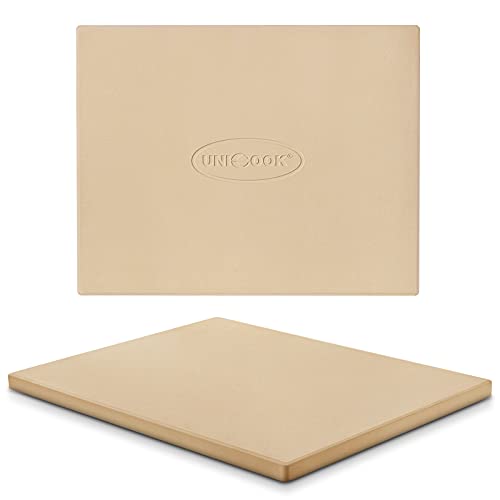
A plain cordierite stone is the simplest step up from a sheet pan, which King Arthur’s article calls a poor substitute because sheet pans are too thin to produce a good crust. Unicook’s is 15 by 12 inches and 0.6 inch thick, weighs about 6.8 pounds, and is rated by the maker to 1,450°F.
The size is its main limit. Unicook says it is for personal pizzas up to 11 inches across, and it asks for 1 to 2 inches of clearance on all sides inside your oven or grill for airflow. The listing also says the porous surface absorbs moisture from the dough, and that both sides can be used.
Care is the usual for unglazed stone: let it cool, scrape it, rinse with warm water and a brush, and do not use detergent, per the maker. It will stain over time, which Unicook calls normal. Unicook is an Amazon-first brand.
Why we like it
- Cordierite rated to 1,450°F, per Unicook
- About 6.8 lb, far lighter than a steel
- Reversible, per the listing
- Includes a plastic scraper
Key specifications
| Model | BP15012 |
|---|---|
| Type | Cordierite |
| Size | 15 x 12 x 0.6 in |
| Weight | About 6.8 lb |
| Heat limit | 1,450°F |
| Works on | Oven and grill (round models for kettles) |
| Care | Scrape and rinse; no detergent |
| Made in | Not stated |
Why we recommend it
Choose this if you want a light, simple stone for personal pizzas and flatbreads.
Skip it if you bake 12-inch or larger pizzas; Unicook points to its larger models for those.
Pros and cons
Pros
- Light to handle
- High heat rating
- Fits most ovens
Cons
- Personal-size pizzas only
- Amazon-first brand
- Stains with use
4. Cuisinart Alfrescamore 13-inch Pizza Grilling Stone – Turns a Gas Grill Into a Pizza Oven
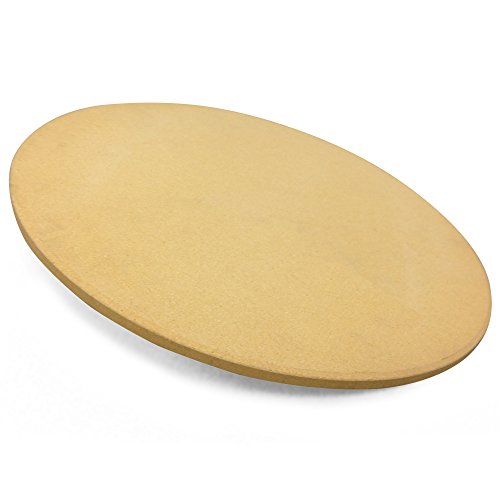
A grill gets hotter than most home ovens, which makes it a good stand-in for a pizza oven in summer. Cuisinart’s Alfrescamore stone is a 13-inch round of cordierite sized to fit almost all grills, and Cuisinart says it also works in almost any oven.
The maker says cordierite will not crack in extreme heat or cold and resists thermal shock better than ceramic, which matters on a grill where one side runs hotter than the other. Cuisinart suggests heating the stone for 15 minutes before the pizza goes on; on a grill with the lid down that may be enough, but in a home oven King Arthur advises a full hour of preheating.
Hand wash only, per the listing, and it carries a 1-year limited warranty. A 13-inch round limits you to medium pizzas, and you will want a peel to get them on and off.
Why we like it
- Cordierite, which Cuisinart says resists thermal shock
- 13-inch round fits almost all grills
- Also works in the oven
- Sold by Amazon.com
Key specifications
| Model | CPS-013 |
|---|---|
| Type | Cordierite |
| Size | 13 in round |
| Weight | Not stated |
| Heat limit | Not stated |
| Works on | Grill and oven |
| Care | Hand wash |
| Made in | Not stated |
Why we recommend it
Choose this if you have a gas grill and want pizza outdoors without buying a pizza oven.
Skip it if you mostly bake indoors; a larger stone or a steel gives you more room in the oven.
Pros and cons
Pros
- Gets grill-level heat
- Simple and light
- Familiar maker
Cons
- Medium-size pizzas only
- Weight and heat limit not stated
- Hand wash only
5. Chefman Everything Maker and Pizza Oven, 12-inch – Pizza on the Counter in Minutes
If your oven is small, slow to heat or simply too hot to run in a Houston summer, a countertop pizza maker is the quickest route to a crisp crust. Chefman’s Everything Maker has heated top and bottom 12-inch nonstick plates that reach 428°F and preheat in as little as 3 minutes, per the listing, with lights to show power and readiness.
It is listed as UL approved, runs on 1440 watts at 120 volts, and comes with a 5-year Chefman warranty. Chefman pitches it for quesadillas, omelets, pancakes, sandwiches, crepes and tostadas too, and it stands on end for storage.
Know the limits: 428°F is well below a pizza oven or a preheated steel, so expect a crisp, pan-style crust rather than a blistered one, and the nonstick plates should be wiped with a damp cloth rather than scrubbed.
Why we like it
- Preheats in about 3 minutes, per Chefman
- Top and bottom plates reach 428°F
- UL approved, per the listing
- 5-year warranty and sold by Amazon.com
Key specifications
| Model | RJ58-EM-MIDNIGHT |
|---|---|
| Type | Electric, nonstick plates |
| Size | 13 x 15 x 4 in; 12-in plates |
| Weight | Not stated |
| Heat limit | 428°F |
| Works on | Countertop, 1440 W, 120 V |
| Care | Wipe with a damp cloth |
| Made in | Not stated |
Why we recommend it
Choose this if you want quick pizzas and quesadillas without heating the whole oven.
Skip it if you want a Neapolitan-style blistered crust; it does not get hot enough.
Pros and cons
Pros
- Very fast preheat
- Does many other jobs
- Stands up for storage
Cons
- Lower heat than a steel or pizza oven
- Nonstick plates need care
- 12-inch maximum
How to choose between steel, stone, grill and countertop
- Want the crispest crust indoors? Buy a steel and accept the weight.
- Need something lighter or easier to clean? Buy a stone; glazed stones clean up more easily, unglazed cordierite is lighter and cheaper to replace.
- Cook outdoors often? Add a grilling stone for summer.
- Small or hot kitchen? A countertop pizza maker avoids running the big oven.
- Measure first. Check the oven’s inside width and depth and the grill’s grate size before you order any slab.
- Get a peel. Any of these needs a way to slide a raw pizza on and a baked one off; see our best pizza peel guide.
How we chose these five alternatives
We used King Arthur Baking’s 2026 steel-versus-stone comparison as the basis for the method advice and the steel-first recommendation, then looked for one strong option per setup from a maker we could identify, read each listing for size, weight, heat rating and care, and confirmed every pick was in stock with a new offer. For the glazed stone we confirmed the maker’s own lead statement. Heat ratings and performance claims are the makers’ own; we did not verify them independently, and we did not bake on these products ourselves. We left out products already recommended on our other pizza guides and add-ons that need a separate kit to work.
Pizza oven alternative questions, answered
How do I get a crispy crust without a pizza oven?
Bake on a steel or stone that has preheated in the oven for at least an hour at 500°F or more, as King Arthur advises, and let it recover a few minutes between pizzas. A sheet pan is too thin to do the same job.
Is a pizza steel better than a pizza stone?
For most people, yes. King Arthur Baking says steels heat faster, transfer heat better and do not crack. Stones are lighter and easier to handle. Our best pizza steel and best pizza stone guides compare more models.
Can I make pizza on a gas grill?
Yes, with a stone made for grill use such as Cuisinart’s cordierite grilling stone. Preheat the stone with the lid closed. For more grill stones, see our best pizza stone for the grill guide.
Do countertop pizza makers work?
They make a good, crisp pan-style pizza quickly. Chefman’s reaches 428°F per its listing, which is well below a pizza oven, so do not expect a charred, puffy rim.
When is a real pizza oven worth it?
If you make pizza every week, cook outdoors anyway and want a blistered Neapolitan crust in a couple of minutes, a dedicated oven earns its place. Our best pizza oven guide covers the options.
Our final word on pizza without a pizza oven
A good steel, a long preheat and a few minutes’ rest between pies get a home oven most of the way to pizza-oven results. Add a grilling stone if you cook outside, or a countertop maker if the oven is off-limits in summer. If you later decide you want the real thing, our best pizza oven guide is the place to start.
And if you would rather leave dinner to us tonight, see the menu or call to order.