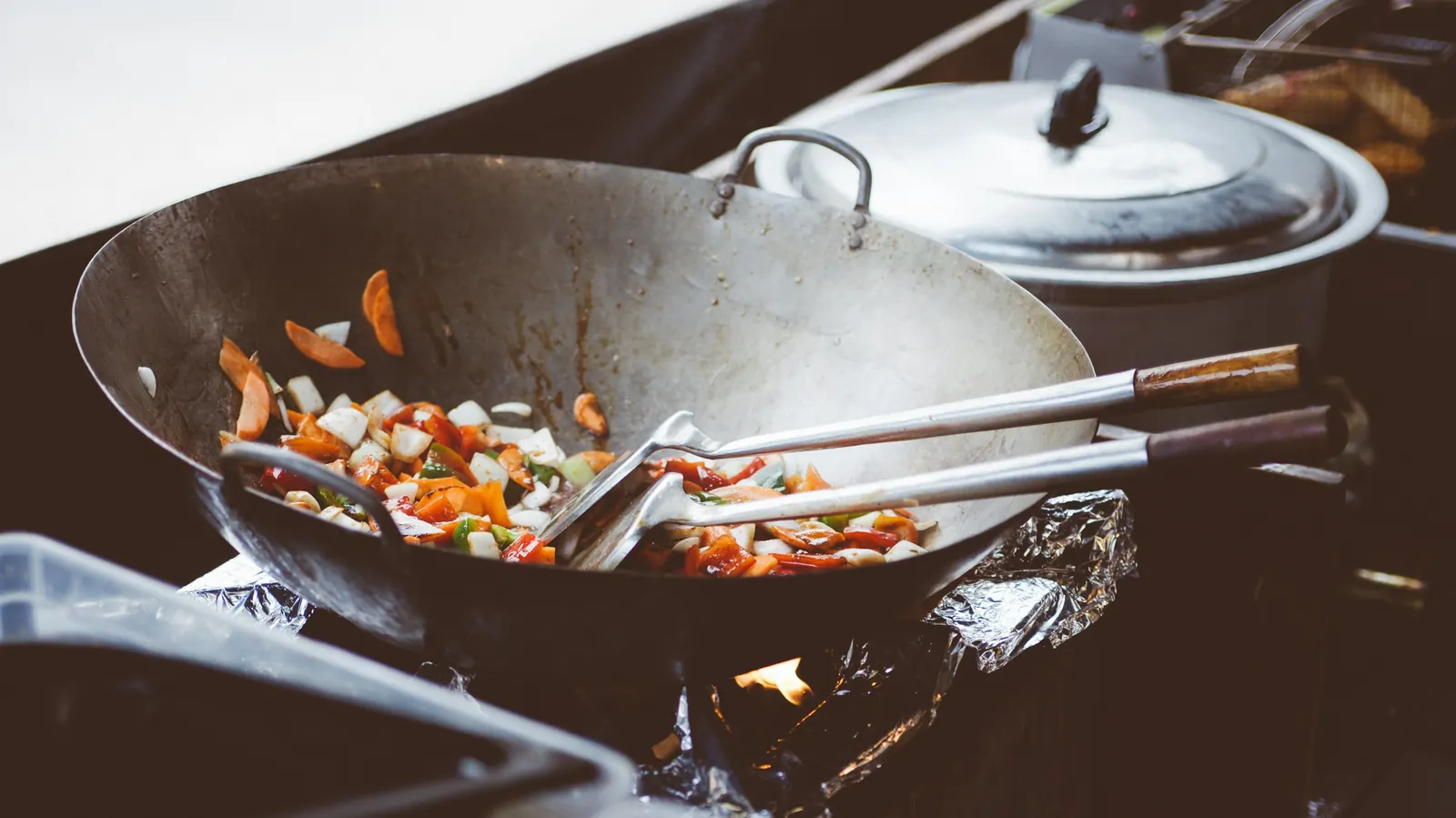
A wok and a frying pan both cook food fast in a little fat over high heat, and plenty of home cooks own one and wonder whether they need the other. They are built for different motions, though. A wok is a deep bowl of thin steel made for food that keeps moving: tossed, pushed up the sides and pulled back down into the heat. A frying pan is a flat disc made for food that stays put long enough to brown: a steak for fajitas, chicken thighs skin side down, a row of tortillas for chilaquiles.
This guide sets the wok and the frying pan, also called a skillet, side by side. It covers shape, heat, tossing, oil and stove type, says who should buy which, and names one well-reviewed example of each. The sizing and performance points come from America’s Test Kitchen’s current reviews of woks and of stainless steel skillets, and the product details from the makers’ Amazon listings.
Julia’s earns a commission on purchases made through links on this page, at no cost to you. Recommendations are based on what a restaurant kitchen looks for, product specifications and verified buyer reports.
Quick verdict: wok, frying pan or both?
Buy a frying pan first if you sear, brown and fry most nights: steak, chicken, eggs, fish, onions and peppers, tortillas. Its wide, flat base gives every piece full contact with hot metal, and it works the same on gas, electric and induction. Add a flat-bottomed carbon steel wok if you stir-fry often, cook for four or more in one go, or want a deep pan for frying with less oil. On a strong gas burner the wok is the better stir-fry pan; on an electric or induction stove its advantage shrinks, and a 12-inch skillet does most of the same jobs.
The table sums up the differences. Each one gets its own section below.
Wok vs pan: the main differences side by side
| Wok (flat-bottomed) | Frying pan (skillet) | |
|---|---|---|
| Shape | Deep bowl, tall sloped walls, small flat base | Wide flat base, low flared sides |
| Usual home size | About 14 inches across | 10 or 12 inches across |
| Flat cooking area | About 6 to 7 inches | About 9.25 to 10.5 inches on a 12-inch pan |
| Heat | Hot zone at the base, cooler walls | Even heat across the whole base |
| Best motion | Tossing and constant stirring | Searing in place, flipping once |
| Oil for frying | Less to fill to a useful depth | Shallow-frying only |
| Usual material | Carbon steel, seasoned | Clad stainless, cast iron, nonstick, carbon steel |
| Best stove | Strong gas burner | Any, including induction |
| Weak at | Searing large flat pieces; small jobs | Tossing large volumes without spilling |
Shape: a bowl versus a flat disc
Everything else follows from the shape. A frying pan puts its whole floor in contact with the burner, so a steak, a chicken breast or a quesadilla lies flat on hot metal from edge to edge. America’s Test Kitchen’s stainless skillet review prefers 12-inch skillets with a broad cooking surface of about 9.25 to 10.5 inches, and favors low, flaring sides because they encourage evaporation for better browning.
A wok gives up most of that flat floor in exchange for depth. The flat-bottomed carbon steel woks in ATK’s wok review have a flat cooking surface of roughly 6.25 to 7 inches, with tall, sloped walls rising around it. That is a small target for a flat cut of meat, but a large, deep bowl for sliced meat and vegetables that will be moved around constantly. The walls also catch what flies when you stir hard, which a low-sided skillet cannot do.
Heat: one hot center or an even floor
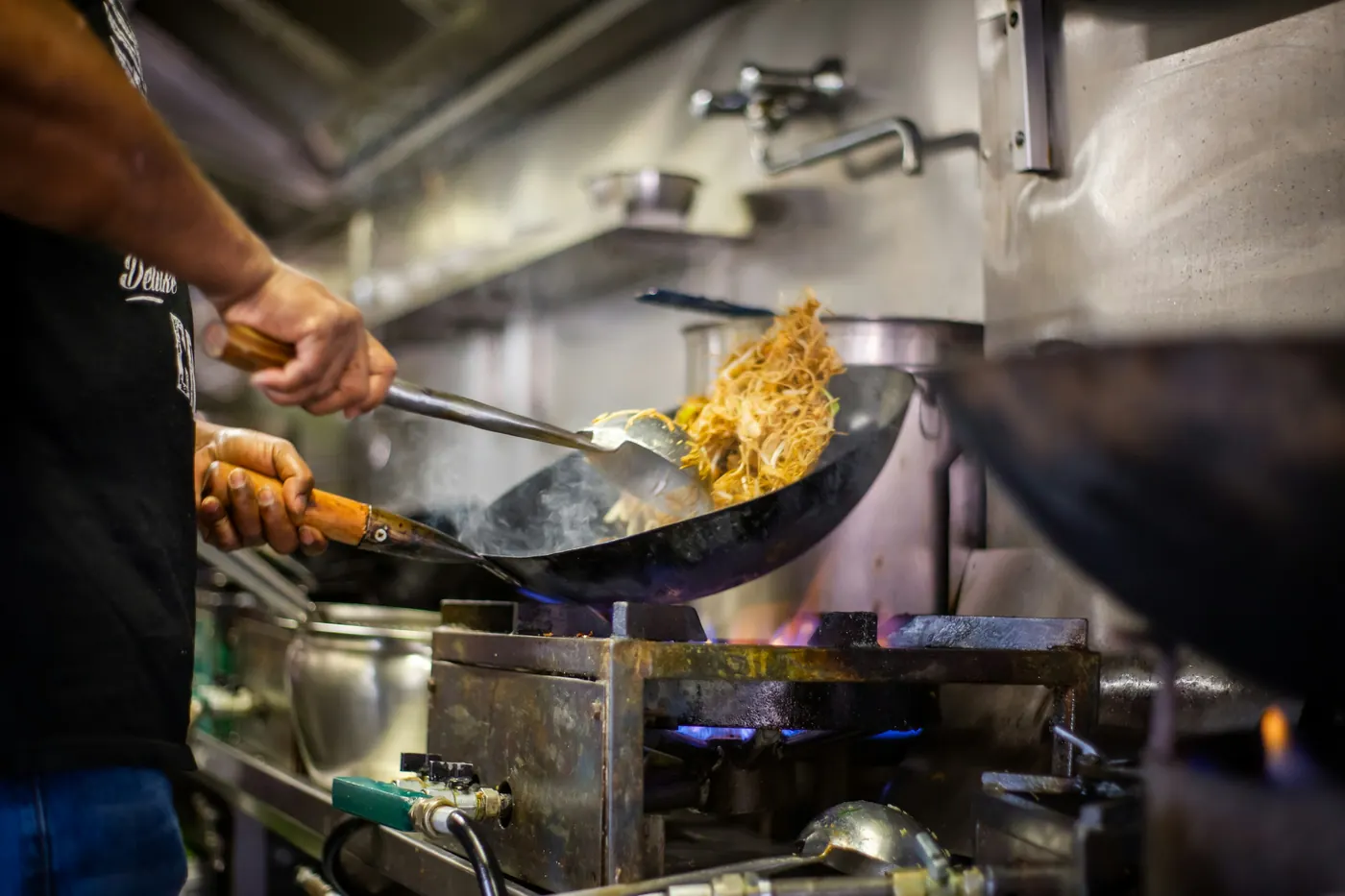
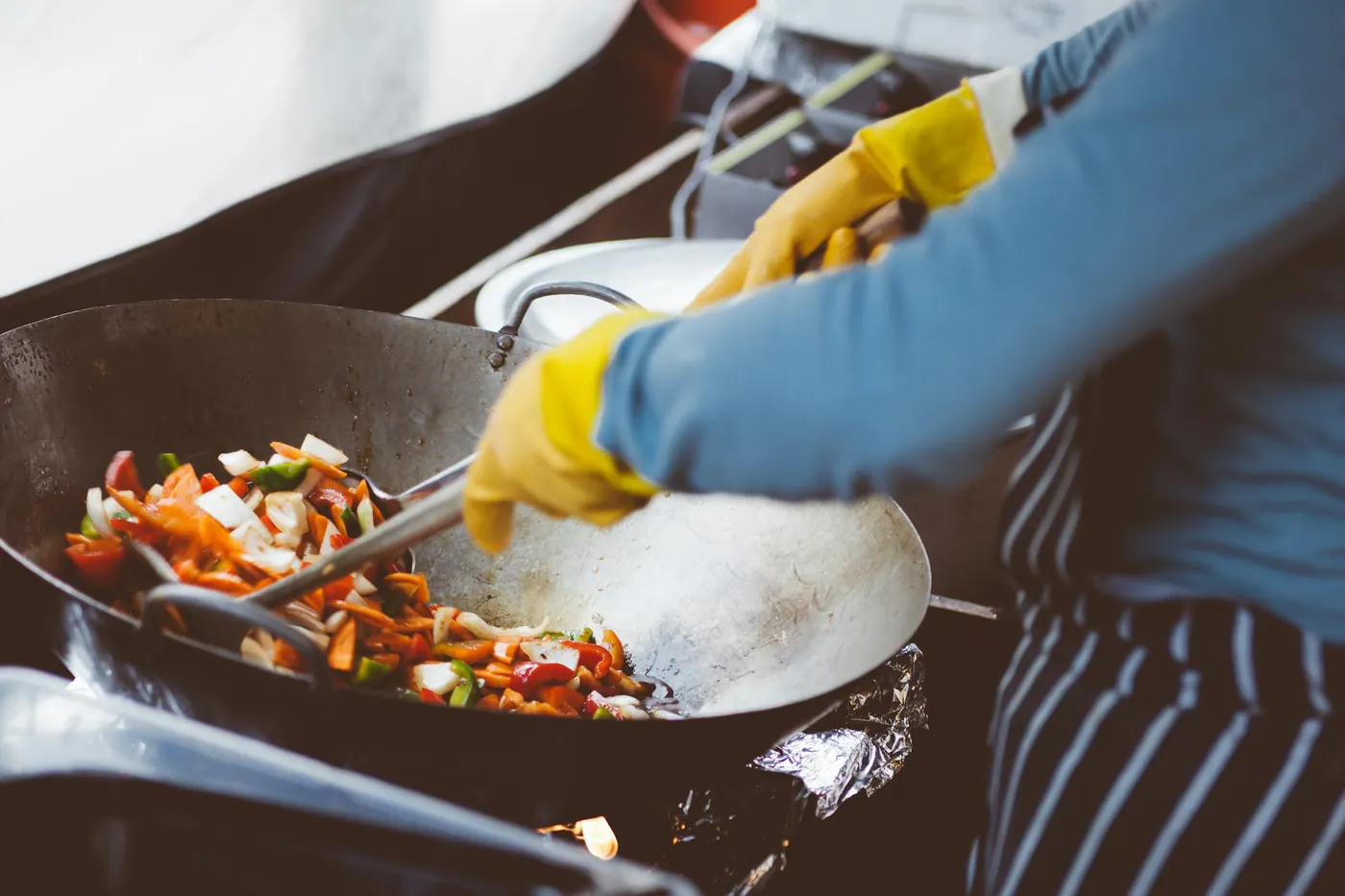
ATK describes a wok as having two zones: a hotter “sear zone” at the base and a lower-heat “steam zone” up the tall, sloped walls, where food keeps cooking through. A cook uses both, pushing finished pieces up the side while the next batch hits the bottom. Done in a well-seasoned wok over high heat, stir-frying produces the smoky, savory flavor called wok hei, which ATK says is more complex than what you get cooking the same food in a skillet.
A frying pan is designed for the opposite: heat that is as even as possible across the whole base. That is why ATK looks for fully clad skillets, built from bonded layers of metal that spread heat quickly and evenly. Even heat is what lets six chicken thighs brown at the same rate, or a whole pan of rajas soften without a scorched patch in the middle.
In practice, the wok wins when the food is cut small and keeps moving; the frying pan wins when the food is in bigger pieces and should sit still.
Tossing and stirring
Stir-frying, as ATK puts it, means high heat and constant motion, and cooks have tossed, turned and flipped food in woks for centuries. The curved walls let you flick food up and catch it, or scrape it up one side with a spatula and let it tumble back, without throwing half the pan on the stove. A 14-inch wok also holds a large volume of sliced vegetables and meat, which is why ATK says that size cooks two to six servings.
A frying pan can be tossed too, and a 10-inch pan of sliced peppers flips easily. But the low sides spill when the pan is full, and a 12-inch stainless skillet is heavy to toss with one hand; ATK found most of the skillets it recommends weigh around 3 pounds, and considered pans over 4 pounds prohibitively heavy. For stirring with a spatula rather than tossing, the skillet’s wide floor is fine.
Oil: frying and stir-frying
For stir-frying, both pans need only a film of oil. The difference shows when you want to fry. Because a wok’s sides slope, a small amount of oil reaches a useful depth in the bottom of the bowl. ATK says that you need about 30 percent less oil when frying certain foods in a wok than in a 7-quart Dutch oven, and the tall, flared sides contain spatters well. That makes a wok a practical pan for frying tortilla strips, a few taquitos or a batch of chicken pieces at home.
A frying pan is a shallow-frying pan: enough oil to come partway up a cutlet or a tostada, then a flip. That suits plenty of jobs, from chiles rellenos to fried eggs, but deep-frying in a skillet means a wide surface of hot oil close to the rim, so a deep pot or a wok is the better choice for anything that needs to float. Whatever the pan, keep hot oil well below the rim and never leave it unattended.
Stove type: gas, electric and induction
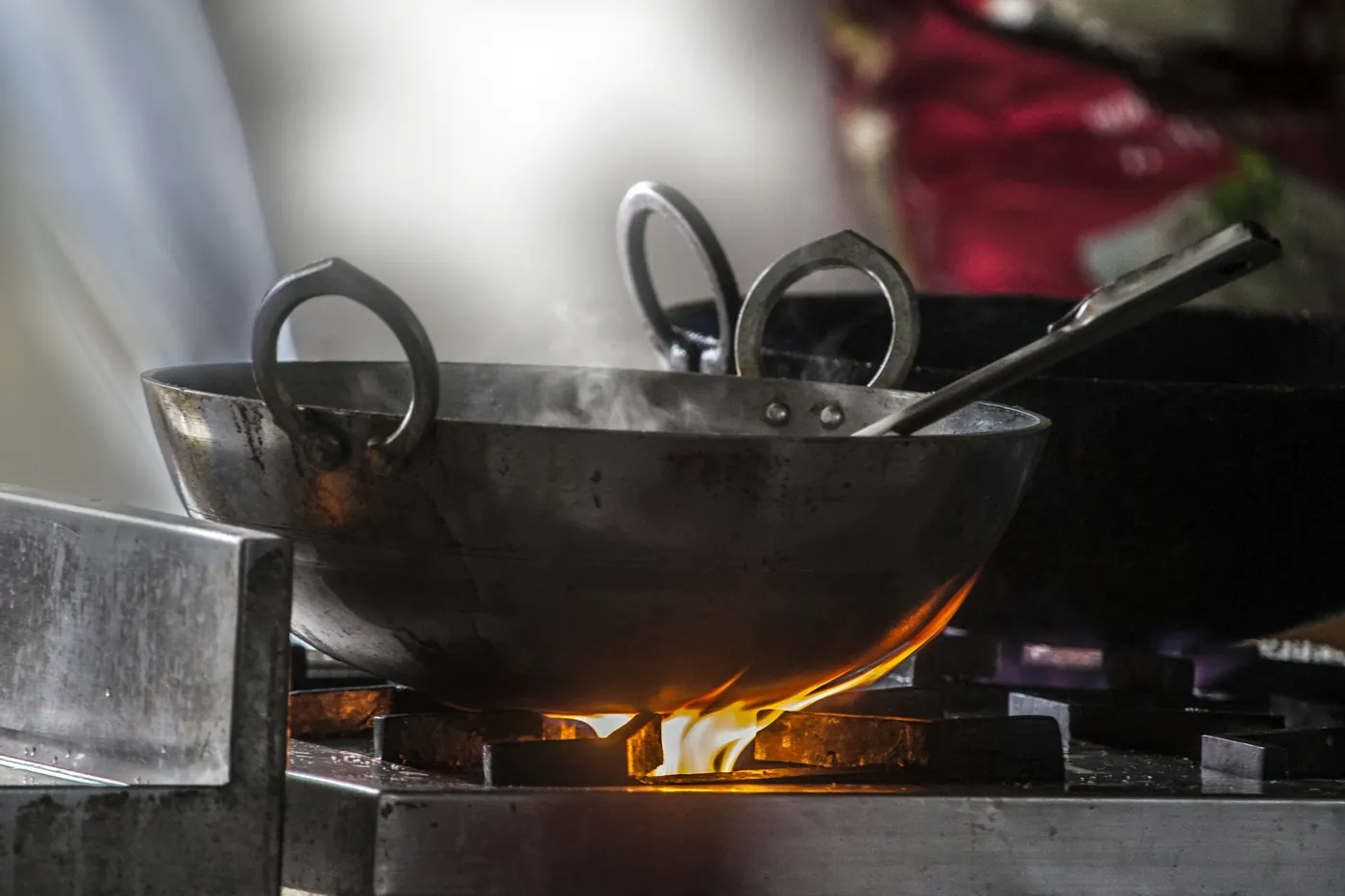
This is where the choice often gets made for you. A traditional round-bottomed wok is meant to sit down inside a strong flame. ATK says it is not a good idea to use a round-bottomed wok by itself on an American-style range, which is why its review covered flat-bottomed woks only: a flat base sits securely on a home stove without a wok ring.
On a gas burner, flames climb the sides of a flat-bottomed wok and heat more of the bowl. On electric and induction stoves, only the small flat base touches the heat. ATK notes that the bigger heat difference between the base and the sides on these stoves raises the risk that a carbon steel wok can warp, that it takes longer to preheat, and that a carbon steel wok can be difficult to season completely on electric or induction. A clad frying pan has none of those problems: the whole base sits flat on the element, and pans like All-Clad’s D3 line are rated for every stovetop including induction.
So if you cook on glass or induction, a 12-inch skillet is the safer first purchase. If you have a strong gas burner, a wok earns its place much more easily.
Materials and care
Most woks worth buying are carbon steel. ATK passed on nonstick-coated woks because they can’t be used safely at the high heat stir-frying sometimes calls for, and on stainless steel woks because they aren’t slick, so food sticks. Carbon steel becomes nonstick as it is seasoned, and ATK preferred it to cast iron because it is lighter and much more responsive to changes in heat. Carbon steel rusts if it is left wet, so it is washed, dried at once and kept lightly oiled. Preseasoned woks cost more but let you start cooking sooner.
Frying pans come in every material: clad stainless that goes in a hot oven and needs no seasoning, cast iron, carbon steel, and nonstick for eggs. Our guide to the best frying pan covers each type, and the best stainless steel pans guide goes deeper on clad stainless.
What each pan does in a Mexican kitchen
The frying pan is the everyday pan of Mexican home cooking: searing skirt steak and chicken for fajitas and tacos, browning chorizo, frying eggs for huevos rancheros, softening onions and chiles, crisping tortillas for chilaquiles and toasting rice before the broth goes in. Our guide to how to eat fajitas shows how much of a fajita plate is pan work.
A wok handles some of the same jobs well, especially for a crowd. Thin-sliced fajita beef with onions and peppers is close to a stir-fry, and a wok holds enough for six without steaming. It also fries tortilla strips and totopos with a modest amount of oil. Where it falls short is anything flat and large: a whole chicken breast, a quesadilla or a row of tortillas needs a frying pan’s floor. For a wider look at searing, frying and braising in Mexican cooking, see Mexican cooking methods explained.
Choose a wok if… / Choose a frying pan if…
Choose a wok if…
- You stir-fry at least once a week and cut food small.
- You cook on a gas stove with a strong burner.
- You often cook a big volume of sliced meat and vegetables at once.
- You want a deep pan for frying tortilla strips or chicken with less oil than a pot.
- You already own a good frying pan.
Choose a frying pan if…
- You can buy only one pan.
- You sear steaks, chicken pieces, fish or chops that should lie flat.
- You cook on an electric, glass or induction stove.
- You want a pan that also goes into a hot oven, or a nonstick pan for eggs.
- You cook for one to four people most nights.
Plenty of kitchens end up with both: a 12-inch skillet for everyday searing and a 14-inch carbon steel wok for stir-fries and frying. If you own a deep sauté pan, it covers some of the wok’s volume, though not its tossing.
One pick for each side
Both picks are pans America’s Test Kitchen rates highly in its current reviews, and both were in stock on Amazon when we wrote this. We have not cooked with either for this guide.
1. Yosukata 13.5-inch Flat-Bottom Carbon Steel Wok – Preseasoned, Ready to Stir-Fry

The Yosukata is a black carbon steel wok with a flat bottom, so it sits securely on a home range without a ring. America’s Test Kitchen rates it Highly Recommended in its wok review and calls it a stellar performer that arrived with a slick preseasoned surface, so testers could start cooking right away. Yosukata says the wok is preseasoned at over 600°F, and notes it still needs proper oil seasoning over time to build its best natural nonstick layer.
At 13.5 inches it is close to the 14-inch size ATK recommends for most households. ATK measured it at 3 pounds 9 ounces, a few ounces heavier than its top pick but still easy to move, with a flat cooking surface of about 6.25 inches. ATK also liked the long wooden handle, which keeps your hand away from the heat, and the lack of interior rivets, which makes cleaning simpler.
The listing says it works on gas, electric, induction and glass cooktops, as well as grills and open fire. As with any flat-bottomed carbon steel wok, it heats best on gas; on electric and induction, give it extra preheating time and moderate the heat to reduce the risk of warping that ATK describes. Wash it by hand, dry it straight away and keep a thin film of oil on it.
Why we like it
- Highly Recommended in ATK’s wok review
- Preseasoned, per Yosukata and ATK
- Flat bottom for home stoves, induction included
- No interior rivets to clean around, per ATK
Key specifications
| Model | 13.5-inch flat bottom, black (model not stated) |
|---|---|
| Material | Black carbon steel, preseasoned |
| Size | 13.5 inches |
| Flat cooking surface | About 6.25 inches (ATK) |
| Weight | 3 lb 9 oz (ATK) |
| Stovetops | Gas, electric, induction, glass, grill, open fire |
| Handle | Long wooden handle |
| Care | Keep seasoned with oil, per the listing |
Why we recommend it
It suits a cook with a gas range who stir-fries often and wants a wok that is ready to use out of the box.
Skip it if you cook only on induction or glass and don’t want to manage carbon steel; a 12-inch clad skillet will serve you better.
Pros and cons
Pros
- Slick preseasoned surface, per ATK
- Easy to maneuver for its size, per ATK
- Works on every stovetop type listed
Cons
- Carbon steel rusts if left wet
- Small flat base; not a pan for searing large cuts
- No lid included
2. All-Clad D3 12-inch Stainless Fry Pan with Lid – Even Browning on Any Stove

The All-Clad D3 is fully bonded tri-ply: an aluminum core between layers of stainless steel, running up the walls as well as across the base. America’s Test Kitchen names the D3 12-inch fry pan, in this version sold with a lid, its longtime favorite stainless steel skillet, and says the fully clad construction helps it heat responsively and brown evenly, with low, flaring sides that encourage browning and evaporation. This listing is the same pan without the lid.
ATK measured the D3 12-inch at 2.8 pounds with a 9.5-inch cooking surface, inside the 9.25 to 10.5 inches it prefers. That is room to sear for up to six people, by ATK’s sizing, and far more flat surface than a wok offers. All-Clad’s listing describes it for searing, sautéing, steaming and simmering, and notes a riveted handle shaped for an underhand grip and a flared edge for drip-free pouring.
It is oven and broiler safe to 600°F and works on any stovetop, including induction. All-Clad recommends hand washing, and it carries a limited lifetime warranty; the listing says it is made in Pennsylvania with global components. Bare stainless needs a properly preheated pan and a little fat to release food cleanly.
Why we like it
- The D3 12-inch is ATK’s favorite stainless skillet
- Fully clad, base and walls
- Works on gas, electric and induction
- Oven and broiler safe to 600°F
Key specifications
| Model | 11644901318 |
|---|---|
| Material | Tri-ply: stainless steel, aluminum core |
| Size | 12 inches |
| Flat cooking surface | 9.5 inches (ATK) |
| Weight | 2.8 lb (ATK) |
| Stovetops | Any, including induction |
| Handle | Riveted stainless; oven safe to 600°F |
| Care | Hand washing recommended, per All-Clad |
Why we recommend it
It suits a cook who wants one pan for searing, sautéing, shallow-frying and pan sauces on any kind of stove.
Skip it if you mostly cook eggs and delicate fish; a nonstick pan releases them with less effort.
Pros and cons
Pros
- Even browning, per ATK
- Broad 9.5-inch cooking surface
- Goes from stovetop to a hot oven
Cons
- Hand washing recommended
- Low sides spill when tossing a full pan
How we compared the wok and the frying pan
We compared the two pans on the things that change at the stove: shape and flat cooking area, how heat spreads, how each handles tossing, how much oil frying takes, and which stoves each suits. The wok guidance comes from America’s Test Kitchen’s review of the best woks, which covered flat-bottomed carbon steel and cast iron models; the frying pan guidance comes from ATK’s review of the best stainless steel skillets. Product details come from the makers’ Amazon listings, and we checked both picks were in stock on Amazon in the United States when we wrote this. We have not cooked with these pans for this guide.
Wok and frying pan questions, answered
Is a wok better than a frying pan?
For stir-frying small pieces over a strong gas flame, yes: the deep bowl, hot base and cooler walls suit constant tossing. For searing anything that should lie flat, and for cooking on electric or induction, a frying pan is better. Neither replaces the other completely.
Wok vs skillet: can a skillet do a stir-fry?
Yes, if you cook in smaller batches so the food isn’t crowded. A 12-inch skillet with a broad flat base browns well, but its low sides spill when you toss a full pan, and ATK says wok-fried food has a more complex flavor than the same food cooked in a skillet.
Can I use a wok on an electric or induction stove?
Use a flat-bottomed wok, not a round-bottomed one. ATK notes that on electric and induction stoves only the base heats, the wok takes longer to preheat, a carbon steel wok can be harder to season fully and there is a higher risk of warping.
Can you fry eggs or sear steak in a wok?
You can fry an egg in the flat base of a seasoned wok, and many cooks do. A steak or a whole chicken breast is another matter: a typical flat base is only about 6 to 7 inches across, so a large cut won’t lie flat. Use a frying pan for those.
Does a wok use less oil than a frying pan?
For stir-frying, both need only a thin film. For frying, the sloped sides mean a little oil reaches a useful depth; ATK says frying certain foods in a wok takes about 30 percent less oil than in a 7-quart Dutch oven.
What size wok and frying pan should I buy?
ATK recommends a 14-inch wok for most households, enough for two to six servings, and a 12-inch skillet to cook for up to six, or a 10-inch skillet for two to four.
Our final word on wok vs pan
The frying pan is the pan to own first: it sears, browns and shallow-fries anything, on any stove. The wok is the pan to add when you stir-fry often, cook for a crowd or have a gas burner that can drive its heat up the walls. If you have only an induction or glass cooktop, a 12-inch skillet will do most of what a wok would.
For carbon steel, cast iron and nonstick woks for the stovetop, start with our guide to the best wok.
For every kind of frying pan, from clad stainless to cast iron and nonstick, start with our guide to the best frying pan. If you want a lid for steaming and finishing, see the best nonstick pan with lid, and for searing chicken, our best skillet for chicken guide. Or let us do the cooking: see the menu or call to order.