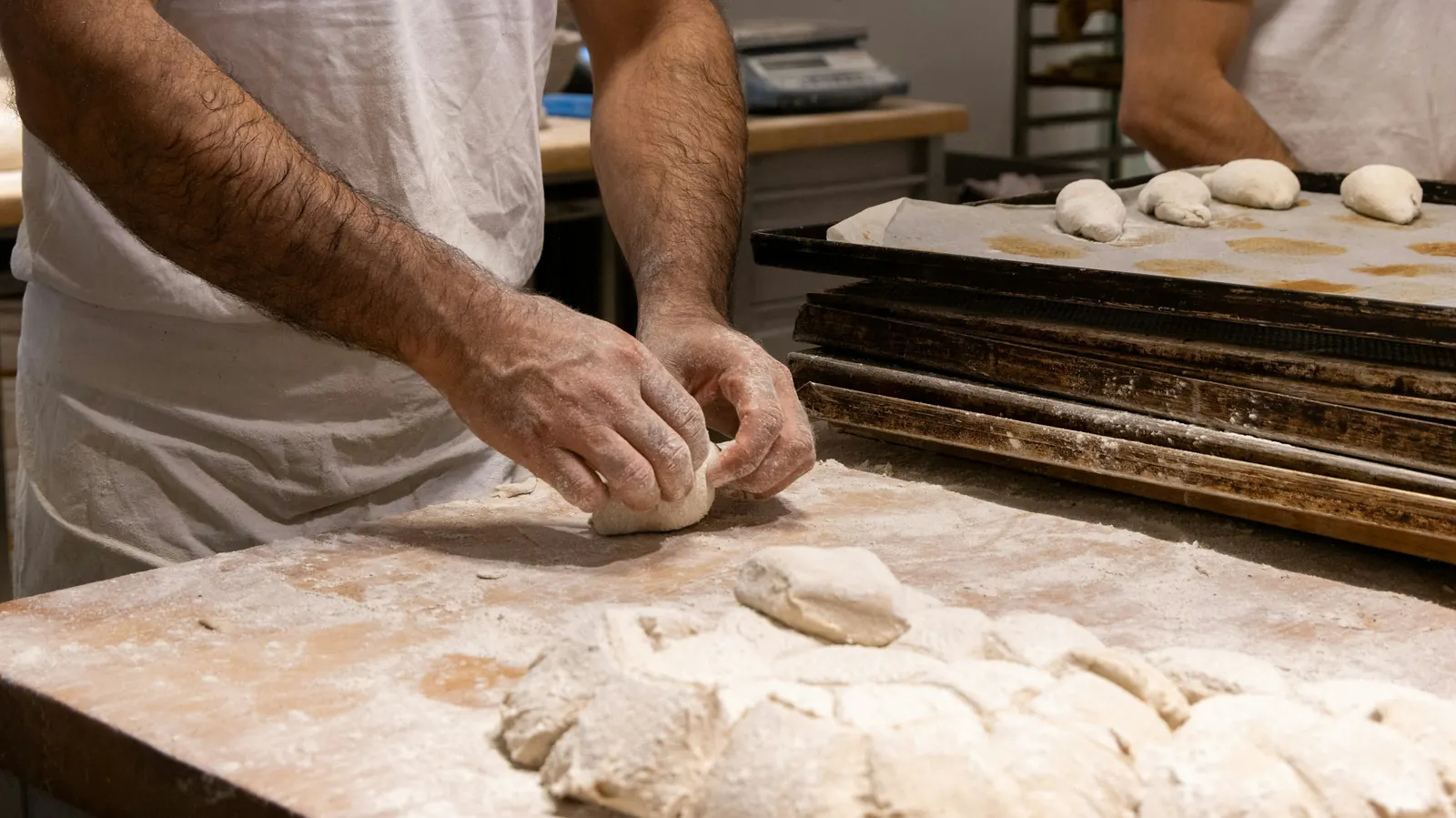
A bench scraper is a flat steel blade with a handle along one edge. It does four everyday jobs: it divides a mass of dough into pieces, lifts and moves dough or shaped loaves, carries chopped food from the board to the pan, and scrapes flour and dried dough off the counter. America’s Test Kitchen describes it as the tool for portioning dough, scraping counters clean and moving chopped ingredients to the stove.
No other single tool does all four as well, but each job on its own has a good stand-in, and you probably own some of them already. This guide sorts out what to use for each job, which tools from identifiable makers are worth buying if you don’t have them, and the honest point at which a cheap bench scraper is the better answer.
Julia’s earns a commission on purchases made through links on this page, at no cost to you. Recommendations are based on what a restaurant kitchen looks for, product specifications and verified buyer reports.
Why cooks look for a bench scraper alternative
- The dough is on the counter and there is no scraper. You need to divide it or move it now, with what is in the drawer.
- Only one of the jobs matters to you. If you only ever move chopped onions to a pan, or only cut pastry into strips, a tool built for that one job may suit you better.
- Drawer space. Some cooks would rather use the knife, spatula or cutting mat they already keep than add another flat tool.
- Protecting the knife. Many people scrape chopped food off the board with the knife edge, which is hard on the blade. They want a better habit.
Quick verdict: the best bench scraper alternative
If you bake bread or make tortillas every week, buy a bench scraper; it is one of the cheapest tools in the kitchen, and our best bench scraper guide covers them. Without one, match the stand-in to the job. To divide dough, use a sharp chef’s knife such as the Winco 8-inch Hollow Ground Chef’s Knife, pressed straight down. To move chopped food, use a flexible cutting mat such as the Joseph Joseph Pop set, which bends into a chute, or flip your knife and use its spine. To move a shaped round or a crust, slide it onto a wide Nordic Ware Cake Lifter. For even strips and squares of rolled dough, an Ateco 5-wheel cutter is faster and more even than any scraper. To loosen dough stuck to the counter, a thin, flexible King Arthur 8-inch offset spatula slides under it.
Five bench scraper stand-ins side by side
Our five picks, one for each job a bench scraper does, with what each maker or listing states.
| Alternative | Job it covers | Material | How close to a scraper | Buy on Amazon |
|---|---|---|---|---|
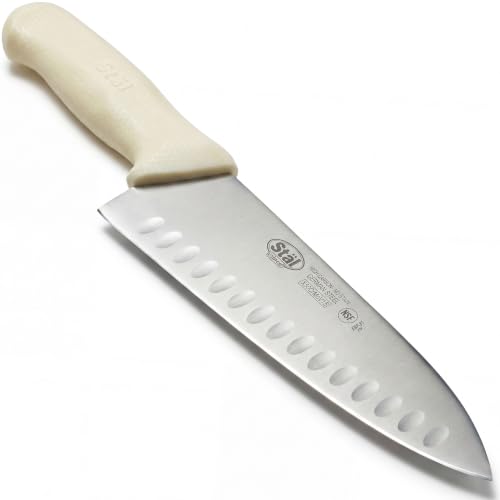
Winco 8-inch Hollow Ground Chef’s Knife, WhiteBest for dividing dough
|
Cutting dough into pieces | German X50CrMoV15 steel (listing) | Cuts cleanly; carries little | View on Amazon |

Joseph Joseph Pop Flexible Chopping Mats, 3-Piece SetBest for moving chopped food
|
Board to pan, scraps to bin | Flexible plastic mats | Better for big piles; no dough work | View on Amazon |

Nordic Ware 10-Inch Cake LifterBest for moving shaped dough
|
Lifting rounds, crusts, loaves | Stainless steel, beechwood handle | Moves bigger pieces; does not cut | View on Amazon |

Ateco 5-Wheel Adjustable CutterBest for even portions
|
Strips and squares of rolled dough | Stainless steel | Beats it on flat sheets only | View on Amazon |

King Arthur Baking 8-inch Offset SpatulaBest for loosening stuck dough
|
Sliding under dough, smoothing | Japanese stainless steel (listing) | Thinner and bendier; narrow blade | View on Amazon |
What a bench scraper does, and what can stand in
It helps to split the scraper into its jobs, because no stand-in covers more than one or two of them well.
Dividing dough
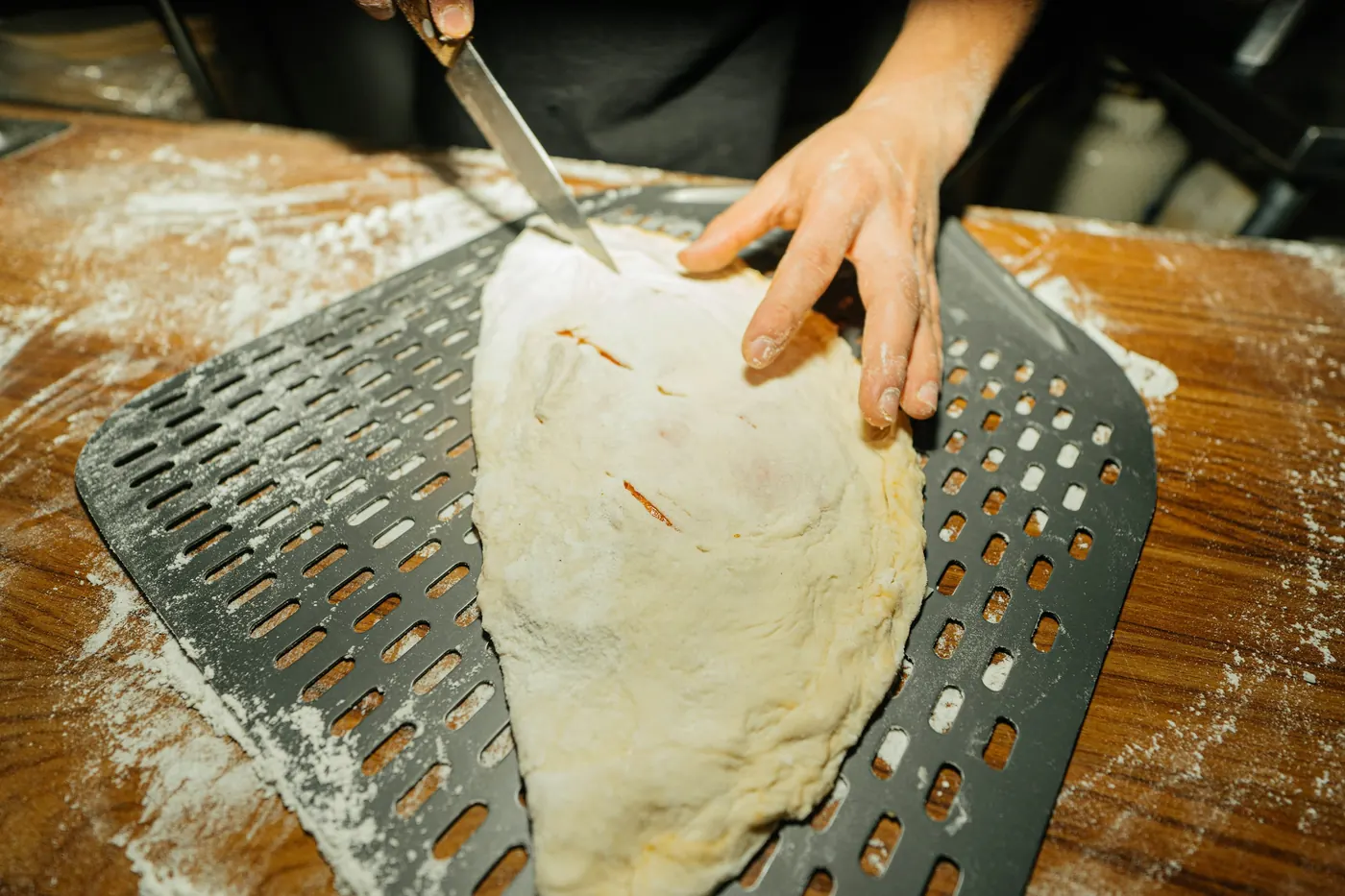
A bench scraper cuts by pressing straight down, which is why it portions bread dough and masa without tearing it. A sharp chef’s knife does the same if you press rather than saw. The limits are length and stickiness: a knife blade is narrower, so wet dough clings to it more, and dipping the blade in flour or water between cuts helps. This is general kitchen sense rather than maker guidance.
Moving chopped food
America’s Test Kitchen’s bench scraper review, by Chase Brightwell (June 2025), found the best blades were rectangular and about 6 by 3 inches, large enough to carry big piles of chopped vegetables, and that smaller blades were less efficient at scooping ingredients. A knife blade is smaller than that, so it carries less per trip. A flexible cutting mat skips the scooping altogether: you lift the whole mat, bend it and pour.
If you do scoop with a knife, turn it over. Chowhound’s Catherine Nyorani (November 2024) explains that knives are built to cut vertically, and that dragging the edge sideways across a board pushes the edge out of alignment. Her advice is to flip the blade and use the thicker, sturdier spine, while noting that a bench scraper is still the better tool because its wide face carries more than a knife can.
Lifting and moving dough
A bench scraper slides under a shaped round of dough so you can lift it into a basket or onto a peel. Any wide, thin, rigid plate does the same job, and the wider it is, the less the dough sags. A cake lifter is the obvious choice; a large flat turner works for smaller pieces. This is general kitchen sense: the makers of these tools list them for cakes, not dough.
Scraping the counter
For dried flour and bits of dough, the flat, stiff edge of a scraper is hard to beat. A thin offset spatula or the back of a large turner can work loose a patch of stuck dough, and a damp cloth finishes the job. A curved plastic bowl scraper is a fair stand-in here too, though America’s Test Kitchen says bowl and bench scrapers are not interchangeable: bowl scrapers are smaller, curved and made mainly for getting dough out of bowls. Our best bowl scraper guide covers those.
Our picks for the best bench scraper alternative
Every pick was in stock with a new lead offer when we checked, and none appears as the same listing on our other pages. Two are other versions of products we cover elsewhere, as noted in their sections. None of them is a bench scraper.
1. Winco 8-inch Hollow Ground Chef’s Knife, White – A Straight Cut Through Dough
The tool most kitchens already have that can divide dough is a chef’s knife. If you don’t own a decent one, a plain restaurant-supply knife is the sensible buy. Winco’s listing describes this 8-inch knife with a blade of X50CrMoV15 German steel, a slip-resistant handle with finger grips, and a commercial-grade build for daily foodservice use. It is NSF listed, according to the listing, and this version has a hollow-ground edge, meaning a row of shallow recesses along the blade.
For dough, press the blade straight down through the mass and lift it out; don’t saw. A flour-dusted or wet blade sticks less. It divides bread dough, masa and pie dough well, and it can also cut cold butter into cubes for pastry. What it cannot do well is carry anything. The blade is much narrower than a 6 by 3-inch scraper, so scooping a pile of chopped onions takes several trips.
When you do scoop, use the spine, not the edge, as Chowhound advises. The listing does not give care instructions, so follow the general rule for knives: wash and dry by hand. Our best chef knife guide covers more knives if you want one to keep for years.
Why we like it
- X50CrMoV15 German steel blade (listing)
- NSF listed for commercial kitchens (listing)
- Slip-resistant handle with finger grips (listing)
- Also does every everyday cutting job
Key specifications
| Model | KWP-81 |
|---|---|
| Type | Chef’s knife, hollow-ground edge |
| Material | X50CrMoV15 German steel; white handle |
| Size | 8-inch blade |
| Scraper jobs it covers | Dividing dough; small scoops with the spine |
| Certification | NSF listed (listing) |
| Care | Not stated; hand wash and dry is the usual advice |
| Warranty | Not stated |
Why we recommend it
It suits a cook who wants one tool that divides dough cleanly and also handles daily chopping, without paying for a premium knife.
Skip it if you already own a sharp chef’s knife; yours will divide dough just as well.
Pros and cons
Pros
- Clean, straight cuts through dough
- Commercial build, NSF listed
- Useful far beyond baking
Cons
- Narrow blade carries little
- Sticky dough clings to it
- Care and warranty not stated
2. Joseph Joseph Pop Flexible Chopping Mats, 3-Piece Set – Bend and Pour Into the Pan
Moving chopped food from the board to the pan is the job most home cooks use a bench scraper for, and a flexible mat does it differently: you don’t scoop at all. Joseph Joseph’s listing says the mats can be bent or folded to direct chopped food into a pan or food scraps into a bin. Each of the three mats has a double-sided, knife-friendly surface and is color coded.
For a pile of diced onion, peppers and tomato for salsa or rice, this is faster than a scraper, because the whole pile goes in at once with nothing left behind. The mats also join together through a hole at one end, according to the listing, which gives them a hanging point. They are dishwasher safe.
The limit is that a mat does nothing for dough. It won’t divide it, and it is too floppy to slide under a shaped loaf. It is also a thin cutting surface, so set it on a damp towel if it slides on your counter; that is general kitchen sense rather than maker guidance. For a full-size board to cut on, see our best cutting board guide.
Why we like it
- Bends to pour chopped food into a pan (listing)
- Double-sided, knife-friendly surface (listing)
- Color coded, three mats (listing)
- Dishwasher safe (listing)
Key specifications
| Model | 92104 |
|---|---|
| Type | Flexible chopping mats, set of 3 |
| Material | Flexible plastic |
| Size | Not clearly stated on the listing |
| Scraper jobs it covers | Moving chopped food; clearing scraps |
| Certification | Not stated |
| Care | Dishwasher safe |
| Warranty | Not stated |
Why we recommend it
It suits a cook who mostly used a scraper to carry chopped vegetables to the stove and would rather pour than scoop.
Skip it if your scraper work is mostly dough; a mat does none of that.
Pros and cons
Pros
- Moves a whole pile in one go
- Three mats for separate foods
- Goes in the dishwasher
Cons
- No use for dividing or lifting dough
- Thin mats can slide on a counter
- Mat size not clearly stated
3. Nordic Ware 10-Inch Cake Lifter – A Wide Plate for Shaped Dough
Lifting a shaped boule into a proofing basket, or moving a rolled crust or a flattened round of dough, needs a wide, thin, rigid plate. A bench scraper is only 6 inches wide, so big pieces sag over its edges. A cake lifter is the same idea, made bigger. Nordic Ware’s listing describes a stainless steel plate about 10 inches across with a beechwood handle, 16.5 by 10 inches overall, made for lifting cakes and other baked goods of generous diameter.
Nordic Ware lists it for cakes, not dough, so using it for dough is our kitchen sense rather than the maker’s claim. Dust the plate with flour and slide it under the dough with one quick push. For cakes, the listing suggests a light coat of cooking spray so they slide off; for dough, a dusting of flour is the usual approach. It also carries a large pile of chopped vegetables, though its round edge lets more fall off than a straight-edged scraper would.
It cannot cut dough or scrape a counter; the plate is thin and the front edge is round. The listing recommends hand washing and gives a 5-year warranty. This is another listing of the Nordic Ware lifter in our best cake lifter guide, included because the plate’s size and shape are exactly what moving dough calls for.
Why we like it
- Plate about 10 inches across (listing)
- Stainless steel with a beechwood handle (listing)
- 5-year warranty (listing)
- Moves pieces too big for a scraper
Key specifications
| Model | 02143 |
|---|---|
| Type | Cake lifter |
| Material | Stainless steel; beechwood handle |
| Size | 16.5 x 10 in; plate about 10 in |
| Scraper jobs it covers | Lifting and moving dough; carrying chopped food |
| Certification | Not stated |
| Care | Hand wash recommended |
| Warranty | 5 years (listing) |
Why we recommend it
It suits a bread or pizza baker who needs to move large, soft pieces of dough without stretching them out of shape.
Skip it if you need to divide dough or clean the counter; it does neither.
Pros and cons
Pros
- Wide enough for a whole loaf or crust
- Thin plate slides under dough
- Stated 5-year warranty
Cons
- Does not cut or scrape
- Hand wash only
- Bulky to store
4. Ateco 5-Wheel Adjustable Cutter – Even Strips in One Pass
Bakers use a bench scraper with ruler marks to cut rolled dough into even strips and squares. For that one job, a multi-wheel cutter is better. Ateco’s listing describes five stainless steel wheels, each 2 1/8 inches across, on an expanding frame that opens up to 4 7/8 inches between wheels. A wingnut locks the spacing, so every pass gives the same width.
Ateco lists it for even cuts of brownies, cookies, cake, pastry and pasta dough. Roll it once lengthwise and once across, and a sheet of dough becomes a tray of even squares for crackers, empanada rounds to trim, or pastry strips for a lattice. Ateco, a family business since 1905 according to the listing, makes professional baking and decorating tools.
It only works on dough that is already rolled flat. It cannot portion a mass of bread dough into balls, lift anything, or scrape the counter. The listing says hand washing gives the best results. Our best pastry wheel guide covers single wheels for trimming and crimping.
Why we like it
- Five 2 1/8-inch stainless wheels (listing)
- Spacing adjusts up to 4 7/8 inches (listing)
- Wingnut locks the spacing (listing)
- Listed for pastry and pasta dough
Key specifications
| Model | 13955 |
|---|---|
| Type | Expandable 5-wheel cutter |
| Material | Stainless steel |
| Size | Wheels 2 1/8 in; up to 4 7/8 in apart |
| Scraper jobs it covers | Cutting rolled dough into even pieces |
| Certification | Not stated |
| Care | Hand wash for best results |
| Warranty | Not stated |
Why we recommend it
It suits a baker who cuts rolled dough into strips or squares often and wants them all the same size.
Skip it if you mainly divide bread dough into balls; a knife or a scraper does that better.
Pros and cons
Pros
- Five even cuts per pass
- Lockable spacing
- All stainless steel
Cons
- Flat, rolled dough only
- Hand wash; more parts to clean
5. King Arthur Baking 8-inch Offset Spatula – A Thin Blade Under Stuck Dough
When dough sticks to the counter, a bench scraper’s stiff edge gets under it. A thin offset spatula does the same in a gentler way, and it is a tool many bakers already own for frosting. King Arthur’s listing describes an extra-flexible 8-inch blade of Japanese stainless steel with a rounded tip and an offset handle, 12.52 inches long overall, that keeps your hand off the work surface.
Slide the blade flat along the counter under the dough and work it loose a little at a time. The offset keeps your knuckles clear, and the thin blade gets under a sticky patch without tearing it. King Arthur lists it for spreading frostings, fillings and batters and for getting the last of a mixture out of a bowl. Using it on dough is our kitchen sense, not the maker’s claim.
It has clear limits. The blade is narrow and flexible, so it will not carry a pile of chopped food or lift a whole loaf, and it is not meant for cutting dough. The listing says it is dishwasher safe. This is the 8-inch size of the King Arthur spatula in our best offset spatula guide, which covers the 4-inch model; the longer blade reaches farther under a sheet of dough.
Why we like it
- Extra-flexible 8-inch Japanese steel blade (listing)
- Offset handle keeps hands clear (listing)
- Dishwasher safe (listing)
- Doubles as a frosting spatula
Key specifications
| Model | 50649K |
|---|---|
| Type | Offset spatula |
| Material | Japanese stainless steel; BPA-free, PFAS-free plastic handle |
| Size | 8-inch blade; 12.52 x 1.14 x 2.2 in |
| Scraper jobs it covers | Loosening stuck dough; light counter scraping |
| Certification | Not stated |
| Care | Dishwasher safe |
| Warranty | Not stated |
Why we recommend it
It suits a baker who works with soft, sticky doughs and also decorates cakes, and wants one thin blade for both.
Skip it if you need to carry food or divide dough; the blade is too narrow and too bendy.
Pros and cons
Pros
- Gets under sticky dough gently
- Useful for frosting and fillings
- Goes in the dishwasher
Cons
- Too narrow to carry chopped food
- Not for cutting dough
- Warranty not stated
Match the stand-in to the job
| Bench scraper job | Best stand-in | What to expect |
|---|---|---|
| Dividing bread dough or masa | Sharp chef’s knife, pressed straight down | Clean cuts; flour or wet the blade |
| Moving chopped food | Flexible mat, or the knife’s spine | Mat pours it all; spine carries a little |
| Lifting a shaped loaf or crust | Cake lifter or wide turner | Moves bigger pieces than a scraper |
| Even strips of rolled dough | Multi-wheel cutter | More even than a scraper |
| Loosening stuck dough | Thin offset spatula | Gentle, but slow on a big mess |
| Scraping dried flour off the counter | A bench scraper | Nothing here does it as well |
Household stand-ins for tonight
This section is general kitchen sense rather than maker guidance. If the dough is ready and none of the tools above is in the drawer, a large metal pancake turner will lift and move small pieces and push flour into a pile. A plastic bowl scraper, if you have one, divides soft dough with its flat side. A thin, flexible plastic cutting board can be lifted and bent to pour chopped food, the same way the Joseph Joseph mats work. Floured hands move a shaped ball of dough well enough, and a damp cloth finishes off the counter.
Avoid tools that were not made for food, such as a putty knife or a paint scraper, even if they look like a bench scraper. And don’t use the knife edge as a scoop; turn it over.
What we left out
We did not include bench scrapers, dough cutters, chopper-scrapers or bowl and bench scraper sets. They are the tool itself, and our best bench scraper and best bench scraper for sourdough guides cover them. We left bowl scrapers to the best bowl scraper guide rather than repeat it here. We also left out cleavers, which overlap with the chef’s knife here, and pastry blenders, which cut butter into flour but do none of a scraper’s other jobs.
Questions about working without a bench scraper
What can I use if I don’t have a bench scraper?
For dividing dough, a sharp chef’s knife pressed straight down. For moving chopped food, a flexible cutting mat or the spine of your knife. For lifting dough, a wide cake lifter or a large turner. For loosening stuck dough, a thin offset spatula.
Can I use a knife instead of a bench scraper?
Yes for cutting dough, and partly for moving food. Chowhound advises scooping with the spine rather than the edge, since dragging the edge sideways across a board knocks it out of alignment. A knife carries much less than a scraper’s wide blade.
Is a bowl scraper the same as a bench scraper?
No. America’s Test Kitchen says the two are not interchangeable: a bowl scraper is smaller and curved, made mainly to get dough out of bowls, while a bench scraper handles a wider range of jobs. A bowl scraper is still a fair stand-in for dividing soft dough.
How do I move chopped vegetables without a bench scraper?
Chop them on a flexible mat and pour them into the pan, as Joseph Joseph describes for its Pop mats. Otherwise, turn your knife over and push the food onto the flat of the blade with the spine.
Is it worth buying a bench scraper?
If you bake bread, make tortillas or chop a lot of vegetables, yes. It is cheap, it does four jobs, and America’s Test Kitchen found a plain 6 by 3-inch blade works best.
When to stop improvising and buy the scraper
Each tool on this page beats a bench scraper at one thing: the knife at clean cuts, the mat at pouring, the lifter at moving big pieces, the wheel cutter at even strips, the spatula at gentle loosening. A bench scraper is the only tool that does all of them reasonably well, and it is cheap. If you divide dough or clear a floured counter more than now and then, start with our best bench scraper guide, and keep these tools for the jobs they do best. For more swaps of this kind, see our rolling pin alternative guide.
And when you would rather someone else made the tortillas, see the menu or call to order.