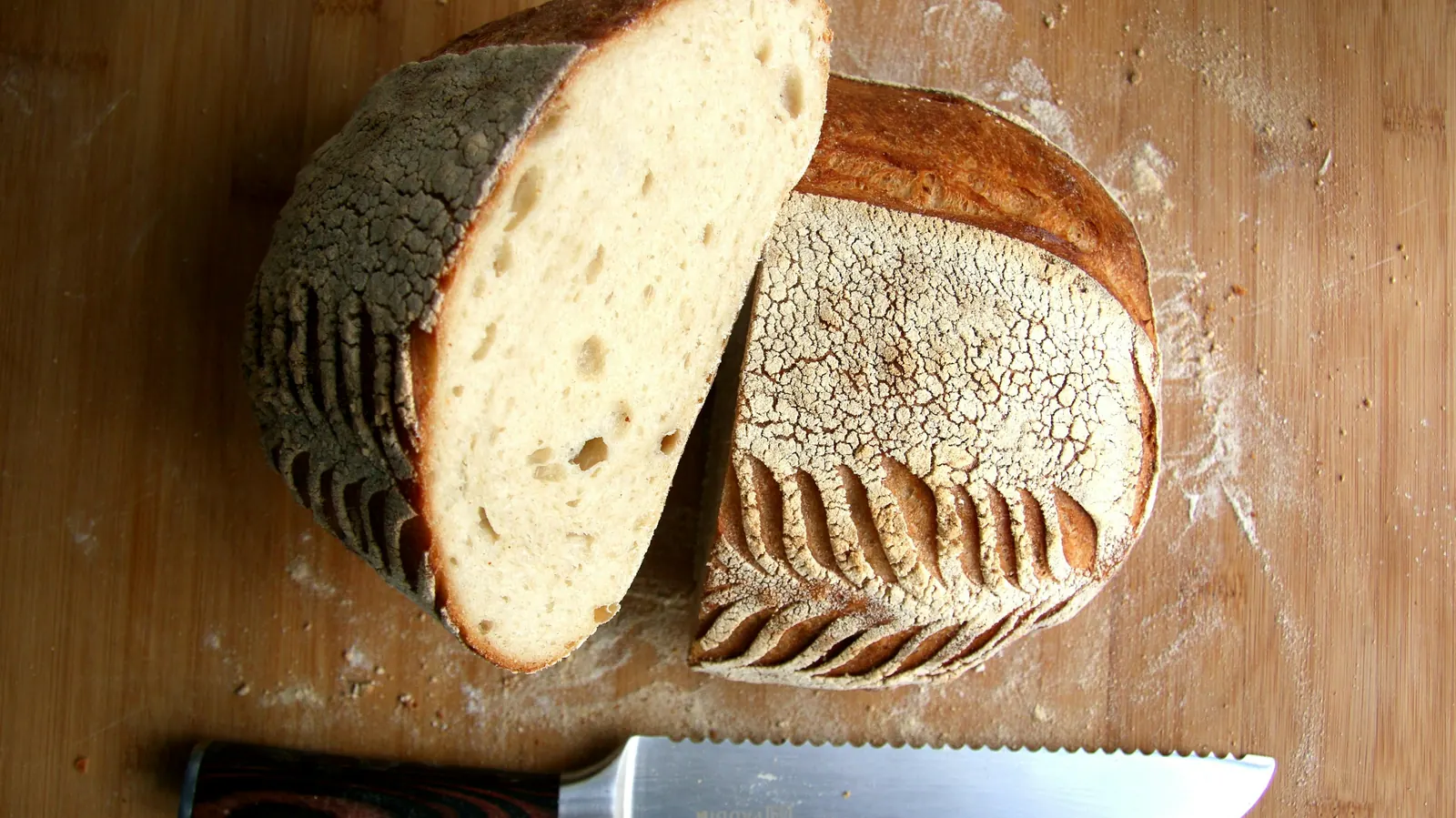
Every torta starts with a cut. A bolillo or a telera has a thin, crackly crust and a soft crumb, and it has to be split lengthwise without squashing it flat or tearing the top away from the bottom. A chef’s knife pushes down and crushes the roll; a good serrated bread knife saws through the crust with its teeth and leaves the inside light. The same knife slices a sourdough boule, a sandwich loaf, a ripe tomato and the tres leches cake at the end of the meal.
Bread knives look alike, but they differ in the things that matter: how long the blade is, how many serrations it has and what shape they are, whether the handle is offset to keep your knuckles off the board, and how the handle feels. This guide compares eight serrated bread knives on those points, using makers’ specifications, the Amazon listings and America’s Test Kitchen’s published bread knife review.
Julia’s earns a commission on purchases made through links on this page, at no cost to you. Recommendations are based on what a restaurant kitchen looks for, product specifications and verified buyer reports.
Quick verdict: which bread knife to buy
For most kitchens, the best bread knife is the Mercer Culinary Millennia 10-inch Wide Wavy Edge Bread Knife: it is the winner of America’s Test Kitchen’s serrated bread knife review, with a long blade, tall serrations and a grippy handle, at a commercial-kitchen price. For an upgrade with a curved blade, the MAC Superior 10.5-inch; for slicing bolillos and teleras, the compact Victorinox Fibrox 8-inch; for knuckle room, the Messermeister Custom 8-inch Offset; and for Japanese steel, the Shun Classic 9-inch.
The table shows our five standout picks, one for each kind of cook. All eight knives are reviewed in full below it.
Five bread knives side by side
Blade and serrations for our five standout picks, as each maker, Amazon listing or America’s Test Kitchen states them.
| Bread knife | Best for | Blade | Serrations | Buy on Amazon |
|---|---|---|---|---|
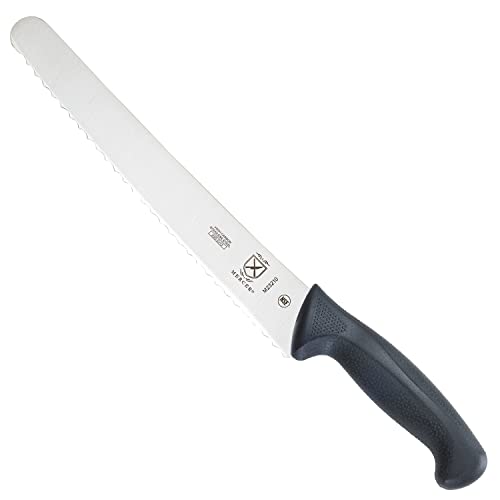
Mercer Culinary Millennia 10-inch Bread KnifeBest overall
|
Big loaves, rolls and cakes | 10 in; 9.2 in usable (ATK) | Wavy; 29 tall teeth (ATK) | View on Amazon |

MAC Superior 10.5-inch Bread KnifeBest upgrade
|
Bread and roasts, rocking cuts | 10.5 in curved; 9.5 in usable (ATK) | Rounded; 34 teeth (ATK) | View on Amazon |

Victorinox Fibrox 8-inch Bread KnifeBest for rolls
|
Bolillos, teleras and baguettes | 8 in stamped, bolsterless | Serrated; type not stated | View on Amazon |
| Tortas and sandwiches on the board | 8 in X50 steel, 58 HRC | Scalloped; offset handle | View on Amazon | |

Shun Classic 9-inch Bread KnifeBest Japanese
|
Clean slices of crusty bread | 9 in VG-MAX, Damascus clad | Wide teeth (Shun) | View on Amazon |
Product images from Amazon. Specifications as stated by each maker or Amazon listing; usable blade length and serration counts are America’s Test Kitchen’s measurements. Check the listing before you buy.
Our picks for the best bread knife
These eight knives cover the main choices: long straight blades for big loaves, a curved blade, a compact knife for rolls, two offset knives, a double-serrated German classic, and premium forged and Japanese options. We judged each one first on bread, from crusty bolillos to soft sandwich loaves, and then on the other jobs a serrated knife does in a Mexican kitchen: ripe tomatoes, layered cakes and pressed tortas.
1. Mercer Culinary Millennia 10-inch Bread Knife – Long Blade, Tall Teeth
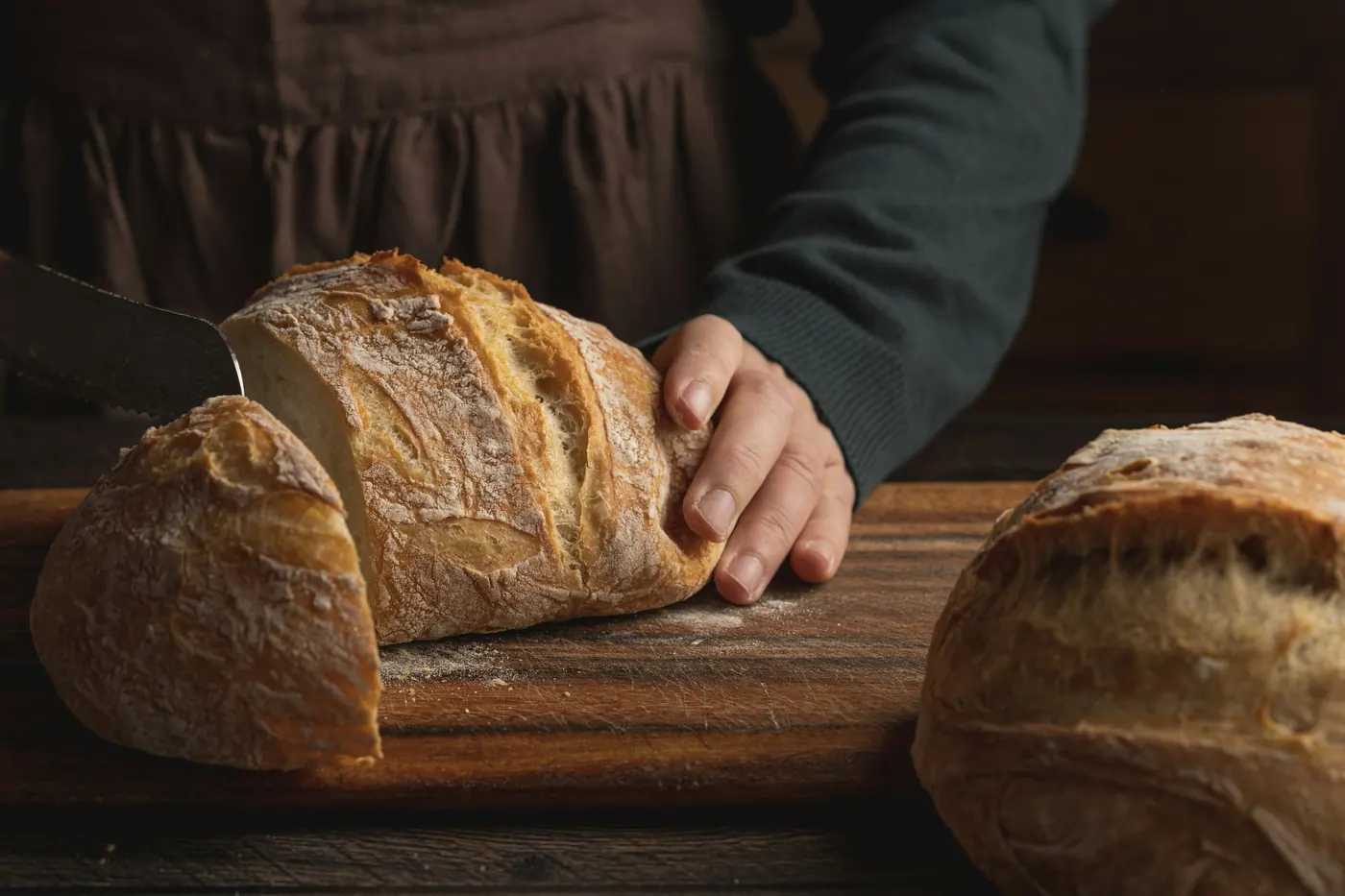
This is the knife that won America’s Test Kitchen’s serrated bread knife review, which describes it as an inexpensive industry favorite. ATK measured 9.2 inches of usable blade with 29 serrations, each 1.2 millimeters tall, and praised its “tall, reasonably sharp serrations” and a “long, rubbery handle” that was “comfortable for hands of all sizes.”
Those numbers match what ATK says to look for: at least 8.5 inches of usable blade so the knife can span a large loaf, and relatively few, tall serrations that bite into crust instead of skating over it. The 10-inch length makes long, even strokes through a sourdough boule or a row of teleras, and Mercer lists bread, angel food cake, meatloaf, fruit and tomatoes among its uses.
Mercer says the blade is one-piece high-carbon Japanese steel, and the handle has textured finger points for grip. Care is strict: wash by hand and dry at once. Mercer’s warranty covers defects in material and workmanship, but it excludes damage from dishwasher use.
Why we like it
- Winner of ATK’s bread knife review
- 9.2 in of usable blade (ATK)
- 29 tall serrations that bite into crust
- Textured, non-slip handle
Key specifications
| Model | M23210 |
|---|---|
| Blade length | 10 in; 9.2 in usable (ATK) |
| Serration type | Wavy edge; 29 serrations (ATK) |
| Steel | One-piece high-carbon Japanese steel |
| Offset handle | No |
| Handle | Textured, 5.75 in (ATK) |
| Dishwasher safe | No; hand wash (Mercer) |
| Warranty | Repair or replace defects; excludes dishwasher damage |
Why we recommend it
It suits nearly every kitchen: long enough for big loaves, effective on crusty rolls, comfortable in any hand and inexpensive enough that you will not worry about it.
Skip it if you want a knife that looks good on a magnetic strip; it is a plain commercial knife.
Pros and cons
Pros
- Top-rated in ATK’s review
- Long blade spans large loaves
- Low price
Cons
- Hand wash only
- Utilitarian looks
2. MAC Superior 10.5-inch Bread Knife – Curved Blade for Leverage
MAC’s Superior bread knife, which ATK lists as the Superior Bread and Roast Slicer, is the runner-up in America’s Test Kitchen’s review, listed with its highly recommended knives. ATK measured 9.5 inches of usable blade with 34 serrations, and found that the gently curved blade “gave us a little extra leverage,” letting you rock the knife through a loaf as well as saw.
The listing describes a thin 2-millimeter blade of rust-resistant high-carbon steel that keeps its edge a long time, a lightweight build and a Pakkawood handle, made in Japan. ATK measured the handle at 5.25 inches, above the 5-inch minimum it recommends for comfort.
The one weakness ATK found was in the serrations themselves, which are rounded rather than pointed: they “sometimes skidded and slipped on crusty bread.” That is worth knowing if most of what you cut is hard-crusted country bread. On softer loaves, cakes and roasts, the long, curved blade is an advantage. MAC says to wash it by hand; the listing does not state warranty terms.
Why we like it
- Runner-up in ATK’s review
- 9.5 in of usable, curved blade (ATK)
- Thin 2 mm blade (listing)
- Also slices roasts
Key specifications
| Model | SB-105 |
|---|---|
| Blade length | 10.5 in; 9.5 in usable (ATK) |
| Serration type | Rounded; 34 serrations (ATK) |
| Steel | Rust-resistant high-carbon steel, 2 mm |
| Offset handle | No |
| Handle | Pakkawood, 5.25 in (ATK) |
| Dishwasher safe | No (listing) |
| Warranty | Not stated in listing |
Why we recommend it
It suits a cook who wants a finer, lighter knife than the Mercer and will use it for roasts and cakes as well as bread.
Skip it if you mostly cut hard-crusted loaves; ATK found the rounded teeth sometimes slipped on them.
Pros and cons
Pros
- Long, curved blade
- Light and thin
- Comfortable long handle
Cons
- Teeth can skid on hard crust (ATK)
- Several times the Mercer’s price
- Warranty not stated in listing
3. Victorinox Fibrox 8-inch Bread Knife – Compact for Rolls
Not every bread knife has to tackle a giant boule. If most of your bread is bolillos, teleras, baguettes and sandwich loaves, an 8-inch blade is easier to steer when you split a roll lengthwise in your hand or on a crowded board. Victorinox’s Fibrox bread knife is a fixture in commercial kitchens, and this is the 8-inch version.
Victorinox describes an ice-tempered, high-carbon stainless steel blade, stamped from cold-rolled steel and conical ground, with no bolster so the whole edge can be used and sharpened. The Fibrox handle is textured and slip-resistant and NSF approved. Victorinox recommends hand washing, gives a lifetime warranty against manufacturer defects and makes the knife in Switzerland.
A caution: America’s Test Kitchen reviewed the longer 10¼-inch Fibrox bread knife, not this one. It rated that knife Recommended and liked the handle, which was “easy for hands of all sizes to grip,” but found its “short serrations just didn’t bite into foods” as well as the winner’s. This 8-inch knife is also shorter than the 8.5 inches of usable blade ATK suggests for big loaves, so treat it as a roll and sandwich knife.
Why we like it
- Compact 8-inch blade for rolls
- Bolsterless edge, easy to sharpen (Victorinox)
- Slip-resistant Fibrox handle, NSF approved
- Lifetime warranty, made in Switzerland
Key specifications
| Model | 47549 |
|---|---|
| Blade length | 8 in |
| Serration type | Serrated; type not stated |
| Steel | Ice-tempered high-carbon stainless, stamped |
| Offset handle | No |
| Handle | Fibrox, textured, NSF approved |
| Dishwasher safe | Hand wash recommended |
| Warranty | Lifetime, manufacturer defects |
Why we recommend it
It suits a kitchen that slices rolls for tortas and sandwiches more often than whole loaves, or anyone short on drawer space.
Skip it if you bake large round loaves; the blade is too short to span them.
Pros and cons
Pros
- Easy to control on rolls
- Grippy handle
- Inexpensive
Cons
- Too short for big loaves
- Fibrox serrations shallow on the 10-inch (ATK)
4. Messermeister Custom 8-inch Offset Scalloped Knife – Knuckle Room on the Board

An offset knife has the handle raised above the line of the blade, so when the edge reaches the cutting board your knuckles are still in the air. That makes it the easiest kind of serrated knife for cutting a stacked torta or a pressed sandwich all the way through without scraping your hand.
Messermeister’s Custom offset knife is made in Solingen, Germany, from cold-rolled X50 German stainless steel that the maker says is heat treated to 58 on the Rockwell scale and sharpened to 15 degrees. Messermeister designed it for pull cuts: the teeth of the scalloped edge keep the knife from skating across the surface while the sharp valleys between them slice through bread, sandwiches, fruit and vegetables.
The Custom line uses a full-tang, triple-rivet design with removable fasteners and handle scales, so you can change the handle’s color and material. The 8-inch blade is the trade-off: America’s Test Kitchen found that the offset knives it reviewed, from Mercer and Dexter Russell, raised the hands well but had blades too short for big loaves. This listing does not state dishwasher or warranty terms.
Why we like it
- Offset handle keeps knuckles clear
- X50 steel at 58 HRC, 15-degree edge (Messermeister)
- Scalloped edge designed for pull cuts
- Made in Solingen, Germany
Key specifications
| Model | 8644-8 |
|---|---|
| Blade length | 8 in |
| Serration type | Scalloped |
| Steel | X50 German stainless, 58 HRC |
| Offset handle | Yes |
| Handle | Full tang, triple rivet, removable scales |
| Dishwasher safe | Not stated in listing |
| Warranty | Not stated in listing |
Why we recommend it
It suits anyone who cuts sandwiches, tortas and rolls on the board and wants a well-made German offset knife.
Skip it if you mainly slice large loaves; an 8-inch offset blade is short for them.
Pros and cons
Pros
- Knuckle clearance
- Maker-stated hardness and angle
- Customizable handle
Cons
- Short for big loaves
- Care and warranty not stated in listing
5. Shun Classic 9-inch Bread Knife – Wide Teeth, Japanese Steel
Shun’s Classic bread knife brings the line’s Damascus-clad steel to a 9-inch serrated blade. Shun says its wide teeth slice through tender and crusty bread alike “with no ripping, squashing or tearing,” and lists a VG-MAX steel core with 68 layers of Damascus cladding and a 16-degree edge.
The handle is the Classic line’s D-shaped Pakkawood, which Shun says suits both left- and right-handed cooks, and each knife is handcrafted in Japan. The listing gives a lifetime warranty and says the knife is supported by free honing from Shun.
We did not find an independent review of this knife; Shun’s bread knives were not part of America’s Test Kitchen’s review. Its 9-inch blade is near ATK’s suggested minimum of usable length, and Shun describes wide teeth but publishes no serration count, so we cannot say how it compares with the Mercer. Buy it if you want a bread knife that matches other Shun Classic knives and you value the look and finish.
Why we like it
- Wide teeth for crusty and soft bread (Shun)
- VG-MAX core, 68-layer Damascus cladding
- Lifetime warranty, free honing (listing)
Key specifications
| Model | DM0705 |
|---|---|
| Blade length | 9 in |
| Serration type | Wide teeth |
| Steel | VG-MAX core, Damascus cladding |
| Offset handle | No |
| Handle | D-shaped Pakkawood |
| Dishwasher safe | Not stated in listing |
| Warranty | Lifetime; free honing |
Why we recommend it
It suits a cook building a matching set of Japanese knives, or anyone who wants a handsome bread knife as a gift.
Skip it if value matters most; ATK’s winner costs a fraction of the price.
Pros and cons
Pros
- Fine finish and steel
- Comfortable D-shaped handle
- Lifetime warranty
Cons
- Premium price
- No independent review found
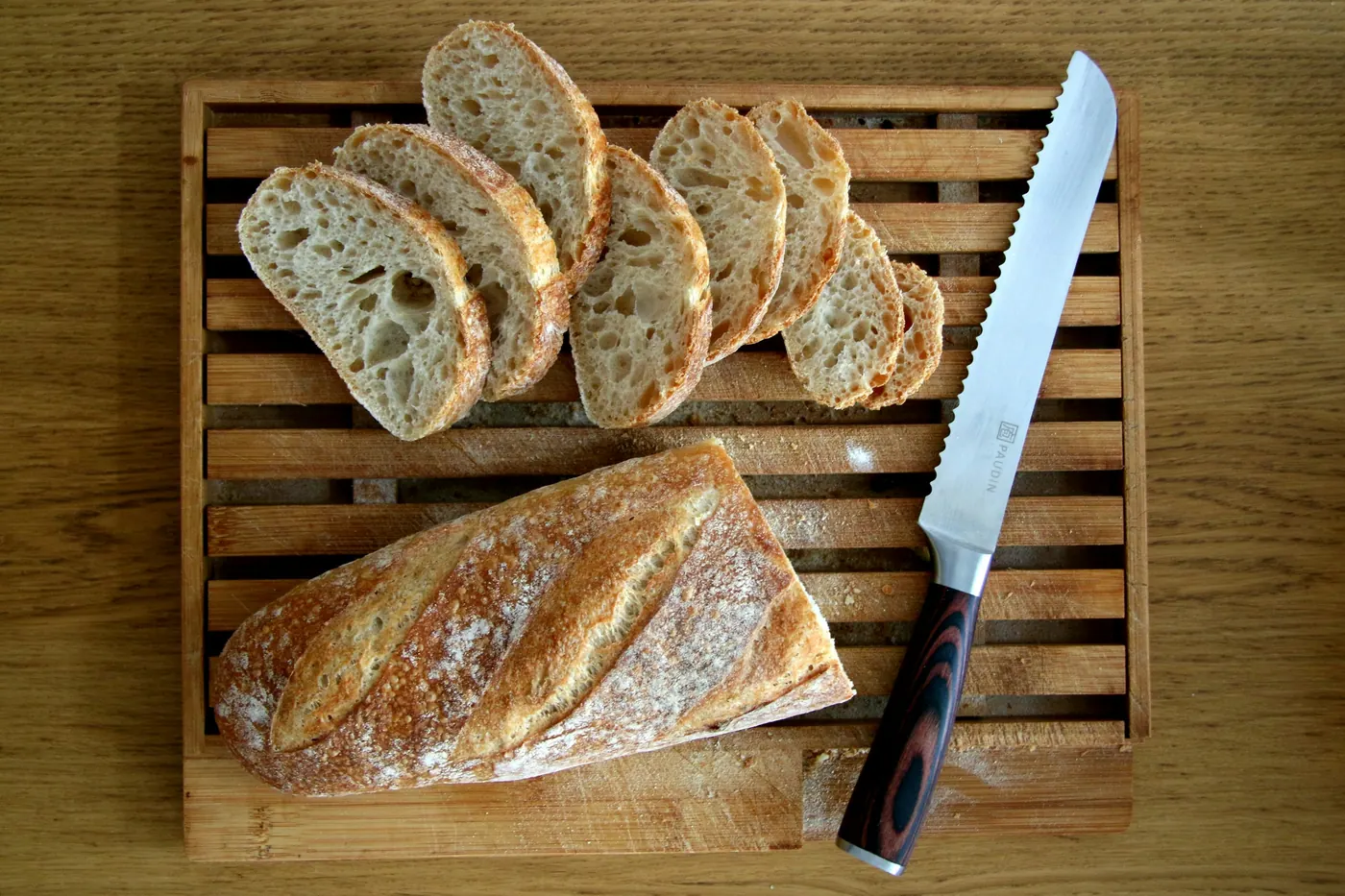
6. Mercer Culinary Millennia 9-inch Offset Bread Knife – Budget Offset

This is the offset version of our top pick, with the same wavy edge, Japanese high-carbon steel and textured handle, at a similar low price. The raised handle keeps your knuckles off the board when you cut through a torta, a stack of quesadillas or a sheet cake.
America’s Test Kitchen reviewed it and rated it Recommended with Reservations. The offset did its job and raised the hands, but ATK measured only 7.25 inches of usable blade, “too short to span and slice big loaves,” and found the serrations “fairly short.”
Mercer’s care advice is the same as for the straight knife: hand wash, dry at once, no dishwasher. The listing gives a limited lifetime warranty.
Why we like it
- Offset handle at a low price
- Same handle as ATK’s winner
- Limited lifetime warranty (listing)
Key specifications
| Model | M23890 |
|---|---|
| Blade length | 9 in; 7.25 in usable (ATK) |
| Serration type | Wavy edge; 29 serrations (ATK) |
| Steel | One-piece high-carbon Japanese steel |
| Offset handle | Yes |
| Handle | Textured, 5.3 in (ATK) |
| Dishwasher safe | No; hand wash (Mercer) |
| Warranty | Limited lifetime |
Why we recommend it
It suits a cook who wants to try an offset knife for sandwiches and cakes without spending much.
Skip it if you want one knife for everything; ATK found the usable blade too short for large loaves.
Pros and cons
Pros
- Cheap offset knife
- Grippy handle
Cons
- Short usable blade (ATK)
- Fairly short serrations (ATK)
7. Wüsthof Classic 9-inch Double-Serrated Bread Knife – Fine Teeth, Fewer Crumbs
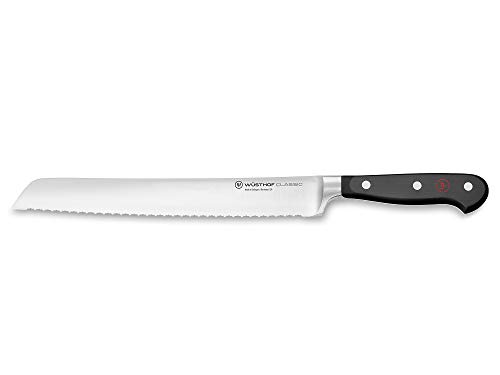
Wüsthof’s Classic bread knife takes a different approach to serrations: it is double serrated, with what Wüsthof calls a serration within the serration. The maker says it glides through crusty bread with minimal crumbs without damaging the inside, and suits delicate produce and angel food cake too.
Wüsthof says the knife is forged from a single block of high-carbon stainless steel tempered to 58 HRC, with its Precision Edge Technology, a full tang and a triple-riveted synthetic handle. It is made in Solingen, Germany, the listing gives a lifetime warranty, and Wüsthof says it is hand wash only.
America’s Test Kitchen reviewed this exact model and rated it Recommended with Reservations. ATK counted 96 serrations and found that the double serrations “often skidded over food,” that the blade, at 8 inches usable, “couldn’t span or cut large loaves,” and that the 4.75-inch handle was short for larger hands. It is a well-made knife, but ATK’s review favored fewer, taller teeth.
Why we like it
- Double serrations for fewer crumbs (Wüsthof)
- Forged, tempered to 58 HRC
- Lifetime warranty (listing)
Key specifications
| Model | 1040101123 |
|---|---|
| Blade length | 9 in; 8 in usable (ATK) |
| Serration type | Double serrated; 96 serrations (ATK) |
| Steel | Forged high-carbon stainless, 58 HRC |
| Offset handle | No |
| Handle | Triple-riveted synthetic, full tang |
| Dishwasher safe | No; hand wash only |
| Warranty | Lifetime (listing) |
Why we recommend it
It suits a cook with a Wüsthof Classic set who mostly slices sandwich loaves, cakes and rolls, and wants a matching knife.
Skip it if you bake big crusty loaves; ATK found the fine teeth skidded and the blade too short.
Pros and cons
Pros
- Forged German construction
- Clean cuts on soft foods
- Lifetime warranty
Cons
- Teeth skid on food (ATK)
- Short usable blade and handle (ATK)
8. Made In 9-inch Bread Knife – Forged in France

Made In’s bread knife is forged in Thiers, France, by what the company describes as a fifth-generation bladesmith, and it was designed in partnership with the baker and chef Nancy Silverton for baguettes, ciabatta and sourdough. This version has an olive wood handle.
The listing is unusually specific about dimensions: a 9-inch blade, 1.75 inches tall, 2 millimeters thick, and 14 inches overall. The steel is nitrogen-treated X50CrMoV15 stainless, the knife is fully forged from a single rod of steel, and the tang runs the full length of the handle. A blade 1.75 inches tall gives a reasonable amount of knuckle room for a straight knife.
The listing does not describe the serration shape, and it does not state dishwasher or warranty terms. We did not find an independent review of this knife. Wood handles in general should be washed by hand and kept out of standing water.
Why we like it
- Fully forged, full tang (Made In)
- 1.75 in tall blade for knuckle room
- Designed with Nancy Silverton for crusty breads
- Made in Thiers, France
Key specifications
| Model | CUT-9-BREAD-WD-2 |
|---|---|
| Blade length | 9 in; 1.75 in tall, 2 mm thick |
| Serration type | Not stated in listing |
| Steel | Nitrogen-treated X50CrMoV15 stainless |
| Offset handle | No |
| Handle | Olive wood, full tang |
| Dishwasher safe | Not stated in listing |
| Warranty | Not stated in listing |
Why we recommend it
It suits a home baker who wants a forged, good-looking bread knife with a wood handle.
Skip it if you want published serration details or a stated warranty before you spend this much.
Pros and cons
Pros
- Forged, full tang
- Tall blade
- Olive wood handle
Cons
- Serration type not stated
- No independent review found
- Wood handle needs care
How to choose a bread knife for loaves and rolls
A serrated knife cuts by sawing: each tooth starts a small cut in the crust, and the knife moves back and forth rather than pressing down. These are the details that decide how well it does that.
1. Blade length
America’s Test Kitchen recommends at least 8.5 inches of usable blade, measured from heel to tip, so the knife can reach across a large loaf and still have room to saw. Listed blade lengths can be misleading: ATK measured 9.2 inches of usable edge on the 10-inch Mercer and only 7.25 inches on the 9-inch Mercer offset. If you mostly cut bolillos, teleras and sandwich bread, 8 inches is enough; for sourdough boules and long country loaves, go to 9 or 10.
2. Serration shape and count: pointed or scalloped
Serrations come in two broad shapes. Pointed teeth, like small saw teeth, dig into a hard crust quickly. Scalloped serrations are rounded arches with sharp valleys between them, as on the Messermeister, which the maker says keep the knife from skating while the valleys slice through bread, sandwiches, fruit and vegetables. ATK favored “tall, pointy” serrations and found rounded ones, such as the MAC’s, could skid on crusty bread. It also found fewer, taller teeth worked best: its top knives had 29 to 34 serrations, while blades with more than about four per inch, including Wüsthof’s double-serrated knife, were harder to use.
3. Straight or offset handle
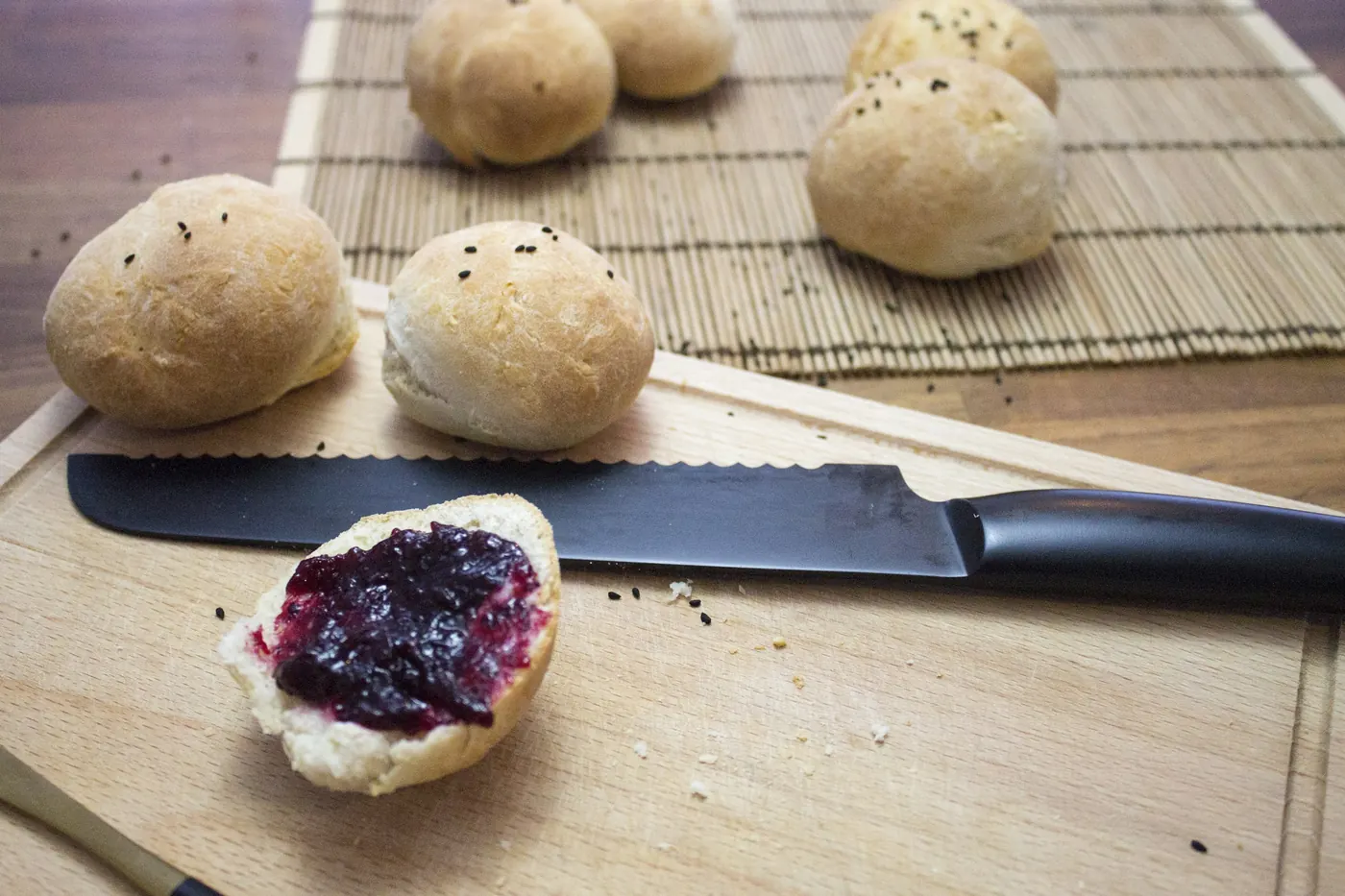
On a straight bread knife, the handle sits in line with the blade, so your knuckles reach the board before the heel of the blade finishes the cut. A tall blade helps; ATK flagged knives with too little knuckle clearance. An offset handle solves the problem completely and is the easiest way to cut a stacked torta or sandwich straight through. The trade-off, in ATK’s review, is that offset blades tend to be shorter and narrower.
4. Handle length and grip
ATK recommends a handle at least 5 inches long, and found shorter ones, like the Wüsthof’s, hard to hold for larger hands. A textured or rubbery handle stays put when your hands are floury or wet with tomato juice.
5. Care and sharpening
Every maker here either says to hand wash or does not say the knife is dishwasher safe, and Mercer’s warranty excludes dishwasher damage. Serrated knives stay useful a long time between sharpenings, but they need a tapered rod or a professional service to sharpen. A bolsterless heel, like the Victorinox’s, makes that easier, according to Victorinox.
How we chose these eight bread knives
We started from what a kitchen asks of a bread knife: splitting crusty rolls for tortas without crushing them, slicing large loaves evenly, cutting ripe tomatoes and layered cakes, and staying comfortable through a stack of sandwiches. We looked for serrated bread knives from established makers sold on Amazon in the United States, kept only knives showing as in stock when we checked, and confirmed each specification against the maker’s Amazon listing. Steel and hardness figures are given only where the maker states them, and where a listing is silent we write “Not stated”. We read America’s Test Kitchen’s serrated bread knife review and cite its measurements and findings by name, and we say when ATK reviewed a different size or did not review a knife. We could not access Wirecutter’s bread knife coverage and did not read Serious Eats’ or Good Housekeeping’s for this page, and we have not used these knives ourselves for this guide.
We left out the Tojiro 240 mm bread knife, which was not available to ship when we checked and which ATK rated Recommended with Reservations for too many short serrations; the 10¼-inch Victorinox Fibrox, which was also not in stock; and several Zwilling and Messermeister models listed with low stock.
Slicing bolillos, teleras and sourdough
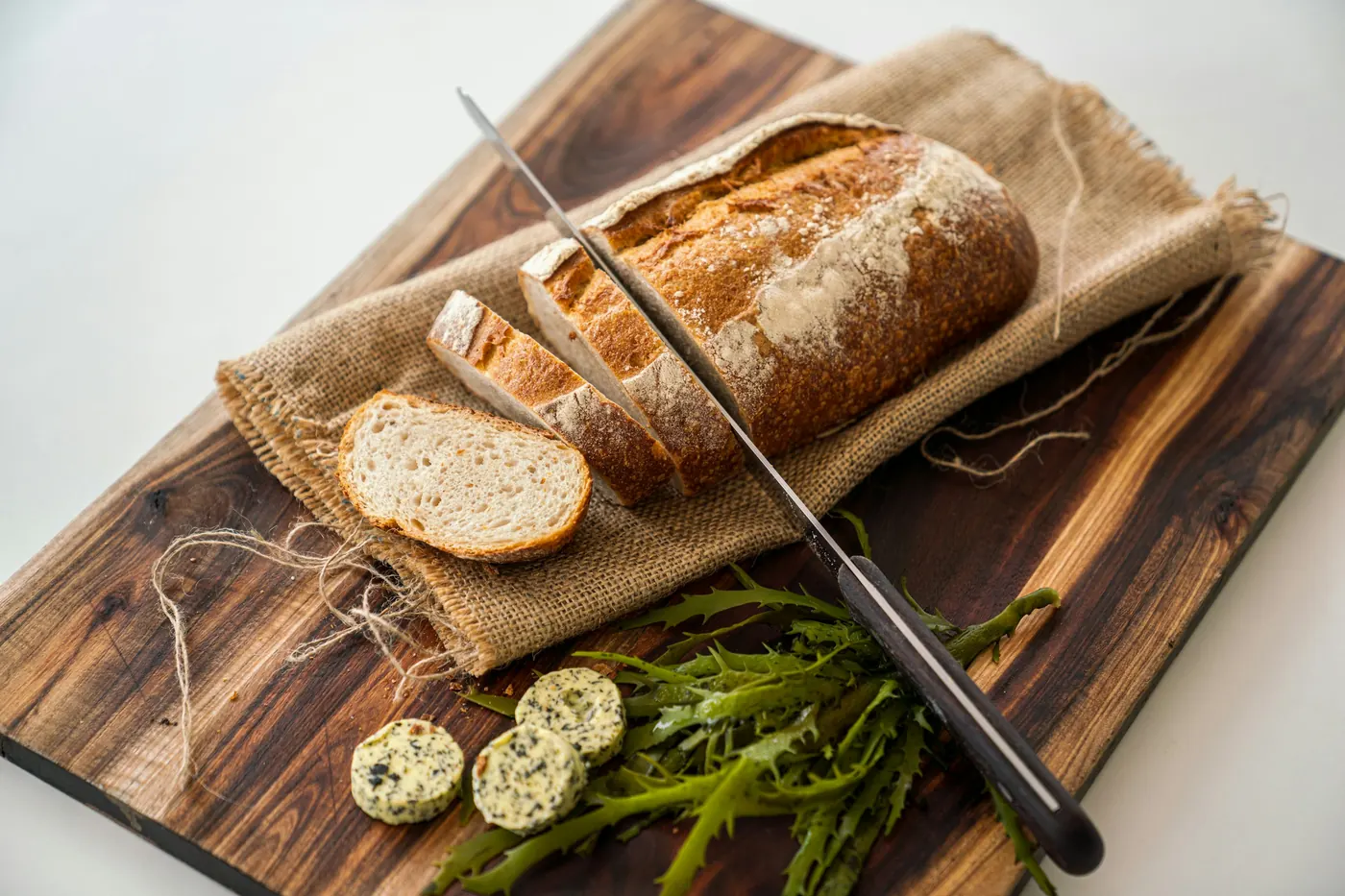
- Bolillos and teleras for tortas: lay the roll flat, hold it with your palm on top, and saw through horizontally with long, light strokes, letting the teeth do the work. Leave a hinge on one side if you like. Many torta makers pull out a little of the soft crumb to make room for the fillings.
- Pressed tortas: after pressing, cut the sandwich in half on the board with an offset knife or a long straight blade. Our best panini grill guide covers the presses, and a cast iron grill press does the same job on a skillet.
- Sourdough and country loaves: start the cut at the far edge with the tip, then saw toward you. Turn a very crusty loaf on its side to cut through the bottom crust first.
- Homemade sandwich bread: let a loaf cool before slicing, or the crumb will compress. Our best baking loaf pan guide covers the pans.
- Tomatoes: a bread knife cuts ripe tomatoes for torta fillings and salsa without crushing them, with the same light sawing motion.
Bread knife questions, answered
What is the best bread knife for sourdough?
A long blade with tall teeth. The Mercer Millennia 10-inch, ATK’s winner, has 9.2 inches of usable blade and 29 tall serrations; the MAC Superior adds a curved blade but its rounded teeth can skid on hard crust, according to ATK.
Which bread knife does America’s Test Kitchen recommend?
ATK’s serrated bread knife review names the Mercer Culinary Millennia 10-inch Wide Wavy Edge Bread Knife as its winner, with the MAC Superior bread knife close behind. It also recommends the Miyabi Kaizen and two 10¼-inch Victorinox models, and rates the Wüsthof Classic double-serrated, Tojiro and Mercer offset knives Recommended with Reservations.
What does Wirecutter recommend?
We could not access Wirecutter’s bread knife review, and we did not read Serious Eats’, Consumer Reports’ or Good Housekeeping’s coverage for this guide, so we cannot report their picks. The independent review we did read is America’s Test Kitchen’s.
What is the best bread knife for the money?
The Mercer Millennia 10-inch. It won ATK’s review and costs a fraction of most premium knives. For rolls only, the Victorinox Fibrox 8-inch is also inexpensive.
Is a scalloped or pointed serrated bread knife better?
For hard-crusted bread, ATK found tall, pointed serrations worked best and rounded ones could skid. Messermeister designs its scalloped edge to grip without skating and then slice, for bread, sandwiches, fruit and vegetables. If you cut mostly crusty bread, choose tall, pointed teeth.
Do I need an offset bread knife?
Not for loaves. An offset handle helps most when you cut all the way through something on the board, like a torta, a sandwich or a sheet cake. ATK found the offset knives it reviewed had blades too short for large loaves, so many cooks keep a straight bread knife and add an offset one.
Our final pick for slicing bread
Buy the Mercer Culinary Millennia 10-inch if you want one bread knife that handles everything, at a low price. Choose the MAC Superior for a lighter, curved upgrade, the Victorinox Fibrox 8-inch if you mostly slice rolls for tortas, the Messermeister Custom offset for sandwiches on the board, and the Shun Classic for Japanese steel and finish.
Want a bread knife made in Japan? See our guide to the best Japanese bread knives.
On a budget? See our guide to the best cheap bread knives.
Prefer a powered blade? See our guide to the best electric bread knives, corded and cordless.
Related guide: Bread knife alternative.
A bread knife is one part of a working kitchen; our Mexican cooking tools guide covers the rest of the kit. And when you would rather someone else built the torta, see the menu or call to order.