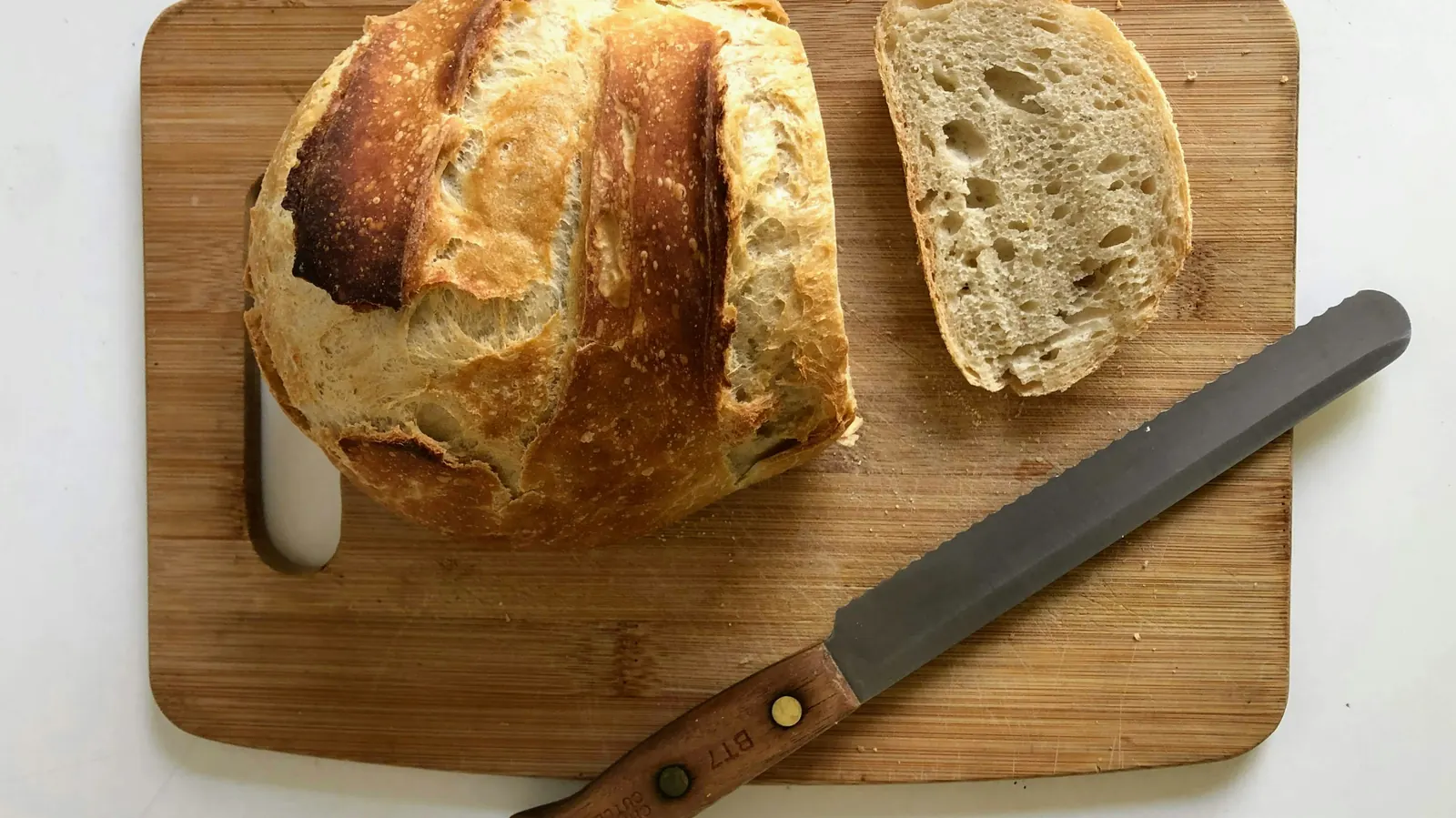
A good bread knife earns its drawer space in any kitchen that buys bolillos for tortas, slices a crusty telera down the middle or cuts a pan dulce without crushing it. Japanese makers bring something specific to the job: hard, thin steel, fine edge angles and light blades that saw through a hard crust without tearing the soft crumb inside.
This guide is narrower than our main best bread knife roundup. Every knife below is a serrated bread knife that its maker or listing says is made in Japan, mostly in the knife town of Seki, and none of them repeats a knife from that page. The two Japanese bread knives already on the main list, the Mac Superior and the Shun Classic 9-inch, are left out here so you get nine more options to weigh.
Julia’s earns a commission on purchases made through links on this page, at no cost to you. Recommendations are based on what a restaurant kitchen looks for, product specifications and verified buyer reports.
Quick verdict: which Japanese bread knife to buy
For most cooks, the best bread knife Japanese makers sell right now is the Enso HD 9-inch Bread Knife: a VG10 core at 61 HRC, a hand-ground edge of about 12 degrees, a published weight of 7.4 ounces and a lifetime warranty, all made in Seki City. For the hardest steel, choose the Miyabi Mizu SG2 at 63 HRC. If you want a knife with no wooden parts at all, the one-piece Global G-9 is the classic choice, and the Shun Classic offset keeps your knuckles off the board.
Below, the five standouts side by side, then all eight in detail and how to choose between them.
Five Japanese bread knives compared
Our five standout picks, one for each kind of cook, with the specifications each maker or listing states. All eight knives are reviewed in full below.
| Bread knife | Best for | Blade & steel | Handle | Buy on Amazon |
|---|---|---|---|---|

Enso HD 9-inch Bread KnifeBest overall
|
Most cooks, everyday loaves | 9 in, VG10 at 61 HRC | Micarta, three rivets | View on Amazon |

Miyabi Mizu SG2 9-inch Bread KnifeHardest steel
|
Longest-lasting edge | 9 in, SG2 at 63 HRC | D-shaped micarta | View on Amazon |
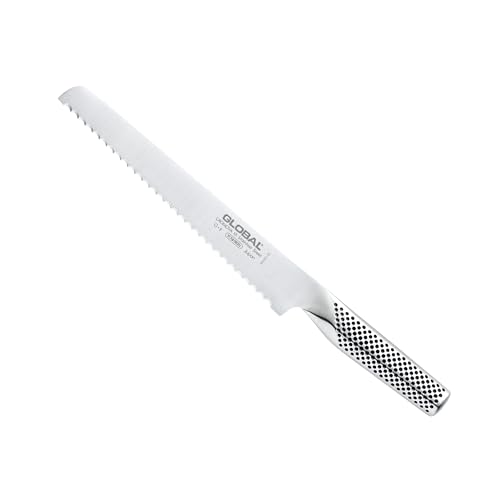
Global G-9 8.75-inch Bread KnifeBest all-steel
|
A light, seamless knife | 8.75 in, molybdenum/vanadium | Dimpled stainless steel | View on Amazon |

Shun Classic 8.25-inch Offset Bread KnifeBest offset
|
Knuckle room, sandwiches | 8.25 in, VG-MAX, 16° | D-shaped Pakkawood | View on Amazon |

Kai Seki Magoroku Damascus 9.5-inch Bread KnifeLongest blade
|
Wide country loaves and big rounds | 240 mm, stainless composite, Damascus pattern | Laminated reinforced wood | View on Amazon |
Product images from Amazon. Specifications are as stated by each maker or its Amazon listing.
Our eight picks for the best bread knife Japanese makers build
These eight cover the real choices in a made-in-Japan bread knife: very hard SG2 and VG10 steels, softer all-stainless blades that shrug off rough handling, straight and offset shapes, blades from 8.25 to 9.5 inches, and handles in micarta, Pakkawood, tagayasan wood and plain steel. Each pick says who it suits and gives one honest reason to skip it.
1. Enso HD 9-inch Bread Knife – Hard VG10, Every Spec Published
The Enso HD is the knife we would point most people to first, because its listing tells you everything: the steel, the hardness, the edge angle, the blade height, the spine thickness and the weight.
Enso makes its knives in Seki City, and this one has a VG10 stainless core inside 37 layers of hammered Damascus steel, hardened to 61 on the Rockwell scale. The listing says the edge is hand-ground to about 12 degrees, which is finer than most Western bread knives. The 9-inch blade is 1.25 inches tall with a 2 mm spine, and the whole knife is 14.5 inches long and weighs 7.4 ounces. That length crosses a sandwich loaf or a round sourdough in one stroke, and it is plenty for splitting bolillos and teleras for tortas.
The handle is black canvas micarta with three stainless rivets and an end cap, a grip that feels familiar to anyone raised on Western knives. Enso’s listing describes the edge as single bevel yet says the knife works for right- and left-handed cooks. Hand wash it, dry it straight away and keep it off glass and stone boards.
Why we like it
- VG10 core in 37 hammered Damascus layers, 61 HRC
- Edge hand-ground to about 12 degrees
- Full published dimensions: 9 x 1.25-inch blade, 2 mm spine, 7.4 oz
- Micarta handle with three rivets and an end cap
- Handcrafted in Seki City with a lifetime warranty against defects
Key specifications
| Model | Enso HD bread knife (HD series) |
|---|---|
| Blade length | 9 in (1.25 in tall) |
| Steel | VG10 core, 37-layer hammered stainless Damascus |
| Hardness | 61 HRC |
| Edge | Serrated, hand-ground to about 12° |
| Handle | Black canvas micarta, three rivets |
| Weight | 7.4 oz (211 g) |
| Made in | Seki City, Japan |
Why we recommend it
Choose it if you want one Japanese bread knife that handles everything from crusty country loaves to soft sandwich bread, and you like knowing exactly what you are buying. The riveted handle and lifetime warranty make it an easy first Japanese knife.
Skip it if you want a knife you can put in the dishwasher or toss in a drawer without a guard; a hard, thin edge like this needs a little care.
Pros and cons
Pros
- Every key spec published by the maker
- Hard VG10 core with a fine edge
- Familiar Western-style grip
- Lifetime warranty
Cons
- Hand wash only
- Bevel description on the listing is a little confusing
- Hammered finish shows smudges
2. Miyabi Mizu SG2 9-inch Bread Knife – Powder Steel at 63 HRC
If you want the edge to stay keen for as long as possible, this is the hardest bread knife on the list.
Miyabi, Zwilling’s Japanese brand, makes the Mizu in Seki from SG2, a micro-carbide powder stainless steel. Miyabi ice-hardens the blade with its Cryodur process to 63 on the Rockwell scale, two points harder than the VG10 knives here. The edge is finished with the honbazuke method, a three-step sharpening process the maker traces back to Japanese sword making, and the listing describes it as a single-bevel serrated edge suited to large crusty loaves, meats, melons and cakes.
The blade has a hammered Damascus finish, and the handle is a D-shaped micarta grip with a bolster, a metal end cap, a mosaic pin and red spacers. It feels more Japanese than the Enso while still sitting comfortably in most hands. The listing does not give a weight.
Very hard steel holds an edge for a long time but can chip if it is twisted or knocked against a hard surface, so treat it as a precision tool and keep it in a block or on a strip.
Why we like it
- SG2 powder stainless steel, ice-hardened to 63 HRC
- Honbazuke three-step edge finishing
- Hammered (tsuchime) Damascus finish
- D-shaped micarta handle with bolster and end cap
- Made in Seki, Japan, with a limited lifetime warranty
Key specifications
| Model | Mizu SG2 bread knife, 1012480 |
|---|---|
| Blade length | 9 in |
| Steel | SG2 micro-carbide powder stainless, hammered Damascus |
| Hardness | 63 HRC |
| Edge | Serrated, single bevel, honbazuke finished |
| Handle | D-shaped micarta, bolster, metal end cap |
| Weight | Not stated |
| Made in | Seki, Japan |
Why we recommend it
Choose it if you bake or buy crusty bread often and want an edge that keeps biting through hard crust for a long time between sharpenings. It is also a handsome knife to leave out on a bread board.
Skip it if your knives tend to get knocked around in a drawer or the sink; steel this hard is less forgiving of rough handling.
Pros and cons
Pros
- Hardest steel on this list
- Comfortable D-shaped handle
- Limited lifetime warranty
Cons
- Weight not stated
- Hard edge can chip under rough use
- Hand wash only
3. Global G-9 8.75-inch Bread Knife – Seamless All-Steel Design
Global’s knives are easy to spot: blade and handle in one continuous run of stainless steel, with a dimpled grip. The G-9 is the bread knife of its classic G series.
The listing describes a lightweight, balanced 8.75-inch blade made of molybdenum/vanadium stainless steel and a stainless handle molded for comfort and dimpled for grip. Retailers that list the G-9 give more detail: Global’s CROMOVA 18 steel hardened to 56 to 58 HRC, a 15-degree edge, a weight of about 160 grams and a hollow handle filled with sand for balance. That softer steel is less likely to chip than the 61 to 63 HRC blades above, which suits a knife that will see a lot of everyday use.
With no wood, rivets or seams, there is nowhere for crumbs or water to hide. The listing covers it with a lifetime guarantee against defects and breakage. Some cooks find the steel handle slippery with wet or buttery hands; the dimples help, but it is a different feel from wood or micarta.
Why we like it
- One-piece stainless construction with no seams to trap crumbs
- Light, at about 160 g according to retailers
- Dimpled handle for grip
- Lifetime guarantee against defects and breakage
Key specifications
| Model | Global G-9 |
|---|---|
| Blade length | 8.75 in (22 cm) |
| Steel | Molybdenum/vanadium stainless (CROMOVA 18, per retailers) |
| Hardness | 56–58 HRC (per retailers) |
| Edge | Serrated, about 15° (per retailers) |
| Handle | Dimpled stainless steel, sand-filled |
| Weight | About 160 g (per retailers) |
| Made in | Japan |
Why we recommend it
Choose it if you want a light, hygienic, easy-to-clean bread knife that matches other Global knives you already own, or if you simply prefer a knife with no wooden parts.
Skip it if you have large hands or often work with wet hands; the slim steel handle is not to everyone’s taste.
Pros and cons
Pros
- Seamless, easy to wipe clean
- Light and well balanced
- Softer steel resists chipping
Cons
- Steel handle can feel slippery
- Several specs come from retailers, not the listing
- Shorter than the 9-inch knives here
4. Shun Classic 8.25-inch Offset Bread Knife – Room for Your Knuckles
An offset bread knife has a handle set higher than the blade, so you can cut all the way through a loaf or a tall sandwich without your knuckles hitting the board.
This one comes from Shun’s Classic series, which Kai’s listing calls the original authentic Japanese cutlery line introduced to the United States. Our main bread knife guide already covers the straight 9-inch Shun Classic; this is a different knife from the same series, with an offset blade, so it earns its own place here. The listing gives VG-MAX steel inside 68 layers of Damascus cladding, a 16-degree edge and a D-shaped Pakkawood handle that suits right- and left-handed cooks. Cutlery and More lists its weight as 6.3 ounces.
The offset shape is especially handy for tortas and other filled sandwiches, where you want to cut straight down through the bread and fillings in one pass. Kai’s listing says Shun offers free honing for this knife. Hand wash it and dry it right away.
Why we like it
- Offset blade keeps knuckles clear of the board
- VG-MAX core with 68 layers of Damascus cladding
- 16-degree edge
- D-shaped Pakkawood handle for either hand
- Handcrafted in Japan, with a lifetime warranty on the listing
Key specifications
| Model | Shun Classic DM0724 |
|---|---|
| Blade length | 8.25 in, offset |
| Steel | VG-MAX core, 68-layer Damascus cladding |
| Hardness | Not stated |
| Edge | Serrated, 16° |
| Handle | D-shaped Pakkawood |
| Weight | 6.3 oz (179 g, per Cutlery and More) |
| Made in | Japan |
Why we recommend it
Choose it if you make a lot of sandwiches, cut on a small board or have big hands that bump the board with a straight bread knife.
Skip it if you mostly slice wide round loaves; at 8.25 inches, the blade is shorter than the 9-inch straight knives here.
Pros and cons
Pros
- Offset design for clean cuts to the board
- Well-known VG-MAX Shun steel
- Comfortable D-shaped handle
Cons
- Shorter blade than most here
- Hardness not stated
- Hand wash only
5. Shun Premier 9-inch Bread Knife – Hammered Finish, Free Sharpening

The Premier is Shun’s hammered-finish line, and its 9-inch bread knife is the one to look at if you like the look of hand-hammered steel.
The listing gives VG-MAX steel inside 68 layers of Damascus cladding, a 16-degree edge and a tsuchime (hammered) finish that Kai says reduces drag and stops food from sticking. Kai describes the wide teeth as slicing tender and crusty bread alike without ripping or squashing. Kai USA lists the weight as 7.8 ounces (221 g).
The handle is contoured walnut-colored Pakkawood for right- or left-handed cooks. Kai’s listing says the Premier is supported by free sharpening and honing, which matters for a serrated knife, because sharpening serrations well takes a tapered rod and some patience.
Why we like it
- VG-MAX core with 68 layers of Damascus cladding
- Hammered tsuchime finish to reduce drag
- Kai USA lists the weight at 7.8 oz
- Free sharpening and honing, according to Kai
Key specifications
| Model | Shun Premier TDM0705 |
|---|---|
| Blade length | 9 in |
| Steel | VG-MAX core, 68-layer Damascus, hammered |
| Hardness | Not stated |
| Edge | Serrated, wide teeth, 16° |
| Handle | Contoured Pakkawood |
| Weight | 7.8 oz (221 g, Kai USA) |
| Made in | Japan |
Why we recommend it
Choose it if you want a full-length Japanese bread knife with a hammered finish and the backup of a free sharpening service.
Skip it if you would rather not post your knife away for sharpening; the service is free, but you have to send it in.
Pros and cons
Pros
- Free sharpening and honing
- Full 9-inch length
- Comfortable contoured handle
Cons
- Heavier than the Shun Kanso below
- Hardness not stated
- Hand wash only
6. Shun Kanso 9-inch Bread Knife – Lightest Knife Here

Kanso means simplicity, and this is Shun’s pared-back line: a single layer of steel, no Damascus pattern and a plain wooden handle.
Kai USA lists the 9-inch (229 mm) blade at 5.2 ounces (147 g), the lightest weight published for any knife on this page. The steel is AUS10A, a high-carbon stainless refined with vanadium, sharpened to 16 degrees per side. The full-tang handle is tagayasan, a hard wood the maker calls “iron sword wood”, and the butt doubles as a bottle opener and a hanging hook.
A single-steel blade has nothing to delaminate or show scratches between layers, and a light bread knife is easy on the wrist when you slice a whole loaf for a family meal. Kai’s listing mentions free honing for this knife.
Why we like it
- 5.2 oz (147 g), per Kai USA
- AUS10A high-carbon stainless with vanadium
- 16-degree edge per side
- Full-tang tagayasan wood handle
Key specifications
| Model | Shun Kanso SWT0705 |
|---|---|
| Blade length | 9 in (229 mm) |
| Steel | AUS10A high-carbon stainless, single layer |
| Hardness | Not stated |
| Edge | Serrated, wide teeth, 16° |
| Handle | Tagayasan wood, full tang |
| Weight | 5.2 oz (147 g, Kai USA) |
| Made in | Japan |
Why we recommend it
Choose it if you want a light, simple Japanese bread knife with a real wooden handle and none of the decorative layering of pricier Shun lines.
Skip it if you want free sharpening; the listing mentions only free honing for the Kanso.
Pros and cons
Pros
- Lightest published weight here
- Simple single-steel blade
- Full-tang wooden handle
Cons
- Bottle-opener butt is not for everyone
- Hardness not stated
- Wood handle needs drying after washing
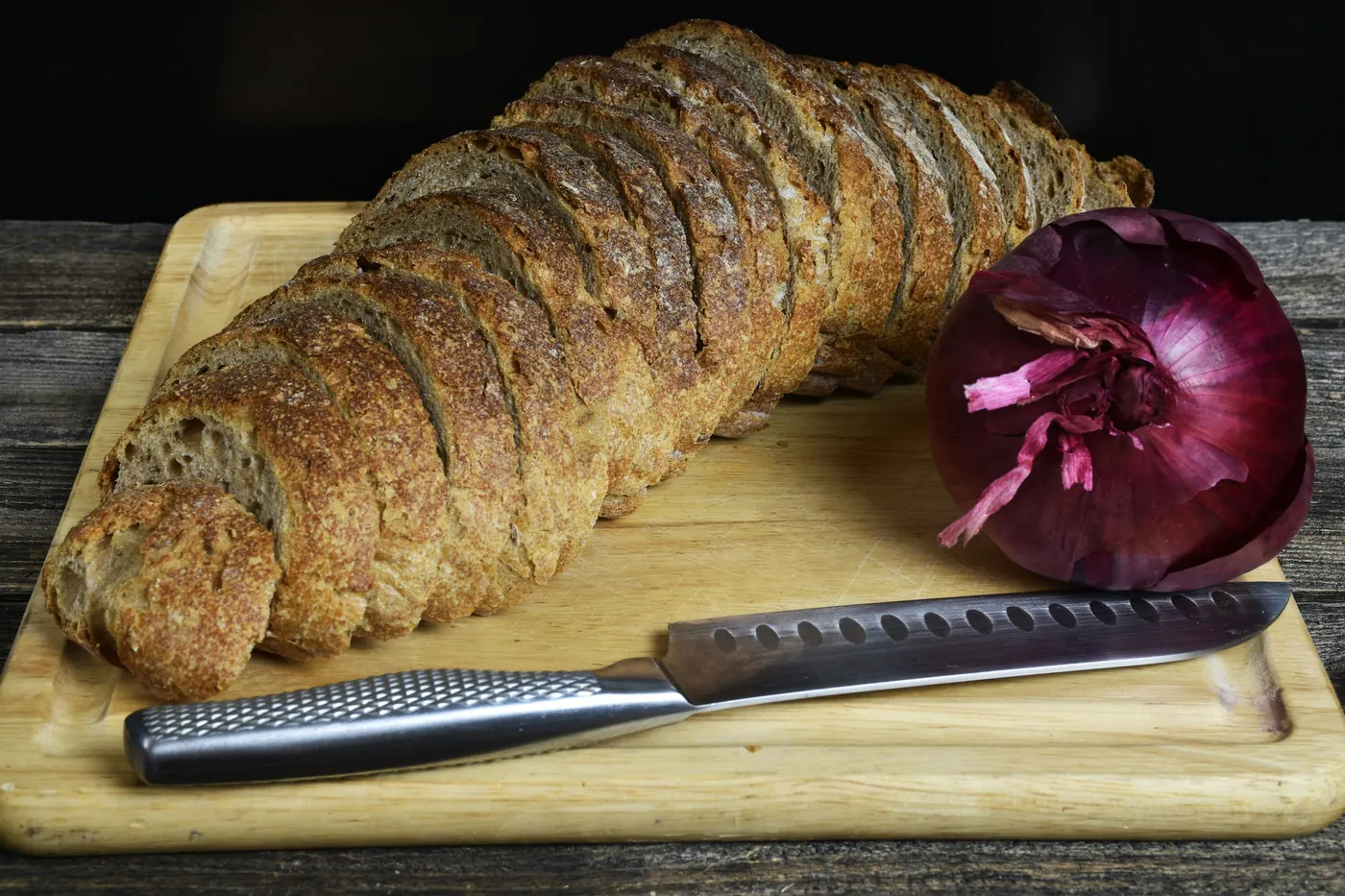
7. Miyabi Koya 9-inch Bread Knife – Faceted Wood Handle

The Koya is one of Miyabi’s newer lines, and it sits a step below the Mizu in hardness while adding a striking faceted handle.
The listing gives FC61 fine carbide stainless steel at 61 HRC, ice-hardened with Miyabi’s Friodur2 process, and a sandblasted katana-style edge hand-honed to 12 degrees. Zwilling’s own page calls the edge serrated and lists a net weight of about 164 grams, with a 23 cm blade. The listing describes the bevel as double, while one large US retailer describes it as single, so treat that detail as unsettled.
The handle is faceted birchwood Pakkawood with a mosaic accent, which Miyabi says is individually weight-adjusted through a nine-step finishing process. The listing says it is handcrafted in Seki, Japan, carries a lifetime warranty and is hand wash only.
Why we like it
- FC61 fine carbide stainless at 61 HRC
- Edge hand-honed to 12 degrees
- Light, at about 164 g according to Zwilling
- Faceted birchwood Pakkawood handle
- Handcrafted in Seki with a lifetime warranty
Key specifications
| Model | Miyabi Koya 1026931 |
|---|---|
| Blade length | 9 in (23 cm) |
| Steel | FC61 fine carbide stainless, Friodur2 |
| Hardness | 61 HRC |
| Edge | Serrated, hand-honed 12° (bevel described inconsistently) |
| Handle | Faceted birchwood Pakkawood |
| Weight | About 164 g (Zwilling) |
| Made in | Seki, Japan |
Why we recommend it
Choose it if you want a light Japanese bread knife with a hard 61 HRC blade and a handle that looks and feels like something special.
Skip it if you like a plain, rounded handle; the faceted shape is a matter of taste and can feel angular to some hands.
Pros and cons
Pros
- Hard steel in a light knife
- Distinctive handle
- Lifetime warranty
Cons
- Bevel details differ between sources
- Faceted handle is not for everyone
- Hand wash only
8. Kai Seki Magoroku Damascus 9.5-inch Bread Knife – Longest Blade Here
At 240 mm (about 9.4 to 9.5 inches), this Damascus knife from Kai’s Seki Magoroku line has the longest blade on the page, which helps with wide country loaves and big rounds of sourdough.
The listing (model AE5207) describes a stainless steel composite blade with a Damascus pattern, a stainless ferrule and butt cap, and a laminated reinforced wood handle. It gives the overall size as about 14.5 by 1.1 inches and the country of manufacture as Japan. The weight line on the listing reads “7.8 lbs (0.275 kg)”, which is a translation error: 0.275 kg is about 9.7 ounces, so this is the heaviest knife here too.
A little extra length and weight can make sawing through a dense, crusty loaf easier, since the blade does more of the work. Kai does not state hardness or edge angle for this model on the listing.
Why we like it
- Longest blade here, at 240 mm
- Damascus-pattern stainless composite blade
- Laminated reinforced wood handle with stainless ferrule
- Made in Japan by Kai
Key specifications
| Model | Kai Seki Magoroku Damascus AE5207 |
|---|---|
| Blade length | 9.4 in (240 mm) |
| Steel | Stainless steel composite, Damascus pattern |
| Hardness | Not stated |
| Edge | Serrated; angle not stated |
| Handle | Laminated reinforced wood, stainless ferrule |
| Weight | About 275 g (listing) |
| Made in | Japan |
Why we recommend it
Choose it if you regularly slice wide loaves and want the extra reach of a 240 mm blade from a long-established Seki maker.
Skip it if you want a light knife or a well-documented one; the listing is thin and partly mistranslated.
Pros and cons
Pros
- Longest blade on this page
- Damascus pattern at a mid-range level
- Wooden handle with steel ferrule
Cons
- Heaviest knife here
- Hardness and edge angle not stated
- Listing contains translation errors
What makes a bread knife Japanese
Plenty of bread knives on Amazon use “Japanese steel” or a Japanese-sounding name while saying nothing about where they are made. For this page we only counted knives whose maker or listing names Japan as the country of manufacture, usually Seki in Gifu Prefecture, home to Kai, Shun, Miyabi and Enso. Global is made in Japan as well.
Japanese bread knives tend to differ from German ones in three ways. The steel is often harder, from about 61 HRC upward for VG10, FC61 and SG2, against the softer steel most German makers use. The edges are often ground finer, at 12 to 16 degrees. And the blades are usually lighter. Harder, finer edges cut through a hard crust cleanly but need more care. If you want a broader look at Japanese knife shapes and steels, our best Japanese knife guide covers gyuto, santoku and nakiri.
How to choose a Japanese bread knife
Blade length
Choose a blade at least an inch or two longer than the widest loaf you cut, so the whole edge can saw back and forth. An 8 to 8.5-inch blade, like the Global G-9 or the Shun Classic offset, is fine for bolillos, baguettes and sandwich loaves. For big round sourdough or country loaves, 9 inches or more is easier; the Kai Damascus at 240 mm is the longest here.
Straight or offset
A straight blade is the classic shape and the easiest to store. An offset blade, like the Shun Classic offset, raises the handle above the edge so you can cut right down to the board without scraping your knuckles. It is especially useful for tall sandwiches and tortas.
Steel hardness
Harder steel, such as the Miyabi Mizu’s SG2 at 63 HRC, holds a sharp edge longer but is more brittle. Softer steel, like the Global’s 56 to 58 HRC, is more forgiving of knocks. For a knife that lives in a busy family kitchen, a middle ground of around 61 HRC, such as the Enso or Miyabi Koya, is a sensible choice.
Handle and weight
Western-style riveted handles (Enso, Miyabi Mizu) feel familiar; D-shaped Japanese handles (Shun Classic) give a secure grip; all-steel handles (Global) are seamless and easy to clean. Light knives, such as the Shun Kanso at 5.2 ounces, are easy on the wrist, while heavier blades let the knife’s weight help on dense crust.
Sharpening and service
Serrated edges tend to keep cutting bread well for a long time, because the points of the teeth do much of the work, but they are harder to sharpen at home: you need a tapered ceramic rod, or a professional. Shun lists free sharpening and honing for some of its lines (the Premier here) and free honing only for others (the Classic and Kanso here). Our whetstone guide is useful for your straight-edged knives, but a whetstone alone is not the right tool for serrations.
Slicing bread for Mexican meals
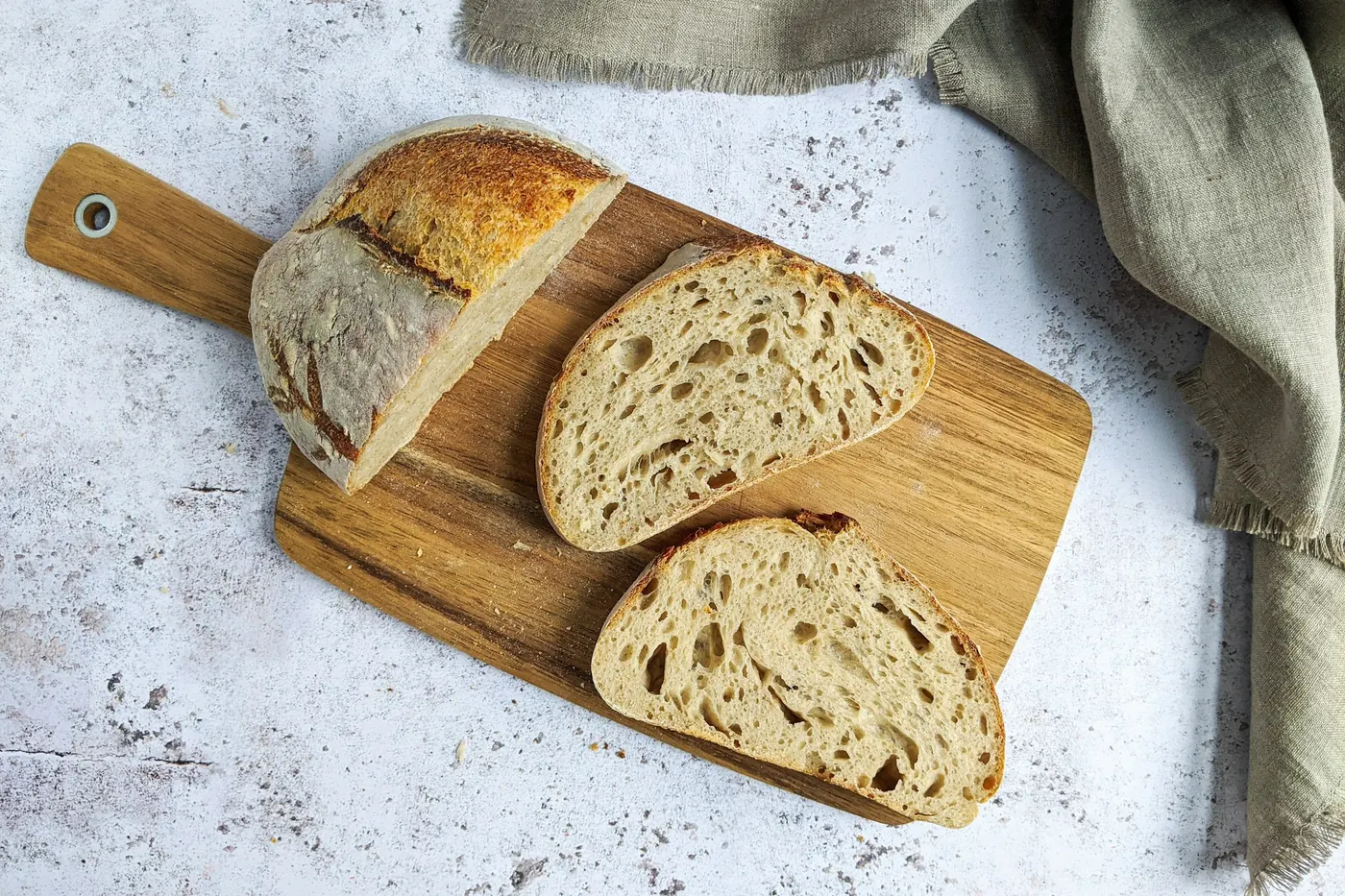
In a Mexican kitchen, the bread knife does most of its work on rolls. A bolillo or a telera for a torta needs splitting lengthwise without crushing the soft middle, and a good serrated edge does that in a few light strokes. Conchas and other pan dulce are soft and sugary, so a fine, sharp edge keeps the topping from cracking off. For capirotada, cutting day-old bolillos into even slices helps them soak evenly.
- Let the teeth work: use long, light strokes and let the serrations do the cutting rather than pressing down.
- Cut crust-side up: start on the top crust and saw down; turn very crusty loaves on their side if the top resists.
- Use a wood board: a wooden or plastic board is kinder to a hard Japanese edge than glass or stone. Our wood cutting board guide covers good choices.
- Wait for warm bread to cool: very warm bread is still setting inside and squashes more easily under any knife.
If you bake a lot of bread, or slice whole loaves for a crowd, an electric knife can be quicker; our electric bread knife guide covers those.
How we picked these eight Japanese bread knives
We started from what a working kitchen asks of a bread knife: a long, sharp serrated edge that cuts through hard crust without tearing soft crumb, a comfortable handle and a blade that holds up to daily use. Then we limited the field to bread knives that the maker or its Amazon listing says are made in Japan, and that were in stock on Amazon US when we checked. We left out the two Japanese bread knives on our main bread knife roundup so this page adds options rather than repeating them, and we passed over the many listings that say “Japanese steel” while naming no maker or country of manufacture.
Specifications come from the makers’ Amazon listings, Kai USA’s Shun pages and, where a listing is thin, named retailers such as Cutlery and More, Zwilling’s own site and Finnish Design Shop (each review says which). We have not cut with these knives ourselves. Several other good Japanese bread knives, including the Tojiro wood-handled bread slicer, Global’s Ukon and SAI bread knives, Miyabi’s Kaizen and Koh, the Shun Sora and the Misono wave-edge knife, showed limited or delayed stock when we checked and were left out for now. We also checked the US Consumer Product Safety Commission’s recall listings for these brands and found no bread knife recalls.
Japanese bread knife questions, answered
Are Japanese bread knives better than German ones?
Not better, different. Japanese bread knives usually use harder steel and finer edges, so they cut crust cleanly and stay sharp longer, but they need gentler handling. German bread knives are often heavier and softer, which some cooks prefer for rough everyday use. Our main bread knife guide includes both styles.
What length of bread knife do I need?
For rolls, baguettes and sandwich loaves, 8 to 8.5 inches is enough. For large round loaves, choose 9 inches or longer so the blade reaches across with room to saw.
Can you sharpen a Japanese serrated bread knife?
Yes, but not on a flat whetstone alone. Serrations are usually sharpened one tooth at a time with a tapered ceramic rod, or by a professional service. Shun offers free sharpening for some of its lines; check the listing for your knife.
Can I put a Japanese bread knife in the dishwasher?
None of the knives on this page is sold as dishwasher safe. Hand wash with warm, soapy water and dry straight away, especially the wood-handled models.
How do I know a bread knife is really made in Japan?
Look for a named maker and a stated town or country of manufacture, such as “made in Seki, Japan”, on the listing or the maker’s site. “Japanese steel” or “Japanese style” on its own does not tell you where the knife was made.
Our final pick for a made-in-Japan bread knife
Buy the Enso HD if you want one Japanese bread knife that does everything well and tells you exactly what you are getting. Choose the Miyabi Mizu SG2 for the hardest edge, the Global G-9 for an all-steel knife that is easy to clean, and the Shun Classic offset if you make a lot of sandwiches. For the widest loaves, the Kai Seki Magoroku Damascus gives you the longest blade here.
For more bread knife choices, including German and American picks, see the best bread knife. And if you would rather someone else made the tortas tonight, see the menu or call to order.