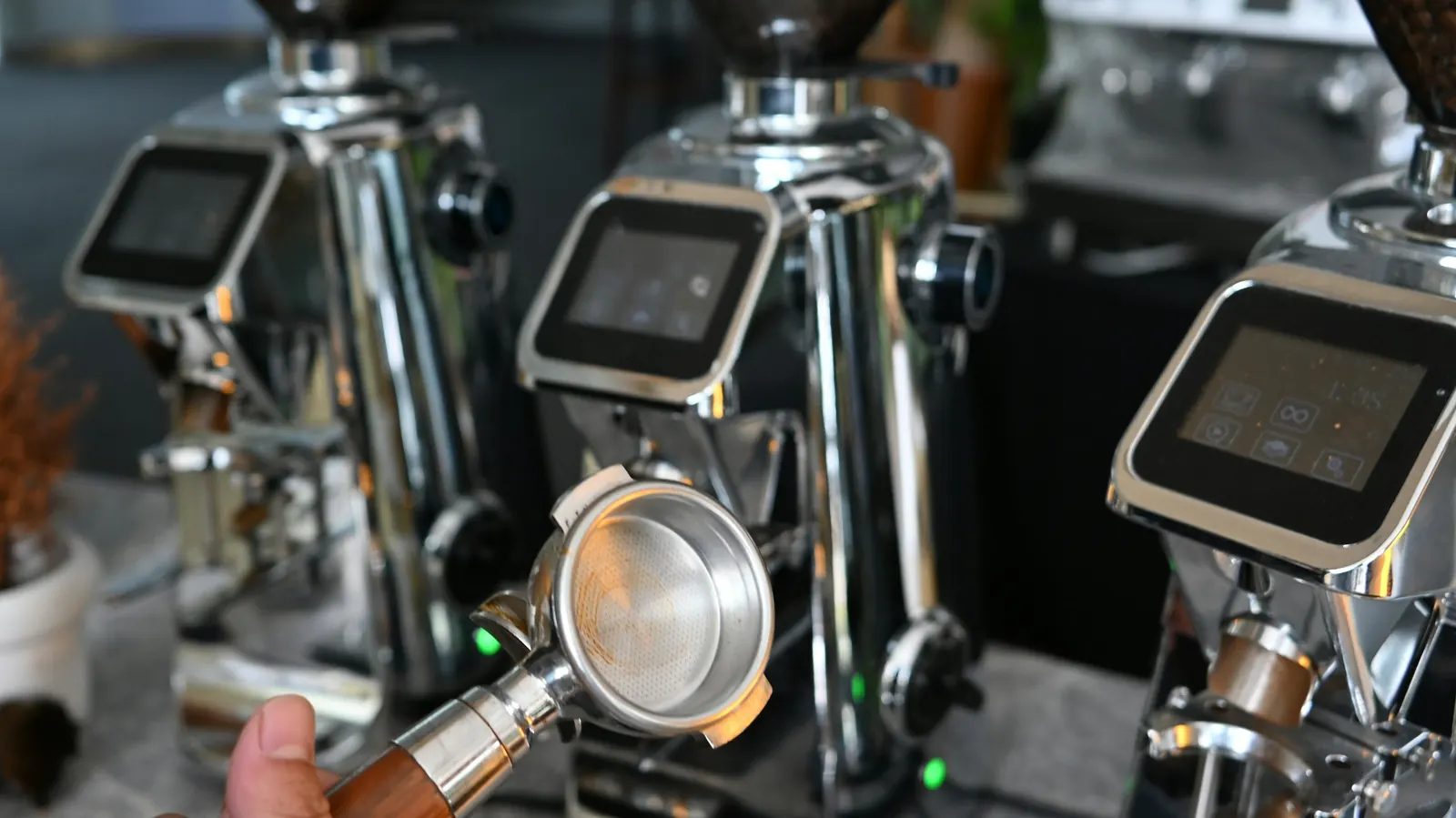
Every espresso grinder worth buying uses burrs, but not every burr grinder can make espresso. A shot needs coffee ground very fine, in a narrow range, and adjusted in small enough steps that you can correct a shot that runs a few seconds fast or slow. Plenty of burr grinders sold for drip coffee reach a “fine” setting yet jump too far between steps, or stop short of true espresso fineness altogether. The burrs, and the mechanism that moves them, decide which side of that line a grinder falls on.
This guide covers eight burr grinders whose makers sell them for espresso: five with flat burrs, two with conical burrs and one hand grinder. We explain the difference between conical and flat burrs below, and for each pick we list the burr type and size, how it adjusts, how it doses and what the maker says about warranty. Where a maker does not publish a figure, we say “Not stated” rather than guess. Our main espresso grinder guide and our guide to small espresso grinders have their own picks, and none of them are repeated here.
Julia’s earns a commission on purchases made through links on this page, at no cost to you. Recommendations are based on what a restaurant kitchen looks for, product specifications and verified buyer reports.
Quick verdict: which burr espresso grinder to buy
For most home espresso setups, the best burr espresso grinder is the Baratza Vario W+: flat steel burrs that Baratza says cover espresso through manual brewing, 220 macro and micro steps, and a built-in scale that stops at your programmed weight to within 0.1 g. If you want the kind of grinder cafés use, the Mahlkönig E65W GBS pairs 65 mm flat burrs with grind-by-weight and electronic burr adjustment. For big flat burrs and single dosing, the MiiCoffee DF83 Gen 2 uses 83 mm burrs with a claimed retention under 0.1 g. For a conical starter grinder, choose the Breville Smart Grinder Pro, and to grind by hand, the Comandante C40 MK4.
The five standouts are compared below, one for each kind of espresso drinker, and all eight grinders are reviewed in full after the table.
Five burr espresso grinders side by side
Burrs, adjustment and dosing for our five standout picks, as each maker or Amazon listing states them.
| Grinder | Best for | Burrs & adjustment | Dosing (as stated) | Buy on Amazon |
|---|---|---|---|---|

Baratza Vario W+ Flat Steel Burr GrinderBest overall
|
Espresso and filter from one hopper | Flat steel; 10 macro x 22 micro steps | Grind by weight, +/- 0.1 g, 3 presets | View on Amazon |

Mahlkönig E65W GBS Espresso GrinderBest premium flat burr
|
Café-style workflow, café-size machine | 65 mm steel flat; electronic, stepless | Grind by weight, built-in load cell | View on Amazon |

MiiCoffee DF83 Gen 2 Single Dose Coffee GrinderBest big flat burrs
|
Weighing each dose, switching beans | 83 mm coated flat; adjustment not stated | Single dose; retention under 0.1 g claimed | View on Amazon |

Breville Smart Grinder Pro, Black TruffleBest conical starter
|
A first espresso machine | Stainless conical; 60 settings | Timer in 0.2 s steps | View on Amazon |

Comandante C40 MK4 Hand Grinder, WalnutBest hand grinder
|
Quiet espresso without a motor | Steel conical; about 30 microns per click | By hand; two jars of about 40 g | View on Amazon |
Product images from Amazon. Burr, adjustment and retention figures are as each maker, listing or named retailer states them; we have not measured them.
Conical or flat burrs for espresso?
A burr grinder crushes beans between two hardened rings of teeth. In a conical grinder, a cone-shaped burr turns inside a ring-shaped one; beans enter at the wide top and are ground finer as they move down the narrowing gap. In a flat grinder, two flat discs face each other, and beans are flung outward from the centre between them until they are small enough to escape at the edge.
Both shapes make espresso, and café grinders use both. Conical burrs can turn slowly and fit in a narrow body, which is why most home grinders and nearly all hand grinders use them; the Breville, Solis and Comandante here are conical. Flat burrs are usually larger, and size matters: a bigger burr has more cutting surface, so it can grind faster or at a lower speed for the same output. Five of our eight picks use flat burrs, from 54 mm to 83 mm.
You will read claims that one shape tastes better than the other. We have not compared shots ourselves, and the result depends as much on the burr design, alignment and coffee as on the shape. What matters more for espresso is how finely and how steadily a grinder adjusts, which is why we list both for every pick.
Our picks for the best burr espresso grinder
Every grinder here is sold by its maker as able to grind for espresso. Two are different finishes of grinders reviewed on our general and hand-grinder pages (the Breville Smart Grinder Pro and the Comandante C40), included because they are the clearest examples of a conical electric and a conical hand grinder that reach espresso; we have used different listings and say so in each review.
1. Baratza Vario W+ Flat Steel Burr Grinder – Flat Burrs That Weigh as They Grind
The Vario W+ is Baratza’s grind-by-weight flat-burr grinder. Its listing says the steel burrs are “dedicated to grinding for all brew methods including espresso”, with a range of 230 to 1,150 microns. Adjustment uses two arms: a macro arm with 10 repeatable steps from fine to coarse, and a micro arm that divides each of those into 22 more, so you can move in very small increments at the espresso end. Retailers including Seattle Coffee Gear list the burrs as 54 mm flat steel; one UK retailer lists ceramic, so we flag the material as the listing gives it, steel.
The W in the name means weight. Three programmable buttons store doses, and Baratza says the grinder stops at the programmed weight to within 0.1 g. A slow, high-torque DC motor drives the burrs, and the 300 g hopper has a shutoff so you can lift it off with beans still inside.
One honest note from Baratza: for espresso it recommends keeping coffee in the hopper and does not recommend single dosing, although single dosing is fine for coarser grinds. If you want to weigh in 18 g at a time, a single-dose grinder suits you better. A calibration tool and burr removal tool come in the box.
Why we like it
- Built-in scale stops at the programmed weight to 0.1 g (listing)
- 220 macro and micro steps for fine espresso changes (listing)
- Covers espresso through manual brewing, 230 to 1,150 microns (listing)
- Calibration and burr removal tools included (listing)
Key specifications
| Model | 987-BLK |
|---|---|
| Burr type | Flat, steel |
| Burr size | 54 mm, per retailers |
| Adjustment | 10 macro x 22 micro steps |
| Dosing | Grind by weight, 3 presets |
| Bean capacity | About 300 g hopper |
| Single dose for espresso | Not recommended by Baratza |
| Warranty | Not stated on listing |
Why we recommend it
It suits a household that drinks espresso most days, makes pour-over on others, and wants every dose weighed without a separate scale.
Skip it if you prefer to single dose for espresso; Baratza itself advises against it on this grinder.
Pros and cons
Pros
- Weighs each dose
- Very fine adjustment steps
- Handles filter coffee too
Cons
- Not meant for single dosing espresso
- Burr material reported differently by one retailer
- Tall at 37 cm
2. Mahlkönig E65W GBS Espresso Grinder – 65 mm Burrs and Electronic Adjustment
Mahlkönig is a German maker of commercial café grinders, and the E65W GBS is one of them, not a home model. The listing describes grind by weight using a high-precision load cell and electronic adjustment through a patented system Mahlkönig calls Disc Distance Detection, which works from the actual gap between the burrs. Retailer Espresso Coffee Shop lists 65 mm special-steel flat burrs and stepless adjustment.
The same retailer lists a 1.2 kg hopper, with optional hoppers of about 250 g and 1.8 kg, a net weight of 11.2 kg and a height of 583 mm, about 23 inches, so measure under your cabinets first. The listing adds portafilter detection, an adjustable lit spout and a Sync app. Sync works directly with certain machines such as some La Marzocco and Sanremo models, the retailer says; others need Mahlkönig’s Sync Scale or brew times entered by hand.
That retailer describes this as a grinder for businesses, restaurant kitchens and canteens, and the connected features only matter if you will use them. For pure grinding, the 65 mm burrs and the measured burr gap are the point. Those size, weight and hopper figures come from the retailer, not the Amazon listing.
Why we like it
- 65 mm special-steel flat burrs (retailer; 65 mm also in the listing title)
- Electronic adjustment with measured burr distance (listing)
- Grind by weight with a load cell (listing)
- From a long-established café grinder maker
Key specifications
| Model | E65W GBS |
|---|---|
| Burr type | Flat, special steel (retailer) |
| Burr size | 65 mm |
| Adjustment | Electronic, stepless (retailer) |
| Dosing | Grind by weight, load cell |
| Bean capacity | 1.2 kg hopper; optional 250 g, per retailer |
| Single dose for espresso | Not marketed for it |
| Warranty | Not stated on listing |
Why we recommend it
It suits a serious home barista or small café that wants commercial flat burrs, weight-based dosing and precise, repeatable adjustment, and has the counter height for it.
Skip it if you want a compact home grinder or will not use the weighing and Sync features; this is a commercial machine.
Pros and cons
Pros
- Large flat burrs
- Measured, electronic adjustment
- Weighs every dose
Cons
- Commercial machine, tall and heavy for a home counter
- Several specs only from a retailer
- Sync depends on your espresso machine
3. MiiCoffee DF83 Gen 2 Single Dose Coffee Grinder – 83 mm Burrs, Almost Nothing Left Behind
The DF83 is the big-burr member of the DF family of single-dose grinders, sold on Amazon by MiiCoffee. Its 83 mm red titanium-coated flat burrs are described in the listing as “espresso flat burrs”, and the burrs can be upgraded to SSP burrs. Four strong springs around guide posts hold the upper and lower burrs in alignment across the grind range.
It is built for single dosing. You weigh the beans for one shot, grind them all, and MiiCoffee claims retention under 0.1 g, with a blow-out funnel and lid to clear the chamber. An ionizer in the exit chute reduces static, an anti-popcorn disc stops beans bouncing, and a 58 mm aluminium dosing cup catches the grounds. The listing gives a one-year warranty.
The listing does not say whether adjustment is stepped or stepless, so we have left it as not stated. MiiCoffee is a brand sold mainly online, and parts and support come through it rather than a large maker.
Why we like it
- 83 mm coated flat burrs, upgradeable (listing)
- Retention under 0.1 g claimed (listing)
- Ionizer and anti-popcorn disc (listing)
- 58 mm aluminium dosing cup (listing)
Key specifications
| Model | DF83 Gen 2 (V2.0) |
|---|---|
| Burr type | Flat, red titanium coated |
| Burr size | 83 mm |
| Adjustment | Not stated |
| Dosing | Single dose |
| Bean capacity | Not stated |
| Single dose for espresso | Yes, retention under 0.1 g claimed |
| Warranty | 1 year |
Why we recommend it
It suits someone who weighs every shot, changes beans often and wants large flat burrs for the money.
Skip it if you want to press a button and walk away; there is no hopper or timer for repeat doses.
Pros and cons
Pros
- Largest burrs here
- Very low claimed retention
- Static control built in
Cons
- Adjustment type not stated
- Online-first brand
- One-year warranty
4. Gaggia MDF 55 Espresso & Coffee Grinder – Made in Italy, Stepless Dial

Gaggia is the Italian espresso machine maker, and the MDF 55 is its home grinder, made and designed in Italy according to the listing. Adjustment is stepless and micrometric, so you can stop at any point between settings, and single and double doses are programmable to a tenth of a second. The housing is brushed stainless steel.
The listing does not give the burrs, but retailers including Whole Latte Love and Segafredo list 55 mm flat hardened steel burrs, which is where the name comes from. Retailers disagree on the hopper (300 g or 250 g) and give a one-year warranty; Segafredo lists an espresso output of 1.2 to 1.8 g per second. Those figures come from retailers, so treat them as a guide.
It is a classic hopper-fed espresso grinder: fill it with a week’s beans, set your dose, and grind straight into the portafilter. That is simple and fast for a household that drinks one coffee, and less suited to switching beans every day.
Why we like it
- Made and designed in Italy (listing)
- Stepless micrometric adjustment (listing)
- Programmable single and double doses to 0.1 s (listing)
- Brushed stainless housing (listing)
Key specifications
| Model | EG4950/90 |
|---|---|
| Burr type | Flat, hardened steel (retailers) |
| Burr size | 55 mm (retailers) |
| Adjustment | Stepless |
| Dosing | Timed single and double, 0.1 s |
| Bean capacity | 250 to 300 g, retailers differ |
| Single dose for espresso | Not stated |
| Warranty | 1 year, per retailers |
Why we recommend it
It suits someone who wants a stepless Italian flat-burr grinder that doses by time from a full hopper, especially alongside a Gaggia machine.
Skip it if you change beans often; a hopper grinder holds old beans in the throat.
Pros and cons
Pros
- Stepless adjustment
- Programmable doses
- Made in Italy
Cons
- Burr details only from retailers
- Hopper size reported differently
- Short listed warranty
5. SHARDOR 64mm Flat Burr Coffee Grinder – Big Flat Burrs With a Timer

SHARDOR’s CG301 puts 64 mm flat burrs, close to the size of the Mahlkönig’s, in a grinder with 100 click-stop settings. The listing says the range covers espresso, moka, drip, pour-over, French press and cold brew, and that the click scale locks each setting so it repeats every day. A 260 W low-speed motor drives the burrs, and the grind chamber is all metal.
Dosing is by time, in 0.1-second steps, with single, double and continuous modes and a portafilter holder to grind straight into the basket. Built-in anti-static, a silicone bellows and a stainless steel cup aim to keep the counter clean, and the discharge pipe, upper burr and hopper come off without tools. SHARDOR also sells a single-dose hopper separately. The listing gives a two-year manufacturer warranty and notes it is for 120 V only.
SHARDOR is a brand sold mainly on Amazon. Its conical espresso grinder appears on our main guide; this flat-burr model is a different machine.
Why we like it
- 64 mm flat burrs (listing)
- 100 click-stop settings that repeat (listing)
- 0.1-second timer with single, double and continuous modes (listing)
- Two-year warranty (listing)
Key specifications
| Model | CG301 |
|---|---|
| Burr type | Flat |
| Burr size | 64 mm |
| Adjustment | 100 stepped settings |
| Dosing | Timer, 0.1 s steps |
| Bean capacity | Not stated |
| Single dose for espresso | Optional hopper sold separately |
| Warranty | 2 years |
Why we recommend it
It suits someone who wants large flat burrs and timed doses without paying for a café brand, and is happy with stepped adjustment.
Skip it if you need stepless adjustment; 100 fixed steps may not land exactly where a shot needs to be.
Pros and cons
Pros
- Large flat burrs
- Timed dosing
- Two-year warranty
Cons
- Stepped, not stepless
- Amazon-first brand
- Burr material not stated
6. Breville Smart Grinder Pro, Black Truffle – Conical Burrs and Two Portafilter Cradles
The Smart Grinder Pro is the grinder many people buy with their first espresso machine. It has stainless steel conical burrs and 60 settings, which Breville says take you from espresso to French press. Our general coffee grinder guide reviews the brushed stainless version; this is the Black Truffle finish, a separate Amazon listing, included here because it is the clearest example of an affordable conical grinder that reaches espresso.
Dosing is by time, which you can adjust in 0.2-second steps, and the LCD shows the grind setting, grind time and number of shots. Two portafilter cradles come in the box, for 50 to 54 mm and 58 mm portafilters, plus a grounds container. The listing gives an 18 oz hopper, 165 W and a two-year limited warranty.
Retailers disagree on the burr diameter (one lists 40 mm, another 54 mm), so we have left it as not stated. Its 60 settings are stepped and spread across every brew method from espresso to French press, so fewer of them fall in the espresso range than on a dedicated espresso grinder.
Why we like it
- Stainless steel conical burrs, 60 settings (listing)
- Timer adjusts in 0.2-second steps (listing)
- Cradles for 50 to 54 mm and 58 mm portafilters (listing)
- Two-year limited warranty (listing)
Key specifications
| Model | BCG820BTR1BUS1 |
|---|---|
| Burr type | Conical, stainless steel |
| Burr size | Not stated (retailers differ) |
| Adjustment | 60 stepped settings |
| Dosing | Timer, 0.2 s steps |
| Bean capacity | 18 oz hopper |
| Single dose for espresso | Not stated |
| Warranty | 2 years, limited |
Why we recommend it
It suits a first espresso setup, especially a Breville machine, where an easy timer and a big hopper matter more than very fine steps.
Skip it if you plan to grow into unpressurised baskets and light roasts; the steps are coarser than on the flat-burr picks.
Pros and cons
Pros
- Easy timer and display
- Two portafilter cradles
- Two-year warranty
Cons
- Stepped adjustment
- Burr size not confirmed
7. Solis Scala Zero Static Grinder – Compact Conical Burrs, Less Mess

Solis is a Swiss small-appliance maker, and the Scala Zero Static (model 960.75) is its compact burr grinder, which the listing says is “optimized for budget espresso grinding”. It has 24 stepped settings, a 60-second adjustable timer to save your dose, and an electrically charged anti-static system in the spout to cut down on grounds clinging to the bin.
The listing does not describe the burrs. Whole Latte Love lists conical steel burrs, and retailers list a 300 g bean container; the burr diameter is not published. The compact body and cord storage let it tuck into a cabinet.
Twenty-four steps is the fewest of any grinder here, so this is a grinder for espresso with a pressurised or forgiving basket rather than for fine-tuning light roasts. In return it is small, simple and tidy.
Why we like it
- Sold for espresso grinding (listing)
- Built-in anti-static in the spout (listing)
- 60-second adjustable timer (listing)
- Compact with cord storage (listing)
Key specifications
| Model | 960.75 |
|---|---|
| Burr type | Conical, steel (retailer) |
| Burr size | Not stated |
| Adjustment | 24 stepped settings |
| Dosing | 60-second timer |
| Bean capacity | 300 g, per retailers |
| Single dose for espresso | Not stated |
| Warranty | Not stated |
Why we recommend it
It suits a small kitchen with an entry-level espresso machine, where a tidy, compact grinder matters more than very fine steps.
Skip it if you use unpressurised baskets; 24 steps may be too coarse to dial in.
Pros and cons
Pros
- Compact
- Anti-static spout
- Simple timer
Cons
- Only 24 steps
- Burr details from retailers only
8. Comandante C40 MK4 Hand Grinder, Walnut – Espresso by Hand, Built to Last
Comandante is a German maker of hand grinders, and the C40 is its best-known model. Our hand-grinder guide reviews the C40 MK4 in another finish; this is the walnut version, a separate listing, included because it is the reference conical hand grinder for espresso. The listing says the MK4 comes with one brown glass jar and one clear polymer-glass jar, each holding about 40 g, and has a redesigned internal axle support that makes filling easier.
Retailers list the C40’s Nitro Blade conical burrs and a standard adjustment of about 30 microns per click. That is coarse for espresso by hand-grinder standards, which is why Comandante sells the Red Clix RX35 axle separately; retailers including Kaffeemacher say it halves the step to about 15 microns, and grind charts suggest it doubles the number of clicks in the espresso range. Without it, the C40 can still reach espresso, but you have fewer settings to choose between.
Hand grinding a shot takes effort and time, but it is quiet, needs no outlet and leaves very little coffee behind.
Why we like it
- Two jars of about 40 g each (listing)
- Redesigned axle support for easier filling (listing)
- Finer Red Clix axle available for espresso, per retailers
- Manufacturer guarantee (listing)
Key specifications
| Model | C40MK4VW |
|---|---|
| Burr type | Conical, Nitro Blade steel (retailers) |
| Burr size | Not stated |
| Adjustment | About 30 microns per click; about 15 with Red Clix (retailers) |
| Dosing | By hand |
| Bean capacity | About 40 g |
| Single dose for espresso | Yes, by design |
| Warranty | Manufacturer guarantee; term not stated |
Why we recommend it
It suits someone who makes one or two shots a day, values quiet and a tool that lasts, and does not mind turning a handle.
Skip it if you want fine espresso steps out of the box; that needs the Red Clix axle, bought separately.
Pros and cons
Pros
- Quiet, no power needed
- Two jars included
- Upgradeable to finer steps
Cons
- Coarse steps for espresso without Red Clix
- Hand effort for every shot
How to choose a burr grinder for espresso
Burrs alone do not make an espresso grinder. These are the things that decide whether one will dial in a shot.
1. It must reach true espresso fineness
Check that the maker sells the grinder for espresso, not just a “fine” setting. Some burr grinders cannot go fine enough; Timemore, for example, says its Sculptor 078 is for pour-over only. Every pick here is sold for espresso.
2. Small steps at the fine end
A shot that runs fast needs a slightly finer grind. Stepless grinders (Gaggia, Mahlkönig) let you stop anywhere. Stepped grinders work if the steps are small: the Vario W+ divides each of 10 steps into 22. Fewer, larger steps (the Solis’s 24, the Breville’s 60) suit pressurised baskets better than unpressurised ones.
3. Burr size and shape
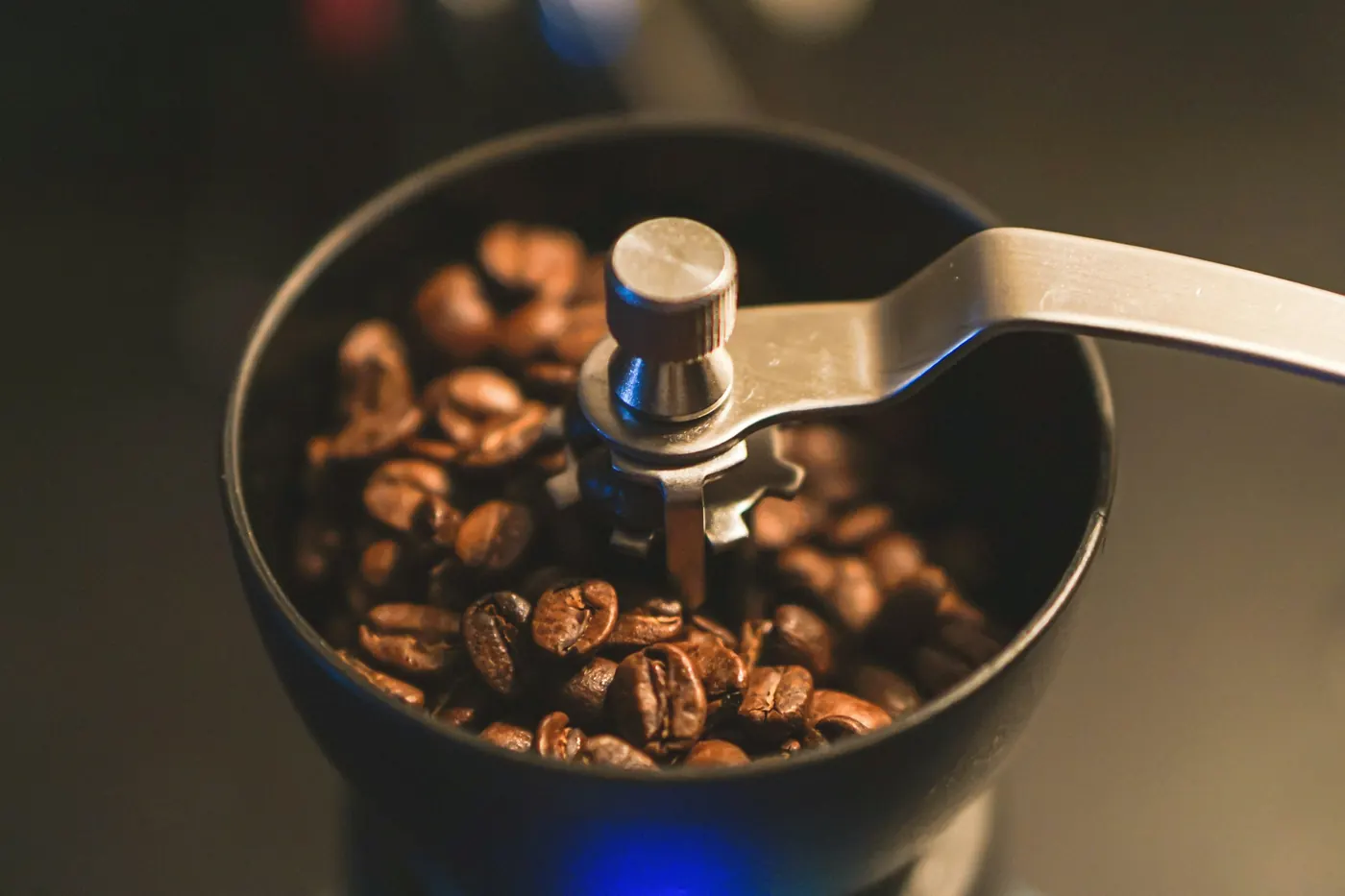
Larger flat burrs (64 mm on the SHARDOR, 65 mm on the Mahlkönig, 83 mm on the DF83) grind more coffee per turn. Conical burrs (Breville, Solis, Comandante) fit smaller bodies and hand grinders. Choose on adjustment and workflow first, burr shape second.
4. Hopper, timer, scale or single dose
A hopper with a timer (Gaggia, SHARDOR, Breville, Solis) repeats a dose at the press of a button. A built-in scale (Vario W+, E65W GBS) repeats it by weight. Single dosing (DF83, Comandante) lets you weigh each shot and change beans freely. If you single dose, a kitchen scale is the most accurate way to measure the beans.
5. Retention and static
Retention is coffee left inside the grinder, which ends up in your next shot. Only MiiCoffee publishes a figure here (under 0.1 g). The DF83, SHARDOR and Solis each list a feature to reduce static.
6. Warranty and parts
An espresso grinder is used daily for years. The Breville and SHARDOR list two-year warranties and the DF83 one year; for the others, check the maker’s terms before you buy.
How we chose these eight burr espresso grinders
We started with what an espresso grinder has to do: grind fine and evenly, adjust in small steps and dose the same way every time. We took specifications from each Amazon listing and used retailer spec sheets (Whole Latte Love, Seattle Coffee Gear, Pro Coffee Gear, Segafredo, Kaffeemacher) only to fill gaps, which we flag in each review. Every pick was in stock on Amazon when we checked. We searched the U.S. Consumer Product Safety Commission’s site for recalls of these brands’ coffee grinders and found none; the only coffee grinder recall that came up was a Starbucks-branded blade grinder in 2009.
We left out grinders already picked on our main espresso grinder and small espresso grinder pages, models that were out of stock or scarce (Eureka Mignon models, Baratza Sette 30, Fellow Opus 2, Mahlkönig X54, Timemore Sculptor 064S, Varia VS3), the Timemore Sculptor 078 and KINGrinder K7, which their makers pitch for pour-over, the Fellow Ode, which is not sold for espresso, and sellers with no identifiable maker. We have not pulled shots with these grinders for this guide; where we describe how one performs, it is the maker’s claim or a named source’s.
A shot for the after-dinner table
In Mexico, espresso turns up most often as a café cortado or as a carajillo: a shot of espresso with Licor 43 over ice, a drink for adults and best sipped slowly. Both depend on a well-ground shot, because there is little milk or ice to hide a sour or bitter one. If your machine has no steam wand, a milk frother covers the cortado, and our drinks menu lists what we pour.
Burr espresso grinder questions, answered
What is the best burr grinder for espresso?
For most home setups, the Baratza Vario W+, for its fine steps and built-in scale. For café-grade flat burrs, the Mahlkönig E65W GBS; for single dosing, the MiiCoffee DF83 Gen 2.
Are conical or flat burrs better for espresso?
Neither is automatically better. Both are used in good espresso grinders. Choose on how finely the grinder adjusts and how it doses, then on burr shape.
Can any burr grinder make espresso?
No. Some burr grinders do not go fine enough, and others jump too far between settings. Check that the maker sells the grinder for espresso.
Is a hand burr grinder good enough for espresso?
Yes, if it adjusts finely. The Comandante C40 reaches espresso, and its optional Red Clix axle halves the step size, according to retailers. It takes effort for every shot.
What is the best espresso burr grinder for a beginner?
The Breville Smart Grinder Pro: a simple timer, a large hopper and cradles for common portafilter sizes.
Our final pick for espresso
Buy the Baratza Vario W+ if you want fine adjustment and weighed doses from one grinder. Choose the Mahlkönig E65W GBS for café-grade flat burrs, the MiiCoffee DF83 Gen 2 or SHARDOR CG301 for big flat burrs, the Gaggia MDF 55 for a stepless Italian hopper grinder, the Breville or Solis for a simple conical starter, and the Comandante C40 to grind by hand. Pair it with a good espresso machine, and see our best coffee espresso grinder guide for more picks or our best coffee grinder guide for drip and French press.