A good espresso grinder used to mean a heavy machine with a big bean hopper that took over a corner of the counter. That has changed. Single-dose grinders, which grind only the beans you weigh out for one shot, need no large hopper, and several of them now fit in a space about as wide as a coffee mug. Hand grinders built for espresso go further: they fit in a drawer.
This guide looks only at compact grinders that can still grind fine enough for espresso: four electric and three hand-cranked, from DF (sold by MiiCoffee), Turin, HiBREW, Timemore, KINGrinder and Normcore. For each we give the burrs, the adjustment, how many beans it holds and, where a maker or retailer publishes them, the dimensions and weight, so you can measure your counter before you buy. Where nobody publishes a figure, we say “Not stated”.
Julia’s earns a commission on purchases made through links on this page, at no cost to you. Recommendations are based on what a restaurant kitchen looks for, product specifications and verified buyer reports.
Quick verdict: the small espresso grinder to buy
For most small kitchens, the best small espresso grinder is the MiiCoffee DF54 Single Dose Coffee Grinder: 54 mm stainless flat burrs, stepless adjustment and a built-in ionizer against static, in a body retailers list at about 11.4 cm wide. If you want the slimmest electric grinder here, the Turin SK40 is about 9.5 cm wide. If there is no outlet or no counter to spare, the Timemore Chestnut C3 ESP Pro is a hand grinder with an espresso-specific adjustment that stores in a drawer.
Our main guide to the best coffee espresso grinder covers full-size machines, including bigger flat-burr grinders. None of the seven below repeat its exact picks. One, the white Turin SK40, is a different color of a grinder that guide reviews in black, and we explain why it is here.
Five compact espresso grinders side by side
The five we would point most people to first, one for each kind of small kitchen, with burrs and footprint as each maker, listing or retailer states them. All seven are reviewed in full below.
| Grinder | Best for | Burrs & adjustment | Footprint (as stated) | Buy on Amazon |
|---|---|---|---|---|

MiiCoffee DF54 Single Dose Coffee GrinderBest overall
|
Flat burrs in a small space | 54 mm steel flat; stepless | About 11.4 x 17.8 cm (retailer) | View on Amazon |

Turin SK40 Single Dose Coffee Grinder, WhiteSlimmest electric
|
Narrow counters, conical burrs | 40 mm steel conical; stepless | About 9.5 x 17 cm (CoffeeGeek) | View on Amazon |

HiBREW G5 Electric Burr Coffee GrinderBest two-speed motor
|
Marked settings, metal body | 48 mm conical; 36 settings | 10.5 x 19 cm (listing) | View on Amazon |

TIMEMORE Whirly 01S Electric Coffee GrinderBest cordless
|
No free outlet, travel | Steel conical; 30 settings | About 7.2 cm across (retailer) | View on Amazon |

TIMEMORE Chestnut C3 ESP Pro Manual Coffee GrinderBest hand grinder
|
Drawer storage, one or two shots | 38 mm steel conical; 0.0233 mm clicks | 52 mm body (listing) | View on Amazon |
Product images from Amazon. Dimensions are as stated by the listing or the named retailer or reviewer; measure your space before buying.
Our picks for the best small espresso grinder
Every grinder below can, according to its maker or listing, grind fine enough for espresso, takes up little counter or drawer space, comes from a brand you can identify, and was in stock on Amazon when we checked. The four electric grinders are single-dose designs or close to it, so none carries a large bean hopper. The three hand grinders hold enough for one or two shots at a time.
1. MiiCoffee DF54 Single Dose Coffee Grinder – Flat Burrs in a Narrow Body
The DF54 is the smaller sibling of the DF64 single-dose grinder reviewed in our main espresso grinder guide. It keeps the same idea, a tilted single-dose grinder with flat burrs and almost nothing left inside after grinding, but uses 54 mm stainless steel flat burrs in a body that retailers list at about 11.4 cm wide, 17.8 cm deep and 30.5 cm tall. That is narrow enough to sit beside a compact espresso machine.
The listing, under the MiiCoffee brand name, says the adjustment is stepless, with a chrome-wrapped dial and a metal indicator, and that it can be dialed in for espresso with high precision. A plasma generator, or ionizer, wraps around the exit chute to reduce static, and an anti-popcorn disc stops beans from bouncing while they grind. MiiCoffee claims retention under 0.1 gram even without the bellows, and includes a blow-out funnel with a lid to clear the dead space.
It comes with a 58 mm transparent dosing cup. The listing notes that a portafilter can sit in the rest, but recommends the cup, especially if your portafilter is not 58 mm. Retailers list the hopper at about 20 grams, or about 50 grams with the bellows fitted, and the weight at about 4.5 kg, so this is small but not light.
Why we like it
- 54 mm stainless flat burrs (listing)
- Stepless adjustment with an indicator
- Ionizer on the exit chute against static
- Retention under 0.1 g claimed by MiiCoffee
Key specifications
| Model | DF54 (version 1.5, per listing) |
|---|---|
| Type | Electric, single dose |
| Burrs | 54 mm stainless steel, flat |
| Adjustment | Stepless |
| Bean capacity | About 20 g; about 50 g with bellows (retailer) |
| Size | About 11.4 x 17.8 x 30.5 cm (retailer) |
| Weight | About 4.5 kg (retailer) |
| Warranty | Not stated |
Why we recommend it
It suits a home espresso maker who wants flat burrs and a single-dose workflow but does not have room for a 64 mm grinder.
Skip it if you want a timer or a hopper that holds a week of beans. You weigh and grind each dose by hand.
Pros and cons
Pros
- Flat burrs in a compact body
- Very low claimed retention
- Fine stepless adjustment
Cons
- Heavy for its size
- Plastic dosing cup
- Warranty not stated
2. Turin SK40 Single Dose Coffee Grinder, White – The Narrowest Electric Here
Our main espresso grinder guide reviews the Turin SK40 in black. We include the white version here because, of the electric grinders we found in stock, it is the narrowest: CoffeeGeek measured it at about 9.5 cm wide and 17 cm deep, roughly 32 cm tall without the bellows and about 35.5 cm with the hopper and bellows on. If you already read that guide, the grinder is the same; only the finish differs.
It grinds on 40 mm stainless steel conical burrs, which Turin’s listing says suit espresso, pour-over and French press. The adjustment is stepless, which the listing says lets you make small changes when dialing in espresso; CoffeeGeek describes it as a worm drive, which is precise but slower to move between very different settings than Turin’s stepped SD40.
The body is tilted, and with the rubber bellows it is designed to clear grounds from the chamber, according to Turin. The box includes a wood lid, a metal hopper, the bellows and a stainless steel dosing cup. Retailers list the hopper at about 40 grams, and CoffeeGeek gives the weight as about 2.75 kg.
Why we like it
- About 9.5 cm wide (CoffeeGeek)
- 40 mm stainless conical burrs
- Stepless adjustment for espresso
- Stainless dosing cup and bellows included
Key specifications
| Model | SK40 |
|---|---|
| Type | Electric, single dose |
| Burrs | 40 mm stainless steel, conical |
| Adjustment | Stepless (worm drive) |
| Bean capacity | About 40 g (retailer) |
| Size | About 9.5 x 17 x 32 cm without bellows (CoffeeGeek) |
| Weight | About 2.75 kg (CoffeeGeek) |
| Warranty | Not stated |
Why we recommend it
It suits a kitchen where the counter is shallow and every centimeter of width counts, and a cook who mostly makes espresso and rarely switches to coarse grinds.
Skip it if you change between espresso and French press every day. The worm-drive dial takes many turns to travel that far.
Pros and cons
Pros
- Narrowest electric pick
- Light for an electric grinder
- Useful accessories in the box
Cons
- Slow to change between brew methods
- Smaller burrs than the DF54
- Warranty not stated
3. HiBREW G5 Electric Burr Coffee Grinder – Two Speeds in a Metal Body
HiBREW’s G5 is the one grinder here that states its own dimensions on the Amazon listing: 10.5 cm wide, 19 cm deep and 31 cm tall. It is a single-dose-style grinder with an aluminum alloy housing, a textured non-slip surface and a 15-degree tilt that the listing says helps empty the grounds.
Inside are 48 mm CNC conical burrs with 36 grind settings, which HiBREW says cover espresso, Turkish coffee, pour-over and drip. The motor runs at two speeds, 500 or 400 revolutions per minute, and HiBREW says the slower speed reduces the heat generated while grinding. A powder discharger and an anti-static coating are meant to reduce grounds left inside the machine.
The bean container holds 50 grams, according to the listing. Retailers give the net weight as about 2.6 kg. HiBREW is a smaller brand that sells mainly online, and the motor wattage varies between retailer listings, so treat any power figure you see with care.
Why we like it
- Stated footprint of 10.5 x 19 cm
- 48 mm conical burrs, 36 settings
- Two motor speeds (HiBREW)
- Aluminum housing
Key specifications
| Model | G5 |
|---|---|
| Type | Electric, single dose |
| Burrs | 48 mm CNC conical |
| Adjustment | 36 settings |
| Bean capacity | 50 g |
| Size | 10.5 x 19 x 31 cm (listing) |
| Weight | About 2.6 kg (retailer) |
| Warranty | Not stated |
Why we recommend it
It suits a cook who wants marked, repeatable settings rather than a stepless dial, in a compact metal body.
Skip it if you want the finest possible control for espresso. Stepped settings can land between the grind you want and the next one over.
Pros and cons
Pros
- Maker states its dimensions
- Larger conical burrs than the SK40
- Slow-speed option
Cons
- Stepped, not stepless
- Amazon-first brand
- Warranty and retention not stated
4. TIMEMORE Whirly 01S Electric Coffee Grinder – Battery Power, No Outlet Needed
The Whirly 01S is a cylinder about the size of a hand grinder with a motor in it. Retailers list it at about 72 mm across and 190 mm tall, and the listing gives the body weight as 760 grams. A rechargeable battery means it does not need an outlet, which matters in an older kitchen where every socket near the espresso machine is already taken.
Timemore says its S2C stainless steel octagonal burrs (retailers give the size as 42 mm) suit espresso and the occasional filter coffee, with 30 grind settings at 0.025 mm per step. According to the listing, one charge grinds up to 20 espresso doses of 20 grams, or 35 pour-over doses of 15 grams, and a full charge takes about three hours. One retailer spec sheet gives about 90 seconds for an 18-gram espresso dose, so this is slower than a mains-powered grinder.
The twist-up hopper clicks into place, and the catch cup holds up to 50 grams, though Timemore recommends 30 grams for light roasts or espresso. The listing describes an auto shut-off and protection against clogs and overheating, and a brush for cleaning is included.
Why we like it
- Rechargeable, no outlet needed
- Up to 20 espresso doses per charge (Timemore)
- 30 settings at 0.025 mm
- About 72 mm across (retailer)
Key specifications
| Model | Whirly 01S |
|---|---|
| Type | Electric, battery powered |
| Burrs | S2C stainless steel, conical (42 mm per retailers) |
| Adjustment | 30 settings, 0.025 mm each |
| Bean capacity | Up to 50 g; 30 g advised for espresso |
| Size | About 72 x 190 mm (retailer) |
| Weight | 760 g |
| Warranty | Not stated |
Why we recommend it
It suits a small apartment kitchen or an office desk, and anyone who wants electric grinding that can go in a cupboard between uses.
Skip it if you pull several shots back to back every morning. A battery grinder is slower and has to be recharged.
Pros and cons
Pros
- Smallest electric pick
- Works anywhere
- Established coffee-gear maker
Cons
- Slow for espresso doses
- Battery needs charging
- Stepped adjustment
5. TIMEMORE Chestnut C3 ESP Pro Manual Coffee Grinder – An Espresso Pitch in a Drawer-Sized Mill
The ESP versions of Timemore’s Chestnut grinders have a finer adjustment pitch than the standard models, and Timemore says that makes them more suitable for espresso. The C3 ESP Pro moves 0.0233 mm per click across about 36 levels, and the listing even prints a starting point: 0.8 to 1.1 turns for espresso, 1.4 to 2.0 for pour-over and 2.0 to 2.3 for French press.
The burrs are Timemore’s S2C660 stainless steel, 38 mm across, on a central shaft held by two bearings. The body is all metal, a single piece 52 mm across, which the listing says is easy to grip even for small hands, and the crank handle folds for storage. Retailers list the capacity at about 20 grams, enough for one double shot, and the weight at roughly 470 to 530 grams depending on the source.
Timemore says it comes apart easily and cleans with a brush. Our main guide reviews the larger C5 ESP Pro; the C3 ESP Pro is the smaller, simpler member of the same family.
Why we like it
- Finer ESP pitch, 0.0233 mm per click
- Printed starting points for espresso
- All-metal 52 mm body
- Folding handle for storage
Key specifications
| Model | Chestnut C3 ESP Pro |
|---|---|
| Type | Manual |
| Burrs | 38 mm S2C660 stainless steel, conical |
| Adjustment | About 36 levels, 0.0233 mm per click |
| Bean capacity | About 20 g (retailer) |
| Size | 52 mm body diameter |
| Weight | About 470–530 g (retailers differ) |
| Warranty | Not stated |
Why we recommend it
It suits someone making one or two espresso drinks a day who would rather keep the counter clear and does not mind a minute or so of cranking.
Skip it if you grind for guests. Twenty grams at a time means grinding again for every drink.
Pros and cons
Pros
- Espresso-specific adjustment
- Stores in a drawer
- No power needed
Cons
- One dose at a time
- Smaller burrs mean more cranking
- Warranty not stated
6. KINGrinder K2 Manual Coffee Grinder – Bigger Burrs, One-Year Warranty
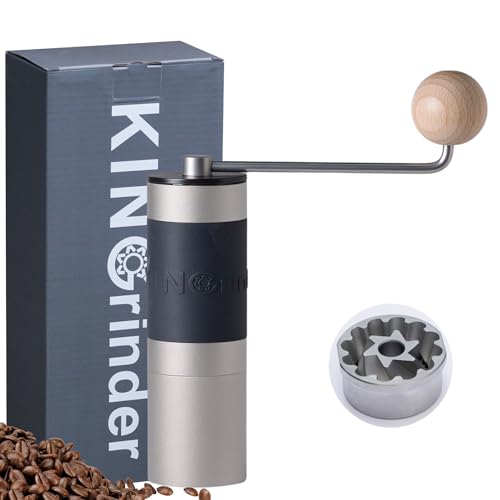
KINGrinder’s K2 is a compact aluminum hand grinder, listed at 16 cm by 5.5 cm, that its maker says supports pour-over and espresso. Retailers give the burr size as 48 mm, larger than the Timemore’s, and larger burrs generally need fewer turns to grind the same dose.
The adjustment is inside, under the burrs: 18 microns per click, with 40 clicks in a single round and printed numbers to keep your place, according to the listing. Steel burrs and a dual-bearing shaft are meant to keep the grind consistent. The hopper holds 20 to 25 grams, and the grinder comes apart by hand for cleaning with a brush.
The listing states a one-year warranty, with the note that shipping for replacement parts may fall to the customer depending on the case. Retailers list the weight at 595 grams. The K6 in our hand grinder guide has an outside dial; the K2 is the simpler model with the adjustment inside.
Why we like it
- 48 mm steel burrs (retailers)
- 18 microns per click (listing)
- One-year warranty stated
- Tool-free disassembly
Key specifications
| Model | K2, straight handle |
|---|---|
| Type | Manual |
| Burrs | Stainless steel, conical (48 mm per retailers) |
| Adjustment | Internal, 18 microns per click, 40 clicks per round |
| Bean capacity | 20–25 g |
| Size | 16 x 5.5 cm (listing) |
| Weight | 595 g (retailer) |
| Warranty | 1 year |
Why we recommend it
It suits a hand-grinder buyer who wants bigger burrs and a written warranty in a body that still fits a drawer.
Skip it if you switch brew methods often. The internal dial means taking the catch cup off every time you adjust.
Pros and cons
Pros
- Larger burrs for a hand grinder
- Fine, numbered steps
- Stated warranty
Cons
- Adjustment hidden inside
- Maker leads with pour-over
- Small hopper
7. Normcore Manual Coffee Grinder V3 – Espresso-Minded Burrs With a Case

Normcore also sells espresso accessories such as spring-loaded tampers on Amazon, and its V3 hand grinder is aimed the same way. The listing describes 46 mm stainless steel burrs that are particularly effective at fine settings like espresso and Turkish coffee, and the body is cut from a single block of aluminum alloy in two segments, with a widened opening that makes loading beans easier.
The adjustment is stepped and internal, with 24 clicks per rotation on a 0.5 mm thread pitch, ranging from espresso to French press. A steel shaft runs on stainless steel ball bearings. One small detail matters in daily use: a fixed silicone band with a thumb rest on the top, which Normcore says lets you hold the grinder with less pressure while you crank.
A carrying case is included. Normcore does not state the bean capacity, dimensions, weight or warranty on this listing, so we mark them as not stated. Normcore is a brand that sells mainly through Amazon.
Why we like it
- 46 mm burrs aimed at fine grinds (Normcore)
- Single-block aluminum body
- Thumb rest for a steadier grip
- Carrying case included
Key specifications
| Model | V3, 46 mm stainless steel burr |
|---|---|
| Type | Manual |
| Burrs | 46 mm stainless steel, conical |
| Adjustment | Internal, 24 clicks per rotation |
| Bean capacity | Not stated |
| Size | Not stated |
| Weight | Not stated |
| Warranty | Not stated |
Why we recommend it
It suits someone who wants a hand grinder they can pack for a trip and still use at home for espresso.
Skip it if you want clear published specs. The listing leaves out capacity, weight and warranty.
Pros and cons
Pros
- Burrs aimed at espresso
- Comfortable grip
- Case for travel
Cons
- Coarser steps than the K2 or C3 ESP Pro
- Amazon-first brand
- Many specs not stated
How to choose a compact grinder for espresso
Espresso asks more of a grinder than any other brew. Hot water passes through a small, tightly packed bed of very fine coffee in well under a minute, so small changes in grind size change the shot. A small grinder has to do that job without the mass and the big burrs of a full-size machine. These are the points that matter.
1. Measure the footprint, including height
Width and depth decide whether a grinder fits beside your espresso machine; height decides whether it fits under the cabinets. The DF54 is listed at about 30.5 cm tall, and the SK40 at about 35.5 cm with its bellows, so measure from the counter to the underside of the cabinet before you buy. Hand grinders and the battery-powered Whirly avoid the question, because they live in a drawer.
2. Fine adjustment matters more than the number of settings
For espresso you need small steps in the fine range. Stepless grinders, such as the DF54 and SK40, can be set anywhere. Stepped grinders work if the steps are small: the Timemore C3 ESP Pro moves 0.0233 mm per click and the KINGrinder K2 18 microns. A grinder with 30 or 36 broad settings spread from espresso to French press may only have a handful in the espresso range.
3. Single dose suits a small kitchen
A single-dose grinder grinds the beans you weigh and leaves almost nothing behind, so there is no hopper of beans going stale on the counter, and switching between a regular and a decaf is easy. The trade-off is weighing every dose, so a small kitchen scale is part of the setup.
4. Electric, battery or hand
Plug-in grinders are the fastest. A battery grinder like the Whirly frees you from the outlet but is slower and needs charging. A hand grinder costs you a minute or so of cranking per double shot, but takes no counter space and no power. If you make several drinks every morning, go electric; if you make one, a hand grinder is a fair trade.
5. Burr size, and what you give up against a full-size grinder
Bigger burrs generally grind faster and with less effort. Compared with the full-size picks in our main espresso grinder guide, these grinders have smaller burrs, smaller or no hoppers and, mostly, no timers. What you keep is the ability to grind fine and adjust in small steps, which is what espresso really needs.
How we picked these seven small grinders
We looked for grinders that their makers or listings describe as suitable for espresso, that are compact by footprint or can be stored in a drawer, that come from identifiable brands, and that were in stock on Amazon when we checked. We left out every exact listing already reviewed in our guides to the best espresso grinder, the best coffee grinder, the best hand coffee grinder and the best budget coffee grinder; the white Turin SK40 is the one color variant, chosen because it is the narrowest electric grinder we found. We limited Amazon-first brands to two (HiBREW and Normcore). Eureka’s compact Mignon grinders and the Baratza Sette 30 were back-ordered or in short supply when we checked, so they are not here.
Specifications come from the Amazon listings; where a listing is silent, we used retailer spec sheets and CoffeeGeek’s measurements of the SK40 and say so in each table. We mark makers’ claims, such as retention figures, as theirs. We have not used these grinders ourselves, and we do not list prices. We searched the U.S. Consumer Product Safety Commission’s recall listings for these brands and found no recall of any grinder on this page.
Small espresso grinder questions, answered
Can a small grinder really grind fine enough for espresso?
Yes, if it is designed for it. Every grinder here is described by its maker or listing as suitable for espresso. What small grinders give up is speed, hopper size and, with the hand grinders, convenience, not the ability to grind fine.
What is the smallest electric espresso grinder on this list?
The Timemore Whirly 01S, at about 72 mm across according to retailers, because it is a battery grinder shaped like a hand mill. Of the countertop grinders, the Turin SK40 is the narrowest at about 9.5 cm wide.
Is a hand grinder good enough for daily espresso?
For one or two drinks a day, yes. Choose one with a fine adjustment pitch, such as the Timemore C3 ESP Pro or the KINGrinder K2, and expect around a minute of cranking for a double shot. For a household of espresso drinkers, an electric grinder saves a lot of effort.
Does a small single-dose grinder need a scale?
In practice, yes. Single-dose grinders grind whatever you put in, so weighing the beans is how you control the dose. Most espresso recipes start from a dose in grams.
Which small grinder pairs with a compact espresso machine?
Any of them can, but check your portafilter size against the dosing cup. The DF54’s cup is 58 mm, and MiiCoffee recommends using the cup if your portafilter is a different size. Our guide to the best espresso machine covers machines to pair with them.
Our final pick for a small coffee corner
Choose the MiiCoffee DF54 for flat burrs and stepless adjustment in a narrow body, the Turin SK40 if width is the tightest limit, and the HiBREW G5 for marked settings and a two-speed motor. If there is no outlet or counter to spare, the Timemore Whirly 01S runs on a battery, and the Timemore C3 ESP Pro, KINGrinder K2 and Normcore V3 are hand grinders that go back in a drawer when you are done.
For full-size grinders with bigger burrs and timers, see our main guide to the best coffee espresso grinder. And if you would rather someone else made the coffee tonight, see our drinks and the menu, or call to order.