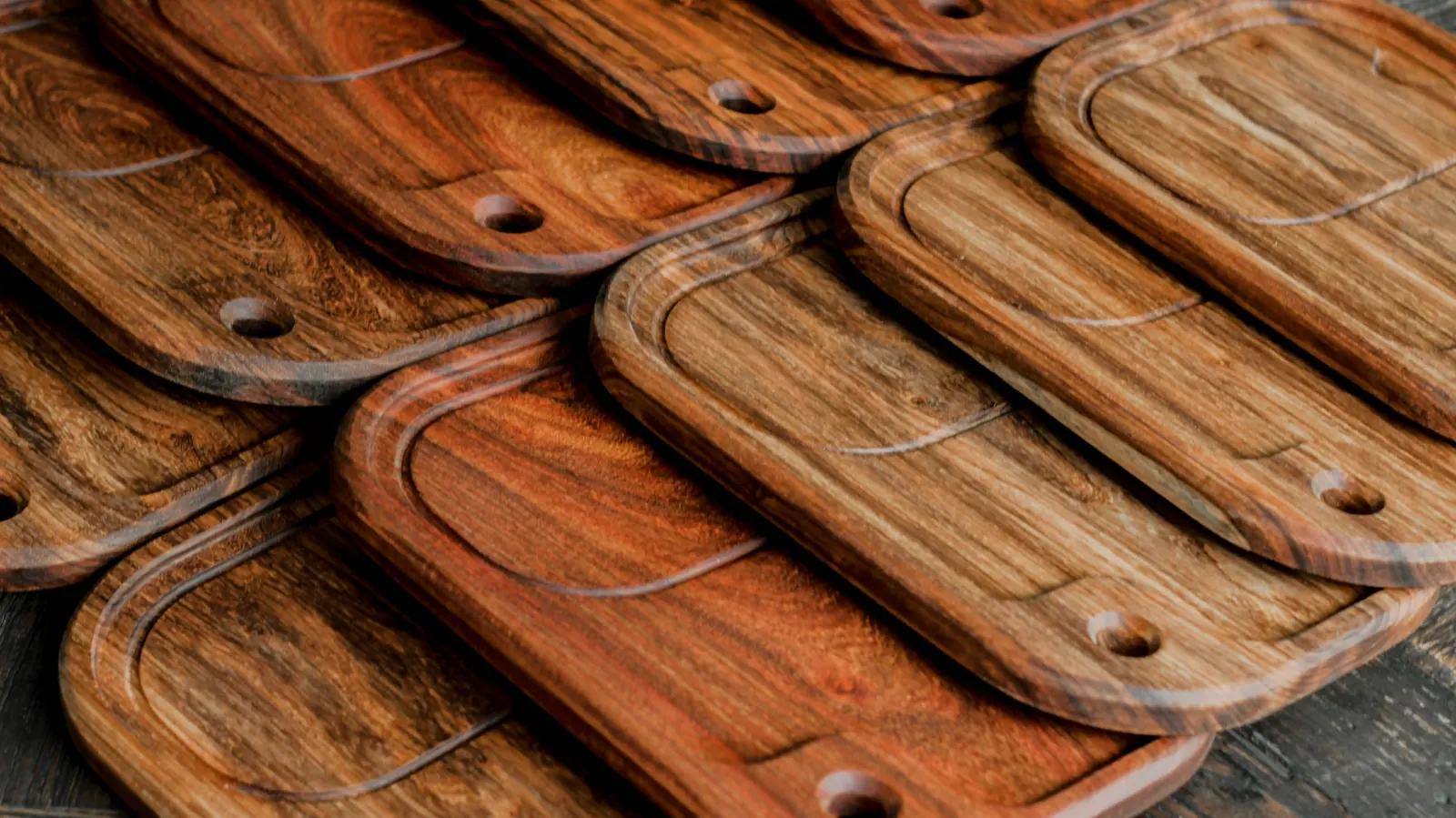
A wooden cutting board lives a hard life. It gets washed after every batch of pico de gallo, it soaks up lime juice and tomato, and in a Houston summer it sits next to a hot stove. Without oil it dries out, turns pale and fuzzy, and eventually cracks along the glue lines. A few minutes with the right oil every few weeks keeps it smooth, darker and much longer lived.
The right oil is not whatever is in the pantry. The University of Maine Cooperative Extension advises against olive and vegetable oils on boards because they may turn sticky and rancid, and recommends a food-safe mineral oil or beeswax instead. This guide compares nine board oils, creams and waxes from John Boos, Howard, CLARK’S, Thirteen Chefs, Walrus Oil and Caron & Doucet, with the ingredients, food-contact claims and how-to each maker states.
Julia’s earns a commission on purchases made through links on this page, at no cost to you. Recommendations are based on what a restaurant kitchen looks for, product specifications and verified buyer reports.
Quick verdict: which board oil to buy
For most kitchens, the best cutting board oil is Howard Butcher Block Conditioner: one bottle that combines USP-grade mineral oil with beeswax and carnauba wax, odorless, with clear directions from Howard. If you prefer the two-step routine of a maker of boards, use John Boos Mystery Oil followed by John Boos Board Cream. If you want to avoid mineral oil, Caron & Doucet Cutting Board Oil is made from refined coconut oil.
Below, the five standouts side by side, then all nine products in full.
Five board oils and creams compared
Our five standout picks, one for each kind of cook, with the ingredients each maker or listing states. All nine products are reviewed in full below.
| Board care product | Best for | Type | Main ingredients | Buy on Amazon |
|---|---|---|---|---|

Howard Butcher Block Conditioner, 12 ozBest overall
|
One-bottle care | Oil and wax conditioner | USP mineral oil, beeswax, carnauba | View on Amazon |

John Boos Mystery Oil, 16 ozBest oil
|
Maple boards and blocks | Oil | Food-grade mineral oil | View on Amazon |
John Boos Board Cream, 5 ozBest cream
|
Sealing after oiling | Cream | Food-grade mineral oil, unbleached beeswax | View on Amazon |

Thirteen Chefs Mineral Oil, 12 ozBest plain mineral oil
|
Simple, unscented oiling | Oil | 100% food-grade mineral oil | View on Amazon |

Caron & Doucet Cutting Board Oil, 8 ozBest mineral-oil-free
|
Plant-based care | Oil | Refined coconut oil, essential oils | View on Amazon |
Product images from Amazon. Ingredients and claims are as stated by each maker or listing; check the label before you buy.
Our picks for the best cutting board oil
These nine products cover the three kinds of board care: thin oils that soak in, creams and conditioners that add wax to seal the surface, and solid waxes that finish it. Most are mineral oil based; two avoid mineral oil altogether. For each one we list exactly what the maker says is inside, the food-contact claim it makes, and how often it says to use it. For the boards themselves, see our guide to the best cutting board.
1. Howard Butcher Block Conditioner, 12 oz – Oil and Wax in One Bottle
Howard’s conditioner does in one step what John Boos does in two. Howard lists the ingredients as pure USP-grade mineral oil, beeswax and Brazilian carnauba wax, with the mineral oil stabilized with vitamin E. The oil soaks into the wood, and the waxes add, in Howard’s words on the listing, another level of protection with the water resistance of beeswax and carnauba.
Howard says the mineral oil exceeds U.S. FDA regulations for direct and indirect contact with food, and that the conditioner is safe for all wood surfaces that touch food, including butcher blocks, cutting boards, bowls and utensils. It describes the product as tasteless and odorless and says it will not go rancid. The listing adds that it prevents drying and cracking in hardwoods and bamboo.
The directions are clear. Shake gently, apply with a clean, soft cloth, and let it stand at least an hour, or overnight if possible, then wipe off the excess. On thick, unconditioned wood of 1.5 inches or more, Howard says to apply three to four coats and treat all sides. After that, reapply whenever the wood looks or feels dry. For best results, Howard suggests seasoning new wood with its plain Cutting Board Oil first.
Why we like it
- USP-grade mineral oil, beeswax and carnauba wax, per Howard
- Odorless and tasteless, per the maker
- One step: conditions and seals
- Clear directions for new and thick boards
Key specifications
| Product | BBC012 |
|---|---|
| Type | Oil and wax conditioner |
| Main ingredients | USP mineral oil, beeswax, carnauba wax, vitamin E |
| Food-safe claim (stated) | Mineral oil “exceeds U.S. FDA regulations” for food contact |
| Size | 12 fl oz |
| Scent | Odorless |
| Made in | Not stated |
| Use frequency (maker) | Whenever the wood looks or feels dry |
Why we recommend it
It suits cooks who want one bottle that oils and seals a board, with no scent, and clear directions to follow.
Skip it if you avoid animal products: it contains beeswax.
Pros and cons
Pros
- Full ingredient list published
- Oil and wax together
- Odorless
Cons
- Contains beeswax
- Needs at least an hour to soak in
- Country of manufacture not stated
2. John Boos Mystery Oil, 16 oz – The Board Maker’s Own Oil
John Boos, the Effingham, Illinois, maker of maple boards and butcher blocks, says it has been a trusted name since 1887, and Mystery Oil is the oil it tells owners to use. Boos’s own spec sheet says it is made with all-natural, food-grade mineral oil, is NSF certified, and absorbs deep into the wood fibers to replace moisture lost to repeated washing, keeping the surface from drying, bleaching and cracking. Boos does not publish a full formula; some retailers also list beeswax, so check the label if that matters to you.
On frequency, the listing says Boos recommends oiling boards and blocks every three to four weeks, and the Boos care page says a minimum of once a month, depending on use and household conditions. The method on the listing is simple: spread it evenly, wait five minutes and wipe off the excess. Boos’s care page goes further and suggests coating all surfaces, letting it soak in, and following with Board Cream.
The bottle is 16 ounces, made in the USA, and the listing says it is safe for cutting boards, butcher blocks, countertops and wooden utensils.
Why we like it
- Food-grade mineral oil, per Boos’s spec sheet
- NSF certified
- Made in the USA
- Clear schedule: every three to four weeks
Key specifications
| Product | MYSB |
|---|---|
| Type | Oil |
| Main ingredients | Food-grade mineral oil (full formula not published) |
| Food-safe claim (stated) | NSF certified; safe for wood food-prep surfaces |
| Size | 16 oz |
| Scent | Not stated |
| Made in | USA |
| Use frequency (maker) | Every 3–4 weeks (at least monthly) |
Why we recommend it
It suits owners of Boos and other maple boards who want the board maker’s own oil and routine.
Skip it if you want a complete ingredient list: Boos names only the mineral oil.
Pros and cons
Pros
- From a board maker
- NSF certified
- Quick five-minute method
Cons
- Full formula not published
- Boos suggests a cream on top too
- Scent not stated
3. John Boos Board Cream, 5 oz – A Beeswax Seal Over the Oil
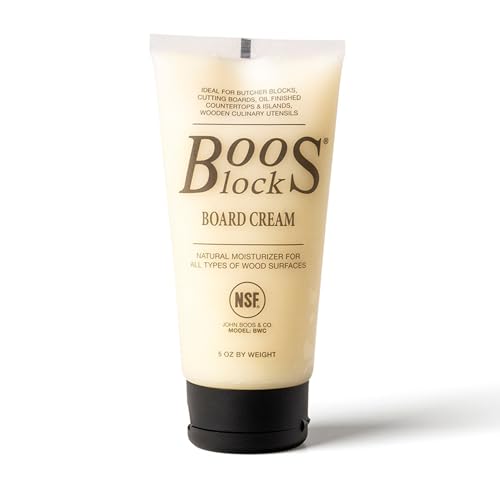
Board Cream is the second half of the Boos routine. The listing describes a formula of food-grade mineral oil and unbleached beeswax, and Boos’s care page calls it a natural, unbleached beeswax and food-grade oil formula. It is thicker than Mystery Oil and leaves a waxy layer on the surface that helps hold moisture in the wood.
Boos’s instructions are to apply an even coat once a month with a clean cloth, paper towel or Boos applicator, let it soak into the wood fibers overnight, then wipe off any excess. The listing says to use it more often in dry or arid climates, and to pair it with Mystery Oil for extra moisture. On a new or very dry board, oil first, then cream.
The listing says the formula is safe for food surfaces. It comes in a 5-ounce tube, which goes a long way because you use a thin layer.
Why we like it
- Food-grade mineral oil and unbleached beeswax
- Seals the surface after oiling
- Once-a-month routine, per Boos
- Tube is easy to apply thinly
Key specifications
| Product | BWCB |
|---|---|
| Type | Cream |
| Main ingredients | Food-grade mineral oil, unbleached beeswax |
| Food-safe claim (stated) | “Safe for food surfaces” (listing) |
| Size | 5 oz tube |
| Scent | Not stated |
| Made in | Not stated |
| Use frequency (maker) | Once a month, overnight; more in dry climates |
Why we recommend it
It suits cooks who already oil their boards and want a beeswax finish that keeps the oil in longer.
Skip it if you want a single product: Boos designs it to follow Mystery Oil.
Pros and cons
Pros
- Two simple ingredients
- Monthly routine
- From a board maker
Cons
- Overnight wait
- Best paired with an oil
- Contains beeswax
4. Thirteen Chefs Mineral Oil, 12 oz – Plain Mineral Oil, Nothing Added
If you want the simplest possible board oil, this is it. Thirteen Chefs describes it as 100 percent pure food-grade mineral oil, colorless, odorless and tasteless, and the listing title calls it a USP finish. Thirteen Chefs says it is NSF certified and bottled in the USA in NSF-certified facilities.
The maker’s routine is generous and easy: apply generously, let it sit four hours or overnight, and wipe off the excess. Thirteen Chefs says one 1-ounce treatment every three months is enough for a board up to 18 inches. The push-applicator cap and squeeze bottle make it easy to drip on without a mess.
Because it is plain oil with no wax, it soaks in and conditions but does not leave a sealing layer. If you want that, follow it with a wax or cream such as the Boos Board Cream or a CLARK’S or Walrus Oil wax. The same bottle also works on wooden spoons, bowls and the handles of knives.
Why we like it
- One ingredient: food-grade mineral oil
- NSF certified, per Thirteen Chefs
- Colorless, odorless, tasteless
- Made in the USA
Key specifications
| Product | CB01 |
|---|---|
| Type | Oil |
| Main ingredients | 100% food-grade mineral oil |
| Food-safe claim (stated) | NSF certified food grade; USP |
| Size | 12 fl oz |
| Scent | Odorless |
| Made in | USA |
| Use frequency (maker) | 1 oz every 3 months (boards up to 18 in) |
Why we recommend it
It suits cooks who want plain, unscented mineral oil and no extra ingredients.
Skip it if you want a wax finish in the same step: it is oil only.
Pros and cons
Pros
- Single ingredient
- Unscented
- Squeeze bottle with applicator cap
Cons
- No wax for sealing
- Four-hour soak
- Petroleum-derived, if you prefer plant oils
5. Walrus Oil Cutting Board Oil, 8 oz – Mineral and Coconut Oil With Beeswax

Walrus Oil says its board oil is trusted by professional woodworkers, and it is a blend rather than a single oil. The maker lists four ingredients: beeswax, fractionated coconut oil, pure mineral oil and vitamin E. Walrus says the oils condition and protect, the beeswax waterproofs and shines, and the vitamin E improves shelf life.
Walrus says the oil is NSF certified for food-contact surfaces and that every ingredient is generally recognized as safe by the FDA; the listing calls it FDA compliant and says it is brewed and bottled in the USA. It is unscented.
The routine on the maker’s page: for unfinished boards, sand to 220 to 400 grit; for used boards, clean and dry the surface. Shake well, apply, let it set for six to twelve hours, and buff away the excess. Walrus says to reapply every one to two months for heavily used boards, and to use its Wood Wax afterward for more sheen.
Why we like it
- Four published ingredients
- NSF certified for food contact, per Walrus
- Unscented
- Made in the USA
Key specifications
| Product | WO-CBO8 |
|---|---|
| Type | Oil with beeswax |
| Main ingredients | Beeswax, fractionated coconut oil, mineral oil, vitamin E |
| Food-safe claim (stated) | NSF certified for food-contact surfaces; FDA compliant |
| Size | 8 oz |
| Scent | Unscented |
| Made in | USA |
| Use frequency (maker) | Every 1–2 months for heavily used boards |
Why we recommend it
It suits cooks who like a woodworker’s finish and want oil and a little wax in one bottle.
Skip it if you want a quick job: Walrus asks for six to twelve hours before buffing.
Pros and cons
Pros
- Clear ingredient list
- Unscented
- Reapply only every 1–2 months
Cons
- Long set time
- Contains beeswax and coconut oil
- Small 8 oz bottle

6. Caron & Doucet Cutting Board Oil, 8 oz – Coconut Based, No Mineral Oil
Some cooks would rather not use a petroleum-based oil. Caron & Doucet, a family company, makes its board oil from refined coconut oil plus a proprietary blend of pure essential oils, and says it contains no mineral oil. The listing says the base is 100 percent coconut derived, made in Canada, and refined by a solventless process that removes the long-chain fatty acids, so it will not go rancid or sticky like flax, canola, olive or linseed oil.
The listing says the coconut oil used is also an ingredient in specialty food production, which is the basis for its food-contact-safe claim. The maker describes the product as vegan and free of petrochemicals. It does not name the essential oils in the blend.
Caron & Doucet’s method is quick: wash the board and let it dry, spread about a teaspoon with a clean microfiber cloth, and let it sit 30 minutes. New or dry wood may need more coats. It gives no fixed schedule, and suggests following with its separate Cutting Board Wax for a waterproof finish.
Why we like it
- No mineral oil: refined coconut oil base
- Made not to go rancid, per the maker
- Fast 30-minute application
- Vegan, per Caron & Doucet
Key specifications
| Product | Caron & Doucet Cutting Board Oil |
|---|---|
| Type | Oil |
| Main ingredients | Refined coconut oil, proprietary essential oil blend |
| Food-safe claim (stated) | “Food contact safe” (listing) |
| Size | 8 oz |
| Scent | Essential oil blend (not named) |
| Made in | Canada |
| Use frequency (maker) | Not set; extra coats for new or dry wood |
Why we recommend it
It suits cooks who want a plant-based, mineral-oil-free board oil and a quick routine.
Skip it if you want every ingredient named: the essential oils are a proprietary blend.
Pros and cons
Pros
- Mineral-oil-free
- Quick to apply
- Made in Canada
Cons
- Essential oils not named
- Contains coconut oil
- No reapplication schedule
7. CLARK’S Cutting Board Oil, 12 oz, Orange and Lemon – Mineral Oil With a Citrus Scent

CLARK’S takes plain mineral oil and adds a little orange and lemon essential oil, so the board smells fresh rather than of nothing. The listing says it is made with food-grade mineral oil and a touch of orange and lemon essential oil, and that it is bottled in FDA-compliant facilities in the USA and regularly tested. Unlike Thirteen Chefs, CLARK’S notes that its oil is not colorless.
The bottle has a push cap for mess-free pouring. CLARK’S says to apply with a towel or by hand and let it soak; the listing gives four hours in one place and two to three hours in its title, so leave it the longer time. Like Thirteen Chefs, CLARK’S says 1 ounce every three months keeps a board up to 18 inches in shape.
The scent is the reason to choose it. If you are sensitive to citrus smells, or simply want your board to smell of nothing, choose an unscented oil instead.
Why we like it
- Food-grade mineral oil with orange and lemon oil
- Bottled in the USA, per CLARK’S
- Push cap for easy pouring
- 1 oz every three months, per the maker
Key specifications
| Product | 853324008005 |
|---|---|
| Type | Oil |
| Main ingredients | Food-grade mineral oil, orange and lemon essential oils |
| Food-safe claim (stated) | Food grade; bottled in FDA-compliant facilities |
| Size | 12 oz |
| Scent | Orange and lemon |
| Made in | USA (bottled) |
| Use frequency (maker) | 1 oz every 3 months (boards up to 18 in) |
Why we recommend it
It suits cooks who want plain mineral oil care with a light citrus smell.
Skip it if you want a scent-free board: the essential oils are the point of this one.
Pros and cons
Pros
- Fresh citrus scent
- Simple ingredients
- Long-lasting bottle
Cons
- Soak time stated two ways
- Scented
- No wax in the oil
8. CLARK’S Cutting Board Wax, 6 oz – Board Butter With Beeswax and Carnauba

CLARK’S calls this a two-in-one wood butter: a soft wax that conditions and seals at once. The listing gives the formula as food-grade mineral oil, beeswax and carnauba wax, scented with orange and lemon essential oils, and says it is made in the USA. CLARK’S says it penetrates the wood and forms a barrier that helps prevent drying, cracking and water damage.
It is similar in make-up to the Howard conditioner but in a jar, as a paste rather than a liquid. That makes it easy to rub into a board with a cloth and buff to a smooth finish, and it works on wooden spoons and salad bowls too. CLARK’S describes the result as a smooth, food-safe finish.
The listing does not give an application method or a schedule for the wax on its own. A sensible routine is the one Walrus Oil states for its products: oil first, then wax.
Why we like it
- Mineral oil, beeswax and carnauba in one paste
- Conditions and seals in a step
- Made in the USA, per CLARK’S
- Easy to buff on spoons and bowls
Key specifications
| Product | CLARK’S Cutting Board Wax |
|---|---|
| Type | Wax (wood butter) |
| Main ingredients | Food-grade mineral oil, beeswax, carnauba wax, orange and lemon oils |
| Food-safe claim (stated) | “Food-safe finish”; food-grade ingredients |
| Size | 6 oz |
| Scent | Orange and lemon |
| Made in | USA |
| Use frequency (maker) | Not stated |
Why we recommend it
It suits cooks who prefer a paste they can rub in and buff, and who like a citrus scent.
Skip it if you want directions on the label: the listing gives no schedule or method.
Pros and cons
Pros
- Full ingredient list
- Conditions and seals
- Good for utensils too
Cons
- No stated schedule
- Scented
- Contains beeswax
9. Walrus Oil Wood Wax, 3 oz – A Mineral-Oil-Free Finishing Wax

Walrus Oil’s Wood Wax is the finishing coat to go over an oiled board. The maker lists three ingredients: beeswax, fractionated coconut oil and vitamin E, so unlike the CLARK’S wax it contains no mineral oil. Walrus says the beeswax waterproofs and shines, the coconut oil conditions and protects, and the vitamin E improves shelf life.
Walrus labels it NSF certified food-contact safe and says every ingredient is generally recognized as safe by the FDA; the listing says it is made in the USA. It is unscented, and Walrus lists it at zero VOCs.
The method is quick. On a clean, dry board, apply with a non-woven pad or rag, let it sit 15 minutes and buff off the excess. If you also use an oil, Walrus’s rule is oil before wax. Reapply every one to two months on a heavily used board. The 3-ounce can is small but a thin layer goes a long way.
Why we like it
- Three published ingredients, no mineral oil
- NSF certified food-contact safe, per Walrus
- Unscented, zero VOCs, per the maker
- Fast 15-minute application
Key specifications
| Product | WO-WW3 |
|---|---|
| Type | Wax |
| Main ingredients | Beeswax, fractionated coconut oil, vitamin E |
| Food-safe claim (stated) | NSF certified food-contact safe; FDA compliant |
| Size | 3 oz can |
| Scent | Unscented |
| Made in | USA |
| Use frequency (maker) | Every 1–2 months for heavily used boards |
Why we recommend it
It suits cooks who want an unscented, mineral-oil-free wax to finish a board after oiling.
Skip it if you want to treat a very dry board: a wax seals, but a thin oil soaks in deeper first.
Pros and cons
Pros
- Short ingredient list
- Unscented
- Quick to apply
Cons
- Small can
- Works best over an oil
- Contains beeswax and coconut oil
How to choose an oil for a wooden board
Board care products look alike on the shelf. These are the differences that matter.
1. Oil, cream or wax
A thin oil soaks deep into the wood and replaces moisture lost to washing. A cream or conditioner mixes oil with wax, so it conditions and leaves a light seal. A wax is mostly a surface finish that slows water getting in. New or very dry boards want oil first; a well-kept board can live on a conditioner. Walrus Oil’s rule is a good one: oil before wax.
2. What is actually in the bottle
Every product here names its main ingredients, and that is the first thing to check on any board oil. Most are based on food-grade or USP mineral oil; Caron & Doucet and the Walrus Oil wax avoid mineral oil and use coconut-derived oils. Beeswax appears in at least five of the nine. If you avoid animal products or have a reason to avoid coconut, read the list.
3. The food-contact claim, as the maker states it
Look for a specific claim rather than a vague “all natural”. Here, Boos, Thirteen Chefs and Walrus Oil say their products are NSF certified; Howard says its mineral oil exceeds FDA regulations for food contact; CLARK’S says its oil is bottled in FDA-compliant facilities. We report these claims as each maker states them.
4. Scent
Howard, Thirteen Chefs and Walrus Oil are odorless or unscented. CLARK’S adds orange and lemon oils; Caron & Doucet adds an unnamed essential oil blend. On a board you cut fruit and cilantro on, many cooks prefer no scent at all.
5. How often, and how long it needs
Schedules range from whenever the wood looks dry (Howard) to monthly (Boos) to every one to two months (Walrus Oil) to 1 ounce every three months (Thirteen Chefs and CLARK’S). Soak times run from five minutes to overnight. The University of Maine Cooperative Extension suggests oiling at least once a month, or more often if the board looks dry.
How to oil a cutting board, the way makers describe it
The makers’ instructions agree on the basics. Start with a clean board that is completely dry; Walrus Oil says to clean and dry a used board, and Caron & Doucet says to wash it and let it dry. Apply a generous coat with a clean cloth or by hand, on every surface, including the edges and underside, so the board takes up moisture evenly. Leave it to soak for the time the maker gives, from five minutes for Boos Mystery Oil to an hour or overnight for Howard, and then wipe or buff off whatever has not soaked in.
For a new board, or one that has gone pale and dry, repeat. Howard says three to four coats on thick, unconditioned wood. Then finish with a cream or wax if you use one. John Boos says never to put its boards in the dishwasher, and the University of Maine guide notes that some wooden boards may warp there; do not leave a board soaking in the sink either. Our best cutting board wood guide sets out the full care routine each board maker asks for.
How we chose these nine oils and creams
We started from what a wooden board needs: an oil or wax that soaks in, does not go rancid, and comes with a clear, stated list of ingredients and a food-contact claim from its maker. We then looked for board oils, creams and waxes sold on Amazon in the United States from identifiable makers, including board makers, covering mineral oil, mineral-oil-free and scented options, and checked each one’s stock with Amazon’s product data before writing. Ingredients, claims and directions come from the maker’s own website or spec sheet (John Boos, Howard, Walrus Oil, Caron & Doucet) or the Amazon listing (Thirteen Chefs, CLARK’S); advice on which oils to avoid and how often to oil comes from the University of Maine Cooperative Extension. Where a maker does not state something, we write “not stated”. We did not use these products for this guide, and we have not cited published reviews because we did not read any for these products.
Board oil questions, answered
What is the best oil for a cutting board?
A food-grade mineral oil or a board conditioner made for the job. Our pick is Howard Butcher Block Conditioner, which combines USP mineral oil with beeswax and carnauba wax. The University of Maine Cooperative Extension recommends food-safe mineral oil or beeswax.
Can I use olive oil or vegetable oil on a cutting board?
The University of Maine Cooperative Extension says it is best to avoid cooking oils such as olive or vegetable oil, because they may become sticky and turn rancid over time. Caron & Doucet makes the same point about flax, canola, olive and linseed oils.
How often should I oil a cutting board?
Makers differ. John Boos says at least once a month, Walrus Oil every one to two months for heavily used boards, Thirteen Chefs and CLARK’S an ounce every three months, and Howard whenever the wood looks or feels dry. Maine’s extension guide says at least monthly, or more often if the board looks dry.
Is mineral oil or a cream better?
They do different jobs. Oil soaks in and conditions; a cream adds wax that seals the surface. John Boos uses both: Mystery Oil first, then Board Cream overnight. Howard’s conditioner combines the two in one bottle.
Do bamboo boards need oil too?
Yes. Howard says its conditioner prevents drying and cracking in hardwoods and bamboo, and Caron & Doucet makes its oil for wood and bamboo.
Our pick for a well-kept board
Buy Howard Butcher Block Conditioner if you want one odorless bottle that oils and seals. Choose John Boos Mystery Oil and Board Cream for the board maker’s two-step routine, Thirteen Chefs for plain mineral oil and nothing else, and Caron & Doucet if you would rather skip mineral oil. Whatever you choose, oil the board before it looks thirsty, not after it cracks.
Need the board itself? Our guide to the best cutting board compares wood, plastic and composite boards, and our guide to Mexican cooking tools covers the rest of the prep kit.
And if you would rather leave the chopping to someone else tonight, see the menu or call to order.