
When a hurricane knocks out power or a boil-water notice goes up, a countertop filter that needs pressure or a plug stops being much help. An emergency water filter is the small, unpowered kind: a straw, a squeeze filter, a pump or a gravity-fed filter that can take water from a tub, a rain barrel or a creek and make it drinkable for the threats it is rated against.
That last part is what this guide is about. A filter that stops bacteria and parasites does not necessarily stop viruses, and almost none of these remove chemicals. Below are seven filters and purifiers from established makers, with exactly what each maker says it removes, and what the CDC, EPA and FEMA say to do about the rest.
Julia’s earns a commission on purchases made through links on this page, at no cost to you. Recommendations are based on what a restaurant kitchen looks for, product specifications and verified buyer reports.
Quick verdict: which emergency filter to buy
The best emergency water filter for most households is the Sawyer Squeeze: a 0.1-micron filter that Sawyer says removes bacteria and protozoa, works by squeeze or gravity and comes with pouches. It does not claim to remove viruses, so pair it with boiling or bleach as the CDC advises. If viruses are the worry, the GRAYL UltraPress is a press bottle that GRAYL says removes 99.9% of viruses, along with bacteria and protozoa.
Five emergency filters at a glance
Our five standout picks, one for each kind of household, with the type, what each maker says it removes and whether it claims viruses. All seven are reviewed in full below.
| Emergency filter | Type | Removes (maker claim) | Viruses | Buy on Amazon |
|---|---|---|---|---|

Sawyer Squeeze Filter SystemBest overall
|
Squeeze / inline | Bacteria, protozoa | Not claimed | View on Amazon |

LifeStraw Go Series Filter Bottle, 22 oz, 2-PackBest for a go-bag
|
Filter bottle | Bacteria, parasites | Not claimed | View on Amazon |
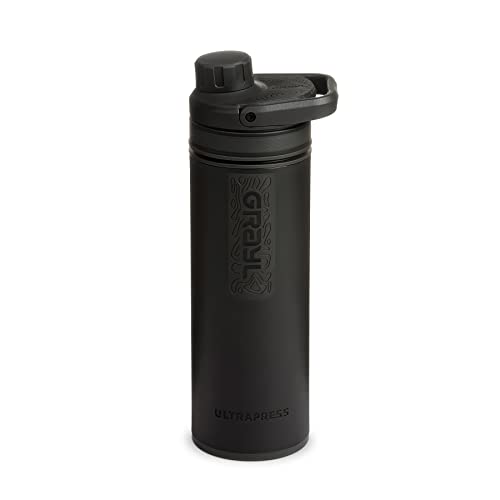
GRAYL UltraPress 16.9 oz Purifier BottleBest for viruses
|
Press purifier bottle | Viruses, bacteria, protozoa | Yes (99.9%, per GRAYL) | View on Amazon |

LifeStraw Home Dispenser, 18-CupBest for a household
|
Gravity-fed dispenser | Bacteria, parasites, lead | Not claimed | View on Amazon |

Survivor Filter Americana 1-Liter Filter BottleBest USA-made bottle
|
Filter bottle | Bacteria, cysts; reduces lead, chlorine, VOCs | Not claimed | View on Amazon |
Product images from Amazon. Removal claims are as each maker or listing states them; none of these filters is a substitute for following a local boil-water notice.
Filter or purifier: what the CDC, EPA and FEMA say
The CDC’s emergency water page is blunt: portable water filters “will not remove viruses.” To remove parasites a filter needs an absolute pore size of 1 micron or smaller, and to remove bacteria 0.3 micron or smaller. Its advice for filtered water is to then add a chemical disinfectant such as chlorine, iodine or chlorine dioxide, which “will kill any viruses and bacteria.”
The EPA’s emergency disinfection guidance says to bring water to a rolling boil for at least one minute (three minutes at high altitude), or to use unscented household bleach at the dose on its page. It adds the part most people miss: boiling or disinfection “will not destroy other contaminants, such as heavy metals, salts, and most other chemicals.” FEMA’s Ready.gov asks households to store at least one gallon of water per person per day for several days, and calls boiling the safest way to treat water.
So for an emergency kit, think in layers: stored water first, a filter for bacteria and parasites, and boiling or bleach for viruses. A “purifier”, in maker language, is a device that claims viruses as well. Two of our picks are purifiers; the rest are filters.
Our picks for the best emergency water filter
Our countertop water filter guide covers filters for treated tap water at home. None of its picks carry claims against bacteria or parasites, so this page uses an entirely different set of products, all from established outdoor and water-treatment makers.
1. Sawyer Squeeze Filter System – Squeeze, Inline or Gravity
The Sawyer Squeeze (SP129) is the filter many preparedness lists start with, and the kit explains why. You get the filter, two 32-ounce collapsible pouches, a drinking straw and hydration-pack adapters. Fill a pouch and squeeze it through the filter into a pot, drink straight through it, thread it onto a standard bottle, or set it up as a gravity filter.
Sawyer says its 0.1-micron absolute hollow-fiber membrane removes 99.99999% of bacteria such as salmonella, cholera and E. coli and 99.9999% of protozoa such as giardia and cryptosporidium, plus microplastics. It cites an independent test report on its product page and says every unit is tested three times. Sawyer does not claim it removes viruses or chemicals, which matches the CDC’s general rule for filters.
The pouches and filter roll up small enough for a kitchen drawer or a go-bag. Sawyer includes a cleaning plunger with its filters and backs the filter with a lifetime limited warranty against defects.
Why we like it
- 0.1-micron absolute membrane (Sawyer)
- Works by squeeze, straw, bottle or gravity
- Two 32-ounce pouches included
- Lifetime limited warranty on the filter (listing)
Key specifications
| Model | Sawyer SP129 |
|---|---|
| Type | Squeeze / inline filter |
| Maker says it removes | Bacteria, protozoa, microplastics |
| Viruses | Not claimed |
| Pore size | 0.1 micron absolute |
| Rated capacity | Not stated |
| Weight | Filter 2 to 3 oz (listing and Sawyer) |
| Warranty | Lifetime limited, filter defects |
Why we recommend it
It suits a household that wants one versatile filter for outages and camping, with bleach or boiling kept as the virus step.
Skip it if you need virus protection from the filter itself.
Pros and cons
Pros
- Very small and light
- Several ways to use it
- Field-cleanable with the plunger
Cons
- No virus claim
- No chemical reduction claim
- Squeezing pouches is slow for large volumes
2. LifeStraw Go Series Filter Bottle, 22 oz, 2-Pack – A Bottle for Every Bag
The LifeStraw Go is a BPA-free bottle with the filter built in: fill it, close it and drink through it, with nothing to assemble. That simplicity is the point in a go-bag or a car kit, and this set gives you two. LifeStraw says it protects against 99.999999% of bacteria, including E. coli and salmonella, and 99.999% of parasites, including giardia and cryptosporidium.
LifeStraw also says it removes 99.999% of microplastics, as well as sand, dirt and cloudiness, and that an activated carbon capsule reduces chlorine, odors and organic chemical matter. It does not claim viruses.
LifeStraw rates the membrane for up to 1,000 gallons (4,000 liters) and the carbon capsule for up to 26 gallons (100 liters), about two months. The listing describes it as a bottle to drink from, not a way to fill a pot, and each one holds only 22 ounces. For that reason it works best as a backup to a filter like the Sawyer.
Why we like it
- Nothing to assemble
- 1,000-gallon membrane rating (LifeStraw)
- Bacteria and parasite claims stated by the maker
- Two bottles in the set
Key specifications
| Model | LifeStraw Go Series, LGV42PBA41 (Icelandic Blue/Aegean Sea) |
|---|---|
| Type | Filter bottle, 22 oz |
| Maker says it removes | Bacteria, parasites, microplastics |
| Viruses | Not claimed |
| Pore size | Not stated |
| Rated capacity | 1,000 gal membrane; 26 gal carbon capsule |
| Weight | Not stated |
| Warranty | Manufacturer warranty; term not stated |
Why we recommend it
It suits anyone building go-bags for two family members, or for a home and a car.
Skip it if it would be your only filter; it is made for drinking, not for filling a pot.
Pros and cons
Pros
- Simple to use
- Carbon stage improves taste, per LifeStraw
- Two bottles to split between bags
Cons
- Drink-through only
- No virus claim
- Carbon capsule needs replacing about every two months
3. GRAYL UltraPress 16.9 oz Purifier Bottle – Viruses Included
The GRAYL UltraPress is a purifier, not just a filter. GRAYL says it removes 99.9% of viruses, including rotavirus, norovirus and hepatitis A, along with 99.9999% of bacteria and 99.9% of protozoan cysts such as giardia and cryptosporidium. That makes it the pick here when the water source might carry viruses, though local boil-water notices still come first.
It works like a French press: fill the outer cup, press the inner bottle down on a low surface, and drink. GRAYL says that takes as little as 10 seconds for 16.9 ounces, with no pump, hose, batteries or chemicals. The listing carries a ten-year warranty on workmanship and materials from authorized retailers.
GRAYL also says the cartridge adsorbs chemicals, heavy metals, PFAS and flavors, but we would not treat fuel or industrial contamination as solved by any device here. It treats one bottle at a time, and this listing does not state how many gallons a cartridge lasts; buy it when viruses are the specific worry.
Why we like it
- 99.9% virus claim (GRAYL)
- A bottle in as little as 10 seconds, per GRAYL
- No pump, hose or batteries
- Ten-year warranty on the listing
Key specifications
| Model | GRAYL UltraPress, 500-COV |
|---|---|
| Type | Press purifier bottle |
| Maker says it removes | Viruses, bacteria, protozoa, particulates |
| Viruses | Yes, 99.9% (GRAYL) |
| Pore size | Not stated |
| Rated capacity | Not stated on this listing |
| Weight | Not stated |
| Warranty | 10-year, workmanship and materials |
Why we recommend it
It suits a household that wants the filter itself to handle viruses, not just bacteria and parasites.
Skip it if you need water for a group; 16.9 ounces at a time is slow going, and a gravity system does more with less effort.
Pros and cons
Pros
- Handles viruses, per GRAYL
- Fast per bottle
- Nothing to assemble
Cons
- Cartridge life not stated here
- Small 16.9-ounce batch
- Pressing takes effort
4. Survivor Filter Americana 1-Liter Filter Bottle – Stated Reductions, Made in the USA
The Survivor Filter Americana is a light filter bottle: it holds 33.8 ounces, about one liter, and weighs 3.9 ounces, according to the listing. Survivor Filter says it is made in the USA and independently tested to reduce 99.9% of bacteria and more than 99.99% of cysts, and to improve taste by reducing lead, chlorine and VOCs.
Be careful with what that leaves out. The listing does not claim viruses, so treat this as a filter and disinfect afterward as the CDC advises. It also says it is for fresh water only, not salt water or seawater. Survivor Filter’s test claims are its own; we did not find a certification listing.
The rating is the main limit. The listing gives up to 25 gallons of untreated water, or 100 gallons of municipal tap water, or about six months of regular use, and one filter is included. That makes it a go-bag bottle for one person, not a household’s main supply. The flow is up to 60 ounces a minute, and the listing gives a lifetime replacement warranty.
Why we like it
- Stated bacteria and cyst reductions (maker)
- Also reduces lead, chlorine and VOCs (maker)
- 3.9 ounces, per the listing
- Lifetime warranty (listing)
Key specifications
| Model | Survivor Filter Americana A100 |
|---|---|
| Type | Filter bottle |
| Maker says it removes | 99.9% of bacteria, over 99.99% of cysts; reduces lead, chlorine, VOCs |
| Viruses | Not claimed |
| Pore size | Not stated |
| Rated capacity | 25 gal untreated; 100 gal tap water |
| Weight | 3.9 oz |
| Warranty | Lifetime replacement (listing) |
Why we recommend it
It suits a go-bag or a car kit where one person needs a light bottle that filters from a stream or an unfamiliar tap.
Skip it if viruses are the worry or you need water for a family; it makes no virus claim and is rated for 25 gallons of untreated water.
Pros and cons
Pros
- Clear stated reductions
- Very light for one liter
- Lifetime warranty stated
Cons
- No virus claim
- Low rating on untreated water
- Test claims are the maker’s own
5. LifeStraw Home Dispenser, 18-Cup – Gravity-Fed With No Pumping
For a family without power, a gravity-fed dispenser does the work while you do something else. LifeStraw Home sits on a counter or a fridge shelf: fill the top, let the water drip through, and draw from a one-hand tap. It holds 18 cups, a little over a gallon, and needs no plug.
The listing says the membrane removes bacteria and parasites along with microplastics, and that the filters also reduce lead, mercury, PFAS, chlorine, pesticides and herbicides. There is no virus claim, so plan to disinfect after filtering when viruses are a concern. It also does not say the dispenser is rated for floodwater, so read the CDC, EPA and FEMA section above before you rely on it for that.
LifeStraw rates the membrane for 264 gallons, about a year, and the carbon and ion-exchange filter for only 40 gallons, about two months, so keep a spare in a home kit. This is a countertop item, not one to carry: it belongs in the house with your other supplies.
Why we like it
- Fills and filters with no pump or power
- Membrane rated for 264 gallons (LifeStraw)
- One-hand tap
- Lists lead and PFAS reduction as well (LifeStraw)
Key specifications
| Model | LifeStraw Home 18-cup (LSH18DPB41) |
|---|---|
| Type | Gravity-fed countertop dispenser |
| Maker says it removes | Bacteria, parasites, microplastics; reduces lead, mercury, PFAS |
| Viruses | Not claimed |
| Pore size | Not stated |
| Rated capacity | 264 gal membrane; 40 gal carbon filter |
| Weight | Not stated |
| Warranty | Term not stated |
Why we recommend it
It suits a family at home that needs several liters at a time during an outage, with little effort.
Skip it if you need something for a go-bag or a trip; it is a countertop dispenser.
Pros and cons
Pros
- Hands-free filtering
- Holds more than a gallon
- Nothing to hang
Cons
- No virus claim
- Second filter lasts about two months
- Not made to travel
6. MSR MiniWorks EX Ceramic Pump – A Pump Held to an NSF Protocol

The MSR MiniWorks EX is a hand pump with a replaceable filter. The listing describes a carbon and ceramic element that removes bacteria, protozoa, organic compounds and particulate and delivers taste- and odor-free water, and it says one cartridge treats up to 2,000 liters. A storage bag is included, and when the cartridge is used up you replace it rather than the pump.
The listing says it meets NSF protocol P231 for removal of bacteria (99.9999%) and protozoa (99.9%). Retailers give the element a 0.2-micron pore size, which is below the CDC’s 1-micron line for parasites and 0.3-micron line for bacteria, but the CDC says filters do not remove viruses, so treat the output with bleach or boiling when viruses are a concern.
It pumps about a liter a minute, weighs about a pound and measures 7.5 by 2.75 inches, per the listing, and it fits a variety of wide-mouth bottles and hydration bladders, sold separately. That is heavy for backpacking but fine for a home emergency kit or a cabin. The listing says it is made in the USA. It gives both a three-year limited warranty and a limited lifetime warranty, so confirm the terms with MSR.
Why we like it
- NSF P231 bacteria and protozoa claims (listing)
- 2,000-liter replaceable cartridge (listing)
- Carbon and ceramic element for taste and odor
- Made in the USA, per the listing
Key specifications
| Model | MSR MiniWorks EX 14006 |
|---|---|
| Type | Ceramic and carbon hand pump filter |
| Maker says it removes | Bacteria, protozoa, organic compounds, particulate (listing) |
| Viruses | Not claimed |
| Pore size | 0.2 micron (retailers) |
| Rated capacity | 2,000 L per cartridge |
| Weight | About 1 lb |
| Warranty | 3-year limited and limited lifetime both listed |
Why we recommend it
It suits a household that wants a pump whose claims are tied to a named NSF protocol, with carbon for better-tasting water.
Skip it if weight matters; at about a pound it is far heavier than a straw or squeeze filter.
Pros and cons
Pros
- NSF P231 claim on the listing
- Replaceable cartridge
- Carbon for taste and odor
Cons
- Heavy
- Slow at about a liter a minute
- No virus claim
7. LifeStraw Peak Collapsible Squeeze Bottle, 1 Liter – Five Ways to Use One Filter

The LifeStraw Peak squeeze bottle pairs a 1-liter collapsible bottle with LifeStraw’s Peak microfilter. LifeStraw says you can drink from it as a bottle, squeeze water through it into a pot or other containers, use it as a straw, take the filter out and use the bottle for storage, or connect it to other Peak Series systems, which makes it a flexible step up from a plain filter bottle.
The listing says it protects against 99.999999% of bacteria, including E. coli and salmonella, 99.999% of parasites, including giardia and cryptosporidium, and 99.999% of microplastics, silt and sand. There is no virus or chemical claim. LifeStraw says the membrane was re-engineered for better flow with silty water, with a custom backwash accessory, and that the bottle uses thicker materials to be leak-proof.
The listing does not state a filter capacity or a weight, so check LifeStraw’s product page if those matter to your kit. At one liter a fill, it suits one person or a go-bag; for a whole family the LifeStraw Home holds more.
Why we like it
- Bottle, squeeze, straw or storage use (LifeStraw)
- Bacteria and parasite claims stated
- Backwash accessory included
- Collapsible 1-liter bottle
Key specifications
| Model | LifeStraw Peak LSPSF1MBWW |
|---|---|
| Type | Squeeze bottle filter |
| Maker says it removes | Bacteria, parasites, microplastics |
| Viruses | Not claimed |
| Pore size | Not stated |
| Rated capacity | Not stated in listing |
| Weight | Not stated |
| Warranty | Not stated |
Why we recommend it
It suits one person, or a go-bag, where you want a single filter that works as a bottle, a squeeze filter or a straw.
Skip it if you need a stated filter lifetime before you buy; the listing gives none.
Pros and cons
Pros
- Flexible setup
- Packs small
- Backwash kit included
Cons
- No virus claim
- Capacity and weight not stated
- One liter per fill

How to choose an emergency water filter
1. What it removes, in the maker’s own words
Read for three groups: bacteria, protozoa (parasites such as giardia and cryptosporidium) and viruses. Most filters here claim the first two. Only purifiers, like the GRAYL UltraPress, claim viruses. The LifeStraw Home lists reductions of lead, mercury and PFAS, but none claims to make chemically contaminated water safe.
2. Your plan for viruses
If your filter does not claim viruses, keep unscented bleach or a pot and a way to boil. The CDC’s filter-then-disinfect approach covers what a filter misses.
3. How many people, how many liters
FEMA’s guideline is a gallon per person per day. For a family, a gravity-fed system beats a straw. For each go-bag, a filter bottle or squeeze filter is enough.
4. Rated life and spare parts
Ratings differ widely: 25 gallons of untreated water for the Survivor Filter Americana, 40 gallons for a GRAYL UltraPress replacement cartridge, per its listing, and up to 2,000 liters, about 530 gallons, for the MSR MiniWorks cartridge. A short-life purifier is still useful, but buy a spare cartridge if it is your main plan.
5. Storage between emergencies
Follow each maker’s cleaning and storage instructions after every use, and keep each kit together in one bag so the hoses, pouches and adapters are there when the power goes out.

How we picked these seven filters
We did not test these filters. We read each Amazon listing through Amazon’s product data and the makers’ pages for Sawyer, MSR and GRAYL, and we report what each one removes only as its maker states it, separating viruses from bacteria and protozoa. We used the CDC, EPA and FEMA emergency water pages for the treatment advice. We checked that every pick was in stock on Amazon when we wrote this, and searched the Consumer Product Safety Commission’s site for water-filter recalls by these brands and found none. We chose established makers only and left out water purification tablets, which treat water but do not filter it. We make no health claims beyond what those agencies say.
Emergency water filter questions, answered
What is the best emergency water filter?
For most households, the Sawyer Squeeze, paired with bleach or boiling for viruses. If you want the filter itself to handle viruses, the GRAYL UltraPress.
Do emergency water filters remove viruses?
Most do not. The CDC says portable filters will not remove viruses; purifiers such as the GRAYL UltraPress claim they do. Otherwise disinfect after filtering.
Can a portable filter make floodwater safe?
Not on its own. Floodwater can carry fuel and chemicals, and the EPA notes that boiling and disinfection do not remove heavy metals, salts or most chemicals. Use stored water and follow local guidance.
How much water should I store?
Ready.gov advises at least one gallon per person per day for several days, for drinking and sanitation.
Is boiling better than filtering?
Ready.gov calls boiling the safest method of treating water, and the EPA says a rolling boil for a minute kills bacteria, viruses and protozoa. A filter adds clarity and works without fuel.
Our emergency water pick for a home kit
Buy the Sawyer Squeeze as the base of a home kit and keep bleach for viruses. Add a LifeStraw Go bottle to each go-bag, the LifeStraw Home if a whole family needs water at once, and the GRAYL UltraPress if you want the filter to handle viruses too. For everyday tap water once the emergency is over, see our countertop water filter picks. To boil water when the power is out, a camping gas stove works outdoors, and a good cooler keeps food and ice going.
Related guide: Best camping water filter.
When the lights are back on, see our menu, or call to order.