
A milk pitcher looks like nothing much, but it decides how the milk moves under the steam wand and how it leaves the spout. Size sets how much milk you can spin well. The shape of the spout decides whether your pour lands as a line or a blob.
The best milk frothing pitcher for you depends on how many drinks you make at once and whether you care about latte art. This guide covers seven stainless steel pitchers from 11.8 to 20 ounces, for use with a machine’s steam wand. If you do not have a wand, see our guide to the best milk frother first.
Julia’s earns a commission on purchases made through links on this page, at no cost to you. Recommendations are based on what a restaurant kitchen looks for, product specifications and verified buyer reports.
Quick verdict: which milk pitcher to buy
Buy the Rattleware 12 oz Latte Art Pitcher for small drinks. It is plain, well reviewed and has a good spout. Choose the Fellow Eddy if you want a sharper spout for fine lines, the Breville Temp Control Milk Jug if you keep overheating your milk, and the Espro Toroid if you struggle to get the milk rolling.
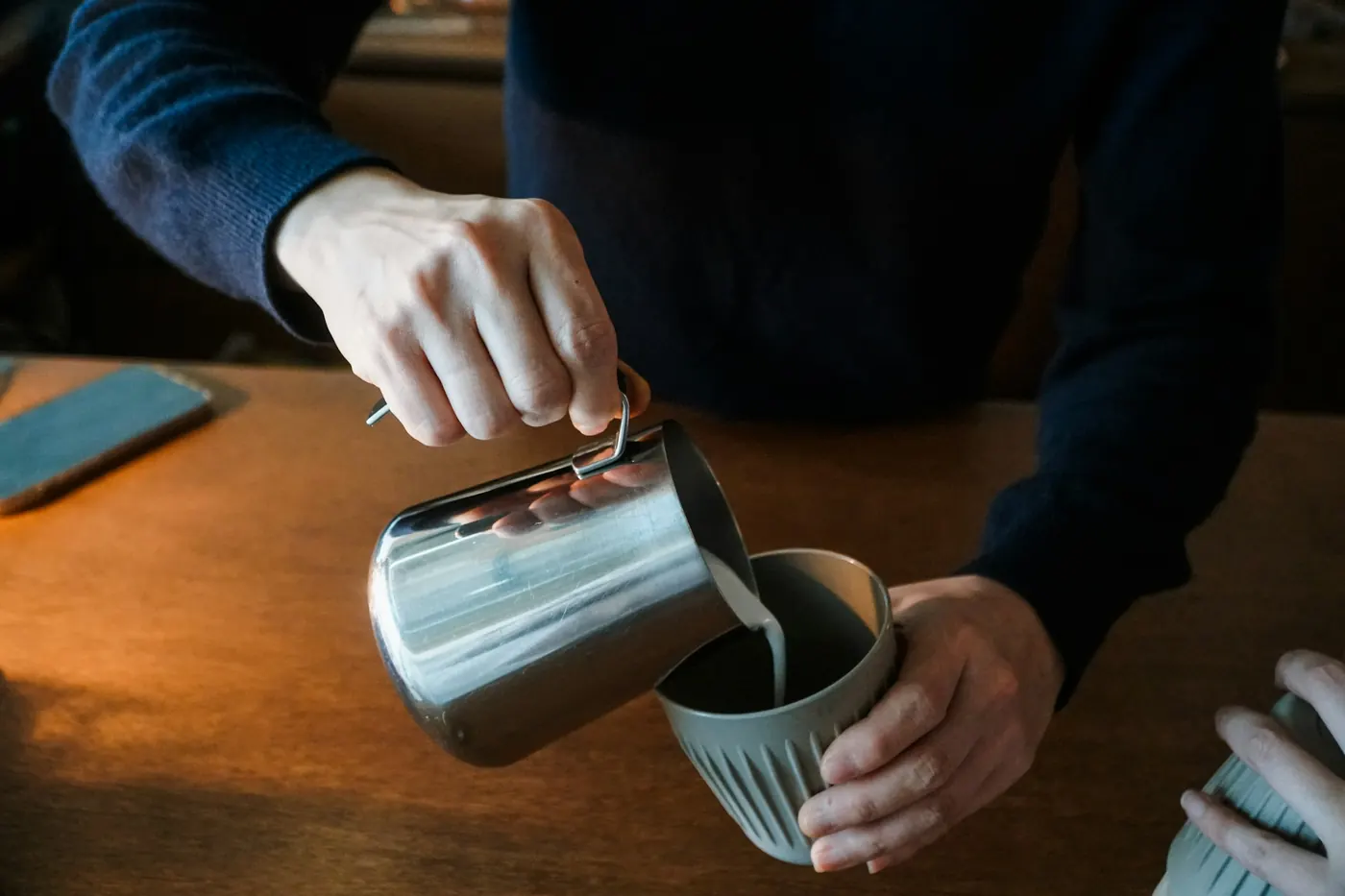
Five pitchers by what you pour
| Pitcher | Capacity | Spout | Best for | Buy on Amazon |
|---|---|---|---|---|
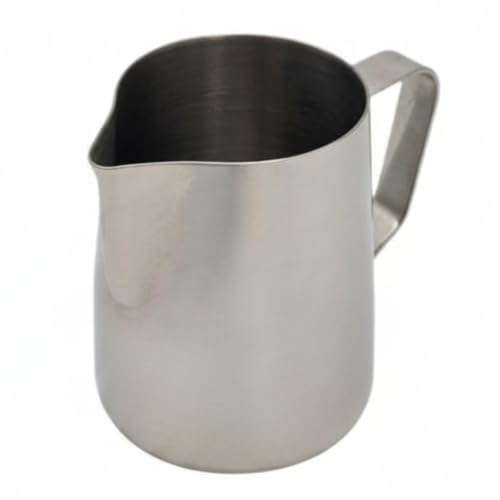
Rattleware 12 oz Latte Art PitcherBest overall
|
12 oz | Tapered | Everyday home use | View on Amazon |

Fellow Eddy 12 oz Steaming PitcherBest for latte art
|
12 oz | Fluted, sharp | Fine latte art | View on Amazon |

Breville Temp Control Milk Jug 16 ozBest temperature aid
|
16 oz | Latte art spout | Learning temperature | View on Amazon |

ESPRO Toroid 20 oz Frothing PitcherBest for easy texture
|
20 oz | Sharp | Beginners, two drinks | View on Amazon |

Motta Europa 11.8 oz Milk PitcherBest classic
|
11.8 oz | Deep, rounded | Tall pours | View on Amazon |
Our picks for the best milk frothing pitcher
1. Rattleware 12 oz Latte Art Pitcher – A Plain Pitcher That Pours Well
If you steam milk for one small drink at a time, this is where we would start. Rattleware designs for cafes and coffee bars, and the pitcher looks the part: plain stainless steel, a tapered spout and no features to learn. The listing gives its size as 4.17 by 3 by 3.8 inches, with a 12 ounce capacity for cappuccinos, macchiatos and practice pours.
Budget Barista named the Rattleware line its best pitcher for amateurs. It likes the value, the sturdy build and a spout with enough control for detailed rosettas. It also says the walls could be thicker, and that you can feel the thin steel when you knock the pitcher on the counter to clear bubbles.
The listing recommends hand washing and also calls it commercial dishwasher safe. Budget Barista notes there are no color options, which will bother nobody who just wants to practice pouring. The line also comes in 20 and 32 ounce sizes if you make bigger drinks.
Why we like it
- Tapered spout with good control, per Budget Barista
- Simple stainless construction
- Hand wash or commercial dishwasher
- Designed for cafe use
Key specifications
| Model | 07000 |
|---|---|
| Capacity | 12 oz |
| Material | Stainless steel |
| Spout | Tapered |
| Inside markings | Not stated |
| Handle | Not stated |
| Care | Hand wash recommended; commercial dishwasher safe |
| Warranty | Not stated |
Why we recommend it
It suits a home barista who wants a dependable pitcher for small drinks and would rather spend time practicing than comparing spouts.
Skip it if you want a heavier, thicker-walled pitcher, or you often steam for several drinks at once.
Pros and cons
Pros
- Named best for amateurs by Budget Barista
- Good spout control
- Right size for one small drink
Cons
- Walls could be thicker
- No color options
- Too small for large drinks
2. Fellow Eddy 12 oz Steaming Pitcher – A Sharp Spout for Fine Lines
Eddy is designed around the pour. Fellow gives it a fine fluted spout, a sharp crease down the front that moves milk toward that spout, and a tapered body that helps the milk spin. The ribbon handle is left open at one end so you can hold it however you pour.
Bustle compares the spout to the tip of a sharpened pencil and says it is made for crisp, clear lines. It also passes on a fair point from a reviewer: cheaper pitchers work fine if you only want steamed milk, and they are simply less comfortable and less precise. Fellow says the pitcher is 304, or 18/8, stainless steel and dishwasher safe.
The 12 ounce has markings inside up to 10 ounces, and Bustle says they are laser-etched so they will not fade. There is also an 18 ounce version and a graphite finish. We chose the polished steel listing. One Amazon data field on it shows a size of 33.8 ounces, but its title and model both say 12 ounces, or 350 ml.
Why we like it
- Fine fluted spout for detail
- Open ribbon handle fits many grips
- Etched measures inside
- Dishwasher safe, per Fellow
Key specifications
| Model | 1186PL12 |
|---|---|
| Capacity | 12 oz |
| Material | 18/8 (304) stainless steel |
| Spout | Fluted, sharp |
| Inside markings | Yes, up to 10 oz |
| Handle | Open-ended ribbon |
| Care | Dishwasher safe |
| Warranty | Not stated on the listing |
Why we recommend it
It suits someone who already makes reasonable microfoam and wants finer lines in hearts, tulips and rosettas.
Skip it if you only want hot milk, since a plainer pitcher will do that job.
Pros and cons
Pros
- Sharp spout for clean lines
- Comfortable open handle
- Markings inside
Cons
- The precision is wasted on plain steamed milk
- 12 oz is small for big batches
- No warranty stated on the listing
3. Breville Temp Control Milk Jug 16 oz – A Thermometer Strip on the Jug
The hardest habit to build in milk steaming is knowing when to stop. Breville’s jug helps with a built-in thermometer strip, so you do not need a clip-on thermometer. The steel is a thick gauge, the capacity is 16 ounces, and the spout is shaped for pouring latte art.
Buyers disagree on how well the strip reads. An owner on a Canadian forum says the reading trails the milk by 5 to 10 seconds, and that it faded and became useless after about a year. Other buyers on Australian sites say it matched a separate thermometer. Best Buy reviewers complain that the indicator is faint, and a reviewer on Breville’s site says it is hard to see when the jug is upright. These are single owners, not measurements, but they point the same way: use it as a rough guide and stop a little early.
The listing gives the strip’s range as 130 to 170 degrees Fahrenheit and 55 to 65 degrees Celsius. Those two ranges do not match at the top end, which is another reason to treat the strip as a guide.
Why we like it
- Thermometer strip built into the jug
- Thick gauge stainless steel
- Spout shaped for latte art
- 16 oz capacity
Key specifications
| Model | BES003XL |
|---|---|
| Capacity | 16 oz |
| Material | Thick gauge stainless steel |
| Spout | Shaped for latte art |
| Inside markings | Temperature strip |
| Handle | Comfort handle |
| Care | Not stated |
| Warranty | Not stated on the listing |
Why we recommend it
It suits a beginner who keeps overheating milk and wants a simple cue without another gadget.
Skip it if you want an exact reading, because owners report lag, and one reports fading.
Pros and cons
Pros
- No separate thermometer needed
- Thick steel
- Useful size between our small and large picks
Cons
- Strip may lag behind the milk
- One owner reports fading after a year
- Strip can be hard to read
4. ESPRO Toroid 20 oz Frothing Pitcher – A Shape That Rolls the Milk
Most pitchers ask you to find the right steam wand angle to get the milk spinning. Espro changed the pitcher instead. According to the listing, you point the wand straight down, and the patented shape circulates milk back to it. The spout is sharp, the fill lines are embossed, and the listing says a pitcher this size is for one large latte or two drinks.
Whole Latte Love, a coffee retailer that sells this pitcher, compared the Toroid with a Rattleware. It saw a more even swirl and milk that seemed a little finer in the Espro, though it stopped short of calling the milk art-ready. In a follow-up it asked whether the extra cost is justified and answered with a maybe. The shape helps, and it will not replace practice.
Whole Latte Love’s review is of the Toroid 2, while this listing is titled Toroid, so details may differ. One buyer report on a smaller Toroid2 mentions a rough, flaking seam near the bottom. That is a single account, but inspect yours when it arrives and clean that area well.
Why we like it
- Works with the wand pointing straight down
- Shape circulates milk back to the wand
- Sharp spout
- Embossed fill lines
Key specifications
| Model | 2020 |
|---|---|
| Capacity | 20 oz |
| Material | Stainless steel |
| Spout | Sharp |
| Inside markings | Embossed fill lines |
| Handle | Ergonomic |
| Care | Not stated |
| Warranty | Not stated |
Why we recommend it
It suits a beginner who struggles to find the right wand angle, and anyone making two drinks at a time.
Skip it if you already get a good roll in a plain pitcher, since the shape then adds little.
Pros and cons
Pros
- Simple wand position
- More even swirl in one comparison
- Good size for two drinks
Cons
- Benefit described as modest in that comparison
- One buyer report of a rough seam
- Review covers the Toroid 2
5. Motta Europa 11.8 oz Milk Pitcher – An Italian Pitcher for Tall Pours
Motta is an Italian maker of barista tools, and Budget Barista calls the Europa a high-quality classic. The listing says it was developed with the Italian barista association. It is made of 18/10 stainless steel, has a heat-resistant handle and is dishwasher safe, with a 1 year warranty on the listing.
Budget Barista names it the best pitcher for experienced hands. The spout is deep and long with a rounded edge, and that length helps when pouring into tall glasses. It is less sharp than the Rattleware, so art may lose a little definition, and the narrow body makes it harder to recombine separated milk and foam.
Bustle reviewed the 17 ounce size and liked the shine and substantial feel. It says the spout is more tapered than a classic spout and that the sharper body angle makes good microfoam. It also points out the lack of markings inside, so you will need to learn your fill level by eye. We chose the 11.8 ounce size because it is plainly in stock and suits a single cappuccino.
Why we like it
- 18/10 stainless steel
- Heat-resistant handle
- Deep, long spout for tall glasses
- Dishwasher safe, per the listing
Key specifications
| Model | 00901/03 |
|---|---|
| Capacity | 11.8 oz |
| Material | 18/10 stainless steel |
| Spout | Deep, long, rounded |
| Inside markings | None, per Bustle (17 oz) |
| Handle | Heat resistant |
| Care | Dishwasher safe |
| Warranty | 1 year, per the listing |
Why we recommend it
It suits someone with a settled technique who likes a substantial Italian pitcher and pours into tall glasses as often as cups.
Skip it if you want fine detail in your art, or you rely on markings to set your milk level.
Pros and cons
Pros
- Long spout suits tall glasses
- Named best for experienced hands
- Warranty on the listing
Cons
- Spout gives less definition than the Rattleware
- No inside markings
- Narrow body makes remixing harder
6. Barista Hustle 20 oz Milk Pitcher – Spout and Handle in Line
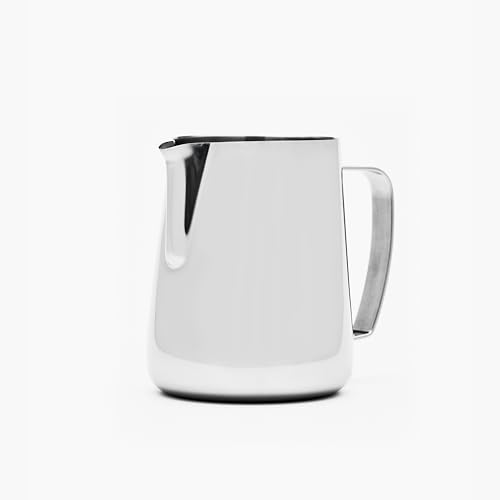
Barista Hustle built this pitcher around one idea: the handle should sit exactly opposite the spout. Sprudge reported at launch that most pitchers are off-center and blamed that for poor pour symmetry. The listing promises guaranteed alignment.
The handle is laser-welded and flush, and Sprudge says that design leaves no crevices for milk to collect in. It also reported a lifetime guarantee, with the handle replaced free if it ever broke. That report dates from the launch, so confirm the terms when you buy. The listing says polished 304 stainless steel with internal 50 ml and 100 ml markings.
Prima Coffee, a retailer, said in its overview that the spout and handle line up reliably and that the pour feels much like other good steel pitchers. That is the honest expectation. You are buying accuracy of build, and the benefit shows up mainly when you pour symmetrical designs.
At 600 ml, or about 20 ounces, it suits two drinks more than one.
Why we like it
- Guaranteed spout and handle alignment
- Laser-welded flush handle
- Markings in 50 and 100 ml steps
- Polished 304 stainless steel
Key specifications
| Model | P2PS600 |
|---|---|
| Capacity | 20 oz (600 ml) |
| Material | 304 stainless steel |
| Spout | Precision |
| Inside markings | 50 and 100 ml |
| Handle | Laser-welded, flush |
| Care | Not stated |
| Warranty | Sprudge reports a lifetime handle guarantee |
Why we recommend it
It suits a keen home barista who pours symmetrical latte art and cares about small differences in build.
Skip it if you are still learning to steam, because a plain pitcher teaches you just as well.
Pros and cons
Pros
- No crevices at the handle
- Accurate build for symmetry
- Clear markings
Cons
- Benefit is subtle at home
- Large for a single drink
- Guarantee reported at launch only
7. De’Longhi 12 oz Milk Frothing Jug – A Simple Match for De’Longhi
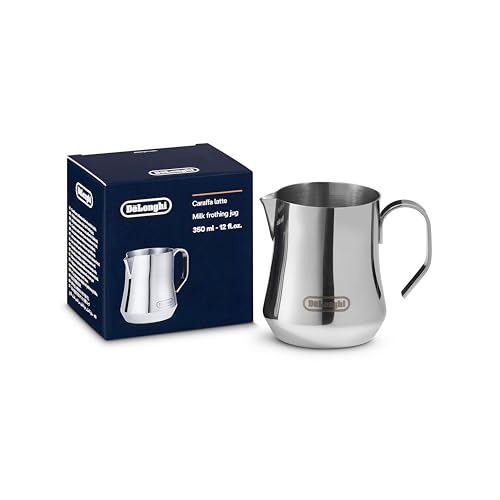
De’Longhi’s own jug is the plainest pick here. It is stainless steel, holds 350 ml, or about 12 ounces, and has a pour spout. The listing says it works with all De’Longhi pump espresso machines and makes no claims about latte art.
That size suits a single cappuccino. A small jug also tends to leave more room under the steam wand on a compact machine, though De’Longhi gives no dimensions on the listing, so measure the gap if space is tight.
This pick rests on De’Longhi’s listing details, since we have no dedicated review to cite. The listing does not mention markings, spout shape or care. We included it for people who want the machine maker’s own part, and who want milk in their coffee more than art on top of it.
If you do want to learn latte art, take the Rattleware instead.
Why we like it
- 350 ml capacity for one drink
- Stainless steel
- Compatible with De’Longhi pump machines, per the listing
- From the machine’s own maker
Key specifications
| Model | DLSC060 |
|---|---|
| Capacity | 12 oz (350 ml) |
| Material | Stainless steel |
| Spout | Pour spout |
| Inside markings | Not stated |
| Handle | Not stated |
| Care | Not stated |
| Warranty | Not stated |
Why we recommend it
It suits someone with a De’Longhi pump machine who wants a simple milk jug from the same maker.
Skip it if you want to pour latte art, because the listing does not describe a spout made for it.
Pros and cons
Pros
- Straightforward to use
- Right size for one drink
- From a major espresso machine maker
Cons
- Few details on the listing
- No latte art claims
- Rests on the listing
How to choose a milk pitcher for latte art
You do not need an expensive pitcher to pour well. You need one that fits your drinks and your machine. These points matter most, in rough order.
1. Size it to the drinks you make
Milk grows as you steam it, so a pitcher works best when it is only partly full. A 12 ounce pitcher is about right for one cappuccino or a small latte. A 20 ounce pitcher is better for two drinks or one large latte, and Espro says as much for its Toroid. If you buy just one, choose by what you make most mornings.
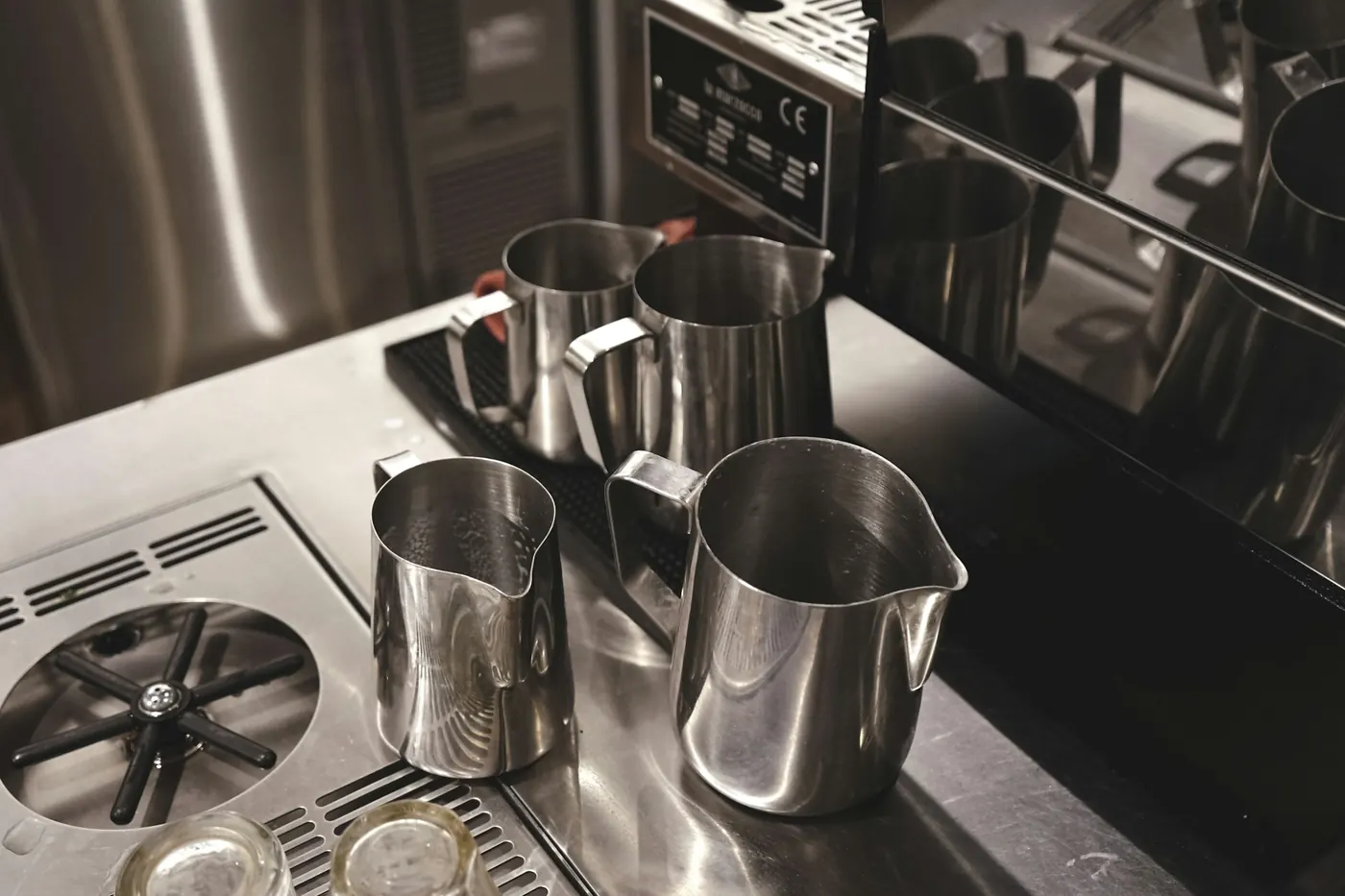
2. Check the spout
A sharper, narrower spout gives you finer lines, which suits rosettas and tulips. A rounder spout pours a broader stream. Budget Barista’s notes on the Rattleware and Motta show the trade-off well: the Rattleware’s taper gives more definition, while the Motta’s deep spout reaches into tall glasses.
3. Think about the body shape
Tapered bodies, such as the Fellow Eddy, are meant to help milk spin in one direction. The Espro goes further and shapes the pitcher to do that job. Narrow pitchers can make it harder to mix separated foam and milk back together, as Budget Barista notes of the Motta.

4. Decide if you want markings
Lines inside the pitcher help you use the same amount of milk each time, which cuts waste. The Fellow, Espro and Barista Hustle have them, while the Motta has none, according to Bustle. Many baristas learn the fill level by eye, so markings are helpful and not essential.
5. Keep the steel simple
All seven picks are stainless steel, and we looked for the grade on the listing or maker page where it was stated. Some pitchers come with non-stick finishes. We left those out, because this page keeps to plain steel. Rinse the pitcher right after you pour, because milk film is much harder to clean once it dries, especially around a seam or handle joint.

How we picked these seven pitchers
We read reviews from Budget Barista, Bustle and Sprudge, coverage from the retailers Whole Latte Love and Prima Coffee, and each maker’s listing and product page. For the Breville, we also read owner comments on forums and store pages. We note where the evidence is thin. The De’Longhi rests on its listing, and the Espro review covers a slightly different version.
We kept to makers that sell coffee gear under their own names, and left out the many near-identical pitchers from little-known Amazon brands. We chose only pitchers that were plainly in stock on Amazon when we wrote this, which ruled out Rhinowares for now. We also searched the saferproducts.gov recall database for each brand and found no recall of a milk pitcher. Our kitchen has not used these pitchers, so this is a guide to specifications and published reviews.
Milk pitcher questions, answered
What size milk pitcher is best for latte art?
Most home baristas do well with 12 ounces for one drink and 20 ounces for two. If you pour only one milk drink at a time, go for the smaller size. There is less milk to waste while you practice.
Can I use a frothing pitcher with a handheld frother?
Yes. A steel pitcher works with a handheld milk frother, though you will not get the same fine texture as with a steam wand. Heat the milk first, since a handheld wand does not warm it.
Should a milk pitcher have a handle?
Most do, and a handle keeps your hand clear of hot steel. Some baristas like handleless pitchers for the extra control. The Normcore handleless models we looked at have coated finishes, so we left them out.
Why not use a glass jug?
Steel lets you feel the heat with your hand, and it stands up to knocks on the counter. A glass pitcher for the table is a different job, and our guide to the best glass pitcher covers that.
How do I keep a pitcher clean?
Rinse it right after pouring, then wash it with hot soapy water. Fellow and Motta’s listing say theirs can go in a dishwasher, and Rattleware recommends hand washing but rates its pitcher for commercial dishwashers. Check the care notes for a jug with a thermometer strip.
Our last word on milk pitchers
Buy the Rattleware 12 oz if you want one honest pitcher to learn on. Pick the Fellow Eddy for finer art, the Breville for a built-in temperature cue, and the Espro if the wand angle gives you trouble. The Motta, Barista Hustle and De’Longhi each suit a narrower need.
Related guide: Best milk thermometer.
Related guide: Best gifts for home baristas.
A pitcher only helps if your machine makes real steam. See our guide to the best espresso machine, or the best milk frother steamer guide if you want hot foamed milk with no wand at all.