Every Mexican kitchen runs on bowls. Masa for tamales gets beaten in one, pico de gallo and guacamole get tossed in another, carne asada sits in lime and garlic in a third, and by the end of a busy prep the counter is lined with them. A good set of mixing bowls does all of that without sliding, staining or reacting with the lime.
The catch is that “mixing bowl” covers four quite different materials: glass, ceramic, plastic and stainless steel. Each is better at some jobs than others. This guide explains which material suits which job, then names the bowls and sets worth buying in each, from a lidded glass set for everyday prep to a 13-quart steel bowl for a tamalada.
Julia’s earns a commission on purchases made through links on this page, at no cost to you. Recommendations are based on what a restaurant kitchen looks for, product specifications and verified buyer reports.
Quick verdict: which mixing bowls to buy
For most kitchens, the best mixing bowls are a lidded glass set such as the Pyrex Ribbed 8-Piece Glass Mixing Bowl Set: four sizes up to 4.5 quarts, a lid for each, microwave and dishwasher safe, and glass will not react with lime or tomato. If you want light, unbreakable bowls for cold prep, get the OXO Good Grips 3-Piece Plastic Set. For tamale masa and party-size batches, add a big stainless bowl such as the American Metalcraft 13-quart.
Most households end up with two kinds: a glass or plastic set for everyday work and one big steel bowl for the days you cook for a crowd.
Five mixing bowls for five kinds of cook
Our five standout picks side by side, one for each kind of kitchen, with the sizes and materials each maker or listing states. All seven are reviewed in full below.
| Bowl or set | Best for | Material | Sizes | Buy on Amazon |
|---|---|---|---|---|
| Most kitchens: mix, microwave, store | Glass, plastic lids | 3 cup, 6 cup, 10 cup, 4.5 qt | View on Amazon | |

OXO Good Grips 3-Piece Plastic Mixing Bowl SetBest plastic set
|
Light bowls that stay put | Plastic | 1.5, 3 and 5 qt | View on Amazon |
| Doughs and masa that need a steady bowl | Earthenware | 6.35 qt (13 in wide) | View on Amazon | |
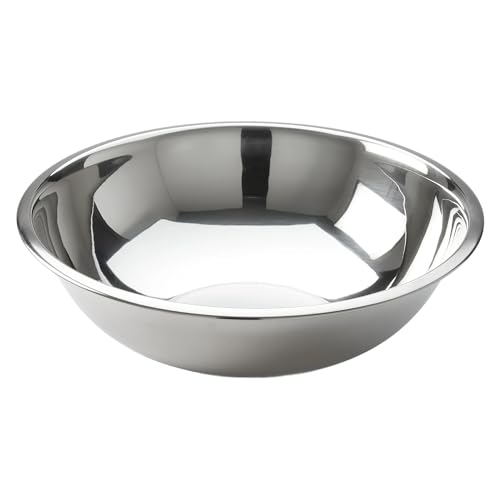
American Metalcraft 13-qt Stainless Steel Mixing BowlBest for big batches
|
Tamale masa, big salads, crowds | Stainless steel | 13 qt, 16 in wide | View on Amazon |
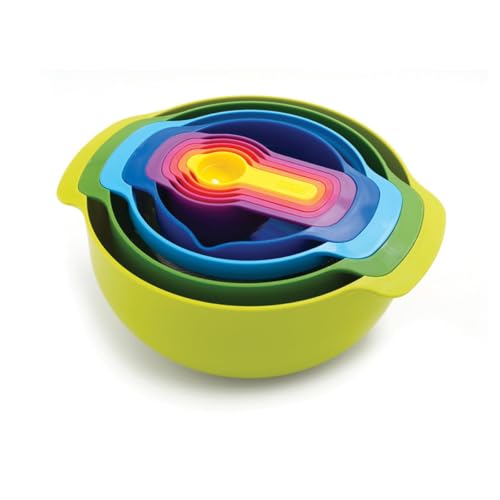
Joseph Joseph Nest 9 Plus Food Preparation SetBest for small kitchens
|
Small kitchens and first kitchens | Polypropylene; steel-mesh sieve | 4.8 qt and 0.5 qt bowls, plus colander, sieve, cups | View on Amazon |
Product images from Amazon. Sizes and materials are as stated by each maker or listing; check the listing before you buy.
Our picks for the best mixing bowls
These seven picks cover every common material: glass for mixing, microwaving and storing; plastic for light, unbreakable everyday prep; earthenware for heavy doughs; and stainless steel for big batches. We have kept stainless to one pick here because our separate guide to the best stainless steel mixing bowls covers steel sets in depth, and our guide to the best glass mixing bowls does the same for glass.
1. Pyrex Ribbed 8-Piece Glass Mixing Bowl Set with Lids – Four Sizes, Four Lids

If one set has to cover everything from a bowl of pico de gallo to a batch of cake batter, a lidded glass set is the safest place to start. This Pyrex set gives you four nesting bowls, 3 cups, 6 cups, 10 cups and 4.5 quarts, each with its own colored lid, according to the Amazon listing.
Glass suits a Mexican kitchen for a simple reason: lime. Pico de gallo, guacamole, ceviche and carne asada marinades are all acidic, and America’s Test Kitchen lists glass, with stainless steel, as nonreactive and safe with acidic ingredients. Glass also lets you see the bottom of the bowl, so you can tell when the onion and tomato are evenly dressed without digging in with a spoon.
The lids are the other half of the appeal. Toss salsa in the largest bowl, snap on the lid and it goes straight into the fridge; the listing rates the set for the microwave, fridge, freezer and dishwasher, and says the bowls are made in the USA. The ribbed sides are there for grip, Pyrex says.
The usual glass caveats apply. Pyrex’s own safety instructions say not to use its glassware on a stovetop or under a broiler, not to add liquid to hot glass, not to set hot glass on a wet or cold surface, and not to move it straight from the freezer to a hot oven. This listing does not state oven use at all, so treat these bowls as mixing, microwave and storage bowls.
Why we like it
- Four nesting sizes from 3 cups to 4.5 quarts
- A lid for every bowl, for fridge storage
- Microwave, fridge, freezer and dishwasher safe, per the listing
- Glass is nonreactive with lime and tomato, as ATK notes
- Made in the USA, according to the listing
Key specifications
| Set | Pyrex Ribbed mixing bowl set (model 120005) |
|---|---|
| Material | Glass bowls, plastic lids |
| Pieces & capacities | 8 pieces: 3-cup, 6-cup, 10-cup and 4.5-qt bowls |
| Lids | Yes, one per bowl (colors vary) |
| Non-slip base | Not stated |
| Microwave/oven-safe (stated) | Microwave, fridge and freezer safe; oven use not stated |
| Dishwasher-safe | Yes |
Why we recommend it
Choose it if you want one set that mixes, microwaves, stores and serves, and you do most of your prep in quantities up to about four quarts. It covers salsas, marinades, batters and leftovers, and the clear walls make it easy to judge a mix at a glance.
Skip it if you make big batches of tamale masa or cook for a crowd: 4.5 quarts is the ceiling here, and glass gets heavy as it gets bigger. ATK weighed a 4-quart Pyrex bowl at about 3 pounds 10 ounces.
Pros and cons
Pros
- Lids on all four bowls
- Nonreactive with acidic salsas
- Microwave and dishwasher safe
- Clear walls show the mix
Cons
- Heavy compared with plastic or steel
- Largest bowl is 4.5 quarts
- Oven use not stated on the listing
- Breaks if dropped
2. OXO Good Grips 3-Piece Plastic Mixing Bowl Set – Light, Grippy, Easy to Pour
Plastic bowls are the light, quiet, unbreakable end of the market, and OXO’s set is the one we would point most people to. You get 1.5-, 3- and 5-quart bowls with a wide grip and a spout on each, a non-slip base, and bowls that nest for storage, according to the listing.
Those features matter more than they sound. A non-slip base keeps the bowl still while you whisk eggs for a batter one-handed or work a dressing with a fork. The wide grip gives you something to hold when you tip a bowl of batter into a pan, and the spout puts it where you aim. The 5-quart bowl has room to toss a big salad or a bowl of shredded cabbage for tacos.
Plastic has trade-offs. America’s Test Kitchen did not test plastic bowls in its mixing bowl review; it says it avoids plastic for microwave and hot-food use and that plastic can hold onto oils and stains. In practice that means a bowl of guacamole or anything with chile oil may leave a tint. OXO’s listing does not say whether these bowls are microwave safe, so we would keep them for cold mixing and serving. The listing title states they are dishwasher safe.
Why we like it
- 1.5-, 3- and 5-quart sizes cover most jobs
- Non-slip base steadies the bowl while you whisk
- Wide grip and spout for pouring
- Nests for compact storage
- Dishwasher safe, per the listing
Key specifications
| Set | OXO Good Grips 3-Piece Plastic Mixing Bowl Set (model 11323200) |
|---|---|
| Material | Plastic |
| Pieces & capacities | 3 bowls: 1.5, 3 and 5 qt |
| Lids | No |
| Non-slip base | Yes |
| Microwave/oven-safe (stated) | Not stated |
| Dishwasher-safe | Yes |
Why we recommend it
Choose it for everyday cold prep, for a kitchen with children helping, or anywhere a dropped glass bowl would be a problem. It is the lightest way to get three useful sizes with grips, spouts and steady bases.
Skip it if you want a bowl for the microwave or for melting butter over a pot: the listing does not rate it for heat, and ATK steers away from plastic for hot food.
Pros and cons
Pros
- Light and shatterproof
- Non-slip bases
- Pour spouts on every bowl
- Three nesting sizes
Cons
- Microwave use not stated
- Plastic can hold stains and oils
- No lids
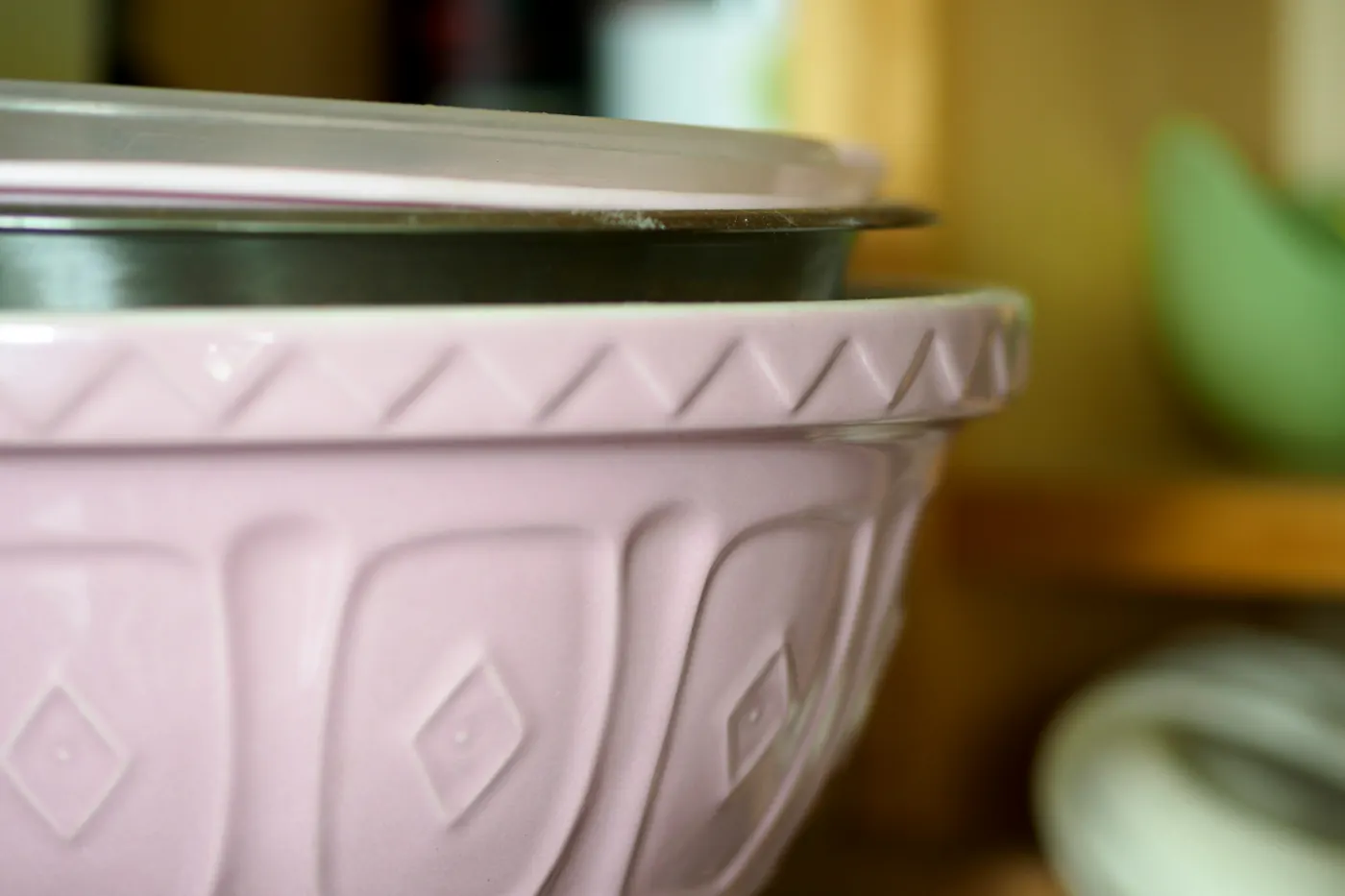
3. Mason Cash Cane Collection S6 Mixing Bowl, 6.35 qt – Heavy, Wide and Steady

The tan, cane-patterned Mason Cash bowl is a classic of English baking, and it earns its place here for one reason: weight. A heavy earthenware bowl sits still on the counter while you beat, knead or stir something stiff, without a rubber base to do the work.
This S6 size holds 6.35 quarts and measures 13 inches across by 6 inches high, according to the listing, which describes it as yelloware earthenware made in England. That is a broad, fairly shallow shape, and it suits jobs where you want room to work with your hands, such as rubbing fat into flour for flour tortillas or working broth into masa for a small batch of tamales.
The listing rates it for the microwave, oven, freezer and dishwasher. As with any glazed ceramic, avoid sudden temperature swings and knocks; a chip in a glazed bowl is the beginning of the end. In an email to a customer, quoted on a third-party blog, Mason Cash’s owner Rayware said its products meet European and UK standards for metal release but that it could not advise all of them to be entirely lead- and cadmium-free; we found no explicit lead-free statement from the maker. America’s Test Kitchen did not test ceramic bowls and notes they are usually heavy, expensive and offered in few sizes, which is a fair description of this one, though the weight is also the point.
Why we like it
- 6.35-quart capacity, 13 inches across
- Heavy earthenware stays put while you knead or beat
- Microwave, oven, freezer and dishwasher safe, per the listing
- Made in England
Key specifications
| Set | Mason Cash Cane Collection S6 (2001.002) |
|---|---|
| Material | Earthenware (yelloware) |
| Pieces & capacities | 1 bowl: 6.35 qt; 13 in diameter x 6 in high |
| Lids | No |
| Non-slip base | No rubber base; weight keeps it steady |
| Microwave/oven-safe (stated) | Microwave and oven safe (listing) |
| Dishwasher-safe | Yes |
Why we recommend it
Choose it if you bake bread, make flour tortillas from scratch or simply want a bowl that will not skate across the counter. It also doubles as a good-looking serving bowl for a big salad or a pot of rice on the table.
Skip it if you need a set of sizes or a bowl you can lift one-handed. It is a single heavy bowl, and earthenware can chip or crack if knocked or dropped.
Pros and cons
Pros
- Stays put under heavy mixing
- Wide shape for kneading
- Oven and microwave safe, per the listing
- Doubles as a serving bowl
Cons
- Heavy to lift
- Single bowl, not a set
- Can chip if knocked
- Weight not stated
4. American Metalcraft 13-qt Stainless Steel Mixing Bowl – Room for a Tamalada
Home mixing bowl sets tend to stop at five quarts. That is fine for a weeknight, and not nearly enough for a tamalada, when masa, lard and broth for several dozen tamales need to be beaten together, or for a party-size bowl of pico de gallo. This is a restaurant-supply bowl: 16 inches across and 13 quarts, according to the listing.
Stainless steel is the right material at this size. America’s Test Kitchen calls stainless bowls virtually indestructible, lightweight and affordable, and lists stainless steel as nonreactive and safe with acidic ingredients, so lime-heavy salsas and marinades are fine. A glass or ceramic bowl this big would be very heavy to lift when full.
The listing says the bowl is dishwasher safe and does not absorb odors or colors, though at 16 inches it will not fit many home dishwashers, so plan on washing it in the sink. Like all metal bowls it cannot go in the microwave, and there are no lids, a base or handles: it is a simple, wide steel bowl.
Why we like it
- 13-quart capacity, 16 inches across
- Stainless steel is nonreactive, per ATK
- Light for its size compared with glass or ceramic
- Dishwasher safe, per the listing
Key specifications
| Set | American Metalcraft SSB1300 |
|---|---|
| Material | Stainless steel |
| Pieces & capacities | 1 bowl: 13 qt, 16 in diameter |
| Lids | No |
| Non-slip base | No |
| Microwave/oven-safe (stated) | Not microwave safe (metal); oven not stated |
| Dishwasher-safe | Yes (listing) |
Why we recommend it
Choose it for tamales, party salsas, big green salads, brining or any time you cook for a crowd. It is the one bowl on this page that will hold a full batch of tamale masa with room to beat it.
Skip it if you are short of storage or rarely cook for more than four: a 16-inch bowl is awkward to store and too big for everyday prep.
Pros and cons
Pros
- Huge 13-quart capacity
- Nonreactive with acidic foods
- Unbreakable
- Light for its size
Cons
- No non-slip base
- Too big for many dishwashers
- Not for the microwave
5. KitchenAid Universal Nesting Plastic Mixing Bowls, Set of 3 – Spouts and Non-Slip Bases
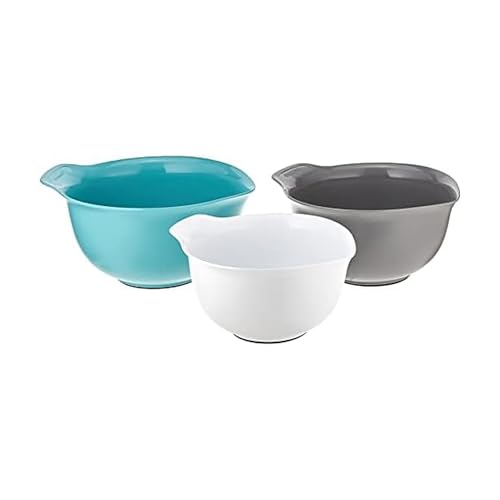
KitchenAid’s plastic set is a close alternative to the OXO, with slightly different sizes: 2.5, 3.5 and 4.5 quarts, according to the listing. Each bowl has a pour spout and a non-slip base, and the three nest together for storage.
The sizes skew a little smaller at the top and bigger at the bottom than OXO’s, which suits cooks who rarely need a five-quart bowl but often want a mid-size one. The 2.5-quart bowl is a good size for pancake batter or a bowl of crema thinned with lime; the 4.5-quart handles a salad or a double batch of guacamole.
The listing says the bowls are dishwasher safe and does not state whether they can go in the microwave, so, as with any plastic bowl, keep them for cold or room-temperature mixing. Expect strongly colored foods, such as adobo or a red chile sauce, to tint plastic over time.
Why we like it
- 2.5-, 3.5- and 4.5-quart sizes
- Pour spout on every bowl
- Non-slip bases for steady mixing
- Nests for storage; dishwasher safe, per the listing
Key specifications
| Set | KitchenAid Universal Nesting Plastic Mixing Bowls (KQ175OSA7A) |
|---|---|
| Material | Plastic |
| Pieces & capacities | 3 bowls: 2.5, 3.5 and 4.5 qt |
| Lids | No |
| Non-slip base | Yes |
| Microwave/oven-safe (stated) | Not stated |
| Dishwasher-safe | Yes |
Why we recommend it
Choose it if you pour as much as you mix: batters, dressings, aguas frescas being strained into a pitcher. The spouts and bases make it an easy everyday set.
Skip it if you need a bowl bigger than 4.5 quarts, or a bowl for the microwave, which the listing does not confirm.
Pros and cons
Pros
- Spouts on all three bowls
- Non-slip bases
- Light and shatterproof
- Nests compactly
Cons
- Microwave use not stated
- Largest bowl is 4.5 quarts
- No lids
6. Nordic Ware Prep and Serve Mixing Bowls Set, 3-Piece – Plastic You Can Warm

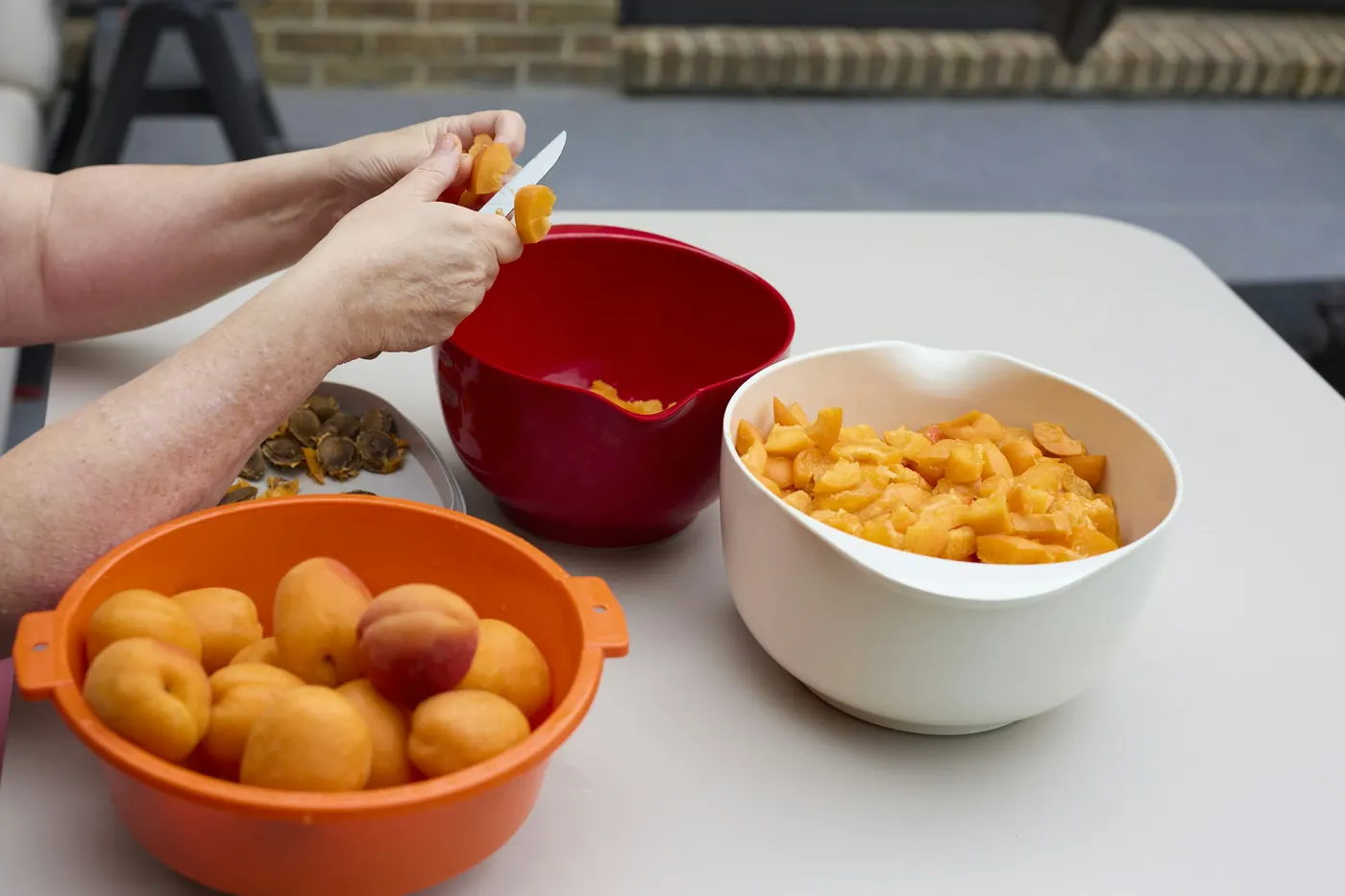
Most plastic bowls are sold for cold work only. Nordic Ware’s set stands out because the listing rates it for the microwave, so you can soften butter, warm a little broth for masa or melt chocolate in the same bowl you then mix in.
The set has three bowls: 2 quarts (8.3 inches across), 3.5 quarts (9.6 inches) and 5 quarts (10.8 inches), according to the listing. Nordic Ware describes them as heavy-duty, BPA- and melamine-free plastic with non-skid bottoms, and says they can be used for mixing, tossing, melting, heating, chilling and storing. The company describes itself as an American maker.
The listing does not say whether the bowls are dishwasher safe or come with lids, so we have listed both as not stated. Heat plastic gently and in short bursts, and stop when the food is warm rather than piping hot.
Why we like it
- Microwave safe, according to the listing
- Non-skid bottoms
- 2-, 3.5- and 5-quart sizes with stated diameters
- BPA- and melamine-free plastic, as Nordic Ware describes it
Key specifications
| Set | Nordic Ware Prep and Serve 3-Piece (69553) |
|---|---|
| Material | Plastic (BPA- and melamine-free, per Nordic Ware) |
| Pieces & capacities | 3 bowls: 2, 3.5 and 5 qt |
| Lids | Not stated |
| Non-slip base | Yes (non-skid bottoms) |
| Microwave/oven-safe (stated) | Microwave safe (listing); oven not stated |
| Dishwasher-safe | Not stated |
Why we recommend it
Choose it if you like light bowls but want to use one in the microwave, for example to warm broth or melt lard before mixing. It is the most versatile plastic set here.
Skip it if dishwasher use matters to you: the listing does not state it, so check with Nordic Ware before relying on the dishwasher.
Pros and cons
Pros
- Rated for the microwave
- Non-skid bottoms
- Light and shatterproof
- Three useful sizes
Cons
- Dishwasher use not stated
- No lids stated
- Plastic can stain
7. Joseph Joseph Nest 9 Plus Food Preparation Set – Nine Tools in One Stack
If cupboard space is the problem, this is the answer. Joseph Joseph’s Nest 9 Plus stacks nine pieces into one tower: a 4.8-quart (10.5-inch) mixing bowl, a 3.2-quart colander, a 1.75-quart steel-mesh sieve, a 0.5-quart small bowl with measurements, and four measuring cups plus a tablespoon, according to the listing.
For a small kitchen that covers a surprising amount of Mexican cooking: rinse beans or rice in the colander, strain an agua fresca or a blended salsa through the sieve, measure the masa harina and broth, and mix in the big bowl. The bowls have wide non-slip bases and easy-carry handles.
The listing says the pieces are BPA-free polypropylene and are not for use in the microwave. Everything except the steel sieve is dishwasher safe; the sieve should be washed by hand. The large bowl is the only true mixing bowl, so this is a starter kit rather than a full set of bowls.
Why we like it
- Nine pieces nest into one stack
- 4.8-quart mixing bowl plus colander, sieve and measuring cups
- Wide non-slip bases and handles
- Dishwasher safe except the sieve, per the listing
Key specifications
| Set | Joseph Joseph Nest 9 Plus (model 40087) |
|---|---|
| Material | Polypropylene; stainless steel mesh sieve |
| Pieces & capacities | 9 pieces: 4.8-qt bowl, 0.5-qt bowl, 3.2-qt colander, 1.75-qt sieve, 4 cups, 1 tbsp |
| Lids | No |
| Non-slip base | Yes (wide non-slip bases) |
| Microwave/oven-safe (stated) | Not for the microwave (listing) |
| Dishwasher-safe | Yes, except the sieve |
Why we recommend it
Choose it for an apartment, a first kitchen or a cook who wants bowls, colander, sieve and measuring cups in one footprint. It is a sensible gift for someone setting up a kitchen.
Skip it if you mostly need mixing bowls: you get only one large and one small bowl, and neither can go in the microwave.
Pros and cons
Pros
- Very compact storage
- Colander and sieve included
- Non-slip bases with handles
- Mostly dishwasher safe
Cons
- Only two mixing bowls
- Not microwave safe
- Sieve is hand wash only
How to choose mixing bowls for the way you cook
Material matters most, then size, then the small features that make a bowl pleasant to use. Here is how we would think it through for a kitchen that cooks Mexican food often.
1. Material: glass, ceramic, plastic or stainless steel
- Glass is nonreactive, microwave safe and transparent, which America’s Test Kitchen says helps when you want to watch a dough rise. It is heavier and more fragile than steel, and ATK could not find a glass bowl larger than 4.5 quarts. Follow the maker’s care rules: Pyrex says not to use its glass on the stovetop or under the broiler, not to add liquid to hot glass and not to set hot glass on a wet or cold surface.
- Ceramic and earthenware are heavy, which keeps the bowl still while you knead or beat. ATK did not test them and notes they are usually heavy, expensive and limited in sizes. They chip if knocked.
- Plastic and melamine are light, quiet and shatterproof. ATK avoids plastic for the microwave and hot food and notes it can hold onto oils and stains, so we treat plastic as a cold-prep material unless the maker rates a bowl for the microwave, as Nordic Ware does.
- Stainless steel is the workhorse. ATK calls it virtually indestructible, light and affordable, and lists it as nonreactive with acidic ingredients; the one thing it cannot do is go in the microwave.
2. Sizes you will actually use
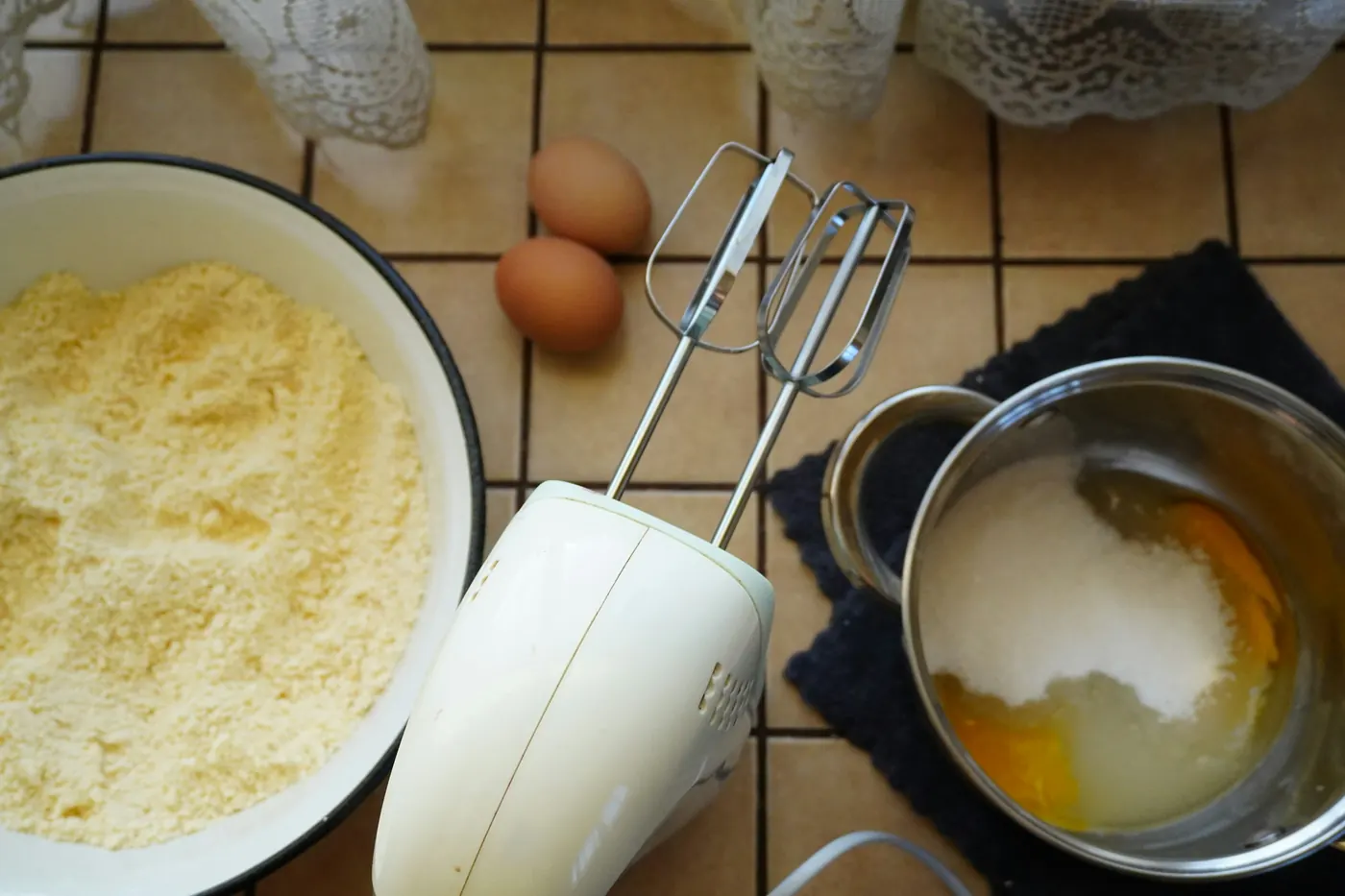
A 1- to 1.5-quart bowl handles eggs, a dressing or a cup of salsa. A 3-quart bowl is the everyday size for guacamole, a marinade or a batch of pancake batter. A 4- to 5-quart bowl takes a salad or a double batch of masa for a handful of tamales. Anything bigger, 8 quarts and up, is for parties and tamaladas, and in practice that means stainless steel.
3. A base that stays put
Whisking or beating is easier when the bowl does not spin. Plastic and steel sets often add a rubber or non-slip base, as the OXO, KitchenAid, Nordic Ware and Joseph Joseph picks do. Heavy glass and earthenware rely on their own weight. If you have a light bowl without a base, set it on a damp towel.
4. Lids, spouts and rims
Lids turn a mixing bowl into a storage container, which is the main reason to buy a lidded glass set. Spouts help when you pour batter or strain an agua fresca. A wide rim gives you a place to hold the bowl: in ATK’s review, only the Pyrex glass bowls had rims wide enough to grip comfortably among the glass sets it compared.
5. Care and storage
Check what can go in the dishwasher and microwave before you buy, and make sure the set nests. A 16-inch steel bowl or a 13-inch earthenware bowl will not fit every cupboard or dishwasher.
How we chose these seven bowls and sets
We started from the jobs a Mexican kitchen gives a mixing bowl: beating masa, tossing salsas and salads, marinating in lime, warming and melting, and storing leftovers. We then looked for bowls and sets from identifiable makers sold on Amazon in the United States and in stock when we checked, and took their materials, sizes and care ratings from the makers’ Amazon listings, which we note in each review. For how the materials behave we relied on America’s Test Kitchen’s mixing bowl review, and for glass safety on Pyrex’s published use-and-care instructions. We deliberately chose one pick per material and job rather than several near-identical sets, and left out listings from sellers with no identifiable brand. We have not used these products ourselves; where we describe how a material behaves, we say whose findings those are.
Mixing bowl questions, answered
What is the best type of mixing bowl?
There is no single best material, which is why most cooks own two. Glass is the best all-rounder for home kitchens because it is nonreactive, microwave safe and often comes with lids. Stainless steel is the best for heavy use and big batches. Plastic is the lightest and safest to drop, and earthenware is the steadiest for doughs.
What is the best brand of mixing bowls?
It depends on the material. Pyrex and Anchor Hocking are the long-standing names in glass, and America’s Test Kitchen named a Pyrex set its best glass bowls. Vollrath was ATK’s top stainless pick, OXO and KitchenAid make well-designed plastic sets, and Mason Cash is the classic name in earthenware.
What do America’s Test Kitchen and other reviewers recommend?
In its mixing bowl review, America’s Test Kitchen named Vollrath’s Economy stainless steel bowls best stainless and a Pyrex 8-piece set with lids best glass, and also recommended OXO and Cuisinart stainless sets. ATK did not test plastic or ceramic bowls. We have not quoted Wirecutter, Serious Eats or other reviewers here because we did not read their current reviews for this guide.
Are glass or stainless steel mixing bowls better?
Glass is better if you want to microwave, store with a lid or watch a mix through the side. Stainless steel is better if you want a light, unbreakable bowl or a really large one; ATK found no glass bowl larger than 4.5 quarts. Both are nonreactive, so either is fine for salsas and lime marinades.
Are there eco-friendly mixing bowls?
The longest-lasting bowls are the ones that will not wear out: stainless steel and glass both last for decades with reasonable care, and Anchor Hocking notes that its glass is recyclable. Buying one good set rather than replacing cheap plastic every few years is the simplest way to cut waste.
What size mixing bowls do I need?
A set of three, roughly 1.5, 3 and 5 quarts, covers almost every home recipe. Add one bowl of 8 quarts or more if you make tamales, cook for parties or toss big salads.
Our last word on mixing bowls
Start with a lidded glass set such as the Pyrex Ribbed 8-piece if you want one set that mixes, microwaves and stores, or the OXO plastic set if light, unbreakable bowls matter more. Add the American Metalcraft 13-quart steel bowl when you start making tamales by the dozen, and a heavy Mason Cash bowl if you bake or make flour tortillas from scratch.
Bowls are only part of a prep kit. Our guides to measuring cups, the dough whisk and silicone spatulas cover the tools that go in them, and if you would rather grind salsa than chop it, see the best molcajete. For the dish that needs the biggest bowl of all, read what tamales are and how they are made.
Baking bread? See our guide to the best mixing bowls for sourdough.
Want bowls that store leftovers too? See the best mixing bowl sets with lids.
And if you would rather leave the prep to us tonight, see the menu or call to order.