A good shot of espresso is only an ounce or two of coffee, so the cup matters more than you might expect. In a big mug it cools fast and the crema spreads out and disappears. In a small, warm cup it stays hot and concentrated down to the last sip.
Espresso cups come in two main materials, glass and porcelain, and each has its fans. This guide covers seven worth buying and what each maker actually says about its materials. We have not used these products ourselves, so we go by makers’ specifications and published guidance from coffee suppliers. These are cups for drinking from. If you want to measure a shot, see our guide to shot glasses for espresso.
Julia’s earns a commission on purchases made through links on this page, at no cost to you. Recommendations are based on what a working kitchen looks for in a small cup, the makers’ own specifications and published guidance, which we name.
Quick verdict: which espresso cup to buy
For most people, the best espresso cups are the De’Longhi Double Wall Thermal Glasses: the double wall keeps the outside comfortable, and 3 ounces is a good size for a double. If you prefer a handle and porcelain, buy the Villeroy & Boch Artesano Original. For single shots, the small Bodum Pavina is the one to get.
The rest of this page explains who each one suits and where each falls short.
Five espresso cups side by side
Five standouts, one for each kind of coffee drinker, with specifications from each maker’s listing. All seven cups are reviewed in full below.
| Cup | Best for | Material & size | Buy on Amazon |
|---|---|---|---|
| Most home espresso drinkers | Borosilicate glass, double wall, 3 oz | View on Amazon | |

Villeroy & Boch Artesano Original Espresso Cup, 3.25 ozBest porcelain
|
A traditional cup with a handle | White premium porcelain, 3.25 oz | View on Amazon |

Bodum Pavina Double Wall Glasses, 2.5 oz, Set of 2Best for single shots
|
Single shots and small pours | Borosilicate glass, double wall, 2.5 oz | View on Amazon |

Fellow Pirch Espresso Glasses, 3.5 oz, Set of 2Best single-wall glass
|
Macchiatos and latte art | Tinted soda lime glass, 3.5 oz | View on Amazon |

Libbey Endeavor Espresso Glass, 3.7 oz, Case of 12Best for a crowd
|
Offices and hosts who need many cups | Glass, 3.7 oz, 12 per case | View on Amazon |
Product images from Amazon. Materials and capacities are as stated by each maker; check the listing before you buy.
Our picks for the best espresso cups
These seven cover the main choices: double-wall glass, thick single-wall glass and plain white porcelain. They are listed in the order we would consider them.
1. De’Longhi Double Wall Thermal Glasses, 3 oz, Set of 2 – A Tulip Shape That Stays Cool Outside
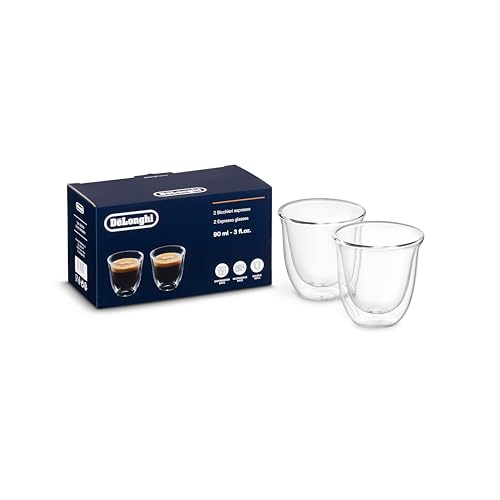
De’Longhi’s small thermal glasses are the cups we would point most people to. They are made for exactly this job, holding a shot or a short milk drink, and they come from a company that makes espresso machines. Each tulip-shaped glass holds 3 ounces, which leaves room for a double shot with a little space at the top.
The double wall is the main reason to buy them. An inner glass sits inside an outer one with a gap between, so you can hold the glass comfortably even when the shot is hot, and the listing says it keeps the drink hot. The clear walls also let you see the layers of a shot or a macchiato, which is half the fun of drinking from glass.
They are borosilicate, the heat-resistant glass, and De’Longhi says they are dishwasher safe. The listing does not mention microwave use, so we would leave them out of the microwave. There is no handle, and hand-made double-wall glass is more delicate than a thick porcelain cup, so take care around a hard sink.
Why we like it
- Double wall keeps the outside comfortable to hold
- 3 oz fits a double shot
- Borosilicate glass
- Dishwasher safe, per De’Longhi
Key specifications
| Model | DLSC310 |
|---|---|
| Material | Borosilicate glass |
| Capacity | 3 oz |
| Count | 2 |
| Walls | Double |
| Handle | None |
| Dishwasher and microwave | Dishwasher safe; microwave not stated |
| Made in | Not stated |
Why we recommend it
It suits most people who drink straight espresso or a small macchiato at home and want a cup that is pleasant to hold from the first sip.
Skip it if you want a handle and a saucer, or the cups will be handled by children or in a busy sink. The Villeroy & Boch porcelain is a better choice there.
Pros and cons
Pros
- Comfortable to hold when hot
- Good size for a double
- You can see the shot
Cons
- No handle
- Thin glass needs some care
- Microwave use not stated
2. Villeroy & Boch Artesano Original Espresso Cup, 3.25 oz – Classic White Porcelain
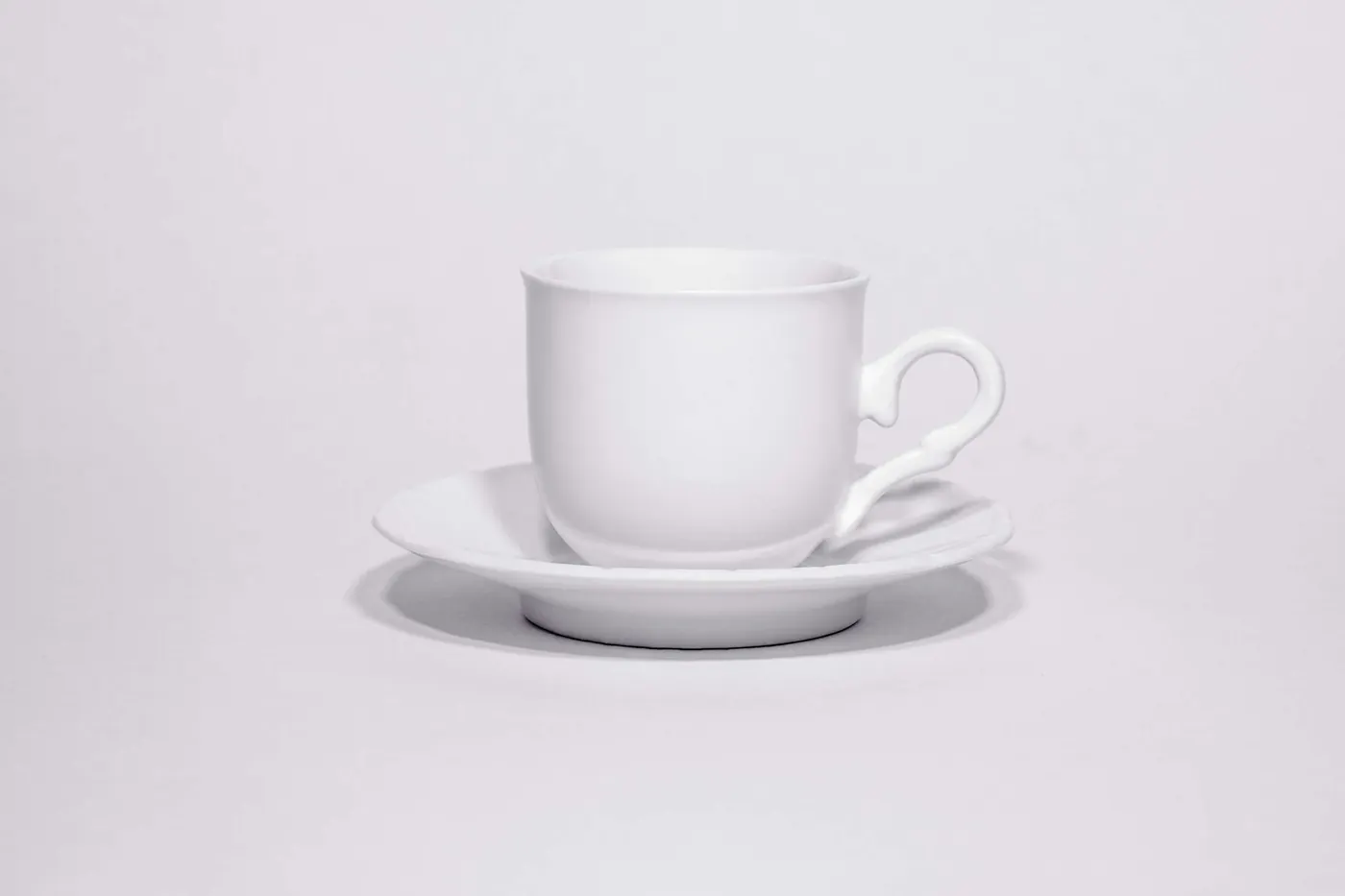
If you picture an espresso at an Italian bar, you picture a small white porcelain cup with a handle. This is that cup, made in Germany by Villeroy & Boch in its premium porcelain. At 3.25 ounces it holds a double, and the listing says it fits under coffee machines with a 6.3-inch clearance, so check your spouts.
Porcelain is what many coffee professionals prefer. Espresso Parts, a coffee equipment supplier, says it is denser and more durable than ordinary ceramic or stoneware. A thick porcelain cup also holds heat well once it is warm, so rinse it with hot water before you pull the shot.
On lead, Villeroy & Boch’s care FAQ says no lead, cadmium or other heavy metals are added to its glazes and porcelain compounds. The same FAQ notes that paints and decorative images can be a different matter, which is why this page keeps to plain white cups and leaves out the decorated patterns. The cup is sold singly, and the matching saucer is a separate purchase.
Why we like it
- Maker says no lead is added to its glazes and porcelain
- Made in Germany
- Dishwasher and microwave safe
- Holds a double shot
Key specifications
| Model | 1041301420 |
|---|---|
| Material | Premium porcelain |
| Capacity | 3.25 oz |
| Count | 1 |
| Walls | Single |
| Handle | Yes |
| Dishwasher and microwave | Both safe |
| Made in | Germany |
Why we recommend it
It suits anyone who wants the traditional look and feel, or who already owns Artesano dinnerware. The listing says the porcelain is durable enough for catering use, which is reassuring for daily use at home.
Skip it if you want a set in one purchase. This listing is a single cup with no saucer.
Pros and cons
Pros
- Traditional handle and shape
- Clear maker statement on glaze
- Dishwasher and microwave safe
Cons
- Sold singly
- Saucer not included
3. Bodum Pavina Double Wall Glasses, 2.5 oz, Set of 2 – A Small Glass for Single Shots
The 2.5-ounce Pavina is the smallest glass on this page, and small is a virtue for espresso. Espresso Parts points out that a cup that is too large lets coffee cool quickly and the crema spread out. A single or a modest double sits well in a glass this size.
The Pavina is mouth-blown from borosilicate glass in two layers, which Bodum says prevents condensation and creates an optical effect. Bodum states it is microwave and dishwasher safe, and it backs the set with a one-year limited warranty.
The size is also the limit. A large double with thick crema will come close to the rim, so anyone who pulls long shots should choose the De’Longhi or the Bodum Bistro in a larger size instead.
Why we like it
- Small size suits single shots
- Microwave and dishwasher safe, per Bodum
- Mouth-blown borosilicate glass
- One-year limited warranty
Key specifications
| Model | 4557-10US4 |
|---|---|
| Material | Borosilicate glass |
| Capacity | 2.5 oz |
| Count | 2 |
| Walls | Double |
| Handle | None |
| Dishwasher and microwave | Both safe |
| Made in | Not stated |
Why we recommend it
It suits someone who drinks a single or a short double and likes a glass that keeps the shot compact and hot.
Skip it if you pull large doubles or want room for milk. There is little space left above the shot.
Pros and cons
Pros
- Right size for a single
- Microwave safe
- Warranty stated
Cons
- Tight for a large double
- No handle
4. Fellow Pirch Espresso Glasses, 3.5 oz, Set of 2 – Weighted Glass With a Curved Interior
Fellow’s Pirch glasses take a different route from double-wall glass. This is one thick, weighted layer of tinted glass, with a thin lip and a curved interior. Fellow says the shape helps milk and foam blend, so a small macchiato or a tiny latte heart is easier to pour.
At 3.5 ounces there is room for a double plus a splash of milk. Fellow makes the glass from soda lime and says it holds warmth and is dishwasher and microwave safe. This set is the Smoke tint, and the same glass is sold in Amber and Woodland. Fellow notes that each glass is individually made, so small bubbles and slight differences in shape are normal.
Single-wall glass does not insulate like the double-wall picks. With one layer, expect the glass itself to get warmer in your hand, and tint means you see less of the shot’s layers.
Why we like it
- Thick, weighted feel
- Curved interior for milk and foam
- Dishwasher and microwave safe, per Fellow
- Comes in several tints
Key specifications
| Model | PMCS03 |
|---|---|
| Material | Tinted soda lime glass |
| Capacity | 3.5 oz |
| Count | 2 |
| Walls | Single |
| Handle | None |
| Dishwasher and microwave | Both safe |
| Made in | Not stated; designed in California |
Why we recommend it
It suits the home barista who makes macchiatos and small milk drinks and wants a solid glass rather than a delicate one.
Skip it if you drink straight shots and want the outside to stay cool. A double-wall glass is better at that.
Pros and cons
Pros
- Sturdy, weighted glass
- Room for a little milk
- Microwave safe
Cons
- Single wall gets warm in the hand
- Tint hides the layers
- Small variations between glasses
5. Luigi Bormioli Stackable Espresso Glasses, 3 oz, Set of 2 – Double Wall Glass That Stacks

Double-wall glasses are usually awkward to store, since they sit side by side and fill a shelf quickly. Luigi Bormioli, an Italian glassmaker, solves that here with a set that stacks. For a small kitchen or a coffee cart with limited space, that is a real difference.
In every other way this is a straightforward double-wall glass. It holds 3 ounces and is made from borosilicate glass that resists thermal shock. The maker says the double wall helps hold temperature and cuts condensation, so the outside stays comfortable. It is microwave and dishwasher safe.
This is a new listing, so our view rests on the listing and the maker’s details. The set has two glasses, so buy two sets if you serve guests.
Why we like it
- Stacks to save cabinet space
- Thermal shock-resistant borosilicate glass
- Microwave and dishwasher safe
- From an established Italian glassmaker
Key specifications
| Model | 10000013453 |
|---|---|
| Material | Borosilicate glass |
| Capacity | 3 oz |
| Count | 2 |
| Walls | Double |
| Handle | None |
| Dishwasher and microwave | Both safe |
| Made in | Not stated |
Why we recommend it
It suits small kitchens, and anyone who likes double-wall glass but hates how much room it takes up.
Skip it if you already have shelf space and prefer the De’Longhi’s tulip shape.
Pros and cons
Pros
- Stacks neatly
- Good size for a double
- Microwave safe
Cons
- New listing; rests on maker details
- Only two to a set
6. Villeroy & Boch NewWave Caffè Espresso Cup, 2.75 oz – A Modern Porcelain Shape

This is a less traditional take on the white porcelain cup. Villeroy & Boch’s NewWave line has a curved, flowing shape and a looping handle that makes it easy to hold. At 2.75 ounces it is a neat size for a single or short double.
The listing calls out shock-resistant and impact-resistant edges, with hardness and scratch resistance suited to daily use and catering. It is German-made premium porcelain, and it is dishwasher and microwave safe. The listing says it fits machines that allow a cup height of 2.75 inches, which is handy if your spouts sit low.
It carries the same maker statement as the Artesano: Villeroy & Boch says no lead, cadmium or other heavy metals are added to its glazes and porcelain compounds. This cup is plain white, with no decoration. Like the Artesano, it is sold singly with no saucer, so a set takes several clicks.
Why we like it
- Maker says no lead is added to its glazes and porcelain
- Impact-resistant edges, per the listing
- Made in Germany
- Fits under low spouts, at 2.75 in
Key specifications
| Model | 1024841425 |
|---|---|
| Material | Premium porcelain |
| Capacity | 2.75 oz |
| Count | 1 |
| Walls | Single |
| Handle | Yes |
| Dishwasher and microwave | Both safe |
| Made in | Germany |
Why we recommend it
It suits someone who likes porcelain for its heat and feel but wants a shape with more character than the classic cup.
Skip it if you want a larger cup for a long double, or a saucer in the same purchase.
Pros and cons
Pros
- Distinctive curved shape
- Sturdy edges
- Low height fits short spouts
Cons
- Smaller than the Artesano
- Sold singly, no saucer
7. Libbey Endeavor Espresso Glass, 3.7 oz, Case of 12 – A Café-Style Case
Most sets here come in twos. If you need a dozen matching cups for an office, a coffee cart or a large family, Libbey’s Endeavor glass comes by the case. Libbey is a long-established American glassware maker, and this model sells in restaurant-supply packaging.
The listing is brief. Each glass holds 3.7 ounces and gets Libbey’s DuraTuff processing, which the listing says gives increased resistance to thermal and mechanical shock. That is the quality you want from a glass that gets filled hot and washed many times over.
The listing does not state dishwasher use or where the glass is made, so check Libbey’s care advice. Twelve is also far more than most homes need, and it is a single-wall glass, so it will not stay as cool in the hand as the double-wall picks.
Why we like it
- Twelve matching glasses
- DuraTuff processing for shock resistance
- Largest capacity here at 3.7 oz
- Simple café-style design
Key specifications
| Model | 15733 |
|---|---|
| Material | Glass |
| Capacity | 3.7 oz |
| Count | 12 |
| Walls | Single |
| Handle | None |
| Dishwasher and microwave | Not stated |
| Made in | Not stated |
Why we recommend it
It suits anyone serving espresso to a group, and it leaves spares for the glass that eventually breaks.
Skip it if you only need a cup or two. Every other pick here is sold in smaller numbers.
Pros and cons
Pros
- Good value in numbers, with matching glasses
- Built for shock resistance
- Room for a double plus milk
Cons
- Too many for most homes
- Care not stated
- Single wall
How to choose espresso cups
Start with the size
Espresso Parts puts a proper espresso cup at about 2 to 3 ounces, with smaller 2-ounce cups suited to single shots. Go by what you drink. A 2.5-ounce cup is fine for a single or a short double, while 3 to 3.5 ounces leaves room for a double or a splash of milk. Beyond that, the coffee has too much room to cool.
Choose porcelain or glass
Porcelain is the café standard. It is dense, durable and, when thick enough, holds heat well. Double-wall glass insulates with its air gap, stays comfortable in the hand and shows off the shot, but it is more delicate. Thick single-wall glass sits between the two: sturdy and attractive, but it does not insulate like the double wall.
Warm the cup first
A cold cup pulls heat straight out of a small shot. A quick rinse with hot water from the kettle or the machine is enough. This matters most with thick porcelain, which takes up more heat before it starts holding it.
Measure the space under your spouts
Espresso machines have limited room between the spouts and the drip tray. Measure yours before you buy, particularly on a compact machine. Villeroy & Boch gives machine clearance figures for its cups, but most makers on this page do not state a height.
Think about handles and storage
Handles make a cup easy to carry and easier to hold if the walls are thin. Glass without a handle needs a double wall or a thick body to be comfortable. If shelves are tight, stackable cups are worth having.
What the makers state about materials and lead
Our rule for glazed surfaces is simple: if a cup has a glaze that touches your drink, we want the maker’s own statement on lead. Plain glass that is not crystal does not have that issue, so it needs no such statement.
| Cup | Material as stated | Lead position |
|---|---|---|
| De’Longhi DLSC310 | Borosilicate glass | Plain glass, no glaze |
| Bodum Pavina | Borosilicate glass | Plain glass, no glaze |
| Luigi Bormioli Stackable | Borosilicate glass | Plain glass, no glaze |
| Fellow Pirch | Soda lime glass | Tinted glass, no glaze |
| Libbey Endeavor | Glass | Plain glass, no glaze |
| Villeroy & Boch Artesano Original | Premium porcelain | Maker says none added to glazes and porcelain |
| Villeroy & Boch NewWave Caffè | Premium porcelain | Maker says none added to glazes and porcelain |
Villeroy & Boch’s statement comes from its care instructions and FAQ. Both of its cups here are plain white, because the same FAQ says heavy metals may be present in paints and decorative images. That statement is the maker’s own, and we have not seen a test report for these specific cups.
How we picked these seven espresso cups
We did not pull shots into these cups. We started with Espresso Parts’ guide to demitasse cups for coffee shops for what matters in a cup, and we read each maker’s listing for material, size and care. Most of the other espresso cup roundups we found were thin affiliate pages, so we did not rely on them, and the picks rest on listing and maker details.
We kept only cups that showed plain in-stock availability when we checked. That ruled out notNeutral’s Lino cups, which Espresso Parts rates highly, along with notNeutral’s Vero glasses, Kinto’s Kronos and Pillivuyt porcelain, all low in stock or unavailable. We also left out any glazed or lined cup with no maker statement on lead, even from well-known brands, and we skipped low-profile porcelain sets from sellers with no independent coverage. We checked the U.S. Consumer Product Safety Commission recall database for every brand here, and none of these seven cups appears in a recall we found.
Espresso cup questions, answered
What size should an espresso cup be?
About 2 to 3 ounces for straight espresso, according to Espresso Parts. A 2-ounce cup suits a single, and 3 ounces gives a double a bit of room. If you add milk, 3.5 ounces is easier.
Are glass or porcelain espresso cups better?
Neither wins outright. Porcelain is sturdy and traditional. Double-wall glass keeps the outside cool and shows the shot, but it needs gentler handling. Choose on how you drink and how rough your kitchen is on cups.
What is the difference between a demitasse and an espresso cup?
In everyday use, nothing much. Demitasse is the French term for a small half cup, and in shops the word usually means a small cup for espresso.
Can double-wall espresso glasses go in the microwave?
It depends on the maker. Bodum and Luigi Bormioli say theirs can. De’Longhi’s listing mentions the dishwasher but not the microwave, so we would keep those out.
Does the Bodum French press recall cover these glasses?
No. The October 2026 recall notice covers French presses with 8-cup and 12-cup replaceable glass carafes. Double-wall drinking glasses are not on it.
Our pick for a daily espresso
Related guide: Best demitasse spoons.
The De’Longhi thermal glasses are the cups we would suggest to most people, because they are the right size, comfortable to hold and easy to wash. Choose the Villeroy & Boch Artesano if you want a classic handle. To make the shot itself, start with the best espresso machine. To measure it, see the best shot glasses for espresso. For bigger drinks, see the best coffee mugs and the best glass coffee mugs. If you would rather leave the cooking to someone else tonight, see Julia’s menu and call to order.