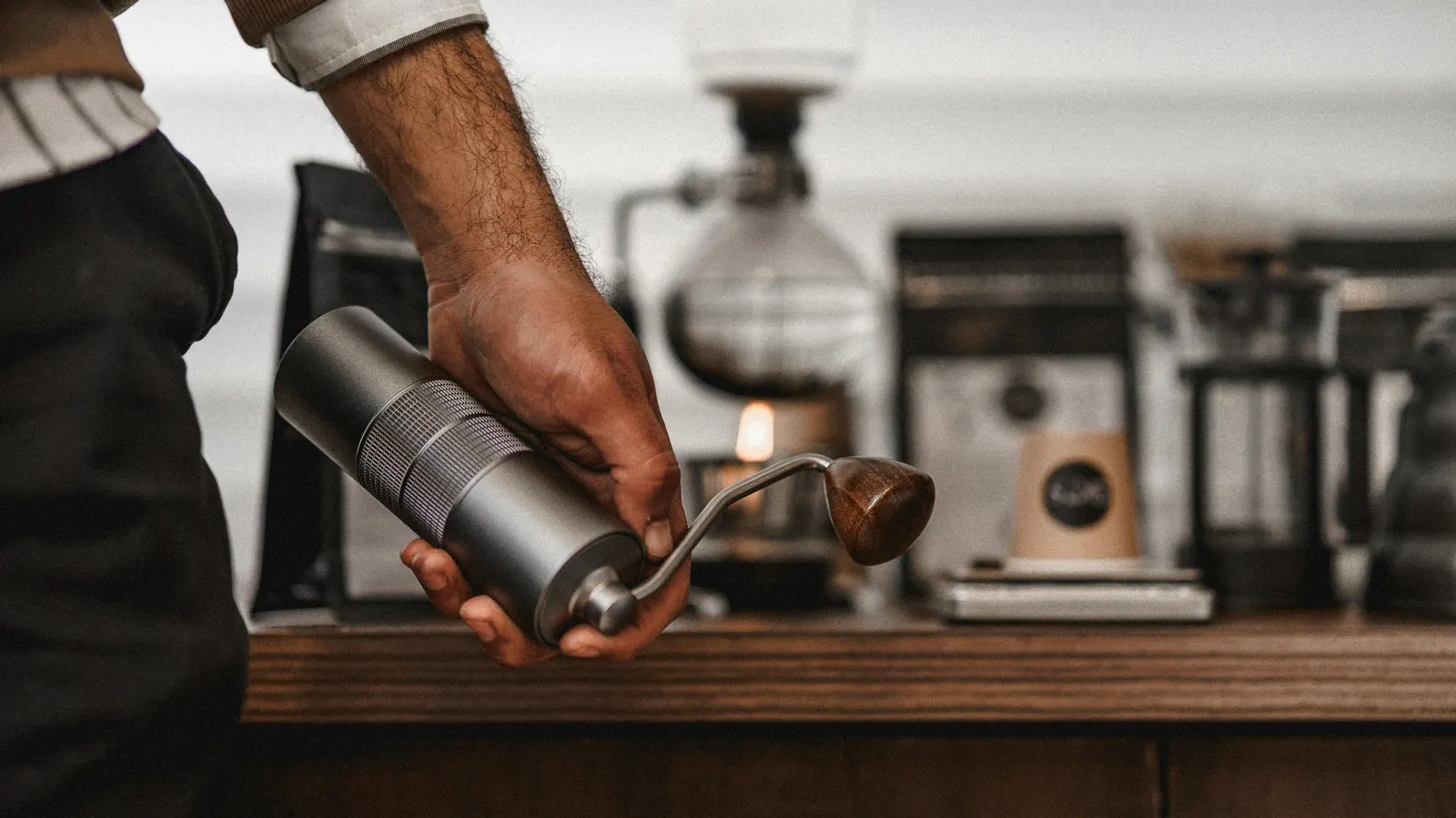
A hand grinder is the cheapest route to good coffee. Whole beans from Chiapas, Veracruz or Oaxaca keep their aroma far longer than ground coffee, and a decent burr grinder that you turn by hand usually costs less than a good electric one. It is quiet enough to use before the house is awake, needs no outlet, and packs into a bag for a weekend away.
Our main coffee grinder guide is mostly electric, with two hand grinders at the end. This page is the hand-grinder version: seven manual burr grinders, from a ceramic mill that holds enough for a big pot to a German grinder built for a lifetime. We avoided the two hand grinders already picked in the main guide so you get new options. Specifications come from each maker or Amazon listing; where a figure is not published or sources disagree, we say so.
Julia’s earns a commission on purchases made through links on this page, at no cost to you. Recommendations are based on what a restaurant kitchen looks for, product specifications and verified buyer reports.
Quick verdict: which hand coffee grinder to buy
The best coffee grinder hand-powered for most people is the 1Zpresso J: big 48 mm stainless burrs that grind quickly, 30 clicks per turn, a 30 to 35 gram capacity and tool-free cleaning, aimed at pour-over, drip and French press. If you also make espresso, the KINGrinder K6 adjusts in 16-micron steps from an outside dial. For a grinder to keep for decades, the Comandante C40 MK4; for the lowest outlay with steel burrs, the Timemore Chestnut C2S; and for a full family pot in one go, the Hario Skerton.
The table compares the five we would point most people toward. All seven grinders are reviewed in full below it.
Five hand grinders compared
Burrs, adjustment and how much each holds, as the maker or listing states them.
| Grinder | Best for | Burrs | Capacity | Buy on Amazon |
|---|---|---|---|---|

1Zpresso J Manual Coffee GrinderBest overall
|
Pour-over, drip, French press | 48 mm stainless conical | 30 to 35 g | View on Amazon |

KINGrinder K6 Manual Coffee GrinderBest for espresso too
|
Espresso to pour-over | Stainless; 16-micron clicks | 25 to 35 g | View on Amazon |

Comandante C40 MK4 Hand GrinderBuilt for a lifetime
|
Buying once | Nitro Blade high-nitrogen steel | About 40 g | View on Amazon |

Timemore Chestnut C2S Manual Coffee GrinderBudget pick
|
A first burr grinder | 38 mm stainless conical | 25 g | View on Amazon |

Hario Skerton Ceramic Coffee MillBiggest batch
|
A full pot at once | Ceramic | 100 g | View on Amazon |
Product images from Amazon. Capacities are for whole beans as each maker or listing gives them; the real figure varies with the roast.
Our picks for the best coffee grinder hand-powered
These seven cover the reasons people buy a hand grinder: better coffee for less money, quiet mornings, travel, espresso without an expensive electric grinder, and a big pot ground in one go. Each pick says who it suits and one honest reason to skip it.
1. 1Zpresso J Manual Coffee Grinder – Big Burrs, Fast Grinding
Burr size is the first thing to look at in a hand grinder, because larger burrs cut more coffee per turn. The 1Zpresso J has 48 mm stainless steel conical burrs, large for a hand grinder, which 1Zpresso says makes grinding fast and efficient. It holds 30 to 35 grams of beans, enough for two big mugs or a small pot.
Adjustment is internal: you set it with a numbered dial under the burr, with 30 clicks per full turn. 1Zpresso lists the J for pour-over rather than espresso, and that is the right way to think about it: it covers pour-over, drip, French press and cold brew. The handle folds away, which stops the grinder rolling off the counter and makes it easier to pack.
It comes apart without tools for cleaning, a brush is included, and 1Zpresso says the burrs are rated for 100 to 200 kg of grinding. The warranty is one year. If you make espresso as well, step up to a grinder with finer adjustment, such as the K6 below.
Why we like it
- 48 mm stainless conical burrs, per 1Zpresso
- 30 clicks per rotation on a numbered dial
- Holds 30 to 35 g of beans
- Tool-free disassembly and a folding handle
Key specifications
| Model | J (silver) |
|---|---|
| Burrs | 48 mm stainless steel conical |
| Adjustment | Internal, 30 clicks per rotation |
| Capacity | 30 to 35 g |
| Weight | Not stated |
| Body | Not stated |
| Best for | Pour-over, drip, French press, cold brew |
| Warranty | One-year limited |
Why we recommend it
It suits anyone brewing filter coffee who wants the grinding to take as little effort and time as a hand grinder allows. It is the grinder we would suggest to most people starting out with whole beans.
Skip it if you want to adjust grind size often; the dial sits inside, under the burr, so changes mean taking off the catch cup.
Pros and cons
Pros
- Large burrs for the size
- Good capacity
- Easy to clean
Cons
- Not aimed at espresso
- Internal adjustment
- Weight not published
2. KINGrinder K6 Manual Coffee Grinder – Fine Steps on an Outside Dial
Espresso needs a grind that can be changed in very small steps, and a hand grinder that does that well usually costs a lot. The K6 offers it for less than the premium names. KINGrinder says each click moves the burrs 16 microns, with 60 clicks per turn and up to four full turns, which gives a wide range from espresso to pour-over.
The dial is external, on the outside of the body under the handle, so you can switch from an espresso setting to a pour-over setting without taking the grinder apart. The body is aluminum, the burrs are stainless, and twin bearings keep the shaft steady. The hopper holds 25 to 35 grams, according to the listing. Retailers give the weight as about 630 grams.
It comes apart by hand for brushing out. KINGrinder gives a one-year warranty, with a note that the customer may pay shipping on replacement parts. This is the straight-handle version; KINGrinder also sells bent-handle models.
Why we like it
- 16 microns per click, 60 clicks per turn
- External dial, quick to change between brews
- All-metal body with dual bearings
- Covers espresso through pour-over, per KINGrinder
Key specifications
| Model | K6 (straight handle) |
|---|---|
| Burrs | Stainless steel (48 mm, per retailers) |
| Adjustment | External, 16 microns per click |
| Capacity | 25 to 35 g |
| Weight | About 630 g (retailers) |
| Body | Aluminum |
| Best for | Espresso, pour-over and between |
| Warranty | One year |
Why we recommend it
It suits someone with an espresso machine who does not want to buy an electric espresso grinder, and anyone who changes grind size often between brewing methods.
Skip it if you only brew drip or French press; the fine steps are wasted, and the J is quicker for coarse grinds.
Pros and cons
Pros
- Fine adjustment for espresso
- External dial
- Solid metal build
Cons
- Many turns needed for coarse grinds
- Heavier than plastic grinders
- Replacement-part shipping may be charged
3. Comandante C40 MK4 Hand Grinder – A Grinder to Keep for Decades
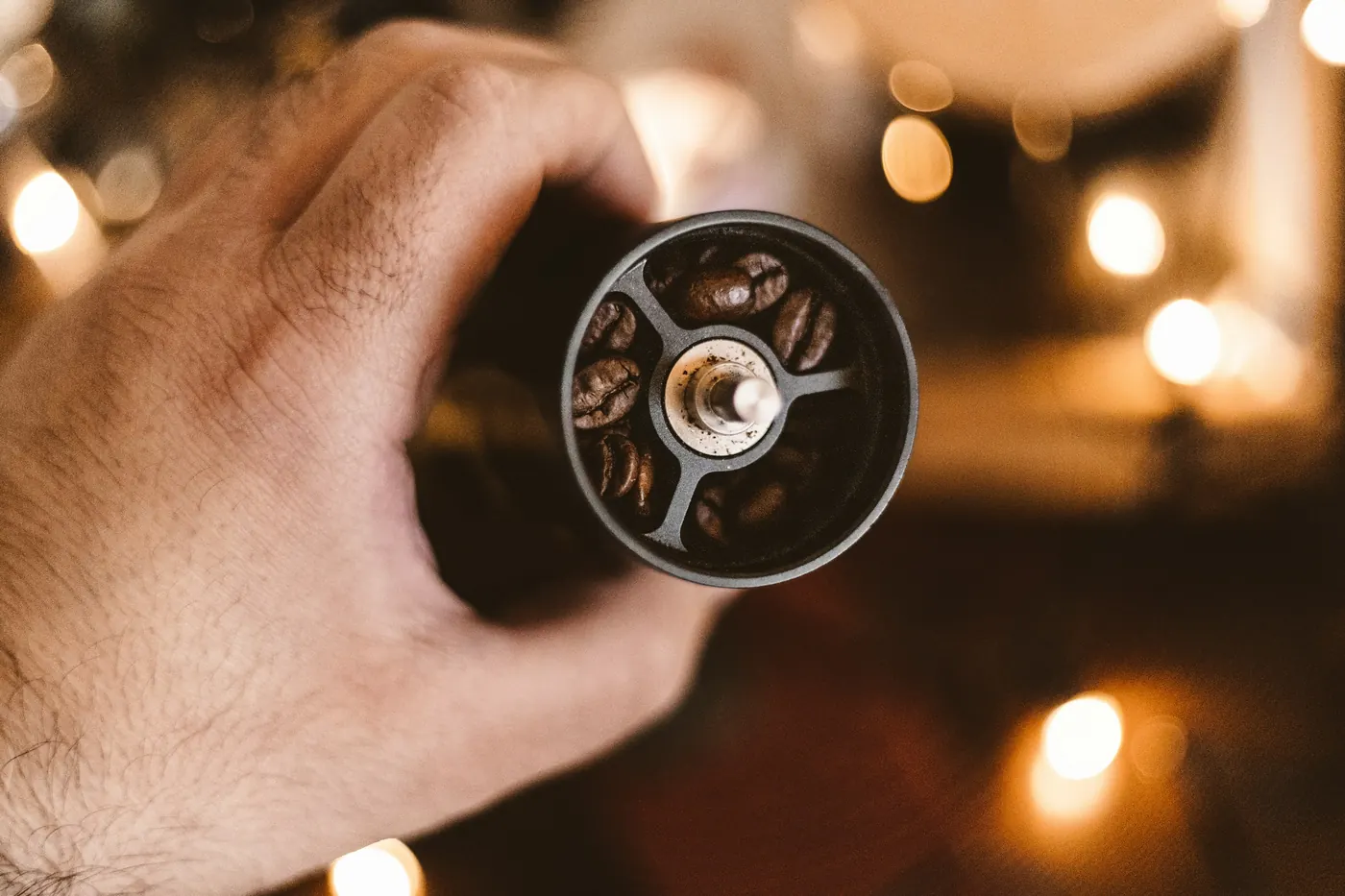
The C40 MK4 is the current version of Comandante’s hand grinder. It is made in Germany, according to its retailers, around Comandante’s own Nitro Blade burrs, which the company describes as a high-alloyed, high-nitrogen stainless steel. Prima Coffee lists the conical burr at 39 mm across.
The MK4 comes with two jars, one brown glass and one clear polymer-glass, each holding about 40 grams of beans, according to the listing. Comandante redesigned the internal axle support on this version to make filling easier. The listing does not describe the adjustment system or give a warranty.
It is a premium grinder, and what you pay for is build: Prima Coffee lists a stainless steel body, axle and crank. Comandante also sells it in other finishes, such as walnut; this listing is the black version.
Why we like it
- Nitro Blade high-nitrogen stainless burrs
- Made in Germany, per retailers
- Two jars, about 40 g each
- Stainless body, axle and crank, per Prima Coffee
Key specifications
| Model | C40 MK4 (black) |
|---|---|
| Burrs | Nitro Blade conical, 39 mm (Prima Coffee) |
| Adjustment | Not stated in the listing |
| Capacity | About 40 g |
| Weight | Not stated |
| Body | Stainless steel (Prima Coffee) |
| Best for | All brew methods, buying once |
| Warranty | Not stated in the listing |
Why we recommend it
It suits the coffee drinker who wants one hand grinder for good and is willing to pay for build quality and well-regarded burrs.
Skip it if value matters; the J and K6 cost far less and are well specified for their price.
Pros and cons
Pros
- Premium burrs and build
- Two jars included
- Made in Germany
Cons
- Premium price
- Few specs in the listing
4. Timemore Chestnut S3 Manual Coffee Grinder – External Dial, Folding Handle

Timemore calls the S3 its flagship hand grinder. It pairs Timemore’s newer S2C890 stainless burrs (42 mm, according to retailers) with an external, point-to-point adjustment ring: each step is 0.015 mm, and the numbers on the ring mean you do not have to count clicks to find your setting again. Timemore says the range covers espresso, moka pot, pour-over and French press.
The body is a single piece of metal, and Timemore says its custom bearings are tighter than standard ones, which keeps the burr steady. The handle is spring-assisted and folds flat against the body, so the grinder will not tip over on the counter and packs easily.
Published weight and capacity vary by seller, so we have marked them “Not stated” rather than guess. The S3 is a step up from the C3S, the Timemore picked in our main grinder guide; it is here for the external dial.
Why we like it
- External ring, 0.015 mm per step
- Numbered settings, no counting clicks
- Full-metal unibody with tight bearings
- Folding, spring-assisted handle
Key specifications
| Model | Chestnut S3 |
|---|---|
| Burrs | S2C890 stainless (42 mm, per retailers) |
| Adjustment | External, 0.015 mm per step |
| Capacity | Not stated (sources differ) |
| Weight | Not stated (sources differ) |
| Body | Full-metal unibody |
| Best for | Espresso through French press |
| Warranty | Not stated in the listing |
Why we recommend it
It suits a cook who switches between espresso, moka pot and pour-over and wants to dial back to a setting quickly. The numbered external ring is the most convenient adjustment here.
Skip it if you want firm published specs; the listing leaves out capacity, weight and warranty.
Pros and cons
Pros
- Easy, repeatable settings
- Fine steps for espresso
- Folds flat
Cons
- Capacity not clearly published
- Warranty not in the listing
5. Timemore Chestnut C2S Manual Coffee Grinder – Steel Burrs for Less
The C2S is the simplest way into stainless burrs. It updates Timemore’s older C2 with a full metal body, which Timemore says fixes the C2’s top cover, which broke easily. The 38 mm conical burrs are CNC machined, according to the listing, and a double bearing keeps the shaft centered so the grind stays even.
It holds 25 grams of beans, enough for a large mug or two small cups, and the listing says it grinds that in about a minute. Adjustment is by a nut inside, with about 36 steps from fine to coarse. The listing claims a range from espresso to French press; for regular espresso the finer steps of the K6 or S3 suit better, but for pour-over, drip, French press and café de olla the C2S does the job.
It weighs 700 grams and comes apart for brushing. Timemore lengthened the steel handle for leverage. The listing does not give a warranty.
Why we like it
- 38 mm CNC-machined stainless burrs
- Full metal body on the updated C2S
- Double bearing for an even grind
- Grinds a mug’s worth in about a minute, per Timemore
Key specifications
| Model | Chestnut C2S |
|---|---|
| Burrs | 38 mm stainless conical |
| Adjustment | Internal nut, about 36 steps |
| Capacity | 25 g |
| Weight | 700 g |
| Body | Full metal |
| Best for | Pour-over, drip, French press |
| Warranty | Not stated in the listing |
Why we recommend it
It suits a first-time buyer moving up from pre-ground coffee or a blade grinder, who wants steel burrs without spending much.
Skip it if you grind for more than two people at a time; 25 grams means refilling for a pot.
Pros and cons
Pros
- Low-cost steel burrs
- Sturdy metal body
- Quick for one mug
Cons
- Small capacity
- Coarse steps for espresso
- No warranty stated
6. 1Zpresso Q Air Manual Coffee Grinder – Fits Inside an AeroPress
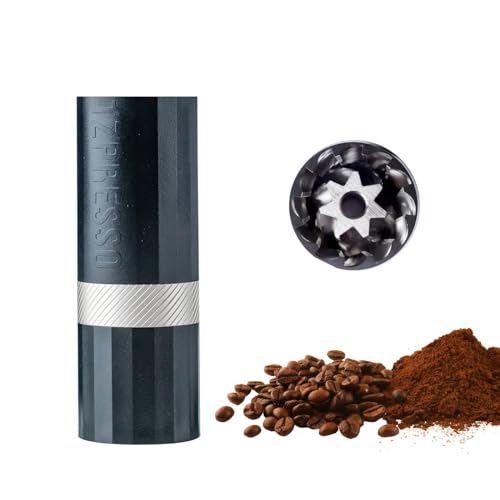
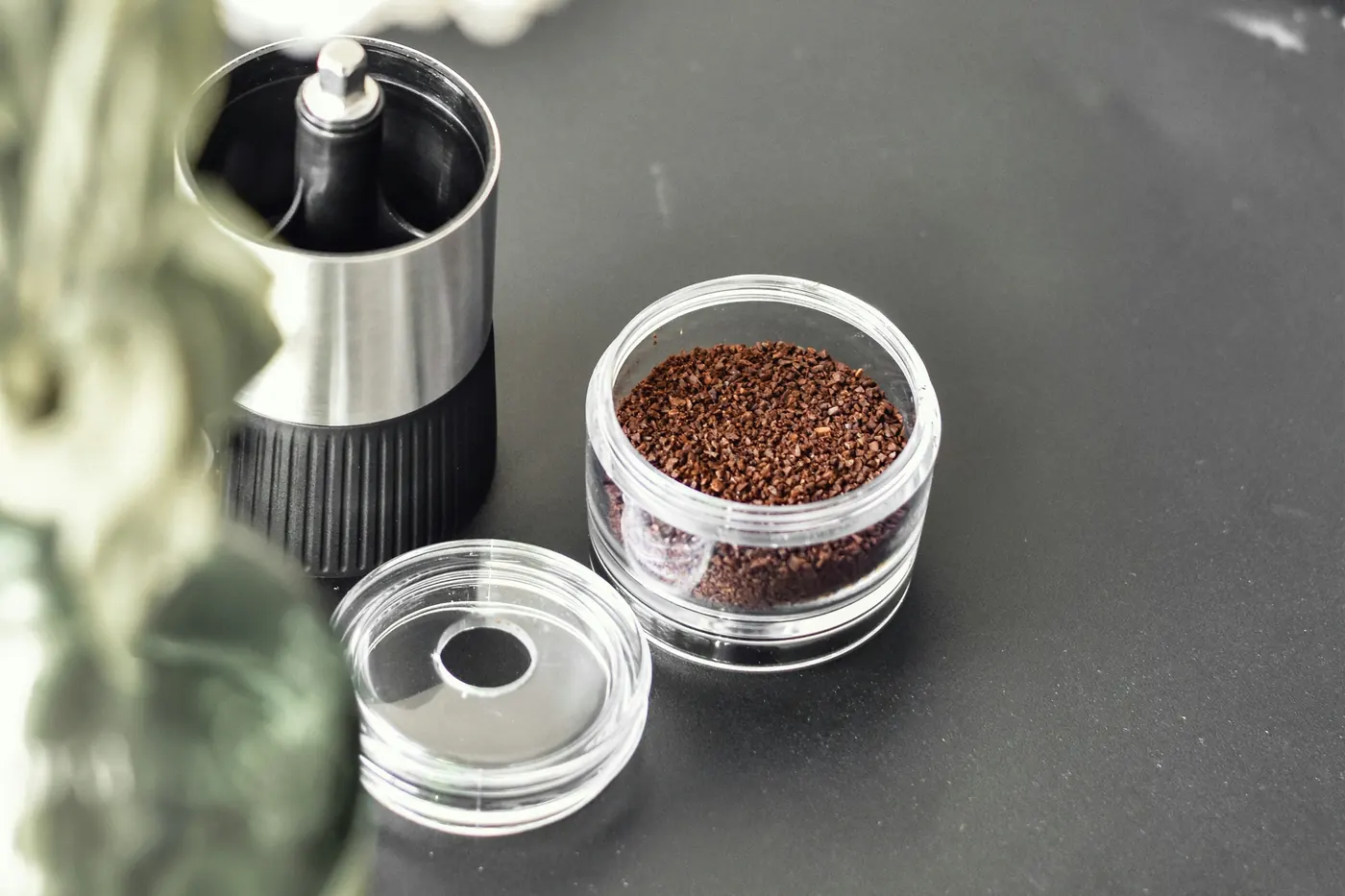
The Q Air is the travel grinder. 1Zpresso says it is smaller than a soda can and fits inside the plunger of an AeroPress, so a grinder and a brewer pack as one object. It holds 15 to 20 grams, which is one cup’s worth.
Inside are stainless conical burrs, factory calibrated, with 30 clicks per rotation for adjustment. 1Zpresso aims it at pour-over and calls it an entry-level grinder for new brewers. Like the J, it is rated for 100 to 200 kg of grinding and has a one-year limited warranty.
The small size cuts both ways: a single cup is all it holds, and a short handle means more turns than a big grinder. For a cabin, a camping trip or a hotel room, that is a fair trade.
Why we like it
- Nests inside an AeroPress plunger, per 1Zpresso
- Stainless conical burrs, 30 clicks per turn
- Light and compact
- One-year limited warranty
Key specifications
| Model | Q Air (black) |
|---|---|
| Burrs | Stainless steel conical (size not stated) |
| Adjustment | 30 clicks per rotation |
| Capacity | 15 to 20 g |
| Weight | Not stated |
| Body | Not stated |
| Best for | Pour-over and travel |
| Warranty | One-year limited |
Why we recommend it
It suits travelers and AeroPress owners, and anyone who wants a burr grinder that takes up almost no drawer space.
Skip it if you grind for more than one cup at a time.
Pros and cons
Pros
- Smallest grinder here
- Packs with an AeroPress
- Steel burrs
Cons
- One cup per fill
- More turns per gram
- Few published specs
7. Hario Skerton Ceramic Coffee Mill – 100 Grams for a Full Pot
Most hand grinders hold enough for one or two cups. The Skerton holds 100 grams, according to the listing, which is enough for a full pot of drip coffee or café de olla for the family in one session. The grounds collect in a heat-resistant glass jar, and a storage lid lets you keep the jar closed.
The burrs are ceramic, which do not rust. The body is a mix of glass, polypropylene and silicone, with a stainless steel handle, and it weighs about a pound. Only the glass part is dishwasher safe, the listing says, and it is made in China.
Be aware of two things. This listing ships with Japanese instructions, as its title says. And the Skerton is slower than the steel-burr grinders above; a 100-gram batch is real work. If you are grinding a lot every day, an electric grinder from our main grinder guide may suit better.
Why we like it
- Holds 100 g of beans, enough for a big pot
- Ceramic burrs that do not rust
- Glass catch jar with storage lid
- Glass jar is dishwasher safe
Key specifications
| Model | MSCS-2B |
|---|---|
| Burrs | Ceramic |
| Adjustment | Not stated in the listing |
| Capacity | 100 g |
| Weight | About 0.48 kg (1.0 lb) |
| Body | Glass, polypropylene, silicone; steel handle |
| Best for | Large batches for drip or French press |
| Warranty | Not stated in the listing |
Why we recommend it
It suits a family that brews one big pot in the morning and wants to grind it all at once by hand.
Skip it if speed matters or you need English instructions in the box.
Pros and cons
Pros
- Largest capacity here
- Rust-free ceramic burrs
- Jar doubles as storage
Cons
- Slow for big batches
- Japanese instructions
- Glass jar can break
How to choose a hand coffee grinder
Five things decide whether a hand grinder will suit you. Looks come well after them.
1. Burrs, not blades
Every grinder here uses burrs, which crush beans between two surfaces set at a fixed distance, so the grounds come out a similar size. Steel burrs (all but the Skerton) cut quickly; ceramic burrs do not rust but are slower. Bigger burrs, such as the J’s 48 mm, grind more per turn.
2. Adjustment
An external dial (K6, S3) lets you change grind size without taking the grinder apart, which matters if you brew several ways. Small steps matter for espresso: 16 microns on the K6 and 0.015 mm on the S3. For drip and French press alone, the internal dials on the J and C2S are fine.
3. Capacity
Most hand grinders hold 20 to 40 grams, one or two mugs. If you grind for a family pot, either accept two fills or choose the Skerton’s 100-gram jar. Weigh your beans on a kitchen scale to know how much you actually need.
4. Weight and grip
Metal grinders such as the C2S (700 g) and K6 (about 630 g) feel steady in the hand and last, but they are heavier to carry. The Q Air is the light one for a bag.
5. Your brewing method
Match the grinder to how you brew. Pour-over and drip need a medium grind, French press and café de olla a coarser one, espresso a fine one. A French press or a pour-over dripper is forgiving; espresso is not.
How we chose these seven hand grinders
We started with established hand-grinder makers whose grinders are sold on Amazon under their own names: 1Zpresso, Comandante, KINGrinder, Timemore and Hario. We took specifications from 1Zpresso’s own page for the J, from each Amazon listing, and, where a listing left gaps, from retailers such as Prima Coffee; where sources disagreed, we wrote “Not stated.” We left out the 1Zpresso K-Ultra and Timemore C3S, already picked in our main grinder guide, and the J-Ultra and C5 ESP Pro, picked in our espresso grinder guide, so this page offers new options. We also left out the Porlex Mini, Hario Mini Slim and OXO manual grinder, which were scarce or out of stock, and grinders from sellers with no identifiable brand. Every pick was in stock on Amazon when we checked. These are hand-powered tools with no electrical parts; we still searched the U.S. Consumer Product Safety Commission’s recall database for every brand and found no grinder recall. We have not ground coffee with these grinders for this guide.
Grinding for café de olla and a Mexican table
Café de olla is simmered and then strained, so it wants a coarse grind, close to French press. Grind it fine and the coffee turns muddy and bitter in the pot. Set the grinder coarse, simmer the water with piloncillo and canela first, then add the grounds off the heat and let them steep a few minutes before straining.
Keep your coffee grinder for coffee. Grinding cumin, chiles or canela in it leaves oils and flavor behind that come out in the next cup; a separate spice grinder or a molcajete is the better tool for spices. For a quick, even pour over your coarse or medium grounds, a gooseneck kettle helps.
Hand coffee grinder questions, answered
What is the best hand grinder for coffee?
For most people, the 1Zpresso J: large 48 mm burrs, 30 to 35 grams capacity and easy cleaning. If you also make espresso, the KINGrinder K6 with its 16-micron external dial.
Is a hand coffee grinder better than an electric one?
Not better, but different. A hand burr grinder usually costs less than an electric burr grinder, is close to silent and needs no power. An electric grinder is faster and easier for large amounts.
Can a hand grinder grind fine enough for espresso?
Some can. Look for small adjustment steps: the KINGrinder K6 (16 microns per click) and Timemore S3 (0.015 mm per step) are designed with espresso in mind. The 1Zpresso J and Q Air are aimed at pour-over.
How long does it take to grind coffee by hand?
It depends on the grinder, the grind size and the roast. Timemore says the C2S grinds enough for a big cup in about a minute. Finer grinds and larger batches take longer.
How do I clean a hand coffee grinder?
Brush out the burrs and chamber regularly; most grinders here come apart by hand and include a brush. Avoid water on steel burrs unless the maker says it is safe, and dry everything completely before you reassemble.
Our final pick for grinding by hand
Buy the 1Zpresso J for fast, even filter coffee, the KINGrinder K6 if espresso is on the menu, and the Comandante C40 if you want one grinder for life. The Timemore C2S is the low-cost way into steel burrs, the Q Air goes in a bag, and the Hario Skerton grinds a family pot in one session. For electric options, see our guides to the best coffee grinder and the best espresso grinder.
Hand-grinding for espresso? See our guide to the best handheld espresso grinders.
Related guide: Hand vs electric coffee grinder.
More coffee gear: cold brew makers for coarse grounds. If you would rather someone else made the coffee and the food, see the menu or call to order.