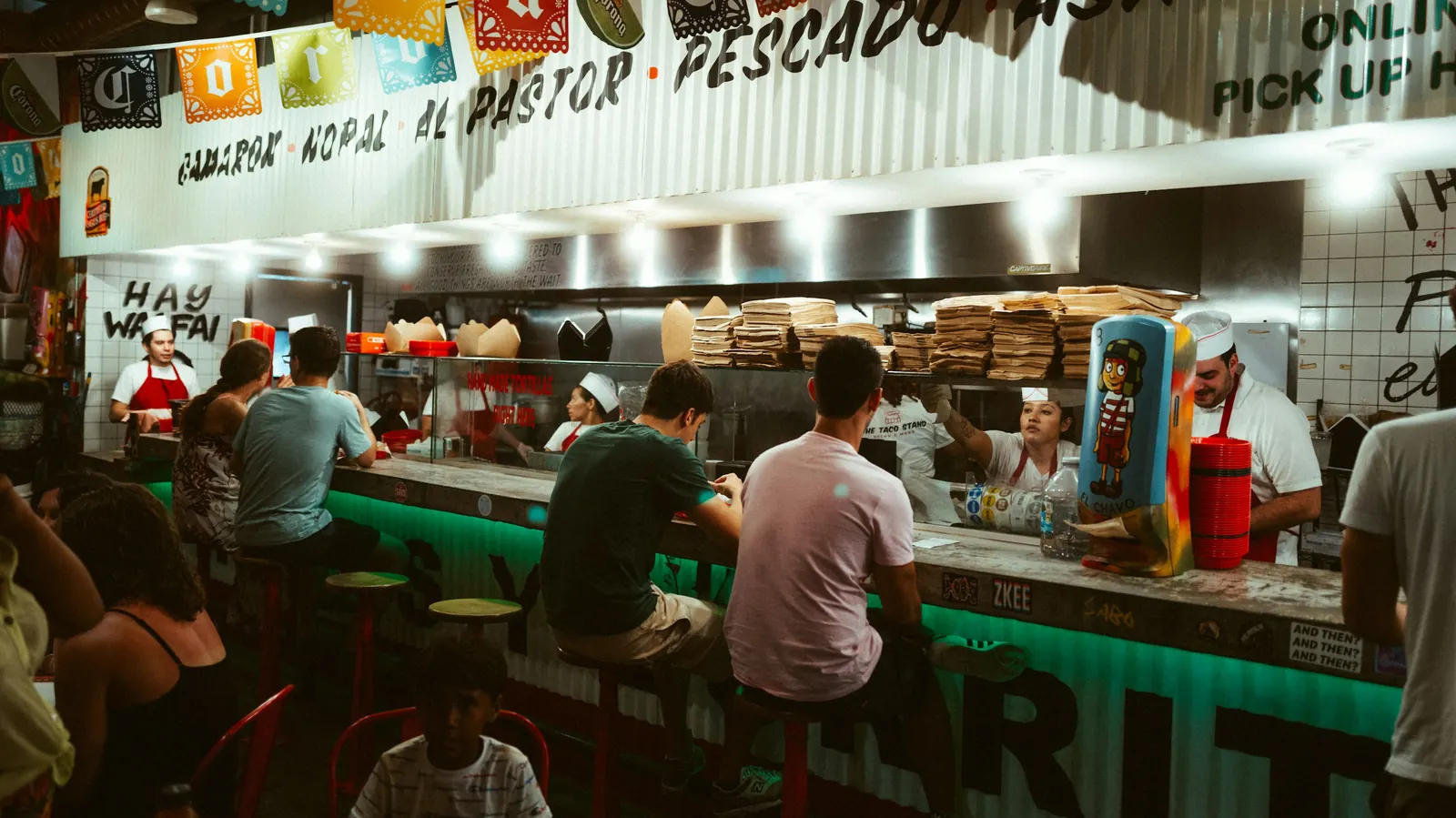
A tortilla press that is fine for Sunday tacos at home can fail fast on a busy line. Hinges loosen, light plates press tortillas thicker on one side, and a cook pressing two hundred dough balls a shift needs leverage, consistency and a press that can be wiped down between rushes. Restaurants, taquerias and food trucks have to think about the electrical supply, the counter space and what the health inspector will want to see, too.
This guide sorts the presses sold on Amazon in the United States that are genuinely built for heavier use, from programmable heated clamshell presses to big cast iron presses and roller machines, and it is honest about where Amazon stops. A tortillería turning out thousands of tortillas an hour runs dedicated machines bought through equipment dealers, not anything in a shopping cart.
Julia’s earns a commission on purchases made through links on this page, at no cost to you. Recommendations are based on what a working Mexican restaurant kitchen looks for in a press, the makers’ own specifications and published reviews, which we cite.
Quick verdict: which commercial tortilla press to buy
For a restaurant that serves flour tortillas in volume, the best tortilla press for commercial use is the Estella 16 x 20-inch Dual-Heat Clamshell Tortilla Press: heated top and bottom plates, programmable digital controls for time, temperature and press length, and room to press several small tortillas at once. It needs a 240-volt outlet. If you only have standard 120-volt power, look at the Estella 18-inch heated clamshell press. For corn tortillas from masa, a heavy manual press such as the Victoria 10-inch HD cast iron press, used two or three at a time on the line, is still the tool most taquerias reach for.
The rest of this page explains why, and which press suits the tortillas you sell.
Five commercial presses at a glance
Our five standout picks side by side, one for each kind of operation, with the details each maker or listing states. All seven presses are reviewed in full below.
| Press | Best for | Plates | Power | Buy on Amazon |
|---|---|---|---|---|
| Flour tortillas in volume | 16 x 20-inch heated aluminum | 240 V, 3,600 W | View on Amazon | |

Estella 18-inch Heated Clamshell Dough PressBest on 120 volts
|
Large flour rounds, standard outlet | 18-inch round, heated top plate | 120 V, 1,200 W | View on Amazon |

Victoria 10-inch HD Cast Iron Tortilla PressBest manual press
|
Corn masa on the line | 10-inch cast iron | None (manual) | View on Amazon |

Kundita 12-inch Cast Aluminum Tortilla PressBest large manual press
|
Large flour rounds, easy to move | 12-inch cast aluminum, nonstick | None (manual) | View on Amazon |

VEVOR 5.5-inch Automatic Tortilla MachineBest automatic
|
Street-taco corn tortillas by the hundred | Rollers with a 5.5-inch mold | Electric (250 W per listing part number) | View on Amazon |
Product images from Amazon. Electrical ratings, sizes and certifications are as stated by each maker or listing; check the listing and your outlet before you buy.
Our picks for the best tortilla press for commercial use
These seven presses cover the ways a working kitchen actually presses tortillas: heated clamshell presses for flour dough, heavy cast iron for corn masa, a stainless press with thickness spacers, a large aluminum press for the occasional big batch and a roller machine for street-taco tortillas. Each pick explains who it suits, the specifications that matter in a commercial kitchen, and one honest reason to skip it.
1. Estella 16 x 20-inch Dual-Heat Clamshell Tortilla Press – Programmable Heat for Flour Tortillas

This is the kind of press you see behind the counter of a burrito shop: a countertop clamshell with a long handle, heated aluminum plates and a small digital control panel. Estella builds it specifically as a tortilla press, and its spec sheet names Mexican restaurants, taquerias and burrito shops as the intended kitchens.
Both plates are heated, and Estella says the top and bottom temperatures can be set independently, up to 450°F. The digital controls cover time, temperature and the length of each press, and programs can be saved, which is the real reason a busy kitchen buys a press like this: every cook on every shift gets the same tortilla from the same settings. Heat matters with flour dough. A patent for heated tortilla presses explains that warm plates make the dough more fluid and easier to press into a round, and help stop it sticking.
The rectangular 16 by 20-inch plates press one tortilla up to 16 inches across, or several smaller ones at once. Estella gives a minimum dough thickness of 1/16 inch. The footprint is large, at 18.5 inches wide, 28 inches deep and 33.75 inches tall, so plan the station before it arrives.
The electrical side needs planning too. It runs on 240 volts, draws 15 amps at 3,600 watts, and ships with a NEMA 6-20P plug, which will not fit a standard kitchen outlet. Estella’s spec sheet shows it as ETL Listed; it does not show NSF certification. The Amazon listing carries Estella’s model name but a generic brand field, so check the seller before you order.
Why we like it
- Heated top and bottom plates, set independently up to 450°F
- Programmable digital controls for time, temperature and press length
- 16 x 20-inch plates press several small tortillas at once
- Built by Estella as a tortilla press for restaurant use
- ETL Listed, according to Estella’s spec sheet
Key specifications
| Model | DPC1620T |
|---|---|
| Type | Dual-heat manual clamshell press |
| Plate size | 16 x 20-inch rectangular; tortillas up to 16 inches |
| Material | Aluminum plates |
| Weight | Not stated (18.5 x 28 x 33.75 inches) |
| Power/heat | 240 V, 3,600 W, 15 A, NEMA 6-20P; up to 450°F |
| Certification | ETL Listed (Estella); NSF not stated |
| Warranty | Not stated |
Why we recommend it
Choose it if flour tortillas are a big part of your menu and you want consistency without relying on one skilled cook at a rolling pin. Saved programs and heated plates turn pressing into a repeatable step that new staff can learn quickly.
Skip it if your kitchen has no 240-volt circuit near the station or you mainly sell corn tortillas. Fresh masa does not need heat to press, and a heavy manual press does that job for far less.
Pros and cons
Pros
- Repeatable, programmable pressing
- Both plates heated, set separately
- Room for several small tortillas
- ETL Listed
Cons
- Needs a 240-volt NEMA 6-20 outlet
- Large footprint; weight not stated
- Warranty and NSF status not stated
- Amazon listing shows a generic brand field
2. Estella 18-inch Heated Clamshell Dough Press – Plugs Into a Standard Outlet
Plenty of small restaurants and most food trucks do not have a spare 240-volt circuit. This sibling of our top pick runs on 120 volts and 1,200 watts, with a standard NEMA 5-15P plug and a 10-amp draw, according to Estella’s spec sheet. That makes it the heated clamshell press on this list that most kitchens can plug in today.
There are trade-offs. Estella sells it as a pizza dough press, not a tortilla press, and only the top plate is heated, to a maximum of 200°F. That is far cooler than the 450°F plates of the tortilla model, so think of it as a press that shapes warm, even rounds rather than one that does any of the cooking. Estella says the heated top plate works with warm or cold dough.
The 18-inch round plates flatten dough up to 18 inches across, enough for the largest burrito tortilla, and the minimum thickness is 1/16 inch. It shares the digital controls for time, temperature and press length, with programs you can save, and the same tall countertop frame: 18.5 inches wide, 28 deep and 33.75 high. Estella lists it as ETL Listed. As with the 240-volt model, the Amazon listing uses Estella’s name with a generic brand field.
Why we like it
- Runs on 120 V with a standard NEMA 5-15P plug
- 18-inch round plates for burrito-size rounds
- Programmable time, temperature and press length
- ETL Listed, according to Estella
Key specifications
| Model | DPC18P |
|---|---|
| Type | Manual clamshell press, heated top plate (sold for pizza dough) |
| Plate size | 18-inch round |
| Material | Aluminum plates |
| Weight | Not stated (18.5 x 28 x 33.75 inches) |
| Power/heat | 120 V, 1,200 W, 10 A, NEMA 5-15P; top plate up to 200°F |
| Certification | ETL Listed (Estella); NSF not stated |
| Warranty | Not stated |
Why we recommend it
Choose it for a food truck, cart or small kitchen that wants large, even flour rounds pressed quickly and cannot add a 240-volt line. Programs keep the press time the same for every cook.
Skip it if you want the plates to start cooking the tortilla. With only the top plate heated, and only to 200°F, the griddle does all the cooking, and Estella designed it around pizza dough.
Pros and cons
Pros
- Works on a standard outlet
- Largest round plates here
- Programmable controls
Cons
- Top plate only, maximum 200°F
- Sold as a pizza press
- Warranty, weight and NSF status not stated

3. Victoria 10-inch HD Cast Iron Tortilla Press – Heavy Plates for Corn Masa
For corn tortillas, the manual press never went out of style in restaurant kitchens. Fresh masa presses easily without heat, and a heavy top plate does most of the work, which is why America’s Test Kitchen found that weight matters more than anything else in a tortilla press. Victoria’s 10-inch HD press is one of the heaviest from an established maker: Victoria lists it at 9.3 pounds.
The HD line is Victoria’s reinforced design. Victoria describes the iron as “spherrous” cast iron, uses stainless steel pins at the hinge, and seasons each press with three layers of flaxseed oil, with no paint or powder coating. The plates are 10 inches across and 12.2 inches from hinge to hinge, so there is room for a large corn tortilla or a medium flour one, and enough handle for good leverage across a long shift. The press is made in Colombia, and its listing names a 6.5-inch and an 8-inch version too.
Many taquerias run two or three manual presses at once rather than one machine: one cook presses while another works the comal, and a spare press means a broken hinge never stops service. Keep a stack of thin plastic liners at each station, and wipe the plates dry after every shift so the iron does not rust. Victoria advises wiping with a dry or lightly oiled towel and, when it is very dirty, a quick wash with warm water and a brush, followed by drying and a thin coat of oil.
Why we like it
- Heavy, at 9.3 lb, so the plate does the pressing
- Stainless steel hinge pins on the reinforced HD design
- Flaxseed-oil seasoning; no paint or powder coating
- No power needed, so it works anywhere
- Lifetime warranty advertised by Victoria
Key specifications
| Model | TOR-010 (10-inch HD) |
|---|---|
| Type | Manual hinged press |
| Plate size | 10-inch round; 12.2 inches hinge to hinge |
| Material | Cast iron, flaxseed-oil seasoning, stainless steel pins |
| Weight | 9.3 lb (Victoria) |
| Power/heat | None |
| Certification | Not stated |
| Warranty | Lifetime, as advertised by Victoria |
Why we recommend it
Choose it if you press corn tortillas to order. It is simple, heavy and repairable, and buying two costs a fraction of any electric press. It is also the large-press pick in our cast iron tortilla press guide.
Skip it if your kitchen needs to press hundreds of flour tortillas an hour. Wheat dough springs back in an unheated press, and no manual press matches a programmed heated press for speed.
Pros and cons
Pros
- Heavy plates press masa evenly
- Stainless hinge pins
- No electrical work needed
- Made in Colombia by an established maker
Cons
- Cast iron rusts if left wet
- One tortilla per press
- Not suited to elastic flour dough
4. ARC 10-inch Heavy Duty Cast Iron Tortilla Press – Maximum Weight, Non-Slip Feet
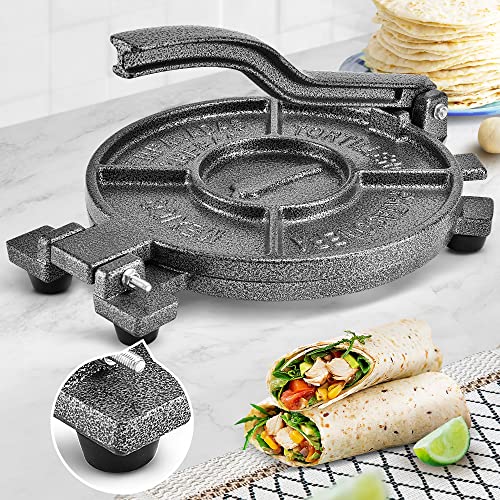
ARC sells this as a heavy duty press, and the weight it gives is striking: 18.25 pounds for the 10-inch size, roughly double the Victoria. That figure comes from ARC’s own listing and is unusually high for a 10-inch press, so treat it as the maker’s claim. Either way, this is a press built for force.
The handle is wider and thicker than a typical press’s, and ARC describes it as not breakable. Non-slip foot pads keep the press from walking across a steel table, which matters when one cook is pressing fast. The iron is pre-seasoned and has what ARC calls a rustproof surface treatment with a natural stone appearance, and the press comes with 100 sheets of parchment.
ARC’s own tip is useful on a line that makes both kinds of tortilla: corn does better in a smaller press, and flour needs a larger pressing area. At 10 inches this one leans toward flour rounds and larger corn tortillas for tlayudas or quesadillas. ARC advises hand washing before and after use and drying the press thoroughly with paper towels.
Why we like it
- Very heavy, per ARC’s figure of 18.25 lb
- Wide, thick handle for leverage
- Non-slip foot pads
- Pre-seasoned, rust-resistant surface treatment
Key specifications
| Model | Not stated (10-inch heavy duty) |
|---|---|
| Type | Manual hinged press |
| Plate size | 10-inch round |
| Material | Cast iron, pre-seasoned, stone-look surface treatment |
| Weight | 18.25 lb (ARC’s figure) |
| Power/heat | None |
| Certification | Not stated |
| Warranty | Not stated |
Why we recommend it
Choose it if your cooks want the heaviest manual press they can get, for larger corn tortillas or for pressing a stiffer dough without leaning on the handle. The non-slip feet suit a busy stainless prep table.
Skip it if staff move the press around the kitchen often. If ARC’s weight is right, it is a lot of iron to lift, and the maker publishes no warranty in the listing.
Pros and cons
Pros
- Very heavy top plate
- Thick handle
- Non-slip feet
Cons
- Weight figure looks unusually high
- Warranty not stated
- Heavy to move and store
5. SELERS 10.5-inch Stainless Steel Tortilla Press – Set Thickness With Spacers
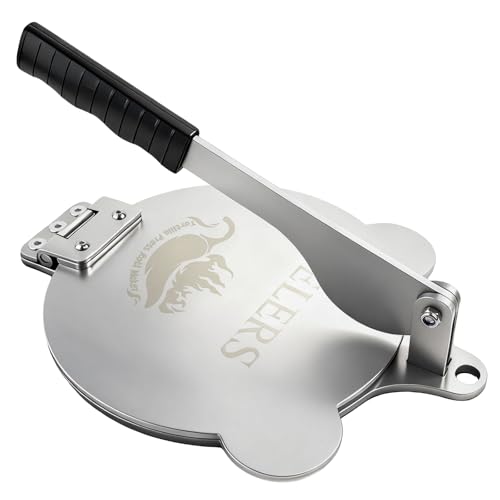
Stainless steel appeals to commercial kitchens for an obvious reason: it does not rust when a busy cook leaves it wet. SELERS makes this 10.5-inch hinged press from stainless steel and says it resists drops and impacts better than most cast iron presses. The detachable design comes apart for cleaning and storage.
The useful detail for a restaurant is thickness control. The press comes with three spacers, 2, 4 and 6 millimeters, that fit at the hinge. Per SELERS, a taller spacer gives a thinner tortilla and a shorter one a thicker tortilla, so a kitchen can fix the thickness for a menu item and keep it there from cook to cook.
The handle has a playful bear-shaped top plate, and SELERS says the “ears” give you something to lift the plate by, keeping fingers out of the pinch point. The listing names flour tortillas, quesadillas, roti, flatbreads and empanadas among its uses. SELERS publishes little beyond the listing, so weight, warranty and certification are not stated.
Why we like it
- Stainless steel, so no seasoning or rust worries
- Three hinge spacers (2, 4 and 6 mm) to set thickness
- Comes apart for cleaning
- Lift tabs keep fingers clear of the hinge
Key specifications
| Model | SELERS0031 |
|---|---|
| Type | Manual hinged press, adjustable thickness |
| Plate size | 10.5-inch |
| Material | Stainless steel |
| Weight | Not stated |
| Power/heat | None |
| Certification | Not stated |
| Warranty | Not stated |
Why we recommend it
Choose it if consistency matters and you would rather not maintain seasoned iron. Fixed spacers are a simple way to make sure every cook presses the same thickness.
Skip it if you want a known maker behind the press. SELERS publishes no weight, warranty or certification, and a lighter stainless press may need more effort on corn masa than heavy cast iron.
Pros and cons
Pros
- Rust-resistant stainless steel
- Thickness set by spacers
- Detachable for cleaning
Cons
- Few maker details published
- Weight and warranty not stated
- Novelty bear shape may not suit every kitchen
6. Kundita 12-inch Cast Aluminum Tortilla Press – Large Rounds, Lighter to Lift
Kundita’s 12-inch press is the largest hinged press here and much easier to move than cast iron of a similar size. Kundita calls it commercial-grade and builds it from cast aluminum with a nonstick surface, so it needs no seasoning and does not rust.
The design detail that matters on a wide plate is the three-pronged handle. Kundita says it spreads force across the plate rather than concentrating it at one point, which helps a large press produce a flat, even round with less effort. The maker also gives a practical tip for flour dough: rest it for about ten minutes, press, turn the round 180 degrees and press again for a thinner, more even result.
It comes with 50 parchment sheets and a dough scraper, and Kundita lists a two-year warranty, the clearest warranty among the manual presses here. The coating type is not stated, so use wooden or silicone tools on the plates, and wipe them down rather than scrubbing.
Why we like it
- 12-inch plates for burrito-size rounds
- Three-pronged handle spreads pressure
- Cast aluminum: no seasoning, no rust
- Two-year warranty listed
Key specifications
| Model | KTP-12in |
|---|---|
| Type | Manual hinged press |
| Plate size | 12-inch round |
| Material | Cast aluminum, nonstick surface (coating type not stated) |
| Weight | Not stated (lighter than cast iron, per Kundita) |
| Power/heat | None |
| Certification | Not stated |
| Warranty | 2 years |
Why we recommend it
Choose it for a catering kitchen or food truck that presses large flour rounds now and then and wants a press that is easy to carry, store and wipe down. It is the same press our flour tortilla press guide covers.
Skip it if you press corn masa all day. America’s Test Kitchen found aluminum presses too light to press dough evenly, so for masa a heavy cast iron press is the better buy.
Pros and cons
Pros
- Largest hinged press here
- Easy to lift and store
- Two-year warranty
Cons
- Lighter plate needs more force
- Coating type not stated
- Not ideal for corn masa all day
7. VEVOR 5.5-inch Automatic Tortilla Machine – Street-Taco Rounds by the Hundred
This is a small roller machine rather than a press. Dough goes into the top, rollers sheet it, a 5.5-inch mold cuts the rounds and a conveyor carries them out. VEVOR says it can produce up to 1,400 tortillas an hour, with thickness adjustable from 1 to 5 millimeters, and it names food trucks, fast-food shops and cafeterias among the places it suits.
The rollers and conveyor are stainless steel with a food-grade nonstick coating, and VEVOR describes the machine as corrosion-proof and resistant to deforming. Beyond tortillas, the listing suggests it for sopes, gorditas, roti and pita. The 5.5-inch round is the classic street-taco size, so this is the machine on the list for a taco truck that sells corn tacos by the hundred.
Two things to know before buying. The listing does not describe a cooking stage, so plan on a separate griddle or comal for every tortilla it makes. And the electrical rating is thin: the part number reads “250 W”, and the listing does not state the voltage, so confirm it with the seller before it goes on a truck.
Why we like it
- Up to 1,400 tortillas an hour, per VEVOR
- Adjustable thickness, 1 to 5 mm
- Stainless rollers and conveyor with nonstick coating
- Street-taco size 5.5-inch mold
Key specifications
| Model | YF-YM08 |
|---|---|
| Type | Electric roller and cutting machine (no cooking stage described) |
| Plate size | 5.5-inch roller mold |
| Material | Stainless steel rollers and conveyor, nonstick coating |
| Weight | Not stated |
| Power/heat | 250 W per part number; voltage not stated; no heat |
| Certification | Not stated |
| Warranty | Not stated |
Why we recommend it
Choose it if you sell small corn tacos in volume and a cook pressing by hand cannot keep up. It is the most output per square foot of counter on this list, and the same machine our electric tortilla maker guide lists for corn tortillas in bulk.
Skip it if you need large tortillas or full certification paperwork. It makes one size, and the listing gives no voltage, weight, warranty or certification.
Pros and cons
Pros
- Highest stated output here
- Adjustable thickness
- Small footprint for the output
Cons
- One size: 5.5 inches
- Does not cook; needs a griddle
- Voltage, weight and warranty not stated
How to choose a press for a commercial kitchen
Five questions decide which press belongs on your line. Start with the tortilla you sell and the power you have, not the size of the press.
1. Corn masa or flour dough
Corn masa presses easily and cleanly in a heavy unheated press, which is why manual cast iron still dominates taqueria lines. Flour dough is elastic and springs back, and heated plates help: they make the dough easier to press flat and less likely to stick. If most of your tortillas are flour and you press more than a few dozen at a time, a heated clamshell press earns its counter space. For a fuller explanation of how the two doughs differ, see corn vs flour tortillas.
2. Your electrical supply
Check the outlet before you check the price. A 240-volt press such as the Estella DPC1620T needs a NEMA 6-20 receptacle and a matching circuit, which many small kitchens and most food trucks do not have. A 120-volt model plugs into a standard NEMA 5-15 outlet, but a press drawing 10 amps will share that circuit with whatever else is plugged into it. Manual presses need no power at all, which is one reason they never left the line.
3. Volume and how many cooks press
A single manual press is fine for a small taqueria; at busier times, two or three presses, each with a cook, keep up with a comal running hot. Past that, a programmed heated press or a roller machine takes over. Programs and fixed spacers matter as much as speed, because they keep tortillas the same size and thickness whoever is on shift.
4. Weight, hinge and materials
For a manual press, weight is the deciding specification: America’s Test Kitchen found that a press needs enough weight to produce an evenly thin tortilla, and that light aluminum presses struggle. Look at the hinge too. Stainless steel pins, as on Victoria’s HD presses, and a spare screw or pin set make a press easier to keep in service. Cast iron needs drying and a little oil after every shift; stainless steel and coated aluminum do not rust, but aluminum presses are lighter.
5. Certification and your health department
Ask your local health department what it expects before you buy. NSF/ANSI 2 is the main sanitation standard for food equipment, covering materials, design and construction, and the FDA Food Code, which most states adopt in some form, accepts equipment certified for sanitation by an ANSI-accredited program as meeting its design rules. None of the presses on this list states NSF certification. The two Estella presses are ETL Listed, which is an electrical safety listing, not a sanitation one. The NSF food equipment standards page and the FDA Food Code explain both.
Where Amazon stops: real tortillería machines
It is worth being clear about the ceiling. A tortillería that supplies stores or restaurants runs a production line, not a press. One used Casa Herrera corn tortilla line listed by the equipment dealer SIGMA Equipment includes a masa feeder, a 16-inch sheeter and cutter, a 150-inch oven and a nine-tier cooling conveyor, runs on 460-volt three-phase power, and is rated at up to 1,200 dozen tortillas an hour. Machines that press masa and carry the rounds through ovens go back to the 1940s, as Wikipedia’s history of the tortilla machine describes. Lines like these are sold through equipment dealers, installed and serviced on site, and are a different investment altogether.
Between a hand press and a full line sit the countertop roller machines, like the VEVOR on this list, and heated clamshell presses. For most restaurants and food trucks, one of those, or a few good manual presses, is all the press they need.
How we picked these seven presses
We started from what a working Mexican kitchen asks of a press on a busy shift: even thickness, enough weight or heat to press quickly, a hinge or frame that lasts, and a power supply the kitchen can actually provide. We then looked at every heavy-duty, lever, heated and automatic press we could find on Amazon in the United States and checked stock with Amazon’s product data on the day of writing. Specifications come from the maker where one publishes them (Estella’s spec sheets and Victoria’s product pages) and otherwise from the brand’s own Amazon listing, which we name as the source. We used America’s Test Kitchen’s tortilla press review for how presses behave. We left out products that were out of stock or down to their last few units, listings with no identifiable maker, and listings whose own descriptions contradict themselves on material. We only say NSF where a maker states it, and none here does. We have not used these products ourselves; where we describe how a press behaves, we say whose findings those are.
Keeping a commercial press in service
Cast iron presses (Victoria and ARC) need to be dry at the end of every shift. Wipe the plates, dry them completely, and rub on a very thin film of oil before the press goes back on the shelf. Check the hinge pin and handle screw weekly; a little play at the hinge is what makes tortillas come out thicker on one side.
Stainless and aluminum presses (SELERS and Kundita) do not rust, but coated plates scratch. Use plastic liners or parchment, wipe the plates with a damp cloth, and keep metal scrapers off the surface.
Heated presses (Estella) should be wiped down only when cool and unplugged. Keep the cord and plug clear of water and of the comal, and follow the maker’s cleaning instructions for the plates.
Roller machines (VEVOR) need masa cleaned out of the rollers and conveyor at the end of every shift, before it dries hard.
Commercial tortilla press questions, answered
What is the best tortilla press for a food truck?
For corn tortillas, a heavy manual cast iron press such as the Victoria 10-inch HD: no power, nothing to break, and a second one costs little. For flour tortillas on a truck with standard power, a 120-volt heated press such as the Estella DPC18P. For street-taco corn tortillas in volume, a small roller machine like the VEVOR, if you confirm its voltage first.
Do restaurants use heated tortilla presses?
Many restaurants that serve flour tortillas do. Heated clamshell presses with programmable controls are sold for exactly that job, and Estella names taquerias and burrito shops as the kitchens its press is designed for. Corn tortilla kitchens more often use manual presses or machines.
Does a commercial tortilla press need to be NSF certified?
It depends on your health department, so ask before you buy. Equipment certified to NSF/ANSI standards is the easiest to get approved, and none of the presses on this list states NSF certification. ETL Listed, as on the Estella presses, refers to electrical safety.
How many tortillas can one manual press make?
It depends on the cook and the comal, not the press. A practical way to plan is one press per cook and enough comal or griddle space for each press to keep up. If you need more, add a press and a cook before you consider a machine.
Can one press do both corn and flour tortillas?
Yes, but not equally well. A heavy manual press handles corn masa best and can press flour dough with resting and a second press. A heated press handles flour dough best. Many kitchens keep one of each.
Our final pick for a commercial kitchen
Buy the Estella 16 x 20-inch dual-heat press if flour tortillas drive your sales and you can provide a 240-volt outlet, or its 120-volt 18-inch sibling if you cannot. For corn tortillas, two or three Victoria 10-inch HD cast iron presses beside a hot comal remain the simplest, most reliable setup, and the VEVOR roller machine is the step up for a taco truck selling small corn tortillas by the hundred. Whatever you buy, check the outlet, ask your health department, and keep the press dry and the hinge tight.
For home kitchens and smaller batches, our best tortilla press guide covers every material. Pair any press with a good comal for tortillas.
And if you would rather someone else did the pressing tonight, see the menu or call to order.