Carbon steel and cast iron are close relatives. Both are mostly iron, both are bare metal under a coat of baked-on oil, both get better the more you cook in them, and both will rust if you leave them wet. The care routine is nearly identical. What separates them is how they are made. Cast iron is poured into a sand mold, so it comes out thick and heavy. Carbon steel is pressed from sheet, so it comes out thin and light. Almost every practical difference follows from that.
Restaurant line cooks reach for thin steel pans because they heat fast and can be tossed one-handed, and they keep heavy iron for jobs where steady heat matters more than speed. This guide compares the two on weight, heat-up, seasoning, acid foods and care, using what the makers say about their own pans. Then it names two picks on each side.
Julia’s earns a commission on purchases made through links on this page, at no cost to you. Recommendations are based on what a restaurant kitchen looks for, product specifications and verified buyer reports.
Quick verdict: which skillet to season first
Buy cast iron first if you want the most forgiving start: it holds heat for searing and pan-frying, it’s sold pre-seasoned and ready to cook, and good ones cost little. Its catch is weight; a 12-inch cast iron skillet usually weighs 6 to 8 pounds. Buy carbon steel first if you sauté, toss and cook eggs and fish more than you sear, or if lifting a heavy pan is a problem. It heats faster, weighs roughly half as much at the same size, and builds a slick surface quickly, but it asks for a little more attention to seasoning early on. Neither suits a long-simmered tomato sauce until it is well seasoned.
The table sums up the differences. The sections below explain each one.
Carbon steel vs cast iron, side by side
| Carbon steel | Cast iron | |
|---|---|---|
| How it is made | Spun or stamped from sheet steel (Lodge) | Sand-cast (Lodge) |
| Weight, 12-inch skillet | About 4 to 6 lb in ATK’s carbon steel review | About 6 to 8 lb in ATK’s cast iron review |
| Heat-up | Fast | Slow |
| Heat retention | Good; cools faster | Longer (Lodge) |
| Seasoning | Smooth surface builds patina readily (ATK); looks splotchy at first | Often needs several rounds to get truly slick (ATK) |
| Acid foods | Tomato sauce stripped most of the patina in ATK’s trial | Lodge: hold off on tomato or lemon until seasoning builds |
| Care | Wash in warm water, dry, oil (Lodge) | Same routine (Lodge) |
| Best at | Sautéing, eggs, fish, tossing | Searing, pan-frying, roasting, cornbread |
Weight: the difference you feel first
Lodge, which makes both, puts it plainly: carbon steel pans are much lighter, because they are spun and stamped rather than sand-cast, and they come out thinner. America’s Test Kitchen’s Hannah Crowley adds the metallurgy. Carbon steel has slightly less carbon than cast iron, which makes it less brittle, so it can be made thin and light and still be durable.
The numbers make it concrete. In America’s Test Kitchen’s carbon steel skillet review, the 12-inch pans weighed between about 4.2 pounds (Lodge) and 6.2 pounds. In its cast iron review, the 12-inch skillets ran from just under 6 pounds for Lodge’s lightweight Blacklock to more than 8 pounds for the heaviest. Size for size, steel is often around half the weight.
That matters every time you lift the pan to pour off fat, slide out an omelet or toss peppers and onions for fajitas. If you have weak wrists, or simply cook fast and move the pan a lot, carbon steel is the kinder pan. If the skillet mostly sits on the burner or in the oven, the weight of cast iron matters less.
Heat-up and heat retention
Lodge describes the trade simply. Cast iron is slow to heat but holds its heat longer than carbon steel, which is why Lodge suggests it for pan-frying and roasting. Carbon steel reaches cooking temperature quickly and, being thinner, cools faster too. America’s Test Kitchen sums up carbon steel as heavy enough to retain heat well but thin enough to heat quickly.
In practice, cast iron rewards patience. Lodge advises preheating for a couple of minutes and says you don’t need to crank up the burner, because the iron stores so much heat. That stored heat is why a cast iron skillet keeps searing when a cold steak lands on it, and why it stays hot at the table. ATK found that the heavier cast iron pans seared most evenly. Lighter cast iron pans heated only on the stovetop developed hot spots.
Carbon steel responds faster when you turn the knob, which suits eggs, fish and anything you want to pull back from the heat quickly. Thinness has a limit, though. The thinnest carbon steel pan in ATK’s review, a 16-gauge restaurant pan, heated very fast but had hot spots and warped by the end of its trial. For home cooking, a medium-thick carbon steel pan is the safer choice.
Seasoning: both need it, steel builds it faster
Neither pan has a factory coating. Both rely on seasoning, a thin layer of oil baked onto the metal, and both improve with use. Lodge foundry-seasons its cast iron and its carbon steel, so either can go straight onto the stove. America’s Test Kitchen says preseasoning is enough to start with, and its advice for cast iron is to just start cooking.
The difference is how quickly the surface gets slick. ATK notes that cast iron often needs several rounds of seasoning to become truly nonstick, while carbon steel’s smoother surface makes it easier to build a slick patina. Its carbon steel article warns that a new pan will look splotchy as the seasoning develops. That’s normal, not a fault.
Some carbon steel arrives unseasoned with a protective wax. Mauviel’s M’Steel pans have a beeswax coating to prevent rust, which you wash off with very hot water before seasoning the pan twice with oil, following Mauviel’s steps. That’s ten minutes of work once, and then you’re cooking. Lodge’s cast iron care guide adds that the seasoning keeps building as you cook, with each layer of oil bonding to the pan.
Acid foods: tomato, lime and wine
This is where both pans need some care, and it matters in a Mexican kitchen, where tomato, tomatillo and lime are everywhere. Lodge’s advice for cast iron is to hold off on dishes with tomato or lemon until you have built up your seasoning. America’s Test Kitchen simmered tomato sauce in carbon steel pans and found that it stripped most of the patina. The food had no off-flavors, though, and about ten minutes of oiling and heating brought the surface back.
So the practical rule is the same for both. A quick deglaze with lime juice or a splash of wine at the end of cooking is fine. A salsa roja or a ranchero sauce simmered for half an hour is better done in stainless steel or enameled cast iron, at least until the pan is well seasoned. That last point is general kitchen sense built on the makers’ guidance. If acid happens, re-oil and heat the pan, and carry on.
Care and rust: one routine for both
Lodge gives the same care routine for both metals: wash in warm water, dry, and oil. For cast iron its care guide adds the details. Let the pan cool, hand wash with warm, soapy water, simmer water for three to five minutes to loosen stuck-on food, then scrape, dry and apply a light layer of oil. ATK suggests heating the pan after oiling until it smokes moderately, so the oil bonds, and warns that too much oil only makes the pan gummy.
Both rust if neglected. Backcountry Iron’s care notes, typical of bare iron, say to keep the pan out of the dishwasher, never soak it overnight or leave it to air dry, and wipe it dry at once before oiling. A chainmail scrubber is safe on both. Our guide to the best chainmail scrubber covers those, and our best cast iron conditioner guide covers seasoning oils.
Stoves, oven and grill
Both are magnetic, so both work on induction, and all four of our picks are listed for it. Lodge says both kinds of pan can go on any kitchen stovetop, in the oven, on the grill and over a campfire. One caution is general kitchen sense rather than a sourced claim: on a glass-top stove, lift a heavy cast iron pan rather than sliding it.
Handles differ too. Cast iron handles are part of the casting, while carbon steel handles are usually riveted on, longer and slimmer. Bare metal handles of either kind get hot on the stove and very hot in the oven, so keep a mitt or a handle holder nearby; our oven mitts for cast iron guide helps there.
Choose carbon steel if… / Choose cast iron if…
Choose carbon steel if…
- You want a lighter pan you can lift and toss with one hand.
- You cook eggs, fish and sautéed vegetables more than thick steaks.
- You like a pan that reacts quickly when you turn the heat down.
- You don’t mind a splotchy-looking pan while the seasoning builds.
Choose cast iron if…
- You sear, pan-fry, roast or bake cornbread and want steady, stored heat.
- You want a pan that is ready to cook the day it arrives and forgiving of mistakes.
- The pan will live on the stove or in the oven, so weight matters less.
- You want the lowest-cost route to a lifelong skillet.
Our picks for the carbon steel vs cast iron question
Two picks a side, all in stock and sold new when we checked. On the carbon steel side we chose a French pair from the line America’s Test Kitchen ranks first, and Lodge’s lighter 12-inch pan. On the cast iron side we chose a machined-smooth 12-inch pan and a small, light skillet made in Pennsylvania. Two picks are other listings of lines we cover elsewhere. The Mauviel pair bundles the 9.4- and 11-inch M’Steel pans from our best carbon steel pan and best frying pan guides; we chose it because two sizes cover most carbon steel cooking. The Lodge is the 12-inch size of the 10-inch Lodge carbon steel skillet in our carbon steel egg pan guide; we chose it because 12 inches is the fair size to set against a 12-inch cast iron skillet.
1. Mauviel M’Steel 9.4- and 11-inch Carbon Steel Frying Pans – French Steel in Two Sizes

Mauviel’s M’Steel is a thick black carbon steel pan with a riveted iron handle, and this bundle pairs the 9.4-inch and 11-inch sizes. America’s Test Kitchen named an M’Steel frying pan its top carbon steel skillet, calling it sturdy and well built to last a lifetime, though slightly heavier than ideal.
Mauviel’s listing describes the steel as extra thick and quick to rise in temperature. It is suitable for gas, electric, induction and halogen stovetops and for the oven. It arrives with a beeswax coating to stop rust in transit. Mauviel says to wash that off with very hot water, wipe away any residue, then season the pan: cover the bottom with flavorless oil, heat for five minutes, let it cool, drain and wipe, and repeat once. After that, it builds its own nonstick surface and darkens with use.
The two sizes split the work well. The 9.4-inch is an egg and single-portion pan, and the 11-inch handles a sauté of peppers and onions or two chicken thighs.
Why we like it
- ATK’s top-rated carbon steel line
- Thick steel for a carbon pan (listing)
- All stovetops including induction, plus oven (listing)
- Clear seasoning steps from Mauviel
Key specifications
| Model | M’Steel 9.4 in + 11 in bundle |
|---|---|
| Material | Black carbon steel, iron handles |
| Size | 9.4 in and 11 in |
| Weight | Not stated |
| Seasoning | Beeswax-coated; season twice before use |
| Heat sources | Gas, electric, induction, halogen, oven |
| Made in | Not stated on this listing |
| Care | Hot water to remove wax; season with oil |
Why we recommend it
It suits a cook who wants the carbon steel experience done properly, with two sizes for eggs and for sautés.
Skip it if you want to cook the day it arrives without a seasoning step; the Lodge below is pre-seasoned.
Pros and cons
Pros
- Independent top rating for the line
- Two useful sizes
- Works on induction and in the oven
Cons
- Needs seasoning before first use
- ATK found it slightly heavy for carbon steel
- No 12-inch pan in the pair
2. Lodge 12-inch Seasoned Carbon Steel Skillet with Handle Holders – Light, Pre-Seasoned and Ready

This bundle pairs Lodge’s 12-inch carbon steel skillet with silicone handle holders. The listing describes 12-gauge carbon steel that heats quickly and holds heat for searing and browning, pre-seasoned with oil and ready to cook. It’s listed for gas, electric and induction stovetops, outdoor grills and open fire. The holders protect hands from heat up to 500°F, according to the listing.
It is the lightest pan here. America’s Test Kitchen weighed the Lodge 12-inch at 4.2 pounds, around half the weight of a typical 12-inch cast iron skillet, and found it light and comfortable to handle. That makes it the pick for anyone who finds cast iron too heavy.
Be clear-eyed about ATK’s reservations, though. It rated the pan “Recommended with Reservations” because its factory seasoning wore as it cooked, food began to stick and the seasoning was hard to rebuild. Lodge’s care routine is to hand wash, dry immediately and rub with oil. Expect to give it a few extra rounds of oil and heat in its first weeks.
Why we like it
- 4.2 lb at 12 inches in ATK’s weighing
- Pre-seasoned by Lodge (listing)
- Induction, grill and open fire (listing)
- Silicone handle holders included
Key specifications
| Model | 12-inch carbon steel skillet + handle holders (bundle) |
|---|---|
| Material | 12-gauge carbon steel |
| Size | 12 in |
| Weight | 4.2 lb (ATK’s weighing) |
| Seasoning | Pre-seasoned with oil |
| Heat sources | Gas, electric, induction, grill, open fire |
| Made in | Not stated on this listing |
| Care | Hand wash, dry at once, rub with oil |
Why we recommend it
It suits a cook who wants a full-size skillet without cast iron’s weight and is willing to keep up the seasoning.
Skip it if you want a pan that stays slick with no fuss; ATK found its factory seasoning wore early.
Pros and cons
Pros
- Very light for 12 inches
- Ready to cook
- Handle holders in the box
Cons
- Factory seasoning wore in ATK’s review
- Recommended only with reservations by ATK
- Model number not stated on the bundle
3. Backcountry Iron 12-inch Smooth Wasatch Cast Iron Skillet – Machined Surface, Family Size
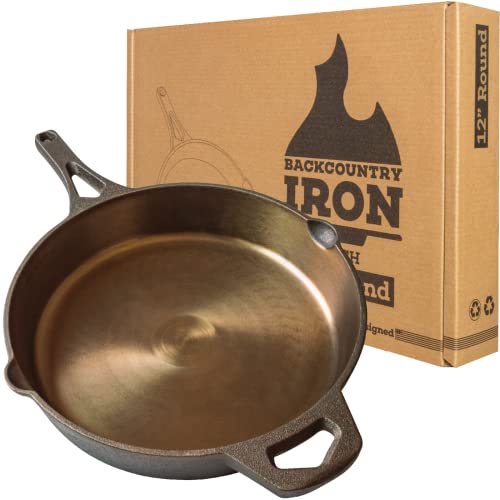
Backcountry Iron’s Wasatch skillet is cast iron with a machined cooking surface and sides, modeled on polished vintage pans. The listing gives a 12-inch diameter, 12.5 inches spout to spout and a 4.75-inch handle. It is quadruple seasoned with vegetable and grapeseed oil, which gives it a bronze color.
A machined surface closes part of the gap with carbon steel. Backcountry Iron says the smooth surface is more uniform and holds seasoning well, and the pan keeps the mass of cast iron for searing. Backcountry Iron lists it for electric, induction and gas stoves, the oven and campfires. At 12 inches, it is big enough for a family batch of carne asada or a full skillet of cornbread.
Its care notes are standard bare-iron rules: no dishwasher, no overnight soaking, no air drying. Use warm water and a flat scraper, a chainmail scrubber if you like, then wipe it dry immediately and oil it. Backcountry Iron doesn’t state a weight for this pan. ATK’s 12-inch cast iron pans weighed between about 6 and 8 pounds, so plan on that range.
Why we like it
- Machined smooth cooking surface (listing)
- Four coats of factory seasoning (listing)
- Induction, oven and campfire (listing)
- Pour spouts; 12.5 in spout to spout
Key specifications
| Model | BL39SK |
|---|---|
| Material | Cast iron, machined surface |
| Size | 12 in (12.5 in spout to spout) |
| Weight | Not stated |
| Seasoning | Four coats, vegetable and grapeseed oil |
| Heat sources | Gas, electric, induction, oven, campfire |
| Made in | Not stated |
| Care | Warm water, scrape, dry at once, oil |
Why we recommend it
It suits a cook who wants cast iron’s stored heat in a full 12-inch pan with a smoother start than an as-cast surface.
Skip it if a long warranty matters to you; the listing gives 90 days, and our best cast iron skillet guide covers makers with longer cover.
Pros and cons
Pros
- Smooth machined surface
- Family-size cooking area
- Any heat source
Cons
- Weight not stated
- 90-day warranty (listing)
- Country of manufacture not stated
4. Lancaster Cast Iron No. 4 Skillet, 7-inch – Two Pounds of American Iron

Lancaster’s No. 4 is a small skillet, cast, machined and seasoned in Pennsylvania, according to the listing. It is 7 inches wide and weighs 2 pounds, and it has a traditional handle, pour spouts and a helper handle marked with the size. It comes with two coats of grapeseed oil seasoning.
It’s here to show that weight is not a fixed cost of cast iron. A small, lighter casting gives you iron’s steady heat for one or two eggs, a skillet cookie, toasting a handful of chiles or warming a sauce, and you can lift it easily. Lancaster lists it for gas, induction, electric, campfire, oven and grill.
For care, follow the usual cast iron routine Lodge describes: cool, wash, dry and oil, and keep long tomato simmers for another pan until the seasoning builds. Lancaster backs its skillets with a lifetime guarantee.
Why we like it
- Stated weight: 2 lb (listing)
- Made in Pennsylvania (listing)
- Pour spouts and helper handle
- Lifetime guarantee (listing)
Key specifications
| Model | SKILLET-004 (No. 4) |
|---|---|
| Material | Cast iron, machined |
| Size | 7 in |
| Weight | 2 lb |
| Seasoning | Two coats, grapeseed oil |
| Heat sources | Gas, induction, electric, campfire, oven, grill |
| Made in | USA (Pennsylvania) |
| Care | Not stated on listing; standard cast iron care |
Why we recommend it
It suits a cook who wants a light, American-made cast iron pan for eggs and small jobs alongside a larger skillet.
Skip it if this would be your only skillet; at 7 inches, it is too small for family meals.
Pros and cons
Pros
- Light and easy to lift
- Made in the USA
- Lifetime guarantee
Cons
- Small cooking area
- Care instructions not on the listing
- Not a main skillet
Carbon steel and cast iron questions, answered
Is carbon steel better than cast iron?
Not better, but different. Carbon steel is lighter and heats faster, and its smoother surface tends to get slick sooner. Cast iron holds more heat and is more forgiving. Choose by what you cook and how much weight you want to lift.
Do you season carbon steel the same way as cast iron?
Essentially yes: thin coats of oil baked on with heat, then regular cooking. Some carbon steel, like Mauviel’s, arrives with a beeswax coating you remove first, while Lodge pre-seasons both its carbon steel and its cast iron.
Can you cook tomatoes in carbon steel or cast iron?
Briefly, yes; for long simmers, wait. Lodge advises holding off on tomato or lemon dishes in cast iron until the seasoning builds, and ATK found tomato sauce stripped most of a carbon steel pan’s patina, though the food tasted fine and the surface was restored with oil and heat.
Which is better for fajitas and carne asada?
Both sear well. Cast iron holds more heat when a load of cold meat goes in, while carbon steel is easier to lift and toss. For serving fajitas at the table, see our best fajita skillet guide.
Does carbon steel rust more easily than cast iron?
Both are bare iron alloys and both rust if left wet. The care is the same for both: wash, dry at once and oil lightly, as Lodge advises.
Which skillet goes on the burner first
For most kitchens, the first skillet should be cast iron. It is ready to cook, forgiving and cheap to own, and its stored heat makes searing easy. Add carbon steel when you want a lighter, quicker pan for eggs, fish and fast sautés, or start with it if weight is the deciding issue. Our best cast iron skillet and best carbon steel pan guides compare more models on each side. And when you would rather someone else did the searing, see the menu or call to order.