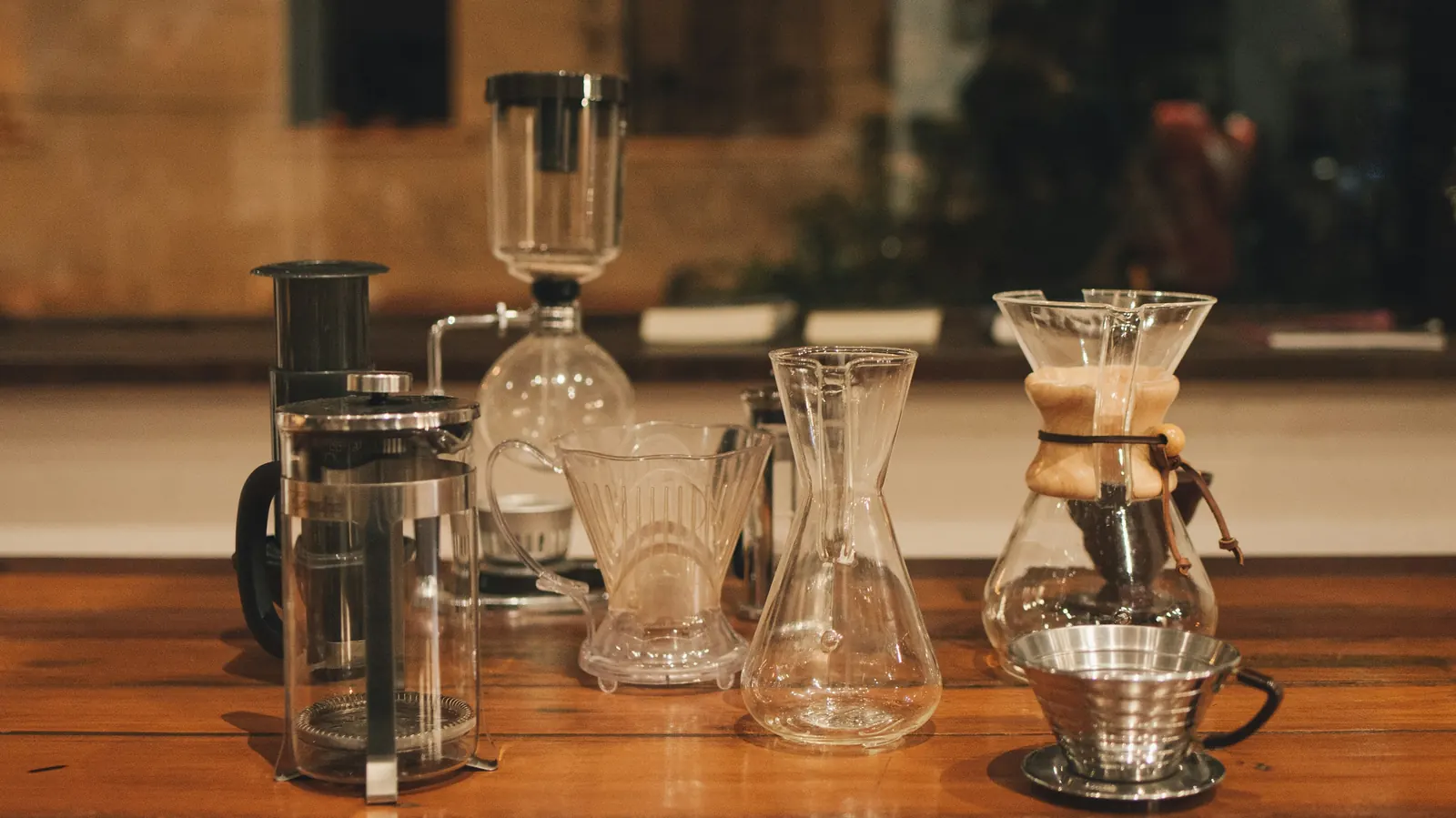
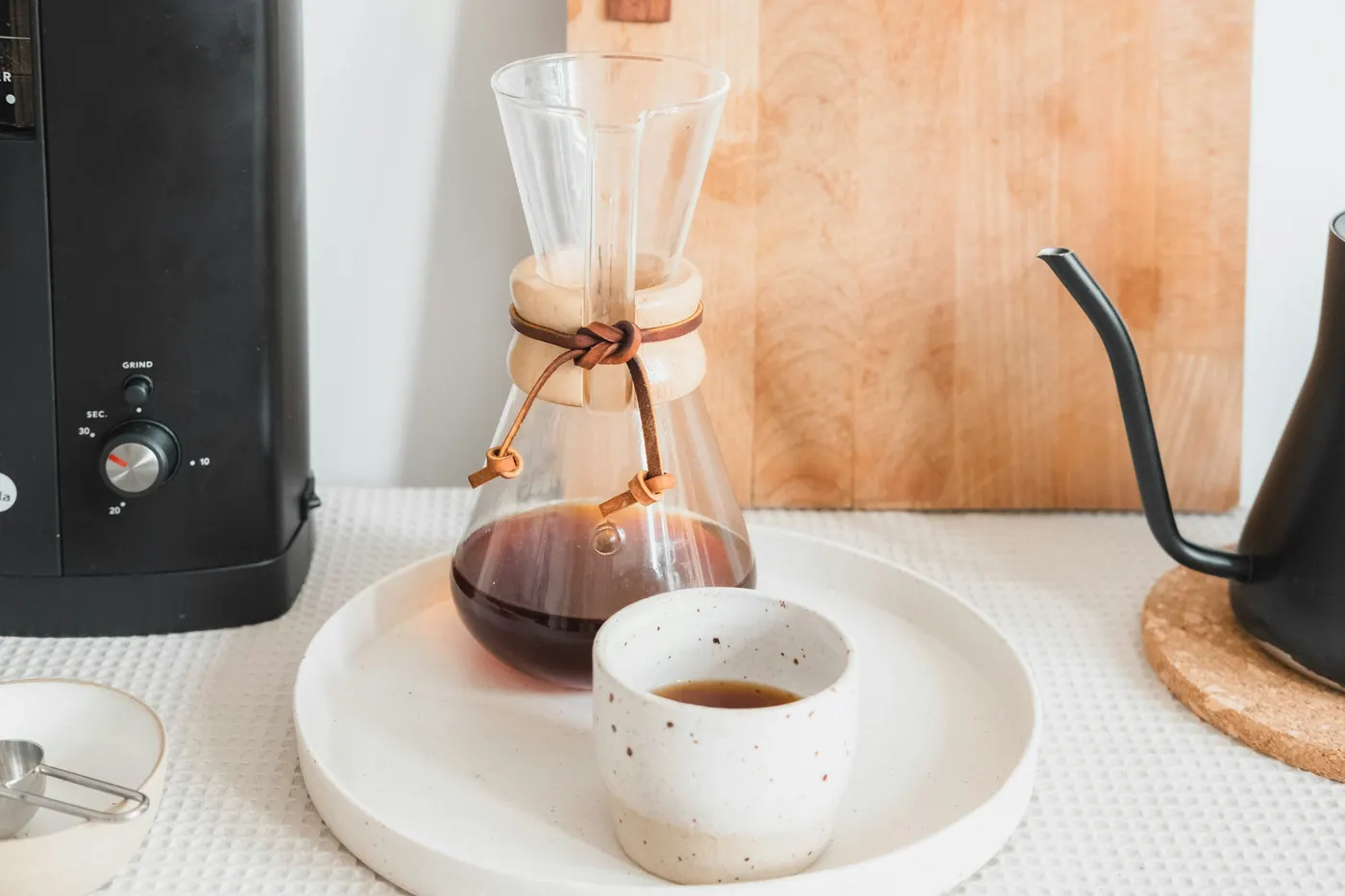
The Chemex and the Hario V60 are the two pour-over brewers most coffee drinkers meet first. Both are cones that hold a paper filter. You pour hot water over ground coffee by hand, and it drips through. Beyond that they are built for different mornings. The Chemex is a glass flask with a wooden collar that brews straight into itself and serves from the same vessel. The V60 is a small cone that sits on top of your mug or a separate server.
This guide compares the Chemex vs V60 on what goes in, what comes out and what it takes to live with each: capacity, filters, grind, flavor, material and cleanup. It uses what each maker states and one named review that tested both. Then it says who should choose which, with picks from each side.
Julia’s earns a commission on purchases made through links on this page, at no cost to you. Recommendations are based on what a restaurant kitchen looks for, product specifications and verified buyer reports.
Quick verdict: Chemex or V60?
For most people learning pour-over, the Hario V60 is the better first brewer. America’s Test Kitchen rated the V60 Highly Recommended and named it the best conical-style dripper, calling it easy to use, while it rated the Chemex only Recommended. The V60 is small and brews one or two mugs at a time. Choose the Chemex if you usually brew for two or more people and want a brewer that doubles as a glass serving carafe: Chemex’s 8-cup model holds 40 ounces, and its thick bonded filters give a very clean cup. Be ready for its own filters and a harder-to-clean flask.
The table sets out the main differences. Each point names its source.
Chemex vs V60, side by side
| Chemex Classic | Hario V60 (size 02) | |
|---|---|---|
| What it is | Brewer and carafe in one glass piece (Chemex) | Cone that sits on a mug or server (Hario) |
| Capacity | 3, 6, 8 or 10 cups of 5 oz; 8-cup holds 40 oz (Chemex) | 1 to 4 cups (Hario) |
| Material | Borosilicate glass, wood collar, leather tie (Chemex) | Plastic, Tritan, glass, ceramic or metal versions (Hario) |
| Filter | Chemex Bonded filters only; standard paper tore in a test (Chemex; ATK) | V60 cone filters, which cling to the wall (ATK) |
| Grind | Medium coarse (Chemex) | Not stated by Hario on the pages we read |
| Flavor, in one named test | Citrus and orange peel with a bitter finish (ATK) | Bright notes, well balanced (ATK) |
| Cleanup | Dishwasher once collar and tie are removed (Chemex); hard to reach inside (ATK) | Simple open cone (kitchen sense) |
| ATK rating | Recommended (6-cup Classic) | Highly Recommended, best conical style (ceramic 02) |
A note on sources. Chemex’s support page and Hario’s global product pages both opened for us. Hario’s US site refused our requests, so a few V60 design details come from Hario’s own Amazon listings, which we label as such. The America’s Test Kitchen review by Valerie Sizhe Li, last updated June 25, 2025, tested a ceramic V60 and a 6-cup Chemex.
Capacity: one mug or a pot to share
This is the first question to ask. Chemex measures its cups in 5-ounce steps, so its Classic flasks hold 15, 30, 40 or 50 ounces for the 3-, 6-, 8- and 10-cup sizes, according to Chemex. The brewed coffee sits in the bottom of the flask, ready to pour at the table.
Hario rates its size 02 V60 for 1 to 4 cups, and its size 03 for up to 6. But the V60 is only the cone. It drips into whatever is underneath, so you need a mug for one cup or a server for more. Hario sells glass servers for that, which adds a second piece to buy and wash.
Our kitchen sense, not a sourced claim: a V60 is happiest making one or two mugs. A Chemex makes a single cup too, but its big flask and thick filter suit three or four mugs better. If you brew a pot for a family breakfast of huevos rancheros, the Chemex is the easier tool.
Filters: the Chemex is fussier
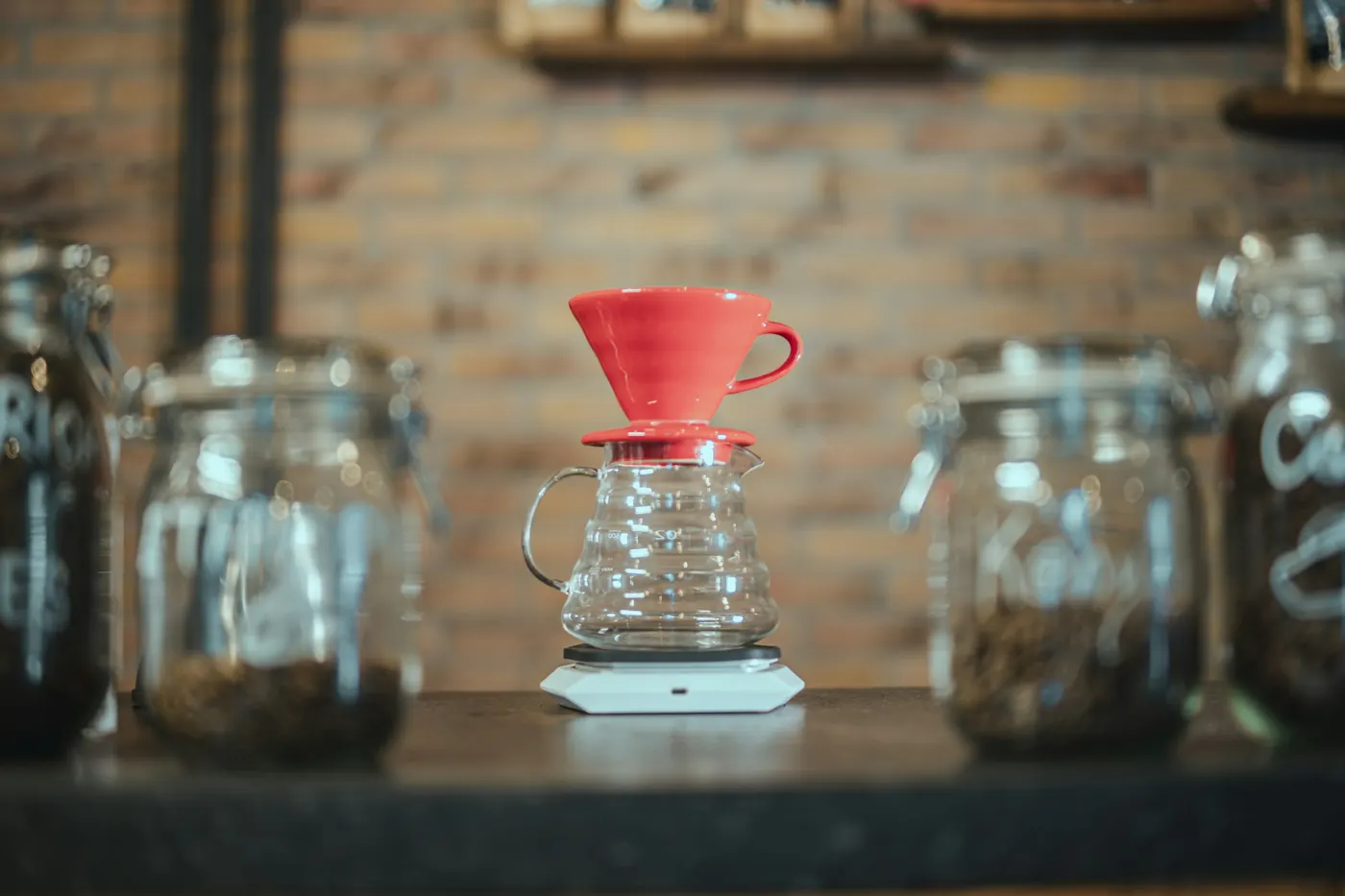
Chemex tells you to use its own Chemex Bonded filters, folded into a cone so that one side has three layers, and to set the thick side against the pouring spout. The listing for the bundle below claims its filters are 20 to 30 percent thicker than competitors’, which keeps oils and fine grounds out of the cup. America’s Test Kitchen found the downside: the Chemex must be used with its proprietary filter, and standard filter paper tore in the middle of brewing.
The V60 also uses its own cone-shaped filters. America’s Test Kitchen says the V60 paper clings to the wall nicely. Hario’s page explains that the cone-shaped paper deepens the bed of coffee, so the water flows toward the center and stays in contact with the grounds longer. Both brewers tie you to one filter shape; the Chemex ties you to one brand. Our best coffee filters guide covers both.
Grind and method
Chemex gives a clear starting point: grind whole beans medium coarse, use about one tablespoon of coffee for each 5-ounce cup, and more for stronger coffee. Bring water to a boil, take it off the heat and let it stop boiling hard. Pour just enough to wet the grounds, wait about 30 seconds, then keep pouring slowly, keeping the water below the top of the flask.
Hario does not state a grind on the pages we could read. Its listings say the spiral ribs let the coffee expand and that the single large hole lets you change the taste by how fast you pour. In plain terms, the V60 gives you more control and asks for more care: pour fast and it runs through quickly, pour slowly and it brews longer. Our kitchen sense, not a sourced claim: start a little finer than for a Chemex and adjust by taste. A good burr grinder matters more for either than the brewer itself; see our best conical burr grinder for pour-over guide.
Flavor: what one named test found
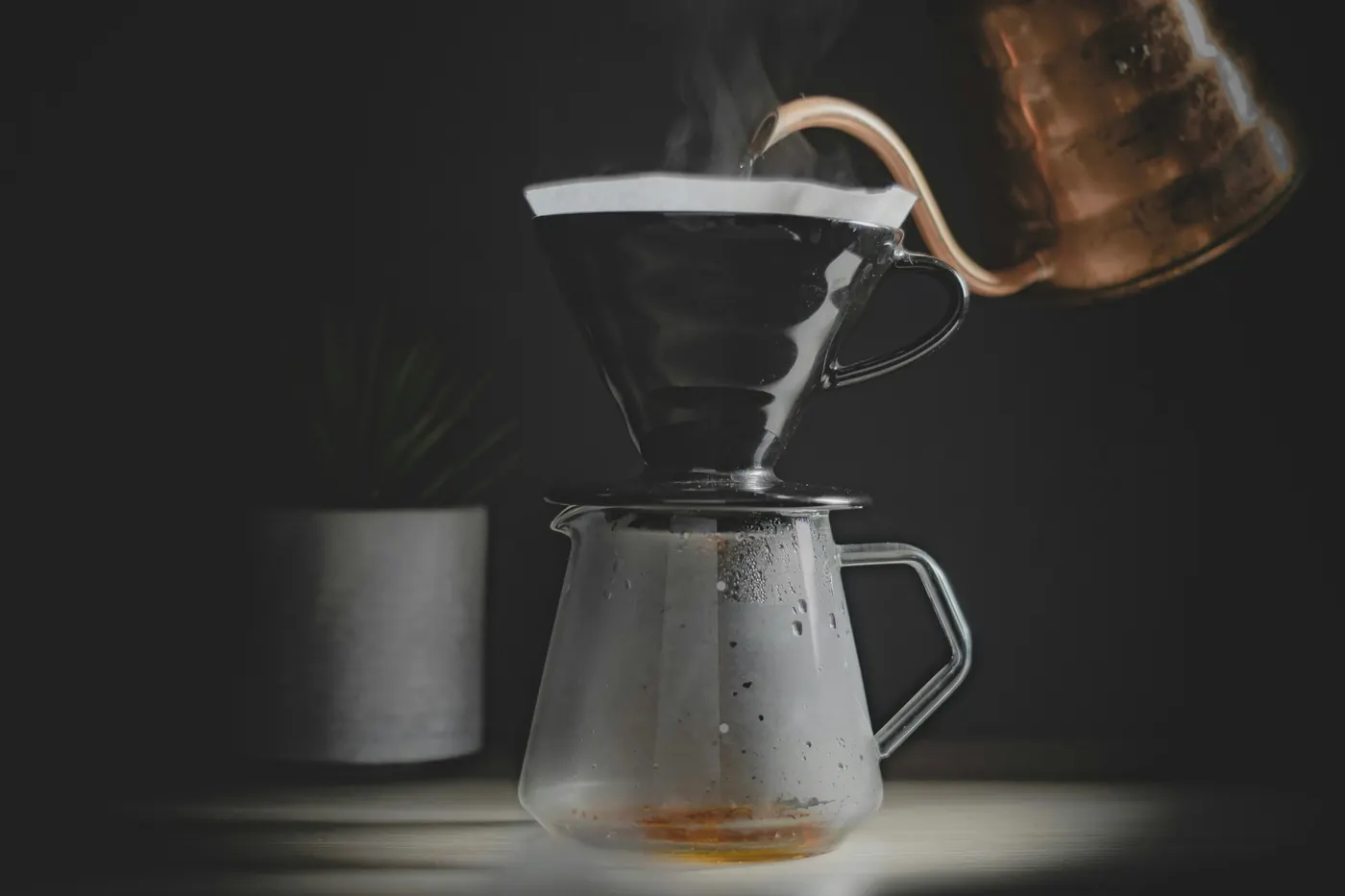
America’s Test Kitchen brewed light roast in both. Its tasters said the V60 amplified bright notes and produced well-balanced flavors overall, and it chose the V60 as its favorite conical model, especially for light roasts. Its tasters found the Chemex coffee had citrus and orange-peel notes but a bitter finish. It rated the Chemex Recommended rather than Highly Recommended.
One test is not the last word on taste, and grind, water and pour change any cup. But it fits the way the two are built. The Chemex’s heavy filter makes a very clean, light-bodied cup, and the V60 lets an attentive cook push a coffee toward brightness.
Material and safety: glass against plastic or ceramic
Chemex says its Classic flasks are made from pure, laboratory-grade borosilicate glass that will not impart any chemicals or flavors into the coffee. It also warns that none of its products should be reheated in the microwave. Plain glass has no glaze, so no lead statement applies.
The V60 comes in many materials. Hario’s global pages list polypropylene for the colored size 02 drippers, acrylonitrile-styrene resin for the clear one, and Tritan resin with a silicone base for the newer V60 NEO. America’s Test Kitchen tested a ceramic V60. Glazed ceramic needs a lead-free statement from the maker before we recommend it, and we could not read one from Hario, so our V60 picks are plastic and Tritan. In the glass V60 listings we found, only thin resellers’ listings were in stock.
Cleanup and handling
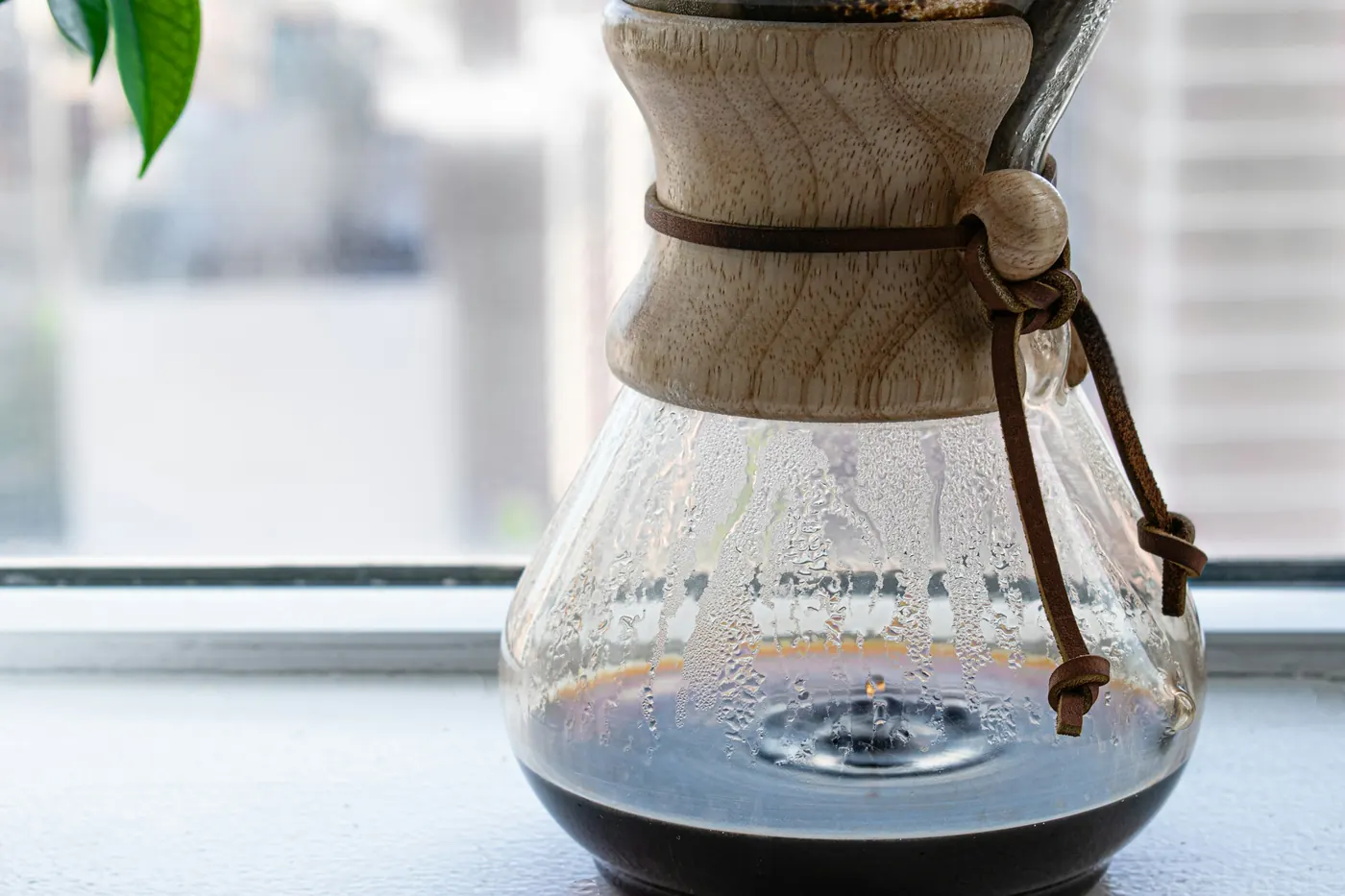
Chemex says the glass flask can go in the dishwasher once you remove the wooden collar and leather tie, as long as it is secure so it does not knock other dishes. It also suggests hand washing. America’s Test Kitchen found it harder to clean than the others, because you can’t reach inside the flask, and it says the wooden collar was too large for small hands and could get very hot. Its listing of the Chemex as not dishwasher-safe differs from Chemex’s own guidance; we follow the maker.
The V60 is an open cone you can rinse under the tap. America’s Test Kitchen praised its broad opening for a clear view while pouring and its handle for lifting it off the cup. The V60 NEO below has no handle, a choice Hario says helps keep the dripper thin.
Which brewer suits which coffee drinker
Choose the Chemex if…
- You brew for two or more people most days.
- You want one glass piece that brews and serves.
- You like a very clean, light-bodied cup.
- You don’t mind buying Chemex filters and hand-cleaning a narrow flask.
Choose the V60 if…
- You usually make one or two mugs.
- You want to learn pour-over and control each brew.
- You drink light roasts and like bright flavors.
- You want the smallest brewer to start with.
Our picks for the Chemex vs V60 decision
One Chemex and two V60s. All three were in stock with a new lead offer when we checked: the Chemex from Chemex’s own Amazon store, the red V60 from Amazon.com and the V60 NEO from UJC Mart Japan, a third-party seller. None of these exact listings appears on our other pages. Two are different listings of models we cover elsewhere: the Chemex 8-cup is in our best Chemex guide, here bundled with filters so you can brew on day one; and the plastic V60 02 appears in other colors in our best pour-over coffee maker and pour-over vs drip coffee guides. We use it because it is the classic V60 and this red one is sold by Amazon.com.
1. Chemex Classic 8-Cup with 100 Square Filters – Brewer, Carafe and Filters in One Box

The Chemex most households should buy. The listing describes the 8-cup Classic glass coffeemaker with a box of 100 square Chemex Bonded filters, made of non-porous borosilicate glass that does not absorb odors or oils. It brews up to 40 ounces, with Chemex counting 5 ounces as a cup, and says you can cover and refrigerate leftover coffee for iced coffee later.
Forty ounces is three or four real mugs, enough for a weekend breakfast. Grind medium coarse, as Chemex advises, and fold the filter with its three-layer side at the spout. Remove the collar and tie before it goes in the dishwasher.
Why we like it
- Brews and serves in one piece
- Borosilicate glass (Chemex)
- Filters included
- Sold by Chemex
Key specifications
| Model | Classic Series 8-cup bundle (601684-CM-8A) |
|---|---|
| Material | Borosilicate glass, wood collar |
| Capacity | 40 oz (8 cups of 5 oz) |
| Filter | Chemex Bonded square, 100 included |
| Grind | Medium coarse (Chemex) |
| Care | Dishwasher after removing collar and tie (Chemex) |
| Server needed | No |
Why we recommend it
It suits a household that brews three or four mugs at once and wants a brewer handsome enough to put on the table.
Skip it if you mostly make one cup; a V60 is simpler and smaller.
Pros and cons
Pros
- Very clean cup from thick filters
- No separate server
- Clear brewing guidance from Chemex
Cons
- Needs Chemex filters
- Hard to reach inside to clean, by review
- Collar can get hot, by review
2. Hario V60 Plastic Dripper, Size 02, Red – The Classic Cone for One to Four Cups

This is the V60 most people start with. Hario lists model VDR-02-R as a polypropylene dripper for 1 to 4 cups, 137 by 116 by 102 mm, made in Japan. The listing gives a weight of about 85 grams. It has a handle for lifting it off the mug, and Hario’s V60 listings describe spiral ribs and a single large hole.
Set it on a mug or a glass server, add a V60 paper filter and pour slowly in circles. Our kitchen sense, not a sourced claim: plastic is light and survives a drop, and it is a low-risk way to see whether you enjoy pour-over before you spend more.
Why we like it
- The V60 02 cone ATK rated highly, in plastic
- Made in Japan (Hario)
- Light and unbreakable
- Sold by Amazon.com
Key specifications
| Model | VDR-02-R |
|---|---|
| Material | Polypropylene (Hario) |
| Capacity | 1 to 4 cups |
| Filter | V60 cone paper, not included |
| Grind | Not stated |
| Care | Not stated on the listing |
| Server needed | Yes, or brew into a mug |
Why we recommend it
It suits someone making one or two mugs who wants to learn pour-over without spending much.
Skip it if you want the exact ceramic model America’s Test Kitchen tested; we did not pick it because we could not read a lead-free statement from Hario.
Pros and cons
Pros
- Bright, balanced cups, by review of the V60
- Easy to see the grounds while pouring
- Small and light
Cons
- Needs a mug or server and filters
- Plastic look
- Same model as on our other guides
3. Hario V60 Dripper NEO, Size 02 – Thin Tritan Cone With 72 Fine Ribs

Hario’s newest take on the V60. Hario lists the NEO as a Tritan resin body on a silicone rubber base, made in Japan, with 72 fine ribs that converge into 9 at the base. The listing says the ribs spread water evenly and the 9 at the bottom help prevent over-extraction, and that dropping the handle and making the dripper as thin as possible reduces the temperature drop while brewing. It brews 1 to 4 cups, measures 12.8 by 12.8 by 10.3 cm and weighs 135 grams.
This is for someone who already likes the V60 and wants Hario’s latest design. It has no handle, so you lift it by the rim.
Why we like it
- New rib design from Hario
- Thin wall to keep heat in (listing)
- Tritan, made in Japan (Hario)
- Rated for 1 to 4 cups
Key specifications
| Model | VDN-02-B |
|---|---|
| Material | Tritan body, silicone base (Hario) |
| Capacity | 1 to 4 cups |
| Filter | V60 cone paper, not included |
| Grind | Not stated |
| Care | Not stated on the listing |
| Server needed | Yes, or brew into a mug |
Why we recommend it
It suits a V60 fan who wants Hario’s newest cone and does not need a handle.
Skip it if you are just starting; the classic red V60 above does the same job for less and is sold by Amazon.com.
Pros and cons
Pros
- Designed to limit over-extraction (listing)
- Light, shatter-resistant plastic
- Made in Japan
Cons
- No handle
- No independent review read
- Sold by a third-party seller
Chemex and V60 questions, answered
Is a Chemex or a V60 better for beginners?
The V60. America’s Test Kitchen calls it easy to use, and it brews a single mug well. The Chemex is simple too, but its filters and narrow flask take more care.
Can I use V60 filters in a Chemex?
Chemex says to use Chemex Bonded filters, and America’s Test Kitchen found that standard paper tore in a Chemex mid-brew. Use the filter made for each brewer.
Does a Chemex make stronger coffee than a V60?
Strength comes from how much coffee you use. Chemex suggests about a tablespoon per 5-ounce cup, more for stronger coffee. The Chemex’s thick filter does make a cleaner, lighter-bodied cup.
Is the Chemex dishwasher safe?
Chemex says yes, once the wooden collar and tie are removed. America’s Test Kitchen listed it as not dishwasher-safe; we follow the maker.
Is pour-over better than a French press?
It is cleaner and lighter, while a press is fuller and oilier. Our French press vs pour-over guide explains the trade.
The pour-over we would start with
Start with a plastic V60 if you drink coffee alone or with one other person: it is light, easy to use and was the stronger performer in the one named test we read. Buy the Chemex if you brew a pot for the table and like a very clean cup. For more brewers, see our best pour-over coffee maker and best cheap pour-over coffee maker guides. And when you would rather someone else made the coffee, see the menu or call to order.