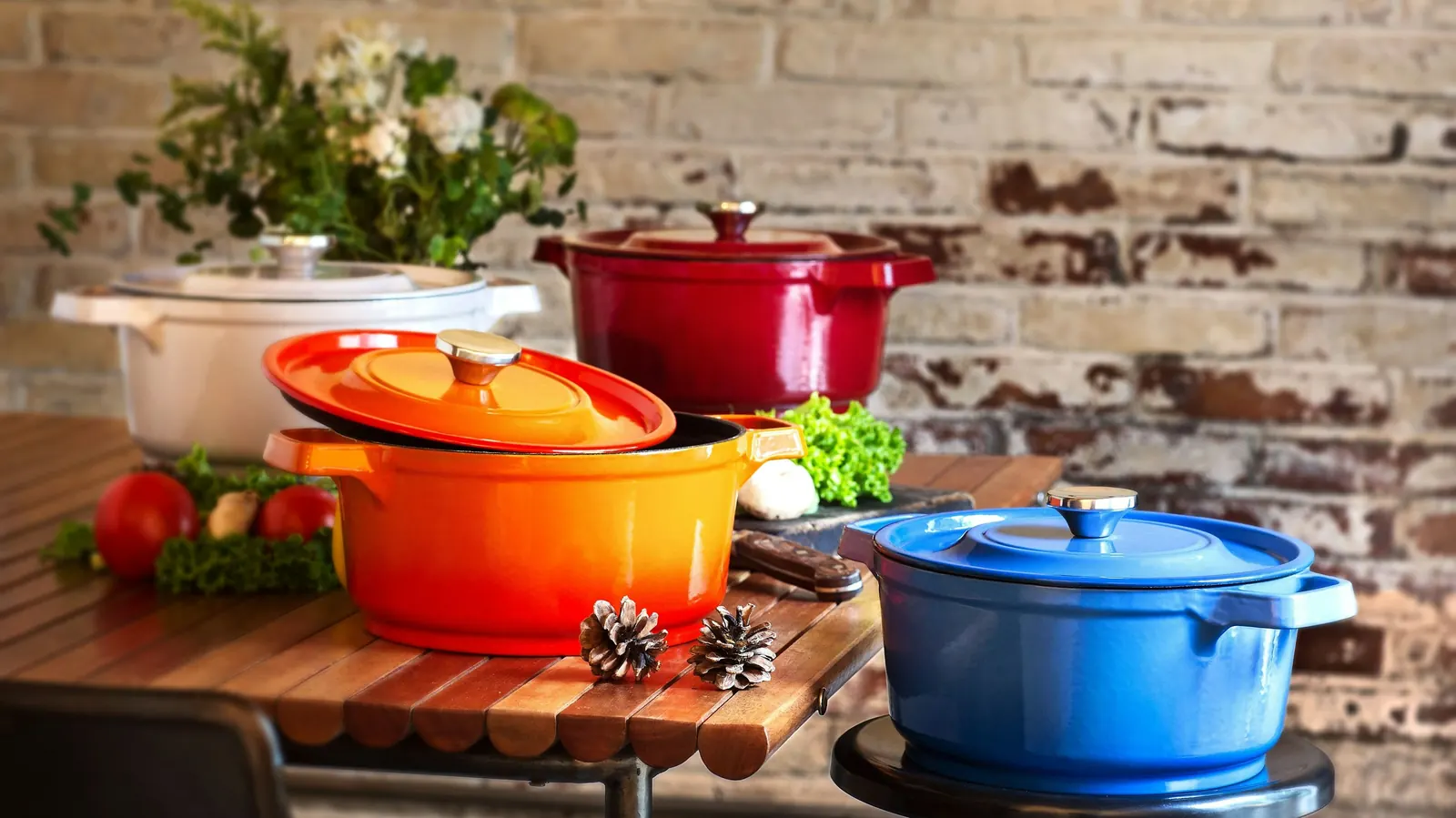
Put a Dutch oven and a braiser side by side and they look like the same pot at two heights. Both are usually enameled cast iron, both have two loop handles and a heavy lid, and both go from the stove into the oven. The difference is the walls. A Dutch oven is deep, with tall sides; a braiser is wide and shallow, closer to a covered skillet. That one change in shape decides which pot browns better, which reduces a sauce faster, and which you want when the pozole needs a gallon of broth.
This guide compares the two on the things that actually change at the stove, using the measurements America’s Test Kitchen published in its Dutch oven and braiser reviews. It sorts the jobs a Mexican home kitchen does between them, says which to buy first, and ends with one of each from the same enameled line, so the comparison stays about shape rather than brand.
Julia’s earns a commission on purchases made through links on this page, at no cost to you. Recommendations are based on what a restaurant kitchen looks for, product specifications and verified buyer reports.
Quick verdict: Dutch oven, braiser or both?
Buy a Dutch oven first if you can own only one heavy pot. Its tall walls hold soups, beans, stews, stock and frying oil, and it still braises well. Buy a braiser as a second pot, or first only if most of what you cook is pieces of meat or vegetables in a modest amount of sauce: chicken thighs, albóndigas, short ribs, a skillet of carne guisada. Its wide, shallow base browns more food in a single layer and reduces sauce faster, but its short walls cannot contain a pot of soup.
The table sums up the differences; the sections after it explain each one.
Dutch oven vs braiser: the two side by side
| Dutch oven | Braiser | |
|---|---|---|
| Shape | Deep, tall straight walls | Wide and shallow, often sloped walls |
| Common sizes | 5 to 7 quarts for most homes | 3.5 to 4 quarts; 5 to 6 for bigger families |
| Cooking surface | About 9 inches on ATK’s 5.5- and 7.25-quart winners | About 10 inches on a 3.5-quart braiser, per ATK |
| Wall height | About 4 to 4.5 inches on ATK’s winners | About 2 to 2.5 inches on 3.5- to 4-quart models |
| Evaporation | Slower; liquid stays in | Faster; sauces reduce quickly |
| Best jobs | Soups, beans, stews, stock, frying, bread | Braising pieces, browning in one layer, oven-to-table dishes |
| Weak at | Browning big batches in one go | Anything with lots of liquid or oil |
| Holds | A whole chicken in a 7-quart pot, per ATK | Three to four in a 3.5-quart braiser, per ATK |
Shape: depth versus width
Everything else follows from the walls. America’s Test Kitchen’s braiser review explains that braisers have two advantages over Dutch ovens for braising: a broader cooking surface, so more pieces fit in a single layer, and shorter walls, which speed evaporation and make it easier to get tongs in to turn food. ATK says the bottom of a 3.5-quart braiser typically measures about 10 inches across, about an inch wider than the 7-quart Dutch ovens it recommends for most people.
The numbers on ATK’s winners show how different the profiles are. Its 3.5-quart Le Creuset braiser has 2.25-inch walls and a 10-inch cooking surface. Its 5.5-quart Le Creuset Dutch oven has a 9-inch surface and an interior 4 inches tall; the 7.25-quart version is 4.5 inches tall on the same 9-inch base. So the Dutch oven holds more because it is deeper, not because it is wider.
Browning: room for one layer
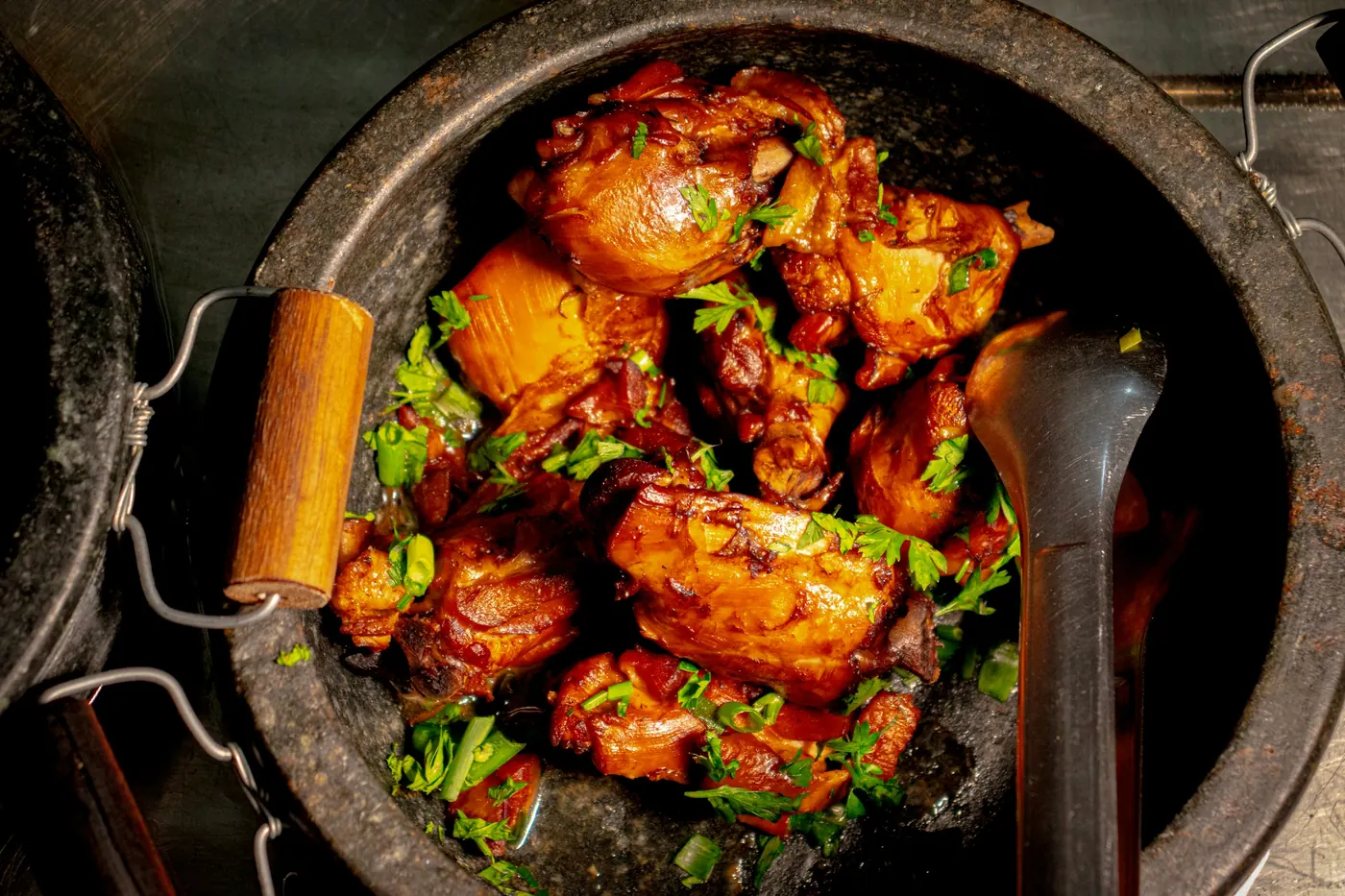
Braising starts with searing, and searing needs space. Crowd the pot and the meat steams in its own juices instead of browning. On a 10-inch braiser base, more chicken thighs or short ribs fit without touching, so the job takes fewer batches. ATK’s braiser review fit whole chicken, meatballs and pork ragu in its winner without crowding.
The Dutch oven can brown well too, but in batches. ATK’s Dutch oven review notes that its favorite 5.5-quart pot was slightly cramped with a pile of short ribs, though the result was still excellent, and that broader surfaces meant fewer batches. For a pot of birria or carne guisada with three pounds of beef, plan on browning in two or three rounds in a Dutch oven, and perhaps one or two fewer in a braiser of similar capacity.
Liquid and evaporation: what the walls hold in
Tall walls slow evaporation and contain liquid; short walls do the opposite. That is why the braiser reduces a sauce faster: the wide surface lets steam leave quickly, and the low sides do not trap it. It is also why ATK warns against using a braiser for anything with a lot of liquid, such as soup or a big batch of tomato sauce: the short walls will not contain spatters the way a Dutch oven’s taller ones will. Le Creuset’s own Amazon listing for its Dutch oven makes the same point from the other side, saying the tall sides and added depth contain splatters and reduce boil-overs.
In practice, any dish where the liquid is the point belongs in the Dutch oven. Pozole, menudo, caldo de res, frijoles de la olla, chicken stock and big batches of chile colorado all need depth. Dishes where the sauce should end up thick and clinging to the meat, such as chicken in mole, pork in salsa verde or albóndigas in chipotle-tomato sauce, are where the braiser’s quick reduction helps. Our guide to charro beans vs refried beans covers one of the Dutch oven’s everyday jobs.
Frying and bread: Dutch oven only
Two jobs belong to the Dutch oven alone. Deep frying needs several inches of oil with room above it so it does not bubble over, and only tall walls give that. ATK’s Dutch oven review lists frying among the pot’s daily jobs and notes that its winner turned out golden, crisp French fries. Bread is the other: the deep pot with its lid on traps the steam a crusty loaf needs, which is why our best Dutch oven for bread guide exists. A braiser’s lid sits too close to the base for a tall loaf, and there is no room for frying oil.
Size and capacity: what fits
ATK recommends a 7-quart Dutch oven for most people, with room for anything from a whole chicken to a batch of baked ziti, and says a 5- to 6-quart pot does everything a 7-quart one can, with more batches when browning or frying. For braisers, it says 3.5 to 4 quarts is the most common size and feeds about three to four people; a 5- to 6-quart braiser suits households that regularly cook for five or six.
Capacity numbers mislead when you compare across the two shapes. A 3.5-quart braiser holds less than a 5.5-quart Dutch oven, but its floor is larger, so it can brown more at once while holding less liquid. If you cook for a big family and want one shallow pot for braising, look at a 5-quart braiser; ATK’s 5-quart winner handled recipes that served six.
Weight and handling
Do not expect a braiser to be much lighter. Both are cast iron, and the weight is in the base and lid. ATK weighed its winning 3.5-quart braiser at 12 pounds and half an ounce, and its winning 5.5-quart Dutch oven at 11 pounds 3.5 ounces, so the shallow pan was actually a little heavier. ATK also notes that some 5-quart braisers weigh over 18 pounds. What the braiser does offer is easier access: the low, sloped walls make it simpler to reach in, turn pieces and serve straight from the pan. ATK describes braisers as ideal for dishes you prepare or serve at the table.
For both, look for large looped handles that you can grip with thick oven mitts, and a lid knob that is easy to grab. ATK preferred both features in each review.
Storage and the lid
A braiser’s shallow body stores more easily on a shelf, but its lid is wide and usually domed. A Dutch oven takes more height in a cupboard but less width. Both lids are heavy; neither stacks well with other pans. If storage is tight, the question is not which pot is smaller but whether you will use the second pot enough to give it the space.
On lid design, ATK found in its braiser review that lids with grooves, ridges or self-basting spikes collected food and were harder to clean, without cooking any better, and it preferred smooth undersides. It reached a similar conclusion on Dutch oven lid spikes.
Choose a Dutch oven if… / Choose a braiser if…
Choose a Dutch oven if…
- You want one heavy pot that does everything: soup, beans, stew, frying and bread.
- Your favorite dishes are brothy: pozole, menudo, caldo, frijoles de la olla.
- You cook in large batches for six or more, or freeze leftovers.
- You deep-fry at home, even occasionally.
- You bake crusty bread or plan to.
Choose a braiser if…
- You already own a Dutch oven and want a second, shallower pot.
- Most of what you cook is meat or vegetables in a modest amount of sauce.
- You want to brown more pieces at once in a single layer.
- You like to cook and serve in the same pan at the table.
- You cook for two to four people most nights.
A deep cast iron skillet with a lid sits between the two. Our guide to the best cast iron skillet with lid covers covered deep skillets alongside three enameled braisers, if you want more options on the shallow side.
Our pick on each side
Both picks come from Le Creuset’s Signature enameled cast iron line, and both are America’s Test Kitchen’s winners in their size categories, so the difference between them is shape. Both were in stock on Amazon in the United States when we checked.
1. Le Creuset Signature 5.5-quart Round Dutch Oven – Depth for Soups, Beans and Bread

This is the pot America’s Test Kitchen named the winner among 5- to 6-quart Dutch ovens. ATK praised its light-colored interior and low, straight sides for making it easy to monitor browning, its large looped handles for moving it even when filled with 4 pounds of short ribs, and its heat retention, noting that French fries came out golden and crisp. Its one drawback in ATK’s review was that a pile of short ribs was slightly cramped.
ATK measured a 9-inch cooking surface, a 4-inch interior height and a weight of 11 pounds 3.5 ounces. Le Creuset’s Amazon listing says it needs no seasoning, works on all cooktops, is oven-safe to 500°F and is dishwasher safe, and that its tall sides contain splatters and reduce boil-overs. It is also the top pick in our best Dutch oven roundup. Le Creuset says its cookware complies with FDA safety regulations; we found no explicit lead-free statement from the maker.
At 5.5 quarts it handles a full pot of beans, a family batch of pozole or a loaf of bread. If you cook for six or more, ATK’s overall winner is the 7.25-quart version of the same pot.
Why we like it
- ATK’s winner among 5- to 6-quart Dutch ovens
- Light interior for watching fond, per ATK
- Large looped handles, easy to move full
- Oven-safe to 500°F, per the listing
Key specifications
| Model | LS2501-26795SS (Artichaut) |
|---|---|
| Capacity | 5.5 quarts |
| Cooking surface | 9 inches (ATK) |
| Wall height | 4 inches interior (ATK) |
| Weight | 11 lb 3.5 oz (ATK) |
| Interior | Light, smooth enamel |
| Oven safe | Up to 500°F |
| Care | Dishwasher safe, per the listing |
Why we recommend it
If you are buying one heavy pot, this is the one: deep enough for soups, beans and frying, and well regarded for braising too.
Skip it if you need to brown large batches in one go; a 9-inch base means working in rounds.
Pros and cons
Pros
- Handles soup, beans, frying and bread
- Light interior shows browning
- No seasoning needed
Cons
- Slightly cramped for big braises, per ATK
- Heavy, as all cast iron is
- Premium price
2. Le Creuset Signature 3.5-quart Braiser – Wide Base for One-Layer Braises

America’s Test Kitchen’s top-ranked braiser. ATK credited its light interior for easy monitoring of browning, a generous cooking surface that fit whole chicken, meatballs and pork ragu without crowding, and large looped handles with a stainless steel knob that gave a secure grip when the pan was heavy and full. ATK also said it looked good enough to double as a serving dish, and that it was one of the lightest braisers it tested.
ATK measured a 10-inch cooking surface, 2.25-inch walls and a weight of 12 pounds half an ounce on the model it tested. Le Creuset’s Amazon listing says the braiser needs no seasoning, has a tight-fitting lid designed to circulate steam, and a stainless steel knob that is safe at any oven temperature; it lists a lifetime warranty. The listing does not state dishwasher use. As with the Dutch oven, Le Creuset says only that its cookware complies with FDA safety regulations; we found no explicit lead-free statement.
The 3.5-quart size suits three to four people, per ATK. It is the pan for chicken thighs in salsa verde, albóndigas, short ribs or a tray of enchiladas finished in the oven and brought straight to the table.
Why we like it
- ATK’s top-ranked braiser
- 10-inch cooking surface for one-layer browning, per ATK
- Stainless knob safe at any oven temperature, per the listing
- Doubles as a serving dish, per ATK
Key specifications
| Model | LS2532-30717SS (Sea Salt) |
|---|---|
| Capacity | 3.5 quarts |
| Cooking surface | 10 inches (ATK) |
| Wall height | 2.25 inches (ATK) |
| Weight | 12 lb 0.5 oz (ATK) |
| Interior | Light, smooth enamel |
| Oven safe | Stainless knob safe at any oven temperature |
| Care | Not stated on the listing |
Why we recommend it
If you already own a Dutch oven and braise often, this wide, shallow pan browns more at once and reduces sauce faster.
Skip it if it would be your only heavy pot; it cannot hold soup, beans in quantity or frying oil.
Pros and cons
Pros
- Broad base, fewer browning batches
- Fast sauce reduction
- Stove to oven to table
Cons
- No good for soups or frying
- Not lighter than a 5.5-quart Dutch oven
- Premium price
How we compared the two
We compared the Dutch oven and the braiser on shape, cooking surface, wall height, evaporation, capacity, weight and handling, and matched each to the jobs a Mexican home kitchen does most. Measurements and performance notes come from America’s Test Kitchen’s current reviews of Dutch ovens and of braisers, both read in full. Product specifications come from Le Creuset’s Amazon listings, and we checked both pots were in stock on Amazon in the United States when we wrote this. We have not cooked with these pots for this guide.
Braiser vs Dutch oven questions, answered
What is the difference between a braiser and a Dutch oven?
Depth. Both are usually enameled cast iron with a heavy lid. A Dutch oven has tall walls, about 4 to 4.5 inches on ATK’s winners, so it holds liquid. A braiser has short walls, about 2 to 2.5 inches on 3.5- to 4-quart models, and a wider base, so it browns more food at once and reduces sauce faster.
Braiser vs Dutch oven: which should I buy first?
The Dutch oven. It does nearly everything a braiser does, plus soups, beans, frying and bread. A braiser makes the most sense as a second pot for people who braise often.
Can a braiser replace a Dutch oven?
Only for some jobs. It handles braises, roasting small cuts and saucy vegetable dishes well, according to ATK, but its short walls will not contain soup, a large batch of sauce or frying oil.
Can I braise in a Dutch oven?
Yes. ATK says you can sear, simmer, roast and braise perfectly well in a Dutch oven. You may need to brown meat in more batches because the base is smaller.
Is a braiser lighter than a Dutch oven?
Not necessarily. ATK’s winning 3.5-quart braiser weighed slightly more than its winning 5.5-quart Dutch oven. The shallower pan is easier to reach into, not easier to lift.
What size braiser should I get?
For three to four people, a 3.5- to 4-quart braiser, which ATK calls the most useful size. For five or six, a 5- to 6-quart braiser, which will weigh and cost more.
Our final word on Dutch oven vs braiser
The Dutch oven keeps liquid in and the braiser lets it go, and that decides most questions about which to reach for. If you are buying one pot, buy the Dutch oven; it braises well enough and does the brothy, deep and fried jobs the braiser cannot. If you already have one and you braise often, a braiser earns its shelf space with a wider floor and faster sauces.
For more choices, see our picks for the best Dutch oven, the best value Dutch oven and the best cast iron skillet with lid. Or let someone else do the braising: see the menu or call to order.